


This article was automatically translated from the original Turkish version.
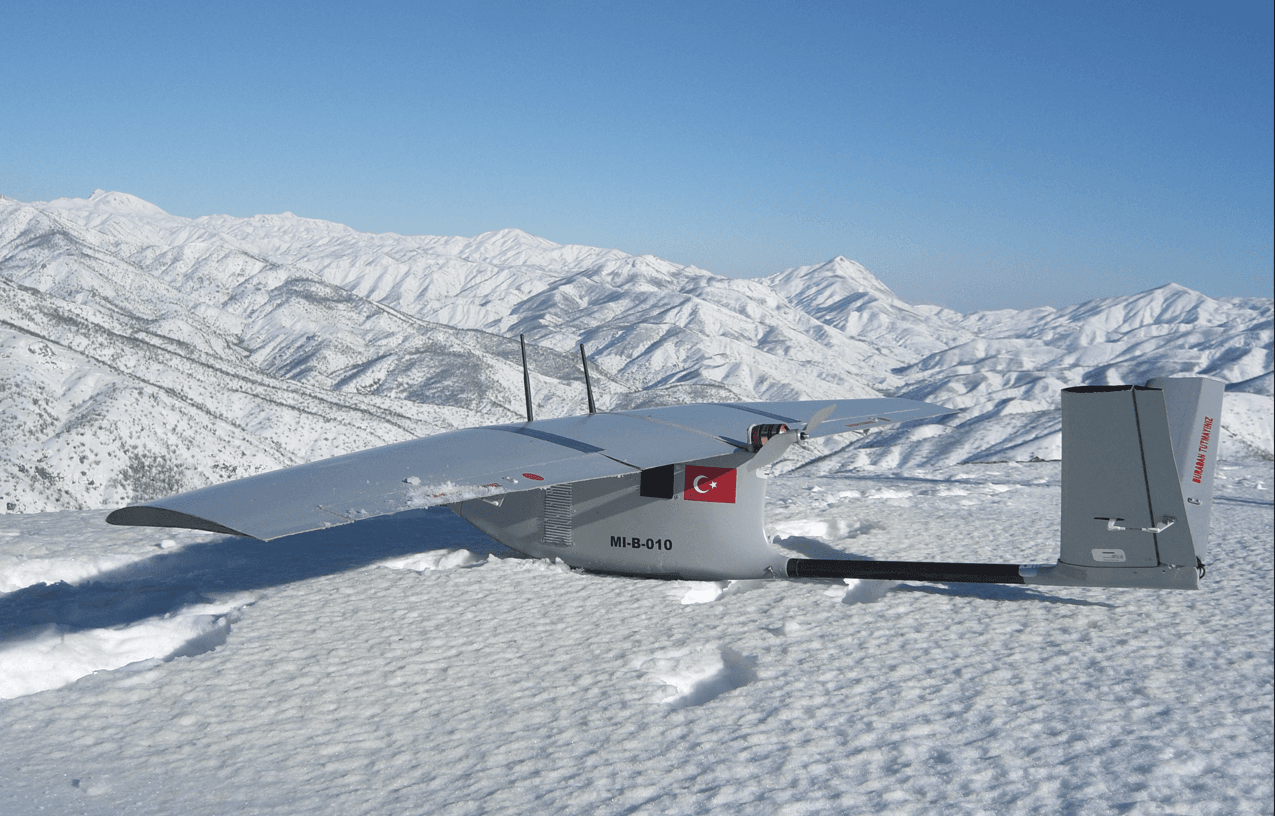
Bayraktar Mini UAV
Entry into Service | October 2007 | ||||||||
|---|---|---|---|---|---|---|---|---|---|
First Flight(s) | 2004 | ||||||||
Developer(s) | Baykar Technology | ||||||||
Flight Hours | 100,000+ (June 2020) | ||||||||
Production Quantity | 500+ | ||||||||
Mission Type | ICU (Intelligence, Surveillance, Reconnaissance) | ||||||||
Class | Mini Unmanned Aerial Vehicle | ||||||||
National Origin | Türkiye | ||||||||
The Bayraktar Mini Unmanned Aerial Vehicle (UAV) has become a symbol of structural transformation in Türkiye's defense industry as the country's first domestically produced and nationally developed aircraft to enter serial production. The risks of embargo, operational constraints, and information security issues previously associated with UAVs sourced from countries such as the United States and Israel have been significantly overcome through this transition to domestic production.【1】 In this regard, the Mini UAV is not merely a tactical platform; it is also a tangible outcome of Türkiye’s quest for technological sovereignty in defense.

Bayraktar Mini UAV (Baykar)
Despite a maximum takeoff weight of just 5.8 kg, it has delivered effective performance through its long flight duration, high-altitude capability, and advanced payload capacity. Its lightweight and portable design has enabled rapid deployment to the field and high operational flexibility, particularly in intelligence, surveillance, and reconnaissance (ISR) missions. These features have enabled the system to find broad application in both military and security-focused civilian operations.
Launched in 2007 as Türkiye’s first domestically produced and nationally developed aircraft to enter serial production, the Bayraktar Mini UAV has been actively used by various security units, primarily the Turkish Land Forces Command, Gendarmerie General Command, Special Forces Command, and General Directorate of Security. On the international stage, the export to Qatar in 2012 marked a historic milestone as the first time a UAV developed by Türkiye was sold abroad.
The Bayraktar Mini UAV has completed over 100,000 flight sorties, and the engineering expertise and operational experience gained from it have laid the foundation for the development of more advanced UAVs, playing a pioneering role in establishing Türkiye as a competitive actor in the global UAV market. In this sense, the system has left a lasting impact not only at the tactical level but also at the strategic level.
The Bayraktar Mini UAV is defined as the first unmanned aerial vehicle system developed indigenously and originally within Türkiye’s defense industry. Its development process spans from initiatives beginning in the early 2000s through field testing to its integration into the Turkish Armed Forces (TAF) inventory in 2007.【2】
Bayraktar Mini UAV First Prototype Test Flights (Baykar)
Baykar’s work on unmanned aerial vehicles began in the early 2000s through the company’s own initiative.【3】 Özdemir Bayraktar, the founder of Baykar, along with his sons Haluk and Selçuk Bayraktar and a small team, conducted intensive research and development activities for UAV systems and subsystem components during this period.【4】
Work gained momentum after Selçuk Bayraktar, who earned a PhD in UAV systems at the Massachusetts Institute of Technology (MIT) in the United States, returned to Türkiye. As a result of these efforts, the first autonomous flight test of the Mini UAV, equipped with national and original electronic and software systems, was successfully conducted in 2004.【5】 The autonomous flight demonstrations of the first prototype, named “Bayraktar A,” were successfully completed in 2005.【6】
In 2005, the Undersecretariat for Defense Industries (SSM) launched a procurement process for a Mini UAV capable of conducting close-range reconnaissance, surveillance, and target acquisition missions during both day and night conditions. The procurement criteria required that at least one component—either the airframe or the electronic systems—be developed and manufactured in Türkiye.【7】 During this process, Baykar Makina partnered with Kale Group under the joint venture “Kale-Baykar” to participate in the tender.【8】
Bayraktar Mini UAV 2005 Demo Flight (Baykar)
During tests conducted in October 2005 at the TUSAŞ facilities in Ankara, the Bayraktar Mini UAV was the only one among four participants to successfully meet all criteria. A contract was signed between Kale-Baykar and the Undersecretariat for Defense Industries in October 2006, following the development of a fully national and original prototype encompassing airframe design, electronic control, and autopilot systems.【9】
Under this contract, Baykar was ordered to deliver 19 Mini UAV systems, comprising a total of 76 aircraft and 38 Ground Control Stations (GCS).【10】

Bayraktar Mini UAV Image from Field Operations in Southeastern Region (Selçuk Bayraktar Social Media Account)
Following the successful demonstration, the General Staff took a more active interest in the project. A workshop was established near Gabar Mountain, close to the 6th Internal Security Brigade in Şırnak, where【11】 all testing, development, and production phases were carried out in the Southeast under real operational conditions.【12】
In December 2007, after successful acceptance procedures, the platform designated as Bayraktar Mini UAV B was officially activated for operational use by the Turkish Armed Forces (TAF). Thus, the Bayraktar Mini UAV became the first national and original UAV system to be formally integrated into the TAF inventory.【13】【14】
Following the initial deliveries, the system’s battlefield success opened the way for new orders and expanded its operational scope. The system’s first public unveiling occurred during the Efes 2010 Exercises in İzmir-Doğanbey.【15】
Subsequent agreements led to orders for over 400 Mini UAVs, with the goal of distributing these systems to all garrisons in the Southeastern Anatolia Region.【16】
Bayraktar Mini UAV - 15 June 2010 (Baykar)
The system is actively used by the Turkish Land Forces Command, Gendarmerie General Command, Special Forces Command, and the Aviation Directorate of the General Directorate of Security. Additionally, 20 Bayraktar Mini UAVs were specifically delivered to the General Directorate of Security.【17】
According to June 2020 data, more than 228 Bayraktar Mini UAVs in the inventories of the Turkish Armed Forces and the General Directorate of Security have successfully completed a total of 100,000 flight hours.【18】
Following its integration into the Turkish Armed Forces inventory in 2007 as the initial B version, the Bayraktar Mini UAV system has been modernized in response to evolving battlefield requirements and technological advancements. These modernization efforts have enhanced the system’s capabilities and led to the development of different configurations (C and D versions).
Based on operational data gathered from intensive use of the initial versions in the field, improvements were implemented. Development and testing of the version designated as “Bayraktar Mini UAV C” or “V3” began by 2017.【19】 This version is described as an intermediate modernization phase offering improved flight stability and imaging capabilities compared to the first-generation models.
Bayraktar Mini UAV C (Baykar)
The most advanced configuration of the system, the Bayraktar Mini UAV D, was developed in 2021 by Baykar’s R&D team using entirely national and original electronic, software, and structural components. The “Mini UAV D” incorporates significant technical improvements over previous versions in terms of operational range, endurance, and imaging quality.【20】
The Bayraktar Mini UAV system is capable of performing effectively even under challenging geographical and meteorological conditions, thanks to its superior features compared to competitors. It stands out for its reliability and performance in critical missions such as reconnaissance, surveillance, and target acquisition. The key technical specifications of the Mini UAV are as follows:
Bayraktar Mini UAV Technical Specifications Table (Baykar)

Bayraktar Mini UAV (Baykar)
The Bayraktar Mini UAV is a portable unmanned aerial vehicle system designed for reconnaissance and surveillance, specifically tailored to meet the needs of special forces for rapid, flexible, and low-visibility operations. Its lightweight structure, weighing approximately 5 kg, allows it to be carried in a backpack; it can be quickly deployed in the field and launched by hand. This feature provides high mobility for forward operating bases and time-sensitive missions. The Bayraktar Mini UAV can also be effectively used in military operations as well as border security, protection of critical infrastructure, disaster management, and search and rescue operations.
The system has an endurance of up to two hours. During this time, real-time video transmission is provided via Baykar’s two-axis camera system, enabling detailed area scanning within the mission zone. After mission completion, it lands safely on the ground using a parachute or body landing. Thanks to its advanced autopilot system, flight planning and mission execution can be fully automated, enhancing operational safety and mission continuity. The system operates effectively in both day and night conditions, providing situational awareness through its ISR capabilities and contributing to target detection and area security.
Following its integration into the Turkish Armed Forces inventory, the Bayraktar Mini UAV began to attract international demand. It holds the distinction of being Türkiye’s first nationally developed UAV system to be exported.
The Qatar Armed Forces were the first international user of the Bayraktar Mini UAV. The export process was formalized through an agreement signed during the International Defense Industry Fair (IDEF) in Istanbul in 2011. Under this agreement, signed on 20 July 2011, ten Mini UAV systems were contracted for delivery to the Qatar Armed Forces.【21】
The systems exported to Qatar were modified to suit the region’s harsh geographical conditions. The aircraft, also known as “Gözcü,” were developed and manufactured to withstand the desert climate. Acceptance tests prior to delivery were conducted in the presence of an official Qatari military delegation on 29 February 2012 and were successfully completed.【22】 Following user training conducted in Doha, the capital of Qatar, the systems were activated for operational use.
The Bayraktar Mini UAV is effectively employed across a wide spectrum of missions, from counterterrorism to border security, urban operations to natural disasters. It has played a critical role in identifying terrorists and directing security forces in the mountainous regions of Cudi, Tendürek, and Gabar in Southeastern Anatolia. It has operated effectively day and night along the Turkey-Syria and Turkey-Iraq borders to detect smuggling and cross-border infiltration. In urban security operations, it has provided real-time visual support for identifying suspicious activities, hostage rescues, and search and rescue missions. Additionally, it has been used in humanitarian aid operations to locate missing persons and identify crisis zones following natural disasters such as earthquakes and floods. With these capabilities, the Bayraktar Mini UAV is a vital asset in both security and humanitarian domains.
Operational information publicly reported on the Bayraktar Mini UAV includes the following:
Accessed November 26, 2025. https://https://www.ssb.gov.tr/urunkatalog/tr/147/#:~:text=TSK%20envanterine%20giren%20ilk%20milli,Komutanl%C4%B1%C4%9F%C4%B1%2C%20%C3%96zel%20Kuvvetler%20Komutanl%C4%B1%C4%9F%C4%B1%2C%20T.C.
Accessed November 26, 2025.
Accessed November 26, 2025.
Accessed November 26, 2025.
Accessed November 26, 2025.
Accessed November 26, 2025.
Accessed November 26, 2025.
Please provide the Turkish citation content you'd like translated. The placeholder `https://www.youtube.com/watch?v=XDigg9GzjZU` does not contain any text to translate. Once you supply the actual citation (e.g., author, title, access date, URL, etc.), I will translate it precisely according to the academic formatting rules specified.
https://gdh.digital/turkiyenin-milli-siha-yolculugu-ve-baykar-teknoloji-62274
https://www.baykartech.com/tr/uav/bayraktar-mini-iha/
https://www.defenceturk.net/gelismis-ozellikleriyle-bayraktar-mini-iha-d-hazir
https://www.milliyet.com.tr/gundem/turk-heron-lar-gabar-da-dogdu-1258874
https://www.yenisafak.com/gundem/kalekaliptan-mini-insansiz-hava-araci-8679
[1]
Çetinkaya, Selma Göktürk, Murat Koç. “Türkiye’nin İnsansız Hava Araçları Serüveni.” Anadolu Strateji Dergisi 5 (1): 1–27. https://dergipark.org.tr/tr/pub/anasamasd/article/1321177.
[2]
Baykar Teknoloji. “Bayraktar Mini İHA.” Erişim Tarihi: 13 Şubat 2026. https://baykartech.com/tr/uav/bayraktar-mini-iha/.
[3]
Baykar Teknoloji. “Özdemir Bayraktar | Bu Dünyadan Bir Akıncı Geçti Belgeseli.” YouTube. 7 Şubat 2026. https://www.youtube.com/watch?v=pwqI5OOc5EA
[4]
Baykar Teknoloji. “Tarihçe.” Erişim Tarihi: 13 Şubat 2026 https://baykartech.com/tr/tarihce/
[5]
Baykar Teknoloji. “2004’Ten Bugüne Milli İHA’larımızın Kilometre Taşları.” YouTube. 7 Aralık, 2016. https://www.youtube.com/watch?v=BILAXyxBXds.
[6]
Baykar Technologies. “Bayraktar Mini UAV Two Axis Gimbal Camera Flight.” YouTube. 4 Eylül 2012. https://www.youtube.com/watch?v=XDigg9GzjZU.
[7]
Habertürk TV. “BAYKAR’a ‘Devlet Desteği’ Polemiği... Haluk Bayraktar Ilk Kez Açık ve Net’te Anlattı.” YouTube. 16 Ocak 2023. Süre: 1-3 dk, https://www.youtube.com/watch?v=qOVEm8kffqg.
[8]
Yeni Şafak Gazetesi. “Kalekalıp’tan Mini Insansız Hava Aracı.” 5 Ekim 2006. https://www.yenisafak.com/gundem/kalekaliptan-mini-insansiz-hava-araci-8679.
[9]
Şentürk, Abdullah. “Türk SİHA’larının Gelişim Serüveni.” M5+ Dergisi. 3 Eylül 2021. https://m5dergi.com/savunma-haberleri/turk-sihalarinin-gelisim-seruveni-3/
[10]
Baykar Teknoloji. “2005 Ekim: Selçuk Bayraktar Mini İHA Uçuş Demosu Kapanış Konuşması.” YouTube. 28 Ocak 2016. https://www.youtube.com/watch?v=FlEyq2DRdP4.
[11]
Kılıç, Adem. “Türkiye’nin Milli S/İHA Yolculuğu ve Baykar Teknoloji.” Gdh.digital. 28 Nisan 2023. https://gdh.digital/turkiyenin-milli-siha-yolculugu-ve-baykar-teknoloji-62274.
[12]
Cebeci, Uğur. “İşte İlk Türk İnsansız Hava Aracını Yapan üç Kardeş.” Hürriyet Gazetesi. 30 Mayıs 2010. https://www.hurriyet.com.tr/yazarlar/ugur-cebeci/iste-ilk-turk-insansiz-hava-aracini-yapan-uc-kardes-14877955.
[13]
Baykar Technologies. “Bayraktar Mini UAV Two Axis Gimbal Camera Flight.” YouTube. 4 Eylül 2012. https://www.youtube.com/watch?v=XDigg9GzjZU.
[14]
Baykar Teknoloji, “Bayraktar Mini İHA.” Erişim tarihi: 13 Şubat 2026. https://baykartech.com/tr/uav/bayraktar-mini-iha/
[15]
Ayral, İbrahim Evren. “Gözcü’ Mehmetçik’in Gözü Olacak.” İhlas Haber Ajansı. 30 Mayıs 2010. https://www.iha.com.tr/haber-gozcu-mehmetcikin-gozu-olacak-123322.
[16]
Cebeci, Uğur. “İşte İlk Türk İnsansız Hava Aracını Yapan üç Kardeş.” Hürriyet Gazetesi. 30 Mayıs 2010. https://www.hurriyet.com.tr/yazarlar/ugur-cebeci/iste-ilk-turk-insansiz-hava-aracini-yapan-uc-kardes-14877955
[17]
Küçük, Tarık. “İHA Serüveni 2: Türk Endüstrisinin Yükselişi.” Turkish Defence Agency. 15 Şubat 2023. https://tdefenceagency.com/iha-seruveni-2-turk-endustrisinin-yukselisi/.
[18]
Alemdar, Ahmet. “Gelişmiş Özellikleriyle Bayraktar Mini İHA D Hazır.” DefenceTurk. 21 Mart 2021. https://www.defenceturk.net/gelismis-ozellikleriyle-bayraktar-mini-iha-d-hazir
[19]
Baykar Teknoloji. “Bayraktar Mini İHA C - 2017.” YouTube. 17 Nisan 2017. https://www.youtube.com/watch?v=Y_pF6ilYjDQ.
[20]
Baykar Teknoloji, “Gelişmiş Özellikleriyle Bayraktar Mini İHA D.” YouTube. 23 Mart 2021. https://www.youtube.com/watch?v=uFyQrg2E800.
[21]
Demir, Yusuf. 2012. “Türk ‘Gözcü’ler Katar’ı Koruyacak.” Gazete Vatan. March 13, 2012. https://www.gazetevatan.com/ekonomi/turk-gozcu-ler-katar-i-koruyacak-436585.
[22]
Demir, Yusuf. 2012. “Türk ‘Gözcü’ler Katar’ı Koruyacak.” Gazete Vatan. March 13, 2012. https://www.gazetevatan.com/ekonomi/turk-gozcu-ler-katar-i-koruyacak-436585.
[23]
Çakır, Şenol. “PKK’dan Cudi Dağı’ndaki Teröristlere ‘Eylem Yapın’ Baskısı.” Milliyet. 4 Nisan 2008. https://www.milliyet.com.tr/gundem/pkkdan-cudi-dagi-ndaki-teroristlere-eylem-yapin-baskisi-513160.
[24]
Baykar Teknoloji. “TSK Efes Tatbikatı Bayraktar Mini İHA” YouTube. 25 Nisan 2013. https://www.youtube.com/watch?v=neL0RP1PEbM.
[25]
Sabah Gazetesi. 2014. “Gözcü Buldu Fırtına Vurdu.” 3 Şubat 2014. https://www.sabah.com.tr/ekonomi/2014/02/04/gozcu-buldu-firtina-vurdu.

Bayraktar Mini UAV
Entry into Service | October 2007 | ||||||||
|---|---|---|---|---|---|---|---|---|---|
First Flight(s) | 2004 | ||||||||
Developer(s) | Baykar Technology | ||||||||
Flight Hours | 100,000+ (June 2020) | ||||||||
Production Quantity | 500+ | ||||||||
Mission Type | ICU (Intelligence, Surveillance, Reconnaissance) | ||||||||
Class | Mini Unmanned Aerial Vehicle | ||||||||
National Origin | Türkiye | ||||||||
Development Process
Initiation and Prototype Development (2000–2005)
Procurement Process and October 2005 Flight Demonstration
Field Operations and Inventory Integration (2006–2007)
Serial Production Process
New Versions of the Mini UAV
Bayraktar Mini UAV C Version
Bayraktar Mini UAV D Version
Chronological Timeline
Technical Specifications
Capabilities
Basic Flight Performance Criteria
Advanced Features
Mission Profile
Export Information
Qatar
Notable Operations
Operational Deployment