


This article was automatically translated from the original Turkish version.
Breast milk is a highly bioavailable, easily digestible, and dynamic source of nutrition that supports healthy growth, development, and immune function in newborns. Each mother’s milk contains a unique composition tailored to her infant’s needs. The World Health Organization (WHO), the United Nations Children’s Fund (UNICEF), the American Academy of Pediatrics (AAP), the American Academy of Family Physicians (AAFP), the American College of Obstetricians and Gynecologists (ACOG), and the Academy of Breastfeeding Medicine (ABM) recommend initiating breastfeeding within the first hour after birth, exclusive breastfeeding for the first six months of life, and continuing breastfeeding for at least two years alongside safe and adequate complementary foods starting at six months of age.
Breast milk is more than a source of nutrition; it also contains antibodies, enzymes, and immunological factors that protect against infections. In this context, it reduces the incidence of respiratory tract infections, otitis media, diarrhea, gastrointestinal infections, meningitis, and measles. Additionally, it lowers the risk of eczema, asthma, obesity, type 1 diabetes, Crohn’s disease, and certain childhood cancers.

Mother and Baby (Anadolu Agency)
EBF means feeding the infant nothing but breast milk for the first six months of life, with no additional solid, semi-solid, or liquid foods, including water. In Türkiye, approximately 41 percent of infants under six months are exclusively breastfed. EBF is designed to meet all of the infant’s nutritional and fluid requirements. During this period, vitamin D and iron supplements may be administered when medically indicated. EBF is a fundamental feeding method that supports the infant’s growth, immune system, and developmental needs.
Breast milk changes in composition over time to meet the infant’s evolving needs:
Colostrum: Secreted during the first five days after birth. It has a yellowish color and is rich in protein and anti-infective components. It provides immune protection and regulates intestinal transition.
Transitional milk: Secreted between days 7 and 14 after birth. It exhibits characteristics of both colostrum and mature milk. Energy and fat content increase, while lactose and vitamin levels rise.
Mature milk: Secreted from day 15 onward. Approximately half of its energy comes from fats. It contains long-chain polyunsaturated fatty acids (DHA and ARA). Its protein structure is easily digestible and it is also rich in lactose and minerals such as calcium and phosphorus.
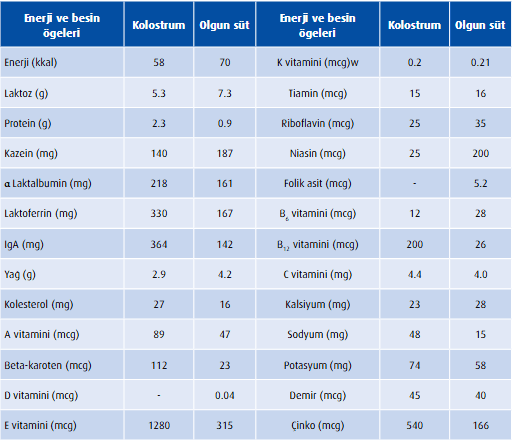
Nutrient Composition of Colostrum and Mature Breast Milk (per 100 mL) (TÜBER, 2022)
【1】
During breastfeeding, milk is classified as foremilk and hindmilk.
Foremilk: Secreted at the beginning of a feeding. It is watery and rich in carbohydrates. It satisfies the infant’s fluid needs.
Hindmilk: Secreted at the end of a feeding. It is rich in fat and promotes satiety. Complete emptying of the breast through full suckling ensures the infant receives an adequate amount of hindmilk. A well-fed infant experiences satisfaction and calmness, supporting healthy sleep patterns.
The average breastfeeding duration in the newborn period is 30 minutes. Complete emptying of one breast takes 10–15 minutes between one and three months of age, and 5–10 minutes in subsequent months. Breastfeeding should be initiated within the first half hour after birth. Mother and infant should remain in the same room, and feeding should be done on demand, both day and night. Use of pacifiers and bottles should be limited. Complete emptying of the breast through full suckling ensures the infant receives adequate hindmilk. In cases where mother and infant are separated, expressed breast milk may be used. Expressed milk can be stored at room temperature for 3–8 hours, in the refrigerator for 3–4 days, and in the freezer for 3–6 months.
Breast milk strengthens the infant’s immune system and provides protection against infections. It reduces the incidence of pneumonia, otitis media, diarrhea, and gastrointestinal infections. It lowers the risk of eczema, asthma, and allergic reactions. It also reduces the risk of necrotizing enterocolitis, obesity, type 1 diabetes, Crohn’s disease, and childhood lymphoma. Breastfeeding supports neurological, cognitive, and psychomotor development, enhancing cognitive performance and school achievement. Healthy development of the teeth and palate is also promoted by breastfeeding.
Early initiation of breastfeeding after delivery reduces postpartum bleeding and accelerates uterine involution. The energy expenditure during breastfeeding contributes to the reduction of maternal body fat and helps restore pre-pregnancy body weight. In mothers practicing EBF, ovulation is suppressed, providing natural contraception during the first six months. Long-term breastfeeding is associated with reduced risks of breast and ovarian cancer, increased bone mineralization, and lower fracture risk during the postmenopausal period. Improved glucose tolerance and reduced risk of type 2 diabetes are also linked to breastfeeding.
Iron: Breast milk is low in iron but has high biological availability. Iron deficiency in infants may occur in cases of maternal iron deficiency, prematurity, delayed cord clamping, or early introduction of complementary foods. In Türkiye, infants aged 4–12 months receive 10 mg of iron per day.
Vitamin D: Essential for bone development. Breast milk is insufficient in vitamin D. In Türkiye, infants aged 0–12 months receive 400 IU of vitamin D per day.
Education and counseling during the antenatal and postnatal periods are essential for increasing the duration of breastfeeding. Research shows that antenatal breastfeeding education improves the initiation of breastfeeding, the rate of EBF, and its duration. Group education and one-on-one counseling significantly extend breastfeeding duration. Support provided by health professionals increases the duration of EBF. The “International Code of Marketing of Breast-milk Substitutes” and similar regulations support breastfeeding by preventing inappropriate marketing of formula products.
Exclusive breastfeeding for the first six months of life, followed by continued breastfeeding alongside complementary foods from six months onward, ensures healthy growth and development. Growth and development are monitored monthly during the first six months, every three months between six and twelve months, and every six months between one and two years of age. Monitoring is a critical indicator for assessing the adequacy of breastfeeding and the infant’s health status.
Factors influencing breastfeeding include maternal age, education level, income, parity, employment status, environmental and social support, smoking, postpartum depressive mood, and the provision of supplementary foods in hospitals. Antenatal counseling increases awareness among mothers and fathers, thereby extending the duration of EBF. Paternal support and the provision of appropriate workplace facilities facilitate the continuation of maternal breastfeeding plans.
Infant suckling stimulates milk production and increases maternal milk secretion. Breastfeeding should begin within the first half hour after birth. Mother and infant should remain in the same room, feeding should be on demand, pacifiers and bottles should be limited, and no food or fluids other than breast milk should be given unless medically indicated.
Breast milk can be expressed and stored for later use under appropriate conditions. Breastfeeding counselors and health professionals provide support to mothers regarding breastfeeding technique or related issues. It is recommended that society recognize breastfeeding as a natural and healthy feeding method, ensure appropriate environments in public spaces, and that health workers actively support breastfeeding.
Anadolu Ajansı. "Anne Sütü Birçok Hastalığa "Kalkan" Oluyor." Accessed August 16, 2025. https://www.aa.com.tr/tr/saglik/anne-sutu-bircok-hastaliga-kalkan-oluyor/3006621
Anadolu Ajansı. "Anne Sütü Obeziteye De Kalkan Oluyor." Accessed August 16, 2025. https://www.aa.com.tr/tr/saglik/anne-sutu-obeziteye-de-kalkan-oluyor/3652659
Garipağaoğlu, Muazzez, Gülhan Samur, A. Tülay, Bağcı Bosi, Müge Yılmaz, and Yasemin Atik Altınok. "Bebeklik ve Küçük Çocukluk Döneminde (0-24 Ay) Beslenme: Emzirme, Anne Sütünün Önemi ve Tamamlayıcı Beslenme." In *Türkiye Beslenme Rehberi (TÜBER)*, edited by Ayla Gülden Pekcan, Nevin Şanlıer, Murat Baş, Nilüfer Acar Tek, and Hülya Gökmen Özel, (2022): 125-129. Accessed August 16, 2025. https://hsgm.saglik.gov.tr/depo/birimler/saglikli-beslenme-ve-hareketli-hayat-db/Dokumanlar/Rehberler/Turkiye_Beslenme_Rehber_TUBER_2022_min.pdf
Irmak, Naciye. "Anne Sütünün Önemi ve İlk 6 Ay Sadece Anne Sütü Vermeyi Etkileyen Unsurlar." *The Journal of Turkish Family Physician* 7, no. 2 (2016): 27-31. Accessed August 16, 2025. https://turkishfamilyphysician.com/makaleler/derleme/anne-sutunun-onemi-ilk-6-ay-sadece-anne-sutu-vermeyi-etkileyen-unsurlar/
[1]
Muazzez Garipağaoğlu, Gülhan Samur, A. Tülay, Bağcı Bosi., Müge Yılmaz ve Yasemin Atik Altınok. "Bebeklik ve Küçük Çocukluk Döneminde (0-24 Ay) Beslenme: Emzirme, Anne Sütünün Önemi ve Tamamlayıcı Beslenme." Türkiye Beslenme Rehberi (TÜBER) içinde Ed. Ayla Gülden Pekcan, Nevin Şanlıer, Murat Baş, Nilüfer Acar Tek, Hülya Gökmen Özel. (2022): 127. Erişim 16 Ağustos 2025. https://hsgm.saglik.gov.tr/depo/birimler/saglikli-beslenme-ve-hareketli-hayat-db/Dokumanlar/Rehberler/Turkiye_Beslenme_Rehber_TUBER_2022_min.pdf


Exclusive Breastfeeding (EBF)
Composition of Breast Milk
Foremilk and Hindmilk
Duration and Practices of Breastfeeding
Effects on Infant Health
Effects on Maternal Health
Nutritional Supplements During Infancy
Breastfeeding Support and Education Programs
Infant Feeding and Monitoring
Factors Influencing Breastfeeding
Protecting and Promoting Breastfeeding