



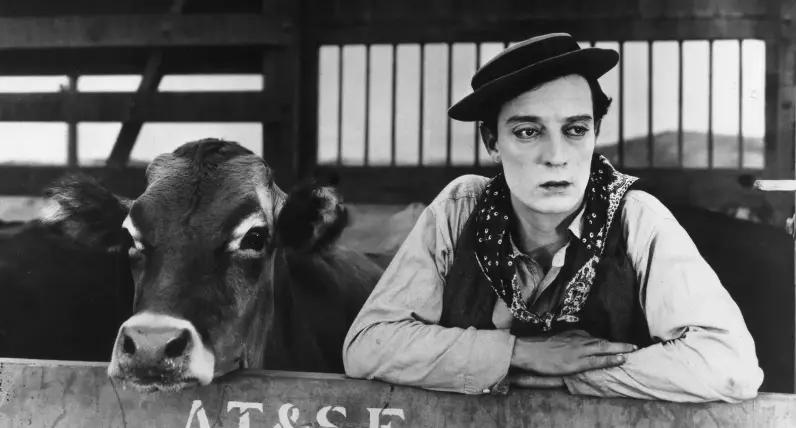
Buster Keaton
Real Name | Joseph Frank Keaton | ||||||||
|---|---|---|---|---|---|---|---|---|---|
Doğum tarihi | 1895-10-04 | ||||||||
Place of Birth | Piqua (USA) | ||||||||
Ölüm tarihi | 1966-02-01 | ||||||||
Place of Death | Woodland Hills (USA) | ||||||||
Nickname(s) | The Great Stone Face | ||||||||
Stage Name | Buster Keaton | ||||||||
Cause of Death | Lung cancer | ||||||||
Height(s) | 165 cm | ||||||||
Active Years | 1898–1966 | ||||||||
First Stage Experience | The Three Keatons (1898) | ||||||||
Last Stage Experience | The Way to the Forum (1966) | ||||||||
Buster Keaton (1895–1966) was an actor, director, and producer active in the United States during the first half of the 20th century. Renowned for his work during the silent film era, Keaton produced 19 silent short films and 10 silent feature films between 1920 and 1928. An artist of major significance in cinema history due to his technical innovations, use of physical comedy, and visual humor, he is particularly recognized as one of the most prominent figures of the silent film period.
Seven of Keaton’s films have been included in the National Film Registry of the Library of Congress as culturally, historically, and aesthetically significant works. These include One Week (1920), Cops (1922), Sherlock Jr. (1924), The Navigator (1924), The General (1926), Steamboat Bill, Jr. (1928), and The Cameraman (1928).
It is known that Keaton received an Honorary Academy Award from the Academy of Motion Picture Arts and Sciences in 1960, the George Eastman Award in 1955, and has two stars on the Hollywood Walk of Fame, one for cinema and one for television. Additionally, Keaton and his works have consistently ranked highly in various categories on lists compiled by film institutions and publications.
Joseph Frank Keaton, known by his stage name Buster Keaton, was born on 4 October 1895 in Kansas, United States. His parents, Joseph Hallie Keaton and Myra Cutler Keaton, were traveling vaudeville performers of the era. Keaton was introduced to the stage as an infant and began performing with his family at the age of nine months.
According to family accounts, Keaton grew up immersed in the world of performance. He regularly appeared on stage in theater venues where child labor laws were not enforced. Some dangerous incidents he experienced behind the scenes have been documented in contemporary newspapers and memoirs.
Although it is widely claimed that the nickname “Buster” was given to him by Harry Houdini, some sources attribute it to George Pardey. However, it is certain that the nickname was used from his childhood onward.
Keaton began his professional entertainment career on 17 October 1900 at Dockstader’s Theatre in Wilmington, Delaware, where he imitated his father’s monologues, delivering silent yet effective comic moments. Contemporary newspapers praised his natural presence and skilled facial expressions despite his young age.
During the 17 years he toured with his family, Keaton developed talents in singing, dancing, playing the ukulele and piano, juggling, magic tricks, and writing comedy sketches. He met contemporaries such as Bill “Bojangles” Robinson and Harry Houdini and learned various stage techniques.
These early experiences laid the foundation for the physical comedy, action choreography, and technical innovations he would later employ in his film career.
Buster Keaton’s entry into cinema occurred in 1917 when he met Roscoe “Fatty” Arbuckle. For his first film, The Butcher Boy, he stepped in front of the camera without rehearsal. Driven by curiosity about cinematic techniques, he took the camera home, disassembled it, and studied its mechanics. He abandoned his weekly salary of $250 on Broadway to accept a supporting role in cinema for $40.
Buster Keaton, Roscoe Arbuckle - The Butcher Boy Silent Short Film - (YouTube)
The Comique Shorts refer to the short films Buster Keaton produced between 1917 and 1923 under his own production company, Comique Film Corporation. This period represents an experimental phase in which Keaton made creative contributions to cinema. Here, he was not only an actor but also a director, producer, and screenwriter, shaping his own artistic vision.
Silent Shorts denote Buster Keaton’s early cinematic productions, typically short films from the silent film era. During this period, Keaton contributed to the language of cinema through physical comedy and slapstick humor. Films in this category emphasize visual storytelling, with comedy primarily derived from physical movement and precise timing.
Keaton developed his distinctive style through short comedies such as One Week (1920), The Play House (1921), and Cops (1922), establishing fundamental principles of visual humor. He began his feature film career with The Saphead (1920), followed by innovative works such as Three Ages (1923), Our Hospitality (1923), and Sherlock Jr. (1924), which demonstrated groundbreaking techniques in cinematic method and special effects.
Keaton’s film The Navigator (1924) became the biggest commercial success of its time, while The General (1926), a comedy set against the backdrop of the American Civil War with dramatic elements, received negative reviews from contemporary critics. Nevertheless, the film has since been recognized as one of the masterpieces of cinema history and is regarded as Keaton’s greatest work.
Buster Keaton, Steamboat Bill, Jr - (YouTube)
In 1928, Buster Keaton signed with Metro-Goldwyn-Mayer (MGM) and began working under the studio system, which restricted his creative autonomy. This period brought personal and professional difficulties, leading to his departure from MGM in 1933 and subsequent bankruptcy filing.
The Educational Shorts are a series of short comedy films starring Buster Keaton, produced between 1934 and 1937 by Educational Pictures. These talkie-era productions were made during Keaton’s years under studio control and typically lasted 10 to 20 minutes. Slapstick comedy elements were heavily used, and Keaton performed without creative control.
The Columbia Shorts are a series of short sound comedies in which Buster Keaton starred for Columbia Pictures between 1939 and 1941. These films reflect his departure from independent creativity and his alignment with the studio system. Running approximately 16 to 20 minutes each, they adhered to the slapstick comedy tradition.
In the 1930s and 1940s, Keaton appeared in minor roles in two-reel comedies. He regained public attention beginning in 1947 through live performances at the Cirque Medrano in Paris. He appeared in Billy Wilder’s Sunset Boulevard (1950) and Charlie Chaplin’s Limelight (1952), and also performed in television series and advertising films.
In 1960, Keaton received an Academy Honorary Award and published his autobiography, My Wonderful World of Slapstick. In his final years, he appeared in films such as It’s a Mad, Mad, Mad, Mad World (1963) and A Funny Thing Happened on the Way to the Forum (1966).
Throughout his career, Buster Keaton not only starred as a lead actor and director but also appeared in numerous films in supporting roles. In these roles, he often occupied a significant place in comedies centered around the main character. Through supporting performances, he expanded his contribution to the film industry and demonstrated a wide range of character types.
Although Buster Keaton is best known for his work in silent cinema, he also transitioned into sound films. With the advent of talkies, Keaton sought to adapt to the evolution of cinema. His sound films, mostly comedies, enabled him to express his physical comedy skills and comedic sensibility within the new medium. These films belong to the later stages of his career and reflect key turning points in cinema history. Keaton’s sound film career also illustrates various cinematic trends of Hollywood’s Golden Age.
Keaton is regarded by film historians and critics as one of the most important figures of his era alongside Charlie Chaplin and Harold Lloyd. As Roger Ebert described him, “the greatest of the silent comedy masters.”
Many of Keaton’s films, notably The General, Sherlock Jr., and The Navigator, have been preserved in the United States National Film Registry. His 10 feature films and 19 short films produced between 1920 and 1928 made lasting contributions to the art of cinema. Filmmakers such as Orson Welles, Steven Spielberg, Jackie Chan, and Mel Gibson have cited Keaton as a major source of inspiration.
Buster Keaton, The General (1926) Trailer - (YouTube)
Buster Keaton. "The Films." Accessed May 31, 2025. https://busterkeaton.org/the-films/
Buster Keaton. “About Buster – Overview.” Accessed May 31, 2025. https://busterkeaton.org/about-buster/about-buster-overview/
Buster Keaton. “About Buster – Part 1: A Vaudeville Childhood.” Accessed May 31, 2025. https://busterkeaton.org/about-buster/part-1-a-vaudeville-childhood/
Buster Keaton. “About Buster – Part 2: The Flickers.” Accessed May 31, 2025. https://busterkeaton.org/about-buster/part-2-the-flickers/
Buster Keaton. “About Buster – Part 3: The Worst Mistake.” Accessed May 31, 2025. https://busterkeaton.org/about-buster/part-3-the-worst-mistake/
Buster Keaton. “About Buster – Part 4: The Lost Years.” Accessed May 31, 2025. https://busterkeaton.org/about-buster/part-4-the-lost-years/
Buster Keaton. “About Buster – Part 5: A Happy, Contented Man.” Accessed May 31, 2025. https://busterkeaton.org/about-buster/part-5-a-happy-contented-man/
IMDb. "Buster Keaton." Accessed May 31, 2025. https://www.imdb.com/name/nm0000036/?ref_=mv_close
YouTube. "Buster Keaton Documentary." Accessed May 31, 2025. https://www.youtube.com/watch?v=7EcZPcFfjqY

Buster Keaton
Real Name | Joseph Frank Keaton | ||||||||
|---|---|---|---|---|---|---|---|---|---|
Doğum tarihi | 1895-10-04 | ||||||||
Place of Birth | Piqua (USA) | ||||||||
Ölüm tarihi | 1966-02-01 | ||||||||
Place of Death | Woodland Hills (USA) | ||||||||
Nickname(s) | The Great Stone Face | ||||||||
Stage Name | Buster Keaton | ||||||||
Cause of Death | Lung cancer | ||||||||
Height(s) | 165 cm | ||||||||
Active Years | 1898–1966 | ||||||||
First Stage Experience | The Three Keatons (1898) | ||||||||
Last Stage Experience | The Way to the Forum (1966) | ||||||||
Life and Career
Early Years
Entry into Cinema
Comique Shorts Era
Comique Shorts Films
Silent Short Film Era
Silent Short Film Era Films
Silent Feature Film Era
Silent Feature Film Era Films
MGM Era and Professional Challenges
Educational Shorts Era
Educational Shorts Era Films
Columbia Shorts Era
Columbia Shorts Era Films
Later Years and Revival
Short Films Made in the Final Years of His Career
Buster Keaton’s Supporting Roles in Cinema
Buster Keaton in Supporting Roles
Buster Keaton’s Sound Film Career
Buster Keaton Sound Film Era Films
Place and Influence in Cinema History