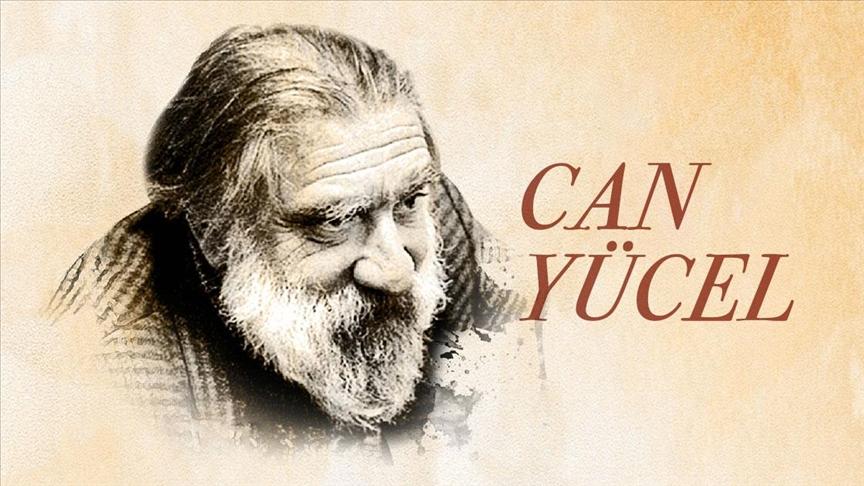



Doğum tarihi | 1926-08-21 | ||||||||
|---|---|---|---|---|---|---|---|---|---|
Eş | Güler Yücel | ||||||||
Place of Birth | Istanbul | ||||||||
Ölüm tarihi | 1999-08-12 | ||||||||
Place of Death | Muğla | ||||||||
Babası | Hasan Âli Yücel | ||||||||
Annesi | Gülsüm Refika Hanım | ||||||||
Çocuk | Can Yücel Hasan Yücel Su Yücel | ||||||||
Profession(s) | Poet Writer Translator | ||||||||
Educational Life | Ankara University Ankara Atatürk High School Boğaziçi Primary School | ||||||||
Literary Movement(s) | Second New Garip Movement | ||||||||
Can Yücel was born on 21 August 1926 in the Kumkapı district of Istanbul. His father was Hasan Âli Yücel and his mother was Gülsüm Refika Hanım. Hasan Âli Yücel is known as a poet, writer, philosophy teacher, inspector of education, and Minister of National Education in İsmet Pasha’s cabinet; he is also the founder of the Conservatory and Village Institutes. Can Yücel has noted a relationship and conflict between his own stance against political power and his father’s role as an agent of the ruling establishment. After the death of his elder sibling Samime, twin children named Can and Canan were born. His youngest sister’s name is Gülümser. His grandfather Ali Rıza Bey’s Mevlevi identity, his grandmother Neyir Hanım’s intellectual character, and his father’s dual role as a cultural and political figure all played guiding roles in shaping Can Yücel’s temperament and artistic personality.
He began his primary education at Boğaziçi Primary School alongside his twin sister Canan. From the third grade onward, he was required to attend boarding school. He completed his secondary education at Atatürk High School. There he recounted reading Nâzım Hikmet, becoming familiar with world literature, and learning Latin. Alongside his high school friend Gazi Yaşargil, he envisioned a “metahumanist” concept of love and respect encompassing humanity and all of nature. After high school, he enrolled in the Classical Philology Department of the Faculty of Language, History and Geography (DTCF), where he studied German philology for a period.
He entered the literary world in the 1950s with his work titled “Yazma.” His early poems show the influence of the Garip movement. The concise and economical style of Garip poetry influenced the content of his early poems and later became structurally dominant in his work, remaining active until the end of his artistic life. Traces of the Second New movement can be found in some of his poems, but he criticized this movement as a “misguided translation effort” and declared himself a proponent of “open subtraction.” He regarded Turgut Uyar and Edip Cansever as successful poets of the Second New, while he viewed İlhan Berk as formalistic and pretentious. He identified Cemal Süreya as the poet closest to him and the one he loved most. His poetry translations of Western poets such as Dylan Thomas, E. E. Cummings, Ezra Pound, and T. S. Eliot significantly influenced his work. He considers Nazım Hikmet the poet he admired most and regarded as the most accomplished in Turkish literature. He believed Nâzım’s poetry was unimitable and aimed to rediscover his mode of perception. His close friend Metin Eloğlu is also among the poets he felt closest to in Turkish poetry. Both were nourished by the Garip movement, but Can Yücel turned toward originality by engaging with world poetry. He regarded Yahya Kemal and Ahmet Haşim as important poets in Turkish literature. During his university years, he met and learned from Ahmet Muhip and Cahit Sıtkı. He also formed close friendships with Enver Gökçe and Ahmet Arif.
With the transition to a multi-party system in 1946, his dissent acquired a political identity. After initially supporting the Democrat Party, he drew closer to leftist artists and politicians. From 1965 onward, he identified as a member of the Workers’ Party. During the 12 March period, he was sentenced to fifteen years in prison for translating a book into Turkish. This period, spent in Toptaşı and Adana prisons, became a turning point in both his life and art. These years provided the foundation for his intense focus on poetry and the sharpening of his dissident identity. His book “Bir Siyasinin Şiirleri” (1974), a product of this era, enabled the poet to reach a broader public. He never compromised his dissident and revolutionary stance until the end of his life.
He spent his final years with his family in Eski Datça. He died on 12 August 1999 in the hospital where he was receiving treatment, due to tonsil cancer.
Anadolu Ajansı. “Can Yücel – 2022.” Photograph. Anadolu Ajansı. Accessed July 1, 2025. https://cdnuploads.aa.com.tr/uploads/Contents/2022/08/11/thumbs_b_c_a18d588cd73b76c4fb59b6437e4dd21f.jpg?v=131356
Anadolu Ajansı. “Can Yücel – 2024.” Photograph. Anadolu Ajansı. July 1, 2025. https://cdnuploads.aa.com.tr/uploads/Contents/2024/08/11/thumbs_b_c_1d82fb96773c78b421d2ebbfd03071c1.jpg?v=120352
Anadolu Ajansı. “Taşlama Şiirin Ustası: Can Yücel.” Accessed July 1, 2025. https://www.aa.com.tr/tr/portre/taslama-siirin-ustasi-can-yucel/2965849.
Anadolu Ajansı. “Yalın Dili ve Farklı Tarzıyla Bilinen Şair: Can Yücel.” Accessed July 1, 2025. https://www.aa.com.tr/tr/kultur/yalin-dili-ve-farkli-tarziyla-bilinen-sair-can-yucel/3300890.
Börklü, Jale Gülgen. Can Yücel’in Hayatı, Edebî Çevresi ve Şiirlerinin İncelenmesi. PhD thesis, Gazi University Institute of Social Sciences, Department of Turkish Language and Literature, Department of Modern Turkish Literature, Ankara, 2012.
TEİS. "Can Yücel." *Türkiye Edebiyatı İsimler Sözlüğü.* Accessed July 1, 2025. https://teis.yesevi.edu.tr/madde-detay/can-yucel.

Doğum tarihi | 1926-08-21 | ||||||||
|---|---|---|---|---|---|---|---|---|---|
Eş | Güler Yücel | ||||||||
Place of Birth | Istanbul | ||||||||
Ölüm tarihi | 1999-08-12 | ||||||||
Place of Death | Muğla | ||||||||
Babası | Hasan Âli Yücel | ||||||||
Annesi | Gülsüm Refika Hanım | ||||||||
Çocuk | Can Yücel Hasan Yücel Su Yücel | ||||||||
Profession(s) | Poet Writer Translator | ||||||||
Educational Life | Ankara University Ankara Atatürk High School Boğaziçi Primary School | ||||||||
Literary Movement(s) | Second New Garip Movement | ||||||||
Educational Life
Literary Environment and Influences
Political Identity and Imprisonment Years
Death
Notable Works