


This article was automatically translated from the original Turkish version.
+1 More
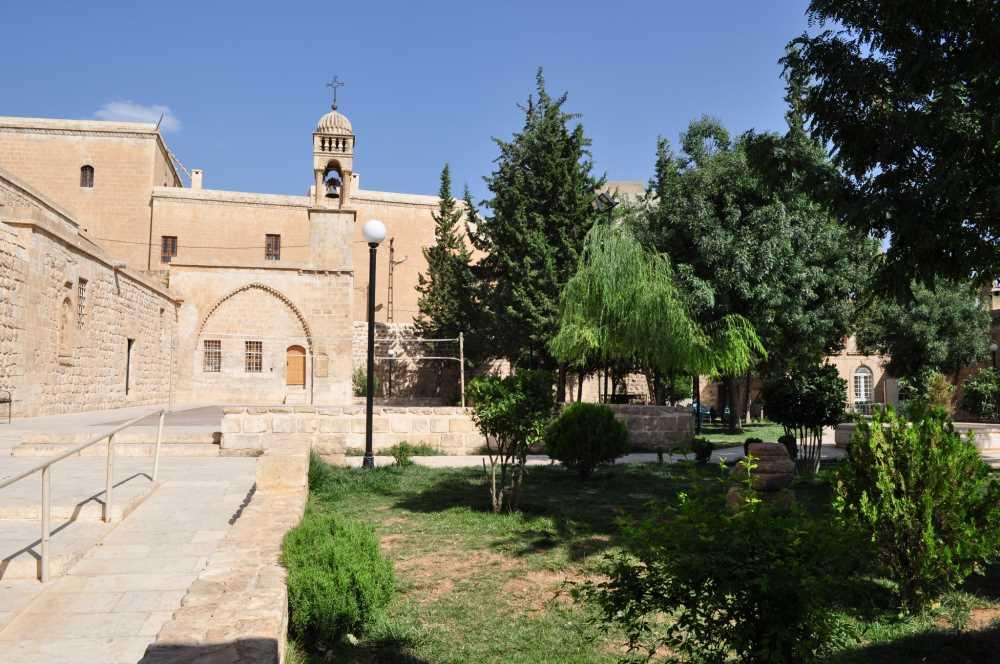
Church of Mor Behnam (Kırklar)
Place(s) | Artuklu Mardin | ||||||||
|---|---|---|---|---|---|---|---|---|---|
Construction Date(s) | 6th century | ||||||||
Namesakes | Mor Behnam and his sister Saro | ||||||||
Religious Connection | Syriac Orthodox Church | ||||||||
Architectural Feature(s) | 12 massive columns finely cut stone masonry arched ceiling | ||||||||
Additional Structures | Patriarchate building (1850), divanhane (1925) | ||||||||
Mor Behnam (Kırklar) Church is located in the Artuklu (city center) district of Mardin Province in southeastern Türkiye. It is one of the most prominent structures within Mardin’s characteristic stone architecture, which is adorned with historic buildings. The church has served for centuries as a central institution in the religious, educational, and administrative life of the Syriac Christian community, offering visitors a rich spiritual and cultural experience.

Mor Behnam (Kırklar) Church. (
The church derives its name from the early Christian legends of Mor Behnam and his sister Saro, both of whom are venerated as martyrs in Christian history. The structure was built in the mid-6th century in their memory. Today, it is more commonly known among the local population as the Church of the Forty, a reference to the forty Christian martyrs in the Syriac tradition.
Mor Behnam Church exhibits the classic features of Syriac church architecture. Built along an east-west axis, it features an impressive vaulted ceiling supported by arches resting on twelve solid columns. The ceiling and walls are constructed of precisely cut stone, reflecting the refined craftsmanship characteristic of Mardin’s stonework. The spaces within the courtyard and the overall layout of the building carry both functional and symbolic significance.

Interior Space (Ministry of Culture and Tourism of the Republic of Türkiye)
After Mardin became the seat of the Syriac Orthodox Patriarchate in 1293, Mor Behnam Church became the primary center for both spiritual and administrative affairs. The patriarchs and metropolitans initially resided in rooms within the church courtyard, whose ceilings were also constructed of cut stone. In 1850, these rooms were replaced by a new patriarchal building. In 1925, this structure was expanded with the addition of a grand assembly hall (divanhane), also built from cut stone, to accommodate administrative and social functions. This expansion enhanced both the administrative and communal roles of the complex.
A school was established within the church complex in 1799. It operated actively between 1825 and 1899, serving as a vital educational institution for the Syriac community. In addition to religious and linguistic instruction, basic sciences were also taught. The church continued its educational function until 1928.
Today, Mor Behnam (Kırklar) Church remains open to visitors and serves both as a place of worship and a cultural heritage site. It hosts important religious ceremonies of the Syriac community and is a major cultural destination attracting both local and international tourists.
Mardin Büyükşehir Municipality. "Kiliseler." Accessed May 1, 2025. https://mardin.bel.tr/kiliseler
Mardin İl Directorate of Culture and Tourism. "Mor Benham (Kırklar) Kilisesi." Accessed May 1, 2025. https://mardin.ktb.gov.tr/TR-311913/mor-benham-kirklar-kilisesi.html
Ministry of Culture and Tourism of the Republic of Türkiye. "Mor Behnam (Kırklar) Kilisesi." *Kültür Portalı.* Accessed May 1, 2025. https://www.kulturportali.gov.tr/turkiye/mardin/gezilecekyer/mor-behnam-kirklar-kilisesi

Church of Mor Behnam (Kırklar)
Place(s) | Artuklu Mardin | ||||||||
|---|---|---|---|---|---|---|---|---|---|
Construction Date(s) | 6th century | ||||||||
Namesakes | Mor Behnam and his sister Saro | ||||||||
Religious Connection | Syriac Orthodox Church | ||||||||
Architectural Feature(s) | 12 massive columns finely cut stone masonry arched ceiling | ||||||||
Additional Structures | Patriarchate building (1850), divanhane (1925) | ||||||||
No Discussion Added Yet
Start discussion for "Church of Mor Behnam" article
Name and Historical Origins
Architectural Structure and Features
Role as a Religious and Administrative Center
Educational and Schooling Activities
Visit Information