


This article was automatically translated from the original Turkish version.
+2 More
Common Cold
Agents | Rhinovirus, Coronavirus, RSV, Adenovirus | ||||||||
|---|---|---|---|---|---|---|---|---|---|
Transmission(s) | Droplets fomite transmission direct contact | ||||||||
Symptoms | Nasal congestion, sore throat, mild fever, cough | ||||||||
Complications | Sinusitis (0.5%–2%), otitis media (20% in children) | ||||||||
Prevention | Hand hygiene, mask, environmental ventilation | ||||||||
The common cold is an acute, infectious, viral infection affecting the upper respiratory tract. This infection, typically confined to the nasopharyngeal region, produces a mild clinical presentation characterized by symptoms primarily in the nose and throat. Rhinoviruses are the most common causative agents, but many other viruses can also lead to the common cold. The illness usually resolves spontaneously without treatment; however, the risk of complications may increase in children, the elderly, and individuals with weakened immune systems.
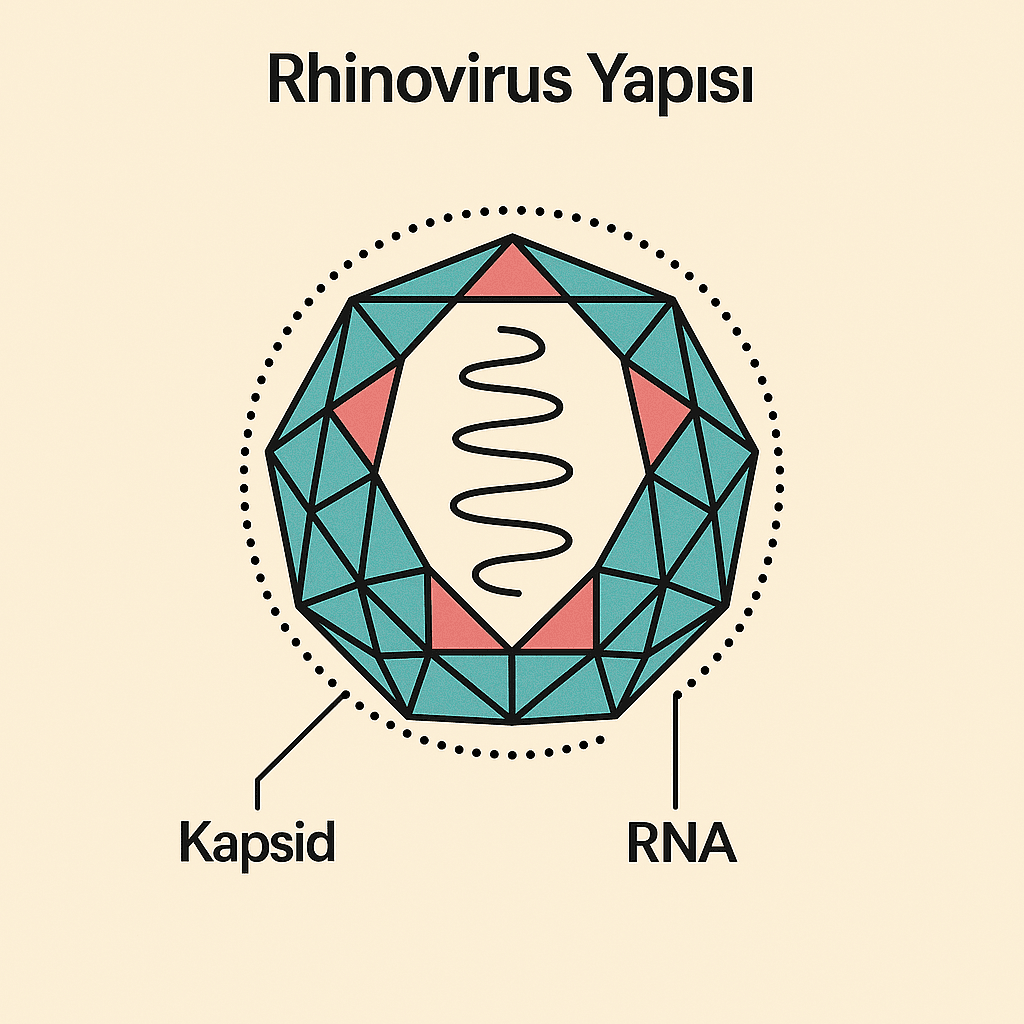
Rhinovirus Structure Diagram (Generated by Artificial Intelligence)
The common cold is one of the most frequently occurring infectious diseases worldwide. Adults experience it on average 2–4 times per year, while children experience it 6–8 times annually. Although rates are similar in developed countries, higher incidence may occur in developing countries due to poor hygiene, crowded living conditions, and inadequate healthcare services. Transmission is faster in settings such as daycare centers, schools, nursing homes, and other enclosed communal spaces. Individuals in higher income groups have lower infection rates due to better hygiene conditions.
The main viruses causing the common cold include:
The pathogenesis of each virus is characterized by similar mechanisms of mucosal inflammation and cell damage. The local inflammatory response is the primary cause of symptoms such as nasal congestion, increased secretions, and cough.
The common cold spreads through three primary routes:
Poor hygiene, crowded environments, and prolonged stays in enclosed spaces elevate transmission risk.
The common cold typically begins with mild symptoms. The incubation period is 1 to 3 days. Initial symptoms usually include dryness, mild burning, and sore throat. Subsequently, symptoms such as runny nose, nasal congestion, sneezing, mild cough, and fatigue develop. Fever is often absent or low-grade; in children, subfebrile temperatures may occasionally occur.
Typical clinical manifestations include:
Symptoms generally resolve spontaneously within 7–10 days. However, in some individuals, this period may extend up to two weeks. Symptoms may persist longer if complications develop or if additional infections are superimposed.
Diagnosis is based on clinical evaluation. History and physical examination are usually sufficient. Differential diagnosis should include the following conditions:
Laboratory tests are rarely necessary. However, in cases of suspected complications, complete blood count, C-reactive protein, and nasal swab PCR tests may be used.
Symptomatic Treatment
Antibiotics are ineffective and not recommended. Their unnecessary use contributes to antibiotic resistance.
Phytotherapy
Plants such as echinacea, ginger, rosehip, and linden are claimed to have antiviral and immune-boosting effects. However, randomized controlled trials supporting these claims are insufficient. For instance, the efficacy of echinacea products has been supported by some studies and contradicted by others. The placebo effect cannot be disregarded.
Acupuncture
Some sources suggest acupuncture may alleviate nasal congestion and general symptoms. However, evidence regarding its physiological effects is limited, and controlled clinical studies are lacking.
These methods should be used only as supportive measures under medical guidance and must not replace standard treatment.
The common cold usually resolves without complications. However, the following may occur:
Risk groups include:
No vaccine or prophylactic medication is currently available.
The common cold is one of the most common reasons for healthcare visits. In the United States, it is estimated to cause approximately 22 million lost school days and 20 million lost workdays annually. Unnecessary antibiotic prescriptions impose an economic burden on the healthcare system. Additionally, widespread self-medication practices sometimes lead to incorrect and harmful treatments.
Büyükkök, Neşe, Buket Güngör, and Ayşe Asena Genç. “Soğuk Algınlığında Kullanılan Bitkisel Droglar.” Mersin Üniversitesi Tıp Fakültesi Lokman Hekim Tıp Tarihi ve Folklorik Tıp Dergisi 12, no. 2 (2022): 262–271. https://dergipark.org.tr/en/pub/mutftd/article/1034196.
Eccles, Ronald. “Understanding the Symptoms of the Common Cold and Influenza.” *The Lancet Infectious Diseases* 5, no. 11 (2005): 718–725. https://doi.org/10.1016/S1473-3099(05)70270-X.
Ersoy, Ezgi. *Soğuk Algınlığı ve Grip Tedavisinde Fitoterapi Uygulamaları.* 2023. https://openaccess.biruni.edu.tr/xmlui/handle/20.500.12445/3306.
Gökdemir, Yasemin, and Refika Ersu. “Soğuk Algınlığı.” *Turkiye Klinikleri Pediatric Sciences-Special Topics* 6, no. 4 (2010): 39–45. https://www.turkiyeklinikleri.com/article/en-soguk-alginligi-59858.html.
Koturoğlu, Güldane, and Zafer Kurugöl. “Soğuk Algınlığı İlaçları-Alternatif Tedavi Yöntemleri.” Turkiye Klinikleri Pediatric Sciences-Special Topics 6, no. 4 (2010): 46–49. https://www.turkiyeklinikleri.com/article/en-soguk-alginligi-ilaclari-alternatif-tedavi-yontemleri-59859.html.
Köroğlu, Fatma Tamara. “Soğuk Algınlığı ve Akupunktur.” Accessed June 24, 2025. https://www.researchgate.net/publication/332332744.
Yahşi, Aysun. “Soğuk Algınlığı.” Klinik Tıp Pediatri Dergisi 9, no. 5 (2017): 16–20. https://dergipark.org.tr/en/pub/ktpd/issue/47786/596824.
Öncel, Selim. “Soğuk Algınlığı Ve Klinik Yaklaşımlar.” Kocaeli Üniversitesi Sağlık Bilimleri Dergisi 4, no. 1 (2018): 27–31. https://dergipark.org.tr/tr/doi/10.30934/kusbed.348505.

Common Cold
Agents | Rhinovirus, Coronavirus, RSV, Adenovirus | ||||||||
|---|---|---|---|---|---|---|---|---|---|
Transmission(s) | Droplets fomite transmission direct contact | ||||||||
Symptoms | Nasal congestion, sore throat, mild fever, cough | ||||||||
Complications | Sinusitis (0.5%–2%), otitis media (20% in children) | ||||||||
Prevention | Hand hygiene, mask, environmental ventilation | ||||||||
Epidemiology
Etiology and Pathogenesis
Transmission Routes
Clinical Features
Diagnosis and Differential Diagnosis
Treatment Approaches
Complementary and Alternative Approaches
Complications
Prevention
Social and Economic Impact