

This article was automatically translated from the original Turkish version.
Source | Mescit Mountains, Bayburt – Türkiye | ||||||||
|---|---|---|---|---|---|---|---|---|---|
Forms İt Passes Through | Bayburt, Erzurum, Artvin | ||||||||
The Çoruh River is a significant river in eastern Türkiye, originating in the İspir district of Erzurum Province and flowing through Artvin until it reaches the Georgian border, where it empties into the Black Sea. The river draws its source from the western slopes of the Mescit Mountains and is 376 kilometers long, approximately 354 kilometers of which lie within Türkiye’s borders. It is particularly notable for its 260-kilometer stretch within the boundaries of İspir district in Erzurum.
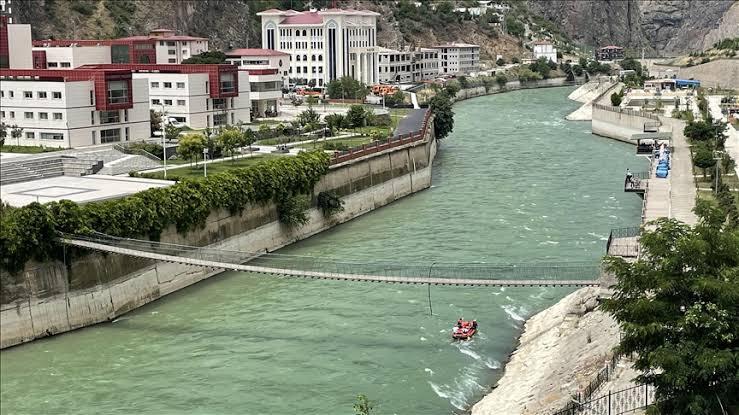
The Çoruh River is one of the fastest-flowing rivers in the world, characterized by a narrow and deep channel. Water levels rise during spring and decline in summer. Along its course, nature and history are intricately intertwined. Castles, churches, and natural beauties lined along its banks offer visitors a unique experience.
The Çoruh River is one of Türkiye’s most important centers for water sports, particularly extreme activities such as rafting and canoeing. With its challenging rapids, it is regarded as Türkiye’s most difficult rafting route. The approximately 127-kilometer stretch from İspir to Artvin is ideal for rafting and attracts domestic and international tourists annually. It has hosted international competitions such as the 4th World River Cross Championship. The rafting season runs from late May through September.
Various projects are underway to preserve the natural and cultural fabric of the Çoruh River. Led by the Bayburt Provincial Directorate, the Çoruh River Urban Passage Project implements flood protection measures and aesthetic improvements without damaging the riverbed. Areas reinforced with natural stones are being restructured to mitigate flood risks. The projects are also evaluated from social and cultural perspectives; the riverbanks are planned as spaces for public relaxation and social interaction.
The Çoruh River Basin Rehabilitation Project, jointly implemented with the Japan International Cooperation Agency (JICA), aims to improve the quality of life for local communities through agriculture, water use, soil conservation, and income-generating activities. Under the project, initiatives such as greenhouse technology, reforestation, and beekeeping are being carried out.
The Çoruh River is also of major importance for electricity generation. Hydroelectric power plants built on the Muratlı, Borçka, Deriner, and Artvin dams have contributed billions of Turkish liras to the national economy. These dams play a critical role in Türkiye’s clean energy objectives.

The name “Çoruh” is derived from the Persian word “Cûy” (river) and the Arabic word “Ruh” (soul, life), meaning “Water of Life.” For the local population, the river is both a source of life and a cultural symbol. With its historical and cultural structure, it holds significant heritage value for the people living in the Bayburt and Artvin regions.
Bayburt İl Directorate of Agriculture and Forestry. “Çoruh Nehri Bayburt’a Hayat Vermeye Devam Ediyor…” Bayburt TarımOrman Haberleri. Accessed May 20, 2025. https://bayburt.tarimorman.gov.tr/Haber/243/Coruh-Nehri-Bayburta-Hayat-Vermeye-Devam-Ediyor%E2%80%A6.
Devlet Su İşleri Genel Müdürlüğü (DSİ). "Çoruh Nehri’nin Doğal ve Kültürel Dokusu Korunacak." DSİ Haberler. Accessed May 20, 2025. https://www.dsi.gov.tr/Haber/Detay/619.
Ministry of Culture and Tourism. "Rafting." *Turkey Culture Portal,Artvin Turizm Activities.* Accessed May 20, 2025. https://www.kulturportali.gov.tr/turkiye/artvin/turizmaktiviteleri/rafting194999.
T.C. Bayburt Valiliği. “Çoruh Nehrinin Doğal ve Kültürel Dokusu Korunacak.” Bayburt Valiliği Resmi Sitesi. Accessed May 20, 2025. http://www.bayburt.gov.tr/coruh-nehrinin-dogal-ve-kulturel-dokusu-korunacak.

Source | Mescit Mountains, Bayburt – Türkiye | ||||||||
|---|---|---|---|---|---|---|---|---|---|
Forms İt Passes Through | Bayburt, Erzurum, Artvin | ||||||||
Geographical Features
Tourism and Recreation
Environmental and Conservation Efforts
Sustainable Development and Economy
Cultural and Historical Significance