


This article was automatically translated from the original Turkish version.
+4 More
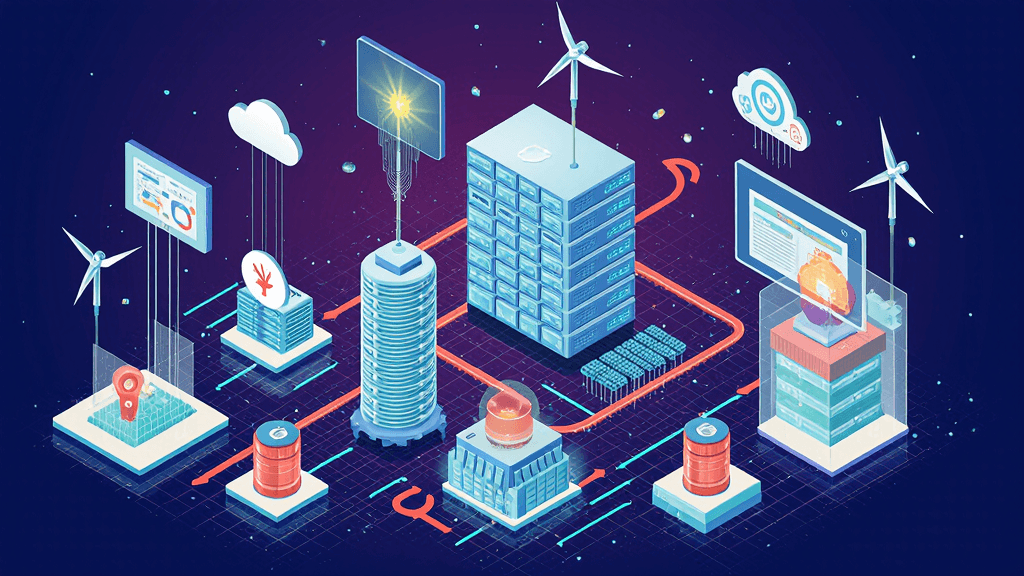
Generated with artificial intelligence.
Data Center Energy Efficiency
Main Energy Consumers | Servers, Cooling Systems, Power Infrastructure | ||||||||
|---|---|---|---|---|---|---|---|---|---|
Basic Efficiency Metric | PUE (Power Usage Effectiveness) | ||||||||
Ideal PUE Value | 1.0 (%100 efficiency) | ||||||||
Key Strategies | Liquid Cooling, Virtualization, Renewable Energy, AI Optimization | ||||||||
A data center is a specialized infrastructure facility designed for the storage, processing, and distribution of vast quantities of digital data. These facilities operate through the integration of hardware and software components such as high-performance servers, data storage systems, network elements, cooling units, power supplies, and security systems. In the modern digital economy, the continuity of many critical services—including cloud computing, big data analytics, artificial intelligence applications, online communication, and e-commerce—depends on the processing power and storage capacity provided by data centers.
To sustain their intensive processing and storage capacities, data centers require substantial amounts of energy. This energy consumption primarily stems from the need to cool the heat generated by processors and network components. While this increases operational costs, it also contributes to growing environmental impacts due to carbon emissions associated with energy use.
The concept of data center energy efficiency aims to achieve the same computing capacity with lower energy consumption. This approach reduces electricity costs, lightens cooling loads, and shrinks the carbon footprint. Methods used to achieve high efficiency include hot-cold aisle management, liquid cooling systems, AI-driven resource optimization, and integration of renewable energy sources.
Rising demand for digital services and growing sustainability concerns have made energy efficiency a top priority in the design, construction, and operation of data centers. International energy standards, environmental regulations, and corporate sustainability strategies are also accelerating this transformation.
Energy consumption in data centers arises from various hardware and infrastructure components, and optimizing this consumption plays a critical role in improving overall energy efficiency. When examining the sources of energy use, four main elements emerge:
The largest energy consumers in data centers are servers and storage units that operate continuously. These systems ensure the uninterrupted operation of applications, web services, email traffic, big data analytics, and cloud-based solutions. High computational intensity and the requirement for constant operation increase their energy demand. In particular, graphics processing units (GPUs) and accelerator hardware used for artificial intelligence training and high-performance computing (HPC) consume significantly more energy than traditional servers.
Servers and storage hardware generate large amounts of heat during intensive operations. Removing this heat is essential for safe equipment operation. Cooling systems can account for 30% to 40% of a data center’s total energy consumption. In recent years, technologies such as direct-to-chip liquid cooling and immersion cooling have been developed alongside traditional air-cooling systems. These technologies more efficiently manage processor and GPU temperatures, reducing energy consumption and extending equipment lifespan.
To ensure reliable power supply, data centers use power distribution units (PDUs), uninterruptible power supplies (UPS), battery systems, and generators. Electrical energy passes through multiple conversion and distribution stages from the facility’s main input to the servers. Energy losses occur during these processes. High-efficiency UPS systems, modular power distribution, and renewable energy integration are among the primary solutions for reducing these losses.
Network hardware such as switches, routers, optical transmission devices, and firewalls also contribute significantly to a data center’s energy consumption. Additionally, auxiliary infrastructure including lighting, security cameras, access control systems, and environmental monitoring sensors are part of the total energy use.
In recent years, the proliferation of artificial intelligence (AI) and high-performance computing (HPC) applications has substantially increased energy demand in data centers. Particularly in applications requiring intensive computational power, such as training large language models, the simultaneous operation of thousands of GPUs can cause a single facility to consume enormous amounts of energy. International assessments indicate that global electricity demand for data centers is rising rapidly and is expected to exceed current levels significantly in the coming years. This trend is transforming energy efficiency solutions and the integration of sustainable energy sources from optional approaches into strategic necessities for data centers.
Standard metrics are used to evaluate the energy efficiency of data centers and compare performance across different facilities. These metrics not only identify current efficiency levels but also help pinpoint areas for improvement. Internationally recognized, these metrics are critical for enhancing industry transparency and promoting best practices.
PUE is the most widely used metric in the data center industry. Developed by the Green Grid consortium, it is calculated by dividing the total energy consumption of a facility by the energy consumed solely by information technology (IT) equipment. The formula is expressed as:
PUE = Total Facility Energy / IT Equipment Energy
The ideal PUE value is theoretically 1.0, meaning all incoming energy is used exclusively by IT equipment (servers, storage units, network devices) with no energy loss in infrastructure systems such as cooling, lighting, or power distribution. However, achieving this value under real-world conditions is impossible. In average data centers, PUE typically ranges between 1.2 and 2.0. In modern facilities designed for high efficiency, values as low as 1.1 have been reported.
This metric, derived as the inverse of PUE, expresses the ratio of IT equipment energy consumption to total facility energy consumption as a percentage. The formula is:
DCIE = (IT Equipment Energy / Total Facility Energy) × 100
The higher the DCIE value, the higher the infrastructure efficiency of the data center. For example, a DCIE of 50% indicates that half of the facility’s energy is used directly by IT equipment.
These metrics enable data center managers to regularly monitor the energy performance of operations. They also allow concrete evaluation of the impact of new technologies or improvement projects on energy consumption. PUE and DCIE provide a standardized framework for international comparisons, enabling the sector to develop common goals for energy efficiency.
Cooling is one of the largest components of energy consumption in data centers. Effective management of heat generated by intensive electronic equipment not only extends hardware lifespan but is also critical for preventing system failures, ensuring operational continuity, and reducing energy costs. Therefore, optimizations in cooling strategies directly determine overall energy efficiency.
One of the most fundamental methods used in data centers is the hot and cold aisle containment layout. In this approach, server racks are arranged back-to-back and face-to-face to separate cold air intakes from hot air exhausts. Cold air is drawn in from the front of the servers, while heated air is directed out from the rear. This prevents the mixing of air streams and improves cooling efficiency. Optimizing airflow also requires sealing unused rack spaces with blanking panels, careful cable management, and proper placement of ventilation grilles.
While cooling optimization is a critical area for energy efficiency in data centers, strategies implemented at the hardware and infrastructure level are also vital for reducing total energy consumption. These strategies encompass a broad spectrum from hardware selection to physical facility design.
Modern servers, storage systems, and network devices are designed to deliver higher processing power while consuming less energy than previous generations. Lower-power processors, energy-efficient memory modules, and high-efficiency network components directly reduce overall energy demand. Adherence to energy efficiency standards such as ENERGY STAR also plays a guiding role in this process.
Virtualization technologies allow multiple virtual machines to run on a single physical server. This increases server utilization rates and reduces the number of idle or underused hardware units. Through hardware consolidation, the same workload can be managed with fewer physical servers. As a result, both energy consumption and cooling requirements are significantly reduced. This approach is widely applied in cloud computing infrastructures.
Energy losses during power conversion and distribution represent a significant portion of a data center’s total energy consumption. Therefore, using high-efficiency uninterruptible power supplies (UPS) and intelligent power distribution units (PDUs) offers major advantages. Additionally, modern power management systems can monitor energy consumption in real time and automatically switch equipment to low-power modes based on workload. Such dynamic power optimizations are particularly effective in reducing energy use during off-peak hours.
A data center’s energy efficiency is influenced not only by the technologies used but also by its physical design and geographic location. Facilities located in regions with favorable climate conditions for free cooling can significantly reduce reliance on mechanical cooling and achieve substantial energy savings. Moreover, modular data center designs offer scalable and flexible structures that simplify capacity expansion according to demand. This reduces both initial investment costs and unnecessary energy use.
Artificial intelligence (AI) has a dual impact on data centers. On one hand, it increases energy demand due to the training of large-scale models and high-performance computing (HPC) workloads. On the other hand, it provides powerful tools for efficiency optimization. AI-based solutions uncover patterns and trends undetectable by traditional methods, enabling more efficient operation management.
AI-powered algorithms analyze real-time data from sensors—such as temperature, humidity, airflow, and energy consumption—to optimize cooling system performance. These systems dynamically adjust cooling loads, reducing both energy consumption and costs. For example, machine learning-based cooling optimization solutions can achieve energy savings levels difficult to attain with manual methods.
AI helps forecast workload demands in data centers, enabling more balanced resource allocation. This prevents unnecessary energy consumption during low-demand periods and ensures infrastructure is pre-emptively prepared during peak demand to avoid performance degradation.
Stable network traffic is critical for uninterrupted service delivery in data centers. AI-based systems can detect abnormal traffic patterns and identify potential failures or security threats in advance. This preserves energy efficiency while ensuring service continuity.
AI applications that predict performance degradation in hardware components before failure prevent unplanned outages. This approach allows maintenance activities to be performed only when needed, extending hardware lifespan and optimizing the energy and resources used in maintenance processes.
AI-supported automation tools streamline processes such as data cleaning, transformation (ETL), and routine monitoring. This reduces human error and enables experts to focus on more strategic tasks. Simultaneously, faster process execution contributes to more balanced energy management.
One of the most effective ways to reduce the carbon footprint of data centers and achieve sustainability goals is to increase the use of renewable and low-carbon energy sources in power supply. Shifting from fossil fuels to clean energy sources reduces environmental impact and provides long-term operational cost advantages.
Renewable energy sources such as solar, wind, and hydropower are increasingly used to meet data center energy demands. Large-scale operators pursue two main approaches:
These methods not only reduce carbon emissions but also provide long-term price stability against energy market fluctuations.
Generating energy within the facility eliminates transmission losses and inefficiencies during energy conversion. This approach reduces dependence on the grid, enhances energy security, and supports uninterrupted power supply for critical systems. Microgrid solutions and intelligent energy storage systems are particularly prominent in enhancing the self-sufficiency of data centers.
In addition to renewable energy, zero-carbon emission sources such as nuclear power are also being considered in data center energy strategies. Furthermore, hydrogen fuel cells and biofuel-based solutions (e.g., hydrogenated vegetable oil – HVO) are evaluated as alternatives to fossil fuels. These technologies offer environmentally friendly options, particularly for emergency generators and backup systems. When implemented holistically, these strategies have the potential to transform data centers from merely energy-efficient facilities into environmentally sustainable, carbon-neutral infrastructures.
Avelar, Victor, Dan Azevedo, and Alan French. *PUE™: A Comprehensive Examination of the Metric*. White Paper #49. The Green Grid, 2012. https://datacenters.lbl.gov/sites/default/files/WP49-PUE%20A%20Comprehensive%20Examination%20of%20the%20Metric_v6.pdf.
Cai, Senhong, and Zhonghua Gou. “Towards Energy-Efficient Data Centers: A Comprehensive Review of Passive and Active Cooling Strategies.” *Energy and Built Environment* (2024). https://doi.org/10.1016/j.enbenv.2024.08.009.
Zhan, Xianyuan, Xiangyu Zhu, Peng Cheng, Xiao Hu, Ziteng He, Hanfei Geng, Jichao Leng, Huiwen Zheng, Chenhui Liu, Tianshun Hong, Yan Liang, Yunxin Liu, and Feng Zhao. “Data Center Cooling System Optimization Using Offline Reinforcement Learning.” arXiv (2025). https://arxiv.org/abs/2501.15085.
Zhang, Y., and J. Liu. “Prediction of Overall Energy Consumption of Data Centers in Different Locations.” *Sensors (Basel)* 22, no. 10 (May 12, 2022): 3704. https://doi.org/10.3390/s22103704.
Zhou, Chaohui, Yue Hu, Rujie Liu, Yuce Liu, Meng Wang, Huiheng Luo, and Zhiyong Tian. “Energy Performance Study of a Data Center Combined Cooling System Integrated with Heat Storage and Waste Heat Recovery System.” *Buildings* 15, no. 3 (2025): 326. https://doi.org/10.3390/buildings15030326.

Generated with artificial intelligence.
Data Center Energy Efficiency
Main Energy Consumers | Servers, Cooling Systems, Power Infrastructure | ||||||||
|---|---|---|---|---|---|---|---|---|---|
Basic Efficiency Metric | PUE (Power Usage Effectiveness) | ||||||||
Ideal PUE Value | 1.0 (%100 efficiency) | ||||||||
Key Strategies | Liquid Cooling, Virtualization, Renewable Energy, AI Optimization | ||||||||
No Discussion Added Yet
Start discussion for "Data Center Energy Efficiency" article
Sources of Energy Consumption in Data Centers
Servers and Storage Devices
Cooling Systems
Power Distribution and Backup Systems
Network Equipment and Other Infrastructure
Energy Efficiency Metrics: PUE and DCIE
PUE (Power Usage Effectiveness)
DCIE (Data Center Infrastructure Efficiency)
Application and Importance
Optimization of Cooling Systems
Airflow Management
Cooling Technologies
Hardware and Infrastructure Strategies
Use of Energy-Efficient Hardware
Virtualization and Consolidation
Efficient Power Management
Data Center Design and Location
The Role of Artificial Intelligence
Energy and Cooling Management
Workload Forecasting and Resource Allocation
Network Traffic Management and Anomaly Detection
Predictive Maintenance
Operational Automation
Renewable Energy and Alternative Power Sources
Integration of Renewable Energy
On-Site Energy Generation
Zero-Carbon Alternatives