


This article was automatically translated from the original Turkish version.
Energy geopolitics is an interdisciplinary field that examines the interdependent relationships between the geographical distribution of energy resources, production and transmission infrastructure, trade networks, technology supply chains, and international power relations. The subject extends beyond merely where resources are located; it addresses questions such as how supply security is ensured, which political vulnerabilities affect price stability, how energy transition creates new forms of dependency, and how the concept of “security” has expanded alongside climate risks.
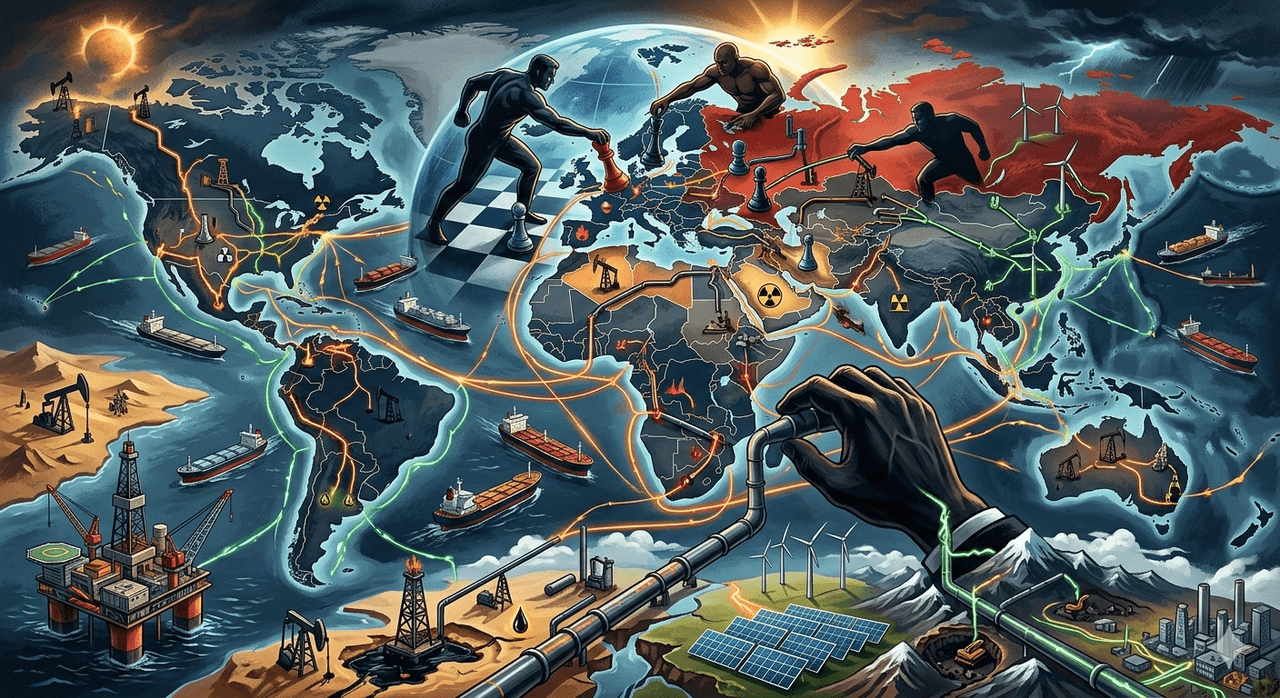
Energy Geopolitics (generated by artificial intelligence)
The geopolitical perspective evaluates the energy system as a “spatial power arrangement.” At the center of this arrangement are extraction, processing, and transportation of resources; on its periphery are demand centers, financial markets, insurance and freight mechanisms, standards, and regulations. The geopoliticalization of the energy system becomes visible when energy flows rapidly turn into subjects of political bargaining during crises. This approach does not treat states as the sole actors; it also considers corporations, international organizations, infrastructure operators, and local communities as part of a multi-scalar interaction field.
In energy geopolitics analysis, three levels are examined together. The first level concerns how the geographical concentration of resources and production influences foreign policy and alliance behavior. The second level focuses on the strategic importance of physical infrastructure such as pipelines, liquefaction and regasification capacity, electricity grid interconnections, and ports as “strategic nodes.” The third level involves the transformation of technology, data, and critical input supply chains into competitive arenas driven by energy transition.
Energy security is grounded in a framework that integrates continuity of supply, affordable access, reliability of infrastructure and markets, and environmental sustainability. Geopolitical risk refers to the emergence of uncertainty as political developments—such as conflict, sanctions, diplomatic tensions, and institutional instability—impact energy supply, prices, and investment decisions. This risk environment affects the timing and direction of investments through shifts in expected supply and demand conditions, increases the likelihood of supply chain disruptions, and can prioritize short-term security objectives over long-term transition goals.
However, it is also observed that geopolitical shocks do not produce unidirectional outcomes. Some empirical approaches argue that rising geopolitical risk can strengthen pressures for energy efficiency, accelerate policy and technological efforts toward rational resource use, and improve energy security indicators along the axis of “resilience.” The same risk climate may also delay transition in economies with different structural configurations and institutional capacities. Thus, energy geopolitics requires viewing risk as a variable that triggers both constraining and adaptive responses.
A significant portion of geopolitical tensions during the fossil fuel era is linked to the concentration of production geography and the asymmetric relationships created by import dependency. Exporting actors gain bargaining power through their influence over supply flexibility and price formation; importing actors, in turn, seek to reduce vulnerabilities through diversification, stockpile management, long-term contracts, and diplomatic engagement. The association of energy resources with national security and regime stability explains their enduring status as a “strategic” item on foreign policy agendas.
During crises, the vulnerability of energy markets becomes more apparent. Rising oil and natural gas prices do not merely generate economic costs; they can also expand the regional and international political influence of supplier actors. Within this framework, energy geopolitics underscores how the link between supply security and domestic political pressures shapes foreign policy decisions and alliance positioning.
Energy geopolitics does not rest solely on the question of “who has the resources”; it also depends on the network topology through which energy flows are transported and how risks spread within these networks. Increased connectivity in global oil trade has brought to the fore the centralization of certain hub economies within trade networks and the reshaping of network density under geopolitical risk conditions. This perspective demonstrates that supply shocks cannot be explained solely through bilateral relationships; the multilateral network structure can accelerate risk contagion and alter energy security exposure based on “network position.”
The network perspective also yields implications for policy design. When the goal of reducing dependence on a single supplier leads to concentration in another node, systemic vulnerability may persist. Therefore, energy geopolitics proposes a resilience approach that evaluates diversification not merely as an increase in supplier numbers but as a combination of infrastructure routes, financial intermediaries, and logistical capacities.
The shift to renewable energy does not eliminate classical fuel geopolitics but transforms it. The broader geographical distribution and local production potential of renewable resources can reduce certain import dependencies. Conversely, regional integration of electricity grids and cross-border transmission lines create new forms of mutual dependency. Because electricity flows are bidirectional and responsive to supply and demand conditions, grid connections can be integrated not only as technical infrastructure but also as instruments of foreign policy.
Another dimension of the transition is the shift in competition from fuels to technologies. Design, production capacity, and standard-setting power in technologies such as turbines, photovoltaic systems, batteries, power electronics, and digital grid components gain geopolitical significance. Within this framework, energy geopolitics debates the potential relative decline of the “petro-state” model alongside the potential reshaping of global power hierarchies through new industrial leadership and technology supply chains.
The material foundation of energy transition rests on critical strategic minerals and their processed intermediate products. Batteries, wind and solar technologies, and electricity grid modernization make reliable access to specific mineral inputs a strategic necessity. This situation creates conditions for the resurgence of the “control of the source” competition seen in fossil fuel geopolitics, but now centered on mining, refining, and intermediate production capacity.
In the geopolitics of critical minerals, risk is not confined solely to countries where reserves are located; permitting processes, environmental and social impacts, the concentration of processing capacity in a limited number of countries, and the fragility of supply chains are equally decisive. Overreliance on resource revenues generating political and economic volatility has revived debates similar to the “resource curse” for mineral economies. In this context, energy geopolitics demands the integrated consideration of industrial policies, strategic stockpiling, supply diversification, and sustainable mining governance.
Hydrogen, as an energy carrier, constitutes a distinct category within energy geopolitics. Its production, transportation, and end-use technologies generate different value chains, determining which countries assume exporter or importer roles, where infrastructure investments concentrate, and which standards define trade. The development of hydrogen trade can contribute to energy security for importers as a backup and diversification mechanism. However, this contribution may also create new dependencies and geo-economic competition zones if market transparency, interoperability of infrastructure, and reliable certification mechanisms are not established.
Therefore, international governance in the hydrogen sector plays a critical role from an early stage. Harmonization of certification, convergence of regulatory frameworks, reduction of investment risks, and joint roadmaps are seen as tools to prevent market fragmentation and inefficient lock-ins. Hydrogen geopolitics emphasizes that energy transition is not merely a matter of cost and technology but also a field of power shaped by standards, regulations, and institutional coordination.
Energy transition proceeds at different speeds and forms depending on regional conditions, highlighting the “territorial” dimension of geopolitics. Multi-scalar approaches show how global trends toward decarbonization intersect with regional historical disputes, economic priorities, and political stability challenges, resulting in more complex transition pathways. Electricity production diversification, hydroelectric and gas-based transition strategies, new renewable capacity zones, and transmission corridors generate spatial processes that realign the interests of local and national actors.
Within this framework, energy geopolitics analyzes not only interstate competition but also the relationships between infrastructure projects and local communities, environmental impacts, and regional development goals. The social legitimacy of transition is closely tied to the effects of energy projects on land use, income distribution, and quality of life.
The agenda of energy geopolitics has expanded with climate change. The impact of fossil fuel use on the climate system redefines energy policy not merely in terms of supply security and price stability but in relation to long-term social and ecological risks. This expansion brings questions such as who will bear the cost of new technologies, how technology diffusion will be financed, and how compensation mechanisms for communities that are less responsible for climate impacts but more affected by them will be established to the center of geopolitical negotiations.
The influence of climate policies on energy prices and investment incentives has also strengthened debates on the renewed attractiveness of nuclear energy. The widespread adoption of nuclear power adds fuel cycle control efforts and associated proliferation risks to the category of geopolitical risk. Thus, energy geopolitics is increasingly viewed as a “connected security” domain where energy security, climate security, and nuclear risks are interlinked.
Energy geopolitics examines a multi-layered field of power operating through resources, infrastructure, markets, and technologies. The supply asymmetries and market vulnerabilities prominent in the fossil fuel era are not eliminated by energy transition but are reproduced in new forms. Renewable energy and electrification shift dependency patterns toward technology and critical mineral supply chains, while new energy carriers like hydrogen increase the need for international governance. Climate change, meanwhile, shifts energy geopolitics from a security-centered framework to a broader “survival” agenda encompassing social well-being and ecological sustainability.

Conceptual Framework and Levels of Analysis
Energy Security, Geopolitical Risk, and Market Vulnerability
Power Relations and Dependency Politics in the Fossil Fuel Regime
Global Trade Networks, Connectivity, and Risk Transmission
Renewable Energy Transition and the Reconstruction of Geopolitical Logic
Critical Strategic Minerals and Supply Chain Geopolitics
The Geopolitics of Hydrogen and the Need for International Governance
Regional Scale, Territorial Dynamics, and Spatial Conflicts of Transition
From Security to Survival Agenda