


This article was automatically translated from the original Turkish version.
+3 More
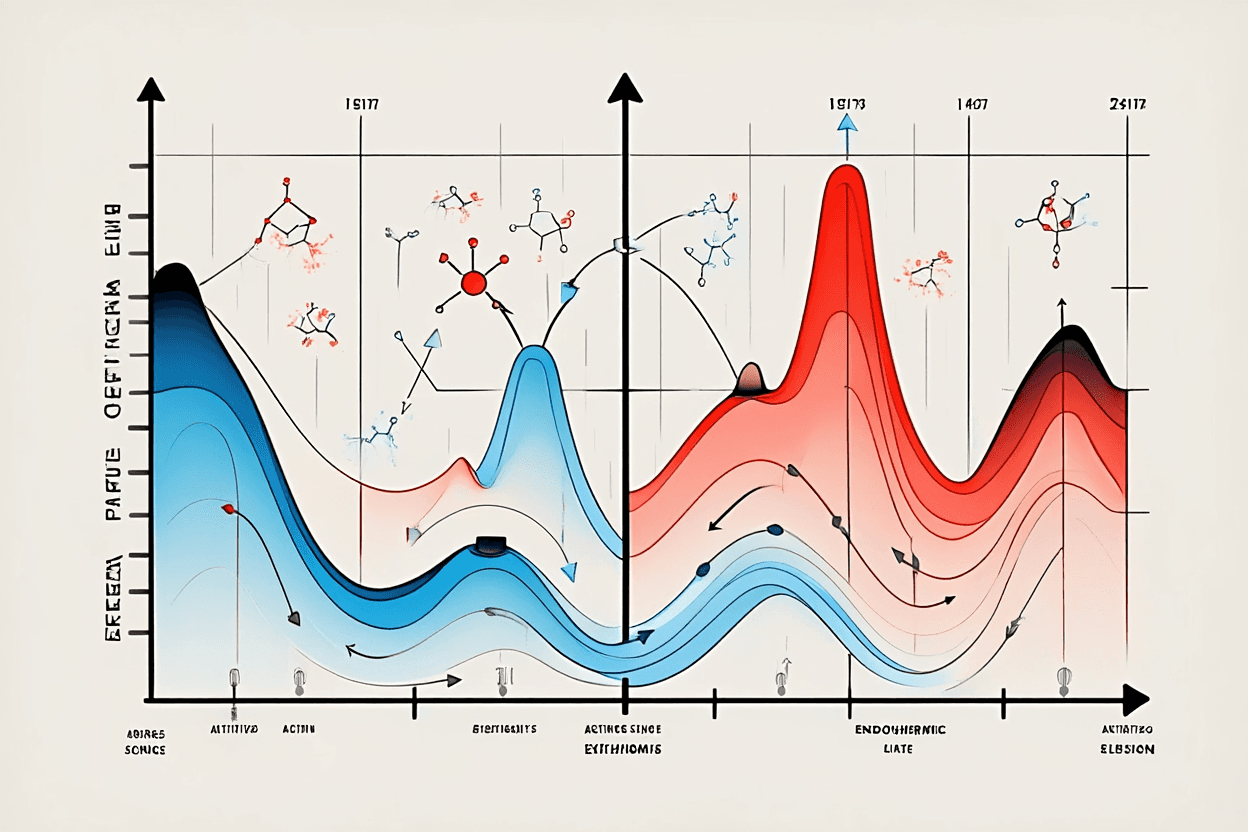
Energy Profile Diagram (Generated with Artificial Intelligence)
Application Area(s) | Chemistry Industrial Energy Management Physics | ||||||||
|---|---|---|---|---|---|---|---|---|---|
Vertical Axis (Y) | Potential Energy / Free Energy | ||||||||
Horizontal Axis (X) | Reaction Coordinate / Position / Time | ||||||||
Main Elements (Chemistry) | Reactants, Products, Activation Energy, Transition State, Intermediates | ||||||||
Main Elements (Mechanics) | Potential Energy, Kinetic Energy, Total Energy, Equilibrium and Transition Points | ||||||||
An energy profile diagram is a scientific tool that graphically represents changes in energy levels within a system during a specific process or reaction. These diagrams enable the visualization of energy transformations in physical, chemical, and industrial systems, facilitating thermodynamic and kinetic analysis of processes. In particular, they are widely accepted as a fundamental visualization method for evaluating system behavior in fields such as process engineering, reaction mechanisms, and energy management.
Energy profile diagrams are scientific tools used to visualize the changes in energy over time during a chemical reaction. These diagrams graphically depict the changes in the system’s potential energy as reactants transform into products. The horizontal axis represents the reaction coordinate, illustrating structural transformations along the reaction pathway, while the vertical axis shows the system’s potential energy. This allows for quantitative analysis of the energy requirements and kinetic properties of the chemical transformation.

Representative Graph of an Energy Profile Diagram in Chemical Reactions (Generated by Artificial Intelligence)
Whether a reaction is endothermic or exothermic can be clearly understood from its energy profile diagram. In exothermic reactions, the potential energy of the products is lower than that of the reactants, indicating that the system releases thermal energy to the surroundings. In such diagrams, the energy curve rises from the initial level to a peak and then descends to a lower final level. The difference in energy represents the energy released during the reaction.
In contrast, in endothermic reactions, the energy of the products is higher than that of the reactants. The system must absorb energy from the surroundings to sustain the reaction. This is shown in the energy profile diagram as a curve that ends at a higher energy level than it began. Such reactions are typically supported by external energy inputs such as increased temperature.
Every chemical reaction requires reactants to overcome a specific energy barrier to transform into products. This energy barrier is called activation energy (Ea) and is defined as the difference between the energy level of the reactants and that of the transition state. The transition state corresponds to the peak of the energy curve along the reaction coordinate and represents an unstable, short-lived molecular arrangement in which old bonds are weakening and new bonds are beginning to form.
The existence of the transition state cannot be observed directly in experiments; however, its presence and properties can be inferred indirectly through kinetic analyses, spectroscopic findings, and theoretical calculations. Reaction rate is largely dependent on the magnitude of the activation energy. Lower activation energy allows molecules to convert into products more easily and rapidly, while higher activation energy restricts the reaction rate.
Some chemical transformations do not occur in a single step. Such reactions consist of multiple consecutive stages, each with its own transition state and activation energy. In these cases, the energy profile diagram contains multiple peaks and valleys. The valleys represent reactive intermediates—transient species formed temporarily and consumed in the subsequent stage.
Reactive intermediates are energetically more stable than transition states but less stable than final products. Examples include carbocations, carbanions, and free radicals, commonly encountered in organic chemistry. Understanding reaction mechanisms depends on correctly identifying and characterizing these intermediates.
Proposed by George S. Hammond in the 1950s, Hammond’s postulate asserts that the structure and energy of the transition state resemble those of the chemical species—reactant, product, or intermediate—that is closest to it along the reaction coordinate. For example, in an exothermic single-step reaction, the transition state is energetically closer to the reactants and therefore structurally similar to them. Conversely, in an endothermic reaction, the transition state is energetically closer to the products and thus structurally resembles them. This postulate is a key principle in organic reaction mechanisms, aiding in the prediction of transition state structures, interpretation of reaction rates, and understanding of kinetic isomerizations. When combined with theoretical chemistry methods, it provides a powerful analytical tool for modeling reaction pathways.
In physics, energy diagrams are used to analyze energy transformations and system behavior as a function of position. In mechanical systems, these diagrams are particularly useful for visually representing changes in potential and kinetic energy of moving objects. Typically, the horizontal axis represents the object’s position (x), and the vertical axis represents the potential energy (U) at that position. If the system is subject only to conservative forces (such as gravity or spring force) and loses no energy to friction or resistance, its total mechanical energy (E) remains constant. This energy equals the sum of potential energy (U) and kinetic energy (K): E = U + K.

Representative Graph of an Energy Diagram in Mechanical Systems (Generated by Artificial Intelligence)
To illustrate this type of energy analysis, consider a skater moving along a parabolic ramp. When the skater begins motion from the highest point, potential energy is at its maximum and kinetic energy is zero. As the skater descends the ramp, potential energy decreases while kinetic energy increases proportionally. At the lowest point of the ramp, potential energy reaches its minimum and kinetic energy reaches its maximum. Throughout this process, total mechanical energy remains constant, represented in the energy diagram as a horizontal line.
Specific critical points on energy diagrams are essential for explaining system behavior. One such point is the equilibrium point. At this location, where potential energy reaches a local minimum, the net force acting on the object is zero, and the system is in stable equilibrium. If the object is slightly displaced from this point, it returns to it.
Another important point is the turning point. This is the position where the object’s kinetic energy becomes zero and its direction of motion reverses. At turning points, the system’s potential energy equals its total mechanical energy. For example, when a skater reaches the highest point on the ramp, they momentarily stop before moving in the opposite direction. At this point, potential energy is maximized and kinetic energy is zero. Such points define the boundaries of oscillatory motion.
Energy diagrams in mechanical systems are not limited to understanding the motion of physical objects; they also serve as fundamental tools for energy management and efficiency analysis. In industrial facilities, “load profiles” or “energy consumption profiles” are used to determine energy usage patterns, identify unnecessary consumption, and develop strategies for energy savings. Such profiles are key components of systematic approaches like energy audits and the Energy Performance Improvement Plan (EnPI2P). A load profile graphically shows how much energy a facility consumes over specific time intervals, enabling evaluation of the energy impact of production processes.
Advanced energy management systems (EMS) monitor load profiles in real time, providing instantaneous analysis. These systems analyze data from IoT-based sensors to support energy savings and sustainable production goals through reporting and automated intervention capabilities.
The first step in creating a load profile is identifying all energy-consuming units within the facility—such as motors, compressors, lighting systems, and HVAC units. The energy consumption of these units is measured and analyzed over time. The resulting data is typically used to generate two types of graphs:
These graphs enable analysis of energy consumption distribution throughout the day, weekly, or seasonal variations. They help determine which equipment or processes are responsible for high energy consumption and identify opportunities for efficiency improvements. Furthermore, by examining the relationship between production scheduling and energy use, more efficient production strategies can be developed. For instance, continuous production can reduce the per-unit energy cost by spreading the initial energy expenditure over a larger volume of output.
In addition to load profiles, energy flow diagrams are used to achieve a more holistic understanding of energy use. One of the best-known examples is the Sankey diagram. Sankey diagrams visualize how energy enters a system, where it is utilized, and where losses occur. In these diagrams, the thickness of the flow lines represents the magnitude of energy flow, making inefficiencies tangible and supporting strategic decision-making in energy management.
Energy profile diagrams provide a common visual language for analyzing and interpreting system behavior across diverse disciplines. Their broad application—from reaction mechanisms in chemistry to mechanical oscillations and from industrial production to energy efficiency planning—makes complex processes more comprehensible and manageable.
Atkins, P., and Julio de Paula. Physical Chemistry. 11th ed. Oxford: Oxford University Press.
Dietschreit, Johannes C. B., Dennis J. Diestler, Andreas Hulm, Christian Ochsenfeld, and Rafael Gómez-Bombarelli. “From Free-Energy Profiles to Activation Free Energies.” *arXiv* preprint, arXiv:2206.02893v2 [physics.chem-ph], 2023. Accessed August 7, 2025. https://doi.org/10.48550/arXiv.2206.02893.
Dietschreit, Johannes C. B., Dennis J. Diestler, and Rafael Gómez-Bombarelli. “Entropy and Energy Profiles of Chemical Reactions.” *arXiv* preprint, arXiv:2304.10676v2 [physics.chem-ph], 2023. Accessed August 7, 2025. https://doi.org/10.48550/arXiv.2304.10676.
House, J. E. Principles of Chemical Kinetics. San Diego: Academic Press, 2007.
Stephanik, Brian M., and Peter S. Shaffer. “Examining Student Ability to Interpret and Use Potential Energy Diagrams for Classical Systems.” arXiv preprint, arXiv:1109.2074 [physics.ed-ph], 2011. Accessed August 7, 2025. https://doi.org/10.48550/arXiv.1109.2074.
University of California. “8.04: Energy Diagrams and Equilibria.” *LibreTexts Physics*. Accessed August 7, 2025. https://phys.libretexts.org/Bookshelves/University_Physics/Book%3A_Introductory_Physics_-_Building_Models_to_Describe_Our_World_%28Martin_Neary_Rinaldo_and_Woodman%29/08%3A_Potential_Energy_and_Conservation_of_Energy/8.04%3A_Energy_diagrams_and_equilibria.
University of Central Florida. “8.4: Potential Energy Diagrams and Stability.” *Pressbooks*. Accessed August 7, 2025. https://pressbooks.online.ucf.edu/phy2048tjb/chapter/8-4-potential-energy-diagrams-and-stability/.

Energy Profile Diagram (Generated with Artificial Intelligence)
Application Area(s) | Chemistry Industrial Energy Management Physics | ||||||||
|---|---|---|---|---|---|---|---|---|---|
Vertical Axis (Y) | Potential Energy / Free Energy | ||||||||
Horizontal Axis (X) | Reaction Coordinate / Position / Time | ||||||||
Main Elements (Chemistry) | Reactants, Products, Activation Energy, Transition State, Intermediates | ||||||||
Main Elements (Mechanics) | Potential Energy, Kinetic Energy, Total Energy, Equilibrium and Transition Points | ||||||||
No Discussion Added Yet
Start discussion for "Energy Profile Diagrams" article
Energy Profile Diagrams in Chemical Reactions
Energy Profiles of Endothermic and Exothermic Reactions
Activation Energy and the Transition State Concept
Multi-step Reactions and Reactive Intermediates
Hammond’s Postulate and Transition State Prediction
Energy Diagrams in Mechanical Systems
Equilibrium Points and Turning Points
Energy Profile (Load Profile) in Industrial Processes
Creating and Interpreting Load Profiles
Energy Flow Diagrams and Visualization Methods