


This article was automatically translated from the original Turkish version.
Eramine-i Acem was a community of Armenian merchants originating from Safavid Iran, active within Ottoman geography between 1550 and 1800. These merchants, who came from New Julfa in Isfahan, established a significant trade network linking Ottoman territories with Iran and Europe by transporting silk, silver, precious metals, and various commercial goods. As traveling traders who lodged in caravanserais and stored their goods there, they gradually formed colonies in Ottoman cities, integrated with local Armenian communities, and influenced both the Ottoman and Safavid economies. However, by the end of the 18th century, their influence diminished due to the decline of overland trade, increased state controls, and processes of localization.
The term Eramine-i Acem appears in Ottoman archival documents from the 16th century onward and primarily refers to Armenian merchants originating from Safavid Iran. This community largely consisted of Armenians displaced from their homes in Isfahan’s New Julfa quarter following the policies of Shah Abbas after 1604, who subsequently assumed key roles in Iran’s internal trade. In Ottoman records, this merchant group is sometimes referred to as “Acem Armenians,” “Acem merchants,” or “bâzergân-ı Acem.” The term “Acem” denotes the Safavid geographical sphere (modern Iran), while “Armenian” reflects both ethnic and religious identity.
This merchant group was not merely itinerant carriers of goods; they formed a social structure characterized by permanent settlements around caravanserais, integration with local Armenian communities, and multi-generational roots in Ottoman territories. While the first generation of these merchants originated in Iran, their children were typically born and raised within Ottoman lands, strengthening their ties to the local society. Nevertheless, this identity was consistently perceived by Ottoman central authorities and local populations as an “external element,” leading to controversies over taxation policies and commercial competition.
The activities of the Eramine-i Acem were shaped primarily within the context of Safavid-Ottoman commercial relations and the internal trade networks of the Eastern Mediterranean and Europe. Between 1550 and 1800, this merchant group transported raw silk, precious metals, and natural products from Iran to markets in Western Anatolia, Rumelia, and Europe, returning with silver, coinage, textiles, and other commercial goods. Cities such as Erzurum, Tokat, Sivas, Kayseri, Bursa, İzmir, and Istanbul served as critical junctions along these trade routes.
From the Safavid perspective, Shah Abbas sought to restrict trade beyond Iran’s borders, yet the New Julfa Armenians emerged as a privileged merchant class benefiting from state-sponsored privileges. Conversely, the Ottoman state, aiming to regulate Safavid trade and gain an advantage in competition with the West, granted these merchants relative freedom within its territories. However, this arrangement occasionally generated tensions, particularly regarding customs and taxation policies, as the outflow of silver and akçe became a critical fiscal concern for the Ottoman treasury.
In this context, the Eramine-i Acem must be understood not only as commercial actors but also as representatives of interstate rivalry, socio-economic structures, and cultural interaction. Their activities enhanced economic vitality in Ottoman provincial regions while directly influencing state regulations concerning taxation, metal circulation, and population mobility. Therefore, “Eramine-i Acem” should be regarded as a crucial conceptual node within the Ottoman early modern triangle of trade, society, and state.
Between 1550 and 1800, these merchants established their commercial networks not only along major international trade routes but also in smaller towns and settlements across Anatolia. The expansion of their commercial activities led them to remain for extended periods in caravanserais and to collaborate with local traders. However, these activities faced significant local resistance concerning tax obligations and commercial priorities in local markets. Numerous decrees issued from the 1550s onward reveal that these merchants generally avoided direct conflict with Ottoman central authorities but frequently evaded customs duties and negotiated exemptions from trade regulations. Their commercial activities are examined primarily through the circulation of goods such as silver and silk and the role of caravanserais.
The commercial activities of the Eramine-i Acem extended beyond major trade routes to form an extensive network encompassing numerous secondary cities and towns across inland Anatolia. Between 1550 and 1800, these merchants operated along routes stretching from the eastern frontiers of the Ottoman Empire through Western Anatolia and into Europe.
In terms of Ottoman overland trade, three primary routes are traditionally identified:
The mobility of the Eramine-i Acem was not confined to these main arteries; they established secondary centers in central and northern Anatolian cities such as Tokat, Amasya, Kayseri, Ankara, and Sivas. Particularly, the Tokat–Sivas axis served as a critical node for east-west and north-south commodity exchange. In addition to transporting silk and precious metals, these merchants established direct links with local markets in these settlements, generating not only transit trade but also local commercial circulation.
The three main trade routes they utilized were:
Erzurum functioned as the eastern gateway of this trade network. Caravans arriving from Iran underwent their first customs inspections in Erzurum, after which goods were either sold locally or transshipped westward. Alongside Erzurum, centers such as Van, Bayezid, Diyarbakır, Tokat, Kayseri, Bursa, İzmir, and Istanbul emerged as key intersection points of this network. İzmir, in particular, became one of the most concentrated cities for Armenian merchants from the 17th century onward, as it developed into a major port opening to the West.
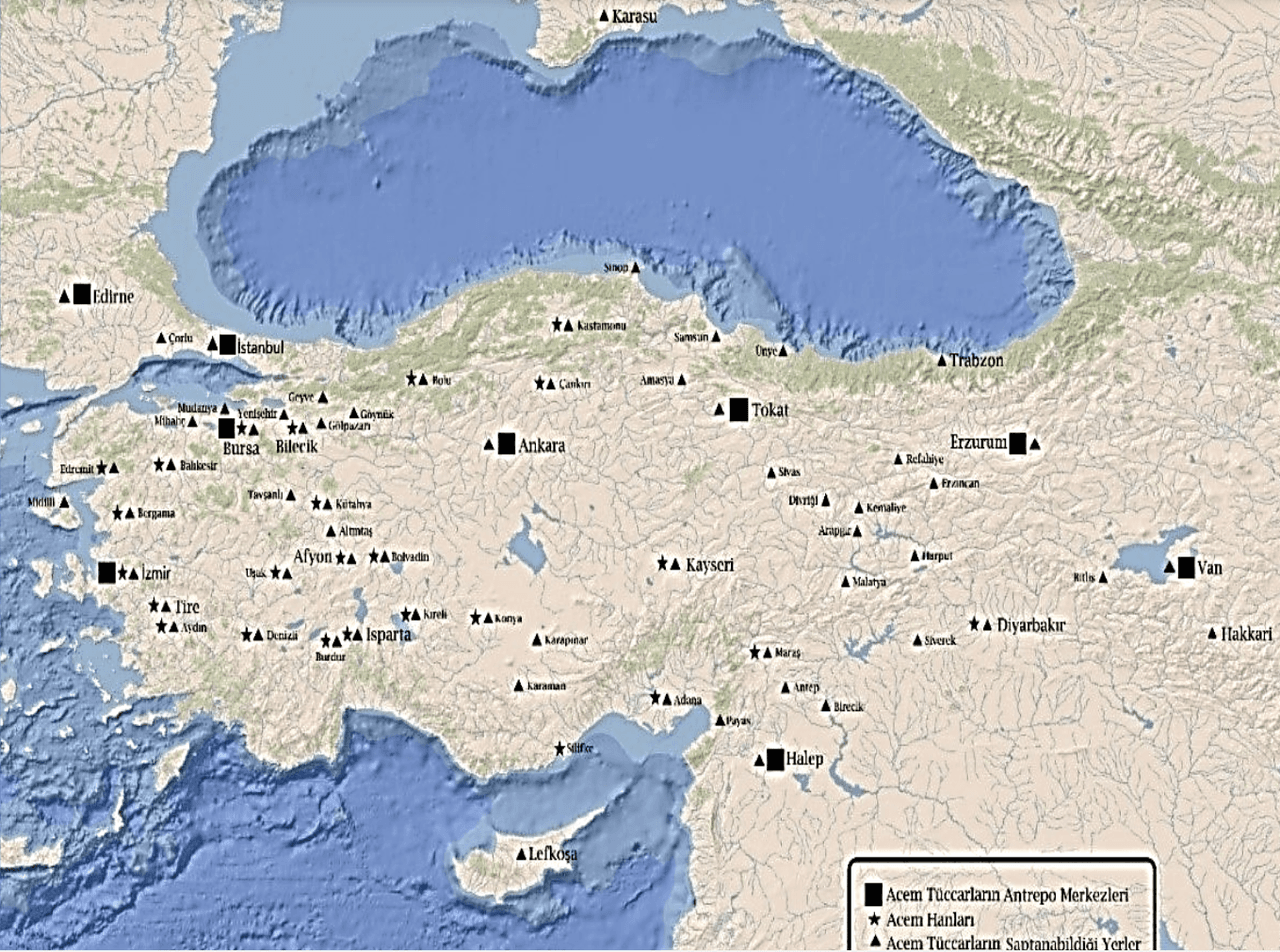
Geographic Distribution of Acem Merchants in Ottoman Anatolia (Cahit TELCİ - İrfan KOKDAŞ)
This network was not limited to overland routes. Maritime routes through Black Sea ports (Samsun, Trabzon, Ünye, Sinop) and via Crimea connected Armenian merchants with Russia. From the second half of the 17th century, the activity of Acem merchants in Black Sea trade, particularly along the Trabzon–Karasu route, became notable; settlements such as the “Acem Mahallesi” in Crimea emerged as evidence of their presence.
This broad geographic distribution demonstrates that Armenian merchants were not merely carriers but also localized actors who integrated into Ottoman urban societies. Roads became channels not only for goods but also for the circulation of information, news, money, and cultural exchange.
The commercial relationships of Acem merchants extended across a vast geography, from Anatolia to the Balkans, various European countries, Russia, and India.
One of the most visible spatial imprints of the Eramine-i Acem within Ottoman commercial geography is the commercial infrastructure developed around caravanserais. These structures served not only as lodging facilities but also as multifunctional commercial centers where goods were stored, trade was conducted, and interaction with the local population occurred.
Many Acem merchants resided for years in specific caravanserais, a practice linked both to the nature of their commercial operations and to expectations of fiscal exemptions. Prolonged stays in caravanserais allowed them to appear as settled merchants and avoid local taxes. Simultaneously, this practice reveals that Acem merchants were not merely transporters but integrated actors within local production and consumption chains. Historical documents refer to specific caravanserais as “Acem Hanı,” indicating that these establishments gradually acquired names associated with the merchant groups that frequented them. Although many were originally constructed under different names, they became permanently identified by the communities that used them. For example, the Hacı İlyas Paşa Hanı in Balıkesir came to be known as the “Acem Hanı.”
The Taş Han (Rüstem Paşa Hanı) and Gümrük Hanı in Erzurum were primary lodging points for caravans arriving from the East. Similarly, records indicate that Acem merchants frequently stayed in caravanserais in relatively remote areas such as Samsun, Trabzon, and Crimea–Karasu. These caravanserais played a central role in ensuring the security of goods, facilitating communication, forming partnerships, and accessing local networks.
The activities conducted in these caravanserais also contributed economically to the state or local administrations as part of waqf revenues. Consequently, operations within these spaces were intertwined not only with commercial interests but also with public and administrative control mechanisms. These centralized commercial hubs also functioned as sites of social interaction between Armenian merchants and the local Ottoman population.
While the commercial presence of the Eramine-i Acem in Ottoman territories was largely built upon the silk trade, beyond this visible domain lay a complex and highly strategic network of commercial activities. Especially during the 16th and 17th centuries, Acem Armenian merchants were not merely carriers of Iranian silk to Ottoman markets; they also acted as both transporters and buyers/sellers of numerous other goods, including silver, coinage, precious metals, textiles, copper, beeswax, soap, leather, wool, and cotton.
Demand for silk between the Ottoman Empire and Europe, particularly under the influence of states such as the Netherlands and Venice, reached high levels, reinforcing the intermediary position of Armenian merchants. Shah Abbas’s establishment of New Julfa in the early 17th century to centralize Armenian merchants demonstrates official Safavid support for this commercial structure. Armenians processed Iranian raw silk in Ottoman centers such as Erzurum, Tokat, Bursa, and İzmir, either selling it locally or transporting it westward.
However, silk was merely the visible face of this commercial system. The true strategic commodity was silver and coinage transported from the Ottoman Empire to the East. These metals were vital for financing the Safavid military and treasury. Acem merchants collected large quantities of precious metals and coinage from Ottoman cities—particularly İzmir, Istanbul, and Bursa—and transported them to Iran. In return, the circulation of valuable metals within the Ottoman market diminished, generating significant concern during periods of Ottoman monetary crises (1550–1650).
The Eramine-i Acem also played a critical role in regional commodity exchange. For instance, along the Crimea–Karasu route, these merchants transported not only Iranian-origin goods but also local products acquired from eastern Anatolia—such as copper and beeswax—to other regions. Similarly, goods transported from Ottoman territories to Iran were not limited to raw silk or metals; locally acquired products destined for resale were also carried.
The activities of the Eramine-i Acem within Ottoman territories occasionally aligned with, and at other times directly clashed with, the economic and political interests of the state. Particularly, their strategies to evade tax obligations prompted continuous state efforts at surveillance, intervention, and regulation.
From the 1550s onward, the Ottoman administration observed irregularities among Armenian merchants regarding customs payments, coinage, and metal exports, leading to the issuance of various decrees and firmans. These documents indicate that merchants generally:
For example, decrees in major centers such as Bursa prohibited the unloading of goods and required their direct shipment to Istanbul. Secret crossings through customs points such as Geyve, İzmit, and Mudanya led to state seizures of goods and penalties against merchants.
The Ottoman state viewed these activities as threats to economic stability and metal control. The export of silver and coinage to Iran was interpreted, especially during wartime (e.g., Ottoman–Safavid Wars), as covert economic assistance, prompting stricter controls at border checkpoints. However, the state’s harsh stance occasionally risked disrupting trade entirely, leading to exceptional accommodations. Rather than banning trade outright, the state sometimes permitted certain merchants to export only coinage while prohibiting the transport of bullion.
The relationship between the Eramine-i Acem and the Ottoman center thus carried a dual character: on one hand, the state regarded these merchants as “a community facilitating the state’s revenue” and encouraged their trade; on the other hand, it imposed strict regulations, particularly concerning the transfer of precious metals. This duality reflects one of the fundamental contradictions of Ottoman classical trade policy: the state’s need for capital versus its desire to control it.
The intense commercial and social presence of the Eramine-i Acem within Ottoman geography began to gradually decline from the late 18th century; by the 19th century, they had largely lost their former central position. The causes underlying this process include transformations in the economic and commercial structure as well as shifts in political and social conditions.
First and foremost, from the mid-18th century onward, the rise of maritime trade at the expense of overland commerce in the Ottoman Empire weakened the traditional silk and metal transport networks of Armenian merchants. Particularly, the direct connections established by ports such as İzmir, Trabzon, and Istanbul with European consulates and capital networks began to render the Acem merchants’ role as intermediaries in overland transport obsolete.
During the same period, increased state control over the circulation of silver and precious metals narrowed one of the most profitable spheres of Armenian merchant activity: metal transfer. The Ottoman central administration, beginning in the early 18th century, expanded the number of internal customs posts to tighten commercial control in the provinces, thereby limiting the merchants’ ability to evade taxes by rerouting their goods.
Additionally, structural transformations in Western European trade systems and the declining importance of the Eastern Mediterranean in Indian trade restricted Iranian silk’s access to European markets. This development led to a contraction of trade flowing from Iran through Ottoman territories, thereby diminishing the strategic role of Iranian-origin Armenian merchants within the Ottoman realm.
Socially, the integration of Acem Armenians with local Ottoman Armenians from the 17th century onward eroded the original structure of this merchant group. Acem Armenians gradually assimilated into Ottoman local communities, transitioned to sedentary lifestyles, and distanced themselves from the classic identity of “itinerant merchants.” By the end of the 18th century, local Armenian merchants in cities such as Kayseri, Amasya, Sivas, and Bursa began to replace their Acem-origin counterparts. Nevertheless, the phenomenon of Eramine-i Acem left a lasting legacy in the context of Ottoman early modern history. They were not merely merchants but also carriers of diplomatic and economic relations between states, social actors bridging the center and the provinces, and strategic figures who shaped the spatial and cultural geography of trade. While the processes of decline and dispersal did not erase this historical function entirely, they repositioned this structure into a more marginal and localized role under the new economic conditions of the era.
Gökçe, Turan. "1695 Tarihli Mufassal Avâriz Defterine Göre Filibe Kazâsında Nüfus ve Yerleşme Düzeni." Tarih İncelemeleri Dergisi 22, no. 2 (2007). https://ottomanplovdiv.org/wp-content/uploads/2024/02/GOKCE-T.-1695-tarihli-mufassal-avariz-defterine-gore-Filibe-kazasinda-nufus-ve-yerlesme-duzeni.pdf
Himmetoğlu, Emel. "Osmanlı'da İhtidâ Hareketleri ve Adana'da İhtidâ Edenler (1750-1799)." https://www.academia.edu/download/65434700/emelhimmetoglu.pdf
Telci, Cahit, and İrfan Kokdaş. “Anadolu’da ‘Eramine-I Acem’i Haritalandırmak: Yollar, Hanlar, Mallar Ve Gümüş”. Tarih İncelemeleri Dergisi 37, no. 2 (December 2022): 687-726. https://doi.org/10.18513/egetid.1226581

Definition and Background
Trade Network and Geographic Distribution
Caravanserais and Commercial Spaces
Taxation, Smuggling, and Relations with the State
Decline and Dispersal