

This article was automatically translated from the original Turkish version.
+1 More
Length(s) | 14.66 m (48 ft 1 in) | ||||||||
|---|---|---|---|---|---|---|---|---|---|
Engine(s) | 1 × General Electric F404-GE-400 Turbofan | ||||||||
Manufacturer(s) | Grumman Aerospace Corporation | ||||||||
Status | Retired (Test program completed in 1992) | ||||||||
Height(s) | 4.26 m (14 ft 3 in) | ||||||||
Type(s) | Experimental Aircraft (Technology Demonstrator) | ||||||||
First Flight(s) | 14 December 1984 | ||||||||
Maximum Speed | Mach 1.6 (1770 km/h) | ||||||||
Thrust | 16000 lbf (71 kN) (with afterburner) | ||||||||
Wing Area | 17.54 m² (188.8 ft²) | ||||||||
Wingspan | 8.29 m (27 ft 2 in) | ||||||||
Crew | 1 (Pilot) | ||||||||
Production Quantity | 2 | ||||||||
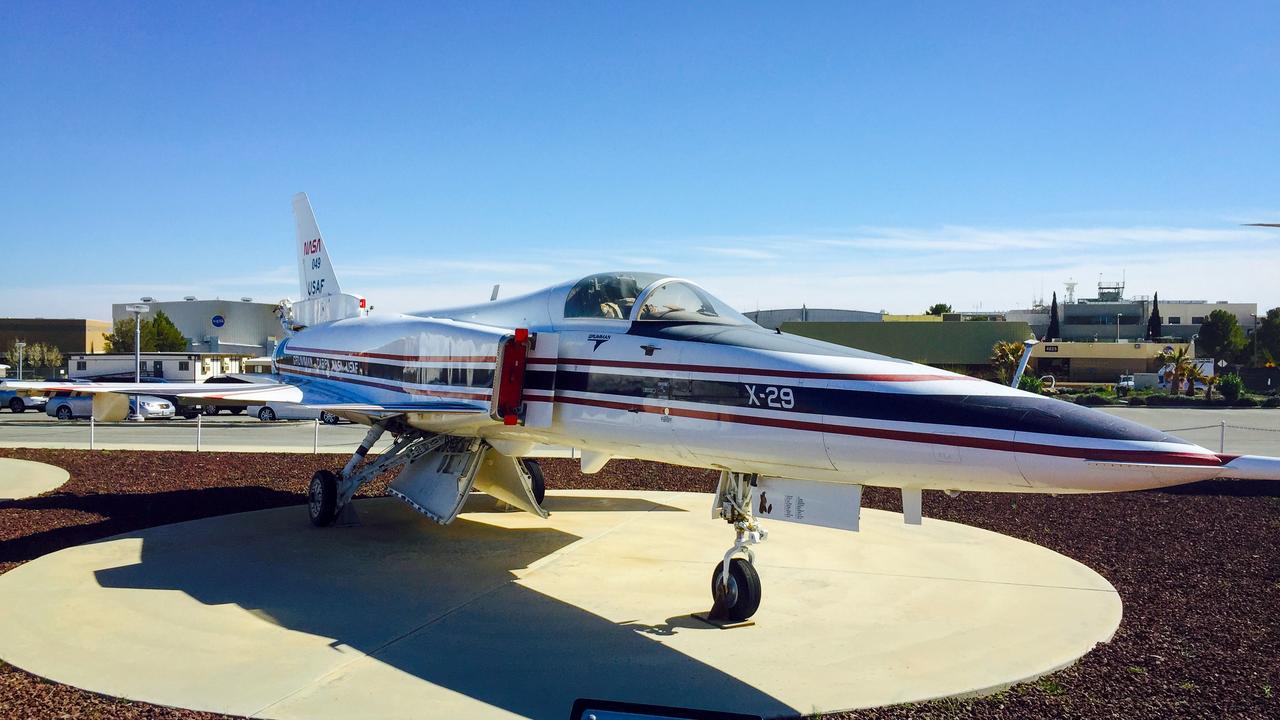
Grumman X-29 is an experimental platform developed under a joint program by the United States Air Force (USAF), NASA, and the Defense Advanced Research Projects Agency (DARPA), featuring a forward-swept wing design. The primary objective of the program was to investigate the aerodynamic characteristics of forward-swept wings at high angles of attack and to test the feasibility of this technology for military aviation platforms. Two prototypes, manufactured by Grumman Corporation, were used for data collection between 1984 and 1992.

Grumman X-29 (Kelly Michals)
The Grumman X-29 program represents a technological evolution where theoretical aerodynamic advantages converged with modern materials science and digital control systems. Its development resulted from an extensive research process spanning from the Second World War to the final years of the Cold War.
The forward-swept wing design was theoretically developed by German engineers in the 1930s. The first large-scale application of this concept was the jet-powered bomber prototype Junkers Ju 287, developed during the Second World War. However, the metal alloy wing structures of that era could not prevent the wingtips from bending upward under aerodynamic loads, leading to structural failure (structural divergence). This mechanical limitation caused the design to remain in the experimental stage for decades.
The introduction of carbon fiber-reinforced composites in aviation during the 1970s eliminated the structural barrier to forward-swept wings. In 1977, the U.S. Defense Advanced Research Projects Agency (DARPA) and the U.S. Air Force (USAF) issued a formal request for proposals to test the high maneuverability potential of this design using modern technologies. In 1981, Grumman Corporation was selected from the submitted proposals and awarded an $87 million contract to produce two prototypes.【1】
Due to the high technical risks involved, the X-29 project was executed using an engineering approach aimed at minimizing costs. Instead of designing a completely new airframe, existing platforms were leveraged for the aircraft’s main structure:
This integration strategy allowed engineers to focus their efforts entirely on the "forward-swept wing" and the "triple-redundant digital flight control system" (fly-by-wire).

Grumman X-29 Technical Drawing (Generated by Artificial Intelligence)
The Grumman X-29 was developed to test the characteristics and operational limits of the forward-swept wing aerodynamic configuration. The aircraft’s airframe architecture was designed to optimize the technical interaction between supersonic flight efficiency and low-speed maneuverability.
The platform’s defining feature is its wing structure, angled 29.27 degrees forward relative to the fuselage axis. In conventional swept-back wings, the boundary layer flow moves from the wing root toward the tips, causing early turbulence and loss of lift (stall) at the wingtips. In contrast, the X-29’s design causes airflow to move inward from the wingtips toward the fuselage, producing fundamental changes in the aircraft’s aerodynamic behavior.
This flow dynamics enables the control surfaces (ailerons) at the wingtips to remain effective for significantly longer durations at high angles of attack (AoA), preserving maneuverability. In conventional designs, stall begins at the wingtips; in the X-29, loss of lift occurs first at the wing root. This allows the aircraft to maintain nose control authority even at critical angles, enabling the pilot to retain control without losing authority.
The primary mechanical risk of forward-swept wings is "aeroelastic divergence," a phenomenon in which aerodynamic loads cause the wingtips to bend upward, threatening structural integrity. This issue was resolved in the X-29 program through the use of "aeroelastic tailoring".
The wing skin was manufactured from 752 layers of graphite-epoxy composite material. These layers were stacked at specific angles (directional stiffness) to minimize bending stress under aerodynamic loads and enhance torsional resistance.
The X-29 employs a "three-surface design" configuration to optimize aerodynamic control. This structure relies on the coordination of three primary surfaces to achieve minimum drag and maximum control authority across different flight phases:
To delay shock wave formation and associated drag increase during transonic flight, the aircraft features a thin supercritical airfoil profile. This geometric shape expands the low-pressure area on the upper wing surface, delaying flow separation and improving fuel efficiency.

Grumman X-29 (Johnny Comstedt)
The Grumman X-29 is a platform exhibiting high static instability due to its aerodynamic configuration. The aircraft’s center of gravity is positioned behind its center of lift, causing a natural tendency for longitudinal instability during flight. This imbalance occurs at a frequency exceeding human reaction time, so stabilization is achieved exclusively through an integrated system of digital flight control software and hardware.
Maintaining the aircraft within its flight envelope depends on the continuous operation of a triple-redundant digital "fly-by-wire" system that sends 40 micro-correction commands per second. This technical necessity renders the aircraft’s controllability entirely dependent on digital systems and control law algorithms.
The X-29 is equipped with a Digital Fly-By-Wire (FBW) system that transmits pilot inputs via electrical signals rather than mechanical cables or hydraulic lines. The system does not directly relay pilot commands to the control surfaces; instead, it first sends them to flight computers. These computers analyze the aircraft’s instantaneous speed, altitude, and angle of attack, then execute micro-corrections 40 times per second to maintain stable flight.【2】
To mitigate the risk of structural divergence that could cause the aircraft to lose structural integrity within seconds due to software or hardware failure, the system architecture incorporates a high level of redundancy. This safety layer consists of three identical digital computers operating in parallel. Each computer processes the same flight data simultaneously, and the results are compared using a "voting" mechanism. If one computer produces a result differing from the other two, its data channel is automatically disabled by the other two computers.
To account for the possibility of total failure of all digital systems, three analog backup channels were also integrated into the flight control architecture. This integration results in a six-layered safety system combining digital and analog pathways. Control laws and software algorithms coordinate with this hardware layer to manage control surfaces—canards, flaperons, and strake flaps—in millisecond intervals. This algorithmic structure compensates for the aircraft’s static instability, ensuring operational stability within its flight envelope.
The X-29 software architecture is built upon an algorithmic foundation known as "control laws." These algorithms command and coordinate all flight control surfaces—including canards, flaperons, and strake flaps—as a single integrated unit. The system’s primary function is to coordinate the aircraft’s aerodynamic surfaces to maintain operational balance with minimum drag.
Operating under the principle of "relaxed static stability," the software continuously compensates for the aircraft’s natural aerodynamic imbalance through real-time data processing. This process eliminates the structural instability through software intervention, enabling the platform to exhibit stable flight characteristics. Additionally, the software architecture includes automatic angle-of-attack limiters to preserve flight safety. These limiters prevent the aircraft from exceeding structural limits or escaping its safe flight envelope, thereby controlling mechanical stress.
X-29 High Angle of Attack Flight (NASA Armstrong Flight Research Center)
The X-29’s flight control data processing relies on real-time analysis of telemetry data from pitot tubes and gyroscopes mounted on the nose and fuselage. The control computers continuously process airflow and orientation data from these sensors to determine commands sent to the control surfaces. The software architecture has the technical capability to detect changes in angle of attack as small as 0.1 degrees and convert this data into canard correction commands within milliseconds.【3】
This speed and precision of data processing is a technical necessity for dynamically balancing the aircraft’s static instability. The sensor integration and high-frequency data processing capacity characterize the X-29 as an advanced flight control and computational system.
The Grumman X-29 program was a flight program conducted between 1984 and 1992, encompassing operational tests of experimental technologies. During this period, technical data on the aircraft’s aerodynamic performance and system integrity were collected using two prototypes.
The first phase, conducted with the first prototype (serial number 82-0003), focused on verifying the aircraft’s basic flight characteristics and structural durability. Aerodynamic responses at subsonic and transonic speeds were measured. The resistance of the carbon fiber-reinforced composite wings to bending stress at high speeds was observed, and the data confirmed the design’s effectiveness against structural divergence. Additionally, tests in 1985 established the X-29 as the first aircraft to achieve supersonic flight with a forward-swept wing configuration.
The second phase, conducted with the second prototype (serial number 82-0049), analyzed the aircraft’s high angle of attack (High Alpha) performance and maneuvering limits. During testing, an angle of attack of 67 degrees was reached. The aircraft’s controllability and stall resistance at these extreme angles were technically verified. The second prototype was used in over 120 test flights to measure responses under high G-forces during military maneuver simulations.
In the third phase, completed in 1992, Vortex Flow Control (VFC) technology was tested using high-pressure nitrogen tanks and nozzles integrated into the nose. At high angles of attack where the vertical rudder loses effectiveness due to disrupted airflow, gas injection from the nose generated artificial vortices. This system demonstrated that directional control (roll/yaw) could be achieved solely through airflow manipulation, without mechanical tail surfaces.
Grumman X-29 Flight Maneuvers (Nasa)
The Grumman X-29 program operated not as an operational fighter prototype, but as an experimental research platform for testing advanced aviation technologies. The technical concepts validated and the telemetry data collected during the program influenced the design parameters of subsequent generations of military and civilian aircraft.
The X-29 was the first large-scale aircraft to apply the aeroelastic tailoring method. It demonstrated technically that bending stress on the wing could be transformed into a structural advantage by layering carbon fiber-reinforced composites at specific angles. The success of this material application provided critical data supporting the adoption of advanced composite structures as industry standards in military platforms such as the F-35 Lightning II and civilian airliners such as the Boeing 787.
The aircraft’s high static instability coefficient generated new datasets for flight control software. The triple-redundant "fly-by-wire" architecture and control laws operating at 40 corrections per second developed for the X-29 became reference models for the flight algorithm architectures of high-maneuverability platforms such as the F-22 Raptor. Data collected during this process formed the foundation for the development of modern autonomous flight systems and digital stabilization technologies.
The program documented the aerodynamic effects of close-coupled canard configurations and three-surface (canard-wing-tail) designs at high angles of attack. Data on stall resistance from forward-swept wings influenced technical development of experimental projects such as the Russian Su-47 Berkut. In Western aviation design, the flow control data from these tests were used as references in aerodynamic efficiency and low radar signature (stealth) optimization efforts.
Following the completion of the test program in 1992, the prototypes were added to museum collections. The first prototype (serial number 82-0003) is preserved at the National Museum of the United States Air Force in Dayton, Ohio; the second prototype (serial number 82-0049) is preserved at NASA’s Armstrong Flight Research Center in California. These platforms continue to be used as case study materials in aerospace engineering education.
Comstedt, Johnny. “Grumman G-712 X-29A 82-0003 at Wright-Patterson.” Flickr, October 6, 2017. Accessed February 10, 2026. https://www.flickr.com/photos/johnnyflight/39344979534/
Cotton, Stacey J., and Lisa J. Bjarke. *Flow-Visualization Study of the X-29A Aircraft at High Angles of Attack Using a 1/48-Scale Model*. NASA Technical Memorandum 4621. August 1994. Accessed February 10, 2026. https://ntrs.nasa.gov/citations/19950004446
DSpace. "The X-29A Advanced Technology Demonstrator: Program Overview and Flight Test Results." Accessed February 10, 2026. https://kb.osu.edu/items/f603b043-453e-48f9-a17e-e8f98c5c91e8.
Davis, W. H. “Applied Transonics at Grumman.” *NASA, Langley Research Center, Transonic Symposium: Theory, Application, and Experiment*, Volume 1, Part 1, March 1989. Accessed February 10, 2026. https://ntrs.nasa.gov/citations/19890011560
Ishmael, Stephen D., John J. Burken, Thomas H. Cox, Dana Purifoy, and Rogers E. Smith. *X-29 High Angle of Attack*. NASA Technical Memorandum 101714. January 1990. Accessed February 10, 2026. https://ntrs.nasa.gov/citations/19920033428
Michals, Kelly. “Grumman X-29.” Flickr, February 8, 2009. Accessed February 10, 2026. https://www.flickr.com/photos/rocbolt/51984893007/
NASA Armstrong Flight Research Center. “X-29 High Angle of Attack.” YouTube video, 1:44. May 25, 2007. Accessed February 10, 2026. https://www.youtube.com/watch?v=O82wx4YN8So
NASA Video. "X-29 High Angle of Attack Flight." YouTube video, 3:34. August 10, 2011. Accessed February 10, 2026. https://www.youtube.com/watch?v=lvAWakvIFfE
NASA. “X-29 Advanced Technology Demonstrator Aircraft.” November 5, 2015. Accessed February 10, 2026. https://www.nasa.gov/aeronautics/aircraft/x-29-demonstrator/
Rehfield, Lawrence W., and Ali R. Atilgan. “A Structural Model for Composite Rotor Blades and Lifting Surfaces.” *Analysis, Design and Elastic Tailoring of Composite Rotor Blades*, September 1987. Accessed February 10, 2026. https://ntrs.nasa.gov/citations/19870017556
Sefic, W. J., and C. M. Maxwell. “X-29A Technology Demonstrator Flight Test Program Overview.” *ISA Aerospace Industries/Test Measurement Symposium*, 1986. Accessed February 10, 2026. https://ntrs.nasa.gov/citations/19860016856
Smith, Rogers E., and Kurt C. Schroeder. *Flight Testing the X-29*. NASA Technical Memorandum 86805. January 1986. Accessed February 10, 2026. https://ntrs.nasa.gov/citations/19870060567
Trippensee, Gary. *Update of the X-29 High-Angle-of-Attack Program*. SAE Technical Paper 912006. September 1, 1991. Accessed February 10, 2026. https://doi.org/10.4271/912006
Walchli, Lawrence A. “Flight Evaluation of Pneumatic Forebody Vortex Control in Post-Stall Flight.” *NASA Dryden Flight Research Center, Fourth High Alpha Conference*, Volume 3, July 1994. Accessed February 10, 2026. https://ntrs.nasa.gov/citations/19950007845
fsll2. “Grumman X-29.” Flickr, October 23, 1988. Accessed February 10, 2026. https://www.flickr.com/photos/classic_aviation/15993530625/
[1]
"X-29 Advanced Technology Demonstrator Aircraft," NASA Armstrong Flight Research Center Fact Sheet, last updated 5 November 2015, accessed 10 February 2026,https://www.nasa.gov/aeronautics/aircraft/x-29-demonstrator/
[2]
"X-29 Advanced Technology Demonstrator Aircraft," NASA Armstrong Flight Research Center Fact Sheet, last updated 5 November 2015, accessed 10 February 2026,https://www.nasa.gov/aeronautics/aircraft/x-29-demonstrator/
[3]
Johnsen, Frederick A. Sweeping Forward. Washington, DC: NASA, 2013. Accessed 10 February 2026. https://www.nasa.gov/wp-content/uploads/2015/04/Sweeping_Forward.pdf.

Length(s) | 14.66 m (48 ft 1 in) | ||||||||
|---|---|---|---|---|---|---|---|---|---|
Engine(s) | 1 × General Electric F404-GE-400 Turbofan | ||||||||
Manufacturer(s) | Grumman Aerospace Corporation | ||||||||
Status | Retired (Test program completed in 1992) | ||||||||
Height(s) | 4.26 m (14 ft 3 in) | ||||||||
Type(s) | Experimental Aircraft (Technology Demonstrator) | ||||||||
First Flight(s) | 14 December 1984 | ||||||||
Maximum Speed | Mach 1.6 (1770 km/h) | ||||||||
Thrust | 16000 lbf (71 kN) (with afterburner) | ||||||||
Wing Area | 17.54 m² (188.8 ft²) | ||||||||
Wingspan | 8.29 m (27 ft 2 in) | ||||||||
Crew | 1 (Pilot) | ||||||||
Production Quantity | 2 | ||||||||
History and Development Process
Conceptual Origins and Early Experiments
The Composite Revolution and DARPA Intervention
Prototype Production and Integration Strategy
Technical Specifications and Aerodynamic Structure
Forward-Swept Wing Geometry
Aeroelastic Tailoring and Composite Structure
Three-Surface Control Configuration
Supercritical Airfoil Profile
General Technical Data
Flight Control System and Software Architecture
Digital Fly-By-Wire (FBW) System
Triple-Redundant Architecture
Control Laws and Software Algorithms
Sensor Integration and Data Processing
Test Programs
Test Program Phases
Aeronautical Legacy and Achievements
Structural and Materials Science Achievements
Digital Control and Algorithm Development
Aerodynamic Database and Design Philosophy
Current Status and Preservation