

 Recently Added:
This article was automatically translated from the original Turkish version.
Israel’s Death Penalty Law Targeting Palestinian Prisoners (2026) is a legal amendment adopted by the Israeli Knesset on 30 March 2026 that paves the way for the imposition of the death penalty on Palestinian prisoners. The law was passed in a parliamentary vote with 62 votes in favor and 48 against.
The law is a legislative measure that grants military courts, where Palestinian defendants are tried, the authority to impose the death penalty. The scope of the amendment is explicitly designed to target Palestinian suspects.
The law was backed by far-right political actors in Israel and emerged as an initiative led particularly by National Security Minister Itamar Ben-Gvir. Following its adoption, the law triggered widespread debate and reactions both within Israel and internationally.

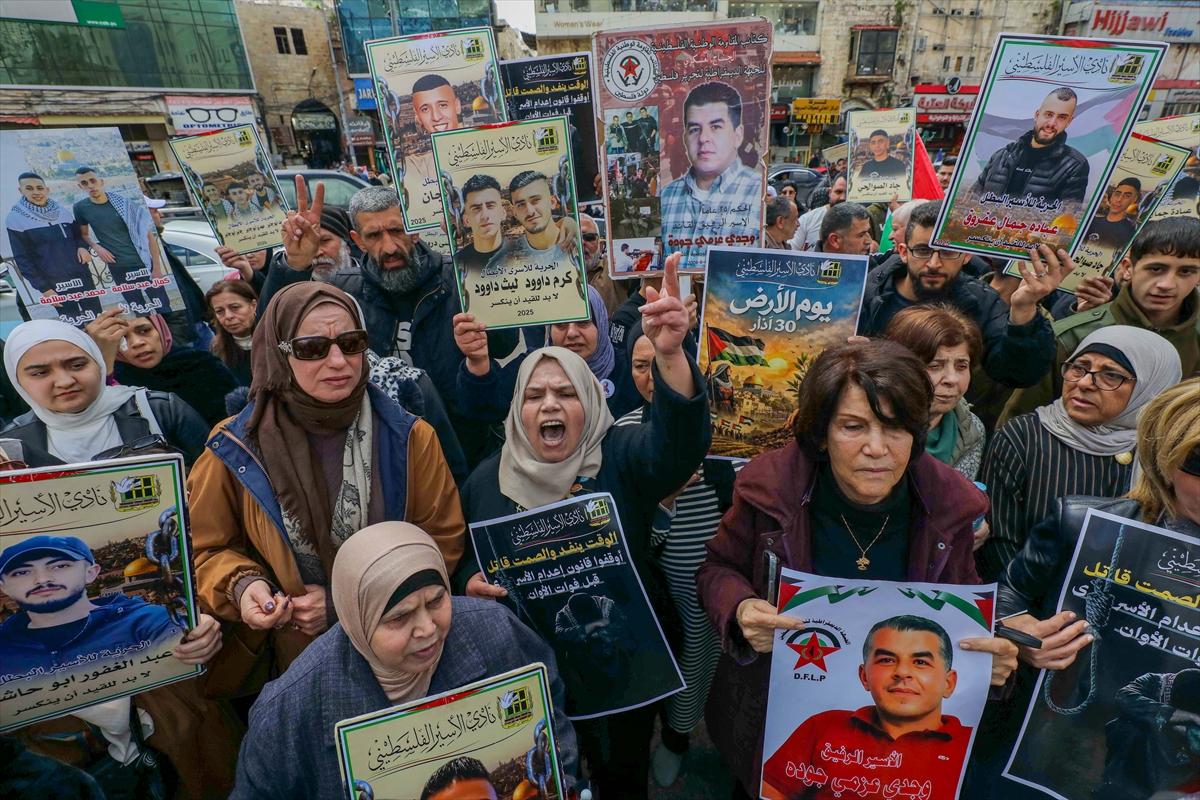
Dozens of Palestinians gathered in Nablus in the occupied West Bank protesting against the death penalty law passed by the Israeli Knesset targeting Palestinian prisoners and policies toward detainees, 31 March 2026 – (Anadolu Agency)
The bill proposing the death penalty for Palestinian prisoners was drafted by the far-right Otzma Yehudit (Jewish Power) party and strongly supported by National Security Minister Itamar Ben-Gvir. The bill underwent the multi-stage evaluation process required under Israel’s legislative procedure and was first approved during its first reading in November 2025.
Following the initial approval, the bill was referred to the Knesset National Security Committee for detailed review and revision. After the committee’s examination and amendments, the bill was resubmitted to the Knesset Plenum for second and third readings.
The bill was finally approved on 30 March 2026 during the second and third readings with 62 votes in favor and 48 against. During the vote, Israeli Prime Minister Benjamin Netanyahu also voted in favor of the bill.
Political tensions arose in the Knesset during the bill’s adoption, with verbal debates among some members. Supporters of the bill argued that the amendment was necessary on security grounds, while opposition representatives and some legislators opposed the legislation.
The law is a legislative measure that provides for the death penalty for individuals who carry out attacks against Israelis resulting in death. Under this provision, offenses include those classified under Israeli law as “terrorist acts” that result in fatalities.
The law stipulates that for the death penalty to be applied, the perpetrator must have the intent to harm the existence of the State of Israel and the Jewish people on their land. The amendment does not limit itself to intentional murder but encompasses a broad range of killing offenses.
Death sentences under the law are to be carried out by hanging. The executions are to be carried out by personnel designated by the Israel Prison Service. Personnel carrying out executions are to be granted identity confidentiality and criminal immunity. The law provides that executions must be carried out within 90 days after the death sentence is issued, and in specific circumstances, this period may be extended up to 180 days.
The law grants military courts, which try Palestinian defendants, the authority to impose the death penalty. The requirement for judicial unanimity in imposing the death penalty has been removed, allowing decisions to be made by simple majority.
Under the law, courts may issue death sentences without a special request from the prosecution. For individuals sentenced to death under this law, appeal and pardon opportunities are restricted.
Individuals sentenced to death are to be held in separate detention facilities. These individuals may only be visited by authorized personnel, and visits are to be strictly limited. Attorney visits are to be conducted only via video link.

Dozens of Palestinians gathered in Nablus in the occupied West Bank protesting against the death penalty law passed by the Israeli Knesset targeting Palestinian prisoners and policies toward detainees, 31 March 2026 – (Anadolu Agency)
Although the law is part of Israel’s legal system, its practical application is specifically directed at Palestinians living in the occupied West Bank. The law is structured to be implemented through military courts that try Palestinian suspects. Accordingly, it applies to Palestinians who are not Israeli citizens and reside in the West Bank.
The definitions of offenses and intent criteria in the law have been formulated specifically to target Palestinians. Therefore, as the law applies exclusively to Palestinians, it carries a discriminatory character.
Following the law’s adoption, the Association for Civil Rights in Israel (ACRI) filed a petition with the Israeli Supreme Court seeking its annulment.
In a statement from ACRI, a petition was submitted to the Israeli Knesset, Prime Minister Benjamin Netanyahu, Defense Minister Yisrael Katz, the Israeli military commander responsible for the occupied West Bank, the Attorney General, the Military Advocate General, and the Supreme Court.
The statement emphasized that this was the first petition filed with the Israeli Supreme Court seeking to annul a death penalty law targeting Palestinians and stressed that the law was “designed with a legal architecture aimed at selectively applying punishment to specific groups,” making it vengeful, racist and unconstitutional.
The statement further noted that while the law imposes the death penalty or life imprisonment for “intent to deny Israel’s existence” as a new offense applicable to Israelis, “in practice, the penalty can only be applied to Palestinians and not to Jews”.
The petition submitted to the Supreme Court, the statement noted, “focuses on challenging the Knesset’s authority to impose laws in areas beyond its sovereign jurisdiction”. It recalled that the West Bank is recognized under international law as an occupied territory and that legislative authority does not belong to the Israeli Knesset.
The statement included the assertion that “any attempt to override this principle constitutes a de facto annexation of occupied territories.” It called on the Israeli Supreme Court to consider that the law could lead to “serious violations of human rights” and to issue an interim injunction suspending the law’s implementation until the petition is reviewed and a decision is reached.

Dozens of Palestinians gathered in Nablus in the occupied West Bank protesting against the death penalty law passed by the Israeli Knesset targeting Palestinian prisoners and policies toward detainees, 31 March 2026 – (Anadolu Agency)
The death penalty law adopted by the Israeli Knesset conflicts with various treaties under international humanitarian law and human rights law. Palestinian authorities have stated that the law specifically violates provisions of the Fourth Geneva Convention regarding the protection of individuals and guarantees of fair trial. It has also been stated that the law is incompatible with the International Covenant on Civil and Political Rights (ICCPR).
Article 2 of the Charter of Fundamental Rights of the European Union prohibits the death penalty, stating that “no one shall be condemned to death or executed”. Israel’s death penalty law contradicts Article 2 of the EU-Israel Association Agreement, which is based on respect for human rights and democratic principles.
European legal frameworks argue that the death penalty lacks deterrent effect and produces irreversible consequences. Additional Protocol No. 6 to the European Convention on Human Rights abolishes the death penalty in peacetime. The 13th Protocol to the European Convention on Human Rights, adopted in 2002, abolishes the death penalty under all circumstances.
International humanitarian law also restricts the application of the death penalty. The Fourth Geneva Convention permits the death penalty only for certain grave offenses but prohibits its application to persons under 18, pregnant women, and civilians. The same convention grants those sentenced to death the right to seek pardon, postponement, and appeal. The absence of pardon and appeal mechanisms in Israel’s new law contradicts these provisions.
Under international criminal law, modern international courts do not impose the death penalty, and it is not included in the Rome Statute.
The Palestinian Presidential Authority announced its rejection of the death penalty law adopted by the Israeli Knesset and characterized the measure as a “war crime” committed against the Palestinian people.
In a written statement from the Palestinian Presidential Authority, the following was stated: “This law constitutes a clear violation of international humanitarian law, particularly the Fourth Geneva Convention, which guarantees the protection of individuals and fair trial rights, as well as a violation of the International Covenant on Civil and Political Rights.”
The statement noted that this step is taken within the context of Tel Aviv’s escalating policies against the Palestinian people in the Gaza Strip and the occupied West Bank, and added: “We reject Israel’s decision to impose the death penalty on Palestinian prisoners and consider it a war crime against our people.”
The statement emphasized that “such laws and practices cannot break the will of the Palestinian people, weaken their resistance, or divert them from their legitimate struggle and goal of establishing an independent Palestinian state with East Jerusalem as its capital,” and further stated: “We warn of the dangerous consequences of such racist laws: they not only escalate tensions and hostilities but also threaten opportunities for security and stability in the region.”
UN Human Rights High Commissioner Spokesperson Thameen Al-Kheetan stated that the United Nations opposes the death penalty law adopted by the Israeli Knesset targeting Palestinian prisoners under all circumstances.
Al-Kheetan recalled a previous statement by UN High Commissioner for Human Rights Volker Türk, who had urged Israeli authorities in January to abandon plans to enact the law, noting that the proposal violated international law at multiple levels. Al-Kheetan reiterated: “We reiterate the High Commissioner’s call and the UN’s unwavering opposition to the death penalty.”
European Union (EU) Spokesperson for Foreign Affairs Anouar Al Anouni stated that the EU is “deeply concerned” by the Knesset’s adoption of the controversial “death penalty law” targeting Palestinian prisoners, describing it as an “unfavorable step” in terms of Tel Aviv’s obligation to respect human rights.
Al Anouni added: “It should also be noted that following the law’s adoption, various voices have emerged in Israel and a petition has now been submitted to the Supreme Court.” Al Anouni affirmed the EU’s consistent opposition to the death penalty under all circumstances, adding: “Because the death penalty is a violation of the right to life, and this is a fundamental value for the EU.”
Al Anouni stated: “The approval of this law represents a serious regression from a principle and approach that Israel itself has previously endorsed.” He called on Israel to comply with its obligations under international law and confirmed that EU officials are in contact with their Israeli counterparts.
German Government Spokesperson Stefan Kornelius, in a written statement, expressed regret over the decision, stating: “The rejection of the death penalty is a fundamental principle of German policy.” The government also expressed concern that such a law would likely apply only to Palestinians in occupied Palestinian territories. Government Spokesperson and Minister for Integration, Social Security and Migration Elma Saiz condemned Israel’s imposition of the death penalty on Palestinian prisoners with the statement: “We condemn this decision as inconsistent with international law.”
Saiz described the Knesset’s decision as “a sign that the country is undergoing a radical drift,” and emphasized that the Spanish government has always been consistent and resolute in condemning such initiatives.
Austrian Foreign Minister Beate Meinl-Reisinger issued a statement on social media regarding the death penalty law adopted by the Israeli Knesset targeting Palestinian prisoners, stating: “The death penalty is inhumane and incompatible with the right to life and human dignity.” Meinl-Reisinger noted that Austria has long advocated globally for the abolition of the death penalty and emphasized that the adoption of this law represents a regression for Israel, which Austria firmly rejects.
Irish Foreign Minister McEntee stated in a written statement: “Ireland condemns the law adopted by the Israeli Parliament to expand the scope of the death penalty and reintroduce its application in Israel and the occupied Palestinian territories.”
McEntee emphasized that the right to life is the most fundamental human right and that Ireland opposes the death penalty under all conditions and circumstances. He added: “I am particularly concerned because the law has a de facto discriminatory character against Palestinians.”
Global Director of Research, Advocacy, Policy and Campaigns at the UK-based organization, Guevara-Rosas stated in a written statement that the Knesset’s decision is a clear manifestation of discrimination, brutality, and disregard for human rights.
Guevara-Rosas highlighted that while death penalties are being abolished worldwide, Israel is expanding their scope, and stated: “This law simultaneously eliminates fundamental safeguards designed to prevent arbitrary deprivation of life and protect the right to a fair trial, thereby strengthening Israel’s apartheid system against Palestinians through a series of discriminatory laws.”
Guevara-Rosas noted that the approved decision reflects the culmination of Israel’s efforts to dehumanize Palestinians, pointing out that among those who voted “yes” was Israeli Prime Minister Benjamin Netanyahu, who has been issued an arrest warrant by the International Criminal Court for war crimes and crimes against humanity.
Guevara-Rosas highlighted that for years Palestinians have been subjected to extrajudicial executions in Israel, while the suspects remain immune from prosecution. He noted that the authority to impose the death penalty has been granted to military courts, which convict Palestinian defendants at a rate of 99 percent, and continued: “By granting military courts, known for disregarding procedural safeguards and principles of fair trial, the authority to impose mandatory death sentences and carry out executions within only 90 days of the final verdict, Israel is explicitly granting itself unlimited authority to execute Palestinians and eliminating the most fundamental guarantees of fair trial.”
Guevara-Rosas emphasized that any death sentence issued under this law would constitute a violation of the right to life and stated: “If applied to Palestinians in the occupied Palestinian territories, it could constitute a war crime. The international community must exert maximum pressure on Israeli authorities to immediately repeal this law, fully abolish the death penalty, and eliminate all laws and practices contributing to the apartheid system against Palestinians.”
The Jordanian Ministry of Foreign Affairs issued a written statement strongly condemning the death penalty law adopted by the Knesset. Jordan affirmed its opposition to this racist, discriminatory, and illegitimate law, which violates international legal norms.
The statement noted that this step is part of Israel’s systematic policy against the Palestinian people and their inalienable rights to self-determination and the establishment of an independent state.
The Egyptian Ministry of Foreign Affairs issued a written statement strongly condemning the law, stating that it reinforces discriminatory practices and the apartheid system. The statement noted that the law clearly violates international humanitarian law and the Geneva Conventions and severely undermines the right to a fair trial.
The statement emphasized that Israeli legislation cannot be applied to Palestinians in the West Bank and noted that this law clearly violates the existing legal status of occupied Palestinian territories.
The statement also called on the international community to assume responsibility and take decisive action to halt these violations, protect the Palestinian people, and safeguard their legitimate rights.
In a written statement from Al-Azhar, the adoption of the death penalty law by the Israeli Knesset was also condemned. The statement noted: “The international legal system has proven powerless to prevent the Israeli Knesset from adopting the ‘death penalty law’ targeting Palestinian prisoners, and we express deep sorrow and great dissatisfaction.”
Arab Parliament Speaker Muhammad Ahmed al-Yemahi characterized the law’s approval as a “systematic crime of genocide” and condemned it. Yemahi emphasized that the law constitutes a clear violation of all international laws and treaties, particularly the Geneva Conventions, which guarantee protection against harm to prisoners and detainees.
Yemahi stated that the law represents a dangerous escalation within Israel’s systematic policy of killing Palestinians and constitutes a full-fledged war crime and crime against humanity, revealing the true face of Israel’s policies based on revenge and elimination and its contempt for international peace efforts in the region.
Yemahi called on the international community, the United Nations Security Council, human rights organizations, and the Red Cross to take deterrent measures to hold the leaders of the occupying entity accountable for their crimes and to provide urgent international protection for Palestinian prisoners.
Hamas issued a press statement in Turkish, Persian, Kurdish, and Indonesian languages via its Telegram account regarding the law’s approval in Israel. The statement stated: “The final approval by the Israeli Knesset of the so-called bill enabling the execution of Palestinian prisoners reflects the bloody nature of the occupation and its approach based on murder and terror, while exposing the falsehood of its repeated claims of adherence to civilization and human values.”
The statement assessed that this fascist law materializes the mindset of a bloodthirsty criminal gang and constitutes a dangerous precedent threatening the lives of prisoners in Israeli detention facilities, and emphasized that this decision “once again confirms that Israel and its leaders disregard international law and all human norms and treaties.”
The statement called on the international community, free peoples of the world, and the United Nations and Red Cross, among other humanitarian organizations, to act urgently to protect Palestinian prisoners from the oppression of occupation, stating: “We call on all our individuals, factions, and forces, inside and outside, to mobilize politically, legally, and in the media at all levels in support of our heroic prisoners. The Zionist enemy and criminal leaders must bear the consequences of these fascist policies, which will be met with a response commensurate with the magnitude of the crime.”
In a joint statement issued on 29 March 2026 by the foreign ministers of Germany, France, Italy, and the United Kingdom, “deep concern” was expressed regarding the Israeli bill expanding the scope of the death penalty.
The statement expressed serious concerns that the bill has a discriminatory character in practice. It also stated that the adoption of the amendment risks weakening Israel’s commitments to democratic principles. The death penalty was described as “an inhumane and degrading punishment” with no deterrent effect. It was further affirmed that opposition to the death penalty is a “fundamental value” for these countries.
The foreign ministers of the four countries called on the Israeli government and decision-makers in the Knesset to abandon the plan.
UNRWA Commissioner-General Philippe Lazzarini, in his statement regarding the death penalty law adopted by the Israeli Knesset targeting Palestinian prisoners, said he was “horrified” by the law.
Lazzarini, referring to the law, said he was deeply horrified by this “degrading” law and expressed hope that it would be overturned by the Supreme Court. Lazzarini stated: “We are accustomed to seeing countries abolish the death penalty. Moreover, this is an extremely discriminatory law because it targets only a specific segment of the population.”
Lazzarini also noted that hundreds of buildings in Gaza have been damaged or destroyed under Israeli attacks, adding: “Israeli authorities are increasingly pressuring UN agencies to stop working with UNRWA. You also know that the Israeli Parliament passed a law to end UNRWA’s presence in occupied East Jerusalem. (Israeli) armed police forcibly closed our schools and health facilities, and local authorities cut off electricity and water to all buildings. These attacks are unprecedented in the 80-year history of the UN.”
Regarding allegations against UNRWA, Lazzarini stated: “The purpose of these baseless and malicious allegations is to justify actions against UNRWA and weaken the support of member states.”
Regarding the Gaza ceasefire process, Lazzarini stated: “The longer the implementation of the next phase is delayed, the more desperate the people of Gaza will become.”
The United States Department of State avoided criticizing the death penalty law adopted by the Israeli Knesset targeting Palestinian prisoners in its statement.
In the statement issued by the U.S. Department of State, it was stated: “The United States respects Israel’s sovereign right to determine its own laws and penalties for individuals found guilty of terrorism.”
The same statement affirmed that the United States is confident that Israel will apply such measures “within the framework of a fair legal process and appropriate safeguards for due process.”
The law was adopted during a period when Israel’s military operations in Gaza and the West Bank are ongoing. The law is scheduled to enter into force 30 days after its adoption.
Al Jazeera. "Dangerous Escalation: World Reacts to Israel Passing Death Penalty Law." Accessed March 31, 2026. https://www.aljazeera.com/news/2026/3/30/dangerous-escalation-world-reacts-to-israel-passing-death-penalty-law
Al Jazeera. "Israel Passes Discriminatory Death Penalty Bill Targeting Palestinians." Accessed March 31, 2026. https://www.aljazeera.com/news/2026/3/30/israel-passes-discriminatory-death-penalty-bill-targeting-palestinians
Al Jazeera. "Outrage and Condemnation Over Israel’s Death Penalty Law for Palestinians." Accessed March 31, 2026. https://www.aljazeera.com/video/newsfeed/2026/3/31/outrage-and-condemnation-over-israels-death-penalty-law-for-palestinians
Anadolu Ajansı. "ABD, İsrail’de Onaylanan Filistinli Esirleri Hedef Alan İdam Yasasını Eleştirmekten Kaçındı." Accessed March 31, 2026. https://www.aa.com.tr/tr/dunya/abd-israilde-onaylanan-filistinli-esirleri-hedef-alan-idam-yasasini-elestirmekten-kacindi/3885965
Anadolu Ajansı. "Batılı 4 Ülke, İsrail’den Filistinli Mahkumlara İdam Cezasını Öngören Tasarının Reddedilmesini İstedi." Accessed March 31, 2026. https://www.aa.com.tr/tr/dunya/batili-4-ulke-israilden-filistinli-mahkumlara-idam-cezasini-ongoren-tasarinin-reddedilmesini-istedi/3884304
Anadolu Ajansı. "Explainer: What Is Israel’s Law for Death Penalty for Palestinian Prisoners?" Accessed March 31, 2026. https://www.aa.com.tr/en/middle-east/explainer-what-is-israel-s-law-for-death-penalty-for-palestinian-prisoners/3885634
Anadolu Ajansı. "Filistin: İsrail Meclisinin Onayladığı İdam Yasası Halkımıza Karşı Savaş Suçudur." Accessed March 31, 2026. https://www.aa.com.tr/tr/dunya/filistin-israil-meclisinin-onayladigi-idam-yasasi-halkimiza-karsi-savas-sucudur/3885600
Anadolu Ajansı. "UNRWA Komiseri, Filistinli Esirleri Hedef Alan İdam Yasası Karşısında Dehşete Kapıldığını Söyledi." Accessed March 31, 2026. https://www.aa.com.tr/tr/dunya/unrwa-komiseri-filistinli-esirleri-hedef-alan-idam-yasasi-karsisinda-dehsete-kapildigini-soyledi/3886203
Anadolu Ajansı. "İsrail Meclisi, Filistinli Esirleri Hedef Alacak İdam Cezası Yasasını Onayladı." Accessed March 31, 2026. https://www.aa.com.tr/tr/dunya/israil-meclisi-filistinli-esirleri-hedef-alacak-idam-cezasi-yasasini-onayladi/3885535
Anadolu Ajansı. "İsrail Yurttaş Hakları Derneği, Meclisin Onayladığı İdam Yasasının İptali İçin Yüksek Mahkemeye Başvurdu." Accessed March 31, 2026. https://www.aa.com.tr/tr/dunya/israil-yurttas-haklari-dernegi-meclisin-onayladigi-idam-yasasinin-iptali-icin-yuksek-mahkemeye-basvurdu/3885771
Anadolu Ajansı. "İsrail’in Filistinli Esirleri Hedef Alan İdam Yasasına Dünyadan Tepkiler Yükseldi." Accessed March 31, 2026. https://www.aa.com.tr/tr/dunya/israilin-filistinli-esirleri-hedef-alan-idam-yasasina-dunyadan-tepkiler-yukseldi/3885715
Anadolu Ajansı. "İsrail’in İdam Yasası Uluslararası Hukuka Aykırı." Accessed March 31, 2026. https://www.aa.com.tr/tr/dunya/israilin-idam-yasasi-uluslararasi-hukuka-aykiri/3886120
BBC News. "Palestinians Convicted Of Lethal Attacks Dace Death Penalty Under New Israeli Law." Accessed March 31, 2026. https://www.bbc.com/news/articles/cp8dkd6lnjdo
Reuters. "Israel Passes Death Penalty Law For Palestinians Convicted Of Lethal Attacks." Accessed March 31, 2026. https://www.reuters.com/world/middle-east/israeli-death-penalty-bill-palestinian-murder-convicts-faces-vote-2026-03-30/
UK Government. "Joint Statement on Israel’s Death Penalty Bill (29 March 2026)." Accessed March 31, 2026. https://www.gov.uk/government/news/joint-statement-on-israels-death-penalty-bill-29-march-2026
In response to the death penalty law adopted by the Israeli Knesset, the Fatah Movement has declared a comprehensive general strike across the occupied West Bank.

General strike in Jerusalem, 1 April 2026 – (Anadolu Agency)
In a statement issued by Fatah, the strike was described as part of efforts to repeal the law, with the legislation characterized as “a dangerous escalation and an open violation”.
The movement called on the Palestinian people to organize widespread actions and stressed the need to establish regional and international pressure to halt the law. In response to Fatah’s call, commercial enterprises, public and private institutions, banks, universities and schools across the West Bank were shut down, with only hospitals and bakeries continuing operations. Streets in many cities, led by Ramallah, were deserted and daily life came to a near standstill.

General strike in the West Bank, 1 April 2026 – (Anadolu Agency)
Hamas, along with Islamic Jihad and other Palestinian groups, issued a joint statement calling for a broad mobilization at the legal, media and public levels to repeal the law.
During the same period, Palestinian merchants in occupied East Jerusalem also joined the general strike, closing shops along Salaheddin, Sultan Süleyman and Zahra streets and in the Old City. Due to the strike, streets and alleys in East Jerusalem were largely empty and commercial activity came to a halt.
In the occupied West Bank city of Ramallah, Palestinians held protests to express opposition to the death penalty law adopted by the Israeli Knesset and to the practices targeting Palestinian prisoners. Protesters carried photographs of Palestinian detainees in Israeli prisons and chanted anti-law slogans.

General strike in the West Bank, 1 April 2026 – (Anadolu Agency)
In West Jerusalem, a group of approximately 50 Israeli activists gathered in front of the Israeli Knesset to protest the law. Demonstrators carried banners with slogans such as “Palestinian lives matter” and “No to the death penalty” and voiced their opposition through chants.
Israeli police intervened in the protest using water cannons and force, resulting in injuries to some demonstrators. During the police operation, at least two individuals were arrested and the protesters were dispersed.
Anadolu Ajansı. "Batı Şeria’da İsrail’in Tartışmalı İdam Yasasına Karşı Genel Grev Gündelik Hayatı Felç Etti." Accessed April 1, 2026. https://www.aa.com.tr/tr/dunya/bati-seriada-israilin-tartismali-idam-yasasina-karsi-genel-grev-gundelik-hayati-felc-etti/3887984
Anadolu Ajansı. "İsrail Polisi, Filistinli Esirlere İdam Cezasını Protesto Eden Göstericilere Müdahale Etti." Accessed April 1, 2026. https://www.aa.com.tr/tr/dunya/israil-polisi-filistinli-esirlere-idam-cezasini-protesto-eden-gostericilere-mudahale-etti/3887154
In response to the death penalty law adopted by the Israeli Knesset, the Fatah Movement has declared a comprehensive general strike across the occupied West Bank.
General strike in Jerusalem, 1 April 2026 - (Anadolu Agency)" image-element-format="right" image-height="800" image-source="https://cdn.t3pedia.org/media/uploads/2026/04/01/cSFjP30L6cXmJKMX4ZAebV7gcQWtfjKv.jpg" image-width="1200">
In a statement issued by Fatah, the strike was described as part of ongoing efforts to repeal the law, with the legislation characterized as a “dangerous escalation and clear violation”.
The movement called on the Palestinian people to organize widespread actions and stressed the need to build regional and international pressure to halt the law. In response to Fatah’s call, West Bank businesses, public and private institutions, banks, universities and schools were closed, with only hospitals and bakeries continuing operations. Ramallah and many other cities saw streets emptied and daily life largely brought to a standstill.
General strike in the West Bank, 1 April 2026 - (Anadolu Agency)" image-element-format="left" image-height="800" image-source="https://cdn.t3pedia.org/media/uploads/2026/04/01/FZhbUqvDa60lhS2UJCi7YZblFLqkoMKj.jpg" image-width="1200">
Hamas, along with Islamic Jihad and other Palestinian groups, issued a joint statement calling for a comprehensive mobilization at legal, media and public levels to demand the repeal of the law.
During the same period, Palestinian merchants in occupied East Jerusalem also joined the general strike, closing numerous shops along Salahaddin, Sultan Süleyman and Zahra streets and in the Old City. Due to the strike, streets and roads in East Jerusalem were largely deserted and commercial activity came to a halt.
In the occupied West Bank city of Ramallah, Palestinians held protests against the death penalty law adopted by the Israeli Knesset and practices targeting Palestinian prisoners. Demonstrators carried photographs of Palestinian detainees in Israeli prisons and chanted anti-law slogans.
General strike in the West Bank, 1 April 2026 - (Anadolu Agency)" image-element-format="right" image-height="800" image-source="https://cdn.t3pedia.org/media/uploads/2026/04/01/TSE0a8eqxbTdFY6BHQMiLuorxcw8YCn5.jpg" image-width="1200">
Additionally, in West Jerusalem, a group of approximately 50 Israeli activists gathered in front of the Israeli Knesset to protest the law. Demonstrators carried banners with slogans such as “Palestinian lives matter” and “No to the death penalty” to express their opposition.
Israeli police intervened in the protest using water cannons and force, resulting in injuries to some demonstrators. During the police operation, at least two individuals were arrested and the protesters were dispersed.
On 1 April, a protest demonstration was held in Gaza at the call of the Palestinian Ministry of Waqf and Religious Affairs. The protest was organized in response to the closure of Al-Aqsa Mosque and the law proposing the death penalty for Palestinian prisoners.
Participants called on the Arab and Islamic world to act to end the violations and reopen Al-Aqsa Mosque for worship. Muhammad Salim, spokesperson for the Palestinian Ministry of Waqf and Religious Affairs, stated that the demonstration was held due to the continuation of the closure of Al-Aqsa Mosque.
Protest against Israel’s death penalty law targeting Palestinians in Damascus, Syria, 1 April 2026 - (Anadolu Agency)" image-element-format="right" image-height="800" image-source="https://cdn.t3pedia.org/media/uploads/2026/04/07/si86AS8LJSf2Qf2BY7vjx8fiEYlAbPhb.jpg" image-width="1200">
Salim also stated that the Ministry condemned the death penalty law. Sheikh Zahir Kesku, a member of the Palestinian Council of Scholars, also denounced the adoption of the law, noting that this development demonstrates the hardening of practices against Palestinian detainees.
Protest against Israel’s death penalty law targeting Palestinians in Damascus, Syria, 1 April 2026 - (Anadolu Agency)" image-element-format="left" image-height="800" image-source="https://cdn.t3pedia.org/media/uploads/2026/04/07/cibr0BbGyk8wHqyQJ8XSeN3FNlOwRz9o.jpg" image-width="1200">
In the Syrian capital Damascus, a protest demonstration was held against Israel’s death penalty law targeting Palestinian prisoners. Demonstrators gathered in front of the United Nations High Commissioner for Refugees building and Aleppo University, carrying banners in Arabic, Hebrew and English.
The demonstrators demanded the repeal of the law and the prevention of the execution of Palestinian detainees. They appealed to the international community to take action to protect Palestinian prisoners. One demonstrator stated that the death penalty law, which is “clearly targeting only Palestinian detainees,” must be repealed. Some protesters expressed concern that a large number of Palestinian detainees could face execution under the law.
Al Jazeera. "Eight Countries Condemn Israel’s One-Sided Death Penalty for Palestinians." Accessed April 7, 2026. https://www.aljazeera.com/news/2026/4/2/muslim-majority-countries-condemn-israels-one-sided-new-death-penalty-law
Anadolu Ajansı. "Türkiye ve 7 Ülke, İsrail’in Filistinli Esirler Hakkında İdamı Öngören Yasa Tasarısını Şiddetle Kınadı." Accessed April 7, 2026. https://www.aa.com.tr/tr/dunya/turkiye-ve-7-ulke-israilin-filistinli-esirler-hakkinda-idami-ongoren-yasa-tasarisini-siddetle-kinadi/3889095
Anadolu Ajansı. "İsrail’in Filistinli Esirleri Hedef Alan İdam Yasası İtalya’da Protesto Edildi." Accessed April 7, 2026. https://www.aa.com.tr/tr/dunya/israilin-filistinli-esirleri-hedef-alan-idam-yasasi-italyada-protesto-edildi/3889913
Anadolu Ajansı. "İstanbul’da Gazze’ye Destek İçin Araç Konvoyu Oluşturuldu." Accessed April 7, 2026. https://www.aa.com.tr/tr/gundem/istanbulda-gazzeye-destek-icin-arac-konvoyu-olusturuldu/3889899

The Israeli Knesset approved a law on 30 March 2026 introducing the death penalty for Palestinian prisoners by a vote of 62 to 48. The law provides for the death penalty in cases of attacks against Israelis that result in death and grants this authority to military courts. The amendment has been criticized internationally and locally as discriminatory on the grounds that it targets Palestinians in practice.
No Discussion Added Yet
Start discussion for "Israel's Death Penalty Law Targeting Palestinian Prisoners (2026)" article
March 31, 2026
Legislative Process and Adoption Stages
March 31, 2026
Scope and Provisions of the Law
March 31, 2026
Scope of Application and Target Population
March 31, 2026
Legal and Institutional Debates
March 31, 2026
Assessments Under International Law
March 31, 2026
Palestinian Responses
March 31, 2026
International Reactions and Statements
March 31, 2026
Entry into Force and Implementation Timeline
April 1, 2026
General Strike and Mass Reactions in Palestine
April 1, 2026
Protests and Security Interventions
April 7, 2026
General Strike and Reactions in Palestine
April 7, 2026
Protests and Security Interventions
April 7, 2026
Protests in Gaza
April 7, 2026
Protests in Damascus