

This article was automatically translated from the original Turkish version.
The Jordanian Royal Circassian Guard is an elite palace unit composed of soldiers of Circassian origin, responsible for ceremonial and protective duties tied to the office of the head of state within the Hashemite Kingdom. Institutionally part of the Jordanian Armed Forces, it holds a special status focused exclusively on the monarch, the royal family, and the royal palaces. Due to its role in the royal family’s daily schedule, official visits, and state ceremonies, the unit has become one of the most visible symbols of the monarchy in both Jordanian public opinion and the international arena.
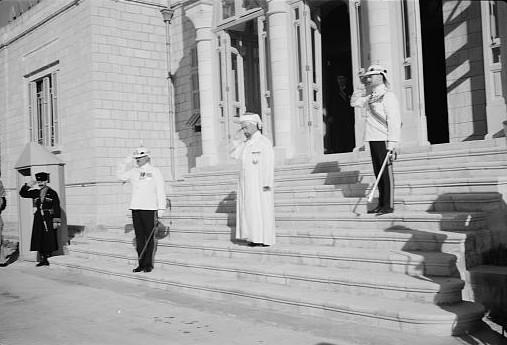
A Circassian Guard is seen on the far left as King Hussein greets during a ceremony (Library of Congress)
The existence of the Royal Circassian Guard institutionalizes the historical relationship between the Circassian community in Jordan and the Hashemite dynasty. The Circassians’ process of settlement in the region, their military traditions, and their position in state service have ensured continuous visibility for this unit at both the palace and public levels. Consequently, this unit is regarded not merely as a security and protocol element but also as an example in terms of minority-society relations, identity representation, and monarchical legitimacy.
The Circassians are a community who identify themselves as Adyghe and are among the indigenous peoples of northwestern Caucasus. Historically organized around numerous dialects and local political units, they lived in distinct clans, tribes, and principalities shaped by the mountainous geography. The region’s multilingual and multicultural character continually reshaped internal divisions as well as alliances and conflicts with neighboring communities.
The expansion of the Russian Empire toward the Black Sea coast and into the Caucasus during the 18th and 19th centuries marked a turning point in Circassian history. The Caucasian-Russian wars, generally dated between 1763 and 1864, completely transformed the region’s political map, exposing the peoples of northwestern Caucasus to direct military pressure, forced displacement, and mass violence. During this period, a significant portion of the Circassian population perished in the wars, while the majority of survivors were forced to choose between remaining within imperial borders or migrating to Ottoman territories.
In the final stages of the wars, Circassians, Abkhazians, Dagestanis, and other northern Caucasian groups sought refuge en masse within the Ottoman Empire; this population movement created a major migration pressure on the empire. Although state-level resettlement policies appeared planned, in practice they were often chaotic; some refugees waited for years in temporary shelters, while others attempted to relocate from their assigned areas to other regions.
This forced migration gave rise among the Circassians to the identity of a “mountain migrant people”; groups with different dialects and regional origins formed tighter bonds around the shared experience of exile and resettlement.
The Ottoman administration settled a portion of the northern Caucasian refugees in the Syrian province’s regions of Jawlan (Golan), Balqa, and Tiberias. The Balqa region, which includes today’s Jordanian territory, held strategic importance due to its arable land and its proximity to caravan routes and future railway lines. Between 1878 and the early 20th century, Circassian refugees established new villages in places such as Amman, Wadi al-Sir, Suwaylih, Jarash, Na’ur, and Rusayfa.
Groups from different parts of the North Caucasus—including Shapsugs, Abzakh, Bzhedug, and Kabardians—came together in the same geographic area, creating a settlement pattern that preserved internal diversity while fostering a shared communal identity as “Jordanian Circassians.”
During this period, not only villages but also several important urban centers in the region were shaped by Circassian settlement. In the late 19th and early 20th centuries, Circassian refugees established approximately seven new settlements in Balqa; some of these later evolved into the largest cities of modern Jordan. The rise of Amman in modern history occupies a distinct position within this context.
Circassian settlers leveraged the property rights granted under the 1858 Ottoman Land Code and the newly constructed railway infrastructure to transform a modest rural settlement into a regional center of trade and transportation within a short time. Thus, Amman became a crossroads where Ottoman capital networks met the new immigrant population.
The first Circassian settlement in Amman began humbly and precariously. New arrivals, in their initial years, were forced to shelter in caves and within the ruins of the ancient city, even living for a time beneath the arches and vaulted sections of the Roman theater. It took several years before the Circassians felt secure enough to construct permanent dwellings.
Over time, stones from Roman and Byzantine structures were reused in the construction of new homes and neighborhoods; the ancient urban fabric became interwoven with Circassian settlement patterns. This phenomenon created a physical and symbolic connection between the Circassian village structure and the imperial heritage in places such as Amman and Jarash.
The Ottoman administration allocated specific plots of agricultural land and residential lots to each Circassian household in Balqa; these lands were officially registered in land records by the end of the 1890s. The initial distribution of land on a household-level individual ownership basis became a crucial factor in shaping long-term social hierarchies and land relations within the villages. Thus, Circassian settlements acquired a structure compatible with the classical Ottoman land regime and established themselves as “native landowners” in relation to other local villagers and nomadic communities in Balqa.
Circassian settlements in Jordan also played a role in reshaping the regional economy and security structure. The new Circassian villages in Balqa quickly became centers engaged in agriculture, transporting their produce to surrounding markets and cities, and establishing commercial ties with urban merchants and nomadic groups.
Circassian villages around Amman became meeting points for traders from Syria and Palestine, local Bedouin groups, and Ottoman administrative officials; thus, the immigrant farmers assumed a mediating role between the rural economy and regional trade networks.
This economic vitality reflected on the Circassians’ social standing. Within a short time, they achieved a relatively stable income level through agriculture, animal husbandry, and trade; as urbanization progressed, clusters of artisans, clerks, and merchants emerged in settlements such as Amman. Over time, a significant portion of the Circassian community developed a profile closely associated with the urban middle class in Jordan.
However, one of the key factors shaping the Circassians’ perception in Jordan was not only their economic success but also their emphasis on military tradition and discipline. The warrior culture developed in the Caucasus, their experience with cavalry units, and their practices of armed self-defense remained central in collective memory after migration and settlement. The perception of Circassian villages as communities contributing to security along frontier zones, strengthening caravan route safety, and operating alongside Ottoman military units conferred upon them the image of “mountain warrior migrants.”
This image laid the groundwork for the institutionalization of Circassian presence within the Jordanian army and royal circles in subsequent decades. The solidarity networks forged through the migrant experience, combined with local roots established through land ownership and the disciplined military community image, positioned the Circassians as reliable and effective actors both within the local society and in the eyes of the central administration. The symbolic and institutional importance later acquired by the Jordanian Royal Circassian Guard largely emerged from this historical background.
In the new political order following the collapse of Ottoman rule after World War I, the territory of modern Jordan was established as a separate administrative unit under British mandate under the name “Transjordan.” The region had long been home to diverse tribal groups, urban elements, and immigrant communities; after the war, the challenge became constructing a new dynasty and state atop this fragmented social fabric.
During this period, the arrival of Emir Abdullah, a prominent member of the Hashemite dynasty, in 1921 placed him at the center of both the mandatory administration’s political design and the local power dynamics. Emir Abdullah embodied both the legacy of the Great Arab Revolt and the Hashemite claim to legitimacy, while simultaneously aligning himself with Great Britain. In this context, Transjordan evolved into a political structure initially shaped by the logic of “state before nation,” gradually institutionalized, and achieving full independence in 1946 as the Hashemite Kingdom of Jordan.
When Emir Abdullah arrived in the region, the social fabric of the Transjordanian highlands was not composed solely of Bedouin tribes. A portion of the Circassian refugees, forcibly displaced from the Caucasus and resettled by the Ottomans since the late 19th century, had been placed along strategic frontier zones such as the Golan Heights, Balqa, and the Tiberias basin. This resettlement process reflected the state’s desire to use immigrants both for agricultural colonization and as a buffer population, though implementation on the ground was often haphazard and inadequately administered.
Long waits, unproductive land, and limited financial support strengthened Circassian internal solidarity networks and elevated local leadership with access to state bureaucracy. This experience simultaneously unified the Circassians around the identity of “migrant mountain dwellers” and positioned them within a new social context defined through negotiations, conflicts, and alliances with local tribal groups.
The Hashemite administration’s ability to take root in Transjordan depended on establishing enduring alliances within this multi-layered social structure. From Emir Abdullah onward, the Hashemite dynasty built its foundations through patronage relationships with local power centers, primarily Bedouin tribes and urban elites. The kingdom’s administrative and military cadres followed a “rotation” policy, periodically appointing members of different tribes and regional elites to high bureaucratic and command positions; this ensured both a sense of belonging and prevented any single group from achieving hegemony over the regime.
Within this system, Circassian-origin families were also represented among the political elite; for example, prominent Circassians who settled in and around Amman from the 1920s onward were represented in the upper echelons of the state bureaucracy and cabinet structure.
What distinguished the alliance between the Circassians and the Hashemites was the security dimension that infused the relationship with a military-political character. In 1921, Circassian cavalry units offered to provide personal protection to Emir Abdullah and the newly established Hashemite dynasty, thus uniting the migrant community’s warrior qualities with the dynasty’s legitimacy within a concrete security arrangement.
The Circassian horsemen’s military experience was deployed during the fragile early years of the kingdom to counter threats from the region and internal rebellions; their role is specifically noted in critical events such as the suppression of the Wahhabi attack in 1922 and the quelling of the Advan revolt in 1923. These conflicts became turning points in consolidating Hashemite authority in Transjordan and reinforced the Circassian community’s image as the “loyal military backbone of the dynasty.”
This military-political alliance evolved into a protective tradition that formed the nucleus of the future Jordanian Royal Circassian Guard. Emir Abdullah’s reliance on Circassian horsemen from 1921 onward to secure his person and the royal court gradually created a symbolic bond of loyalty between the dynasty and the Circassian community. The presence of Circassian guards served not only to physically protect the royal court but also to strengthen the dynasty’s legitimacy narrative. Thus, the alliance established among “Hashemites–Circassians–Arab tribes” became not merely a political coalition but a central pillar in the founding of the Jordanian state.
The institutional framework of the royal guard in Jordan developed alongside the evolution of the Arab Army following the consolidation of Hashemite power. Established in 1921, the Jordanian Arab Army initially consisted of a limited number of military units and local elements; over time, it transformed into an organization with diverse arms and specialized fields.
During the emirate period, priorities included border security, suppression of internal rebellions, and maintaining the regime amid the precarious conditions of the mandate era. The guard units surrounding the emir—and later the king—were not institutionally distinct from the army but rather formed a narrow security circle composed of elite elements of the army, particularly Circassian horsemen.
As the army professionalized and its organizational structure expanded, specialized units focused on the royal family and palaces emerged. An official historical account of the Arab Army notes that in 1961 the “Royal Armored Force” was established, organized under two combat groups, one of which included the “First Royal Guard Units.”
This reference indicates that royal-designated armored units and guard units organized under the title “royal guard” were treated as part of a unified framework, particularly during King Hussein’s reign. Thus, the royal guard emerged not merely as a ceremonial unit stationed at the palace gate but as an institution linked to a broader military structure with specific armored components and organized command levels.
The Circassian guards stand out within the royal guard tradition as a relatively small but highly visible unit operating primarily within the inner circle of the palace. Organized as a team of 14 personnel, this unit is stationed at the royal compound in Basman and Raghadan palaces, positioned in ceremonial formation at the palace courtyard and entrance staircases.
This team is described as the core palace guard unit that accompanies the king, crown prince, and other royal family members, receives visiting heads of state and official delegations, and performs ceremonial marches along designated routes. Daily guard rotations and ceremonial duties are concentrated at specific entry and reception areas of the royal palaces, according to the royal schedule.
Institutionally, it is clear that the Circassian guards do not possess an autonomous structure outside the Jordanian Armed Forces. The actual protection of the royal family and palace protocol duties are considered part of the broader security framework provided by the army and other security institutions. The Circassian Guard unit represents a specialized domain within the wider guard tradition, linked to the army’s royal guard structures and assigned specifically to ceremonial duties at the royal palaces.
In contrast, responsibilities such as close protection of the royal family, convoy security, and risk management along routes outside the palace are typically handled by other military and security units. Thus, the Circassian Guard is positioned as a unit focused primarily on palace visibility and symbolic representation within the broader security architecture.
The development of the royal guard can be divided into distinct phases parallel to Jordan’s political history. During the emirate period (1921–1946), Circassian horsemen were mobilized to protect Emir Abdullah and the newly established administrative center of Amman, and were perceived as foundational elements of both the palace and the army. The involvement of Circassian units in suppressing local rebellions and operations against frontier threats during this period blurred the boundary between their protective function and active military duties.
During King Abdullah I’s reign (1946–1951), the proclamation of the kingdom and the constitutional reorganization of state institutions transformed the royal guard into a more clearly defined palace institution. The architectural expansion of the palace, the construction of new reception halls and protocol areas, and the increased diplomatic activity of the royal family heightened the need for a specialized ceremonial and protective unit within the palace.
During King Hussein’s long reign (1952–1999), the modernization of the army, the development of armored units, air forces, and special forces, alongside the kingdom’s encounters with internal and external crises, imposed new functional roles on the royal guard at both symbolic and operational levels. It is understood that the guard units mentioned alongside the royal armored forces in the 1960s occupied a significant place within the army’s broader transformation.
During King Abdullah II’s reign (from 1999 onward), the royal guard has become increasingly professionalized and specialized, with the Circassian guard team’s role becoming more distinctly focused on ceremonial and representational functions. The close media coverage of daily royal palace programs has transformed the Circassian guards stationed at Basman and Raghadan palaces into visual symbols of the Jordanian monarchy not only for the local public but also for the international audience.
The Jordanian Royal Circassian Guard is positioned within and immediately around the royal palaces as a small but highly visible team. The unit is particularly prominent in its duties at Basman Palace and Raghadan Palace in Amman.
At Basman Palace, guards stationed on either side of the main staircase entrance have become an inseparable part of the palace facade during the royal family’s daily reception programs and the welcoming of official guests. Similar arrangements are made at Raghadan Palace and other royal residences, with entry axes, inner courtyards, and doors to reception halls designated as fixed or semi-mobile duty stations for the Circassian guards.
At the team level, the Circassian guards operate within a pre-planned structure of a specific number of soldiers and scheduled guard rotations. The area of responsibility around the palace is defined along a line extending from the “front facade”—the staircases and entry sections—to the inner courtyards and reception halls.
The guard duty here is not merely passive waiting but involves a disciplined practice of posture, marching, and saluting. Within the daily schedule, when the royal family arrives at the palace, guests are received, or movements occur within the palace, the team assumes predetermined positions; the symmetrical formations seen in photographs and video recordings are the result of this disciplined order.
The unit’s most conspicuous function is its role in Jordan’s official ceremonies and protocol arrangements. The Circassian guards form the visual framework of ceremonies by lining the palace staircases and along the red carpet during receptions of heads of state, prime ministers, and representatives of international organizations.
This scenario repeats consistently during national holidays and commemorative days, as well as during official visits under bilateral relations. The unit, through salutes, weapon handling, sword drawing, and movements tied to specific commands, helps define the rhythm of protocol during these state-level receptions and welcoming ceremonies.
The ceremonial function is not limited to the reception of foreign guests. The Circassian guards also play a role in internal protocol events such as national holidays, military parades, and the awarding of medals and honors, framing the entry and exit patterns of the royal family and defining movement paths within the palace.
In ceremonies where mounted units are involved, Circassian guards on horseback waiting near the palace entrance visibly evoke both the historical cavalry traditions of the monarchy and the equestrian culture brought by the Circassians from the Caucasus. Thus, the unit, through its protocol role, becomes not merely a security cordon but also a scenic element symbolizing historical continuity.
By virtue of its organization and mandate, the Jordanian Royal Circassian Guard also accompanies the royal family in their daily official activities. During receptions and meetings held by the king, queen, or crown prince within the palace, Circassian guards are stationed at the doors and entry points of reception halls.
From the perspective of daily operations, guard personnel must possess detailed spatial knowledge of the palace compound and precise familiarity with the timing of royal protocol. Changes in the schedule, sudden receptions or meetings, and unexpected visits require the team commander to rapidly reorganize new formations and routes.
In this context, the Circassian guards are not merely “soldiers waiting at the door”; they assume a function that adapts to the flow of the royal program, organizes spatial use accordingly, and coordinates with other palace units when necessary.
The Jordanian Royal Circassian Guard, within Jordan’s broader security architecture, is a unit positioned at the innermost ring of the royal palaces, with a distinctly ceremonial and representational focus. In contrast, the personal security of the royal family and the external perimeter protection of the palaces fall under the responsibility of other military and security units.
Surveillance of approach routes, outer gates, walls, and surrounding roads is conducted by regular units equipped with heavy weapons and armored vehicles; intelligence, threat analysis, and risk assessment are handled by specialized security institutions with distinct expertise.
Within this division of labor, the Circassian guards perform a duty that is highly visible but technically more akin to “honor guard” functions, located immediately in front of the palace entrance and within interior spaces. In situations requiring close protection, even within the palace, other units may be deployed; the Circassian guard team, by mandate, focuses on maintaining the designated ceremonial line and the continuity of palace protocol.
Thus, the unit assumes a central role within the expanding and specialized security apparatus, both as the physical manifestation of royal authority in specific spaces and as a representation of how the Jordanian state presents itself, while carrying out its military-security function as part of a broader institutional network.
The Jordanian Royal Circassian Guard recruits its personnel from among the young members of the Circassian community living in Jordan. Candidates raised in Circassian settlements around Amman are inclined to join the unit due to familial ties and the prestige associated with the guard profession within the community. Circassian cultural memory includes military discipline, cavalry warfare traditions, and armed self-defense practices as key elements; this heritage renders royal guard service a “respectable and identity-meaningful” career path in the eyes of younger generations.
Personnel selected for the unit are generally required to have completed basic education, demonstrate high physical fitness, and exhibit discipline. Membership in the Circassian community is one of the fundamental criteria for the unit’s identity; this ensures that the visible face of the guards reflects their ethnic and cultural background and is interpreted as a contemporary expression of the historical bond between the Circassians and the monarchy. Families often view their children’s acceptance into the guard as both a mark of social status and a visible sign of loyalty to the state; thus, the inclination to join is not merely individual but also collective.
Applicants seeking to join the Royal Circassian Guard must meet a set of criteria encompassing both general military standards and the unit’s unique characteristics. Physical fitness is paramount; candidates must fall within specified height and weight ranges, successfully pass endurance and strength tests, and demonstrate the ability to remain standing motionless for extended periods. These are fundamental requirements, as much of the palace duty involves prolonged standing, ceremonial marching, and symmetrical formations, demanding both musculoskeletal resilience and precise posture and stance control.
In addition to these physical criteria, applicants are expected to have clean criminal records, no history of disciplinary issues, to pass security investigations, and to exhibit a profile consistent with the army’s general personnel policies. Serving in the royal palace means operating within the highest levels of state protocol; thus, guards must be able to adhere to confidentiality principles and avoid any personal behavior that could harm the institution.
The unit’s high visibility also elevates representation and image standards in the selection process. Guards, as bearers of the uniform, are expected to maintain a neat appearance, move in coordinated unison when given commands, and display a posture that does not disrupt the integrity of the ceremonial performance. Within this framework, candidates’ basic communication skills, self-expression style, and demeanor before crowds are also evaluated.
Personnel accepted into the Royal Circassian Guard undergo an intensive, multidimensional training program before assuming duty. This program integrates general military fundamentals with specialized modules unique to palace protocol and honor guard duties. Candidates are trained in weapons handling, marksmanship, close combat, physical endurance, and coordinated movement within the team. The goal at this stage is to develop both individual skills and a shared discipline enabling synchronized team performance.
For guards assigned to royal palaces, protocol rules and ceremonial behavior form a distinct dimension of training. Formation on palace staircases, salutes with sword or rifle, parade movements, step tempo, and turning commands are meticulously practiced. Specialized work is conducted on bodily control and attention management for prolonged stationary guard duties; guards are expected to maintain their posture even under heavy crowds and intense camera presence.
Another dimension of training focuses on familiarizing personnel with the palace’s spatial layout and royal protocol. Personnel gain knowledge of the internal and external design of royal palaces, the use of reception and meeting halls, and the flow of different types of official visits and ceremonies. This enables them to rapidly assume new positions in response to changing schedules, navigate routes correctly, and coordinate with other palace units when necessary. Some guards also receive instruction in basic greeting phrases and body language for encounters with foreign guests, ensuring that ceremonies adhere to international protocol standards.
As a unit subordinate to the Jordanian Armed Forces, the Royal Circassian Guard follows the army’s standard hierarchical rank structure. Within the unit, alongside privates and non-commissioned officers, there are commissioned officers and junior officers serving as team commanders and in higher ranks. Daily operations within the team are managed through this small command chain; guard schedules, participation lists for ceremonies, and training programs are overseen by the team commander.
In terms of career progression, a person beginning service as a guard may, with seniority and performance, assume greater responsibilities in training activities, mentor new recruits, and eventually take on administrative roles within the team or unit. Guards who serve for extended periods and reach certain seniority levels may also transfer to other branches of the army to continue their careers in different arms. Thus, the discipline, protocol experience, and skills acquired through service in the royal guard can be transferred to a broader military career.
Socially, serving in the Royal Circassian Guard is widely regarded as a prestigious professional position within the Circassian community. This perception sustains the interest of younger generations in joining the unit and reinforces both its institutional standing within the Jordanian Armed Forces and its symbolic weight within Circassian society.
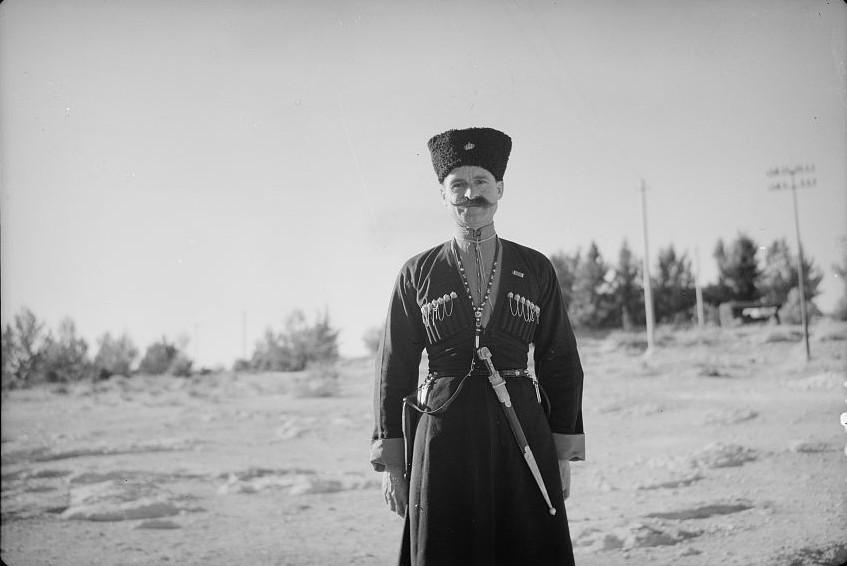
One of the most distinctive features of the Jordanian Royal Circassian Guard is their uniform, adorned with traditional elements worn during palace duties. Designed for cold climates, this attire creates a striking contrast with Jordan’s desert environment. Guards wear black woolen winter caps, red capes extending from the shoulders downward, and long leather boots. These elements create a visual appearance evoking Circassian warrior heritage while establishing a strong visual contrast within the palace setting, making the guards highly conspicuous.
The uniform is completed with a simple tunic or jacket worn over the body, crossed by a cartridge belt across the chest. The color, cut, and fabric texture of the uniform represent a hybrid form, merging modern military uniform standards with traditional Circassian clothing. Thus, the guards are perceived both as official representatives of a modern state and as bearers of a warrior culture transplanted from the Caucasus, standing before the palace architecture.
One of the distinguishing features of the Circassian guard uniform is the row of cartridge holders on the chest. The uniform features 16 decorative ammunition cartridges, adorned with black leather and silver details. These cartridges are not functional ammunition but serve as symbolic reminders of a historical military practice. The arrangement of cartridges crossing the chest is designed to evoke the armed struggles of Circassian warriors in the 19th century.
Beneath the cartridges, a double-layered leather belt is worn around the waist. This belt secures the tunic and cape to the body and allows for carrying a sword, dagger, and small items. On the belt, metal buckles and sometimes ornamental decorations are fitted to harmonize with the uniform’s overall aesthetic. Thus, the belt becomes both a practical carrying element and a visual component that enhances the uniform’s weight and presence.
Within the historical narrative of the cartridges, it is recounted that one of these small containers held poison for use in suicide if captured, while another carried a flask of honey to provide energy during long duties. This narrative symbolically expresses the ideal of “resisting until the last moment” rather than retreating or surrendering, and the will to endure under harsh conditions. Although today the cartridges contain no chemical substances, this historical story persists as a reminder of the connection between the uniform’s materials and the Circassian warrior ethos.
The completeness of the Circassian guard’s attire is finalized by the carrying of cutting weapons at the waist and side. Within the ceremonial equipment of the unit, two distinct swords stand out. The first is the long sword known as the “seshweh.” Its hilt and scabbard are decorated with ornamental metal elements and leather coverings. The blade bears an Arabic inscription: “If God helps you, no one can overcome you.” This phrase transforms the sword from a mere weapon into a symbol of divine assistance and protection.
The second weapon is the shorter, broader-bladed “qama,” a type of short sword or dagger common in the Caucasus. In the Jordanian context, this weapon is referred to by a name meaning “the scent of death” in Arabic. This naming emphasizes the qama’s lethal nature in close combat and alludes to the Circassian warrior tradition of direct, face-to-face confrontation. The simultaneous carrying of the long sword and the short qama physically manifests two distinct weapons suitable for different combat distances within a single uniform ensemble.
The uniform and equipment of the Jordanian Royal Circassian Guard carry symbolic meaning on several levels. First, the attire associated with Circassian identity demonstrates that a community exiled from the Caucasus has preserved its existence and cultural heritage in its new homeland. The uniform carries the Circassian community’s historical memory into the public sphere through palace staircases and state ceremonies.
Second, the bond established between the attire and the Hashemite monarchy is significant. The inscription on the sword and the identification of the guard institution with loyalty to the dynasty transform this uniform into a visual extension of monarchical legitimacy. The red capes and cartridge belts of the guards are perceived not merely as military aesthetics at the palace entrance but as the enacted embodiment of “the dynasty’s armed protection.”
Third, the tension between the uniform’s warrior elements and its current ceremonial function is noteworthy. Today, the guards carry cartridges that are empty and swords that are not used in actual combat, yet they appear as figures wearing historical warrior attire. This indicates that the uniform fulfills a narrative role rather than a functional one, transforming the memory of warfare into a form of representation. Thus, the uniform of the Jordanian Royal Circassian Guard acquires meaning as a complex ensemble of symbols expressing identity, history, and state authority simultaneously in Jordan.
The Jordanian Royal Circassian Guard has become a frequently used motif in Jordan’s international visual representations. In recent years, the intensified presence of royal activities in written and visual media has increased the visibility of the Royal Circassian Guard. In photographs and footage published on royal websites, news agency bulletins, and international press, Circassian guards are often seen lined up on staircases or in palace courtyards alongside royal guests. These images have become nearly standard components of news coverage on the Jordanian monarchy.
On television programs, documentary content, and interviews, occasional brief narratives about the guards’ service duration, training, and daily duties appear; this contributes to the unit’s transition from being perceived as a “closed palace institution” to becoming a subject of public curiosity and partial recognition.
Domestic public perception is generally shaped along two axes. On one hand, guard service is equated with discipline, loyalty, and professionalism; on the other, it is viewed as the contemporary continuation of the Circassian community’s historical service and relationship with the state. Therefore, the image of guards standing watch before the palace is not merely perceived as “official ceremonial decor” but also as a kind of collective memory object.


No Discussion Added Yet
Start discussion for "Jordanian Royal Circassian Guard" article
Historical Background: The Circassian Migration and Settlement in Jordan
Circassian Settlements in Jordan
Socio-Economic Position and Military Image
Founding of the Hashemite Kingdom and Alliance with the Circassians
Institutionalization of the Circassian Guard
Emergence of the Arab Army and Royal Guard Units
Institutional Position of the Circassian Guard
Royal Guard in Different Periods
Organization and Duties
Position and Area of Responsibility within the Palace
Ceremonial and Protocol Functions
Accompanying the Royal Family and Daily Activities
Division of Labor with Other Security Units
Selection, Training, and Professional Profile
Personnel Source and Social Background
Selection Criteria and Application Process
Training Process and Professional Competencies
Rank Structure and Career Opportunities
Uniform, Equipment, and Symbols
Key Elements of the Uniform
Cartridge Belts, Belts, and Additional Accessories
Swords, Daggers, and Inscriptions
Symbolic Meaning of the Uniform
The Circassian Guard Image in Popular Culture