
This article was automatically translated from the original Turkish version.
Leopard 2 is a third-generation main battle tank (MBT) manufactured in Germany. It was developed and produced by Krauss-Maffei Wegmann (KMW). As the successor to Germany’s former main battle tank, the Leopard 1, development began in the 1970s and it entered service with the West German Armed Forces (Bundeswehr) in 1979. Thanks to its superior combination of mobility, firepower and armor protection, it now forms the backbone of armored forces in many European countries and other nations worldwide.
In 1977, the German Army selected Krauss-Maffei (today KMW) as the prime contractor for series production of the Leopard 2. An initial order for 1,800 MBTs was placed, of which 990 units were produced by Krauss-Maffei and the remaining 810 units by Rheinmetall. These two companies became the principal partners in the tank’s series production. Rheinmetall specifically supplied the tank’s main weapon, the 120 mm smoothbore gun, and key components of the fire control system.
The first production Leopard 2 was delivered by Krauss-Maffei to the German Army in Munich in October 1979. Production rates increased steadily: 6 tanks were delivered in 1979, 100 in 1980, 220 in 1981, and from 1982 onward, annual production reached 300 tanks.
The Leopard 2A4 model is the most widespread variant of the Leopard 2 family and forms the foundation of today’s Leopard tank series. This model introduced significant improvements over earlier versions:
Throughout its service life, the Leopard 2 has undergone continuous modernization and numerous variants have been developed.

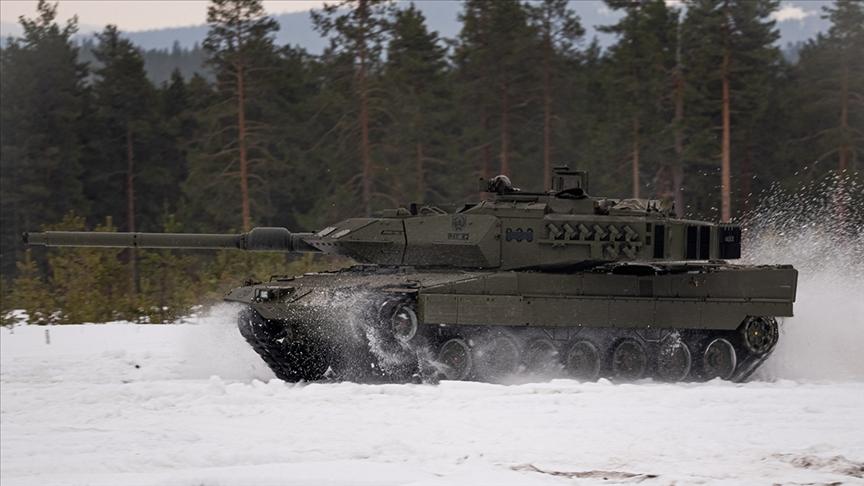
Leopard 2A4 (Anadolu Agency)
The Leopard 2 tank is currently used by numerous countries, including primarily Germany, as well as Austria, Canada, Chile, Denmark, Finland, Greece, the Netherlands, Norway, Poland, Portugal, Singapore, Switzerland, Sweden, Spain and Türkiye. In recent years, the tank has gained prominence due to military aid deliveries to Ukraine:
The Leopard 2A4 was developed toward the end of the Cold War and adopted as the standard main battle tank by West Germany. Following the end of the Cold War and structural changes within the German military, hundreds of surplus Leopard 2A4 tanks were exported to numerous countries under favorable conditions. This has made the Leopard 2A4 one of the most widely used modern main battle tanks globally.
Leopard 2A4s first gained large-scale combat experience as part of NATO-led peacekeeping forces in Kosovo (KFOR). Canada actively deployed its Leopard 2A4s in Afghanistan against the Taliban, demonstrating the tanks’ effectiveness in crew protection and firepower against improvised explosive devices (IEDs). However, the tank’s vulnerabilities in asymmetric warfare conditions became evident during Türkiye’s operations in Syria.
In the mid-2000s, Türkiye acquired 354 second-hand Leopard 2A4 tanks from Germany in two packages. These tanks represented a major step in modernizing the Turkish Land Forces’ armored units, replacing older-generation M60 Patton tanks. For many years, Leopard 2A4s were primarily used in peacetime duties and training exercises until they experienced their first serious combat during the Operation Euphrates Shield in Syria between 2016 and 2017.
During the operation, particularly in urban combat around Al-Bab, Leopard 2A4 tanks proved vulnerable to the asymmetric threats of the time. The tanks suffered significant losses against modern anti-tank guided missiles (ATGMs), rockets, and IEDs employed by ISIS militants. The turret and side armor, originally designed to counter older-generation anti-tank weapons, proved inadequate against modern threats. This experience highlighted an urgent need for modernization of the Leopard 2A4s within the Turkish Armed Forces.
In response, Türkiye launched the Leopard 2A4 TİYK (Turkish Industrial Capabilities Enhanced) project based on lessons learned in Syria. Led by domestic defense industry firms such as ASELSAN and ROKETSAN, the modernization program aims to significantly enhance crew survivability. The following systems have been integrated into the tanks:
The first modernized prototype tanks emerged in 2021, and serial modernization activities have since begun. The goal of this program is to bring the Leopard 2A4s up to the requirements of 21st-century battlefields.
Following Russia’s invasion of Ukraine in 2022, Western nations provided comprehensive military aid to the Ukrainian Armed Forces. One of the most significant components of this aid has been the donation of Leopard tanks by various European countries. The “Leopard Coalition,” comprising Germany, Poland, Spain, Canada, Norway and others, has transferred large numbers of Leopard 2A4 tanks to Ukraine. Ukrainian crews, after accelerated training in countries such as Poland and Germany, have begun deploying these tanks on the front lines. Leopard 2A4s played a key role in the counteroffensive operations launched in summer 2023. In mechanized assaults aimed at breaking through Russian defensive lines, these tanks have demonstrated superior firepower, accuracy, crew protection and mobility compared to Soviet-era tanks.
However, dense minefields, Russian ATGMs (particularly the Kornet), and kamikaze drones such as the Lancet have also caused losses among Leopard 2A4s. Open-source intelligence reports indicate that numerous Leopard 2A4s have been destroyed or damaged. Nevertheless, one of the tank’s most important advantages has been its crew survivability. Unlike Soviet-designed tanks, Leopard 2A4s, built to Western standards, have demonstrated that even when hit, their ammunition compartments are designed to vent explosions outward and their high-quality armor significantly increases crew survival rates. This has provided a critical advantage to the Ukrainian military by preserving experienced crews.
The Leopard tank family, an iconic armored platform of the Cold War, is undergoing significant evolution in response to the changing threat environment and technological advancements of the 21st century. Its future is shaped by a multi-layered strategy involving comprehensive modernization of existing models, production of new variants, and ultimately, replacement by an entirely new combat system.
The most advanced and technologically sophisticated representative of the Leopard platform is the Leopard 2A8. Designed in light of combat experience in Ukraine, this variant aims to maximize survivability and situational awareness. Key innovations of the 2A8, developed from the Leopard 2A7V, include:
Countries such as Germany, Norway, Italy and the Czech Republic have committed to acquiring the Leopard 2A8, confirming that the platform will remain Europe’s standard main battle tank at least until the 2040s. In parallel, the company KNDS is developing radical concepts such as the Leopard 2 A-RC 3.0, featuring an unmanned turret. Such designs aim to enhance survivability and reduce weight by placing the crew in a more protected capsule within the hull and using automated loading systems.
The long-term successor to the Leopard 2 is not a single tank but a “system of systems” known as the Main Ground Combat System (MGCS) project. Led jointly by France and Germany, this ambitious initiative aims to replace both the Leopard 2 and the French Leclerc tank by the 2040s.
The core philosophy of MGCS is based on the recognition that future battlefields cannot be dominated by a single platform. The system is planned to include the following elements:
The MGCS represents a transition from the traditional main battle tank concept embodied by the Leopard to a network-centric, manned-unmanned teaming combat system. This project will inherit the legacy of the Leopard platform and define the future of European land power.
Aghakazim Guliyev. “Türkiye Launches Comprehensive Upgrade of Leopard 2A4 Tanks.” Caliber.az, September 8, 2025. https://caliber.az/en/post/turkiye-launches-comprehensive-upgrade-of-leopard-2a4-tanks.
Akshan Elezhor. “KNDS Flaunts Leopard 2A-RC 3.0 Tank With Remote Turret, ‘Expanded’ Firepower.” Next-Gen Defense, August 12, 2025. https://nextgendefense.com/knds-leopard-unmanned-turret-tank/.
Alexey Tarasov. “MGCS Status Update.” European Security & Defence, August 27, 2025. https://euro-sd.com/2025/08/articles/exclusive/45998/mgcs-status-update/.
Cem Devrim Yaylalı. "Drones, Tanks and Ships: Takeaways from Turkey's Annual Defense Report." Defense News, March 11, 2024. https://www.defensenews.com/global/europe/2024/03/11/drones-tanks-and-ships-takeaways-from-turkeys-annual-defense-report/.
David Murphy. “Will Leopard 2 Tanks Be a Game-Changer in Ukraine?” Maynooth University, January 2023. https://www.maynoothuniversity.ie/research/spotlight-research/will-leopard-2-tanks-be-game-changer-ukraine.
Dean Sidney. “Main Ground Combat System (MGCS): A Status Report.” European Security & Defence, January 23, 2023. https://euro-sd.com/2023/01/articles/29122/main-ground-combat-system-mgcs-a-status-report/.
Jill Marc Münstermann. Leopard Tanks in Action: History, Variants and Combat Operations of the German Leopard 1 & 2 Main Battle Tanks. K&F Verlag, 2021.
KNDS. “LEOPARD 2 A8.” ATRESMEDIA. Accessed October 12, 2025. https://www.atresmedia.com/documents/2025/01/24/41DE10EC-D361-4E32-A1D7-64B5831EF51E/kndsbansichtleopard2a8en.pdf.
Michael Jerchel. Leopard 2 Main Battle Tank 1979–98. New Vanguard, no. 24. Oxford: Osprey Publishing, 1998.
Nigel James. “German Tanks Always Flop. The Leopard 2 Is No Different.” The Spectator, April 14, 2025. https://www.spectator.co.uk/article/german-tanks-always-flop-the-leopard-2-is-no-different/.
Presidency of the Republic of Turkey, Presidency of Defence Industries. “Turkish Defence Industry Products Catalogue.” Accessed October 12, 2025. https://www.mfa.gov.tr/data/ENFORMASYON/SSB-tanitim-catalog.pdf.
Rheinmetall AG. “Leopard Main Battle Tank (a Trademark of KNDS Deutschland GmbH & Co. KG).” Rheinmetall. Accessed October 12, 2025. .
Rheinmetall AG. “Option for New Generation Main Battle Tanks: Rheinmetall Presents the Concept Uncrewed Turret at Eurosatory 2024.” Press release, June 17, 2024. https://www.rheinmetall.com/Rheinmetall%20Group/Presse/News/Documents/2024/06/Presskit-Eurosatory/en/Premiere_17.06.2024-16Uhr/2024-06-17%20Rheinmetall%20MBT%20CUT%20en%20Eurosatory%202024_final.pdf.
TOC. “81 Turkish Leopard 2A4 Tanks Will Receive New Fire Control Systems.” BulgarianMilitary.com, March 23, 2023. https://bulgarianmilitary.com/2023/03/23/81-turkish-leopard-2a4-tanks-will-receive-new-fire-control-systems/.
“APS Trophy for Leopard 2A8 Main Battle Tank Under Contract.” ES&T, September 6, 2023. https://esut.de/en/2023/09/meldungen/44432/aps-trophy-fuer-kampfpanzer-leopard-2a8-unter-vertrag/.
“Army Logistics – a Branch of the Army.” Bundeswehr. Accessed October 12, 2025. https://www.bundeswehr.de/en/organization/army/organization/branches/army-logistics.
“Canada's Equipment in Afghanistan.” CBC News, March 4, 2014. https://www.cbc.ca/news/canada/canada-s-equipment-in-afghanistan-1.850849.
“EDA Seeks European Defence Industry's Input on Main Battle Tank Optimization.” European Defence Agency, September 22, 2017. https://eda.europa.eu/news-and-events/news/2017/09/22/eda-seeks-european-defence-industry-s-input-on-main-battle-tank-optimization.
“German Tank ‘Leopard 2’.” KOPIRAIT. Accessed October 12, 2025. https://kopirait.com.ua/en/german-tank-leopard-2/.
“Leopard 2A8.” Army Recognition. Accessed October 12, 2025. https://www.armyrecognition.com/military-products/army/main-battle-tanks/main-battle-tanks/leopard-2a8-mbt-main-battle-tank-technical-data.
“Tank Modernization Solutions by Aselsan.” Defence Turkey Magazine. Accessed October 12, 2025. https://www.defenceturkey.com/en/content/tank-modernization-solutions-by-aselsan-2779.

Development and Production
Leopard 2A4 Variant
Variants
User Countries and International Sales
Operational History
Use and Modernization in the Turkish Armed Forces
Use in Ukraine
The Future of Leopard Tanks