

This article was automatically translated from the original Turkish version.
+2 More
Megali Idea, in Greek, means “Great Idea,” “Great Ideal,” or “Great Aspiration.” This concept formed the core ideological framework of modern Greek nationalism, aiming to shape Greece’s national identity, expand its territory, and establish historical and cultural continuity. It was first formally articulated in 1844 by Ioannis Kolettis, then Prime Minister of Greece, in the Greek Parliament. According to Kolettis, the Kingdom of Greece was the smallest and oldest part of the Hellenic nation; all lands historically and culturally connected to the remaining Greeks must be incorporated into this state.
The Megali Idea was not merely a territorial expansion program but evolved into a multifaceted doctrine that reinterpreted historical heritage, supported nation-building, and pursued expansion through cultural and religious propaganda. From the mid-19th century to the early 20th century, this idea defined Greece’s foreign policy and became a national ideal that unified the populace and facilitated identity formation domestically.
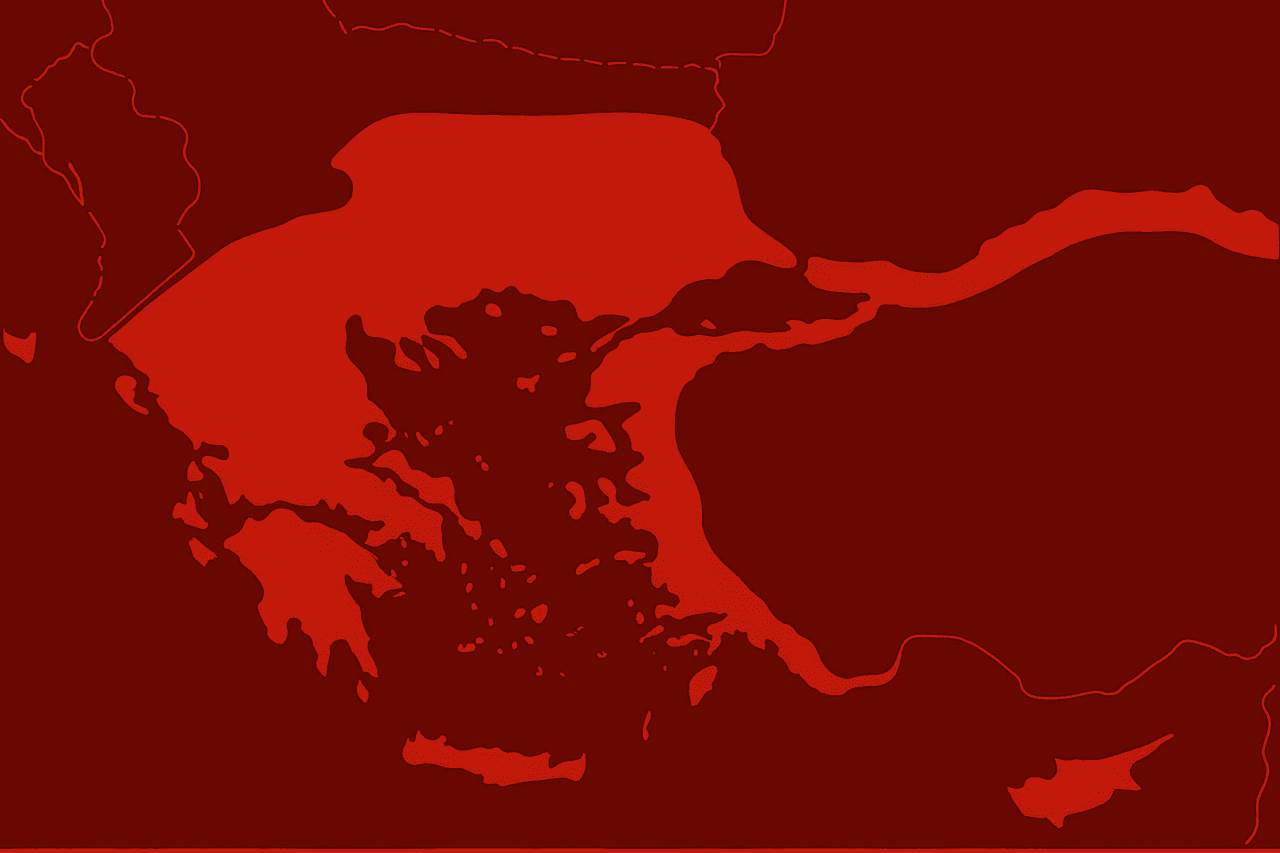
Megali Idea (generated by Artificial Intelligence)
One of the primary goals of the Megali Idea was to reestablish the Byzantine Empire within its widest historical boundaries and transform it into a state ethnically, linguistically, and culturally Hellenic. Istanbul was designated as the capital. It was argued that the Byzantine Empire constituted a continuous part of Greek history, stretching from Ancient Greece to the modern Greek nation. This rebirth aimed to appropriate the Eastern Roman legacy and realize a vision of a Hellenic state in the Western sense.
The second fundamental aim of the Megali Idea was to incorporate all regions inhabited by people of Hellenic origin or associated with Hellenic culture into the Greek state. The phrase “liberating our brethren under the yoke” was frequently used in this context. This idea was understood as completing national unity and ensuring ethnic integrity.
The territories targeted by the Megali Idea include:
These regions were historically associated with Ancient Greece, the Byzantine Empire, or the Rum Orthodox communities and thus incorporated into Greek national objectives.
The Megali Idea was not merely a military or political expansion plan but also a long-term mobilization effort conducted through education and culture. For the success of this ideological project, raising public awareness, systematically constructing, and disseminating Hellenic identity were essential tools. Educational policies and cultural propaganda played central roles in implementing the Megali Idea.
The University of Athens, founded in 1837, was one of the earliest institutional expressions of the cultural dimension of the Megali Idea. This university became a center not only for students within Greece’s borders but also for Greek-speaking youth living under Ottoman rule. Graduates served as teachers and clergy, transmitting Hellenic culture to Orthodox communities in the Balkans.
Many Rum schools were established in regions of the Ottoman Empire with dense Rum populations. The language of instruction was Greek, and curricula included Ancient Greek history, Greek mythology, Hellenistic philosophy, and Byzantine history. The primary aim of these educational efforts was to instill a Greek identity in local children and prepare them to see themselves as natural citizens of Greece in the future.
The Patriarchate of Constantinople became one of the most important institutional actors operating in line with the Megali Idea. The Patriarchate conducted propaganda infused with religious and cultural content, appointed teachers to schools, promoted Hellenic nationalism through sermons, and propagated the idea that the Greek state was the “natural protector” of Orthodox Christians. This clearly demonstrates how religious institutions fulfilled ideological functions within the Megali Idea.
The educational mobilization was also carried out through symbols. Hagia Sophia, the double-headed Byzantine eagle, Hellenic heroes, and Byzantine iconography were used as visual elements in educational materials and on school walls. Through these symbols, the sanctity, historical continuity, and imperial mission of Hellenic identity were embedded in children’s subconscious.
Greek associations and cultural societies established in Greece and abroad, particularly in cities such as Istanbul, İzmir, and Thessaloniki, actively promoted the systematic dissemination of Hellenic culture. These organizations organized theater, music, lectures, and religious ceremonies to mobilize public support around the Megali Idea.
To ensure the ideological continuity of the Megali Idea, the past had to be reconstructed and historical events reinterpreted within the framework of Hellenic identity. This process constituted a historical construction effort sustained at both academic and public memory levels. Hellenic historiography was structured to legitimize the Megali Idea.
The historical understanding of the Megali Idea sought to establish an unbroken link between Ancient Greek civilization, Macedonian Hellenism, the Byzantine Empire (Medieval Hellenism), and modern Greek identity. This concept of historical continuity asserted that the modern Greek nation had developed over the same territory and around the same values since antiquity. Thus, the Byzantine Empire was defined as a Greek state.
German historian Jacob Philipp Fallmerayer sparked significant debate by arguing that modern Greeks were not ethnically descended from the Ancient Greeks. Proponents of the Megali Idea launched intense historical propaganda against this thesis, claiming through archaeological and written sources a continuous lineage of blood, language, and culture connecting Ancient Greece, Byzantium, and modern Greece.
In Greek educational curricula, particularly at primary and secondary levels, Ancient Greece and the Byzantine period occupied central positions. These two eras were presented as the foundational pillars of modern Greek identity and transmitted to students as “the legacy of our ancestors.” In this sense, history education became one of the most powerful propaganda tools of the Megali Idea.
Hellenic historiography portrayed Greek culture as superior to Eastern civilizations and framed the “civilizing mission of Hellenizing the East” as a historical responsibility. This perspective emphasized Hellenism as a universal set of values to be spread. This historical outlook provided an intellectual justification for political expansion.
Following independence, the Megali Idea became an ideological and practical cornerstone in Greece’s process of nation-building. As the state institutionalized, the population coalesced around political unity, and modern Greek identity was formed, the Megali Idea generated both historical and cultural legitimacy.
The borders of modern Greece, established by the 1829 Treaty of Edirne and the 1830 London Protocol, were widely perceived as too narrow compared to popular historical expectations. This created a sense of national incompleteness; the public came to believe that the state encompassed only a small fraction of true Greek lands. The Megali Idea filled this psychological void by offering a national goal based on the belief that Greece was a “nation unfinished.”
The Megali Idea sought to subordinate internal class, regional, and economic divisions by uniting all citizens around a common “Hellenic goal.” This ideal particularly strengthened the bond between the state and the rural population. Through the rhetoric of struggle against common enemies and the liberation of lost territories, the Megali Idea fulfilled a function of strengthening national unity.
Economic crises, political instability, and social unrest following independence were temporarily overshadowed by the Megali Idea. Governments periodically revived the Megali Idea to mitigate the domestic impact of crises, placing discourses of the “external enemy,” “liberated lands,” and “historical rights” at the center of public discourse.
The historical narrative offered by the Megali Idea strengthened national pride and a sense of historical belonging by presenting the Greek people with an uninterrupted identity from antiquity to the present. According to this view, modern Greeks were the direct heirs of Ancient Greek philosophers, Byzantine emperors, and Hellenic heroes. Thus, a vision of a nation unbroken from its past was constructed.
The cultural narrative promoted by the Megali Idea was based on the assumption that Hellenic civilization was superior to others. This approach instilled in the Greek people both historical and cultural self-confidence and supported the notion of a “civilizing mission” toward the East. This led to the emergence of cultural imperialism as a goal alongside territorial expansion.
In defining national identity, Greek was positioned not merely as a language of communication but as a symbol connecting people to history and identity. The emphasis placed on Classical Greek and Hellenic history in educational policies aimed to shape individuals’ identities in accordance with the state’s ideological line. This was especially true for Rum populations living under Ottoman rule.
The Megali Idea aimed to incorporate regions associated with Hellenic culture or inhabited by Rum populations into Greece. Geographically, these objectives included:
Seven Islands (Ionian Islands) – 1864 The Seven Islands, under British control, were ceded to Greece in 1864. This development was regarded as Greece’s first significant territorial gain under the Megali Idea.
Thessaly – 1881 As a result of the Treaty of Constantinople, the Ottoman Empire ceded a large part of Thessaly to Greece. This region held strategic importance for Hellenic expansion in the Balkans.
As a result of the Balkan Wars, Greece:
Annexation of Crete: After the 1897 Greco-Turkish War, Crete gained autonomy, and Prince George was appointed governor. In 1908, under the leadership of Eleftherios Venizelos, Crete declared union with Greece. This annexation was internationally recognized by the 1913 Treaty of London. The annexation of Crete was regarded as the first symbolic success of the Megali Idea in practice.
Acquisition of the Dodecanese: After Italy’s defeat in World War II, the Dodecanese were ceded to Greece under the Paris Peace Treaty of February 10, 1947. This is considered the last major territorial gain under the Megali Idea.
Anatolian Campaign (1919–1922): Occupation of İzmir and Western Anatolia On May 15, 1919, the Greek army landed in İzmir in accordance with decisions of the Paris Peace Conference and occupied Western Anatolia. The goal was to incorporate Western Anatolia into Hellenic territory and revive the Byzantine Empire through the capture of Istanbul.
Military Defeat and Withdrawal: Greece suffered a severe defeat in the war led by the Turkish National Movement. The Great Offensive and the liberation of İzmir between August 26 and September 9, 1922 ended the Greek occupation. This defeat is known in Greek history as the “Asia Minor Catastrophe” (Mikra Asia Katastrofi). This event is regarded as the end of the Megali Idea on both military and political levels.
Treaty of Lausanne (1923) and Official Withdrawal: Under the 1923 Treaty of Lausanne, Greece was forced to abandon many of its Megali Idea objectives and fully withdraw from Anatolian territories. Claims to regions other than Gökçeada and Bozcaada were rejected, and the military status of the Aegean islands was placed under international regulation.
Crete was one of the earliest and most intense targets of the Megali Idea. Selected as one of the first areas for Hellenic expansion due to its geopolitical position and its historical, ethnic, and religious structure, the process of removing Crete from Ottoman rule and uniting it with Greece served as a concrete example of the Megali Idea’s gradual implementation. Local resistance and international intervention played decisive roles in this process.
Crete is located in the eastern Mediterranean, between the Aegean Sea and North Africa. The island had a strong Rum population and an Orthodox Christian belief system. In this context, Crete, identified with Hellenic culture, was defined as part of Greek national objectives. Within the Megali Idea, Crete was viewed as an “indivisible part of the Hellenic homeland.”
Revolts broke out on Crete simultaneously with the 1821 Greek War of Independence. These uprisings weakened Ottoman control and increased unrest and internal conflict on the island. A major revolt in 1866, supported by foreign representatives including the Russian consul in Chania, was one of the first open movements demanding Crete’s union with Greece. The “Arkadi Monastery Incident” during the revolt received international press coverage, prompting European public opinion to show sympathy toward the Rum population.
Following an agreement between the Ottoman Empire and Cretan Rum leaders, the island gained autonomous status. The Halepa Pact established a council with majority Rum representation, allowed the governor to be either Christian or Muslim, granted official status to the Greek language, and expanded rights in education, schools, and press freedom. The 1897 Greco-Turkish War escalated tensions on Crete to the international level. After the war, European powers mediated and granted Crete autonomous administration. Prince George, son of the Greek king, was appointed governor with international approval.
Eleftherios Venizelos, a Cretan lawyer and politician, became one of the main actors in the Enosis process. After a disagreement with Prince George, he quickly assumed leadership of the political developments on the island. The 1913 Treaty of London, following the First Balkan War, officially recognized Crete’s union with Greece internationally. With this development, the first major goal of the Megali Idea was achieved, and Crete was incorporated into Greece.
The union of Crete with Greece strengthened the belief that the Megali Idea was a viable policy. This development increased trust in the Greek state among the Rum population, generated hope among Rum communities in other target regions, and strengthened European sympathy toward Greece.
The western coasts of Anatolia, one of the ultimate goals of the Megali Idea, were occupied by Greece between 1919 and 1922. This process represented the transformation of the Megali Idea into a concrete military campaign. However, this occupation ended in a severe military defeat for Greece and is referred to in historical literature as the “Asia Minor Catastrophe” (Mikra Asia Katastrofi) or the “Great Disaster.”
Paris Peace Conference (1919) After World War I, the victorious powers addressed the partitioning of Ottoman territories. Greece, at the Paris Peace Conference, cited the presence of a Rum population and Hellenic cultural heritage in Western Anatolia to assert historical claims over the region.
Prime Minister Eleftherios Venizelos, through diplomatic efforts in Paris, demanded that İzmir, Thrace, and the Aegean Islands be ceded to Greece, arguing that these claims were legitimate under the Megali Idea. These proposals, backed by Britain, advanced despite partial reservations from France and Italy.
Occupation of İzmir: On May 15, 1919, the Greek army landed in İzmir with the approval of the Allied Powers. This landing was supported by the local Rum population, and the occupation rapidly spread across the Aegean region.
Greece and Western Anatolia: During the occupation, the Greek army advanced into the interior of Western Anatolia, capturing strategic cities. Fighting occurred in 1920 along the Gediz and Uşak fronts. In 1921, Greek forces occupied cities such as Bursa and Eskişehir, establishing a line aimed at reaching Ankara. This period witnessed widespread destruction and waves of displacement.
Battle of Sakarya: The Greek army’s advance toward Ankara was halted at the Sakarya River line. After a 22-day, 22-night battle, the Turkish army achieved a decisive defensive victory, forcing Greek units to retreat. This battle marked a strategic turning point in halting the occupation. On August 26, 1922, the Turkish army launched a major offensive along the Afyon-Kocatepe line. As a result, the Greek army suffered a crushing defeat and rapidly withdrew. Greek forces were expelled from İzmir, and the city came entirely under Turkish control. This development symbolized the end of the Greek presence in Anatolia and marked the historical beginning of the collapse of the Megali Idea.
In Greek public opinion, this period was called the “Asia Minor Catastrophe.” Its consequences included:
The migration of hundreds of thousands of Rum from Anatolia,
The İzmir fire and civilian losses,
Domestic political turmoil in Greece (deposition of the king, military coup).
Following the defeat of 1922 and the dissolution of the Greek army, a deep political crisis erupted in Greece. Military leaders and government officials were held accountable, and many high-ranking figures were tried and executed. A strong societal backlash against the monarchy followed the defeat. In 1924, a popular referendum abolished the monarchy and proclaimed a republic. This process laid the groundwork for the removal of the Megali Idea from state policy.
Lausanne Conference: During the Lausanne Peace Conference, Greece renounced all territorial claims in Anatolia and accepted a population exchange agreement with Turkey. This treaty established the new status of Western Anatolia, Eastern Thrace, and the Aegean Islands, diplomatically ending the expansionist policy of the Megali Idea.
Under the Treaty of Lausanne, Greece abandoned all claims over the Rum population in Turkey and recognized Anatolian territories as belonging to the Republic of Turkey. Thus, the Megali Idea’s goal of territorial expansion was definitively ended under international law. The 1923 Turkey-Greece Population Exchange Agreement resulted in approximately 1.2 million Anatolian Rums migrating to Greece and 500,000 Muslims relocating to Turkey. This process eliminated the social foundation of the Megali Idea’s ideal of “reuniting the Hellenic world.”
After the 1920s, Greece shifted toward building a national identity based on internal consolidation and economic stability. The resettlement of refugees, economic development within new borders, and the promotion of social cohesion became the pillars of national policy.
Eleftherios Venizelos, one of the most important political representatives of the Megali Idea, when returning to power in 1928, no longer advocated expansionist policies. Instead, he aimed to develop peaceful relations with Turkey. The Turkish-Greek Friendship Treaty signed in Ankara in 1930 is a concrete example of this shift.
Although politically the Megali Idea ended, cultural attachment to the Hellenistic legacy persisted. Themes of the Megali Idea continued to appear indirectly in educational programs, literature, and art. The Greek Orthodox Church also remained a carrier of this cultural continuity.
In the 1950s, the idea of linking Cyprus to Greece resurfaced as a reflection of the Megali Idea. This time, however, the opposition was not the Ottoman Empire but Britain and later Turkey. The 1955 EOKA movement and the establishment of the Cyprus Republic in 1960 represent the late echoes of this ideal.
In modern Greece, the Megali Idea is no longer a state policy. However, it persists as a nostalgic element within historical and academic circles, particularly in diaspora communities and certain nationalist circles. In Greek history textbooks, this ideal is generally presented as part of the national awakening, and the idea has not been entirely eradicated.
Ak, Gökhan. “Megali İdea’dan Önyargı ve Güvensizliğe Türk-Yunan İlişkileri.” JAVStudies, 2024: 842–851. Accessed August 4, 2025. https://javstudies.com/files/javstudies_makaleler/1435103636_842-851-MEGALİ%20İDEA%E2%80%99DAN%20ÖNYARGI%20VE%20GÜVENSİZLİĞE%20TÜRK-YUNAN%20İLİŞKİLERİ.pdf
Erdem, Nilüfer. “Megali İdea’nın Anadolu’daki Destekçilerinden Doktor Apostolos N. Psaltoff’un 1912–1922 Dönemindeki Etkinlikleri.” *Çağdaş Türkiye Tarihi Araştırmaları Dergisi* 13, no. 27 (2013): 63–77. Accessed August 4, 2025. https://dergipark.org.tr/tr/download/article-file/237049.
Jenkins, Mary A. *To Megali Idea—Dead or Alive?: The Domestic Determinants of Greek Foreign Policy.* PhD thesis, Naval Postgraduate School, 1994. Accessed August 4, 2025. https://calhoun.nps.edu/server/api/core/bitstreams/ca8daa51-2d39-46fb-8508-656c344d526f/content.
Ntokme, Outkou Kirli. “Ulus Devlet Oluşturmada Yunanistan Örneği: Büyük Ülkü Megali İdea.” Ankara Üniversitesi Türk İnkılâp Tarihi Enstitüsü Atatürk Yolu Dergisi, no. 46 (2010): 401–424. Accessed August 4, 2025. https://dergipark.org.tr/en/download/article-file/20518.
Toprak, Serap. “Megali İdea’ya Bir Örnek: Girit.” *İnsan ve Toplum Bilimleri Araştırmaları Dergisi* 1, no. 1 (2012): 118–142. Accessed August 4, 2025. https://dergipark.org.tr/en/download/article-file/92771.
Yalçın, Emruhan. “Yunanların Bitmeyen İdeali: ‘Megali İdea.’” *Toros Üniversitesi İİSBF Sosyal Bilimler Dergisi* 4, no. 7 (2017): 33–48. Accessed August 4, 2025. https://dergipark.org.tr/tr/download/article-file/394799.
Zafeiridis, Constantinos. “‘Megali Idea’ and the Aim of Inclusion of the Southern Black Sea Hellenic Population in the Modern Greek Notion (1896–1922).” Master's thesis, International Hellenic University, 2020. Accessed August 4, 2025. https://core.ac.uk/download/pdf/328007096.pdf.

Main Objectives
Geographical Target Areas
Megali Idea and Education
Megali Idea and Identity
Targeted Territories under the Megali Idea
Balkan Wars and Expansion
Megali Idea and Crete
Occupation of Anatolia
Treaty of Lausanne and Population Exchange