
This article was automatically translated from the original Turkish version.
Name | National Technology Initiative | ||||||||
|---|---|---|---|---|---|---|---|---|---|
Official Start Date | 18 September 2019 | ||||||||
Declared Strategy Documents | 2023 Industry and Technology Strategy 2030 Industry and Technology Strategy | ||||||||
Objectives | Economic and Technological Full Independence Domestic Production of Critical Technologies Global Competitiveness in High Technology Original and Innovative Production Strengthening the R&D and Innovation Ecosystem Directing Youth Toward Technology Production | ||||||||
Relevant Institutions and Organizations | Ministry of Industry and Technology Presidency of Defense Industries General Directorate of National Technology and Artificial Intelligence Türkiye Technology Team (T3) Foundation Scientific and Technological Research Council of Türkiye (TÜBİTAK) Presidency of Small and Medium Enterprises Development and Support Administration | ||||||||
Relevant Programs | TEKNOFEST Aviation, Space and Technology Festival DENEYAP Technology Workshops Technology-Oriented Industry Initiative Program (HAMLE) HIT-30 High Technology Investment Program National Technology Academy 42 School of Software | ||||||||
National Technology Initiative (NTI) is a comprehensive industrial, technological, research and development (R&D), entrepreneurship, and human resources-oriented policy framework established to strengthen Türkiye’s economic and technological independence, enhance high-value-added production capacity, and reduce dependence on foreign critical technologies. The concept began to be used in technology policies especially from the second half of the 2010s and was transformed into a comprehensive public policy framework with the publication of the 2023 Industry and Technology Strategy in 2019.

Milli Teknoloji Hamlesi Temsili Görsel (T.C. Sanayi ve Teknoloji Bakanlığı)
Türkiye’s history of industrialization, technology transfer, and local production policies extends back to the late Ottoman Empire. In the early years of the Republic, alongside state-supported investments, local aviation initiatives emerged from figures such as Vecihi Hürkuş and Nuri Demirağ but were interrupted by economic bureaucratic and political obstacles. The embargoes imposed after the 1974 Cyprus Peace Operation highlighted the constraints caused by dependence on foreign defense technologies and laid the groundwork for the development of a local defense industry ecosystem including institutions such as ASELSAN TUSAŞ and later ROKETSAN.
From the 2000s onward, the process accelerated with the strengthening of policies aimed at developing local and original technologies. During the 2010s it expanded through developments in the defense industry, R&D technology parks and private sector technology investments. Following the establishment of the T3 Foundation in 2016 the social dimension of NTI was strengthened through DENEYAP workshops scholarships technology competitions and entrepreneurship programs. Since 2018 the T3 Foundation and the Ministry of Industry and Technology have jointly organized the TEKNOFEST Aviation Space and Technology Festival aiming to spread a culture of technology development and production across all segments of society and to foster a fundamental shift in mindset.
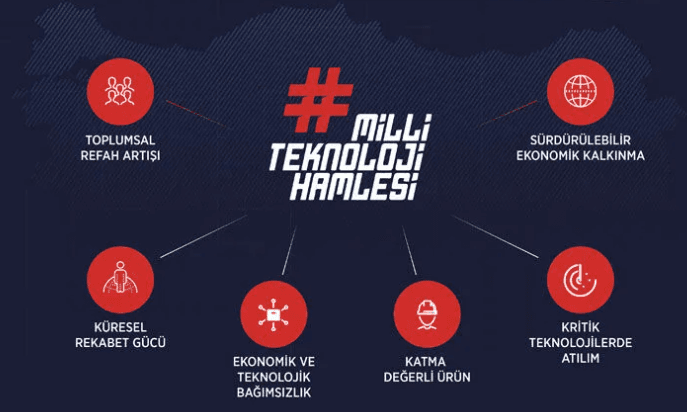
2023 Sanayi & Teknoloji Belgesi MTH Hedefleri (AA)
The comprehensive public policy framework of NTI was established through the 2023 Industry and Technology Strategy prepared by the Ministry of Industry and Technology. Announced on 18 September 2019 and based on the vision of “National Technology Strong Industry” the strategy consists of five core components and 23 sub-policies: High Technology and Innovation Digital Transformation and Industrial Initiative Entrepreneurship Human Capital and Infrastructure. Within this framework NTI spans a broad spectrum from the defense industry to space technologies artificial intelligence to electric vehicles and cybersecurity.
This approach has been extended toward longer-term goals with the announcement of the 2030 Industry and Technology Strategy on 26 March 2025. The new strategy aims to enhance competence in critical technologies digital and green transformation and high-tech production. Thus NTI continues as a long-term policy aimed at making Türkiye a country that develops produces and exports critical technologies.
Türkiye’s journey in technology development and local production is the product of a deep historical accumulation and continuity stretching from the Ottoman Empire’s initial responses to the Industrial Revolution to today’s National Technology Initiative. Efforts to reduce dependence on foreign inputs began in the late 18th century with the establishment of military-industrial facilities such as İmalat-ı Harbiyye Tophane and Beykoz factories. These efforts were interrupted during the Ten-Year War (1912–1922) and were subsequently reshaped within the frameworks of planned development models state-led industrialization policies and private initiatives after the proclamation of the Republic.
The increasing foreign dependency regime following the Truman Doctrine and Marshall Plan after World War II experienced a major turning point with the 1974 Cyprus Peace Operation and subsequent embargoes. This situation led to the emergence of national defense industry institutions such as ASELSAN TUSAŞ and ROKETSAN under the leadership of the Turkish Armed Forces Strengthening Foundation (TSKGV). In the 2000s political stability achieved under the leadership of then Prime Minister Recep Tayyip Erdoğan and particularly the decisions of the May 2004 Defense Industry Implementation Committee (SSİK) marked a decisive shift from direct foreign procurement to domestic production and original design models forming the practical starting point of today’s defense industry transformation and the NTI vision.【1】 【2】
Industrialization Efforts in the Ottoman Era (TRT)
The roots of local production and technology development efforts in Türkiye lie in the Ottoman Empire’s responses to the Industrial Revolution.【3】 From the end of the 18th century transformation initiatives in textiles shipbuilding and military industry led to the establishment of institutions such as Mühendishane-i Bahr-i Hümayun (1773) Mühendishane-i Berr-i Hümayun (1793) Tophane Müşirliği Zeytinburnu Demirhanesi Bakırköy Baruthanesi and Dumansız Barut Fabrikası.【4】
During this period Istanbul’s Beykoz district became the central hub of the empire’s industrial production due to its water resources and strategic geographical location.【5】 In this context during the reign of III. Selim the Beykoz Paper Factory (1804) and the Beykoz Linen Factory (1805) were constructed. The Beykoz Leather and Boot Factory (Tabakhane-i Âmire) established by Hamza Bey in 1810 and transferred to the army in 1812 transitioned to steam power in 1827 and to electric energy in 1895 becoming one of the most modern production infrastructures of its time. Additionally thanks to the longstanding Çeşm-i bülbül tradition initiated by Mehmed Dede’s 1804 glass workshop the Porcelain and Glass Factory (1844) and Paşabahçe Ispermeçet Candle Factory (1858) achieved institutional scale.【6】
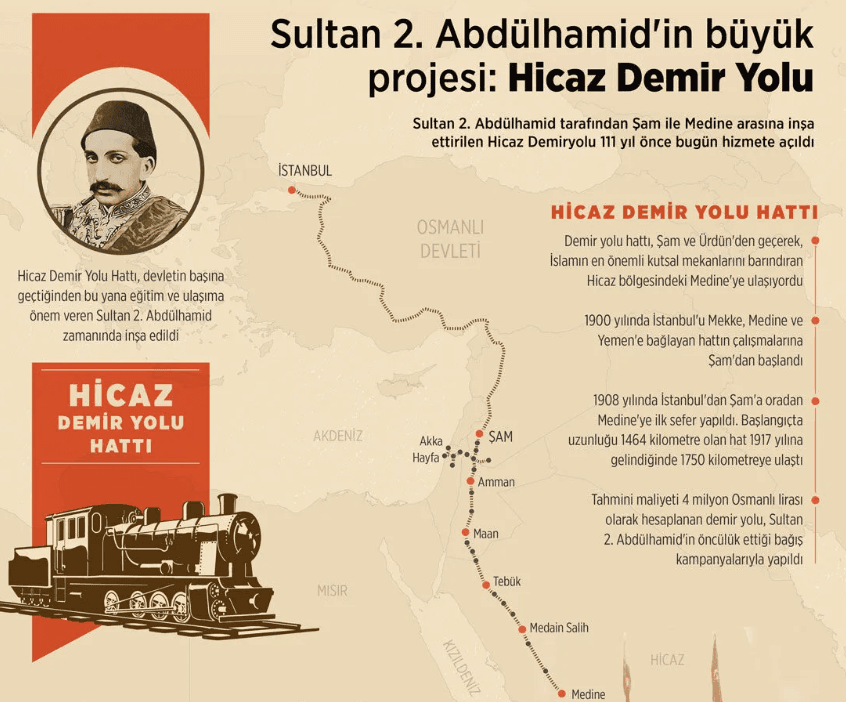
Hicaz Demiryolları (AA)
Sultan II. Abdülhamid accelerated projects in transportation finance health and industry aimed at reducing foreign dependence and establishing a national infrastructure.【7】 To ensure military logistics and economic unity a total of 5792 kilometers of railway were constructed of which 4138 kilometers were transferred to the Republican era. Alongside strategic lines such as İzmit-Ankara Eskişehir-Konya and Baghdad the HamidiyeHicaz Railway (1908) was implemented with funding entirely from domestic sources and donations collected from the Islamic world.
To support farmers and promote modern agriculture the 1888Ziraat Bankası was established schools were opened to enhance agricultural education and experts were sent to Europe. In the health sector the Gülhane Military Hospital (1898) and the Hamidiye Etfal Hospital (1899) were opened as centers of Western-style clinical and practical education and modern hospitals were expanded in rural areas. In industry the Dumansız Powder Factory was added to the Zeytinburnu heavy industry complex and in 1893 the Hamidiye Paper Factory was established to support local paper production.【8】
In 1909 the İmalat-ı Harbiyye-i Umumiyye Müdürlüğü was established as the successor to Tophane Müşirliği becoming the largest military-industrial complex of its time with nearly 5000 employees. However the Ten-Year War period (1912–1922) (Balkan Wars World War I and the National Struggle) destroyed the production infrastructure and caused a loss of skilled human capital.【9】
The industrialization movements of the early Republican years are historically divided into two periods. The first period extending until 1929 aimed to achieve industrialization largely through private entrepreneurship. During this phase policies focused on encouraging local production and private enterprise rather than direct industrial investments.【10】
One of the key steps of this period was the İzmir Economic Congress held in 1923. Decisions were made at the congress to increase local production support private entrepreneurship and strengthen economic independence. The aşar tax was abolished to reduce the burden on agriculture. In 1924 the Ministry of Agriculture was established and the Zonguldak Mining and Engineering School was opened to train qualified personnel for mining. In 1925 the Sanayi ve Maadin Bankası was founded to support industrial and mining enterprises. One of the most important regulations of this period was the Teşvik-i Sanayi Law adopted in 1927 which aimed to encourage private industrial investments and develop industrial activities in the country.【11】
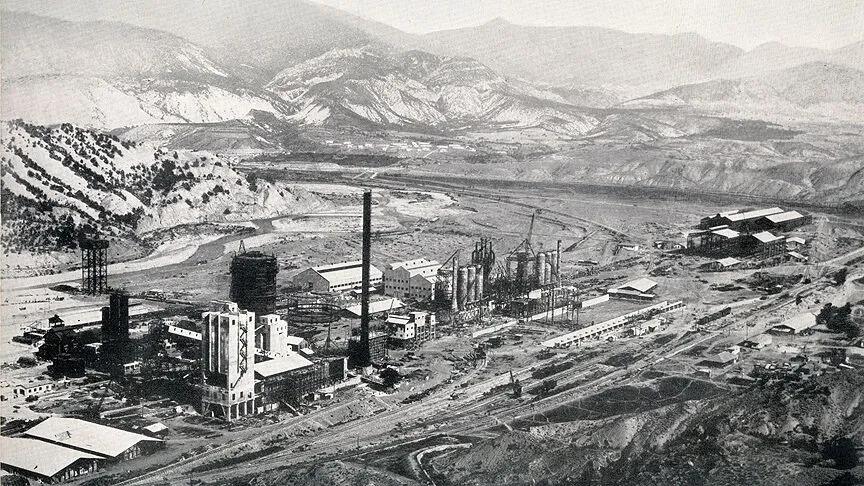
The foundations of the Kardemir Karabük Iron and Steel Plant were laid in 1937 (AA)
After the 1929 Great Depression private entrepreneurship proved insufficient leading to a shift toward state-led industrialization. Under the framework of the First Five-Year Industrial Development Plan (1933) prepared with credit and technical reports from the Soviet Union the State Industry Office (1932) and Sümerbank (1933) were established. Within Sümerbank the Kayseri Textile Factory (1935) Nazilli Printing (1937) Bursa Merinos (1937) Konya Ereğli (1937) and Malatya Cotton (1939) facilities were launched. These factories were not merely production units but also pioneer models of Western and modern social life in Anatolian cities with housing schools cinemas and sports facilities. In heavy industry the Karabük Iron and Steel Factory (1937) and the Kırıkkale Military Factories were established.
In the early years of the Republic both state investments and private initiatives emerged to develop the defense and aviation industries. These efforts in aircraft engine weapon and ammunition production contributed to the formation of Türkiye’s first local defense and aviation industry production infrastructure.
One of the first steps toward institutionalization in aviation was the founding of the Turkish Aircraft Society on 16 February 1925. In the same period a partnership with the German Junkers firm led to the creation of Tayyare ve Motor Türk Anonim Şirketi (TOMTAŞ) and in 1926 an aircraft factory began operations in Kayseri. After Junkers withdrew from the partnership in 1931 the facility came under state control. The facility continued production under the name Kayseri Aircraft Factory producing approximately 200 local aircraft.【12】
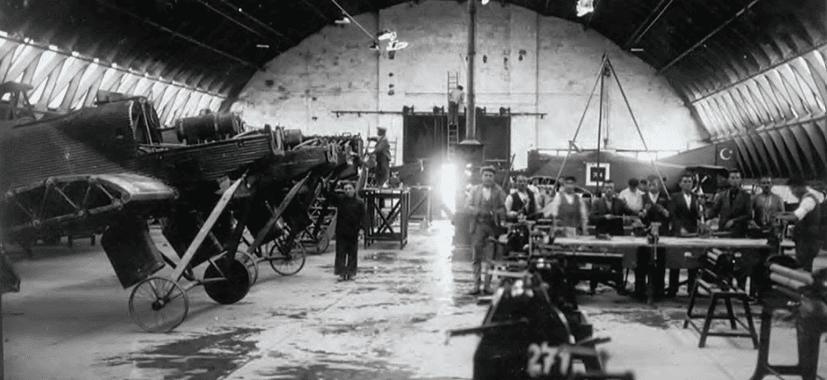
1941 Yılında Açılan Etimesgut Uçak Fabrikası (İletişim Başkanlığı)
This infrastructure expanded with new investments in subsequent years. Between 1939 and 1941 the THK Etimesgut Aircraft Factory【13】 was established. Starting production in 1944 this large-scale initiative manufactured 116 aircraft and 56 gliders. During the same period Turkey’s first engine factory was established by THK at the Gazi Forest Farm and operations continued until 1951 when due to prevailing conditions it was transferred to the Machine and Chemical Industry Corporation on 18 June 1952.【14】
To develop research infrastructure in aviation the construction of the Ankara Wind Tunnel (ART) was completed in 1950 becoming one of the most important investments to enhance Türkiye’s aerodynamic research and testing capacity.【15】
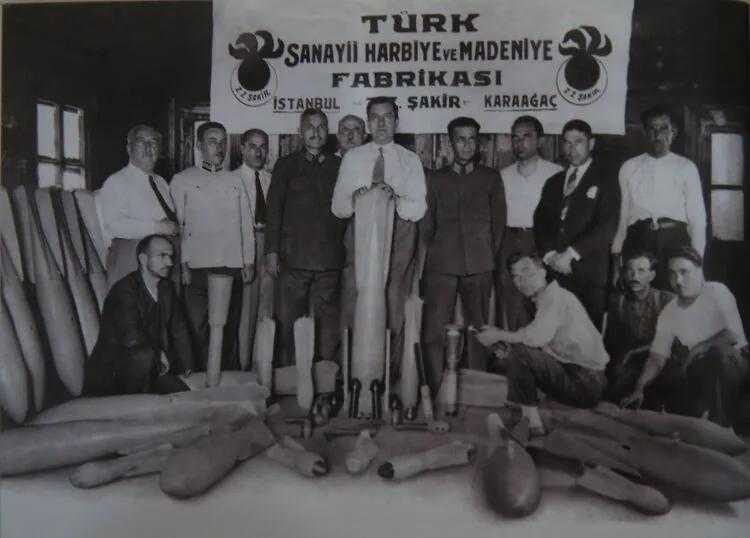
Türk Sanayii Harbiye ve Madeniye Fabrikası - 1925 Yılında Kurulmuştur (AA)
Alongside state investments private entrepreneurs also played a role in the development of the local defense and aviation industry. During this period Şakir Zümre established the first private ammunition factory producing local bombs Nuri Killigil manufactured pistols and grenades Nuri Demirağ opened an aircraft factory to produce passenger aircraft and train pilots and Vecihi Hürkuş brought the first entirely locally designed aircraft into the sky.
Şakir Zümre: In 1925 he established Türkiye’s first private military factory named the “Turkish Military and Mining Industry Factory”. Within the facility a wide range of ammunition was produced from firearms to hand grenades bullets to mines and submarine depth charges. For the Turkish Air Force the first 100 300 500 and 1000 kilogram aircraft bombs were manufactured. The produced ammunition was exported to GreeceBulgaria Poland and Egypt marking the first defense industry export successes of the young Republic. However after Türkiye joined NATO defense budgets were redirected toward foreign-made weapons and orders to the factory ceased forcing Zümre to abandon military production and convert the facility to stove manufacturing.
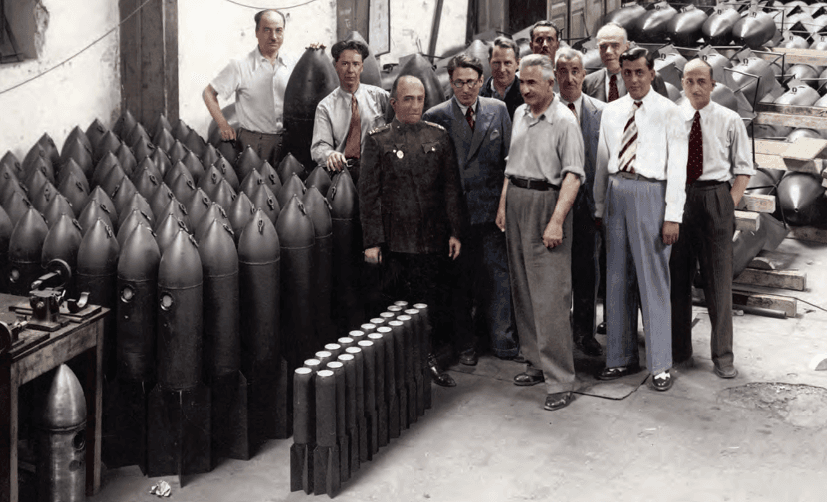
Nuri Killigil, at the Sütlüce Weapons Factory (İletişim Başkanlığı)
Nuri Killigil (Nuri Paşa): In 1924 he founded the Kütahya Ceramics Joint Stock Company. Later he transferred this factory and turned to defense industry with the support of the Ministry of National Defense purchasing a factory in Sütlüce and beginning local production of weapons gunpowder and ammunition. Nuri Paşa developed various weapon designs and obtained patents for them. He achieved serial production of Turkey’s first 9 mm pistol known as the “Nuri Pistol”. At the Sütlüce facility he manufactured cannons grenades anti-aircraft shells and aircraft bombs to enhance the army’s firepower and became one of the first entrepreneurs to contribute to the development of local defense industry through private enterprise.
During the 1948 Arab-Israeli War Nuri Paşa who supported the Palestinian people and Arab armies continued ammunition production. Nuri Paşa died in a major explosion at his Sütlüce factory on 2 March 1949. With this tragic event one of the early local weapons industry initiatives in Türkiye was abruptly halted.
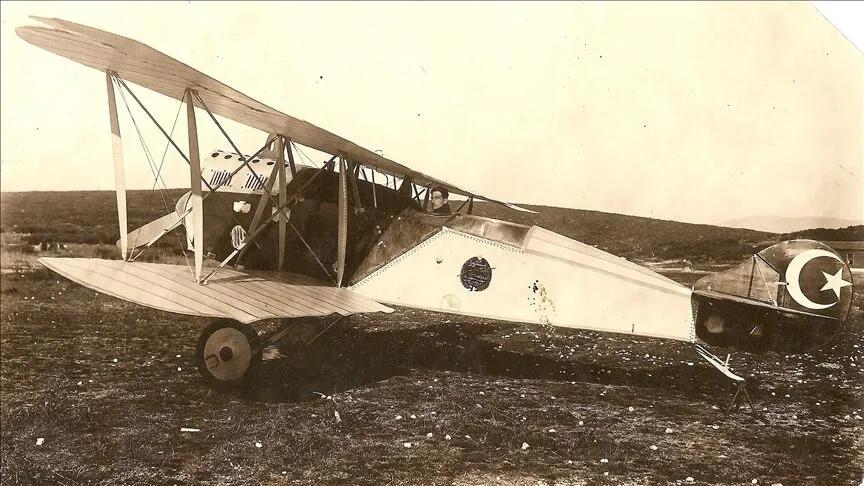
Vecihi Hürkuş (AA)
Vecihi Hürkuş: In 1924 he built Türkiye’s first locally designed aircraft the Vecihi K-VIVecihi K-VI using captured Greek aircraft materials from the War of Independence. He requested flight certification but the certification process was delayed due to lack of qualified personnel to evaluate the aircraft. Unable to obtain a license Hürkuş was penalized on 28 January 1925 for flying without authorization. As the only pilot among the founders of the Turkish Aircraft Society established on 16 February 1925 he earned the title of “Turkey’s First Aviator”. In a rented woodworking shop in Kadıköy Osmanağa neighborhood he built the two-seat single-engine Vecihi K-XIV the country’s first civilian aircraft within three months and conducted its first flight on 27 September 1930 at Fikirtepe. Unable to obtain a flight permit in Türkiye he dismantled the aircraft shipped it by rail to Prague obtained certification from Czech officials and returned to Türkiye by air on 25 April 1931.
In 1932 he founded the first Turkish civilian aviation school Vecihi Sivil Tayyare Mektebi and trained 12 students. However the school was forced to close because its diplomas were not recognized. With Nuri Demirağ’s financial support of 5000 liras he built the “Nuri Bey” (Vecihi K-XVI) and “Vecihi XV” aircraft in 92 days and conducted demonstration flights. Hürkuş assigned his aircraft to the Türkkuşu School and in 1937 was sent by THK to Germany where he obtained a diploma in Aircraft and Machinery Engineering in 1939. In 1947 he founded the company “Türk Kanadı” for agricultural spraying and in 1954 he founded “Hürkuş Hava Yolları” but faced flight restrictions and obstacles. With his last remaining aircraft he conducted thorium uranium and phosphate exploration in Southeastern Anatolia under the direction of the Mineral Research and Exploration Institute (MTA).
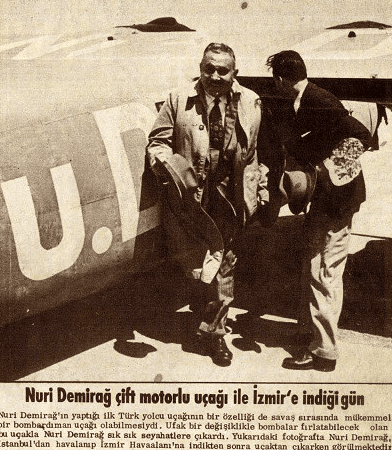
Türkiye's First Domestic Passenger Aircraft NU.D-38 (Sivas Valiliği)
Nuri Demirağ: In the 1930s he began efforts to meet the military’s aircraft needs and in 1936 signed an agreement with a Czech company to build a highly modern aircraft factory for its time. He purchased the 1559-hectare land of today’s Atatürk Airport in Yeşilköy for testing flight workshops and hangars and established the Nuri Demirağ Gök Uçuş School which trained 290 pilots until 1943. With the drawings of Turkey’s first aircraft engineer Selahattin Reşit Alan the first single-engine aircraft Nu.D-36 was manufactured in 1936. In 1938 the first locally designed Turkish passenger aircraft Nu.D-38 was produced with all components except engines manufactured by Turkish technicians and workers. It featured twin 160 horsepower engines reached a speed of 325 km/h had a range of 1000 km and a capacity of six passengers. In 1944 the Nu.D-38 was classified in the global aviation industry as a Class A passenger aircraft and was designed to be convertible into a military transport or bomber aircraft if needed.
The Nu.D-38 completed its first official flight on 26 May 1944 from Istanbul to Ankara Etimesgut Airfield in 1.5 hours and later conducted test flights to Bursa İzmir Kayseri and Sivas. It also manufactured Turkey’s first parachute. However the project was halted due to cancellation of domestic orders citing a crash during a test flight a ban on exporting the produced aircraft and the termination of state orders. The factory was closed in 1944 the land was nationalized and the manufactured aircraft were later scrapped.
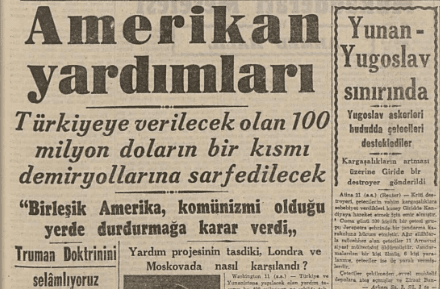
12 Mayıs 1947 Sayılı Cumhuriyet Gazetesi Manşeti (Gaste Arşivi)
Following World War II the declaration of the Truman Doctrine (1947) and the Marshall Plan (1948) redirected Türkiye toward agriculture mining and road infrastructure rather than heavy industry and defense production.【16】 Türkiye’s membership in NATO in 1952 increased foreign dependency in defense industry as foreign-supplied weapons and equipment replaced local production. This period saw the cessation of local production through direct procurement of ready-made aircraft engines and military equipment.
Under these policies the Kayseri Aircraft Factory unable to secure orders was converted into the Kayseri Air Maintenance and Repair Center in 1950. Similarly the Turkish Air Force’s Etimesgut Aircraft and Engine Factories were transferred to the Machine and Chemical Industry Corporation (MKEK) after failing to secure orders and were converted into a textile factory in 1968. Meanwhile in 1950 under Law No. 5591 the assets of the General Directorate of Military Factories were transferred to the Machine and Chemical Industry Corporation (MKEK).
Aselsan’s 50th Anniversary Introduction Video (Aselsan)
The 1964 Cyprus Crisis brought to light potential limitations in using foreign-supplied defense systems and particularly the arms embargo imposed after the 1974 Cyprus Peace Operation made the need for developing a local defense industry more evident. The U.S. arms embargo applied between 1975 and 1978 became a critical turning point accelerating policies aimed at meeting defense needs through domestic capabilities.
During this period the Turkish Navy Society was established in 1965 the Turkish Air Force Strengthening Foundation in 1970 the Turkish Navy Foundation in 1972 and the Turkish Land Forces Strengthening Foundation in 1974. These institutions supported by public donations contributed to the creation of institutional and financial infrastructure for the development of the local defense industry.
During the same period defense industry institutions were established to create local production capacity in various technology fields. TUSAŞ (Turkish Aircraft Industry Inc.) was established in 1973 ASELSAN in 1975 ASPİLSAN in 1981 and HAVELSAN in 1982. Thus an institutional infrastructure began to emerge for developing local technology in fields such as aviation communications electronics energy systems software and command and control. To produce and integrate F-16 aircraft in Türkiye the Turkish-American joint venture TUSAŞ Aviation and Space Industry Inc. (TAI) was established expanding production and system integration capacity in aviation. The Land Sea and Air Forces Strengthening Foundations were unified under the Turkish Armed Forces Strengthening Foundation (TSKGV) in 1987 and with the establishment of ROKETSAN in 1988 the defense industry ecosystem was completed with the addition of rocket and missile technologies.【17】
This period from the 1960s to the 1980s established the institutional foundation in Türkiye for the concepts of local production gaining competence in critical technologies and reducing foreign dependence. With the transition to an export-led growth model in the 1980s industry opened up to international markets but high-tech development and R&D capacity remained limited. In the 1990s due to economic and political instability the desired level of long-term technology investments and R&D capacity development was not achieved.
From the 2000s onward under the premiership of Recep Tayyip Erdoğan policies promoting local design R&D and national production in the defense industry gained strength. One of the key turning points of this process was the Defense Industry Implementation Committee (SSİK) meeting held in May 2004 under Erdoğan’s leadership. The committee canceled existing foreign procurement tender processes for modern tanks attack/tactical reconnaissance helicopters and unmanned aerial vehicles with a total value of approximately 11 billion dollars.【18】 The committee decided that these needs would be met through a new supply model based on direct domestic production and original design. This approach significantly accelerated efforts to develop local and original defense systems paving the way for projects such as the ALTAY tank the ATAK helicopter the Bayraktar and ANKA UAV.
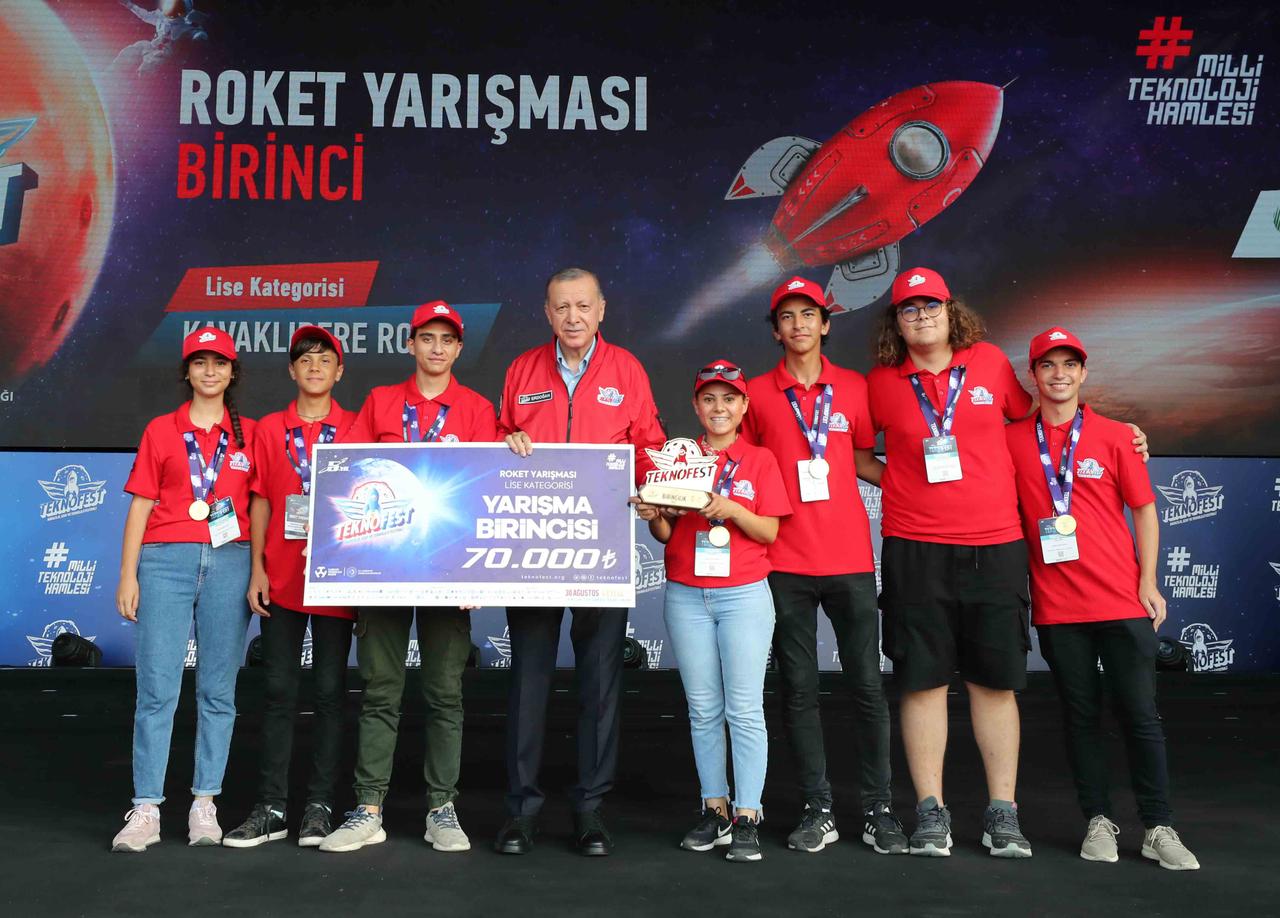
Cumhurbaşkanı Recep Tayyip Erdoğan Teknofest Yarışmalarında Dereceye Giren Takımlara Ödüllerini Takdim Etti (T3 Vakfı)
During the same period technological transformation was not limited to the defense industry. The proliferation of technology parks R&D and design centers and organized industrial zones increased R&D support and private sector technology investments expanding Türkiye’s technology and production ecosystem. This transformation was reflected in several indicators:【19】
TEKNOFESTs Held Annually Form the Strongest Social Base and Driving Force of NTI (TRT Haber)
In the 2010s technology policies gained a broader economic and social framework and with the establishment of the T3 Foundation in 2016 technology education scholarships technology team support and entrepreneurship programs became widespread. Since 2018 the TEKNOFEST Aviation Space and Technology Festivals have become one of the most important platforms for reaching broad audiences with a culture of technology development and production.
This process was transformed into a comprehensive public policy framework under the vision of “National Technology Strong Industry” with the announcement of the 2023 Industry and Technology Strategy on 18 September 2019. The long-term goals of NTI have been continued through the 2030 Industry and Technology Strategy announced on 26 March 2025 with priorities placed on developing local capacity in high and critical technologies and strengthening technological independence. The strategy highlights efforts in areas such as artificial intelligence semiconductors quantum nuclear and space technologies robotics and next-generation communications.
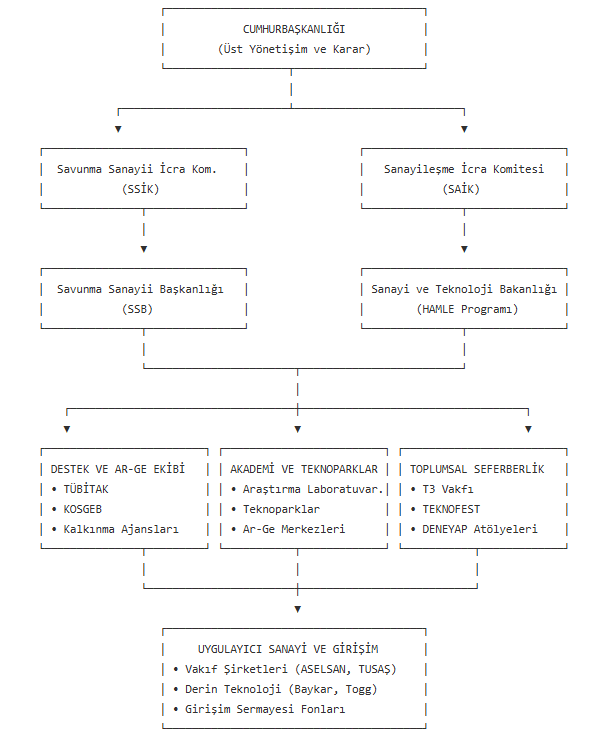
The success of the National Technology Initiative rests on a multi-layered and holistic governance ecosystem that aligns public academic private sector and civil society toward the same strategic direction.【20】 At the apex of this institutional structure are the Defense Industry Implementation Committee (SSİK) which operates under the Presidency and coordinates public procurement power and long-term supply and production plans and the Industrialization Implementation Committee (SAİK) which focuses on the civil sector.
The process is orchestrated through the Ministry of Industry and Technology’s Technology-Oriented Industrial Initiative (HAMLE) Program and sectoral roadmaps. The program’s most innovative aspect is the holistic and simultaneous management of support mechanisms from TÜBİTAK R&D and Innovation Supports KOSGEB SME Supports and Ministry of Industry and Technology Investment Incentive Systems through a single window.
Resilient original supply models are implemented through the Undersecretariat for Defense Industries (SSB) and the Defense Industry Fund. The R&D and financing arm of the ecosystem is supported by TEYDEB ARDEB and BİDEB programs through TÜBİTAK KOSGEB and 26 Regional Development Agencies. The seven national research infrastructures under Law No. 6550 the 94 Technology Development Zones (Teknoparks) and R&D/Design Centers facilitate the transfer of academic knowledge to industry. On the societal level structures such as the T3 Foundation’s TEKNOFEST and DENEYAP Workshops identify talented youth and trigger a mindset shift while deep technology startups supported by growing venture capital funds and private sector R&D centers emerge as the most dynamic implementers of the initiative.
The National Technology Initiative is grounded in the belief that technology is a fundamental element for economic growth social welfare and strategic independence. Accordingly the policy framework aims to develop critical technologies in Türkiye increase high and medium-high technology production convert R&D outcomes into commercial products foster technology startups and increase qualified human resources.
This approach also aims to change Türkiye’s position in the global technology market. Alongside traditional manufacturing it focuses on paradigm shifts and disruptive technologies aiming to build production capacity in high-value-added areas such as artificial intelligence semiconductors advanced materialsbiotechnology robotics autonomous systems electric vehicles battery technologies communication systems space technologies and advanced defense systems.

TÜBİTAK Logosu (TÜBİTAK)
The first core component of the National Technology Initiative was high technology and innovation. The 2023 Industry and Technology Strategy outlines the determination of technological competencies and sectoral roadmaps the development of strategic materials the strengthening of the R&D ecosystem the establishment of centers of excellence the enhancement of testing and certification infrastructure the support of global initiatives in new technologies and the expansion of intellectual property capacity.
The Scientific and Technological Research Council of Türkiye (TÜBİTAK) is a key public institution supporting R&D activities. The institution implements various support mechanisms targeting universities researchers and industrial organizations. Alongside academic research programs 1001 and 1003 programs such as 1501 1505 1507 and 1511 for industrial R&D and innovation are key financial instruments of this ecosystem. Separate support mechanisms have also been created for areas such as artificial intelligence green transformation and entrepreneurship. Direct technology and research activities are carried out by TÜBİTAK’s research centers and institutes including BİLGEM MAM UZAY SAGE and UME.
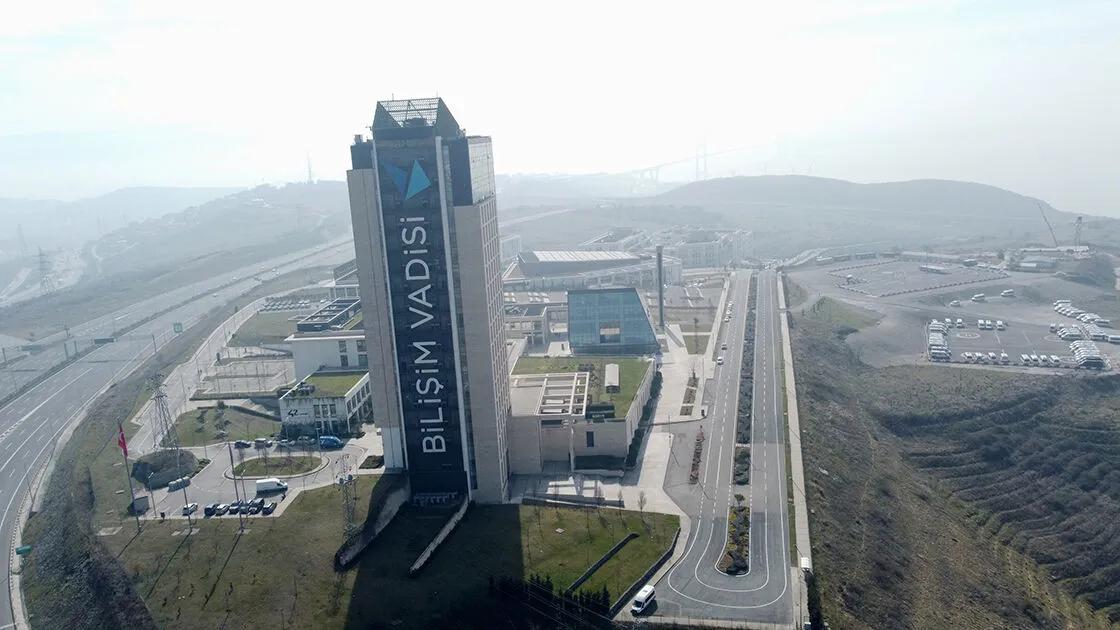
Bilişim Vadisi 2019 Yılında Faaliyete Alınmıştır (AA)
One of the key centers of this ecosystem is Bilişim Vadisii a Technology Development Zone established in Gebze Kocaeli. Bilişim Vadisi brings together universities research institutions technology companies and startups within a single ecosystem and hosts R&D and technology development activities in areas such as mobility information and communication technologies artificial intelligence gaming design and connected technologies thereby contributing to the conversion of research and development activities into technological products and commercial value.
While Türkiye’s R&D capacity has grown over the long term a gap remains compared to high R&D intensity OECD countries. According to OECD data the total R&D expenditure as a share of GDP rose from 1.39% in 2023 to 1.46% in 2024 while the 2024 OECD average was approximately 2.72%. Nevertheless real R&D expenditures in Türkiye grew by over 5% in 2024. These indicators demonstrate that increasing investments in high technology and innovation remains crucial despite growth in R&D capacity.【21】
The second component of the National Technology Initiative encompasses the technological transformation of industry. The main elements of this transformation are the digitalization automation artificial intelligence data analytics Internet of Things and integration of robotic systems into industry.

Digital Transformation and Industrial Initiative Stand Out as the Second Component of MTH (Generated with Visual Artificial Intelligence)
One of the key tools in this area is the Technology-Oriented Industrial Initiative Program. Launched in 2019 the program is designed to encourage the production of critical products in Türkiye within medium-high and high technology sectors. The program aims to coordinate support provided by the Ministry of Industry and Technology TÜBİTAK and KOSGEB for specific investment projects. Calls have been issued in areas such as machinery mobility health chemicals digital transformation and structural transformation in manufacturing.
This model does not aim merely to produce an existing product in Türkiye but also to develop the necessary technology and commercialize the product. Thus the goal is to create a seamless process linking R&D investment and mass production.
Technology entrepreneurship is one of the core components of the National Technology Initiative. Startups are recognized not merely as new businesses but as essential tools for converting developed technologies into products and economic value.
The policy framework in this area has been expanded through the National Technology Entrepreneurship Strategy. The strategy aims to make Türkiye an international hub for technology startups and to reach 100000 technology startups by 2030. TÜBİTAK entrepreneurship supports technology parks incubation and acceleration centers venture capital funds and investor networks are among the main instruments of this ecosystem.
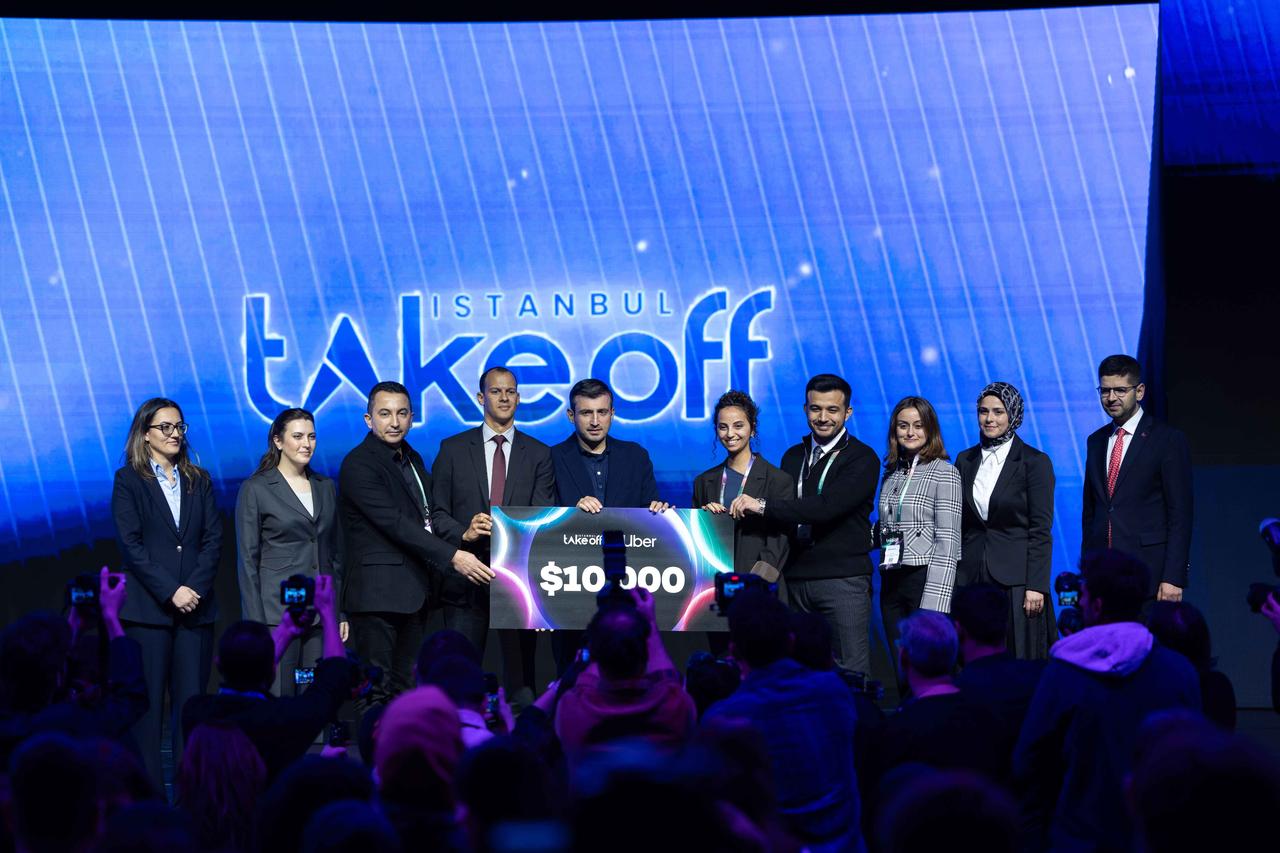
Take-Off Uluslararası Girişim Zirvesi (T3 Vakfı)
Platforms such as the Take Off Istanbul Startup Summit aim to connect technology startups with investors and the international technology ecosystem. The TEKNOFEST Entrepreneurship Program supporting the commercialization of projects developed within TEKNOFEST is one of the mechanisms designed to transform technologies emerging from competitions into commercial ventures.
One of the important projects in this ecosystem is Terminal İstanbul a technology and entrepreneurship center developed under the umbrella of Bilişim Vadisi at Atatürk Airport. The center aims to bring together entrepreneurs technology companies investors universities and researchers in a single environment and provides an integrated infrastructure for incubation and acceleration programs co-working and R&D spaces investor meetings and technology events.
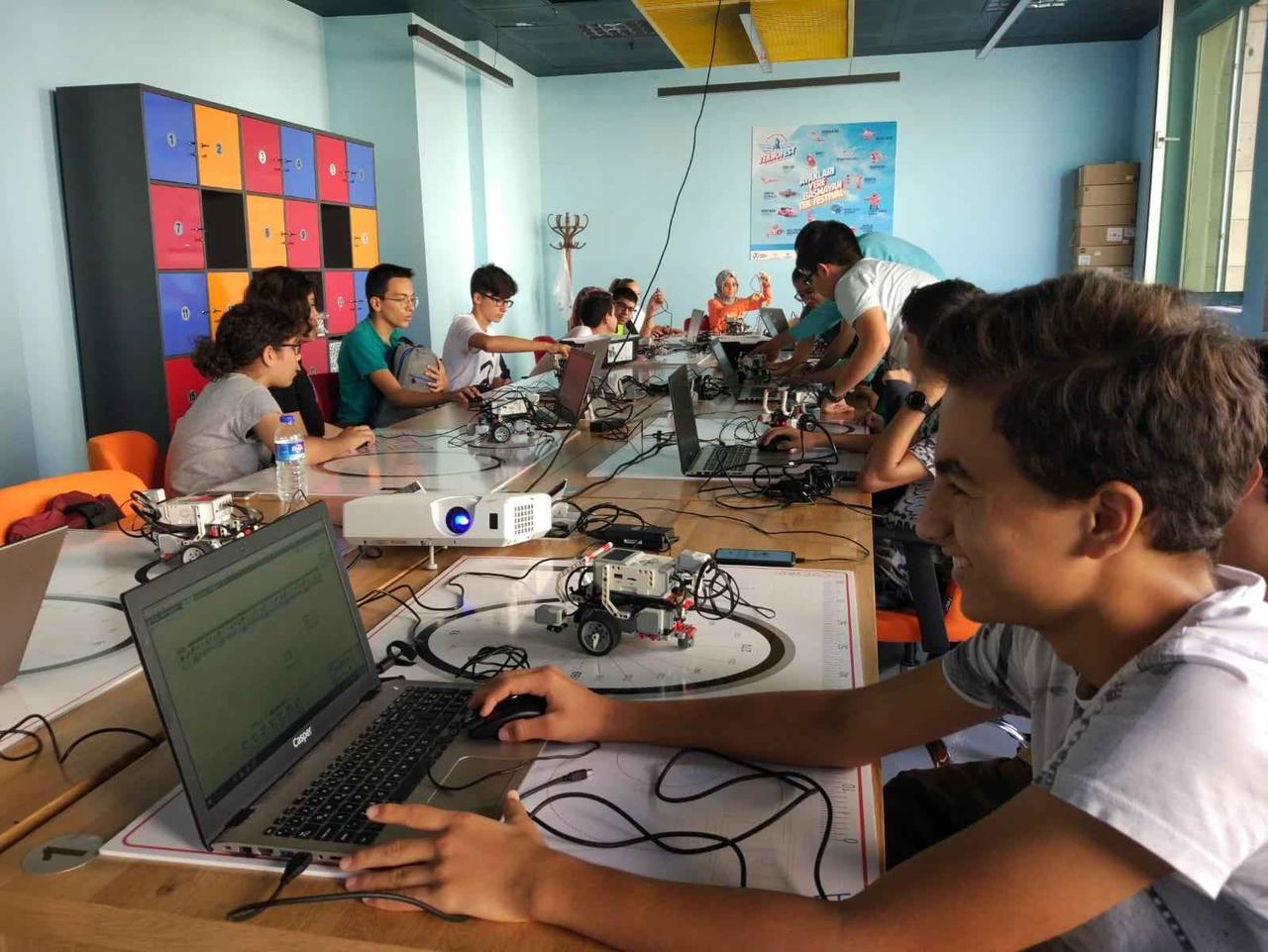
Deneyap Atölyelerinden Bir Görsel (Deneyap Türkiye)
The development of qualified human resources is a fundamental element for achieving the long-term goals of the National Technology Initiative. Toward this end the strategy aims to expand science and technology education from early childhood through university and postgraduate levels enhancing students’ competencies in research software engineering and entrepreneurship.
One of the main initiatives in this area is DENEYAP Türkiye which is implemented under the joint leadership of the Ministry of Industry and Technology the Ministry of Youth and Sports TÜBİTAK and the T3 Foundation providing practical education to students in areas such as design programming electronics robotics aviation and artificial intelligence. Projects such as Bilim Türkiye and Keşif Kampüsü also support this process through experiential and hands-on learning to foster a science and technology culture from an early age.

KÜRE, Dijital Ansiklopedisi (Küre Ansiklopedi)
At the university level the National Technology Clubs Union supports student communities while the National Technology Teams Support Program supports technology teams. The Özdemir Bayraktar National Technology Scholarship Program provides scholarships and development opportunities to students at various educational levels while the TÜBİTAK BİDEB and STAR programs enable undergraduate and graduate students to gain research experience. The TÜBİTAK International Leading Researchers Program offers support to attract qualified researchers to Türkiye to strengthen the country’s research capacity.
To develop software and digital skills 42 Software Schools operate in Istanbul and Kocaeli using peer-learning models. T3 Akademi offers online technology education while KÜRE Digital Encyclopedia supports research resource use and digital information production and T3 AI supports technical work and developer ecosystems in artificial intelligence. Thus efforts to develop human capital are carried out within a broad structure extending from early science education to advanced research and technology development.
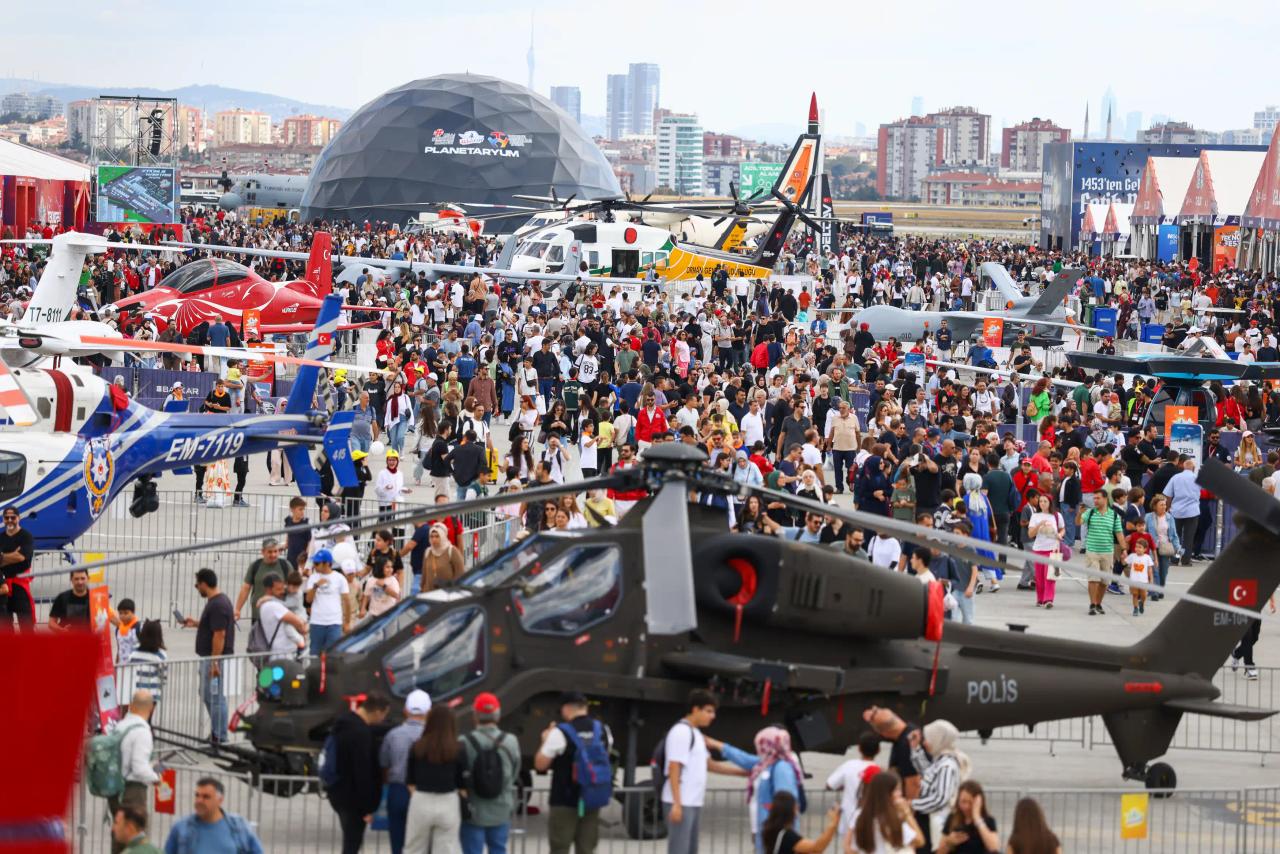
A Visual from TEKNOFEST 2025 (Teknofest)
One of the most comprehensive initiatives to socialize the National Technology Initiative is the TEKNOFEST Aviation Space and Technology Festival. First held in Istanbul in 2018 the festival is implemented under the primary leadership of the T3 Foundation and the Ministry of Industry and Technology with participation from public institutions universities technology companies media organizations and civil society groups.
One of the core elements of TEKNOFEST is technology competitions. Competitions are held across diverse fields ranging from aviation and space to artificial intelligence robotics biotechnology agricultural technologies energy unmanned systems and environmental and health technologies. Thus the festival serves not only to raise awareness of technology but also as a platform for students to develop projects form teams and transform some projects into startups.
According to T3 Foundation data TEKNOFEST events have welcomed over 11 million visitors and received over 6 million applications from competitors in technology competitions【22】
The National Technology Initiative aims to develop local competencies in technology areas critical to Türkiye’s economic and technological capacity and strategic independence. These priority areas include defense and aviation space artificial intelligence semiconductors mobility biotechnology energy quantum robotics advanced materials and next-generation communication technologies.
Electric and connected vehicle technologies are among the prominent areas under the National Technology Initiative. The electric vehicle project developed by Türkiye’s Automobile Initiative Group (Togg) has become a symbolic project representing the transformation of Türkiye’s automotive sector toward electric vehicles.

Yerli Marka Togg Arabalar 2022 Yılında Seri Üretime Geçti (AA)
The mobility policy encompasses not only automobile production but also a broader ecosystem including batteries power electronics autonomous driving sensors charging infrastructure software and connected vehicle technologies. The 2030 Industry and Technology Strategy highlights Togg’s first delivery as one of the developments emerging under the National Technology Initiative since 2019.
Ford Otosan’s Ecotorq heavy-duty engines are present in global markets while TÜMOSAN produces diesel engines for agriculture and industry. In the energy storage segment ASPİLSAN develops local lithium-ion cylindrical battery cells radio and vehicle battery packs at Türkiye’s first local battery production facility to meet the energy needs of defense and civil industries. Togg also integrates electric power transmission and battery modules internally.
Space technologies are one of the strategic areas of the National Technology Initiative. Türkiye’s efforts in this field advanced through satellite projects such as BİLSAT RASAT and GÖKTÜRK-2 and a formal institutional structure was established with the founding of the Turkish Space Agency (TUA) on 13 December 2018 to coordinate space policies.
The National Space Program announced on 9 February 2021 has systematically consolidated Türkiye’s objectives in space. The program encompasses goals such as lunar research satellite technologies regional positioning and timing systems independent access to space spaceports space atmosphere and astronomical observation development of the space industry and strengthening of human resources. The implementation framework of these goals is defined in the 2022–2030 National Space Program Strategy Document.
As a result of accumulated satellite technology expertise Türkiye developed the İMECE Earth observation satellite with sub-meter resolution followed by the first locally developed communication satellite Türksat 6A which was launched into space. Under the National Space Program additional efforts are underway including the Lunar Research Program the development of local rocket technologies and the acquisition of independent access to space through the Micro Satellite Launch System (MUFS).
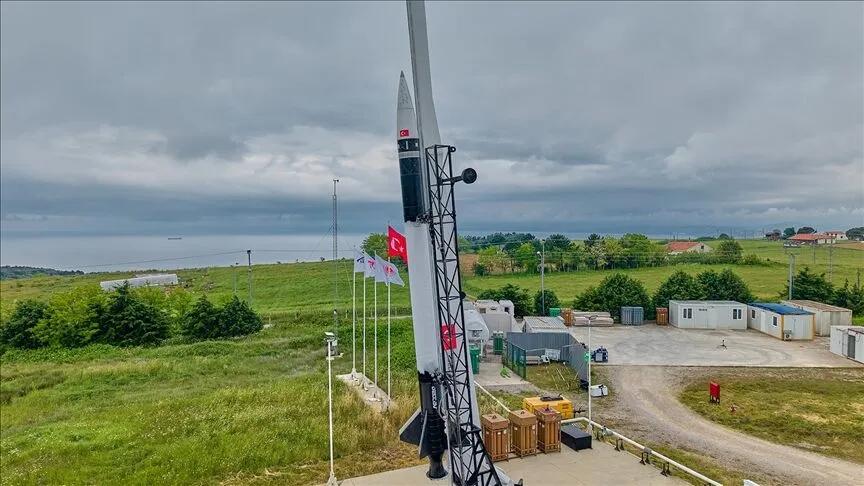
DeltaV's Hybrid Rocket System (AA)
One of the important developments in this area is the hybrid rocket motor developed by DeltaV Space Technologies. This hybrid propulsion technology combining solid fuel with liquid oxidizers is part of Türkiye’s efforts to develop local capabilities in rocket and space systems. The technology developed by DeltaV is planned to be used in space missions including the Lunar Research Program under the National Space Program.
The program’s long-term goal is to increase local technological capacity in satellite development rocket and launch systems and space research reduce dependence on foreign critical technologies and establish a sustainable space industry and human resources ecosystem in Türkiye.
Artificial intelligence is one of the priority areas of the National Technology Initiative in terms of digital transformation and technological independence. Türkiye’s first comprehensive policy document in this field the National Artificial Intelligence Strategy (2021–2025) aims to increase qualified human resources support research and entrepreneurship and develop data and technical infrastructure. The strategy also sets as a key goal the increase of artificial intelligence’s contribution to GDP to 5% by 2025.

Bilge is Türkiye's Native and National Large Language Model(Bilge)
Efforts to develop local artificial intelligence technologies have accelerated accordingly. The TÜBİTAK BİLGEM Artificial Intelligence Institute is working on developing large language models trained on Turkish data. One of the key outputs of these efforts is BİLGE a local large language model designed to reflect the linguistic characteristics of Turkish for use in public and private sector applications.
Türkiye’s artificial intelligence policy has entered a new phase with the 2026–2030 Turkey Artificial Intelligence Action Plan announced on 13 June 2026. The plan is built on four main pillars: “Recognize Utilize Produce and Govern”. Key objectives include promoting AI literacy enhancing qualified human resources strengthening data and computing infrastructure developing local AI models and expanding the use of AI across sectors.
Alongside artificial intelligence cybersecurity cloud computingcloud computingbig databig data open-source softwareblockchain and next-generation communication technologies constitute important areas of digital transformation policies. Structures such as the TÜBİTAK Artificial Intelligence Institute and the Türkiye Open Source Platform contribute to enhancing research human capital and technology development capacity in these areas.
Energy technologies are one of the strategic areas of the National Technology Initiative linked to its goals of strengthening energy supply security reducing foreign dependence and transitioning to low-carbon production. In this context the strategy aims to increase the use of renewable energy sources and develop local R&D design and production capacity in energy technologies.
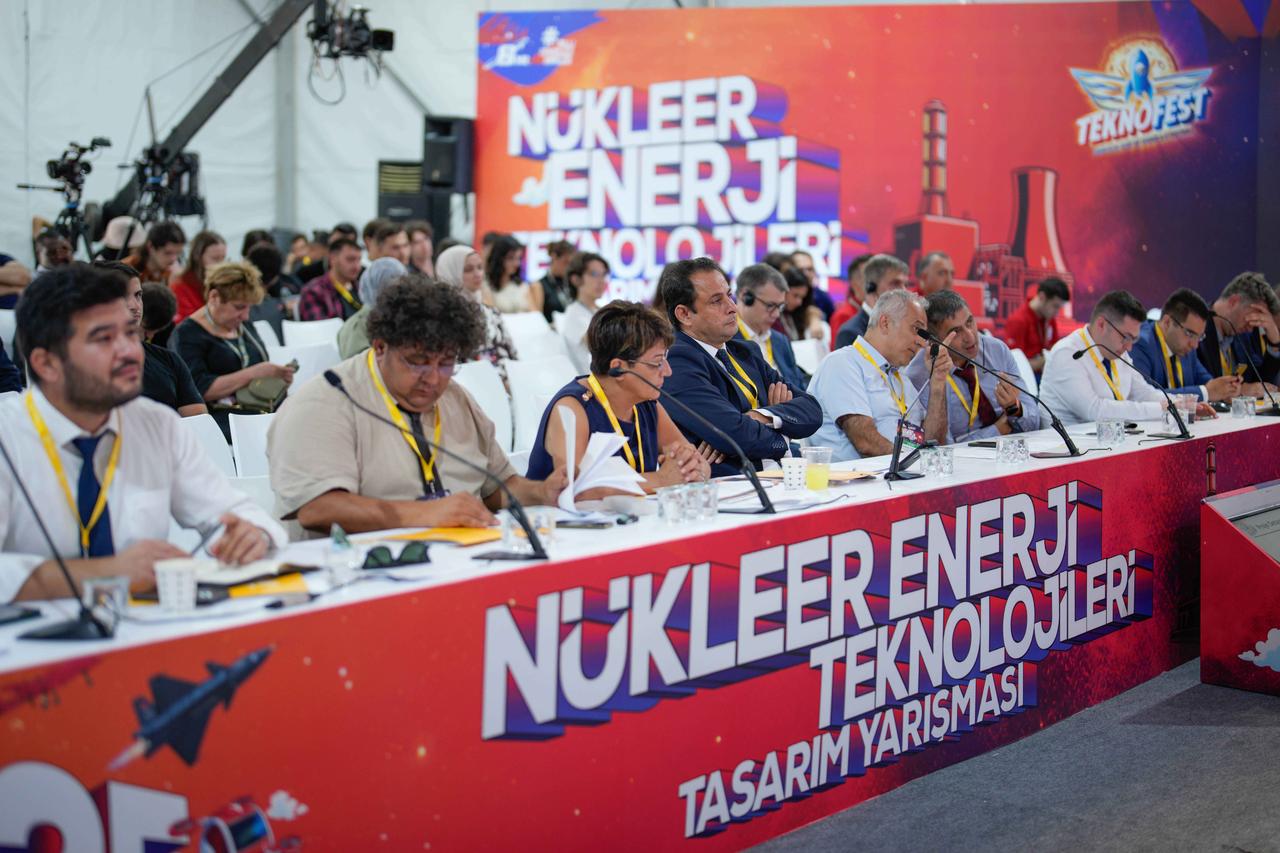
TEKNOFEST Nükleer Enerji Teknolojileri Tasarım Yarışması 2024 Yılından İtibaren Düzenlenmektedir (Teknofest)
Investments in local production of turbines generators solar panels and other critical components for wind and solar energy are supported while work is also underway in energy storage battery and grid technologies. In addition green hydrogen technologies for hydrogen production storage and transportation and next-generation energy systems are among the areas of research and investment.
Nuclear energy technologies are also addressed within this framework. Alongside existing nuclear energy investments in Türkiye research and technology development efforts are underway on next-generation reactor technologies such as small modular reactors (SMRs) and molten salt reactors. These efforts aim to develop local knowledge and human resources in nuclear technologies.
The transformation in energy technologies is also linked to Türkiye’s 2053 net zero emissions target. Under green transformation policies the widespread adoption of renewable energy energy efficiency hydrogen storage and low-carbon production technologies is targeted.【23】 Thus the development of energy technologies constitutes an essential component of the National Technology Initiative’s goal of technological independence as well as its energy security and green transformation policies.
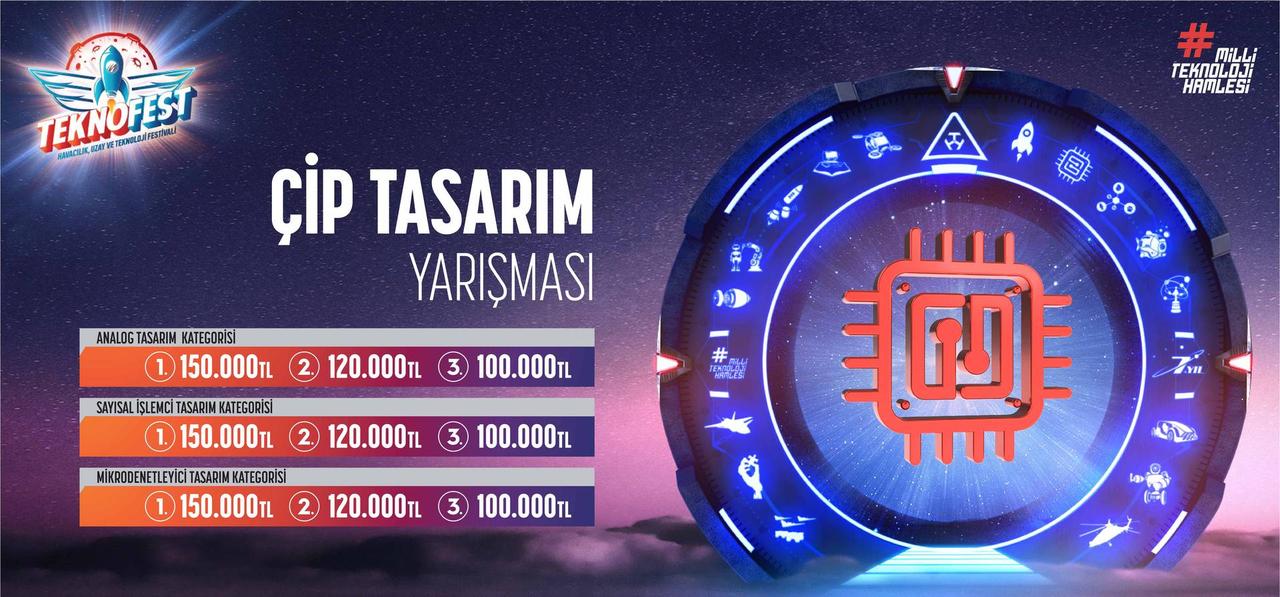
Since 2022, a Chip Design Competition has been organized at TEKNOFEST events(Teknofest)
Cybersecurity is one of the strategic areas of the National Technology Initiative aimed at digital independence and protecting critical infrastructure. ASELSAN and HAVELSAN develop secure communication data analysis network security and intrusion detection and prevention systems while TÜBİTAK BİLGEM conducts R&D activities in cybersecurity and cryptography. These efforts aim to develop local cybersecurity technologies and increase qualified human resources.
Chip and semiconductor technologies are one of the strategic areas of the National Technology Initiative. In addition to R&D activities conducted at universities research centers and technology companies programs such as the TEKNOFEST Chip Design Competition aim to develop local chip design capability and human resources in this field. The 2030 Industry and Technology Strategy also aims to strengthen local capacity from design to production in semiconductors.
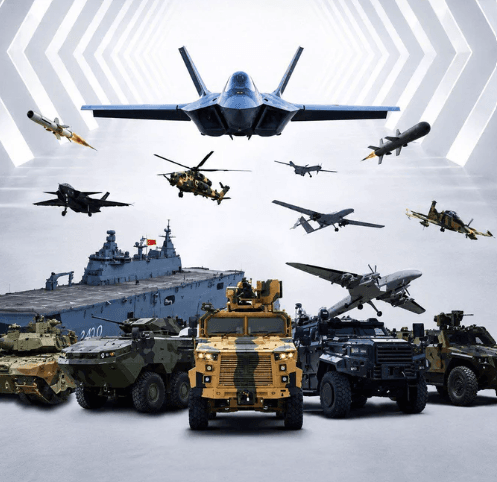
Savunma Sanayi Ürünleri (SSB)
The defense industry has become one of the primary areas where the National Technology Initiative took root and produced its first tangible results. The R&D engineering and production capabilities gained through the development and production of local and original high-technology platforms have established the defense industry as one of the pioneering and flagship sectors of NTI.
Various defense products developed in Türkiye including indigenous aerial platforms UAVs and SUAV systems munitions armored ground vehicles electronic systems and naval platforms under the MİLGEM project are exported to international markets.
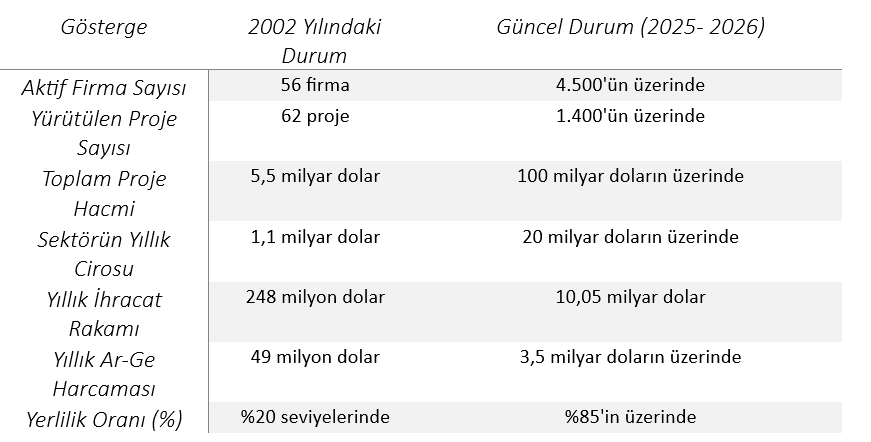
Comparison of the Defense Industry in 2022 with the Present Period(Bilgiler TRT Haber'den Alınmıştır)
The growth of the defense and aviation industry has been reflected in export figures. Defense sector exports rose from 248 million dollars in 2002 to 10.05 billion dollars by the end of 2025. 2025 exports reached 10.054 billion dollars with annual revenue exceeding 20 billion dollars. The same report indicates that over 3500 companies 1400 projects and approximately 100000 direct employees are active in the sector.
In Türkiye’s aviation industry platforms such as the KAAN national fighter jet the HÜRJET jet trainer and light attack aircraft the HÜRKUŞ basic trainer aircraft the T129 ATAK attack helicopter and the GÖKBEY general-purpose helicopter have been developed. These projects aim to build local design production and system integration capabilities in fighter jets trainer aircraft and helicopters. The supply process for HÜRJET conducted with Spain has become one of the first major programs oriented toward the international market.
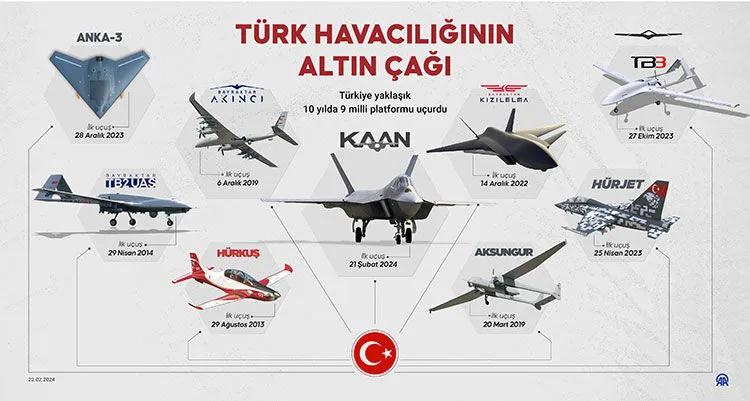
Uçak ve İnsansız Hava Araçları Kategorisinde 2013 Yılından Bu Yana Geliştirilen Platformlar (AA)
Türkiye’s efforts in unmanned aerial vehicles accelerated in the 2000s. Baykar developed the Bayraktar Mini UAV Smart Munitions SİVRİSİNEK and MIZRAK the K2 Kamikaze UAV the Bayraktar TB2 the AKINCI the Bayraktar TB3 and the unmanned combat aircraft KIZILELMA. TUSAŞ has developed various classes of UAVs including the ANKA the AKSUNGUR and the ANKA III. As a result a UAV ecosystem has emerged in Türkiye covering applications from reconnaissance and surveillance to armed missions and ship-based operations.
Under the MİLGEM project Ada-class corvettes and Istif-class frigates have been developed. The TCG Ufuk intelligence ship the TCG Bayraktar and TCG Sancaktar amphibious ships and the TCG Anadolu multi-purpose amphibious assault ship have been commissioned. The Reis-class submarine project led to the entry of the TCG Piri Reis into service.
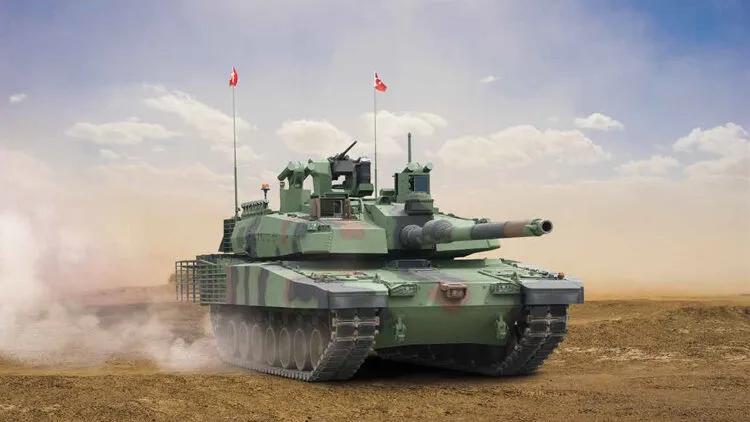
Altay Tankı 2025 Yılında Envantere Alınmaya Başlandı (AA)
In ground vehicles families of armored vehicles such as KİRPİ KİRPİ II EJDER YALÇIN PARS and VURAN have been developed and the ALTAY main battle tank project aims to develop local tank design and production capabilities.
In the missile and munitions field systems such as SOM SOM-J ATMACA GÖKDOĞAN BOZDOĞAN MAM-C and MAM-L have been developed. ROKETSAN and TÜBİTAK SAGE are among the main institutions in this field. ASELSAN also conducts research on radar electronic warfare electro-optical and air defense systems as well as AESA radar technologies.
In engine technologies TEI develops the TS1400 turbo-shaft engine for helicopters the PD170 engine for UAVs and new engine families for higher power classes. Work is also underway on the TF6000 and TF10000 projects to develop national turbofan engine technologies.
Kale Ar-Ge has developed the KTJ-3200 KTJ-1750 and KTJ-3700 turbojet engines for various missile and munition systems. BMC Power develops the TUNA and UTKU engines for ground vehicles and the BATU power unit for the ALTAY tank.
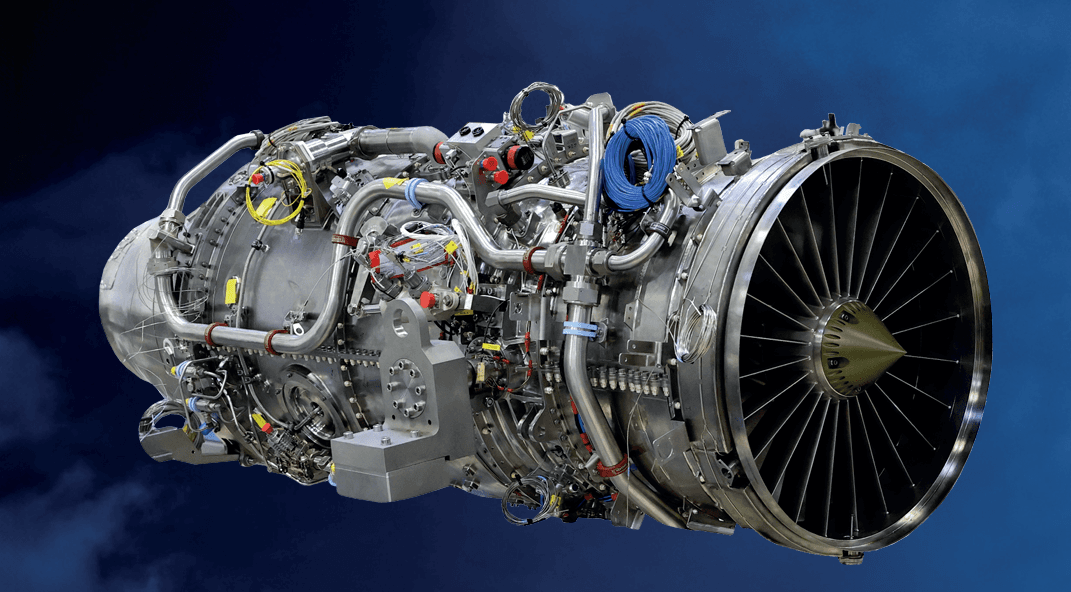
TF 6000 Türkiye's First National Turbofan Aircraft Engine(TEI)
Local subsystem development in the defense industry is not limited to engines. ASPİLSAN Energy develops battery and energy storage systems ASELSAN develops electronic and sensor technologies and other local institutions work on transmission systems power electronics avionics and various critical components. These projects aim to increase local technological capacity not only in platforms but also in engines electronics sensors energy and other critical subsystems.
Under the National Technology Initiative increasing R&D capacity developing high-tech production expanding technology entrepreneurship and raising value-added in exports are key economic and technological objectives. The 2030 Industry and Technology Strategy also identifies defense industry mobility artificial intelligence quantum semiconductors and chip technologies space healthcare and agricultural technologies technology entrepreneurship and the R&D ecosystem as strategic transformation areas.【24】
Türkiye’s R&D capacity has expanded significantly in recent years. According to TÜİK data total R&D expenditure reached 651.8 billion TL in 2024 and its share of GDP rose to 1.46%. This ratio was 1.39% in 2023.【25】 The fact that 64.8% of R&D expenditures are carried out by companies demonstrates the growing weight of the private sector in research and development activities.【26】
The advancement in technology-intensive production has also been reflected in export figures. Medium-high and high-tech product exports exceeded 112 billion dollars in 2025 and according to the Ministry of Trade their share in total exports reached 43.5%.【27】 Meanwhile according to TÜİK data the share of high-tech products in manufacturing exports reached 3.4% in the January–April period of 2026.【28】
With the development of R&D and innovation infrastructure a broad research and technology ecosystem has emerged in Türkiye consisting of technology parks R&D centers and design centers. According to the Ministry of Industry and Technology Türkiye has 115 Technology Development Zones (Teknoparks) 1368 R&D Centers and 349 Design Centers. The number of companies operating in Teknoparks exceeds 10000 and total employment exceeds 100000. These structures serve as key infrastructures for conducting R&D technology development design and commercialization activities between universities research institutions and the private sector.【29】 【30】
In corporate R&D investments the defense and aviation industry stand out. According to the 2025 Türkiye R&D 500 Study the total R&D expenditure of the 500 companies reached 257.9 billion TL. TUSAŞ ranked first with approximately 65.2 billion TL followed by ASELSAN with 48.2 billion TL and ROKETSAN with 21.4 billion TL. These figures demonstrate the significant weight of high-tech sectors in Türkiye’s private sector R&D investments.【31】
The policy framework of the National Technology Initiative that took shape after 2019 has been expanded with the 2030 Industry and Technology Strategy announced on 26 March 2025. The strategy identifies as key objectives the increase of local production capacity in high and critical technologies the digital and green transformation of industry the strengthening of production infrastructure the development of technology entrepreneurship and the increase of Türkiye’s share in global technology production.
Within this framework NTI continues as an industry and technology policy encompassing areas such as R&D investments qualified human capital university-industry collaboration intellectual property venture capital and high-tech exports.
Anadolu Ajansı. "Kamuda Ar-Ge harcamalarında en yüksek pay savunma sanayisinin." December 18, 2024.https://www.aa.com.tr/tr/ekonomi/kamuda-ar-ge-harcamalarinda-en-yuksek-pay-savunma-sanayisinin/3436986
Asiliskender, Burak. "Sanayileşme ve Mekânsal Değişim: Cumhuriyet Sonrası Kalkınma Hareketi Olarak." *Türkiye Araştırmaları Literatür Dergisi (TALİD)*, no. 13 (2009):https://dergipark.org.tr/tr/pub/talid/article/529933
Bozdoğan, Kaan. "Kanatlanan bir hayal: Vecihi Hürkuş ile Türk havacılığının doğuşu." Anadolu Ajansı, July 16, 2025.https://www.aa.com.tr/tr/gundem/kanatlanan-bir-hayal-vecihi-hurkus-ile-turk-havaciliginin-dogusu/3632082
Erhan, Çağrı, Süleyman Baştürk, Doğu Çağdaş Atilla, Oğuz Ata, and Onur Ağma. "Uluslararası İlişkiler Bağlamında Millî Teknoloji Hamlesi." In *Millî Teknoloji Hamlesi*. Ankara: Türkiye Bilimler Akademisi (TÜBA). Accessed September 21, 2026.https://www.tuba.gov.tr/tr/yayinlar/suresiz-yayinlar/bilim-ve-dusunce/mill-teknoloji-hamlesi/uluslararasi-iliskiler-baglaminda-mill-teknoloji-hamlesi
Hürriyet. "Tank ve helikopter ihaleleri iptal edildi." May 14, 2004.
Kacır, Mehmet Fatih. "2000'li Yıllar: Millî Teknoloji Hamlesi ve Gelecek Perspektifi." In *Millî Teknoloji Hamlesi*. Ankara: Türkiye Bilimler Akademisi (TÜBA). Accessed September 18, 2026.https://www.tuba.gov.tr/tr/yayinlar/suresiz-yayinlar/bilim-ve-dusunce/mill-teknoloji-hamlesi/2000li-yillar-milli-teknoloji-hamlesi-ve-gelecek-perspektifi
Kuştemir, Sibel Kaya, and Nurgün Oktik. "Osmanlı'nın Son Dönemi'nde Sanayileşme ve Modernleşme: Beykoz Örneği." *Cumhuriyet Tarihi Araştırmaları Dergisi (CTAD)* 18, no. 36 (Fall 2022): 697–727.https://www.researchgate.net/publication/383362037_Osmanli'nin_Son_Donemi'nde_Sanayilesme_ve_Modernlesme_Beykoz_Ornegi
OECD. "OECD overall R&D growth stable; government R&D budgets decline and reorient towards defence." OECD Data Insights: Statistical Releases, March 2026.https://www.oecd.org/en/data/insights/statistical-releases/2026/03/oecd-overall-rd-growth-stable-government-rd-budgets-decline-and-reorient-towards-defence.html
Rakipoğlu, Zeynep. "Savunma sanayi öncüsü Şakir Zümre'nin torunundan İHA ve SİHA'ya muhteşem yorumu." Anadolu Ajansı. Accessed September 21, 2026.https://www.aa.com.tr/tr/gundem/savunma-sanayi-oncusu-sakir-zumrenin-torunundan-iha-sihaya-muhtesem-yorumu/2553815
Rehimov, Ruslan. "Türk savunma sanayisinin öncülerinden Nuri Killigil'in vefatının 77. yılı." Anadolu Ajansı, March 2, 2026.https://www.aa.com.tr/tr/savunma-sanayisi/turk-savunma-sanayisinin-onculerinden-nuri-killigilin-vefatin-77-yili/3846100
T.C. Ministry of Industry and Technology. "Türkiye's Space Journey Is Beginning." News. Accessed September 23, 2026.https://www.sanayi.gov.tr/medya/haber/turkiyenin-uzay-yolculugu-basliyor
T.C. Ministry of Industry and Technology.Türkiye Sanayi and Technology Strategy. Ankara: T.C. Ministry of Industry and Technology.
T.C. Presidency. "Kurumsal." art.gov.tr. Accessed September 23, 2026.
TRT Haber. "Türk savunma sanayiinin öncüsü Nuri Killigil." March 2, 2026.https://www.trthaber.com/haber/gundem/turk-savunma-sanayiinin-oncusu-nuri-killigil-936105.html
TRT Haber. "Türkiye'nin ağır sanayideki 82 yıllık yolculuğu." April 2, 2019.https://www.trthaber.com/haber/turkiye/turkiyenin-agir-sanayideki-82-yillik-yolculugu-410598.html
TRT Haber. "Türkiye'nin ilk uçak fabrikası 92 yıl önce Kayseri'de açıldı." October 5, 2018.https://www.trthaber.com/haber/turkiye/turkiyenin-ilk-ucak-fabrikasi-92-yil-once-kayseride-acildi-387891.html
Turkish Armed Forces Strengthening Foundation (TSKGV). "Tarihçemiz." Accessed September 22, 2026.https://tskgv.org.tr/tarihcemiz
Turkish Statistical Institute (TÜİK). "Research and Development Activities Survey, 2024." News bulletin, no. 53932, October 20, 2025.https://veriportali.tuik.gov.tr/tr/press/53932
Turkishtime. "Ar-Ge 500 2025 Araştırması açıklandı." September 7, 2026.https://turkishtimedergi.com/arastirma/ar-ge-500-2025-arastirmasi-aciklandi/
Türkiye Cumhuriyeti Çevre, Şehircilik ve İklim Değişikliği Bakanlığı. "2053 Net Sıfır Hedefi ve Türkiye'nin Uzun Dönemli İklim Değişikliği Stratejisi." Net Sıfır Türkiye. Accessed September 23, 2026.https://netsifirturkiye.org/2053-net-sifir-hedefi-ve-turkiyenin-uzun-donemli-iklim-degisikligi-stratejisi/
Türkiye Teknoloji Team Foundation (T3 Vakfı. "Milli Teknoloji Hamlesi." Accessed September 18, 2026.https://www.t3vakfi.org/tr/hakkimizda/mth/
Türkiye Teknoloji Team Foundation (T3 Vakfı. "TEKNOFEST." Projects. Accessed September 22, 2026.https://t3vakfi.org/tr/projelerimiz/teknofest
Türkiye İstatistik Institute (TÜİK). "Press Bulletin, No. 58236." News Bulletin. Accessed September 23, 2026.https://veriportali.tuik.gov.tr/tr/press/58236
Yıldız, Gültekin. "Osmanlı'dan Cumhuriyet'e Türkiye'de Yerli Üretim ve Millî Teknoloji Geliştirme Hamleleri (1860-1960)." In Millî Teknoloji Hamlesi. Ankara: Türkiye Bilimler Akademisi (TÜBA). Accessed September 21, 2026.
Özbay, Rahmi Deniz, and Sema Yılmaz Genç. "Birinci Beş Yıllık Sanayi Planı." *Atatürk Ansiklopedisi*. Date Published October 27, 2020. Accessed September 22, 2026.https://ataturkansiklopedisi.gov.tr/detay/725/Birinci-Be%C5%9F-Y%C4%B1ll%C4%B1k-Sanayi-Plan%C4%B1
[1]
Hürriyet. "Tank ve helikopter ihaleleri iptal edildi." 14 Mayıs 2004. https://www.hurriyet.com.tr/ekonomi/tank-ve-helikopter-ihaleleri-iptal-edildi-225670
[2]
Haber 7, "Her şey 2004'te iptal edilen anlaşmalar ile başladı: Erdoğan'dan tarihi karar," Accessed September 28, 2026,https://www.haber7.com/guncel/haber/3395520-her-sey-2004te-iptal-edilen-anlasmalar-ile-basladi-erdogandan-tarihi-karar
[3]
Gültekin Yıldız, "Osmanlı'dan Cumhuriyet'e Türkiye'de Yerli Üretim ve Millî Teknoloji Geliştirme Hamleleri (1860-1960)," in *Millî Teknoloji Hamlesi* (Ankara: Türkiye Bilimler Akademisi, 2026), p. 53,https://www.tuba.gov.tr/tr/yayinlar/suresiz-yayinlar/bilim-ve-dusunce/mill-teknoloji-hamlesi/osmanlidan-cumhuriyete-turkiyede-yerli-uretim-ve-mill-teknoloji-gelistirme-hamleleri-1860-1960
[4]
Yıldız, "Osmanlı'dan Cumhuriyet'e Türkiye'de Yerli Üretim ve Millî Teknoloji Geliştirme Hamleleri." Page: 58
[5]
Sibel Kaya Kuştemir and Nurgün Oktik, "Sanayileşme ve Modernleşme: Osmanlı'nın Son Dönemi'nde Beykoz Örneği," *Cumhuriyet Tarihi Araştırmaları Dergisi (CTAD)* 18, no. 36 (Fall 2022): p. 107.
[6]
Kuştemir and Oktik, "Sanayileşme ve Modernleşme: Beykoz Örneği" in Osmanlı'nın Son Dönemi, pp. 709–722.
[7]
Yıldız, "Osmanlı'dan Cumhuriyet'e Türkiye'de Yerli Üretim ve Millî Teknoloji Geliştirme Hamleleri." Page: 53
[8]
Kuştemir and Oktik, "Sanayileşme ve Modernleşme: Beykoz Örneği" in "Osmanlı'nın Son Dönemi," pp. 710-712.
[9]
Yıldız, "Osmanlı'dan Cumhuriyet'e Türkiye'de Yerli Üretim ve Millî Teknoloji Geliştirme Hamleleri." p. 58
[10]
Burak Asiliskender, "Cumhuriyet Sonrası Kalkınma Hareketi Olarak Sanayileşme ve Mekânsal Değişim," Türkiye Araştırmaları Literatür Dergisi (TALİD), no. 13 (2009): sayfa: 154-155, https://dergipark.org.tr/tr/pub/talid/article/529933
[11]
Burak Asiliskender, "Cumhuriyet Sonrası Kalkınma Hareketi Olarak Sanayileşme ve Mekânsal Değişim," Türkiye Araştırmaları Literatür Dergisi (TALİD), no. 13 (2009): Sayfalar: 154-155 https://dergipark.org.tr/tr/pub/talid/article/529933
[12]
TRT Haber, "Türkiye's first aircraft factory opened in Kayseri 92 years ago," June 10, 2018,https://www.trthaber.com/haber/turkiye/turkiyenin-ilk-ucak-fabrikasi-92-yil-once-kayseride-acildi-387891.html
[13]
Türk Hava Kurumu (THK), "Türk Tayyare Cemiyeti," erişim 28 Eylül 2026, https://www.thk.org.tr/turk_tayyare_cemiyeti.php
[14]
Türk Hava Kurumu (THK), "Türk Tayyare Cemiyeti."
[15]
T.C. Cumhurbaşkanlığı, "Kurumsal," art.gov.tr, erişim 23 Eylül 2026, https://www.art.gov.tr/node/3
[16]
Çağrı Erhan ve diğerleri, "Uluslararası İlişkiler Bağlamında Millî Teknoloji Hamlesi," içinde Millî Teknoloji Hamlesi (Ankara: Türkiye Bilimler Akademisi, 2026), Sayfa: 159, https://www.tuba.gov.tr/tr/yayinlar/suresiz-yayinlar/bilim-ve-dusunce/mill-teknoloji-hamlesi/uluslararasi-iliskiler-baglaminda-mill-teknoloji-hamlesi
[17]
Türk Silahlı Kuvvetlerini Güçlendirme Vakfı (TSKGV), "Tarihçemiz," erişim 22 Eylül 2026, https://tskgv.org.tr/tarihcemiz
[18]
Hürriyet. "Tank ve helikopter ihaleleri iptal edildi."
[19]
Mehmet Fatih Kacır, "2000'li Yıllar: Millî Teknoloji Hamlesi ve Gelecek Perspektifi," in *Millî Teknoloji Hamlesi* (Ankara: Türkiye Bilimler Akademisi, 2026), pp. 31–33.
[20]
Kacır. "2000'li Yıllar: Millî Teknoloji Hamlesi ve Gelecek Perspektifi." pp. 31-39.
[21]
OECD, "OECD overall R&D growth stable; government R&D budgets decline and reorient towards defence," OECD Data Insights: Statistical Releases, Mart 2026, https://www.oecd.org/en/data/insights/statistical-releases/2026/03/oecd-overall-rd-growth-stable-government-rd-budgets-decline-and-reorient-towards-defence.html
[22]
Türkiye Teknoloji Takımı Vakfı (T3 Vakfı), "TEKNOFEST," Projelerimiz, erişim 22 Eylül 2026, https://t3vakfi.org/tr/projelerimiz/teknofest
[23]
T.C. Ministry of Environment, Urbanization and Climate Change. "2053 Net Zero Target and Turkey's Long-Term Climate Change Strategy." Net Zero Turkey, Accessed September 23, 2026.https://netsifirturkiye.org/2053-net-sifir-hedefi-ve-turkiyenin-uzun-donemli-iklim-degisikligi-stratejisi/
[24]
T.C. Sanayi ve Teknoloji Bakanlığı, Türkiye Sanayi ve Teknoloji Stratejisi Ankara: T.C. Sanayi ve Teknoloji Bakanlığı, Sayfa 10, https://www.sanayi.gov.tr/assets/img/popup-image/pdf/SanayiTeknolojiStratejisi2030.pdf
[25]
Türkiye İstatistik Kurumu (TÜİK), "Araştırma-Geliştirme Faaliyetleri Araştırması, 2024," haber bülteni, sayı 53932, 20 Ekim 2025, https://veriportali.tuik.gov.tr/tr/press/53932
[26]
Türkiye İstatistik Kurumu (TÜİK), "Araştırma-Geliştirme Faaliyetleri Araştırması, 2024."
[27]
T.C. Ticaret Bakanlığı, "Türkiye, Sanayide Teknoloji Odaklı Dönüşümünü Hızlandırarak." https://ticaret.gov.tr/haberler/turkiye-sanayide-teknoloji-odakli-donusumunu-hizlandirarak-orta-yuksek-ve-yuksek-teknolojili-urun-ihracatini-112-milyar-dolarin-uzerine-tasimis-toplam-mal-ihracati-icindeki-payini-43-5e-yukseltmis-uretimde-ar-ge-inovasyon-ve-markalasma-destekleriyle-katma
[28]
Türkiye İstatistik Kurumu (TÜİK), "Basın Bülteni, Sayı 58236," haber bülteni, erişim 23 Eylül 2026, https://veriportali.tuik.gov.tr/tr/press/58236
[29]
T.C. Sanayi ve Teknoloji Bakanlığı, "Ar-Ge, Tasarım Merkezleri ve Teknoloji Geliştirme Bölgeleri," erişim 28 Eylül 2026, https://www.sanayi.gov.tr/arge-tasarim-merkezleri-ve-tgb
[30]
Anadolu Ajansı, "Kamuda Ar-Ge harcamalarında en yüksek pay savunma sanayisinin," 18 Aralık 2024, https://www.aa.com.tr/tr/ekonomi/kamuda-ar-ge-harcamalarinda-en-yuksek-pay-savunma-sanayisinin/3436986
[31]
"Ar-Ge 500 2025 Araştırması açıklandı," Turkishtime, 7 Eylül 2026, https://turkishtimedergi.com/arastirma/ar-ge-500-2025-arastirmasi-aciklandi/

Name | National Technology Initiative | ||||||||
|---|---|---|---|---|---|---|---|---|---|
Official Start Date | 18 September 2019 | ||||||||
Declared Strategy Documents | 2023 Industry and Technology Strategy 2030 Industry and Technology Strategy | ||||||||
Objectives | Economic and Technological Full Independence Domestic Production of Critical Technologies Global Competitiveness in High Technology Original and Innovative Production Strengthening the R&D and Innovation Ecosystem Directing Youth Toward Technology Production | ||||||||
Relevant Institutions and Organizations | Ministry of Industry and Technology Presidency of Defense Industries General Directorate of National Technology and Artificial Intelligence Türkiye Technology Team (T3) Foundation Scientific and Technological Research Council of Türkiye (TÜBİTAK) Presidency of Small and Medium Enterprises Development and Support Administration | ||||||||
Relevant Programs | TEKNOFEST Aviation, Space and Technology Festival DENEYAP Technology Workshops Technology-Oriented Industry Initiative Program (HAMLE) HIT-30 High Technology Investment Program National Technology Academy 42 School of Software | ||||||||
No Discussion Added Yet
Start discussion for "National Technology Initiative" article
Historical Background
Late Ottoman Industrialization Efforts and Industrial Legacy (1860–1922)
Early Republican Industrialization Policies
Early National Aviation and Defense Initiatives
State-Supported Initiatives
Private Initiatives
Post-World War II Foreign Dependency Period and Embargoes
Technology and Defense Industry Surge in the 2000s
National Technology Initiative and TEKNOFEST
Institutional Structure and Actors
Core Objectives
High Technology and Innovation
Digital Transformation and Industrial Initiative
Entrepreneurship
Human Capital and Technology Education
TEKNOFEST
Strategic Areas
Electric Vehicles and Automotive Technologies
Space Technologies
Artificial Intelligence and Digital Technologies
Energy Technologies
Cybersecurity
Chip and Semiconductor Technologies
Defense Industry and the National Technology Initiative
Aircraft Platforms
Unmanned Aerial Vehicles
Land and Naval Platforms
Missiles Munitions and Radar Systems
Engines and Subsystems
Economic and Technological Indicators
2030 Industry and Technology Strategy and Future Outlook