


This article was automatically translated from the original Turkish version.
NATO Steadfast Dart 2026 Exercise is a live military exercise designed to test the rapid deployment of multi-domain forces with high readiness levels under the Allied Reaction Force (ARF) framework, conducted by NATO in Germany in 2026.
Exercise activities were carried out across Central Europe with Germany as the central hub. Led by the Joint Force Command Brunssum (JFC Brunssum), the exercise constituted the first deployment of the ARF within Brunssum’s area of responsibility.
Strategic movement activities began on 2 January 2026; the official opening of the exercise took place on 15 January 2026. The exercise was conducted within a multi-domain structure integrating land, air, maritime, cyber, space, and special operations forces. According to NATO, the exercise aimed to test the ability of the Allied Command Operations to respond rapidly to a potential threat. Approximately 10,000 military personnel participated in the exercise.

NATO's Steadfast Dart 2026 Exercise: Units of the 66th Mechanized Infantry Brigade Command arriving in Germany, 7 February 2026 - (Anadolu Agency)
NATO Allied Reaction Force (Allied Reaction Force – ARF) is a NATO force structure capable of conducting high-readiness, multi-domain operations at the strategic level. The ARF is structured to operate across land, air, maritime, space, cyber, and special operations domains and possesses a faster time-to-effect capability compared to previous force structures.
The ARF was established in 2024 to replace the NATO Response Force (NRF). It is positioned under NATO’s new Force Model and is one of the key elements supporting the Concept for the Deterrence and Defence of the Euro-Atlantic Area (DDA), adopted at the 2023 Vilnius Summit.
The ARF’s mission encompasses serving as a rapidly deployable strategic reserve force during crisis situations, positioning itself as a deterrent force, and responding swiftly to crises of varying nature.
The force is maintained at the highest readiness level and can be deployed immediately under the orders of the Supreme Allied Commander Europe (SACEUR).
In terms of deployment capacity, up to 800,000 NATO personnel are expected to be moved within six months across SACEUR’s area of responsibility, with approximately 20,000 ARF personnel ready to move within ten days.
Steadfast Dart 2026 is the second overall deployment of the ARF.
Steadfast Dart 2026 was planned as an exercise to test the rapid deployment of NATO’s high-readiness forces and their ability to conduct integrated multinational operations. Key objectives included enhancing the allies’ joint operational capability, testing the rapid movement and sustainment of high-readiness forces, validating command and control mechanisms, and improving interoperability between land, maritime, and air components.
The exercise was conducted under the Allied Reaction Force (ARF) framework and marked the second deployment of the ARF and its first deployment within the Brunssum area of responsibility. NATO stated that the exercise aimed to demonstrate the Allied Command Operations’ ability to respond “immediately” to emerging threats.
Steadfast Dart 2026 Exercise was conducted across Central Europe, with Germany serving as the primary hub. The exercise was carried out across multiple locations in Central Europe, particularly in Germany, within a simulated conflict scenario involving a near-peer adversary.
The land phase’s press and distinguished observer day event was held at the Bergen Training and Exercise Area near the city of Hannover. Maritime activities took place in the Baltic Sea, with Turkish Naval Forces units operating in the Kiel region. The TCG Anadolu vessel transported marine and amphibious forces over a distance exceeding 8,000 kilometers.
During the exercise, counter-Unmanned Aircraft System (c-UAS) training was conducted over the Baltics, with NATO confirming these activities took place along its eastern flank.
Eleven allied nations participated in the exercise. The countries contributing ARF elements are:
In addition, the following nations conducted national activities linked to the exercise:
.
During the exercise, the role of Combined Force Air Component Commander (CFACC) was assumed by Türkiye. Türkiye executed this responsibility through the Joint Force Air Component, providing senior command and control functions in the air domain.
A general officer from the Turkish Air Forces served within the ARF headquarters as Deputy Commander-Air, ensuring that air operations were conducted in alignment with the commander’s intent. The CFACC structure under Turkish leadership coordinated the integration of air power with land and maritime operations.
NATO Airborne Warning & Control System (AWACS) aircraft participated in the exercise, providing air command and control and cross-domain coordination. AWACS assets provided commanders with an operational situational picture to support decision-making.
In the air domain, fighter aircraft and support assets from Germany, Italy, and Spain participated, integrating their operations with land and maritime components.
In the air domain of the exercise, various missions were conducted along NATO’s eastern flank. Air assets operated in an integrated manner with land and maritime components within the multi-domain operational framework. Counter-Unmanned Aircraft System (c-UAS) training was conducted over the Baltics, including defensive and interdiction scenarios against unmanned aerial systems.
The exercise included German and Italian Eurofighter (EF2000) aircraft, Spanish F-18 fighter jets, and one A400M tanker aircraft. Additionally, more than 20 military aircraft participated in the exercise, including platforms such as EF2000, F-16, and A400M.
In c-UAS training, the Bayraktar TB3 unmanned aerial vehicle was employed. Additionally, three Bayraktar TB3 UAS operated within maritime units during the exercise.
A total of 17 maritime platforms participated in the exercise, including amphibious assault ships, frigates, mine countermeasure vessels, destroyers, and submarines. After the maritime task group arrived in Kiel, it consisted of 15 ships carrying approximately 2,600 personnel.
More than 1,500 military vehicles were used during the exercise, including main battle tanks, rocket systems, tracked self-propelled howitzers, infantry fighting vehicles (IFV), and armored personnel carriers (APC). Intelligence, surveillance, and reconnaissance (ISR) assets included unmanned aerial systems (UAS), unmanned ground vehicles (UGV), and electro-optical and thermal sensor systems.

NATO's Steadfast Dart 2026 Exercise: Units of the 66th Mechanized Infantry Brigade Command arriving in Germany, 7 February 2026 - (Anadolu Agency)
Steadfast Dart 2026 Exercise was conducted in three main phases to encompass the full deployment cycle.
The first phase covered the deployment of Allied Reaction Force (ARF) elements to Germany. Simultaneous, multi-modal force movement was executed via air, sea, rail, and road transport.
On 15 January 2026, the first Italian naval transport vessel arrived at Emden Port, carrying more than 1,500 military vehicles. The Spanish and Turkish joint naval task group departed from Rota Port, Spain, on 31 January 2026.
The group proceeded northward; on 8 February 2026, the German frigate FGS Brandenburg joined the fleet in the North Sea. During the Skagerrak transit, it integrated into the Standing NATO Maritime Group-1 (SNMG-1). The task group anchored at Kiel Port on 11 February 2026, where it was reinforced by the Standing NATO Mine Countermeasures Group-1 (SNMCMG-1).
This phase included Reception, Staging, and Onward Movement (RSOM) activities.
The second phase was conducted from 9 to 20 February 2026. During this phase, land, air, maritime, special forces, and cyber elements were integrated, and multinational training activities were carried out. Live-fire exercises, amphibious maneuvers, maritime interdiction operations, special forces missions, and demonstrations of innovative systems were conducted.
On 18 February 2026, an amphibious landing operation was conducted at Putlos Military Training Area in Schleswig-Holstein, along the Baltic Sea coast. Media Day on 19 February 2026 and Distinguished Observer Day on 20 February 2026 were held at the Bergen Training and Exercise Area in Germany.
Following the completion of the main training activities, participating forces began a coordinated redeployment process. Redeployment activities will be conducted from the end of February until 18 March 2026.

NATO's Steadfast Dart 2026 Exercise: Units of the 66th Mechanized Infantry Brigade Command arriving in Germany, 7 February 2026 - (Anadolu Agency)
Türkiye participated in the Steadfast Dart 2026 Exercise with land and maritime force elements. Approximately 2,000 personnel from the Turkish Armed Forces were deployed.
Türkiye’s participation encompassed a movement distance of approximately 6,450 kilometers, executed via land and maritime routes. Amphibious elements conducted a strategic deployment exceeding 8,000 kilometers, utilizing air, sea, and land transportation.
The 66th Mechanized Infantry Brigade, under the Turkish Land Forces, participated in the exercise as part of the Allied Reaction Force (ARF), operating alongside Italian mechanized units.
During the land phase, scenarios were executed to seize and secure a hostile area. Live-fire exercises were conducted, and multinational land forces carried out joint operations. Units were transferred from TCG Anadolu and operated alongside BMC Vuran 4x4 tactical wheeled armored vehicles.
The Turkish Naval Forces conducted amphibious operations during the exercise. The naval task group consisted of the TCG Anadolu (LHD), TCG Oruçreis (F-245), and TCG İstanbul (F-515) platforms, supported by logistics units. Additionally, TCG Derya participated in the exercise. The task group included an amphibious marine battalion, armored amphibious assault vehicles, underwater attack and defense commandos, helicopters, unmanned maritime vehicles, and three Bayraktar TB3 UAS. TCG Anadolu actively participated in the maritime phase, with its embarked units and equipment contributing to operations in the Baltic Sea.
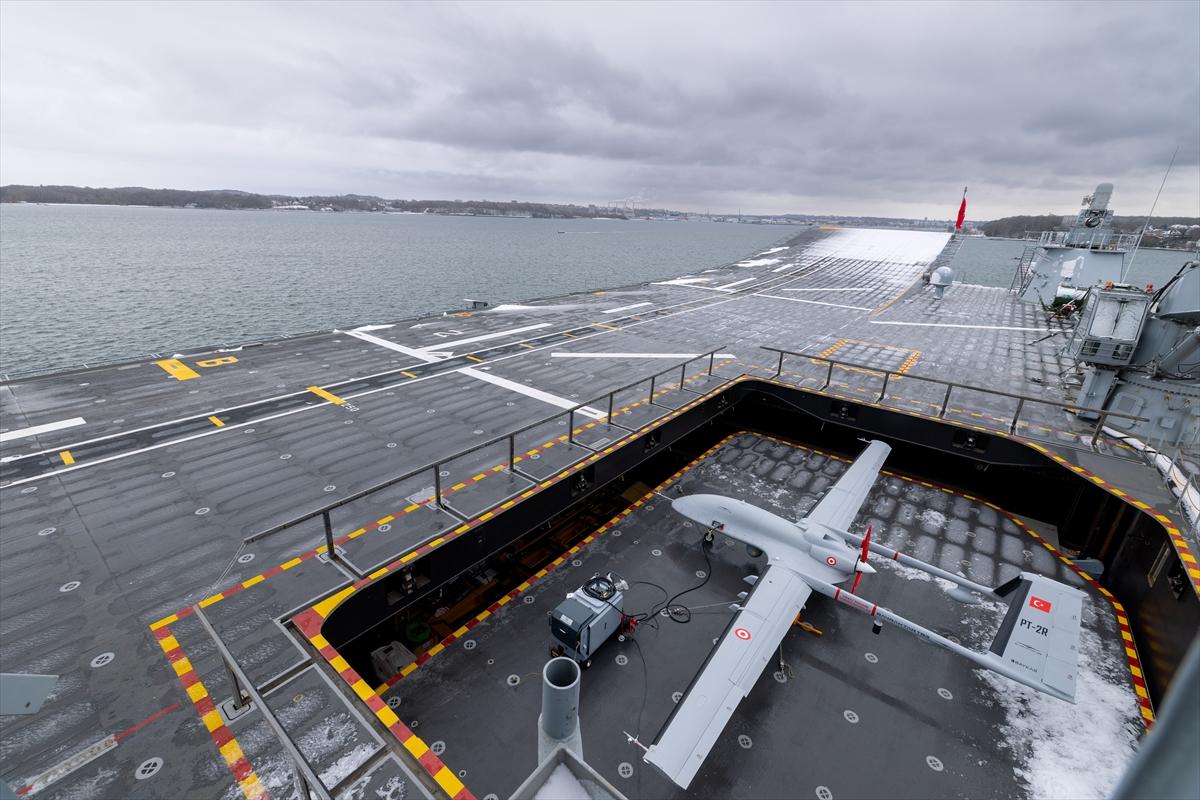
Bayraktar TB3 UAS, NATO's Steadfast Dart 2026 Exercise, 15 February 2026 - (Baykar)
Bayraktar TB3 Armed Unmanned Aerial Vehicle (UAV) participated in the maritime phase of NATO’s Steadfast Dart 2026 exercise. According to Baykar, the Bayraktar TB3 UAS stationed aboard TCG ANADOLU conducted autonomous takeoff from a short runway.
During Steadfast Dart 2026, the Bayraktar TB3 UAS operated within both maritime and air components. Three Bayraktar TB3 UAS platforms participated, operating from TCG ANADOLU.
The Bayraktar TB3 executed a short runway takeoff and conducted a dual salvo MAM-L strike against a designated maritime target. After the strike, the platform returned and landed autonomously on TCG ANADOLU, completing its mission.
Bayraktar TB3 - Steadfast Dart 2026 NATO Exercise, 15 February 2026 - (Baykar)
This activity marked the first operational demonstration of the Bayraktar TB3 platform outside its home country.
During the Baltic Sea phase of the exercise on 18 February, the Bayraktar TB3 conducted flight operations under conditions of temperatures as low as minus 5 degrees Celsius, heavy snowfall, and strong winds.
The Bayraktar TB3, launched autonomously from the short runway of TCG ANADOLU, flew in turbulent conditions caused by strong winds over the sea, completed its mission, and then performed an autonomous landing on the ship after the icy runway was cleared. It was noted that while other aircraft and helicopters were grounded due to the weather conditions, the Bayraktar TB3 successfully conducted its flight.
During the exercise, General Ingo Gerhartz, Commander of NATO’s Joint Force Command Brunssum, visited TCG ANADOLU. He observed the Bayraktar TB3’s flight and target strike. In his remarks, General Gerhartz stated, “As NATO Commander, I am deeply grateful to the Turkish Armed Forces for their significant and noteworthy contribution to the Steadfast Dart 2026 exercise.”
After the strike, General Gerhartz visited the Bayraktar TB3’s operational area alongside Commander of the Turkish Naval Forces, Admiral Ercüment Tatlıoğlu, congratulated the personnel involved, and took commemorative photographs.
On 21 February, the Bayraktar TB3 conducted a joint mission with Eurofighter fighter jets under the NATO exercise. Launched from TCG ANADOLU, the Bayraktar TB3 remained airborne for eight hours and covered a distance of 1,700 kilometers alongside the Eurofighters. This prolonged flight demonstrated the platform’s endurance, communication capabilities, and joint operational effectiveness.
Spain participated in the Steadfast Dart 2026 Exercise with land, maritime, air, and special forces elements. Spanish Armed Forces units deployed to Germany in stages. The Spanish Land Forces shipped 57 vehicles, 8 trailers, and 20 containers to Germany during the initial deployment phase, followed by a second vehicle shipment.
The Spanish Navy contributed the Castilla amphibious assault ship to the exercise. Castilla served as the starboard ship of the Maritime Component Command during the exercise, hosting elements of the Spanish Navy Headquarters.
The Cristóbal Colón frigate accompanied Castilla. Additionally, the Standing NATO Maritime Group-1 (SNMG-1) participated in the exercise. Command of SNMG-1 was led by Spain, with the command staff stationed aboard the Almirante Juan de Borbón frigate. The task group operated in coordination with the Patiño replenishment oiler as of 6 February.
Spain’s Joint Special Operations Command (MCOE) assumed the Special Operations Component Command (SOCC) role for the second time during the exercise. The Spanish Air and Space Force contributed two Special Operations Air Assets (SOALI), one supporting the land component and the other the maritime component. Approximately 1,500 Spanish military personnel were deployed in Germany during the training phase.

No Discussion Added Yet
Start discussion for "NATO Steadfast Dart 2026 Exercise" article
NATO Allied Reaction Force (Allied Reaction Force – ARF)
Objectives and Goals of the Exercise
Geographic Scope and Operational Areas
Participating Countries
Command Structure
Türkiye’s CFACC Role
NATO AWACS and Air Command and Control Elements
Air Power, Unmanned Systems, and Force Equipment Elements
Exercise Phases and Timeline
Phase 1 – Strategic Deployment and RSOM Process (2 January – 12 February 2026)
Phase 2 – Force Integration and Combat Training (9–20 February 2026)
Phase 3 – Redeployment and Reconstitution (End of February – 18 March 2026)
Türkiye’s Participation
Bayraktar TB3 Activities During the Exercise
Spain’s Participation