


This article was automatically translated from the original Turkish version.
+1 More
Neurosis is, in its broadest sense, a psychological disorder caused by anxieties, fears, and internal conflicts. Throughout the history of psychology, the concept of neurosis has been widely debated, but the common point is this: a neurotic individual does not lose touch with reality; they are not in a state perceived as “mad.” On the contrary, they continue with their lives but constantly struggle internally with a sense of anxiety, unease, and imbalance.
One characteristic of neurosis is that it is considered “mild.” This mildness refers to the individual not losing their overall functionality. However, this does not mean they are unaffected; quite the opposite, neurosis significantly impairs a person’s quality of life. On one hand, they participate in life, but on the other, they become a prisoner of their own inner distress.
Psychosis and neurosis are two entirely distinct phenomena. A person experiencing psychosis breaks their connection with reality. They may suffer from hallucinations (seeing or hearing things that do not exist) and delusions (irrational beliefs). A psychotic person is often unaware of their illness. The distinction between neurotic and psychotic individuals is also socially significant. A neurotic person is typically labeled as “anxious, meticulous, fussy, obsessive”, whereas a psychotic person is often stigmatized as “mentally ill”. This creates a major social divide: neurotics may be misunderstood but are seen as “manageable” individuals; psychotics, however, are perceived as “dangerous” or “people to avoid.”

Representative Visual of Neurosis (Generated by Artificial Intelligence)
One of the most fundamental traits of neurotic individuals is a persistent state of anxiety. This anxiety can be triggered even by simple everyday events. For example, the question “Did I lock the door?” which a normal person would consider insignificant, can lead a neurotic person to repeatedly check. This is a sign of obsessive tendencies. In addition, neurotics commonly experience low self-esteem. They perceive themselves as inadequate, worthless, or unsuccessful. Even when they achieve success, they dismiss it with excuses like “It was luck” or “I was fortunate.” This keeps them trapped in a cycle of guilt and dissatisfaction.
Neurotic individuals tend to have rigid attitudes. Regardless of changing circumstances, they respond in the same way. During a disagreement, a healthy person behaves flexibly according to the situation, while a neurotic person either always becomes angry or always withdraws inward. This makes their relationships with others difficult. Another characteristic is imbalance in interpersonal relationships. Some become excessively dependent, unable to take any step without the approval of others. Others, conversely, avoid everyone entirely, living an isolated life under the guise of independence. Yet both extremes stem from the same root: insecurity.
The most challenging aspect of these traits is the “anxiety–guilt cycle.” A neurotic person first feels anxiety about something, then restricts their behavior or makes a mistake because of that anxiety, followed by feelings of guilt, which in turn generate new anxiety. Thus, a vicious cycle is formed: they become anxious, then make a mistake, blame themselves, and fall into anxiety again.
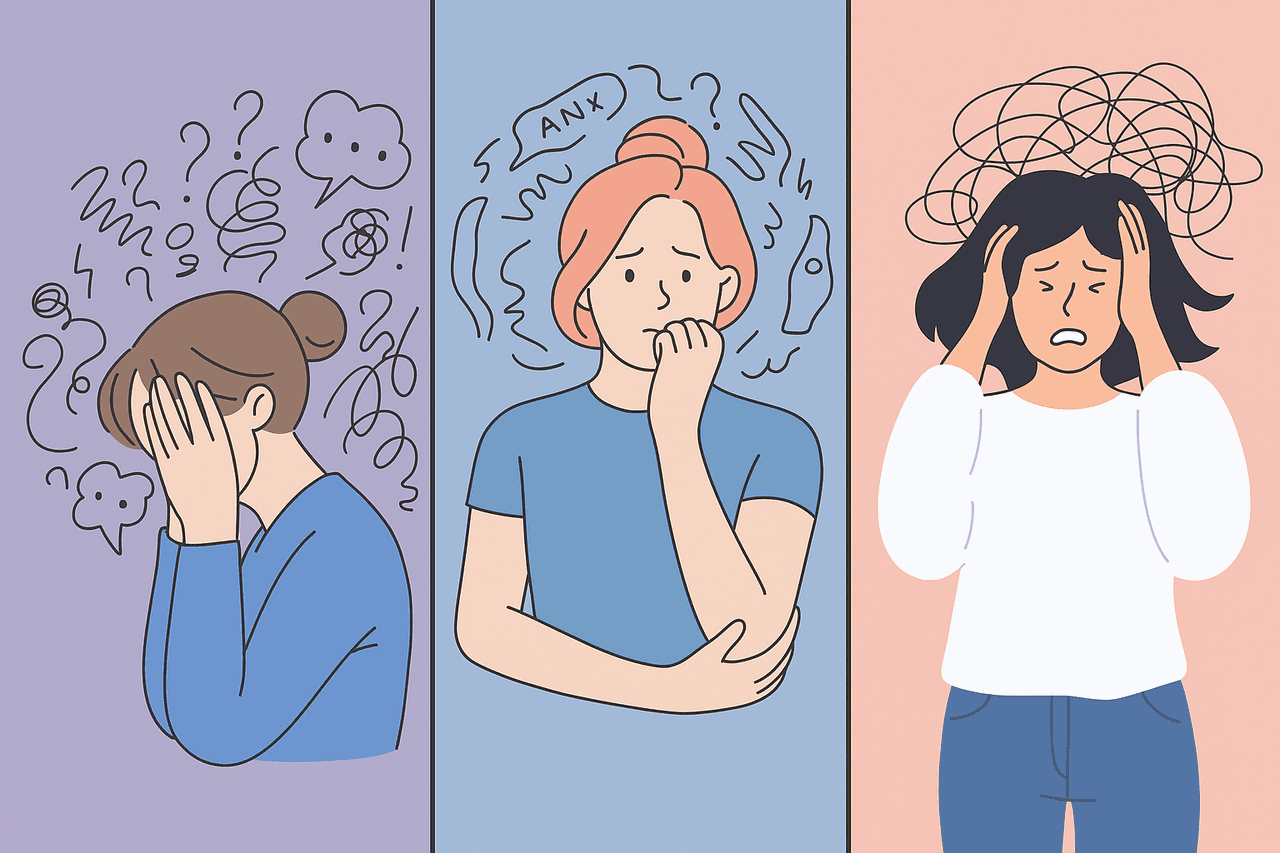
Representative Visual of Neurotic Anxiety (Generated by Artificial Intelligence)
Neurosis has no single cause; rather, it emerges from the combination of many factors. However, in the history of psychology, two causes have received the most attention: childhood experiences and repressed impulses.
Childhood Experiences: Karen Horney and many modern psychologists trace the origins of neurosis to early childhood. If a child does not receive sufficient love, trust, and acceptance from their family, they begin to perceive the world as hostile. This creates what Horney calls “basic anxiety.” A child raised in an overly protective family never learns independence and may develop an overly dependent personality later in life. Conversely, a child raised in an indifferent or neglectful family feels lonely and worthless, leading to trust issues and inner emptiness in adulthood. A child constantly subjected to pressure fears parental authority, and this fear manifests later as various anxiety disorders.
Repressed Impulses: Freud, however, views the issue differently. According to him, neurosis is particularly linked to the repression of sexual impulses. Sexual curiosity and desires experienced in childhood are suppressed by societal norms. But nothing repressed disappears; it remains in the unconscious and returns as anxiety.

Representative Visual of Neurotic Anxiety (Generated by Artificial Intelligence)
Karen Horney categorized the behavioral patterns individuals develop in response to anxiety and insecurity into three types: compliant, aggressive, and detached. These three orientations reflect how people relate to their environment. Some seek security through closeness to others, others attempt to suppress anxiety by asserting dominance or control, and others protect themselves by withdrawing entirely.
The compliant type is oriented toward others. This type constantly adapts to please others in order to be loved and accepted. Their life philosophy is essentially: “I am only valuable if others love me.” Therefore, they may sacrifice their own desires to satisfy others. In relationships, they display dependency and fear abandonment or loneliness. In today’s world, this type may manifest in people on social media who constantly seek approval, chasing “likes” and comments.
The aggressive type, by contrast, adopts a stance against others. In their worldview, power, success, and superiority come before everything else. They feel secure by dominating or controlling others. These individuals often lack empathy and disregard the feelings of others. In relationships, they may appear cold and distant. The ruthless, competitive leaders often seen in business are living examples of this type. Society labels them as “successful,” yet internally they harbor an insatiable anxiety.
The detached type withdraws from people. For these individuals, independence is the most important value. They avoid close relationships and emotional bonds because attachment increases the risk of being hurt. They prefer to live within their inner world. From the outside, they are often labeled as “asocial” or “cold.” In the modern age, the virtual worlds offered by technology provide an outlet for this type; people distance themselves from real relationships and retreat into their shells.
These three types represent different extremes. We all may exhibit these tendencies at times in our lives. However, in neurotic individuals, these tendencies become rigid, inflexible personality traits. That is, a person remains perpetually compliant, consistently aggressive, or entirely detached. This profoundly affects their social relationships, professional life, and inner peace.

Representative Visual of Neurotic Anxiety (Generated by Artificial Intelligence)
The relationship between religion and neurosis has been a widely debated topic in the history of psychology. Particularly, Freud and Jung held diametrically opposed views on this issue. Freud approaches religion with strong criticism. To him, religion is essentially a cultural neurosis—a domain in which people express their unconscious fears and repressed desires through symbols. Rituals, according to Freud, resemble obsessive-compulsive behaviors: constant repetition, rigid rules, and feelings of guilt. Therefore, Freud sees religion as a factor that hinders psychological development and keeps individuals trapped in childhood dependency.
Jung, on the other hand, argues the opposite. To him, religion serves a protective function for mental health. It fulfills people’s spiritual needs, answers existential questions, and provides them with a sense of wholeness. Jung states that as religious practice declines in the modern world, cases of neurosis increase. In his view, having religion is, in a sense, a psychological mechanism that maintains inner balance.
Atalay, Serdar. “Sigmund Freud’da Dinin Kökeni ve Mahiyeti Meselesi.” *Çukurova Üniversitesi İlahiyat Fakültesi Dergisi (ÇÜİFD)* 24, no. 1 (2024): 184–201. Accessed August 22, 2025. https://dergipark.org.tr/tr/download/article-file/3667825
Demir, Batuhan. “Psikanaliz Anoreksiyaya Yeter mi?” *Felsefe Sanat Psikanaliz* (2021). Accessed August 22, 2025. https://freudcupsikanalizdernegi.com/wp-content/uploads/2021/03/FSP-3.-Sayi.pdf#page=6
Demir, Batuhan. “Semptom: Bitmeyen Tekrar.” *Felsefe Sanat Psikanaliz* (FSP), no. 0 (May 2020). Accessed August 22, 2025. https://freudcupsikanalizdernegi.com/wp-content/uploads/2020/05/FSP-Say%C4%B1-0-May%C4%B1s-2020-1.pdf#page=6
Katipoğlu, Bedri. “Freud Psikanalizindeki Nevroz Açılımına Tepkiler.” *Balıkesir Üniversitesi Sosyal Bilimler Enstitüsü Dergisi* 14, no. 26 (2011): 259-266. Accessed August 22, 2025. https://dergipark.org.tr/en/download/article-file/854304
Moroğlu, Aygül Kakırman, and Ceylin Özcan. “Kaygı nevrozunun psikanalitik kuram üzerinden incelenmesi: Bir vaka örneği.” *Journal of Clinical Psychology Research* 8, no. 2 (2024): 283–293. Accessed August 22, 2025. https://dergipark.org.tr/tr/download/article-file/2823146
Yıldırım, Sena Nur. “Nevrotik kişilik tipleri ve evli bireylerin ilişki istikrarı arasındaki ilişki.” Accessed August 22, 2025.
Özakkaş, Tahir. “Psikoterapi tarihi ve bütüncül psikoterapi.” *Türkiye Bütüncül Psikoterapi Dergisi* 1, no. 1 (2018): 1–24. Accessed August 22, 2025. https://dergipark.org.tr/en/download/article-file/396284

General Characteristics of Neurotic Individuals
Causes of Neurosis
Other Contributing Factors
Types of Neurosis
Religion and Neurosis