+1 More

Birth | 1934, Kahramanmaraş | ||||||||
|---|---|---|---|---|---|---|---|---|---|
Death | 18 October 2019, Ankara | ||||||||
Profession(s) | Thinker Poet Writer | ||||||||
Literary Genres in Which He/She Produced Works | Translation Letter Play Diary Poetry Essay | ||||||||
Education | Istanbul University Faculty of Law | ||||||||
Influential Figures | Sezai Karakoç Necip Fazıl Kısakürek | ||||||||
Award(s) | 2013 Ministry of Culture and Tourism Culture and Art Grand Prize 2019 Presidency Culture and Art Grand Prize 2014 Necip Fazıl Respect Prize | ||||||||
Place of Burial | Taceddin Dergahı, Ankara | ||||||||
Nuri Pakdil (b. 1934, Kahramanmaraş – d. 18 October 2019, Ankara) is a writer, essayist, playwright and thinker who stands out in Turkish literature and intellectual history for his distinctive language, his aesthetic framework centered on the concept of “native thought,” and his protest-oriented literary stance. Recognized as one of the most influential representatives of Islamic thought in literature during the Republican era, Pakdil established a unique intellectual circle through the journal Edebiyat and Edebiyat Dergisi Yayınları, opening up debates on modernization, alienation and Westernization within a native linguistic framework.

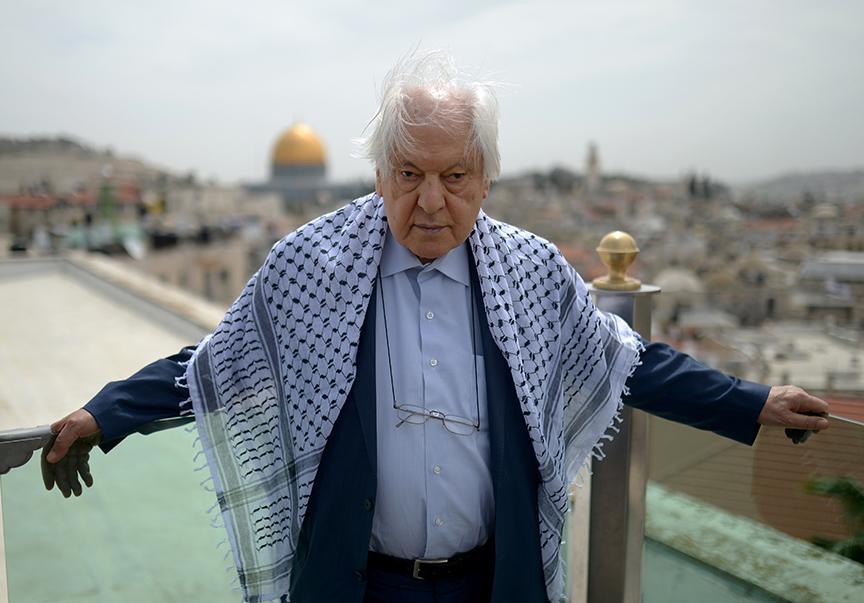
Nuri Pakdil (Anadolu Agency)
Nuri Pakdil was born in 1934 in the Yörükselim neighborhood of Kahramanmaraş into a culturally rooted family. His father, Mehmet Emin Ziyai, and his mother, Hatice Vecihe Hanım from the Tefsirzade family, were both fluent in Arabic and deeply committed to religious tradition. The family maintained a critical distance from the official education system of the time, believing it conflicted with their own values. For this reason, Pakdil entered primary school through an external examination and continued his education with private tutors.
During childhood, the stories of Algeria told by his mother awakened in him an early “consciousness of the world.” He often recounted sleeping with the atlas his mother had given him, through which he began to perceive the world as a unified whole. In Pakdil’s works, images from childhood — fountains, sun, wind, earth — recur as metaphors for a continuous search for roots.
Pakdil began secondary school three years late and continued his education at Maraş High School. During these years his interest in literature became evident; together with schoolmates he founded a journal titled Hamle. Hamle transcended the status of a mere local student publication and attracted attention from literary circles in Istanbul and Ankara. Nurullah Ataç, writing in Türk Dili, noted that the young writers involved would become significant figures in the future.
Pakdil graduated from the Faculty of Law at Istanbul University in 1959. During his university years he met Necip Fazıl Kısakürek and Sezai Karakoç, deepening his intellectual world. These years coincided with Turkey’s period of political turbulence preceding the 27 May coup. Pakdil described this phase of his student life as “the years I could not write,” marked by intellectual uncertainty.
After graduation, he worked as a legal consultant and served as an expert at the State Planning Organization between 1967 and 1973. In 1973 he left public service to devote himself fully to writing. He returned to the State Planning Organization in 1988 and retired in 1999.
Following the closure of the journal Edebiyat in 1984, Pakdil entered a “period of silence” that lasted approximately thirteen years. He defined this period not as “silence” but as “speaking in another way.” The notes he wrote during these years later evolved into the six-volume series Otel Gören Defterler.
Nuri Pakdil oriented his literary career through the essay form. His essays fall into two main categories: thought-centered and critical texts, and short, intense pieces composed of aphorisms. He constructs his writings as acts of thinking, demanding from the reader questioning, resistance and awakening. His language is often tense, sharp and fragmented. The excessive weight placed on words sometimes keeps meaning on the surface; yet this is a deliberate stylistic choice. His sentences are loosely connected, with language prioritizing rhythm over meaning.
The fundamental aim of his essays is “to awaken consciousness.” Central themes include the defense of native thought, the construction of identity in opposition to the West, and the reinterpretation of Islam’s ethical and social dimensions. In these texts, much of the meaning lies beneath the surface, like the submerged part of an iceberg; words acquire symbolic depth before transforming into thought.
For Pakdil, literature is not merely an aesthetic pursuit but a social act of consciousness. Writing, in his worldview, is a form of worship: “Writing is love arrived at its peak.”【1】 This expression encapsulates his perspective. Literature, for him, is the means by which the human being comes to realize their responsibility before God. Art, therefore, becomes an instrument of existential struggle. In his view, “native thought” is not merely a cultural preference but the human effort to exist on earth with authentic identity.
The concept of “action” holds central importance in Pakdil’s texts. Action is the embodiment of thought; writing itself is a form of action. He positions art as “the aesthetic language of a Muslim consciousness.” In this sense, he is also seen as a thinker of action.
Launched in Ankara in 1969, the journal Edebiyat is one of the longest-running publications in modern Turkish literature grounded in the framework of native thought. Founded under Pakdil’s leadership, it aligned itself with the intellectual trajectories of Necip Fazıl’s Büyük Doğu and Sezai Karakoç’s Diriliş, yet developed its own distinctive language. Between 1969 and 1984, it published 141 issues and featured nearly forty writers and poets.
Edebiyat sought to establish an artistic language rooted in native and Islamic values, in opposition to the state’s official cultural policies. The writings published in the journal emphasized folk culture, labor, the working class, solidarity and resistance. Translations from Middle Eastern, African and Arabic literatures forged connections with the Islamic world. This approach enabled Islamic thought in Turkey to attain a universal dimension through literature.
Established in 1972, Edebiyat Dergisi Yayınları published works not only by Pakdil but also by young writers, becoming one of the most prolific independent publishing houses of the era with a total of forty-five books. This institution functioned not merely as a publishing outlet but as a “school.” The intellectual formation of figures such as Rasim Özdenören, Akif İnan and Erdem Bayazıt was decisively shaped by this circle.
In Pakdil’s thought system, Westernization constitutes a cultural and spiritual process of “alienation.” The detachment of Turkish society from its own core values and its imitation of Western aesthetics and politics signify, in his view, rootlessness. In this context, the West is not merely a civilization but a “consciousness-disrupting system.”
For Pakdil, authentic modernization is not imitation of the West but the attainment of a consciousness in which the human being reestablishes their bond with God. He therefore interprets modernity as “a contemporaneity nourished by native thought and capable of reestablishing a relationship with the sacred text.”
The alienation produced by Westernization leads individuals to become estranged from their labor, their identity and their community. The most powerful defense against this alienation, in Pakdil’s thought, is the concept of “native thought.” Native thought is defined as a movement of return to one’s essence, both religious and social.
In Pakdil’s literature, Islam is not merely a belief but a form of resistance. In his writings, Islam serves as the foundation of social justice, the sanctity of labor and human dignity. The recurring concept of “revolution” in his works does not refer to Western-style political revolutions but to Islam’s continuous process of renewal and revival. He views Islam as a “consciousness of perpetual revolution,” emphasizing its unceasing struggle against oppression on earth.
A spirit of dissent lies at the heart of his works. This stance manifests as a sharp critique of capitalism, imperialism, materialism, the corrosive effects of urbanization and official ideology. For him, the writer is the individual who stands in opposition to their age; writing is the noblest form of protest. His language is tense and revolutionary, directly expressing this dissent.
In Pakdil’s worldview, human labor is sacred. Every individual has the right to consume only the fruits of their own labor. His critiques of injustice, exploitation and unjust gain are grounded in this principle.
Pakdil is known in Turkish literature as the “Poet of Jerusalem.” In his works, Jerusalem is not merely a city but a conscience, a measure of time and a symbol of resistance. The line “I carry Jerusalem like a wristwatch” is a concise expression of this metaphor. The poet positions Jerusalem as both the central consciousness of Islam and the heart of humanity’s quest for justice.
For him, Jerusalem is the geography of faith and the collective memory of all peoples who have suffered oppression throughout history. This consciousness is consistently articulated not only in his poetry but also in his essays. To lose Jerusalem is to lose the human heart.
Pakdil’s poem “Mothers and Jerusalems” encapsulates the essence of his entire intellectual world. In the poem, the feeling of motherhood merges with love for Jerusalem; the mother represents humanity’s conscience, while Jerusalem is the space of that conscience. The poet’s lines “Walk, brother, let the power of Jerusalem enter your feet” constitute a poetic call to action.
Pakdil’s poetry is independent of classical forms and woven with intense imagery. His poetic language, like his essays, is tense and fragmented. It creates a fluid structure between thought and emotion. He views poetry as a field of awakening consciousness; each line thus functions as a summons or a warning. In his poems, metaphysical depth unites with moral responsibility, giving rise to a form of resistance that is both individual and collective.

Nuri Pakdil and Recep Tayyip Erdoğan (Anadolu Agency)
Nuri Pakdil’s major works include:
His works interweave genres including theater, diary, essay, letter and poetry. The formal uniqueness of his language opened a new aesthetic domain within the Turkish essay tradition.
Beginning in 1997, Pakdil reissued his own books and maintained his connections with literary circles. In 2013 he received the Ministry of Culture and Tourism’s Grand Cultural and Art Award, in 2014 the Necip Fazıl Commemorative Award, and in 2019 the Presidency Grand Cultural and Art Award.
Nuri Pakdil died on 18 October 2019 at the age of 85 in a hospital in Ankara where he was receiving treatment. After the funeral prayer held at Hacı Bayram Veli Camii, he was buried at Taceddin Dergâhı.
Accessed November 26, 2025. https://www.aa.com.tr/tr/kultur/ahlatta-acilan-kurslarla-geleneksel-tas-isciligi-yasatiliyor/3116279.
Accessed November 26, 2025.
Accessed November 26, 2025.
Anadolu Ajansı. “Kalbi Kudüs’le Atan Edebiyatçı Derviş: Nuri Pakdil.” Accessed October 18, 2025. https://www.aa.com.tr/tr/portre/kalbi-kudusle-atan-edebiyatci-dervis-nuri-pakdil/3022658
Anadolu Ajansı. “Yazmaya ve Kudüs’e Âşık Bir Derviş: Nuri Pakdil.” Accessed October 18, 2025. https://www.aa.com.tr/tr/kultur/yazmaya-ve-kuduse-asik-bir-dervis-nuri-pakdil/3719414
Biography. "Nuri Pakdil." *Biography.* Accessed October 18, 2025. https://www.biyografya.com/tr/biographies/nuri-pakdil-35a8bee5
Doğan, Tuğba. *Nuri Pakdil’de Protest Tavır.* Master's thesis, Department of Turkish Language and Literature, Istanbul, 2017. Accessed October 18, 2025. https://acikerisim.fsm.edu.tr/xmlui;/bitstream/handle/11352/2460/Doğan.pdf?sequence=1&isAllowed=y
Kılıç, Rüveyda. *Türk Düşünce Tarihinde Nuri Pakdil ve Modernleşme Anlayışı.* Master's thesis, Çorum, 2015. Accessed October 18, 2025. https://www.proquest.com/openview/713b52da32036b77175021374ef660fb/1?pq-origsite=gscholar&cbl=2026366&diss=y
Pakdil, Nuri. Derviş Hüneri. Ankara: Edebiyat Dergisi Yayınları, 2012.
Sadıkoğlu, İlhan. *Modern Türk Edebiyatı İçinde Nuri Pakdil’in Edebiyat Dergisinin Yeri ve Rolü.* Master's thesis, İstanbul, 2013. Accessed October 18, 2025. https://acikerisim.fsm.edu.tr/xmlui/bitstream/handle/11352/183/Sadıkoğlu.pdf?sequence=1&isAllowed=y
TEİS – Türkiye Edebiyatı İsimler Sözlüğü. “Pakdil, Nuri.” TEİS. Accessed October 18, 2025. https://teis.yesevi.edu.tr/madde-detay/pakdil-nuri
Topci, Davut. “Nuri Pakdil ve Toplumsal Yabancılaşma.” *Din Sosyolojisi Araştırmaları* 1, no. 1 (October 2021): 29–42. Accessed October 18, 2025. https://dergipark.org.tr/tr/pub/disar/issue/72176/1162530
Turna, Murat. “İslamcılık Üzerine Bazı Dikkatler ve Nuri Pakdil’in İslamcı Çizgideki Yeri.” *SUTAD* 49 (August 2020): 211–232. Accessed October 18, 2025. https://www.academia.edu/77695922/ISLAMCILIK_UZERINE_BAZI_DIKKATLER_VE_NURI_PAKDIL_IN_ISLAMCI_CIZGIDEKI_YERI
Yücer, Hür Mahmut. “Türkiye’de Bir Kudüs Şairi: Nuri Pakdil ve Aşk-ı Kudüs.” *Akademik Platform İslami Araştırmalar Dergisi* 2, no. 2 (August 2018): 28–43. Accessed October 18, 2025. https://dergipark.org.tr/tr/pub/apjir/issue/39018/457782
İsmail Kara Arşivi (İstanbul Sabahattin Zaim Üniversitesi). "KA953, KA2067, KA7591 Belgeleri." Accessed October 18, 2025.
Şahin, Emir Ali. “Nuri Pakdil’in Şiir Coğrafyasında Kudüs.” *Akademik Platform İslami Araştırmalar Dergisi* 2, no. 1 (June 2018): 69–78. Accessed October 18, 2025. https://dergipark.org.tr/tr/pub/apjir/issue/39017/457748
Şahin, Veysel. “Nuri Pakdil’in Şiirlerinde Kimliği İnşa Eden Mekânlar: Mekânları İnşa Eden Kimlikler.” *Fırat University Journal of Social Sciences* 30, no. 2 (2020): 153–164. https://doi.org/10.18069/firatsbed.724518
Şuoruç, Batuhan. *Sezai Karakoç, Nuri Pakdil ve İsmet Özel’in Şiirinde İsyan.* Master's thesis, Samsun, 2022. Accessed October 18, 2025. http://acikerisim.omu.edu.tr/xmlui/bitstream/handle/20.500.12712/34092/142547.pdf?sequence=1
[1]
Nuri Pakdil, Derviş Hüneri (Edebiyat Dergisi Yayınları), 40.

Birth | 1934, Kahramanmaraş | ||||||||
|---|---|---|---|---|---|---|---|---|---|
Death | 18 October 2019, Ankara | ||||||||
Profession(s) | Thinker Poet Writer | ||||||||
Literary Genres in Which He/She Produced Works | Translation Letter Play Diary Poetry Essay | ||||||||
Education | Istanbul University Faculty of Law | ||||||||
Influential Figures | Sezai Karakoç Necip Fazıl Kısakürek | ||||||||
Award(s) | 2013 Ministry of Culture and Tourism Culture and Art Grand Prize 2019 Presidency Culture and Art Grand Prize 2014 Necip Fazıl Respect Prize | ||||||||
Place of Burial | Taceddin Dergahı, Ankara | ||||||||
Life
Family and Childhood
Educational Years
Professional Life and the Period of Silence
Literary Identity and Style
Essayist Identity
Concept of Thought and Art
Edebiyat Journal and Cultural Environment
Intellectual Worldview
Modernization, Westernization and Alienation
Islamic Identity and Protest Stance
The Theme of Jerusalem and Poetic Consciousness
The Place of Jerusalem
The Poem “Mothers and Jerusalems”
Concept of Poetry
Works
Final Years and Death