


This article was automatically translated from the original Turkish version.
Quantum dot-controlled processing refers to next-generation manufacturing platforms that directly utilize fabrication technologies for nano-scale quantum structures. These systems enable high-precision control processes by leveraging the sensitive responses of quantum dots to light, electric fields, and environmental interactions. Particularly in electronics, photonics, and biomedical manufacturing, these systems offer a structure that is far more finely tunable and responsive than traditional mechanical or optical controls.
Quantum dots are semiconductor crystalline structures typically measuring 2 to 10 nanometers in size. In these structures, electrons are confined in all three dimensions, resulting in discrete energy levels. This property renders them highly sensitive light absorbers and emitters. In manufacturing systems, these characteristics have become critical tools for optical sensors, nanoimprint lithography, and high-resolution positioning mechanisms.
The foundation of these systems consists of integrated control modules capable of monitoring and directing quantum dot behavior. These modules are typically composed of artificial intelligence-assisted algorithms combined with nano-optomechanical structures, piezoelectric control circuits, or quantum state analyzers. As a result, even minute changes in environmental parameters during processing can be responded to instantly, enabling atomic-scale precise positioning and energy guidance.
In quantum dot-based systems, the energy or position of a dot can be precisely altered through light-excited electrons. This feature allows dynamic adjustment of laser power, positioning, or temperature during micro/nano manufacturing according to the morphology of the processed material. In particular, these systems offer revolutionary innovations in nano-lithography and biomolecular labeling processes.
Quantum dots integrated into processing systems also serve as sensors that continuously monitor the manufacturing environment. Variables such as temperature, pH, pressure, or electromagnetic fields can be easily tracked via quantum dot fluorescence. This not only overcomes the dimensional limitations of conventional sensors but also enables previously impossible forms of control, such as single-molecule-level manufacturing monitoring.
Key application areas for these systems include nano-chip production, biomedical implant surface treatments, photovoltaic nano-structure arrangements, and optoelectronic integrated circuit designs. Quantum dot-controlled processing also has the potential to provide infrastructure for photon-based quantum information systems, thereby laying the groundwork for hybridization in both manufacturing and information technologies.
Due to their inherently high sensitivity, quantum dots require control algorithms to operate with high accuracy. For this reason, systems typically employ artificial neural networks or fuzzy logic-based control systems. These algorithms learn the behavior of quantum dots in real time, enabling the system to perform processes without being affected by external disturbances.
One of their greatest advantages is energy efficiency. Quantum dot-controlled systems are structured to activate only during processing and respond sensitively to external stimuli. This allows energy consumption to be limited to only what is necessary during manufacturing. The use of these systems is particularly significant in fields such as micro-LED production, which demand high precision and low energy consumption.
Quantum dot technologies are also more scalable than classical manufacturing systems. The same system can be easily adapted to different types of nanostructures. For example, a system used for biological targeting can be reconfigured for optoelectronic circuit production with a minor parameter adjustment. This makes quantum dot-controlled systems highly adaptable manufacturing tools.
Quantum dots are crystalline nanostructures made from semiconductor materials, typically 2 to 10 nanometers in diameter. These dots confine electrons in all three dimensions, meaning electrons can only occupy specific energy levels. This transforms quantum dots into systems with discrete energy levels, best explained by quantum mechanics rather than classical physics. This fundamental property causes them to exhibit unique behaviors in electronic and optoelectronic applications.
As the physical size of quantum dots decreases, the energy gap between levels (bandgap) increases. This directly alters their optical properties. For instance, smaller quantum dots emit higher-energy photons, corresponding to colors closer to blue in the visible spectrum. Larger quantum dots shift toward red. This phenomenon, known as the “quantum size effect,” is of great importance in color-controlled optoelectronic applications.
From an electronic perspective, quantum dots behave like miniaturized versions of semiconductor structures. However, unlike conventional semiconductors, they can operate at much lower energy levels and are extremely sensitive to external fields. This sensitivity makes them ideal for electrical control and preferred in high-resolution detector systems. Their use in photovoltaic cells for efficient light collection and conversion into electrical energy is particularly noteworthy.
Quantum dots are also known for their fluorescent properties. When excited by high-energy radiation such as UV light, they emit light at specific wavelengths. This feature is utilized in a wide range of applications, from intracellular imaging in biological systems to material surface analysis. Their greater stability, brightness, and narrower emission spectra compared to traditional fluorescent dyes are among the reasons for their preference.
Another factor influencing their electronic behavior is the material composition of the quantum dot. They are commonly made from compounds such as CdSe, InP, PbS, and ZnS. Each has distinct bandgaps and energy levels. For example, cadmium selenide (CdSe) quantum dots can emit light across a broad spectral range, while lead sulfide (PbS)-based dots are more active in the infrared region. This makes them useful in infrared camera systems and medical imaging technologies.
The electronic properties of quantum dots are also directly related to their surface states and core-shell structures. Unsaturated atomic bonds on the surface can create free electron states. These unwanted energy levels reduce quantum efficiency. Therefore, most quantum dot structures are passivated by coating the core with a shell material such as ZnS. This structure enhances stability and optimizes energy transfer.
Although physically stable, quantum dots remain highly sensitive to environmental conditions. External variables such as light, temperature, pH, and ionic environment can affect the emission intensity and energy of quantum dots. This makes them ideal for use as environmental sensors. At the same time, this sensitivity provides significant advantages for real-time monitoring of manufacturing processes.
Quantum dot-controlled systems have begun industrial implementation across many high-tech fields, including electronics, optoelectronics, biomedical engineering, energy, and sensor technologies. Their nanosecond response times, discrete energy levels, and surface sensitivity have transformed them into components that surpass conventional microfabrication technologies. These structures are actively used in microprocessor production, high-resolution display technologies, and targeted drug delivery systems.
One primary application area is high-resolution imaging panels. Quantum dot technology significantly enhances color accuracy, brightness, and energy efficiency in LED and OLED displays. QLED technology, developed and commercialized by companies such as Samsung and LG, provides a sharper and wider color gamut than traditional LCD systems by enabling more controlled and homogeneous color generation.
In biomedical applications, quantum dots are used for cell labeling, molecular diagnostics, and drug delivery systems. Their high fluorescence enables imaging of intracellular structures; additionally, by binding to specific biological targets, they can detect particular tissues such as cancer cells. These systems deliver faster and more precise results than classical diagnostic methods. When functioning as drug carriers, they minimize side effects through targeted release.
Quantum dot-controlled structures also hold a significant position in photovoltaic systems. In third-generation solar panels, the enhanced light absorption of quantum dots improves energy conversion efficiency. Their ability to remain active even under low-light conditions makes them viable for urban environments or regions with limited sunlight. When integrated with perovskite-based structures, quantum dots pave the way for high-performance hybrid photovoltaic systems.
Another notable field is quantum information technology. Quantum dots serve as single-photon sources and function as fundamental components in quantum computing and quantum cryptography systems. Specifically, controlled quantum dot pairs at low temperatures generate entangled photons, forming the basis of revolutionary systems for data security. This area remains under intensive research, but early applications have already begun in commercial laboratories and the security sector.
The broad adoption of quantum dot-controlled processing systems stems not only from their physical properties but also from their ease of integration. Particularly in microchip fabrication processes, the small size and adaptability of quantum dots enable parallel operation with existing CMOS technologies. This allows them to move beyond research-focused applications and become integrated into large-scale industrial production.
Despite their high precision and functionality, quantum dot technologies face several technical barriers to widespread industrial adoption. One of the most fundamental problems is their excessive sensitivity to environmental factors. Minor changes in parameters such as temperature, light, pH, and ionic environment can alter the optical and electronic behavior of quantum dots. This can lead to performance deviations in production lines requiring long-term stability.
Another significant challenge is the tendency of quantum dots to aggregate and precipitate. Quantum dots suspended in colloidal media can cluster over time and lose homogeneity. This can cause signal loss, reduced efficiency, and unpredictable deviations in manufacturing processes, especially in applications requiring large surface areas. Various surface modification techniques and stabilizing additives are employed to overcome this issue; however, they add complexity to the production process.
The toxicity risk of quantum dots is also a technical and environmental obstacle. Cadmium-based quantum dots, such as CdSe, can cause cellular toxicity when used in biological systems. Consequently, safer alternatives such as carbon-based dots or cadmium-free ZnSe derivatives are increasingly preferred for biomedical applications. However, the optical efficiency and production cost of these next-generation dots have not yet reached desired levels.
Integration into electronic systems presents another challenge. The environments in which quantum dots are synthesized (solution-based colloidal systems) are generally incompatible with the electronic substrates they must be integrated into (e.g., silicon-based chips). As a result, transfer processes can lead to sensitivity loss, contamination risks, and structural damage. Specialized manufacturing techniques such as atomic layer deposition (ALD) and low-temperature spin coating have been developed to address this issue.
Another technical limitation in quantum dot-controlled systems relates to scalability and production repeatability. Quantum dots that perform well under laboratory conditions can pose challenges in terms of homogeneity, quality control, and cost during serial production. This is one of the factors delaying broader industrial adoption of the technology. In particular, the cost of quantum dots specially designed for different applications can be high, affecting the economic sustainability of the system.
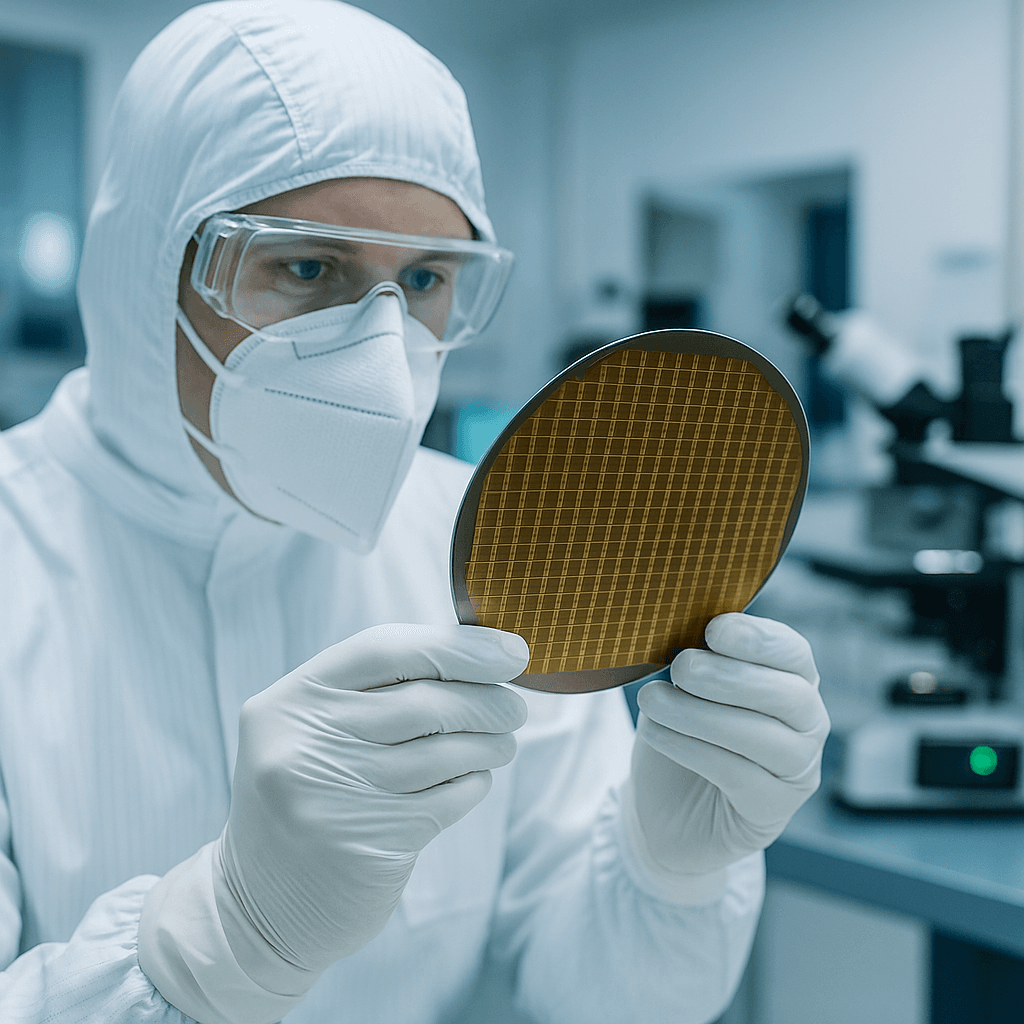
Researcher examining a silicon wafer containing quantum dot arrays in a cleanroom environment (generated by artificial intelligence)
Quantum dot-controlled systems not only enhance existing manufacturing and control processes but also hold the potential to be at the center of future technological transformation. These systems directly support key elements of sustainable manufacturing, including energy efficiency, material reduction, environmental sensitivity, and automation capacity. Particularly in sectors requiring precise control at micro and nano scales, they optimize resource use by enabling higher accuracy with fewer inputs.
From an energy perspective, quantum dot systems consume significantly less power than conventional sensor and control systems due to their ability to deliver maximum response with minimal power. In this regard, they can play a vital role in supporting green manufacturing technologies. Simultaneously, quantum dot-based solutions in LED and solar panel systems open the path toward developing highly efficient and long-lasting energy systems.
The innovation potential of quantum dot-controlled systems is evident not only at the material level but also in their interaction with artificial intelligence and machine learning. Within the Industry 5.0 vision, such AI-controlled quantum-based systems can be used to create human-centric production lines.
In particular, in healthcare and biotechnology, quantum dots are expected to enable precise diagnostics at the individual patient level and the development of personalized treatment systems. Systems capable of detecting microscopic changes in protein levels within a single cell can play a major role in early diagnosis and preventive healthcare strategies. This feature is being evaluated across a broad spectrum, from public health monitoring to rapid pandemic response systems.
Space, defense, and advanced optoelectronic applications are also anticipated to be key areas for the widespread adoption of quantum dot-controlled systems. Considering weight and energy constraints in spacecraft, compact and energy-efficient technologies such as quantum dot sensors offer significant advantages. Additionally, quantum dot sources in photon-based communication systems are becoming critical components for more secure and faster data transmission.

No Discussion Added Yet
Start discussion for "Quantum Dot Controlled Processing" article
Physical and Electronic Properties of Quantum Dots
Industrial Applications of Quantum Dot-Controlled Systems
Technical Challenges in Quantum Dot-Controlled Systems
Sustainability and Innovation Perspective