


This article was automatically translated from the original Turkish version.
“Silent factory technology” refers to a new generation of manufacturing philosophy developed in contrast to the noisy, chaotic, and loud nature of traditional production facilities. It involves digitally enabled, automation-supported systems that operate at low decibel levels and prioritize human-machine compatibility. This concept encompasses not only physical “silence” but also an “operational silence” characterized by invisible data flows, minimized human intervention, and early suppression of errors.
This technological transformation, considered an extension of Industry 4.0, has been developed to integrate, harmonize, and make production processes more environmentally friendly. Silent factories aim to reduce traditional production indicators such as noise and vibration while simultaneously enhancing production efficiency, safety, and worker satisfaction. These objectives have been implemented through exemplary models in countries with high industrial standards, such as Europe and Japan.
The most distinctive feature of such factories is a new cultural approach in which sound is no longer perceived as a sign of productivity. In the past, the noise generated by operating machinery was taken as an indicator that production was underway; in silent factories, production flow is monitored through digital signals on screens, data dashboards, and automated feedback systems rather than machine noise. This represents a paradigm shift at the perceptual level.
The foundation of silent factory technology is “intelligent silence.” Here, silence does not merely mean reducing audible frequencies; it also entails eliminating unnecessary machine movements, preventing defective production from occurring in the first place, avoiding energy waste, and suppressing all potential noise at the informational level. Thus, these factories are silent not only acoustically but also operationally.
In traditional factories, sounds such as mechanical friction, pneumatic system bursts, and metal impacts were inseparable parts of production; in silent factories, such systems have either been digitized or entirely eliminated. For instance, the preference for electromechanical actuators over pneumatic systems reduces noise levels and decreases maintenance requirements. Additionally, physical improvements such as sound-absorbing materials, specialized flooring designs, and enclosed cabins support acoustic management.
This technology also reshapes human-machine relationships. In noisy environments, communication becomes difficult; in silent factories, workers interact more efficiently with machines through voice command systems, augmented reality glasses, and digital panels. This particularly reduces operator fatigue and prevents attention dispersion, especially on production lines.
From an environmental perspective, silent factories are also significant. Noise pollution creates adverse effects both indoors (on worker health) and outdoors (on local communities and nature). Therefore, silent factories represent the convergence point between occupational health and safety regulations and environmental sustainability goals. The European Union’s noise regulations form the political backdrop for this transformation.
Energy efficiency is also an inseparable part of the silent factory concept. Quieter-operating machines typically generate less friction and vibration, which translates into lower energy consumption and longer equipment lifespan. Furthermore, these machines, continuously monitored through digital twin technology, detect potential failures in advance, minimizing unplanned downtime and maintenance periods.
The feasibility of silent factory technology depends on highly integrated digital systems and physical engineering solutions. The technologies employed in these factories do not merely reduce noise levels; they also enhance production quality, protect human health, and promote sustainability. Silence here is not a physical byproduct but the result of holistic engineering and automation success.
The first and most defining technological component is electromechanical actuator systems. Traditional pneumatic or hydraulic systems generate high-decibel noise through sudden releases, impacts, and mechanical vibrations caused by compressed air and fluids. Electromechanical systems, by contrast, operate with lower friction and execute movements more quietly. These systems also offer more precise positioning, reduced maintenance needs, and higher energy efficiency.
Another critical component is noise insulation technology. In silent factories, machine enclosures are lined with specialized acoustic panels made from sound-absorbing materials that prevent resonance-induced vibrations in metal surfaces. Floor coverings are also specially selected. Rubber-based floors that reduce vibration and vibration-damping suspension systems prevent machine-generated noise from spreading into the environment.
Intelligent sensor systems enable the management of silence at the informational level. Acoustic sensors detect situations exceeding a specific decibel threshold and activate early warning mechanisms. These sensors also analyze machine vibration profiles and detect frequency shifts indicative of potential failures, providing data to maintenance systems. Thus, sound becomes not a result but a diagnostic tool.
Digital twin technology forms the backbone of the silent factory concept. A virtual replica of each machine is monitored in real time within a digital environment. This allows performance curves, sound profiles, and vibration behaviors to be simulated in advance, enabling testing of silent operation scenarios. For example, silent operation tests can be conducted on a digital twin model before running an entire production line.
Energy monitoring and control systems play a vital role in silent factories because energy waste is often linked to mechanical friction and unnecessary movements. Intelligent energy management ensures machines operate only when needed, resulting in fewer active mechanisms and thus supporting silence. Additionally, energy recovery systems—such as those that capture kinetic energy generated during braking and return it to the system—enhance both efficiency and silence.
Human-machine interface systems (HMI) form the foundation of silent communication. In factories, announcements, shouting, or manual alerts are replaced by digital displays, LED indicators, and haptic notification systems. In some systems, augmented reality (AR) glasses provide workers with all machine-related alerts and information silently and visually. This ensures a noise-free flow of information.
Artificial intelligence-supported production control software represents the highest-level components that integrate silence with efficiency. These software systems optimize data flow on production lines, prevent bottlenecks, eliminate unnecessary production repetitions, and enhance energy efficiency. Simultaneously, they use data analysis to detect and preemptively signal abnormal, noise-generating behaviors—such as machine strain—before they escalate.
Autonomous mobile robot systems (AMR) also directly contribute to silence. These vehicles operate significantly quieter than traditional forklifts or human transport systems due to their wheeled structures and brushless motors. Additionally, because they plan their routes using artificial intelligence, noise caused by collisions, sudden braking, or unnecessary movements is largely eliminated.
Finally, integration of occupational health and safety must also be considered a technological component. Silent factories directly protect worker health by preventing noise-induced hearing loss. Moreover, a quiet working environment facilitates healthier communication among employees, indirectly boosting productivity. International sound standardization protocols such as the ISO 11200 series also guide silent factory design.
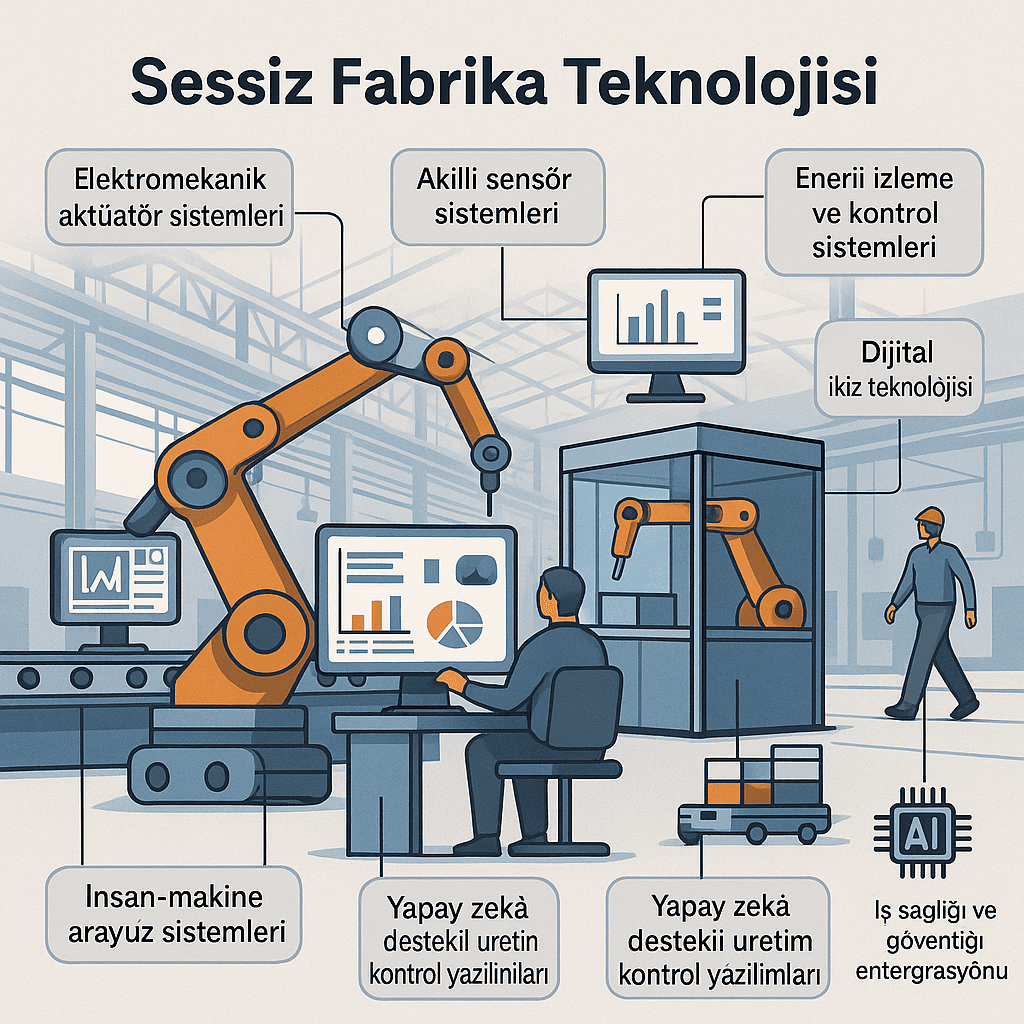
Key Technologies Used in Silent Factories (This image was generated by artificial intelligence.)
Silent factory technology does not aim merely to reduce noise; it significantly enhances production quality and overall efficiency. These two factors are not natural byproducts of silence but the result of deliberate engineering decisions and an integrated technological architecture. Here, silence is not merely a physical comfort; it has become an indicator of a stable, repeatable, controllable, and optimizable production process.
Noise is often a symptom of irregularities within a system. For example, high-frequency metallic sounds typically indicate excessive friction, uneven assembly, or misalignment—quality issues. Acoustic monitoring systems used in silent factories detect such problems at an early stage, automatically stopping machines or sending maintenance signals. This prevents defective production and eliminates quality losses from the outset.
From an efficiency standpoint, silent production lines typically operate in digital synchronization. Tasks are assigned not by human commands but by manufacturing execution systems (MES) and AI systems. Each machine or robot optimizes its own task while adapting to the overall production flow. This eliminates line idle times, task conflicts, and unnecessary stoppages.
Quality control systems in silent factories are particularly noteworthy. Image processing technologies operate through visual indicators and data dashboards instead of audible alarms. Every produced part is evaluated using high-resolution cameras and AI algorithms. When a defective part is detected, the system halts the part flow and sends a silent alert to the relevant operator, replacing noisy sirens or human intervention.
Silent environments also prevent attention dispersion in operator-driven quality checks. In noisy factories, communication among workers is difficult, leading to information loss, misunderstandings, and errors. In silent production lines, workers can exchange real-time information through digital interfaces, enhancing process coordination and collaboration, which directly improves quality.
Moreover, the physical comfort provided by silence increases worker performance and error-free production capacity. Research shows that workers exposed to constant noise experience declines in both cognitive and motor skills. In silent factories, this effect is minimized, resulting in greater stability, speed, and accuracy in production. This difference is especially pronounced in delicate operations such as assembly, welding, or soldering.
Efficiency encompasses not only production speed but also energy and resource utilization. Equipment used in silent factories consumes less energy because they generate less vibration. Additionally, energy monitoring systems ensure machines operate only when needed. This reduces energy costs per unit of production. Thus, silence is directly linked to environmental sustainability.
In such factories, production data is collected and continuously analyzed in centralized systems. For example, a machine’s sound profile during operation gradually becomes a reference dataset. This enables the system to issue early warnings whenever any anomaly occurs. This facilitates maintenance planning, equipment lifespan optimization, and reduction of production interruptions. Interventions made before failures occur enhance both quality and efficiency.
One of the most important outcomes of silent factory technology is its direct contribution to worker health and occupational safety. In traditional production facilities, high levels of noise, vibration, sudden sound bursts, and physical strain are leading causes of workplace accidents and occupational diseases; in silent factories, these risks are minimized at the system level. Silence here is not merely a comfort factor but a safety measure.
The most direct health benefit is the elimination of hearing loss risk. According to the World Health Organization, prolonged exposure to sound levels above 85 dB can lead to permanent hearing damage. While exposure to such levels is common in traditional factories, machines in silent factories operate at average levels of 60–70 dB. This largely eliminates the necessity for hearing protection equipment.
Silent production environments also reduce cognitive fatigue and attention dispersion. Workers exposed to constant noise exhibit longer reaction times, elevated stress levels, and increased susceptibility to errors. In silent environments, workers can focus more intensely on their tasks. This enhances occupational safety, particularly in hazardous operations and tasks requiring millimeter-level precision. Research indicates that silent environments increase worker productivity by 10 to 15 percent.
Noise not only affects hearing but also has adverse effects on cardiovascular and mental health. In silent factory environments, these health risks are minimized. Scientific evidence confirms that heart rate, cortisol levels, and blood pressure are higher in noisy environments. Thus, a silent production environment directly improves worker well-being.
Another critical area for occupational safety is hazard perception and communication. In noisy environments, communication among workers becomes difficult, warnings go unheard, and hazardous situations may arise. In silent factories, workers are instantly informed through digital screens, light-based warning systems, and smart helmets. This enables information flow through visual and data-based channels rather than auditory ones.
Vibration-induced occupational diseases are also among the reduced risks in silent factories. Traditional machinery with high vibration levels can, over time, cause hand-arm vibration syndrome (HAVS), musculoskeletal disorders, and nerve damage. Silent factory technologies prevent these risks through quiet motors, balancing structures, and ergonomic design solutions.
Prevention of workplace accidents in silent factories is achieved not only through hardware but also through software systems. AI-supported image analysis systems detect when a worker enters a hazardous zone and issue warnings. Autonomous mobile robots can anticipate human interaction and develop collision-avoiding routes. These systems perform more accurately in quiet environments, where sensor outputs are clearer, enhancing system reliability.
Emergency response management is also more effective in silent factories. Instead of traditional alarm systems, combined audio-visual alerts are used. During fires, gas leaks, or equipment failures, workers are rapidly directed through on-screen instructions, automated door controls, and emergency lighting. The effectiveness of these systems depends critically on low levels of distracting noise.
Silent working environments also increase overall job satisfaction and motivation. Noise raises stress levels among workers and weakens communication and collaboration skills. Silent factories foster a calmer atmosphere, positively influencing workplace culture. Workers remain productive for longer periods and require fewer breaks.
In conclusion, silent factories represent not merely a reactive but a proactive approach to occupational health and safety. Rather than implementing safeguards after risks emerge, they eliminate the root causes of risk at the design and technology levels. This transforms the workplace into not only a safer but also a more humane and sustainable environment.
Silent factory technologies do not merely transform today’s production systems; they also form the foundational building blocks of future industrial paradigms. These systems are pioneers of a cleaner, more efficient, and more sustainable production vision—not by eliminating sound alone, but by minimizing the chaotic, uncontrolled, and unplanned production structures underlying noise. In the coming years, silent factories will become the standard for environmentally focused industrial ecosystems.
First, the future of silent factories holds significant strategic value in the context of reducing carbon footprints. Noise sources in traditional factories typically stem from high-energy, inefficient systems. Silent factory design significantly reduces carbon emissions through low-friction systems, energy recovery, intelligent motor drivers, and process optimization. This aligns them with climate policies.
Additionally, silent factories contribute to sustainability from the perspective of environmental noise pollution and urban planning. In countries where industrial facilities are located near residential areas, the ability to operate silently minimizes social conflicts and community grievances, supporting the “smart city” vision of harmonious industrial integration.
In the future, the success of silent factories will largely depend on the advancement of artificial intelligence and algorithmic management systems. Less noise means more data, because sensors operate with higher sensitivity in quiet environments. This provides a critical advantage for AI systems to enhance capabilities such as predictive maintenance, automated task allocation, and energy forecasting.
Similarly, human-centered design philosophy will be one of the key criteria shaping the future of silent factories. An aging workforce and increasing ergonomic demands necessitate physically less taxing and psychologically more comfortable production environments. Silent factories not only meet this demand but also support long-term workplace loyalty and satisfaction by enhancing mental comfort.
On the other hand, silent factories are becoming more compatible with modular and flexible production systems. Traditional production systems, which were large-scale and fixed-line, are now transitioning toward smaller, portable production cells. For these cells to operate cohesively, both physical and acoustic compatibility is required. Silence forms the infrastructure for this integration.
International standards and regulations will accelerate the global adoption of silent factories. Sound measurement and evaluation standards such as the ISO 11200 series provide manufacturing firms with concrete targets, while government policies support this transition through incentives. In the near future, factories that fail to reduce noise levels may even face difficulties obtaining environmental permits.
Furthermore, the development and testing of silent factories through virtual production simulations will shape the future of digital twin technology. Simulating all noise sources before production begins, revising designs accordingly, and optimizing them through acoustic modeling has created a new field in engineering: digital acoustic engineering.
In the future, silent factories will enable cross-sector integration. For example, a single factory may produce both automotive and electronic components; the challenge of balancing differing equipment noise levels can be overcome with a silent infrastructure. This allows production lines to be more easily reconfigured, enhancing industrial flexibility.
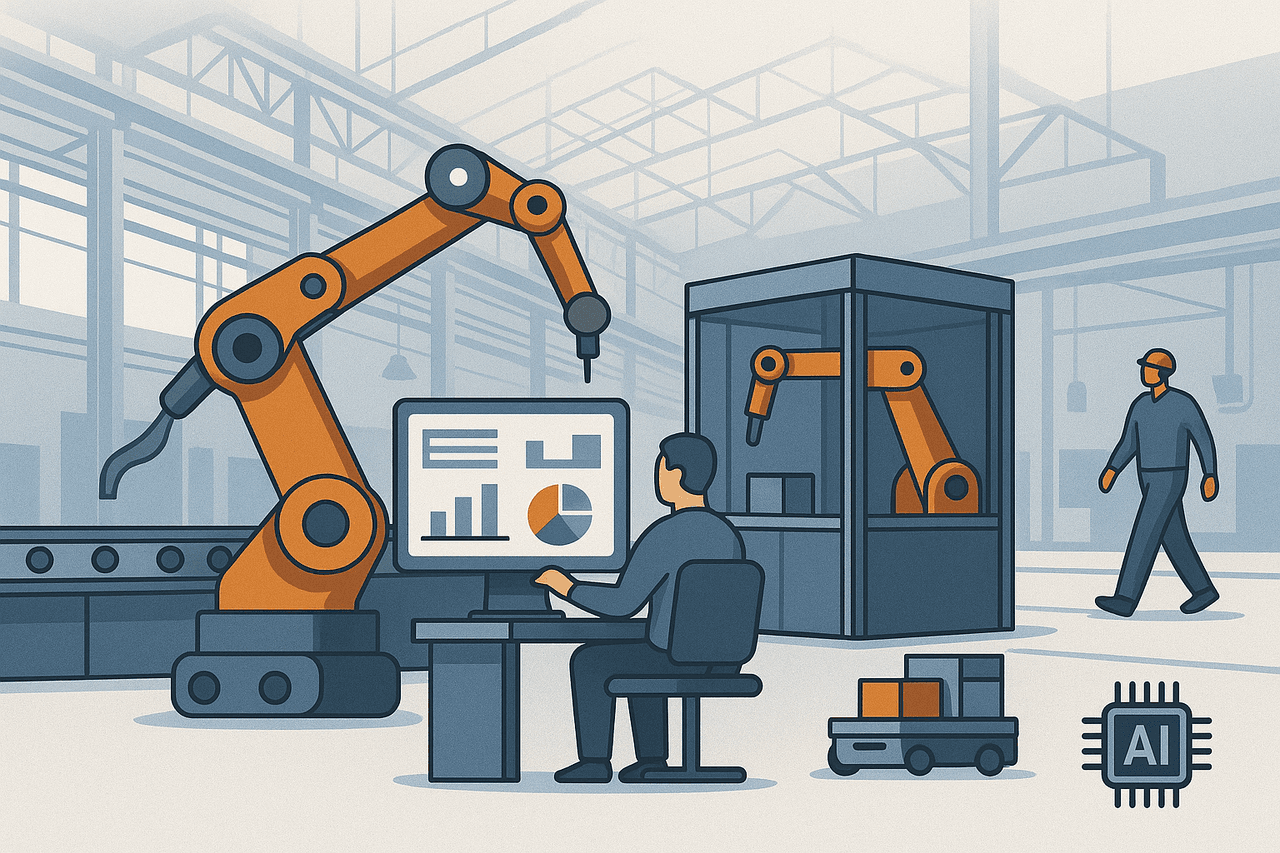
Artificial intelligence and algorithmic management systems (This image was generated by artificial intelligence.)

No Discussion Added Yet
Start discussion for "Silent Factory Technology" article
Key Technologies Used in Silent Factories
Production Quality and Efficiency in Silent Factories
Worker Health and Occupational Safety in Silent Factories
The Future of Silent Factory Technologies and Sustainability