


This article was automatically translated from the original Turkish version.
+2 More
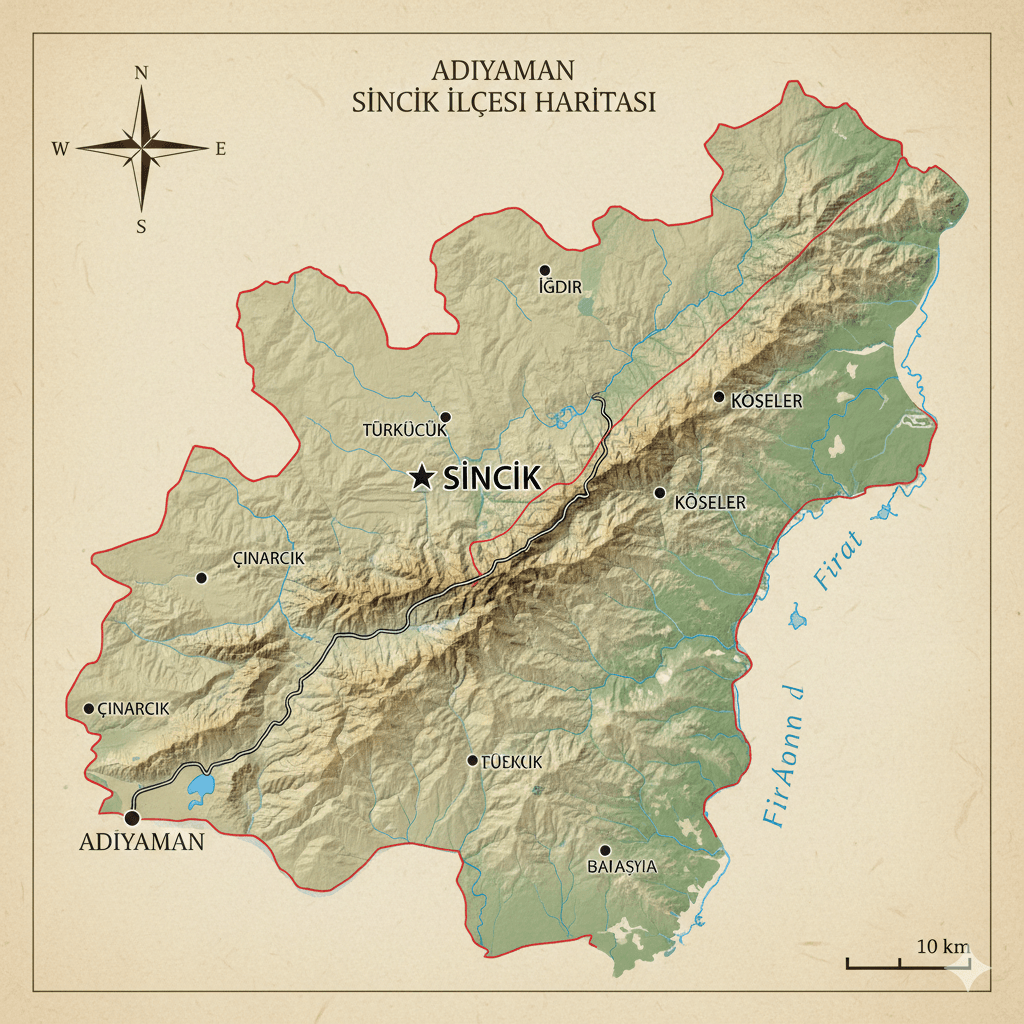
Sincik (generated with artificial intelligence)
Mayor(s) | Mehmet Korkut | ||||||||
|---|---|---|---|---|---|---|---|---|---|
Climate(s) | Continental | ||||||||
Elevation(s) | 1325 m | ||||||||
Region(s) | Eastern Anatolia | ||||||||
Province(s) | Adıyaman | ||||||||
Population | 16,016 (2024) | ||||||||
District Governor | Fatih Yıldız | ||||||||
Sincik, is a district located 70 kilometers northeast of the city center of Adıyaman in the Southeastern Anatolia Region of Türkiye. With a total area of 364 km², the district constitutes a portion of Adıyaman province’s total land area.
Geographically, Sincik is bordered by Malatya to the north, Pütürge to the northeast, Gerger to the east, Kahta to the south, the Adıyaman city center to the southwest, and Çelikhan district to the west. The district has an average elevation of 1325 meters, with altitude increasing from south to north.
Sincik consists of mountains and hills in the southern section of the Southeastern Taurus Mountains and features a rugged and mountainous terrain. The highest point in the region is Türk Dağı, located in the north at an elevation of 1608 meters. Additionally, Nemrut Dağı lies to the east of the district and is geographically close to the Sincik settlement.
The district is predominantly characterized by steppe climate conditions. As a result, winters are cold and marked by heavy snowfall, while summers are hot and dry. Due to its high elevation, cooler temperatures are experienced during the summer months.
The main water sources of the district are the Kıran Çayı, Aksu Çayı and Yarpuzlu Çayı rivers. Geologically, Sincik lies on fault segments of the Hatay-Mersin extension of the East Anatolian Fault Zone and is situated within a first-degree earthquake zone.
The historical past of Sincik and its surroundings extends back to antiquity, when the region was under the control of the Hittites, Hurrians and Mitanni. Following the Kingdom of Commagene, the region came successively under the rule of the Roman, Byzantine, Seljuk and Ottoman states.
Administratively, until 1954 Sincik was a sub-district (nahiye) under Malatya province. In 1954, with the elevation of Adıyaman to provincial status, Sincik was reclassified as a village under Kahta district. It gained independent district status on 9 May 1990 with the enactment of Law No. 3644.
Today, the civil administration of the district is managed by the Sincik Subprefecture, currently headed by Kaymakam Yunus Emre Bozkurtoğlu. Local government services are provided by the Sincik Municipality, established in 1971, with Mehmet Korkut serving as mayor.
Administratively, Sincik comprises one town, 24 villages and 65 hamlets. The district center was formed by the unification of six former hamlets. Karaman and Merkez neighborhoods are among the main settlement centers of the district.
Under infrastructure projects implemented by the municipality, concrete asphalt paving, interlocking paving stones and curb installations are carried out on major roads such as Mehmet Ataman Street in Karaman neighborhood. Among the district’s cultural assets, the registered cultural site of the Heron Sacred Area and the traditional Sincik Carpet, as an example of local handicrafts, stand out.
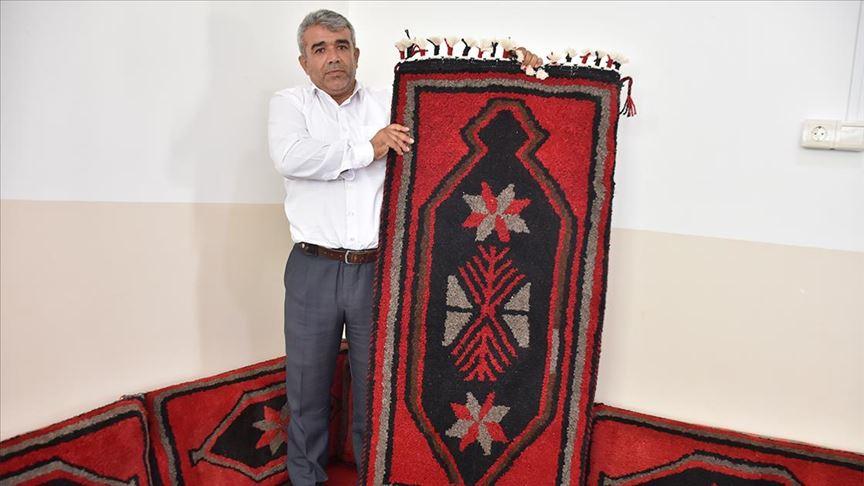
Sincik Halısı (Kaynak Anadolu Ajansı)
Social service initiatives include home care programs for the elderly. Additionally, hunting tourism and natural attractions contribute to the district’s recreational potential.
Adıyaman Valiliği. "Sincik." Accessed February 18, 2026. http://www.adiyaman.gov.tr/sincik.
Anadolu Ajansı. "Tescilli Sincik Halısı Köylülerin Geçim Kaynağı Oldu." Accessed February 18, 2026. https://www.aa.com.tr/tr/turkiye/tescilli-sincik-halisi-koylulerin-gecim-kaynagi-oldu/1907786.
PaintMaps. "Türkiye Harita Kırpma Aracı." Accessed February 18, 2026. https://tools.paintmaps.com/tr/harita-kirpma/TR/4-890464251/ornekler.
Sincik Kaymakamlığı Governorship. "Sincik District Governorship." Accessed February 18, 2026. https://www.sincik.gov.tr/.
Sincik Municipality. "Sincik Belediyesi." Accessed February 18, 2026. https://www.sincik.bel.tr/.

Sincik (generated with artificial intelligence)
Mayor(s) | Mehmet Korkut | ||||||||
|---|---|---|---|---|---|---|---|---|---|
Climate(s) | Continental | ||||||||
Elevation(s) | 1325 m | ||||||||
Region(s) | Eastern Anatolia | ||||||||
Province(s) | Adıyaman | ||||||||
Population | 16,016 (2024) | ||||||||
District Governor | Fatih Yıldız | ||||||||
Geographical Location and Physical Environmental Characteristics
Climate, Hydrography and Geological Structure
Historical Development and Administrative Transformations
Settlement Structure, Infrastructure and Economic Assets