

This article was automatically translated from the original Turkish version.
+2 More
Country | Germany (Nazi Germany) | ||||||||
|---|---|---|---|---|---|---|---|---|---|
Period(s) | World War II (1943–1945) | ||||||||
Location | Suhl (C.G. Haenel factory) Germany | ||||||||
Designer | Hugo Schmeisser | ||||||||
Manufacturing Companies | Mauser Steyr-Daimler-Puch Erma Sauer & Sohn C.G. Haenel | ||||||||
Production Period | 1943–1945 | ||||||||
Total Production | Approximately 425000 units | ||||||||
Weapon Type | Assault rifle | ||||||||
User Units | Waffen-SS Wehrmacht | ||||||||
Ammunition | 7.92×33 mm Kurz | ||||||||
Magazine Capacity | 30 rounds | ||||||||
Weight(s) | 5.2 kg (loaded) 4.6 kg (empty) | ||||||||
Length(s) | 940 mm | ||||||||
Barrel Length | 419 mm | ||||||||
Rate of Fire | 500–600 rounds per minute | ||||||||
Effective Range | 300–400 metres | ||||||||
Fire Modes | Fully automatic Semi-automatic | ||||||||
Material(s) | Wooden stock Steel sheet metal receiver | ||||||||
Notable Variants | Krummlauf MP 44 MP 43/1 MP 43 MKb 42(H) | ||||||||
Initial Usage Area | Eastern Front (against the Soviet Union) | ||||||||
Propaganda Name | Assault Rifle Sturmgewehr | ||||||||
Namer | Adolf Hitler (1944) | ||||||||
Significance | The world's first modern assault rifle | ||||||||
Post-War Use | Vietnam Africa Middle East East Germany | ||||||||
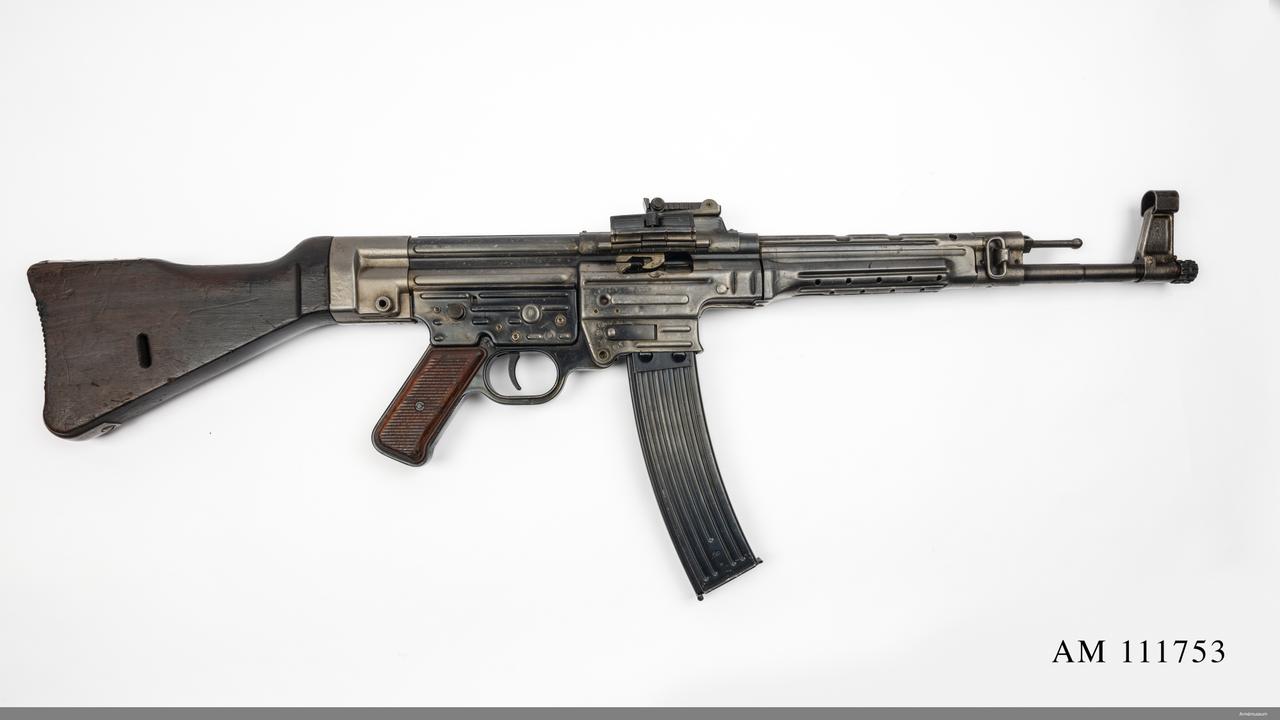
Sturmgewehr 44 (abbreviated as StG 44) is the world’s first modern assault rifle, developed by Nazi Germany during World War II. It features a selective-fire system and a gas-operated mechanism. Its design aimed to combine the range and power of a rifle with the automatic fire capability of a submachine gun, marking a turning point in the development of modern infantry weapons. The term “Sturmgewehr” was officially adopted in 1944 when Hitler personally named the weapon, and it later became the standard term used worldwide to describe this class of firearm.
The StG 44 provided an intermediate solution in both ammunition type and design, bridging the gap between submachine guns effective at close range and traditional rifles with longer range. In this regard, it pioneered the technical principles later adopted by postwar assault rifles such as the AK-47, M16, and G36.
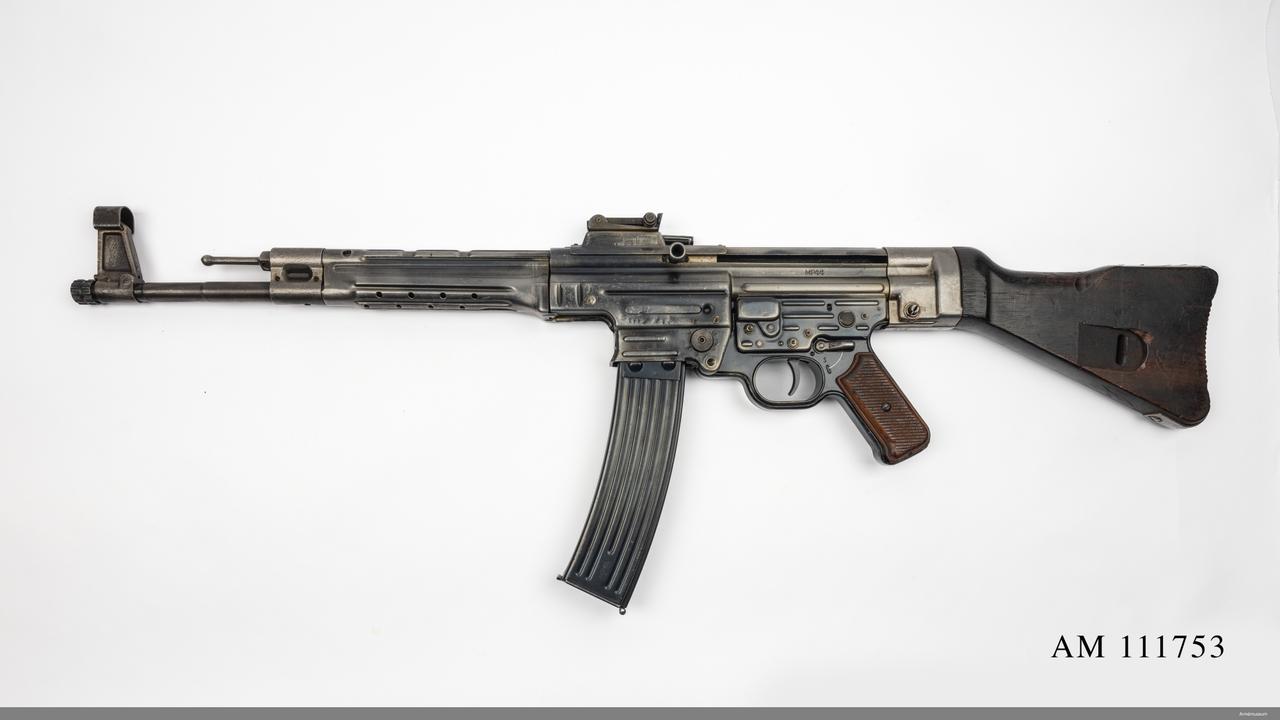
StG 44 (DigitaltMuseum)
Since the beginning of World War II, German arms engineers observed that traditional rifle ammunition was often excessively powerful for battlefield conditions. Most engagements occurred at distances under 800 meters, meaning more than half the energy of the standard round was wasted. This observation led to the idea of developing a shorter, less powerful “intermediate cartridge” (Mittelpatrone).
By the late 1930s, the German Army’s Weapons Office (Heereswaffenamt) sought a new cartridge that would strike a balance between pistol and rifle ammunition. In 1934, the “7.92×33 mm Infanterie Kurz Patrone” emerged as the solution, offering reduced recoil and improved controllability.
The task of designing a weapon for the new cartridge was assigned in 1938 to C.G. Haenel Waffenfabrik. Hugo Schmeisser was appointed chief engineer. Schmeisser aimed to reduce recoil by aligning the barrel axis with the stock line. By 1940, the fundamental design principles were established, but production progressed slowly due to insufficient manufacturing capacity and limitations in stamping technology. Haenel was forced to subcontract some components to subcontractors such as Erma and Merzwerke.
In the summer of 1942, the first 50 prototypes were produced under the designation “Maschinenkarabiner 42(H)” (MKb 42(H)). This model featured a gas-operated mechanism and a distinctive 30-round curved magazine. Although testing yielded positive results, Carl Walther’s company had also developed a similar model during the same period.
In early 1943, Hitler sought to halt the project, arguing that production of the 7.92×33 mm Kurz cartridge would interfere with standard 7.92 mm Mauser ammunition output. However, the army secretly continued production by renaming the weapon the “Maschinenpistole 43” (MP 43). Encouraged by positive reports from the Eastern Front, Hitler personally tested the weapon in 1944 and, satisfied with its performance, renamed it “Sturmgewehr 44”.
This renaming was not merely technical but also propagandistic; the concept of the “Sturmgewehr” or “assault rifle” was used to boost morale among the German public during the final stages of the war.
Use of the StG 44 during World War II (spottydog4477)
The StG 44 is a gas-operated, long-stroke piston, rotating bolt firearm. It fires the 7.92×33 mm Kurz cartridge and, thanks to its selective-fire system, can be fired in semi-automatic or fully automatic modes. The receiver is stamped from steel to reduce manufacturing costs, while the stock is made of wood.
The muzzle velocity of the weapon is approximately 685 m/s, and the bullets contain a lead-core projectile encased in a steel cartridge. The trigger mechanism was riveted shut and could not be repaired; if damaged, the entire trigger group had to be replaced. While this simplified production, it created maintenance challenges.
Several intermediate models were developed during the StG 44’s evolution: MKb 42(H), MKb 42(W), MP 43, MP 43/1, and MP 44. The MP 43/1 variant included minor structural modifications to allow the attachment of a grenade launcher to the muzzle.
In the later stages of the war, a curved barrel attachment called “Krummlauf” was developed with 30° or 45° bends, designed for firing around corners. Experimental models equipped with the “Vampir” infrared sighting system for night operations were also produced, though only in very limited numbers.
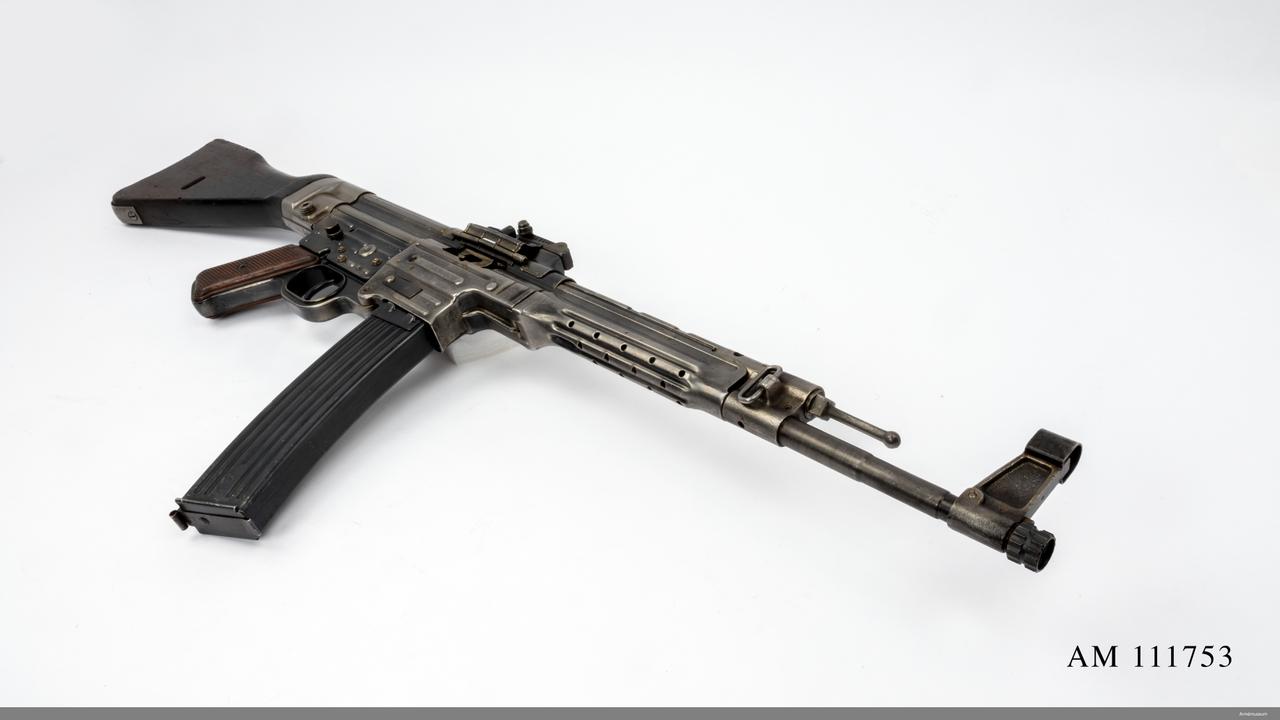
StG 44 (DigitaltMuseum)
Serial production of the StG 44 began in 1943 and continued until Germany’s surrender in 1945. The primary production center was C.G. Haenel’s facility in Suhl; other manufacturers involved included Sauer & Sohn, Erma, Steyr-Daimler-Puch, and Mauser.
Total production reached approximately 425,000 units. Stamping technology was used in mass production, reducing part count and lowering costs. However, this method compromised the receiver’s durability, making the weapon prone to deformation under battlefield conditions.
The StG 44 entered service from late 1943 onward, primarily on the Eastern Front. It proved effective with Wehrmacht and Waffen-SS units in forested and urban combat. Particularly on the Stalingrad and East Prussia fronts, soldiers praised the weapon’s firepower and range.
The StG 44 enabled infantry squads to achieve superiority at intermediate ranges without relying on machine guns. This significantly increased individual soldier firepower. However, due to difficulties in ammunition production and supply, the weapon was never widely distributed to all German units.
User reports indicate that the StG 44’s accuracy and controllability during automatic fire were excellent for its time. Nevertheless, issues such as thin steel receivers being crushed under impact and bolt jams occurred. The German Army issued official directives advising against prolonged fully automatic fire, recommending only short bursts or semi-automatic mode.
The weapon’s weight, exceeding 5 kg when loaded, caused fatigue during prolonged carrying. Nevertheless, soldiers clearly noted its firepower advantage over Soviet semi-automatic rifles such as the SVT-40.
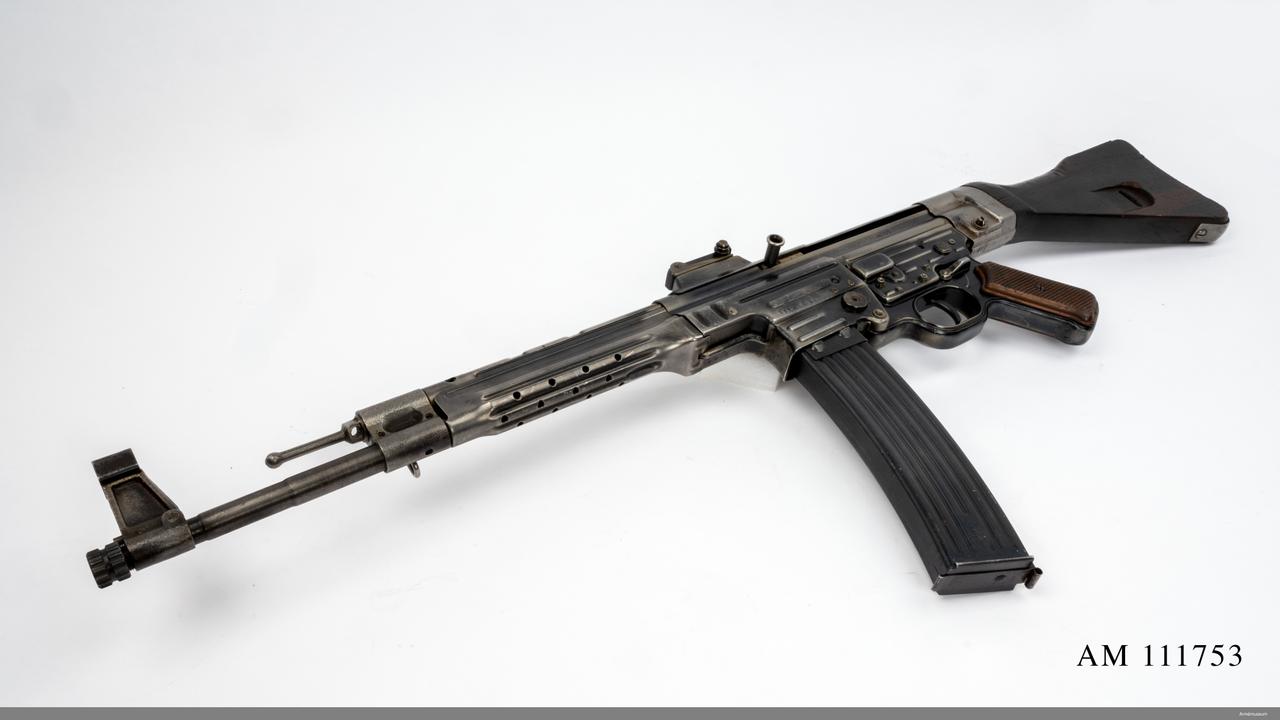
StG 44 (DigitaltMuseum)
The StG 44 did not decisively alter the outcome of the war, but it established the foundational concept of the modern assault rifle. After the war, the Soviet Union captured large numbers of StG 44s and distributed them to countries such as East Germany, Syria, Lebanon, and Egypt.
The influence of the StG 44 on the design of the AK-47 has long been debated. The fact that Hugo Schmeisser, the chief designer of the StG 44, was employed at the Izhmash factory in the Soviet Union between 1946 and 1952 strengthens the possibility of technical transfer.
In the postwar years, the StG 44 remained in service with East German police forces until the 1960s. Examples of the weapon were also found in the hands of organizations such as the Palestine Liberation Organization and Hezbollah.
Today, the StG 44 is considered a highly valuable firearm among collectors. Few examples remain in working condition. The Australian War Memorial holds a 1945-dated StG 44 marked “ai/45” in its collection. Numerous examples are also displayed in museums and private collections across Europe. Currently, the German company GSG (German Sport Guns) produces a semi-automatic .22 caliber version of the weapon.
Although the Sturmgewehr 44 emerged in the final stages of World War II, it left a lasting mark on modern military history. It symbolizes the birth of the “assault rifle” concept through its intermediate cartridge and selective-fire system. While it did not change the course of the war, it became the precursor to a class of weapons that would become standard in nearly every army worldwide in the decades following the conflict. In this sense, the StG 44 is not merely a German innovation but the starting point for all small arms engineering in the second half of the 20th century.
Australian War Memorial. "StG44 Assault Rifle." Accessed October 17, 2025. https://www.awm.gov.au/collection/C1081085?image=1
Bishop, Chris, ed. The Encyclopedia of Weapons of World War II. New York: Barnes & Noble Books, 1998. Accessed October 17, 2025. https://books.google.com.tr/books?id=MuGsf0psjvcC&pg=PA218&redir_esc=y#v=onepage&q&f=false
D-Day Overlord. "StG 44 – Sturmgewehr 44." Accessed October 17, 2025. https://www.dday-overlord.com/en/material/weaponry/sturmgewehr-44
DigitaltMuseum (Sweden). “Automatkarbin STG-44.” Accessed October 17, 2025. https://digitaltmuseum.se/011024469588/automatkarbin-stg-44
EcuRed. "Sturmgewehr 44." Accessed October 17, 2025. https://www.ecured.cu/Sturmgewehr_44
Emsworth, John Jones. “STG-44 — Assault Rifle.” Military Historia. Accessed October 17, 2025. https://militaryhistoria.com/stg-44-assault-rifle/
Erenfeicht, Leszek. “Sturmgewehr: Hitler’s Only True Wunderwaffe.” Small Arms Defense Journal. Accessed October 17, 2025. https://sadefensejournal.com/sturmgewehr-hitlers-only-true-wunderwaffe/
Lone Sentry. "Machine Carbine Promoted." Accessed October 17, 2025. https://www.lonesentry.com/articles/ttt07/stg44-assault-rifle.html
MacGregor, Steve. “Birth of the Assault Rifle – The Sturmgewehr 44.” War History Online. Accessed October 17, 2025. https://www.warhistoryonline.com/instant-articles/birth-of-the-sturmgewehr-44.html
McIntosh, Matthew A. “From Bolt to Burst: The STG-44 and the Shifting Geometry of Modern War.” Brewminate. Accessed October 17, 2025. https://brewminate.com/from-bolt-to-burst-the-stg-44-and-the-shifting-geometry-of-modern-war/
Military Times. “TBT — The Real Story Behind the Legendary StG-44 (Sturmgewehr) Rifle.” Accessed October 17, 2025. https://www.militarytimes.com/off-duty/gearscout/tacticool/2019/12/12/tbt-the-real-story-behind-the-legendary-stg-44-sturmgewehr-rifle/
Mizokami, Kyle. “Meet the StG-44: The First Assault Rifle Ever (And a Nazi Invention).” The National Interest. Accessed October 17, 2025. https://nationalinterest.org/blog/buzz/meet-stg-44-first-assault-rifle-ever-and-nazi-invention-113821
Moncure, Billy. “StG 44 – Approved by Hitler, The Gun that Revolutionized Modern Rifles (includes footage).” War History Online. Accessed October 17, 2025. https://www.warhistoryonline.com/instant-articles/stg-44-the-nazi-gun.html
National Museum of American History. “StG-44 Assault Rifle.” Accessed October 17, 2025. https://americanhistory.si.edu/collections/object/nmah_1093839
Sadowski, Robert. “StG 44: Father Of The Modern Fighting Rifle.” Gun Digest. Accessed October 17, 2025. https://gundigest.com/gun-reviews/military-firearms-reviews/stg-44
Wehrmacht-Info. “Sturmgewehr 44 (StG44 - MP44).” Accessed October 17, 2025. https://wehrmacht-info.com/stg44.html
spottydog4477. “STG 44 - Wehrmacht assault rifle.” YouTube. Accessed October 17, 2025. https://www.youtube.com/watch?v=6ZP16Nx1sx4

Country | Germany (Nazi Germany) | ||||||||
|---|---|---|---|---|---|---|---|---|---|
Period(s) | World War II (1943–1945) | ||||||||
Location | Suhl (C.G. Haenel factory) Germany | ||||||||
Designer | Hugo Schmeisser | ||||||||
Manufacturing Companies | Mauser Steyr-Daimler-Puch Erma Sauer & Sohn C.G. Haenel | ||||||||
Production Period | 1943–1945 | ||||||||
Total Production | Approximately 425000 units | ||||||||
Weapon Type | Assault rifle | ||||||||
User Units | Waffen-SS Wehrmacht | ||||||||
Ammunition | 7.92×33 mm Kurz | ||||||||
Magazine Capacity | 30 rounds | ||||||||
Weight(s) | 5.2 kg (loaded) 4.6 kg (empty) | ||||||||
Length(s) | 940 mm | ||||||||
Barrel Length | 419 mm | ||||||||
Rate of Fire | 500–600 rounds per minute | ||||||||
Effective Range | 300–400 metres | ||||||||
Fire Modes | Fully automatic Semi-automatic | ||||||||
Material(s) | Wooden stock Steel sheet metal receiver | ||||||||
Notable Variants | Krummlauf MP 44 MP 43/1 MP 43 MKb 42(H) | ||||||||
Initial Usage Area | Eastern Front (against the Soviet Union) | ||||||||
Propaganda Name | Assault Rifle Sturmgewehr | ||||||||
Namer | Adolf Hitler (1944) | ||||||||
Significance | The world's first modern assault rifle | ||||||||
Post-War Use | Vietnam Africa Middle East East Germany | ||||||||
Development Process
Historical Background
Design Emergence
Naming and Political Process
Technical Specifications
Key Technical Data
Variants and Modifications
Production and Factories
Usage and Combat Experience
Frontline Deployment
Tactical Role
Performance and Reliability
Postwar Influence and Legacy
Collections and Current Status