


This article was automatically translated from the original Turkish version.
+1 More
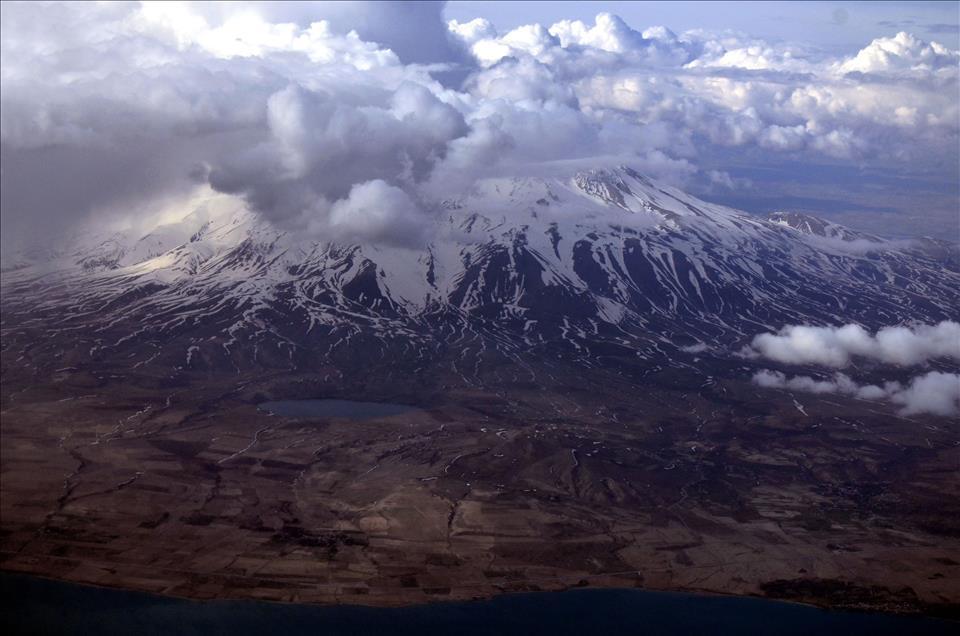
Süphan Dağı
Location | Türkiye northwestern shore of Lake Van Tatvan Bitlis | ||||||||
|---|---|---|---|---|---|---|---|---|---|
Coordinate(s) | 38°54′N 42°49′E | ||||||||
Elevation(s) | 4058 metres (13314 ft) | ||||||||
Type(s) | Stratovolcano (Layered volcano) | ||||||||
Volcanic Status | Extinct | ||||||||
Regional Importance | The third highest mountain in Türkiye; the second highest mountain in Eastern Anatolia | ||||||||
Süphan Dağı is a large stratovolcano located in eastern Türkiye, north of Lake Van. The mountain lies within the boundaries of Adilcevaz district, Bitlis Province, and is situated between Ağrı Dağı to the northeast and Nemrut Dağı to the southwest. As one of several major volcanic structures bordering Lake Van, Süphan Dağı reaches a summit elevation of 4,058 meters, making it the third highest mountain in Türkiye and the second highest stratovolcano after Ağrı Dağı.
Major settlements near the volcano include the districts of Ahlat in Bitlis Province, Malazgirt in Muş Province, and Erciş in Van Province. The coordinates of Süphan Dağı are 38.931°N latitude and 42.833°E longitude. Its elevation ranges from 1,650 meters to 4,058 meters, covering an area of 52,329 hectares. The region falls within the administrative boundaries of Bitlis, Ağrı, and Muş provinces, and the districts of Adilcevaz, Patnos, and Malazgirt.

Süphan Dağı. (AA)
Süphan Dağı possesses a complex geological volcanic structure formed by volcanic activity ranging from andesitic-dacitic lava flows to basaltic lavas. Basaltic lavas have been found to extend up to 30 kilometers from the volcano. The mountain contains volcanic products with compositions ranging from basaltic to rhyolitic. Numerous lava domes and pyroclastic cones have been observed on its western slopes and surrounding areas, erupted along radial and circular fractures. In later stages, dacitic and rhyolitic lava domes formed in the summit region; one of these domes is approximately 64,000 years old. The most recent volcanic eruption at Süphan Dağı has been dated to around 8,000 years before present.
The Süphan Dağı Important Natural Area hosts a rich flora and several rare species. Dry mountain steppes are widespread on the slopes, while higher elevations remain largely snow-covered throughout the year. Forest cover is extremely limited, with only sparse shrub communities found on the southern slopes.
The area is significant for its endemic plant species. Among the Turkish endemic and endangered species are Isatis undulata, Marrubium vanense, Paracaryum leptophyllum, Salvia odontochlamys, and Verbascum coronopifolium. Additionally, the Süphan lizard (Eremias suphani), a narrowly distributed endemic reptile species named after the mountain, is found only here. The area also serves as a regional breeding and habitat ground for certain bird species such as the bearded vulture (Gypaetus barbatus).
Human activities around Süphan Dağı are limited and traditional. The main economic activity is animal husbandry, with small livestock grazed on highland pastures. Agriculture is restricted to limited production of animal feed. The mountain offers suitable conditions for nature-based sports such as mountaineering, hiking, camping, ski touring, and paragliding. Climbing activity peaks during the summer months, particularly from late June to mid-September. Winter climbs occur between early March and early December. The most common climbing route begins in Aydınlar Village and continues via camps established at Şekerpınarı or Süphan Yaylası. The average duration for ascent and descent is 8 to 10 hours, though it can extend up to 12 hours.
Süphan Dağı is located more than 860 kilometers from Ankara. The nearest city is Erciş district of Van, approximately 45 kilometers away. The population within a 5-kilometer radius of the mountain is 158, within a 10-kilometer radius it is 8,090, within a 30-kilometer radius it is 120,340, and within a 100-kilometer radius it is 1,759,980.
Süphan Dağı is classified as “Dependent on Protection” and holds the status of a “Wildlife Development Area.” Vegetation, particularly due to overgrazing, is under significant pressure. Additionally, a radio transmission road on the eastern slopes has partially destroyed the natural steppe ecosystem. Expansion of agricultural land and the removal of plants such as astragalus (Astragalus sp.) and thyme thistle (Acantholimon sp.) for use as fuel pose serious threats.
Adilcevaz Kaymakamlığı. "Süphan Dağı ve Sutey Yaylası." Accessed June 6, 2025. http://www.adilcevaz.gov.tr/suphan-dagi-ve-sutey-yaylasi#:~:text=S%C3%BCphan%20Da%C4%9F%C4%B1n%C4%B1n%20volkanik%20olu%C5%9Fumlu%20bir,bu%20araziler%20tar%C4%B1m%20i%C3%A7in%20kullan%C4%B1l%C4%B1r.
Anadolu Ajansı. “Süphan Dağı.” *aa.com.tr*. Accessed June 6, 2025. https://www.aa.com.tr/tr/pg/foto-galeri/suphan-dagi/0/126790.
Köşker, Hasan, and Mehmet Kahyaoğlu. “SÜPHAN DAĞI’NI ZİYARET EDEN YERLİ TURİST PROFİLİ”. Bitlis Eren Üniversitesi Sosyal Bilimler Dergisi 4, no. 1 (July 2015): 75–92. Accessed June 19, 2025. https://dergipark.org.tr/en/pub/bitlissos/issue/3713/49125#article_cite
Maden Tetkik ve Arama Genel Müdürlüğü. "Süphan." *MTA Türkiye Volkan Atlası*. Accessed June 6, 2025. https://mta.gov.tr/turkvolc/tr/suphan.

Süphan Dağı
Location | Türkiye northwestern shore of Lake Van Tatvan Bitlis | ||||||||
|---|---|---|---|---|---|---|---|---|---|
Coordinate(s) | 38°54′N 42°49′E | ||||||||
Elevation(s) | 4058 metres (13314 ft) | ||||||||
Type(s) | Stratovolcano (Layered volcano) | ||||||||
Volcanic Status | Extinct | ||||||||
Regional Importance | The third highest mountain in Türkiye; the second highest mountain in Eastern Anatolia | ||||||||
Geological Structure and Volcanic Activity
Ecological Features and Biodiversity
Use and Human Activities
Population and Accessibility
Threats and Conservation Status