


This article was automatically translated from the original Turkish version.

The concept of logistics is defined as the effective and efficient planning and implementation of the movement of all types of products, services, and information from their point of origin to their point of destination to meet human needs. A transportation network must be implemented to facilitate the movement of goods, services, and information.
The transportation sector plays a crucial role in the formation of relationships between people and their environments. By facilitating the transfer of information, capital, goods, and services from one place to another, it enables resource allocation and the development of connections. Transportation can be defined as “the economic, rapid, and safe movement of people and goods to generate spatial and temporal benefits.”
It has been demonstrated that the strategic use of transportation sub-systems to complement and enhance each other’s capabilities is a key factor in countries’ success in global trade. Countries that have completed their logistics network structures, improved logistics quality, expanded port capacities, and developed air, sea, and especially rail transportation networks have not only increased their share of global trade but have also experienced economic growth. In light of the above, it can be said that the expected advantages of transportation will increase in proportion to the efficiency of logistics.
Logistics is a long-term and effective process that begins at the point of production of a product or service and ends with the timely delivery of the finished product to the final consumer. Originally used only in military contexts, the term “logistics” became synonymous with “transportation” due to technological advancements and the effects of globalization. Today, activities under the umbrella of logistics encompass marketing, storage, transportation, sales, and handling. Logistics has acquired the status of a significant service sector that includes processes such as product and service production and contributes to enhancing competitiveness.
The logistics sector has emerged as a critical factor in enhancing the global competitiveness and sustainability of this energy source. To this end, countries have prioritized improvements in infrastructure, rail transportation, delivery speed, warehouse capacity, and the number of warehouses to develop robust logistics hubs within their borders and achieve regional leadership.
Anatolia has hosted numerous civilizations that profoundly influenced the course of human history. It has also served as a corridor for the movement of peoples engaged in migration, trade, and warfare. Among the most important historical routes connecting major trade corridors are the Lydian King’s Road, the Silk Road, and the Spice Road. It is evident that the Romans constructed significant road networks in Anatolia characterized by superior materials and craftsmanship. During the Seljuk period, transportation policies were developed to take advantage of Anatolia’s transit role. As a result, caravanserais were established at approximately 30 km intervals (equivalent to a nine-hour camel journey) along both east-west and north-south axes.
From the foundation of the Ottoman Empire until the conquest of Istanbul, the Seljuk road system was intensively used. As new political centers gained importance over time, Ottoman road networks were affected and underwent transformation. In contrast, the establishment of Istanbul as the capital led to the emergence of a city-centered road system. The primary objective of Ottoman transportation policy was to facilitate military mobility. Meanwhile, foreign capital began investing in railways to guarantee the flow of goods between European and Ottoman markets and to establish their own influence networks and routes within Ottoman territories.
The first motorway in Türkiye was the 24 km long Boğaz Köprüsü-Çevre Yolu, opened in 1973. During the 1980s, efforts to accelerate motorway construction intensified as the physical and geometric capacity of existing state and provincial roads was expanded. The length of the motorway network increased from 24 km in 1980 to 241 km in 1990 and reached 1,674 km by 2000. During this period, the length of the railway network also rose to 10,922 km.
Between 1950 and 2000, road length increased by approximately 80 percent, while railway length increased by only 11 percent. Additionally, as of 2000, the tonnage of the Turkish Merchant Fleet for vessels exceeding 300 gross tons (GRT) reached 10.4 million deadweight tons (DWT), and the share of Turkish-flagged vessels in foreign trade rose to approximately 35 percent.
From the early 2000s onward, motorway investments continued, and construction of divided roads also began. As a result, the length of divided roads, including motorways, increased from 6,101 km at the beginning of the period to 28,660 km. Furthermore, as of 2025, the total motorway length reached 3,726 km. As of 2025, the total motorway length in the country, including rural areas, is 68,617 km.
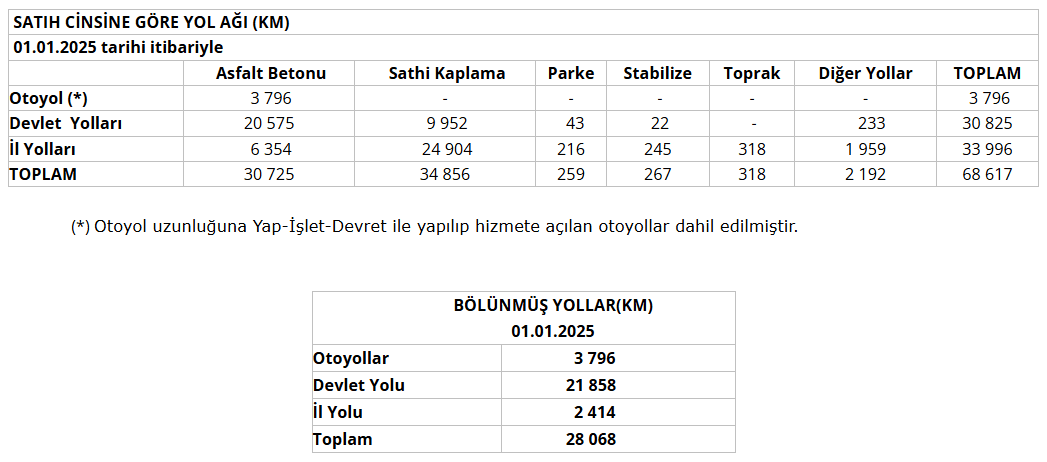
Türkiye Road Network by Surface Type (km) (
In 2024, Türkiye will have 57 active airports open to civil air traffic, with a total air route length of 75,902 km. Türkiye has a total of 403 coastal facilities, including 182 that operate internationally. By the end of 2024, the total length of the road network (including provincial, state, and motorway roads) reached 68,617 km, while the railway network length (including conventional and high-speed lines) reached 13,128 km.
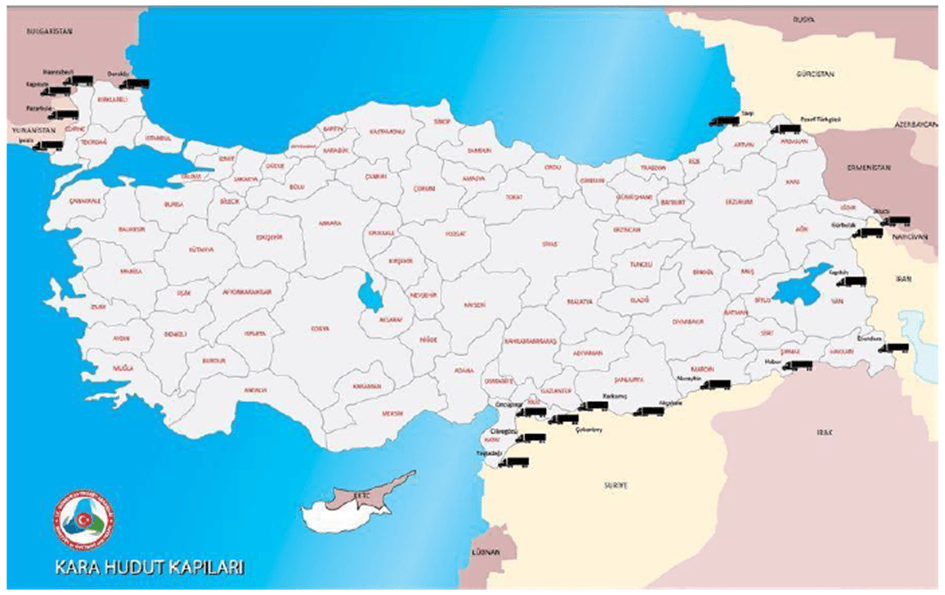
In terms of international road transport, Türkiye shares land borders with Bulgaria (Kapıkule, Hamzabeyli, and Dereköy), Georgia (Sarp, Türkgözü, and Aktaş), and Iraq (Habur and Üzümlü). Additionally, border crossings exist with Iran (Gürbulak, Kapıköy, and Esendere), Nakhchivan (Dilucu), Syria (Karkamış, Cilvegözü, Öncüpınar, Nusaybin, and Akçakale), and Greece (Pazarkule and İpsala). Due to political and security concerns, border crossings with Armenia (Akyaka, Alican) and certain Syrian road crossings (Yayladağ, Mürşitpınar, etc.) are currently not in operation.
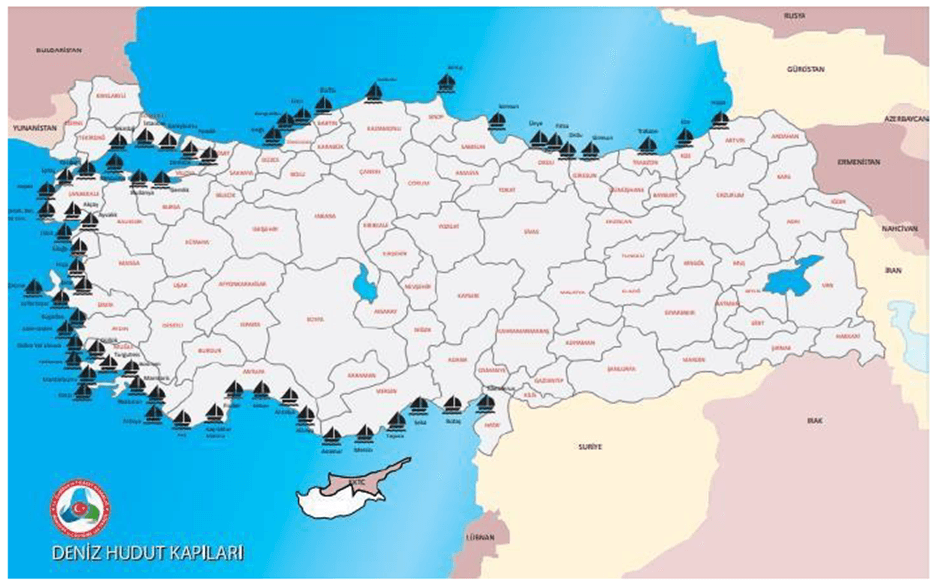
Türkiye’s strategic geographic location, situated at the intersection of three continents, enables it to serve as a central hub in a transportation network connecting the Atlantic Ocean via the Strait of Gibraltar, the Arabian Peninsula and the Indian Ocean via the Suez Canal, and the Black Sea with the Mediterranean Sea through the Turkish Straits, thereby linking Eurasia and the Far East. This feature clearly demonstrates Türkiye’s strategic importance in terms of cabotage, international, and transit transportation.
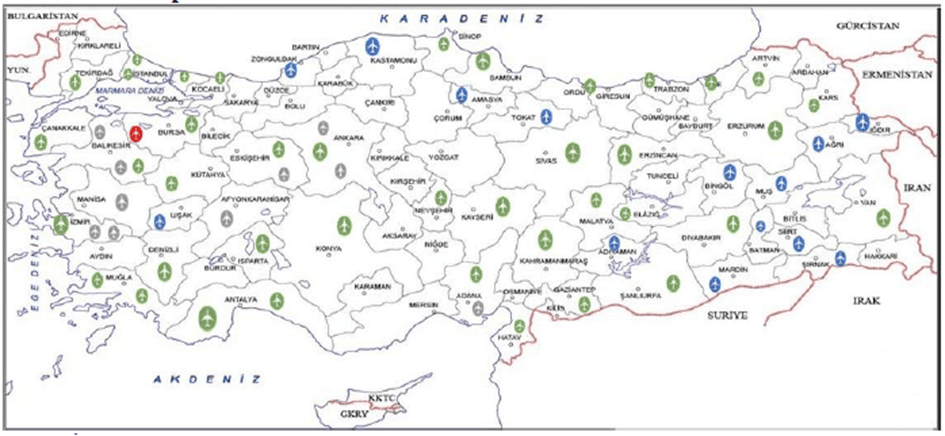
Air Border Crossings (Boundary Gates)
Türkiye has a total of 66 air border crossings, of which 55 are civilian, 10 are military, one is dedicated to facilitating Hajj and Umrah pilgrimages, and all except five are operational.
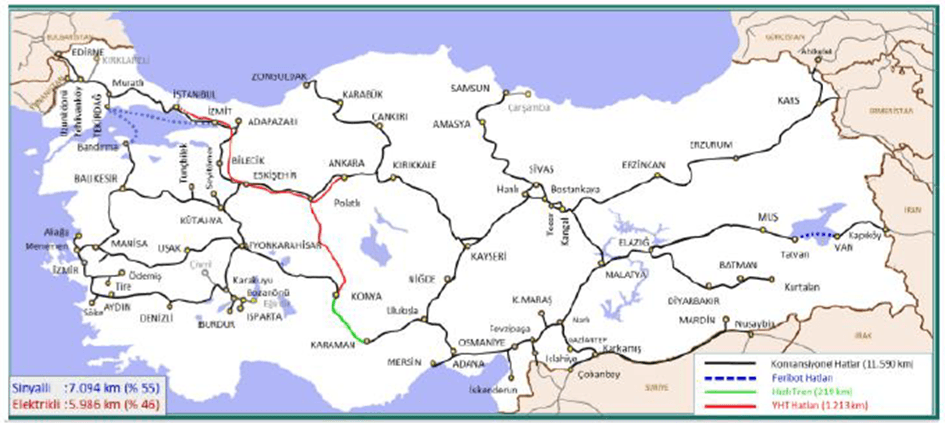
Türkiye has eight railway border crossings connected to six different countries. However, three of these crossings (two in Syria and the connection to Armenia) are currently closed.
Türkiye holds a pivotal role in the global logistics network due to its strategic geographic location, advanced transportation infrastructure, high trade volume, and dynamic economy. With these characteristics, it occupies a transit corridor connecting Europe, Asia, Africa, and the Middle East and possesses the potential to become one of the world’s most important logistics centers. Türkiye occupies a critical transit route and a natural connection hub for east-west and north-south trade corridors.
As international competition intensifies and evolves, the necessity for concentrating logistics capabilities in designated centers has become increasingly evident. To achieve this goal, logistics hubs have been established. A logistics hub is defined as a center coordinating services such as transportation, handling, storage, export, import, customs clearance, transit operations, and infrastructure to contribute to the national economy.
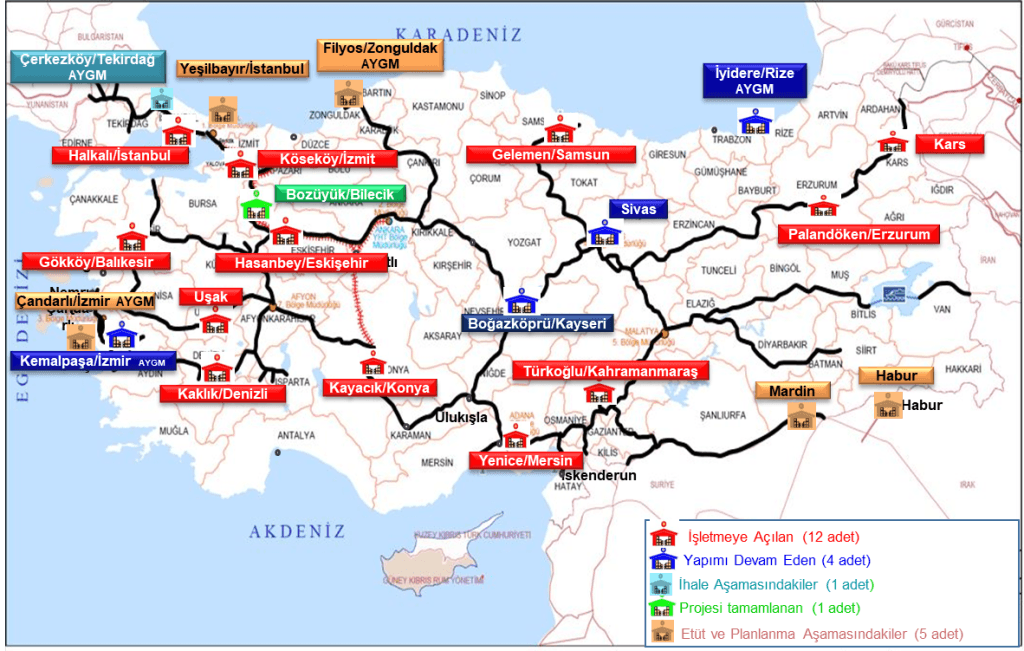
Türkiye, due to its strategic location at a major crossroads of global trade, offers access to numerous markets with substantial foreign trade volumes. Its advantageous geographic position enables the country to become a central hub for logistics and transportation activities and significantly contributes to the export of goods and services. A four-hour flight from Türkiye provides access to 67 countries with a combined population of 1.4 billion and a trade volume of $8.6 trillion.
It is expected that the logistics and transportation sector will contribute $40 billion, or 36 percent of the total, to the sector’s $110 billion service export target by 2024. By the end of 2028, a $200 billion service export target has been set, of which $78 billion is allocated to logistics and transportation service exports.
【1】
【2】
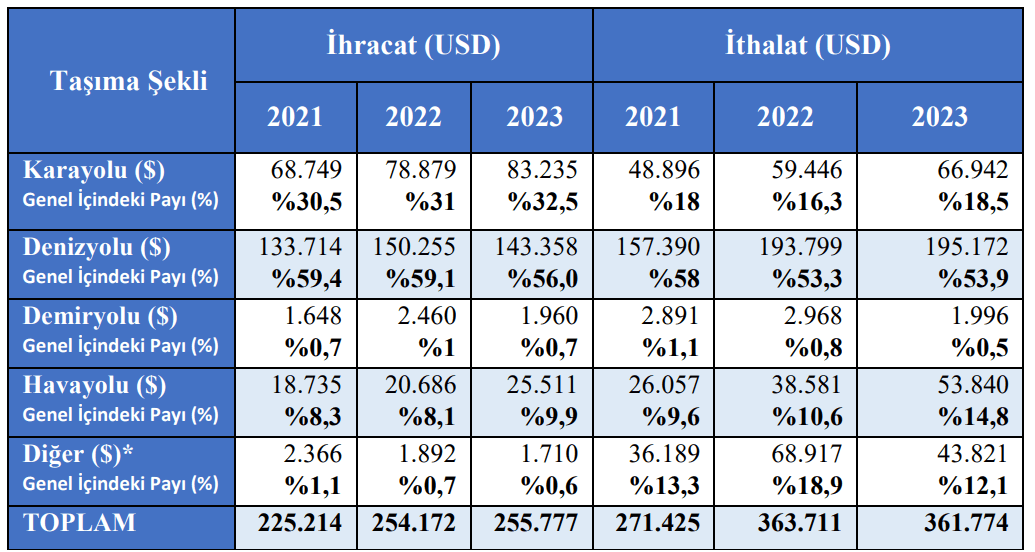
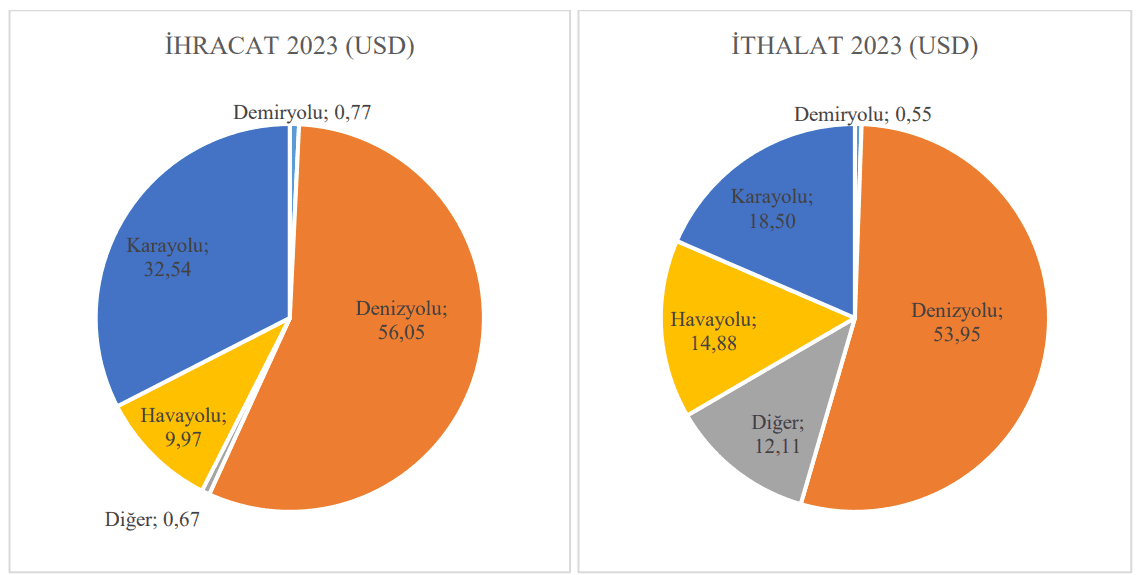
When analyzed in monetary terms (USD), sea transport accounted for 56 percent of exports in 2023, making it the dominant transport mode. Road transport is the second most common mode, contributing 32.5 percent of exports. Air transport, with a 9.9 percent share, is the third most common mode. Rail transport, with only a 0.7 percent share, is the least significant mode in export traffic.
In monetary terms (in USD), sea transport is clearly the primary import mode for 2023. Of the total export value of $361 billion, 53.9 percent was transported by sea. Road transport is the second most common mode, accounting for 18.5 percent of the total. Air transport, representing 14.8 percent of the total, is the third most used mode. Rail transport has the smallest share at 0.55 percent.
【3】
【4】
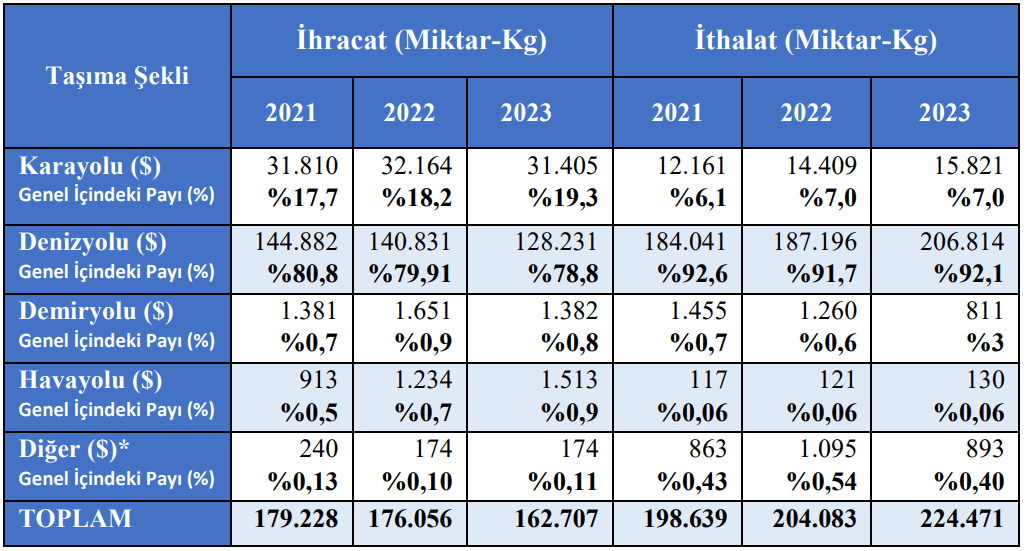
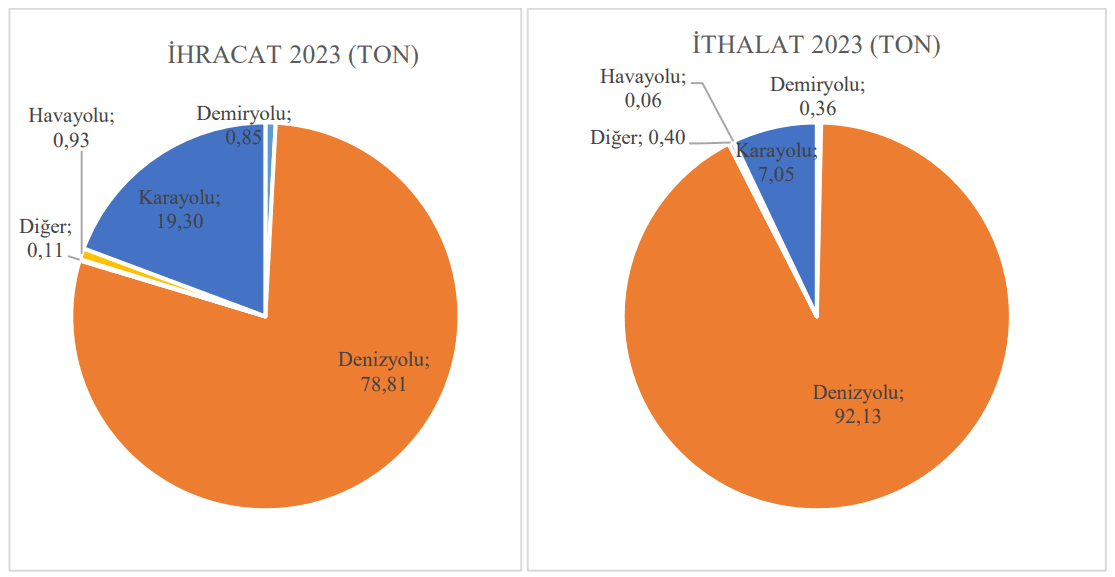
A quantitative analysis of export data by volume (tons) reveals that in 2023, sea transport dominated with 78.8 percent of total export shipments. Road transport is the second most common mode, accounting for 19.3 percent of exports. Air transport, with a 0.9 percent share, is the third most common mode. Rail transport, contributing only 0.8 percent of exports, is the least prevalent mode.
In monetary terms (in USD), sea transport is clearly the primary import mode for 2023. Of the total export value of $361 billion, 53.9 percent was transported by sea. The second largest transport mode is road transport, accounting for 7 percent of the total.
The acronym SWOT, meaning “Strengths, Weaknesses, Opportunities, and Threats,” is a strategic planning tool that helps organizations identify their internal strengths and weaknesses as well as external opportunities and threats. SWOT analysis can be used to systematically examine any organization in relation to its environment. This method aims to evaluate the organization’s strengths and weaknesses, identify potential opportunities, and analyze external threats. Subsequently, it seeks to develop strategies to address challenges and leverage opportunities to ensure future success.
When evaluating the strengths, weaknesses, opportunities, and potential threats of Türkiye’s transportation and logistics infrastructure:
1. Strategic Geographic Location: Türkiye occupies a critical position as a transit point between Asia and Europe, facilitating the movement of goods and people via land, sea, and air routes. This provides a significant advantage in international transportation.
2. Advanced Road Network: Türkiye possesses a highly developed road infrastructure consisting of divided highways and motorways that facilitate fast and efficient land transport across the country.
3. Airports and Air Transport Infrastructure: Istanbul Airport is progressing toward becoming one of the world’s largest airports. Türkiye has a strong air transport infrastructure and demonstrates significant potential for further growth and development in this sector.
4. Maritime Transport and Ports: Türkiye’s extensive coastline and strategically located ports (such as Istanbul, İzmir, and Mersin) provide major advantages in maritime transport. Additionally, the international transit of goods through the Istanbul Straits enhances Türkiye’s status as a key logistics center.
5. Logistics Centers: The establishment of logistics villages and organized industrial zones in Türkiye has facilitated the acceleration of logistics activities.
1. Regional Infrastructure Disparities: In some regions of Türkiye, particularly rural areas, existing transportation infrastructure is insufficient to meet population needs. This can create challenges in delivering logistics services effectively.
2. Bureaucratic Barriers and Slow Procedures: The presence of bureaucratic obstacles, particularly slow customs and permitting processes, can act as a barrier to trade.
3. Traffic Problems and Infrastructure Deficiencies: Traffic congestion, especially in urban areas, can cause significant delays and inefficiencies in transportation processes. In some regions, transportation infrastructure is unable to meet rapidly growing demand.
4. High Energy Dependence: Türkiye meets a large portion of its energy needs through imported energy sources. This contributes to rising costs in logistics and transportation.
1. Regional Trade and Belt and Road Initiative: Türkiye’s participation in initiatives such as China’s Belt and Road Initiative positions it as a potential central hub for trade between Central Asia, Europe, and the Middle East, offering significant opportunities for the Turkish logistics sector.
2. Railway and High-Speed Train Investments: Türkiye’s railway network is undergoing significant expansion with the commissioning of high-speed rail lines. This will facilitate efficient cargo transport and enhance the attractiveness of rail transport.
3. Digitalization and Logistics Technologies: The implementation of the Internet of Things (IoT), artificial intelligence (AI), and digital tracking systems has the potential to increase efficiency in Türkiye’s logistics sector. Digitalization of the sector creates opportunities for faster and more cost-effective transportation solutions.
4. Green Logistics and Sustainable Transportation: In light of increasing global awareness of environmental issues, Türkiye has the opportunity to invest in green logistics solutions and transition to sustainable transportation systems. The adoption of innovative solutions in this area can provide Türkiye with a competitive advantage in the global market.
1. Political and Economic Instability: Negative impacts on the logistics and transportation sector may arise from economic fluctuations as well as uncertainties in domestic and foreign policy. Security issues in border regions and disruptions in customs procedures can hinder trade flows.
2. Competition and Market Saturation: The logistics sector currently operates in a highly competitive environment both domestically and internationally. This situation may lead to declining prices and profit margins within the sector.
3. Global Crises and Supply Chain Disruptions: The emergence of global health crises such as pandemics, combined with rising energy prices and increased frequency of natural disasters, has the potential to disrupt the movement of goods and logistics processes, ultimately leading to supply chain breakdowns.
4. Environmental Burden and Traffic Problems: Especially in urban areas, traffic congestion reduces the efficiency of logistics services and exacerbates environmental impacts. This situation may increase demand for environmentally friendly transportation solutions.
Türkiye’s transportation and logistics infrastructure offers a range of advantages, including a strong geographic position, a well-developed road network, a comprehensive air transport system, and a sophisticated maritime infrastructure. However, areas requiring improvement remain, such as infrastructure gaps, environmental concerns, and bureaucratic challenges. Nevertheless, advanced regional trade, digitalization, and expectations for green logistics can enhance Türkiye’s competitiveness in this field. At the same time, the sector may be negatively affected by political instability and global crises. A strategic planning process that takes into account potential opportunities and threats is essential to facilitate the development of Türkiye’s logistics infrastructure.
Bayhan, M., M. Türkmen, and D. Kepe. “Denizli-Kaklık Lojistik Köyünün SWOT Analizi ile Değerlendirmesi – Evaluation of Denizli-Kaklık Logistics Village with SWOT Analysis.” *Mehmet Akif Ersoy Üniversitesi Sosyal Bilimler Enstitüsü Dergisi*, no. 9 (2017): 555–574. Accessed June 11, 2025. https://doi.org/10.20875/makusobed.367392.
Erdoğan, A. “Türkiye’de Lojistik Sektörünün SWOT Analizi.” The Journal of Social Sciences 47, no. 47 (2020): 108–116. Accessed June 11, 2025. https://doi.org/10.29228/sobider.45558.
General Directorate of Highways, Republic of Turkey. "Yol Ağı." 2024. Accessed June 11, 2025. https://www.kgm.gov.tr/sayfalar/kgm/sitetr/kurumsal/yolagi.aspx.
Kansız, N., Ş. Akın Acuner, and M. A. Yavuz. “Çay Sektörü SWOT Analizi.” Accessed June 11, 2025. https://www.cayelitso.org.tr/belgeler/cayswot.pdf.
Ministry of Environment, Urbanization and Climate Change of the Republic of Türkiye. "Çevresel Göstergeler." 2024. Accessed June 11, 2025. https://cevreselgostergeler.csb.gov.tr/.
Ministry of Trade of the Republic of Turkey & General Directorate of International Trade in Services. *Dış Ticaret Lojistiği*. Ministry of Trade of the Republic of Turkey, 2024. Accessed June 11, 2025. https://ticaret.gov.tr/data/5b87bf9113b8761160fa1258/D%C4%B1%C5%9F%20Ticaret%20Lojisti%C4%9Fi%202024.pdf.
“Türkiye ve Dünyada Lojistik Üsler.” 2022. Lojistikbilimi. Accessed June 11, 2025. https://lojistikbilimi.com/turkiye-ve-dunyada-lojistik-usler/.
[1]
Dış Ticaret Lojistiği, 2024. s.2
[2]
Dış Ticaret Lojistiği, 2024. s.2
[3]
Dış Ticaret Lojistiği 2024, s.3
[4]
Dış Ticaret Lojistiği 2024, s.3
A General Overview of Transportation History in Türkiye
An Overview of the Logistics Sector in Türkiye
SWOT Analysis
Strengths
Weaknesses
Opportunities
Threats