


This article was automatically translated from the original Turkish version.
+1 More
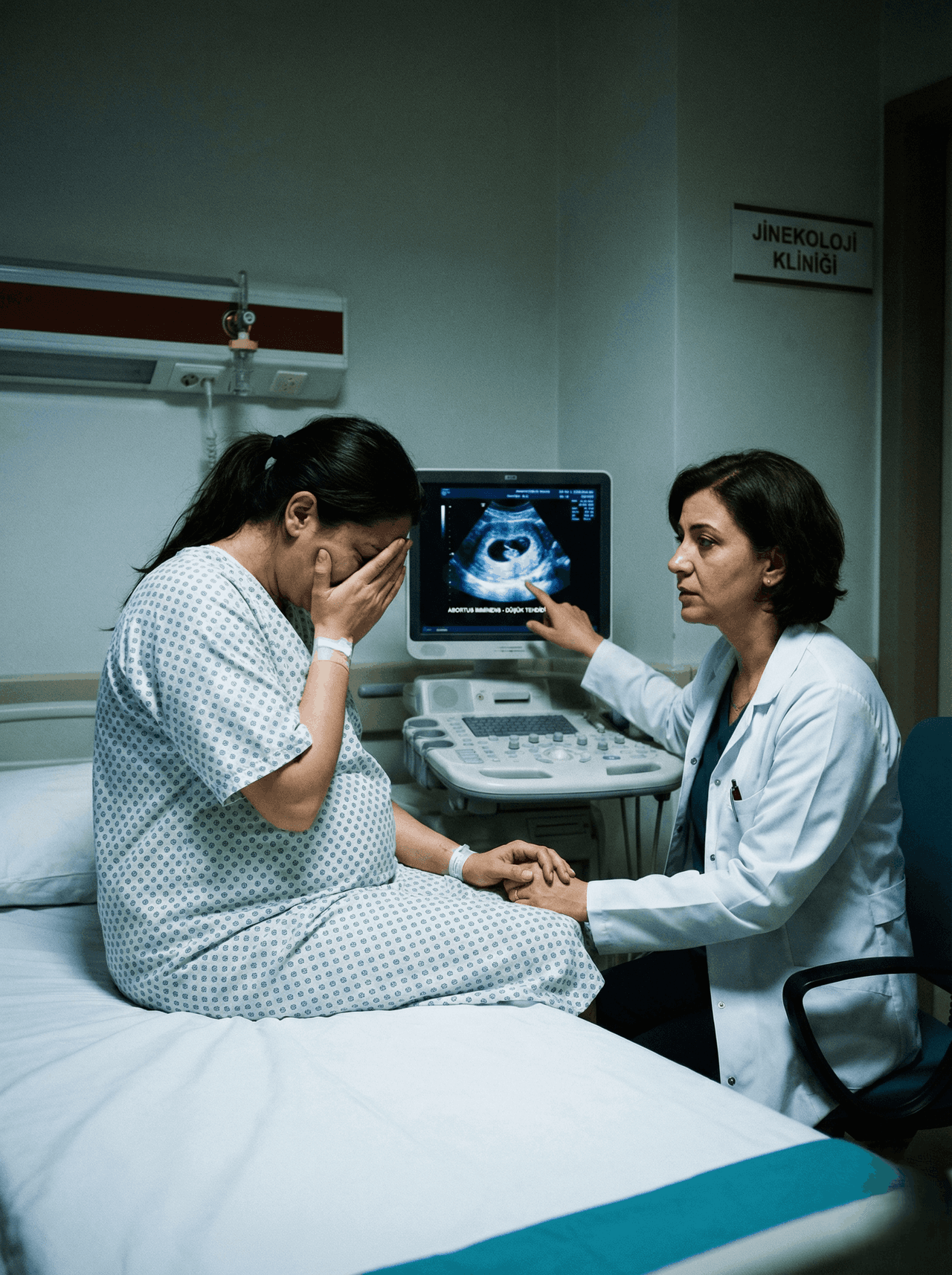
Düşük Tehdidi
(Yapay Zeka ile Oluşturulmuştur)
Threatened abortion (Abortus imminens); is a clinical presentation of vaginal bleeding occurring during the first half of pregnancy, typically within the first 20 weeks, without cervical dilation or effacement. In this clinical picture, ultrasonographic evaluation confirms the presence of an intrauterine pregnancy with a viable fetus; however, there is a threat to the continuation of the pregnancy.
This condition is one of the most common complications of pregnancy, affecting approximately 15-25% of clinically recognized pregnancies. About half of these cases result in spontaneous abortion, while the other half proceed with ongoing pregnancy. Increased risk has been reported in women over 35 years of age and under 20 years of age, as well as in those with a parity of more than three.【1】
The etiology of threatened abortion is multifactorial. In early pregnancy, inadequate trophoblast invasion (implantation of placental cells into the uterine wall) can lead to reduced placental blood flow and oxidative stress, contributing to threatened abortion. Low levels of Kisspeptin-10 (Kp-10), which regulates trophoblast invasion, have been associated with ineffective placentation.【2】
Other etiological factors include chromosomal abnormalities (trisomy, polyploidy), inadequate endometrium, hormonal imbalances (particularly luteal phase deficiency), placental anomalies, and maternal systemic diseases (diabetes, hypertension, thyroid dysfunction). In conditions with heightened systemic inflammatory response, increased fibrinogen levels and decreased albumin levels are observed; a high Fibrinogen/Albumin Ratio (FAR) is considered an independent risk factor. Environmental factors such as advanced maternal age, prior history of spontaneous abortion, IVF treatment, multiple gestations, infections, and poor nutrition also play a role in disease development.
The most prominent symptom of threatened abortion is vaginal spotting or bleeding occurring early in pregnancy. This bleeding may be accompanied by mild abdominal, inguinal, or back pain; however, the cervix remains closed. Diagnosis involves a combined assessment of clinical symptoms and imaging methods:
Various parameters have been studied to predict pregnancy outcomes:
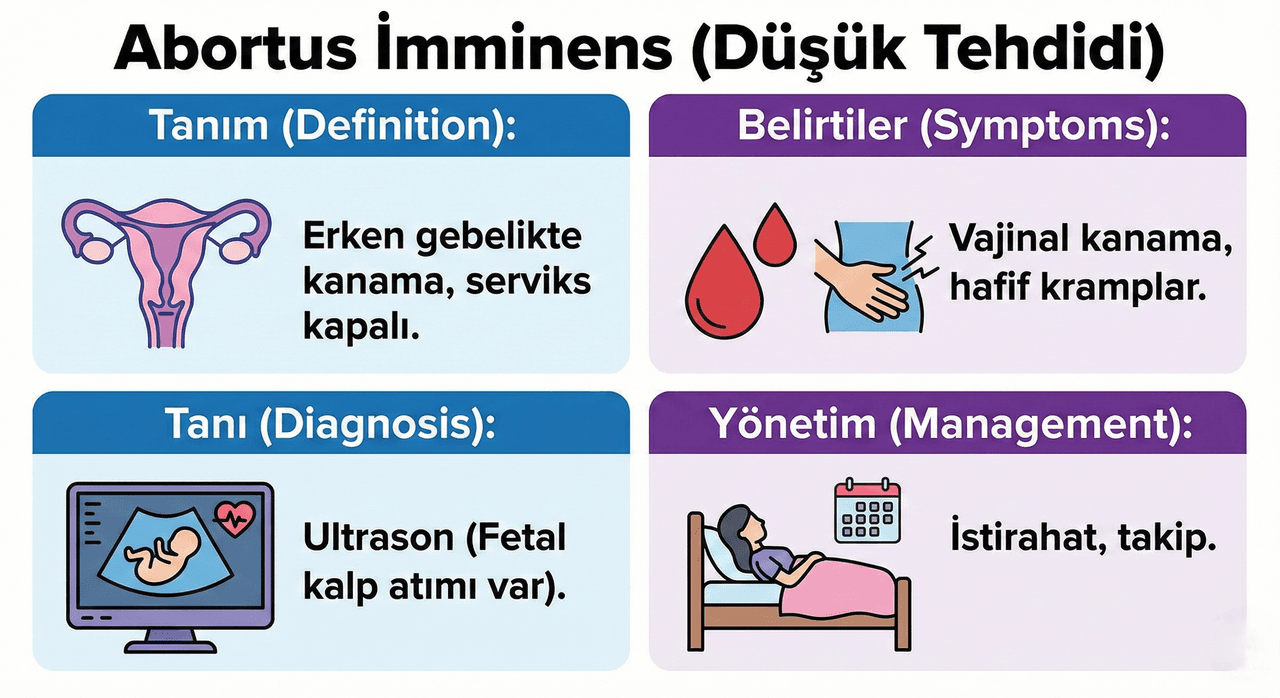
Threatened abortion (Abortus imminens)
(Generated by Artificial Intelligence)
Women diagnosed with threatened abortion who continue their pregnancies face an increased risk of various obstetric complications in later weeks. These complications include preterm birth (preterm labor), preterm premature rupture of membranes (PPROM), low birth weight, and increased rates of cesarean delivery.
In particular, among groups classified as "high risk" (e.g., recurrent miscarriage history, IVF pregnancy, etc.), neonatal intensive care unit admission and low APGAR scores are more frequently observed. Additionally, even among patients with threatened abortion who are in the low-risk group, an increased risk of postpartum uterine atony (failure of uterine contraction after delivery) has been observed. In cases accompanied by subchorionic hematoma, pregnancy tends to end earlier, and rates of operative delivery (cesarean section) are elevated.【6】
Therapeutic approaches are generally empirical and include the following:
Warning: The content in this article is provided solely for general encyclopedic informational purposes. The information presented here should not be used for diagnosis, treatment, or referral. Before making any decisions regarding health matters, you must consult a physician or qualified healthcare professional. The author and KÜRE Encyclopedia assume no responsibility for any consequences arising from the use of this information for diagnostic or therapeutic purposes.
Alan, Yasemin, Murat Alan, Beril Gürlek, Yüksel Kurban, İbrahim Uyar, Yaşam Kemal Akpak, and Ahmet Nuri Danışman. "Abortus İmminens Tanılı Olgularda Antikardiyolipin Antikor Pozitifliği ile Gebelik Sonuçları Arasındaki İlişki." *Bakırköy Tıp Dergisi* 15, no. 2 (2019): 136–141. Accessed February 16, 2026. https://bakirkoymedj.org/pdf/580eb5e7-1480-44a6-9404-b8b7446acbcb/articles/BTDMJB.galenos.2018.20180306081759/BTD-15-136.pdf
Altınboğa, Orhan, Betül Yakıştıran, Seyit Ahmet Erol, Ali Taner Anuk, Emre Başer, Yüksel Oğuz, and Ali Turhan Çağlar. "Abortus İmminens Tanılı Hastalarda Subkoryonik Hematom Varlığının Gebelik Sonuçlarına Etkisi." *Jinekoloji - Obstetrik ve Neonatoloji Tıp Dergisi* 17, no. 3 (2020): 416–419. Accessed February 16, 2026. https://dergipark.org.tr/en/download/article-file/1128505
Avşar, A. Filiz, B. Sıtkı İsenlik, Kemal Selçuk, H. Levent Keskin, Mustafa Uzun, and Serpil Aydoğmuş. "Abortus İmminens, Erken Doğum Eylemini Öngördürebilir Bir Faktör mü?" *Türkiye Klinikleri Jinekoloji Obstetrik Dergisi* 18, no. 2 (2008): 88–92. Accessed February 16, 2026. https://www.academia.edu/97274531/Abortus_%C4%B0mminens_Erken_Do%C4%9Fum_Eylemini_%C3%96ng%C3%B6rd%C3%BCrebilir_Bir_Fakt%C3%B6r_m%C3%BC
Evrenos, Ayşe Nur, Ayşe Nur Çakır Güngör, Cavidan Gülerman, and Emine Coşar. "Obstetric Outcomes of Patients with Abortus Imminens in the First Trimester." *Archives of Gynecology and Obstetrics* 289, no. 3 (March 2014): 499–504. Accessed February 16, 2026. https://link.springer.com/content/pdf/10.1007/s00404-013-2979-5.pdf
Güzin, Kadir, Gülter Güran, Nuray Sözeri, Mükremin Ceylan, Canan Gökçen, and Necdet Süer. "Abortus İmminens Prognozunu Belirlemede Ultrason, Serum β-HCG ve Progesteron'un Yeri." *T Klin Jinekoloji Obstetrik* 5, no. 2 (1995): 81–84. Accessed February 16, 2026. https://www.jcog.com.tr/pdf/?pdf=464842e19917ae080673ccaff0c769b3
Hamidah and Siti Masitoh. "Faktor Dominan Yang Berhubungan Dengan Kejadian Abortus Imminens." *Jurnal Ilmu & Teknologi Ilmu Kesehatan* 1, no. 1 (September 2013): 29–33. Accessed February 16, 2026. https://www.poltekkesjakarta3.ac.id/ejurnalnew/index.php/jitek/article/view/21/17
Kavvasoglu, Serif, Zehra Sema Ozkan, Banu Kumbak,Mehmet Sımsek, and Necip Ilhan. "Association of Kisspeptin-10 Levels with Abortus Imminens: A Preliminary Study." *Archives of Gynecology and Obstetrics* 285, no. 3 (March 2012): 649-653. Accessed February 16, 2026. https://link.springer.com/content/pdf/10.1007/s00404-011-2061-0.pdf
Kusuma, Aulia. "Faktor-Faktor Yang Melatarbelakangi Kejadian Abortus Imminens Pada Ibu Hamıl Di Sukadana Kabupaten Kayong Utara." Bachelor's thesis, Muhammadiyah Pontianak University, 2016. Accessed February 16, 2026. https://repository.unmuhpnk.ac.id/163/1/JURNAL%20AULIA%20KUSUMA.pdf
Kılıç, Gökhan, Serap Yaltı, Özay Oral, and Mustafa Kekova. "Abortus İmminens Olgularında Maternal Serum Alfa Fetoprotein Seviyelerinin Prediktif Değeri." *Kartal Eğitim ve Araştırma Hastanesi Tıp Dergisi* 9, no. 1-4 (1998): 695-698. Accessed February 16, 2026. https://pdf.journalagent.com/scie/pdfs/KEAH_9_2_695_698.pdf
Sucipto, Nur Ilhaini. "Abortus Imminens: Upaya Pencegahan, Pemeriksaan, dan Penatalaksanaan." CDK-206 40, no. 7 (2013): 492-496. Accessed February 16, 2026. https://lib.fkm.ui.ac.id/detail?id=101532&lokasi=lokal
Usta, Ceyda S., Tugba K. Atik, Ruhsen Ozcaglayan, Cagla B. Bulbul, Figen E. Camili, and Ertan Adali. "Does the Fibrinogen/Albumin Ratio Predict the Prognosis of Pregnancies with Abortus Imminens?" *Saudi Medical Journal* 42, no. 3 (March 2021): 255–263. Accessed February 16, 2026. https://smj.org.sa/content/smj/42/3/255.full.pdf
Wallner, Hanns Jürgen. "Der Abortus imminens und seine Konsequenzen." *Deutsches Ärzteblatt* 69, no. 19 (May 1972): 1201–1203. Accessed February 16, 2026. https://api.aerzteblatt.de/pdf/69/19/a1201.pdf
İtil, İ. Mete, Mert Kazandı, Aydın Özsaran, Bilgen Gediz, Hüseyin Yılmaz, and Ömer Dinçer. "Abortus İmminens Olgularında Prognostik Faktörlerin Değerlendirilmesi." T Klin Jinekoloji Obstetrik 9, no. 2 (1999): 65-71. Accessed February 16, 2026. https://www.jcog.com.tr/pdf/?pdf=4d5530230e59c9acd221610e0d68641a
[1]
Hamidah and Siti Masitoh, "Faktor Dominan yang Berhubungan dengan Kejadian Abortus Imminens," Jurnal Ilmu & Teknologi Ilmu Kesehatan 1, no. 1 (September 2013): 29-33, accessed 16 February 2026, https://www.poltekkesjakarta3.ac.id/ejurnalnew/index.php/jitek/article/view/21/17
[2]
Serif Kavvasoglu et al., "Association of Kisspeptin-10 Levels with Abortus Imminens: A Preliminary Study," Archives of Gynecology and Obstetrics 285, no. 3 (March 2012): 649-653, accessed 16 February 2026, https://link.springer.com/content/pdf/10.1007/s00404-011-2061-0.pdf
[3]
Kadir Güzin et al., "Abortus İmminens Prognozunu Belirlemede Ultrason, Serum β-HCG ve Progesteron'un Yeri," T Klin Jinekoloji Obstetrik 5, no. 2 (1995): 81-84, accessed 16 February 2026, https://www.jcog.com.tr/pdf/?pdf=464842e19917ae080673ccaff0c769b3
[4]
Orhan Altınboğa et al., "Abortus İmminens Tanılı Hastalarda Subkoryonik Hematom Varlığının Gebelik Sonuçlarına Etkisi," Jinekoloji - Obstetrik ve Neonatoloji Tıp Dergisi 17, no. 3 (2020): 416-419, accessed 16 February 2026, https://dergipark.org.tr/en/download/article-file/1128505
[5]
Yasemin Alan et al., "Abortus İmminens Tanılı Olgularda Antikardiyolipin Antikor Pozitifliği ile Gebelik Sonuçları Arasındaki İlişki," Bakırköy Tıp Dergisi 15, no. 2 (2019): 136-141, accessed 16 February 2026, https://bakirkoymedj.org/pdf/580eb5e7-1480-44a6-9404-b8b7446acbcb/articles/BTDMJB.galenos.2018.20180306081759/BTD-15-136.pdf
[6]
Orhan Altınboğa et al., "Abortus İmminens Tanılı Hastalarda Subkoryonik Hematom Varlığının Gebelik Sonuçlarına Etkisi," Jinekoloji - Obstetrik ve Neonatoloji Tıp Dergisi 17, no. 3 (2020): 416-419, accessed 16 February 2026, https://dergipark.org.tr/en/download/article-file/1128505
[7]
Aulia Kusuma, "Faktor-Faktor Yang Melatarbelakangi Kejadian Abortus Imminens Pada Ibu Hamil Di Sukadana Kabupaten Kayong Utara" (Published Bachelor’s Thesis, Muhammadiyah Pontianak University, 2016), accessed 16 February 2026, https://repository.unmuhpnk.ac.id/163/1/JURNAL%20AULIA%20KUSUMA.pdf


Düşük Tehdidi
(Yapay Zeka ile Oluşturulmuştur)
No Discussion Added Yet
Start discussion for "Threatened Miscarriage" article
Epidemiology
Etiology and Pathophysiology
Clinical Signs and Diagnostic Methods
Prognostic Biochemical Markers and Obstetric Complications
Management, Treatment, and Psychosocial Aspects