


This article was automatically translated from the original Turkish version.
+2 More
Date(s) | 13th century BCE | ||||||||
|---|---|---|---|---|---|---|---|---|---|
Period(s) | Hittite Empire | ||||||||
Building Type | Open-air temple | ||||||||
Sections | Room A (Procession of the Gods), Room B (Cult of the Dead) | ||||||||
Function(s) | Three periods (siege wall eastern wing arrangement) monumental entrance | ||||||||
Protection | Cultural heritage area | ||||||||
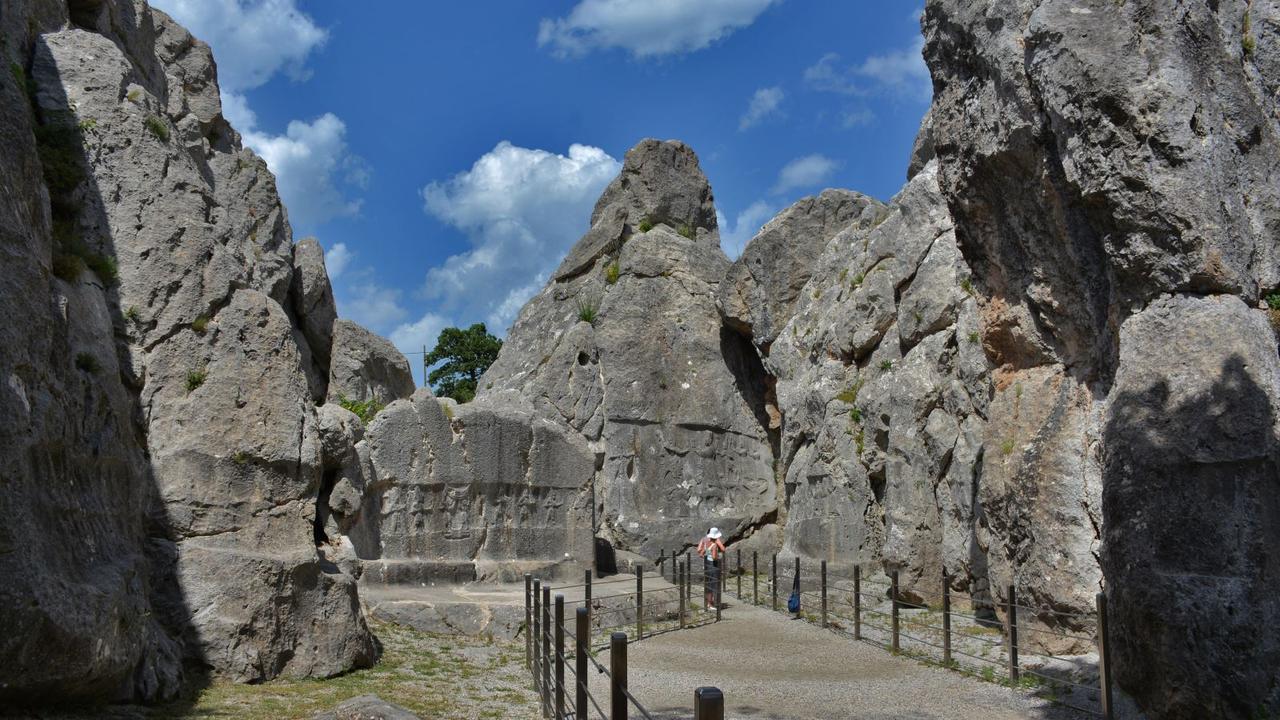
The Yazılıkaya Open-Air Sanctuary is located approximately two kilometers northeast of Hattusa, the capital of the Hittite Empire (modern Boğazkale), nestled among natural rock formations. This open-air sanctuary, built atop natural cliffs, was a significant sacred space used by the Hittites for religious ceremonies. The structure consists of two main sections, Rooms A and B, and reveals three distinct construction phases.

Yazılıkaya Open-Air Sanctuary (Türkiye Culture Portal)
In the first construction phase, a enclosing wall was built to separate the sanctuary from the external world. During the second phase, a monumental entrance structure and a building conforming to Hittite temple tradition were added. In the third phase, a more functional transitional area was created at the entrance to Room B on the eastern wing. Small niches carved into the rock at the entrance were used to hold candles employed in religious rituals.
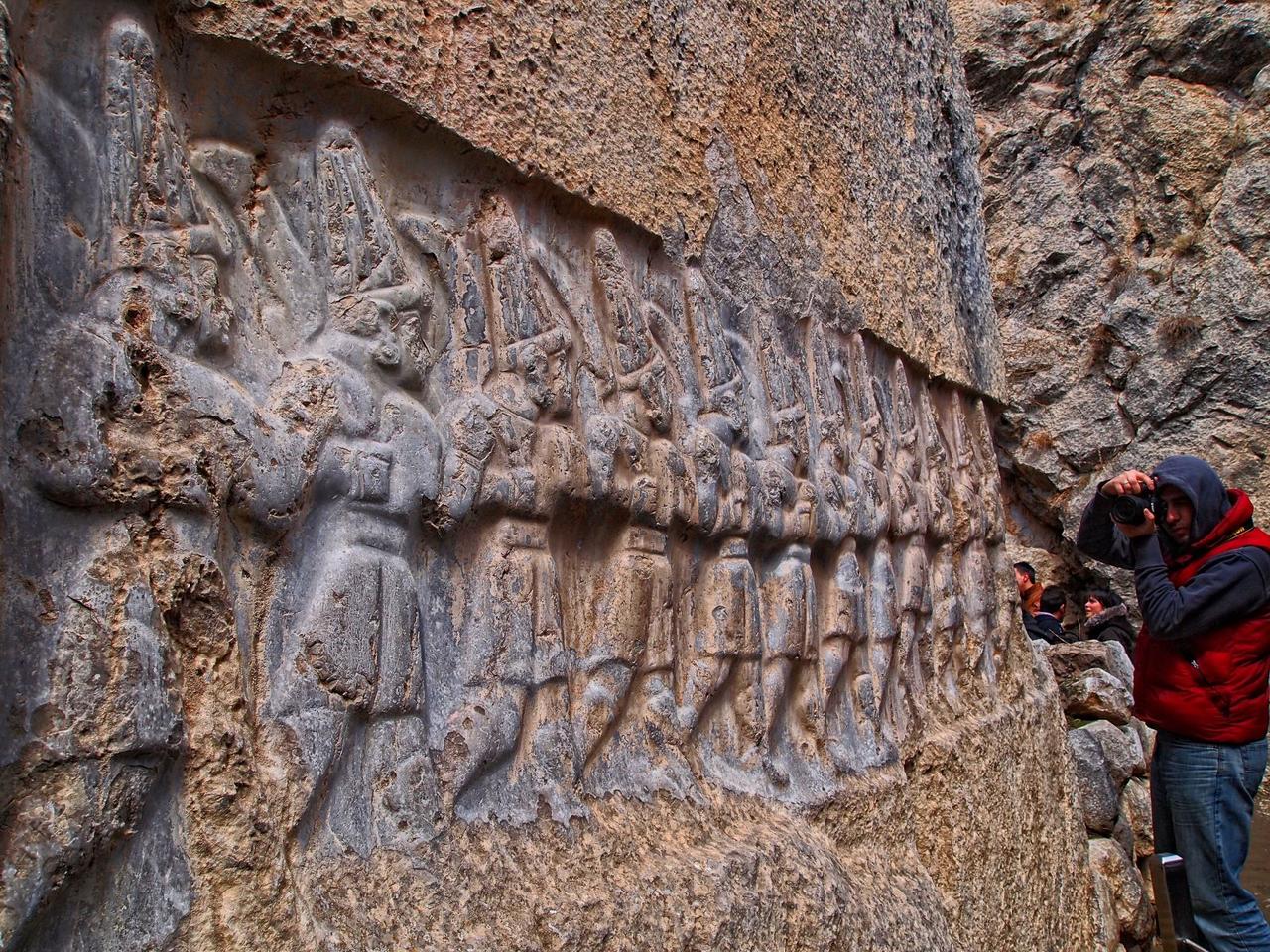
Room A contains over ninety relief carvings depicting gods, goddesses, animals, and mythical beings from the Hittite pantheon. Gods are arranged on the left wall, while goddesses are depicted on the right wall. The central scene portrays the meeting of Tešup, the Storm God, with Hepat, the Sun Goddess of Arinna, and their son Šarruma. The north wall illustrates the union of these deities. This arrangement follows Hurrian religious ritual traditions but is stylistically shaped according to Hittite artistic conventions. The names of all figures are inscribed above their heads in hieroglyphic script. These scenes are dated to the reign of Hattusili III (c. 1275–1250 BCE).

Yazılıkaya Open-Air Sanctuary (Türkiye Culture Portal)
Room B is a narrow and elongated chamber. At its entrance, flanking a stone-ramped passage, are two relief carvings of winged, human-bodied demons with lion heads, positioned facing each other. These beings are believed to be hybrid creatures associated with the underworld. The positioning and stylistic rendering of the reliefs reflect Hurrian-influenced art. The room also features carvings of twelve underworld deities and the god Nergal. This arrangement suggests that the room may have been dedicated to the funerary cult of King Tudhaliya IV.

Yazılıkaya Open-Air Sanctuary (Türkiye Culture Portal)
On the eastern wall of Room B stands a 2.95-meter-tall relief of Tudhaliya IV, depicted with his protective deity Šarruma placing his arm around the king’s shoulder. Beside this relief is a carved sword planted into the ground, with the head of the god Nergal above it. Hittite religious texts support the interpretation that this relief is connected to purification rituals. The view that Room B was constructed as a funerary sanctuary after the death of Tudhaliya IV is reinforced by these elements.
Yazılıkaya Open-Air Sanctuary (Türkiye Culture Portal)
The two lion demons flanking the entrance are depicted with lion heads, human bodies, and wings. The reliefs are rendered in profile for the heads and legs, with frontal views of the torsos. Detailed craftsmanship is evident in the belts, skirts, wing patterns, and gestures of the figures. These beings are interpreted as guardians associated with the descent of the Sun Goddess into the underworld, overseeing the transition of the souls of the dead into the realm of the dead.
The iconography of the Yazılıkaya reliefs is dominated by Hurrian influence. Among the deities are figures of Mesopotamian origin, such as the Water God Ea, the Moon God, and the Grain God, while the arrangement of gods and goddesses presents a ritual hierarchy. The lion demons exhibit iconographic similarities to the Mesopotamian “ugallu” figures, embodying a universal symbolism as supernatural entities linked to the underworld and death.
Culture and Tourism Ministry. "Örenyerleri." *T.C. Çorum İl Kültür veTurizm Müdürlüğü. Accessed June 18, 2025. https://corum.ktb.gov.tr/TR-58708/orenyerleri.html.
Ministry of Culture and Tourism. "Hititlerin Ulusal Tapınağı: Yazılıkaya." *T.C. Kültür ve Turizm Bakanlığı E-Kitap*. Accessed June 18, 2025. https://ekitap.ktb.gov.tr/TR-80077/hititlerin-ulusal-tapinagi-yazilikaya.html.
Oral, Ebru. “Yazılıkaya B Odası Girişindeki Aslan Demonlarının İkonografik ve İkonolojik Değerlendirmesi.” *Batman Üniversitesi Yaşam Bilimleri Dergisi* 2, no. 1 (2012): 148–156. Accessed June 18, 2025. https://dergipark.org.tr/tr/download/article-file/313462.
Türkiye Kültür Portalı. “Yazılıkaya Açıkhava Tapınağı - Çorum.” *Kulturportali.gov.tr*. Accessed June 18, 2025. https://www.kulturportali.gov.tr/turkiye/corum/gezilecekyer/yazilikaya-acikhava-tapinagi.

Date(s) | 13th century BCE | ||||||||
|---|---|---|---|---|---|---|---|---|---|
Period(s) | Hittite Empire | ||||||||
Building Type | Open-air temple | ||||||||
Sections | Room A (Procession of the Gods), Room B (Cult of the Dead) | ||||||||
Function(s) | Three periods (siege wall eastern wing arrangement) monumental entrance | ||||||||
Protection | Cultural heritage area | ||||||||
No Discussion Added Yet
Start discussion for "Yazılıkaya Open-Air Temple" article
Construction Phases and Architectural Features
Room A: The Procession of Gods and Goddesses
Room B: The Underworld and the Cult of the Dead
Tudhaliya IV and the Protective God Šarruma
Lion Demons
Iconographic and Cultural Context