


This article was automatically translated from the original Turkish version.
+1 More
The Baltazzi family is an Italian-origin family that settled in İzmir in the mid-18th century. They initially operated in the financial sector. In the 19th century, they played an active role in Western Anatolia and became landowners in the Aydın Vilayeti from the mid-century onward. The Baltazzi family was among the Galata Bankers who exerted influence over Ottoman finance in the 19th century. The Galata Bankers were capital holders composed of Jewish, Greek, Armenian, and Levantine families rooted in the moneychanger tradition and controlled the financial sector during the 19th century. The Baltazzi family maintained financial relations with the Ottoman State for approximately a century, engaging in various economic activities during this period.
One of the family members, Démosthènes Baltazzi (1836–1896), a descendant of the Levantine Baltazzi family, developed a strong interest in archaeology. He served as Acting Director of Antiquities for the Aydın Vilayeti from 1880 to 1892. From 1892 onward, he held the position of Keeper at the Müze-i Hümayun in Istanbul. Between 1880 and 1895, Démosthènes Baltazzi conducted numerous archaeological expeditions on behalf of the Müze-i Hümayun across Anatolia, making significant discoveries and enriching the museum’s collections. He carried out excavations under his own name in 1887 and 1890 within the boundaries of Germencik district in Aydın, at the ancient site of Menderes Magnesia. The Baltazzi Pavilion in İzmir stands as an example of the historic buildings constructed during the period when Levantines resided in the city.
The Baltazzi family is of Italian origin and settled in İzmir in the mid-18th century. The family is classified as Levantine. İzmir became a major commercial port from the 17th century onward and, due to this status, became home to numerous families of European origin who settled in the Eastern Mediterranean and were collectively known as Levantines. Indeed, from the 13th century onward, Italians began settling in İzmir following the Genoese acquisition of the right to establish colonies through the Treaty of Nymphaeum signed with the Byzantines on 13 March 1261.
The Baltazzi family played an active role in Western Anatolia during the 19th century. According to the statement of Alex Baltazzi, a family member, the family has been present in these lands since 1736. Alex Baltazzi described himself as having an “Italian-Turkish mindset.”
The Baltazzi family was a prominent representative of the Galata Bankers class, which held significant influence over Ottoman finance in the 19th century. The Galata Bankers played a central role in the Ottoman State’s financial system during this period. This group consisted of Jewish, Greek, Armenian, and Levantine capital holders who inherited the tradition of moneychangers and controlled the financial sector. The Baltazzi family’s financial relations with the Ottoman State lasted for approximately a century.
The bankers, including the Baltazzi family, played a crucial role in addressing the Ottoman State’s persistent financial problems during the 19th century. The revival of Mediterranean trade under Sultan Mahmud II and the commercial treaties signed with Britain in 1838 and France in 1839 led to a substantial increase in foreign trade, which encouraged the Galata bankers to support and benefit from the new commercial order. The rise in customs revenues was viewed as a positive development for bankers who held accumulated claims against the treasury. However, the trade deficit caused by import surpluses quickly reached large proportions, leading to the export of gold, silver, and copper coins from the country to settle payments. This situation created a liquidity crisis, and the lack of sufficient development in the banking sector made finding solutions difficult.
The Baltazzi family also participated in the Ottoman State’s first foreign borrowings. For instance, they acted as intermediaries for loans obtained from England and France in 1854 and 1855 through the Dersaadet Bank. One of the six founders of the bank was Manolaki Baltazzi. During this period, the family fulfilled an important function by providing credit to the Ottoman economy and acting as intermediaries in international markets. Their financial activities contributed not only to funding the empire’s modernization efforts and war expenditures but also shaped the state’s borrowing policies.
From the mid-19th century onward, the Baltazzi family became landowners in the Aydın Vilayeti. This demonstrates that the family was active not only in finance but also in agriculture. In Western Anatolia, they were among the major Levantine landowners.
The family’s farms were the sites of various incidents. For example, the farm owned by Themistocles Baltazzi in Aksihar was subject to an intervention by the Cebni Tribe on 15 April 1856. Efforts were made to prevent this intervention. On 24 June 1856, letters were sent to the governor of İzmir and the district governor of Saruhan to prevent another attack on the same farm. A year later, on 17 June 1857, another attack occurred on this farm and another property owned by the Baltazzi family, this time by the Çakıroğulları. A letter was again sent to the governor of İzmir to prevent further attacks, and investigations concluded that the Çakıroğulları were unjustified in their actions.
Another incident related to the family’s landownership involved Madam Baltazzi’s attempt to evict peasants from her land. Madam Baltazzi sent men employed by her Greek steward, Eliopulos, to drive out the villagers. In response, the farms were occupied by the peasants in June 1895.
Démosthènes Baltazzi (1836–1896), a member of the Baltazzi family, is particularly noted for his contributions to archaeology. As a prominent figure of the Levantine Baltazzi family, he showed great interest in the field.
Between 1880 and 1895, Démosthènes Baltazzi conducted numerous archaeological projects on behalf of the Müze-i Hümayun (Imperial Museum) across Anatolia. These efforts led to significant discoveries and enriched the museum’s collection with valuable artifacts.
In terms of his official positions, Démosthènes Baltazzi served as Acting Director of Antiquities for the Aydın Vilayeti from 1880 to 1892. During this tenure, he played an active role in preserving and documenting the region’s archaeological heritage. From 1892 onward, he continued his service as Keeper at the Müze-i Hümayun in Istanbul. He is said to have maintained a close relationship with the museum’s director, Osman Hamdi Bey.
Démosthènes Baltazzi also conducted direct excavations. The most well-known of these were carried out in 1887 and 1890 at the ancient city of Menderes Magnesia, located within the boundaries of Germencik district in Aydın. These excavations are regarded as among the most important examples of archaeological activity during the Ottoman period. It is also noted that he engaged in the collection of archaeological artifacts.
The Baltazzi family is also notable for its architectural legacy in the Ottoman Empire, particularly in İzmir. An important example of this legacy is the Baltazzi Pavilion in İzmir.
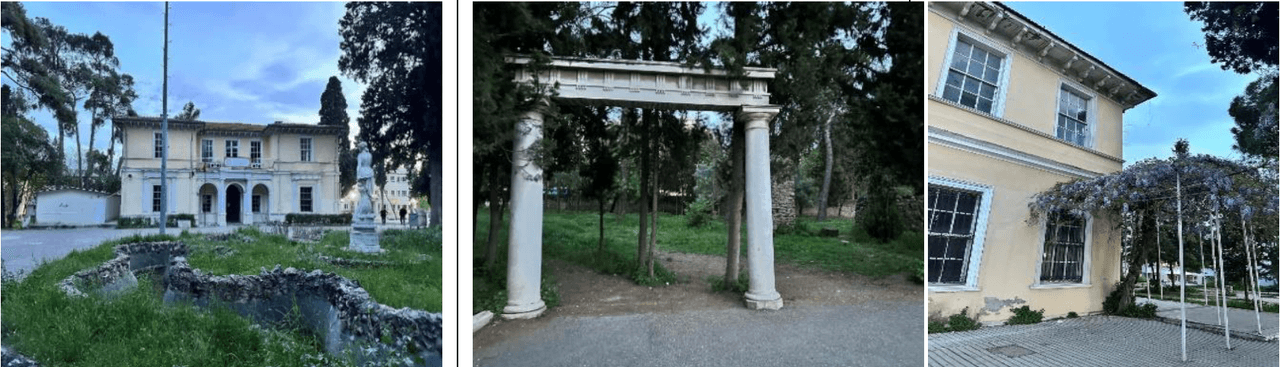
Baltazzi Pavilion (Source: Repurposing of Historical Structures and Baltazzi Pavilion)
The Baltazzi Pavilion is one of the historic buildings constructed during the period when Levantines were densely settled in İzmir. Such structures were often required to adapt to changing urban and temporal needs. Situations such as loss of function or inability to meet contemporary demands have made the adaptive reuse of historic buildings necessary.
Adaptive reuse is defined as assigning a new function to a space while preserving its unique characteristics. Utilizing existing buildings in this manner not only provides economic benefits but also ensures the preservation of the structure and the transmission of cultural heritage to future generations. The Baltazzi Pavilion serves as an example studied in the context of adaptive reuse of historic buildings.
The relationship of the Baltazzi family with the Ottoman State, and the internal perspectives on this relationship, have been examined within the context of differing historical interpretations of the Galata Bankers. Regarding the Galata Bankers, two opposing views exist: some portray them as “traitors,” while others depict them as “heroes.” One study adopted the method of interviewing a living representative of this culture and perspective in order to clarify these contrasting judgments.
Through an interview with Alex Baltazzi, the Baltazzi family’s perspective on the Ottoman State was explored. The family’s approximately century-long financial relationship with the Ottoman State, including the credit they provided and their role in borrowing processes, significantly shaped this viewpoint. The family fulfilled an important function by supplying resources to the Ottoman economy during various periods and acting as intermediaries in international financial markets.
The legacy of the Baltazzi family extends beyond financial activities. Their extensive landholdings and agricultural operations in Western Anatolia had a demonstrable impact on the regional economy. Moreover, archaeological work by family members such as Démosthènes Baltazzi directly contributed to the study and preservation of Ottoman cultural heritage. Architectural structures such as the Baltazzi Pavilion in İzmir represent the physical legacy the family left on the city’s social and cultural fabric. These diverse activities reveal that the Baltazzi family exerted a multifaceted influence during the final decades of the Ottoman Empire.
Kökdemir, Görkem. “120. Ölüm Yıldönümünde Aydın Vilayeti Müze-i Hümayun Müdür Vekili Démosthènes Baltazzi ve Menderes Magnesiası’ndaki Çalışmaları 1887, 1890.” *TÜBA-AR Türkiye Bilimler Akademisi Arkeoloji Dergisi*, no. 19 (January 2016): 291–305. Accessed July 15, 2025. https://dergipark.org.tr/en/download/article-file/1726384
Manav, Nursel. *Devlet-Banker İlişkileri Çerçevesinde Baltazzi Ailesi*. Master's thesis,Marmara Üniversitesi, 2009. Accessed July 15, 2025. https://search.proquest.com/openview/c50e456b872205d195b115405f4083b4/1?pq-origsite=gscholar&cbl=2026366&diss=y
Oğlakçı, Mehmet. *Galata Bankerlerinin Osmanlı Devlet Maliyesi Sistemine Etkileri: Baltazzi (Baltacı) Ailesi Örneği*. Master's thesis, Afyon Kocatepe University, Institute of Social Sciences, 2007. Accessed July 15, 2025. https://acikerisim.aku.edu.tr/xmlui/handle/11630/3034
Çetin, Cem. *Baltazzi Ailesinin İktisadi Faaliyetleri ve Osmanlı Maliyesi ile İlişkileri*. PhD thesis, Marmara Üniversitesi, 2009. Accessed July 15, 2025. https://search.proquest.com/openview/8a0bcbfa2dbffa7987d6bf070768dc27/1?pq-origsite=gscholar&cbl=2026366&diss=y
Öden, Hülya Yavuz. “Tarihi Yapılarda Yeniden İşlevlendirme ve Baltazzi Köşkü.” *Premium e-Journal of Social Sciences (PEJOSS)* 7, no. 32 (2023): 633–642. Accessed July 15, 2025. https://pejoss.com/index.php/pub/article/view/249

Origins of the Baltazzi Family and Their Settlement in the Ottoman Empire
The Galata Bankers Era and Financial Activities
Landownership and Agricultural Activities
Contributions to Archaeological Research: The Case of Démosthènes Baltazzi
The Baltazzi Pavilion and Other Structures
The Family’s Perspective on the Ottoman State and Its Legacy