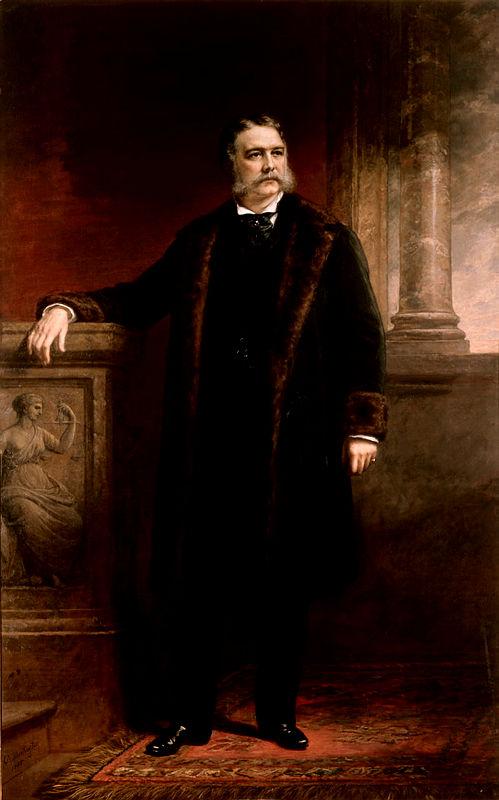
Doğum tarihi | 1829-10-05 | ||||||||
|---|---|---|---|---|---|---|---|---|---|
Eş | Ellen "Nell" Herndon Arthur (m. 1859 – d. 1880) | ||||||||
Place of Birth | Fairfield, Vermont, USA | ||||||||
Ölüm tarihi | 1886-11-18 | ||||||||
Place of Death | New York City, New York, USA | ||||||||
Parents | William Arthur, Malvina Stone Arthur | ||||||||
Presidential Order | 21st President of the United States (1881–1885) | ||||||||
Chester Alan Arthur was born on October 5, 1829, in the town of Fairfield, Vermont. His father, William Arthur, was a Baptist minister who had emigrated from Northern Ireland, and his mother was Malvina Stone Arthur. Due to William Arthur’s ministerial duties, the family frequently moved between Vermont and New York. Arthur completed his early education in various parts of New York, including Greenwich, Perry, and Lansingburgh. He entered Union College in 1845 and graduated in 1848 at the top of his class. After graduation, he worked as a teacher to finance his legal studies and was admitted to the New York Bar in 1854.
Arthur’s early legal career was shaped particularly by anti-slavery cases. He began his practice in the law office of Erastus D. Culver and played an active role in the Lemmon Slave Case and the Elizabeth Jennings case. The former resulted in a landmark ruling that individuals enslaved in other states were considered free upon setting foot in New York. The Jennings case contributed to the elimination of racial discrimination in New York’s public transportation. During this period, Arthur’s political views shifted away from the Whig Party toward the Republican Party, aligning with its anti-slavery stance. He briefly traveled to Kansas to support anti-slavery settlers but returned due to the lawlessness and violence in the region. In 1859, he married Ellen “Nell” Herndon.
During the American Civil War, Arthur was appointed by New York Governor Edwin D. Morgan as engineer-in-chief responsible for engineering operations within the state militia. He was later promoted to quartermaster general, overseeing the state’s supply logistics. In these roles, he organized the logistics for thousands of soldiers and gained recognition for his administrative abilities. He was removed from office in 1863 by the newly elected Democratic governor. Afterward, Arthur returned to private legal practice and became an active member of the Stalwart faction of the Republican Party, led by Roscoe Conkling.
In 1871, President Ulysses S. Grant appointed Arthur as Collector of the Port of New York, a powerful position responsible for managing a large portion of the nation’s revenue and overseeing a staff of approximately 1,300. Arthur administered the office through patronage appointments and political fundraising. Although he was never directly accused of corruption during his tenure, he maintained the “spoils system,” which required employees to contribute politically. He was removed from office in 1878 by reform-minded President Rutherford B. Hayes.
At the 1880 Republican National Convention, no consensus could be reached on a presidential candidate. To balance the ticket, James A. Garfield was nominated for president and Arthur for vice president. The Republican Party won the November election, and Arthur assumed the vice presidency on March 4, 1881. Arthur, who showed little loyalty to President Garfield, worked to protect the interests of the Stalwart faction. On July 2, 1881, President Garfield was shot and died on September 19. Arthur succeeded to the presidency in accordance with constitutional procedure.
Chester A. Arthur took the oath of office as President of the United States on September 21, 1881. The most notable achievement of his presidency was the passage of the Pendleton Civil Service Reform Act in 1883, which established that federal employees should be appointed based on merit rather than political connections and eliminated the requirement for civil servants to make political contributions.
Arthur also vetoed the initial version of the Chinese Exclusion Act of 1882 but signed a revised, more moderate version. The law suspended Chinese immigration for ten years and became the first federal immigration restriction based on ethnicity. In foreign policy, he sought to expand trade with Latin America. Domestically, he supported the Tariff Act of 1883, which reduced customs duties to balance excess budget revenues.
Arthur initiated the modernization of the United States Navy, securing funding for the construction of steel warships and earning the title “Father of the Modern American Navy.” He proposed legislation to support education and land ownership for Native Americans. He attended the opening of the Brooklyn Bridge alongside New York Governor Grover Cleveland.
In 1882, Arthur was diagnosed with Bright’s disease (chronic kidney inflammation), but he kept his condition secret from the public. Due to his declining health and weakening support within his party, he did not seek nomination in the 1884 election. The Republicans nominated James G. Blaine instead, but Democrat Grover Cleveland won the election. After leaving office, Arthur returned to New York and died on November 18, 1886. He was buried beside his wife and family at Albany Rural Cemetery in Albany.
American Battlefield Trust. “Chester Arthur.” American Battlefield Trust. Accessed August 4, 2025. https://www.battlefields.org/learn/biographies/chester-arthur
Biographical Directory of the United States Congress. “Arthur, Chester Alan.” Accessed August 4, 2025. https://bioguide.congress.gov/search/bio/A000303
Doenecke, Justus. “Chester A. Arthur: Life Before the Presidency.” Miller Center, University of Virginia. Accessed August 4, 2025. https://millercenter.org/president/arthur/life-before-the-presidency
Historical Society of the New York Courts. “Chester Alan Arthur.” Accessed August 4, 2025. https://history.nycourts.gov/figure/chester-alan-arthur/
Hudson River Valley Institute. “Chester A. Arthur.” Accessed August 4, 2025. https://www.hudsonrivervalley.org/documents/d/guest/chesterarthur
Library of Congress. “Chester A. Arthur: A Resource Guide.” Library of Congress. Accessed August 4, 2025. https://guides.loc.gov/chester-arthur
Library of Congress. “Chester Alan Arthur Papers.” Library of Congress Digital Collections. Accessed August 4, 2025. https://www.loc.gov/collections/chester-alan-arthur-papers/
Library of Congress. “President Chester A. Arthur: Topics in Chronicling America.” Chronicling America: Historic American Newspapers. Accessed August 4, 2025. https://guides.loc.gov/chronicling-america-president-chester-a-arthur
National Constitution Center. “A Birthday Look at Chester Alan Arthur, a Forgotten President.” Accessed August 4, 2025. https://constitutioncenter.org/blog/a-birthday-look-at-chester-alan-arthur-a-forgotten-president
The White House Archives. “Chester A. Arthur.” Biden White House Archives. Accessed August 4, 2025. https://bidenwhitehouse.archives.gov/about-the-white-house/presidents/chester-a-arthur/
University at Albany. “Chester A. Arthur (1829–1886).” Albany Rural Cemetery Educational Resources. Accessed August 4, 2025. https://www.albany.edu/arce/Arthur19.html
White House Historical Association. “Chester A. Arthur.” White House History. Accessed August 4, 2025. https://www.whitehousehistory.org/bios/chester-arthur

Doğum tarihi | 1829-10-05 | ||||||||
|---|---|---|---|---|---|---|---|---|---|
Eş | Ellen "Nell" Herndon Arthur (m. 1859 – d. 1880) | ||||||||
Place of Birth | Fairfield, Vermont, USA | ||||||||
Ölüm tarihi | 1886-11-18 | ||||||||
Place of Death | New York City, New York, USA | ||||||||
Parents | William Arthur, Malvina Stone Arthur | ||||||||
Presidential Order | 21st President of the United States (1881–1885) | ||||||||
Political Rise and Vice Presidency
Presidency (1881–1885)