


This article was automatically translated from the original Turkish version.
+2 More
The Columbian Exchange, also known as the Columbian Transfer (Eng. Columbian Exchange), refers to the widespread exchange of diseases, ideas, foodstuffs, and populations between the New World (the Americas) and the Old World (Europe, Africa, and Asia, including the Eastern Hemisphere) following Christopher Columbus’s voyage to the Americas in 1492. This process permanently altered the ecology, agriculture, culture, and demographic structure of both hemispheres. It began abruptly, leading to the displacement of millions of people, the introduction of new diseases that caused far greater mortality, and the large-scale expansion of commercial agriculture.
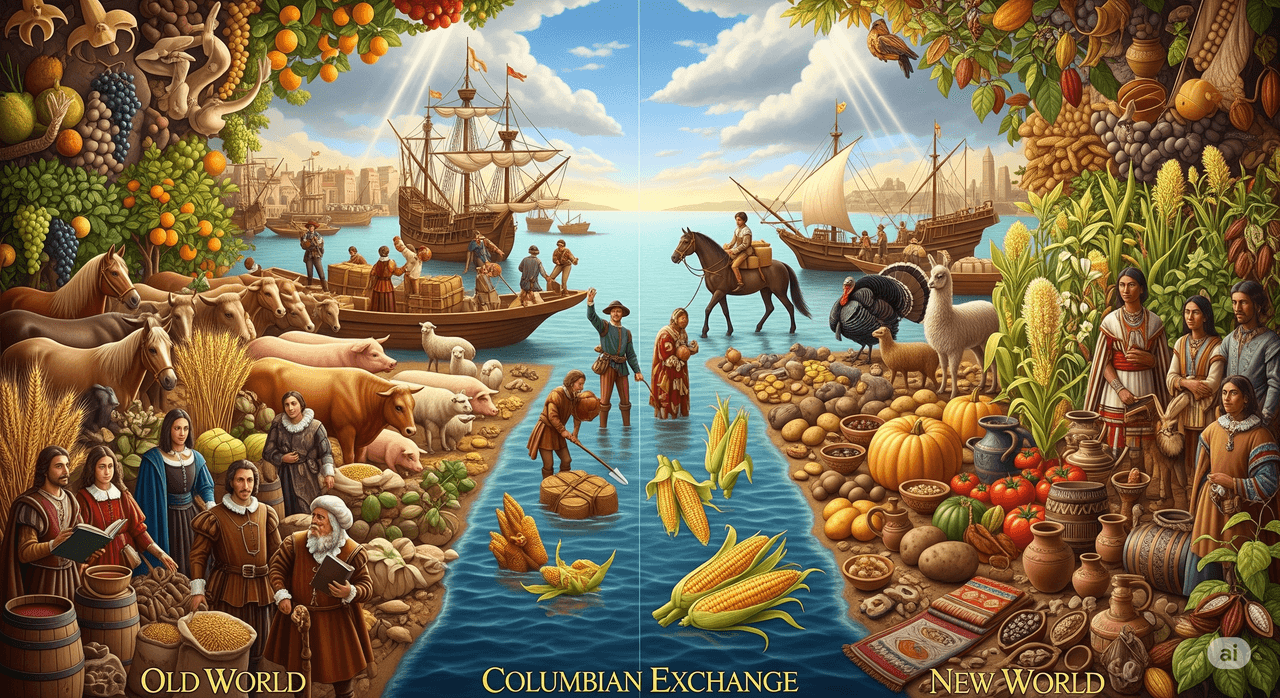
Biological exchange between the New and Old Worlds. (Generated by artificial intelligence.)
The most prominent outcomes of the exchange occurred in the realm of biological transfers, primarily through diseases, food crops, and animals.
European contact introduced pathogens to previously isolated populations. Europeans brought deadly viruses and bacteria such as smallpox, measles, typhus, and cholera, to which Indigenous Americans had no immunity. Since the native populations had had no prior exposure to Old World diseases, they were immunologically defenseless. This resulted in devastation surpassing that caused by the Black Death in 14th-century Europe.
The demographic impact of these diseases was severe. Although the exact magnitude of population decline remains uncertain, it is estimated that between 80 and 95 percent of the Indigenous American population perished in the first 100 to 150 years after 1492. For example, the estimated Taino population of Hispaniola, ranging from 60,000 to 8 million, was nearly eradicated within 50 years of contact. The population of central Mexico fell from approximately 15 million in 1519 to about 1.5 million a century later. It is estimated that even the least affected regions lost at least 80 percent of their population, while the most severely affected regions lost their entire population, with a typical community losing about 90 percent of its inhabitants【1】.
Examples of diseases transmitted from the New World to the Old World are few. The most notable exception is syphilis. According to the theory known as the “Columbian Hypothesis,” the causative agent, Treponema pallidum, originated in the New World and was transmitted to Europeans via sexual contact with Indigenous people on Hispaniola by Christopher Columbus and his crew in 1493. The disease reached Hungary and Russia by 1497, Africa, the Middle East, and India by 1498, and China by 1505. During the late 15th and early 16th centuries, syphilis was frequently fatal and its symptoms were more severe. Phylogenetic evidence supports the Columbian Hypothesis that syphilis is a New World disease【2】.
The exchange expanded the global supply of agricultural products. The Old World gained new staple foods such as the potato, sweet potato, maize, and cassava. These New World foods offered improvements in caloric and nutritional value over existing staples. Less calorie-dense foods such as tomato, chili pepper, cocoa, peanut, and pineapple were also introduced.
The discovery of the Americas provided the Old World with vast, relatively sparsely populated lands suitable for cultivating specific crops in high demand in Old World markets. The exchange also increased the availability of Old World products such as sugar and coffee, which thrived in New World soils and climates. These crops could be cultivated more productively in the New World than in their original habitats in the Old World.
One of the most striking examples is sugarcane. Sugarcane was brought to the New World during Columbus’s second voyage in 1493 and began to be cultivated in Spanish Santo Domingo (present-day Dominican Republic). The Portuguese also transported sugarcane across the Atlantic, and by 1526, sugar exports from Brazil to Lisbon had begun. By 1680, the New World dominated global sugarcane production. This large-scale production created an abundant supply, making sugar accessible to ordinary people in Europe.
Two aspects of the Columbian Exchange laid the groundwork for mass migrations:
1) The decimation of the Indigenous population of the New World by Old World diseases.
2) The profitable cultivation of Old World crops such as sugar and coffee in the New World.
This situation created a massive demand for labor in the Americas.
This labor demand was met by the capture and forced migration of more than 12 million Africans between the 16th and 19th centuries. This was the largest forced migration in history. West African slaves also played a role in transporting crops such as African rice to the Americas.
In response to the abolition of slavery, employers turned to indentured labor contracts. Over half a million indentured laborers were transported from the Indian subcontinent to the British Caribbean during the 19th and early 20th centuries. China also served as a major source of indentured labor. The 19th and 20th centuries also witnessed a surge in voluntary migration from the Old World. Between 1851 and 1924, 45 million people migrated from the Old World to the Americas.
The transfer of non-food plants also had global effects:
The Columbian Exchange differs fundamentally from earlier prehistoric globalization processes such as the “Trans-Eurasian Exchange.” The Columbian Exchange began abruptly and was largely completed within a relatively short period of about a century, whereas long-distance connections in the Old World emerged gradually, unevenly, and in waves. Owing to thousands of years of internal interaction and exchange, Old World populations possessed technologies, species, and especially diseases that enabled them to transform the New World in unprecedented ways within a few centuries.
Boivin, Nicole, Dorian Q. Fuller, and Alison Crowther. “Old World Globalization and the Columbian Exchange: Comparison and Contrast.” *World Archaeology* 44, no. 3 (2012): 452–469. Accessed October 21, 2025. https://doi.org/10.1080/00438243.2012.729404.
Nunn, Nathan, and Nancy Qian. “The Columbian Exchange: A History of Disease, Food, and Ideas.” *Journal of Economic Perspectives* 24, no. 2 (2010): 163–188. Accessed October 21, 2025. https://pubs.aeaweb.org/doi/pdfplus/10.1257/jep.24.2.163.
[1]
Nathan Nunn ve Nancy Qian, “The Columbian Exchange: A History of Disease, Food, and Ideas,” Journal of Economic Perspectives 24, no. 2 (2010): 165
[2]
Nathan Nunn ve Nancy Qian, “The Columbian Exchange: A History of Disease, Food, and Ideas,” Journal of Economic Perspectives 24, no. 2 (2010): 166

Biological and Ecological Changes
Transmission of Diseases
From the Old World to the New World
From the New World to the Old World
Food Products and Agriculture
Transfer of New World Crops to the Old World
Cultivation of Old World Crops in the New World
Indirect Consequences and Global Effects
Labor Demand and Migration
The Transatlantic Slave Trade
Contract Labor and Voluntary Migration
Other Plant Transfers and Consequences
Comparison