

This article was automatically translated from the original Turkish version.
Location | Diyarbakır / Türkiye | ||||||||
|---|---|---|---|---|---|---|---|---|---|
Region(s) | Southeastern Anatolia Region | ||||||||
Construction Date(s) | 4th century AD | ||||||||
First Protection Decision | 11 March 1972 | ||||||||
UNESCO Registration | 2015 | ||||||||
Total Length | 5800 metres | ||||||||
Number of Towers | Inner Castle: 19 towers Outer Castle: 82 towers | ||||||||
Castle Material | Lime mortar Brick Basalt stone | ||||||||
Gates | Yeni Kapı (Dicle or Su Gate) Mardin Kapı (Tell Gate) Urfa Kapı (Rum or Aleppo Gate) Dağ Kapı (Harput Gate) | ||||||||
Civilizations that Established Sovereignty | Ottomans Akkoyunlus Artuqids Great Seljuks Marwanids Abbasids Umayyads Byzantines Romans Hellenistic Kingdoms Persians Medes Urartians Assyrians | ||||||||
Diyarbakır Castle and Hevsel Gardens is a two-component cultural landscape located within the boundaries of Diyarbakır Province in Türkiye. At the 39th UNESCO World Heritage Committee Meeting held in Bonn Germany in 2015, the Diyarbakır Castle and Hevsel Gardens Cultural Landscape was inscribed on the UNESCO World Heritage List as Türkiye’s 14th heritage site. Listed under number 1488, the site has been recognized under cultural criteria (i), (iii) and (v).
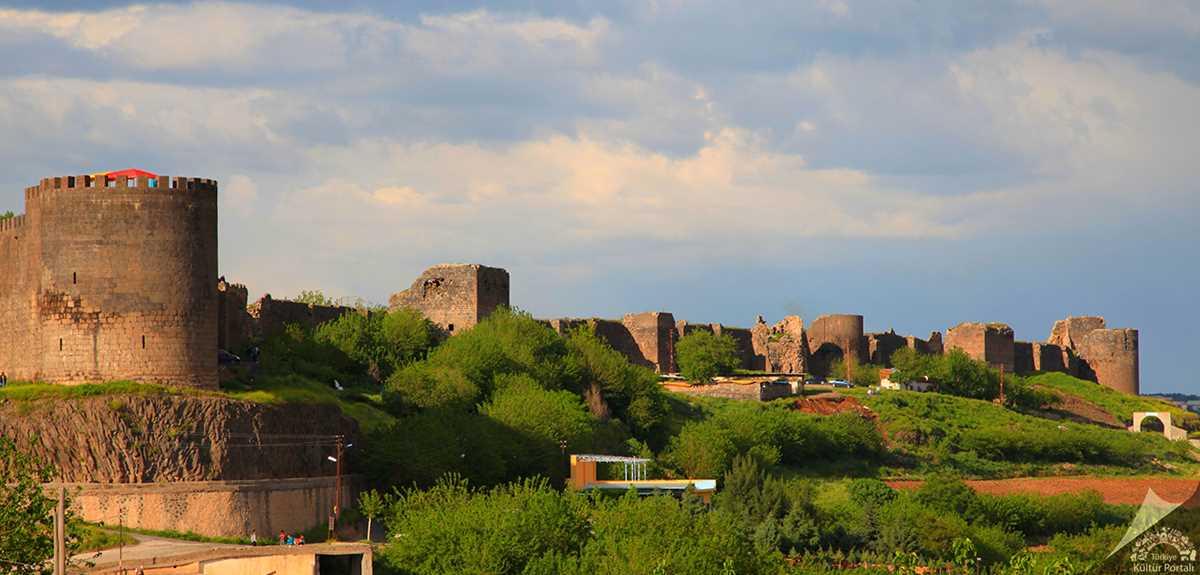
Diyarbakır Castle is built on the eastern slopes of the plateau extending from Karacadağ to the Tigris River, commanding a dominant position over the river. The castle consists of two main sections: the Inner Castle and the Outer Castle. The Outer Castle is surrounded by walls approximately 5,200 metres in length; together with the Inner Castle walls, the total length reaches 5,800 metres.
The walls are fortified with towers ranging in height from 7 to 22 metres and in thickness from 1.4 to 5 metres. There are 82 towers on the Outer Castle and 19 on the Inner Castle. The construction of the walls employed basalt stone, brick and lime mortar.
Throughout history, the castle has come under the control of numerous civilizations. It was repaired and strengthened during the reign of the Roman Emperor Constantius II in 349 CE. Inscriptions and reliefs on the walls bear traces of approximately thirty different cultures. Major towers within the castle include Keçi Tower, Yedi Kardeş Tower, Ben-u-Sen Tower and Nur Tower.
The castle gates are positioned according to ancient road routes. The main outer gates are Dağ Gate (Harput Gate), Urfa Gate (Bab-el Rum), Mardin Gate (Tell Gate) and Yeni Gate (Tigris Gate). These gates incorporate architectural features from the Byzantine, Roman and Islamic periods. Inscriptions, crosses, bird motifs, column capitals and medallion reliefs on the walls reflect the site’s layered history.

Diyarbakır Walls (Türkiye Culture Portal)
Archaeological excavations at the Amida Mound within Inner Castle, the city’s oldest settlement area, have revealed that human occupation dates back to the 5th millennium BCE. Finds from the Late Chalcolithic, Bronze and Iron Ages have been identified. Inner Castle contains numerous structures from the Roman, Byzantine, Artuqid, Akkoyunlu and Ottoman periods, including the Artuqid Palace, Military Barracks, Saint George Church, Kale Mosque, Meşhed, 7th Corps Building and the Headquarters Building used by Atatürk. Today, Inner Castle is being reactivated as an archaeopark, museum complex and cultural space.
The Hevsel Gardens are an agricultural production area located between the Diyarbakır Walls and the Tigris River, with a history stretching back approximately 8,000 years. These gardens, which supply the city’s food needs, reflect Mesopotamia’s traditional four-channelled garden design. The geographical boundaries of the gardens have been defined according to the integrity of their irrigation and road systems and are recognized as a cultural landscape. The Hevsel Gardens constitute a vital agricultural area integrated with the city, serving both local food production and cultural continuity. Their proximity to the Tigris River and rich biodiversity also confer ecological value. Additionally, the Hevsel Gardens are notable for their traditional horticultural practices, production based on local seed varieties and their role as a stopover for migratory birds.

Hevsel Gardens (Ministry of Culture and Tourism)
Diyarbakır and its surroundings have hosted various civilizations throughout history, including the Assyrians, Urartians, Romans, Parthians, Sassanids and Byzantines. The Islamic conquest occurred during the Rashidun Caliphate, followed by rule from the Umayyads, Abbasids, Marwanids, Great Seljuks, Anatolian Seljuks, Artuqids, Akkoyunlus and Ottomans. This historical continuity is reflected in the architecture, inscriptions and urban fabric of the area.
Following its inscription on the UNESCO World Heritage List, a “Site Management Plan” was developed by the Diyarbakır Metropolitan Municipality and the Site Management Directorate. The total area of 1,942.66 hectares is divided into three zones: the World Heritage Site (520.76 ha), the Surici Buffer Zone (132.20 ha) and the Surdışı Buffer Zone (1,289.69 ha). The management plan aims to protect and restore the walls and gardens, sustain cultural heritage, plan functional revitalization and ensure sustainable use.
Diyarbakır Castle and Hevsel Gardens stand out for encompassing the historical, cultural, architectural and agricultural heritage of Upper Mesopotamia. Their layered structure — walls bearing traces of multiple civilizations and gardens enabling continuous settlement and production — form a significant cultural landscape. The holistic conservation and transmission of the site to future generations is ensured through multidisciplinary protection and planning efforts.
Anadolu Ajansı. “3 Bin Yıllık Zerzevan Kalesi UNESCO Dünya Mirası Geçici Listesi’ne Girdi.” Accessed June 22, 2025. https://www.aa.com.tr/tr/kultur-sanat/3-bin-yillik-zerzevan-kalesi-unesco-dunya-mirasi-gecici-listesine-girdi/1808190.
Boran, Ali, and Razan Aykaç. “Yeni Araştırmalar Bağlamında Diyarbakır Kalesi.” *Selçuk Üniversitesi Sosyal Bilimler Enstitüsü Dergisi*, 42 (2019): 273–282. https://dergipark.org.tr/tr/pub/susbed/issue/61823/925026.
Diyarbakır Kalesi Municipality. "Diyarbakır Castle andHevsel Bahçeleri Cultural Landscape Area Management Plan." Accessed June 22, 2025. https://kvmgm.ktb.gov.tr/Eklenti/57317,diyarbakir-yonetim-planipdf.pdf?0.
Diyarbakır Türk Kızılay Şubesi. “Diyarbakır Kalesi.” Accessed June 22, 2025. https://diyarbakir.kizilay.org.tr/gezi-rehberi/diyarbakir-kalesi.
General Directorate of Cultural Assets and Museums. "Diyarbakır Kalesi ve Hevsel Bahçeleri Kültürel Peyzajı (Diyarbakır)." Accessed June 22, 2025. https://kvmgm.ktb.gov.tr/TR-44403/diyarbakir-kalesi-ve-hevsel-bahceleri-kulturel-peyzaji-diyarbakir.html.
Kültür Portalı. "Diyarbakır Kalesi ve Hevsel Bahçeleri." Accessed June 22, 2025. https://www.kulturportali.gov.tr/portal/diyarbakirkalesivehevselbahceleri.
UNESCO Türkiye Millî Komisyonu. “Diyarbakır Kalesi ve Hevsel Bahçeleri Kültürel Peyzajı UNESCO Dünya Miras Listesi’ne Girdi.” *UNESCO Türkiye*, 2015. Accessed June 22, 2025. https://www.unesco.org.tr/Home/AnnouncementDetail/303.

Location | Diyarbakır / Türkiye | ||||||||
|---|---|---|---|---|---|---|---|---|---|
Region(s) | Southeastern Anatolia Region | ||||||||
Construction Date(s) | 4th century AD | ||||||||
First Protection Decision | 11 March 1972 | ||||||||
UNESCO Registration | 2015 | ||||||||
Total Length | 5800 metres | ||||||||
Number of Towers | Inner Castle: 19 towers Outer Castle: 82 towers | ||||||||
Castle Material | Lime mortar Brick Basalt stone | ||||||||
Gates | Yeni Kapı (Dicle or Su Gate) Mardin Kapı (Tell Gate) Urfa Kapı (Rum or Aleppo Gate) Dağ Kapı (Harput Gate) | ||||||||
Civilizations that Established Sovereignty | Ottomans Akkoyunlus Artuqids Great Seljuks Marwanids Abbasids Umayyads Byzantines Romans Hellenistic Kingdoms Persians Medes Urartians Assyrians | ||||||||
No Discussion Added Yet
Start discussion for "Diyarbakır Fortress and Havsel Gardens" article
Diyarbakır Castle and Walls
Inner Castle and Amida Mound
Hevsel Gardens
Cultural and Historical Layers
Management and Protection