This article was automatically translated from the original Turkish version.
+1 More
First Television Broadcast
Where | İTÜ Maçka Kampüsü | ||||||||
|---|---|---|---|---|---|---|---|---|---|
When | 9 July 1952 | ||||||||
By Whom | Prof. Dr. Mustafa Santur | ||||||||
Publication Content | Theatrical Sketches, Music Performances | ||||||||
Although TRT is the first organization that comes to mind when thinking of television broadcasting in Türkiye, the pioneering role in this field belongs to Istanbul Technical University (İTÜ). The first television broadcast in Türkiye was carried out in 1952 through İTÜ TV. This initiative held significant importance both technically and culturally.

A news report about the broadcast (İstdergi)
The foundations of İTÜ TV were laid on 16 July 1951 with a letter written by Professor Dr. Mustafa Santur to the university administration. In this letter, attention was drawn to the global development of television, and it was proposed that a small-scale experimental television facility be established at İTÜ’s High Frequency Laboratory in the Faculty of Electrical Engineering.
The İTÜ administration accepted this proposal. However, since the necessary equipment was not available in Türkiye, a collaboration was established with the Dutch electronics company Philips. Philips provided İTÜ with television equipment under favorable conditions. Additionally, Adnan Ataman was sent to the Netherlands for a three-month television training program.
The first broadcasts began in a small studio on the roof of İTÜ’s Taşkışla building. The studio was equipped with Philips’ super iconoscope camera, a film projector, an audio monitor, and other essential broadcasting equipment. Broadcasts occurred once a week, initially between 18:00 and 20:00. The first program featured a film about the Korean War. The first live guests were journalist Burhan Felek.
İTÜ TV was not merely a broadcasting center but also an educational laboratory. Many of the devices were produced within the university by İTÜ engineers. For instance, the first editing device was built by Avni Morgül and the first lapel microphone by Duran Leblebici.
Over time, broadcast hours increased and content diversified. By the 1960s, the number of television receivers in Istanbul began to rise. Television could be watched in neighborhoods such as Suadiye, Büyükada, Beyoğlu, and Bakırköy. İTÜ TV was recognized not only as a technical innovation but also as a cultural milestone.
İTÜ TV concluded its final broadcast on 25 April 1971 with the transmission of the Germany-Türkiye football match. When TRT began its Istanbul broadcasts in 1972, it utilized İTÜ TV’s Maçka studio and technical infrastructure.

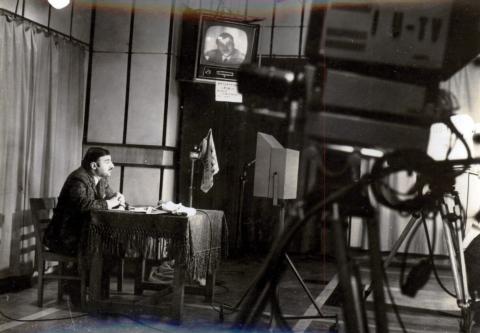
A scene from one of the broadcasts (Istdergi)
İTÜ TV was not only Türkiye’s first television broadcast; it is also regarded as the country’s first television engineering school. The broadcasts provided practical engineering education for students of İTÜ’s Faculty of Electrical Engineering. Students gained hands-on experience in every stage, from signal production and studio lighting to microphone design and sound insulation. Figures such as Avni Morgül, Duran Leblebici, Aldo d’Orfani, and İlhan Türegün played key roles in both the development of technical equipment and the advancement of broadcasting. This technical expertise contributed significantly to the later establishment of Türkiye’s broadcasting infrastructure.
Thanks to İTÜ TV’s weekly broadcasts, the public encountered regular television programming for the first time. Although initially reaching only a limited audience, these broadcasts stimulated the production, import, and use of television receivers, accelerating the development of visual culture in Türkiye.
The broadcasts featured hosting, music, theater, and short films. As a result, many individuals who later worked at TRT gained their first on-screen experience at İTÜ TV. For example:
all acquired their initial screen experience through İTÜ TV.
When İTÜ TV ceased its broadcasts in 1971, TRT had not yet begun operations in Istanbul. The building later used by TRT as its Istanbul studio was İTÜ’s Maçka campus studio. Thus:
This transition signified the transfer of institutional television broadcasting foundations from İTÜ TV to TRT.
The archival nature of İTÜ TV’s work and its contribution to the birth of broadcasting in Türkiye continue to attract the interest of researchers and historians. At the same time:
The Istanbul Metropolitan Municipality, TRT, and academic institutions continue to document and promote İTÜ TV’s pioneering role through archival materials and digital platforms.
Bahadır, Osman. “Türkiye’de Televizyon Yayınının Başlaması: İTÜ TV.” *Sarkaç.* Accessed July 8, 2025. https://sarkac.org/2020/10/turkiyede-televizyon-yayininin-baslamasi-itutv/.
TRT Haber. “Türkiye’de Televizyon Yayıncılığı 67 Yıl Önce İTÜ TV ile Başladı.” TRT Haber. Accessed July 8, 2025. https://www.trthaber.com/haber/kultur-sanat/turkiyede-televizyon-yayinciligi-67-yil-once-itu-tv-ile-basladi-422379.html.
İST Dergi. “Türkiye’nin İlk Televizyonu: İTÜ TV.” *İST Dergi.* Accessed July 8, 2025. https://www.istdergi.com/tarih-belge/turkiyenin-ilk-televizyonu-itu-tv.

First Television Broadcast
Where | İTÜ Maçka Kampüsü | ||||||||
|---|---|---|---|---|---|---|---|---|---|
When | 9 July 1952 | ||||||||
By Whom | Prof. Dr. Mustafa Santur | ||||||||
Publication Content | Theatrical Sketches, Music Performances | ||||||||
No Discussion Added Yet
Start discussion for "First Television Broadcast in Türkiye" article
Stages in the Establishment of the First Television Broadcast at İTÜ
Initial Steps: Professor Dr. Mustafa Santur’s Proposal
Technical Preparations and Collaboration with Philips
Commencement of Broadcasts (Spring 1952)
Technical Team and Student Participation
Development and Impact of the Broadcasts
Cessation of Broadcasts
Impact of İTÜ’s Television Broadcasts on Subsequent Developments
A Groundbreaking Laboratory for Technical Education
Laid the Foundation for Visual Culture and Broadcasting in Türkiye
Paved the Way for TRT’s Technical Infrastructure
A Lasting Legacy in Cultural and Academic Memory