


This article was automatically translated from the original Turkish version.
+1 More
German Idealism is a philosophical movement that emerged in late 18th and early 19th century Germany and redirected modern philosophy around the claim that human knowledge and sometimes even reality itself are shaped by the mind’s cognitive structures or activities (“ideals”). Its most prominent figures are Immanuel Kant (whose critical philosophy raised many of the movement’s central questions), Johann Gottlieb Fichte, Friedrich Wilhelm Joseph Schelling, and Georg Wilhelm Friedrich Hegel. German Idealism spans from epistemological positions — that knowledge is structured by thought — to metaphysical claims — that reality is in some sense spiritual or rational.
German Idealism arose in the aftermath of the Enlightenment and the philosophical crisis triggered by Immanuel Kant’s Critique of Pure Reason (1781/1787). Kant argued that while we must respect the limits of empirical knowledge, the human mind imposes fundamental forms — such as space and time — and categories — such as causality — that make experience possible. Kant’s “transcendental” method — questioning how cognition itself makes experience possible — generated extensive debate. Fichte, Schelling, and Hegel developed or radicalized Kant’s project in different directions: Fichte emphasized the self-positing subject and its practical, moral foundation; Schelling focused on the identity between nature and mind and the world; Hegel produced a comprehensive systematic idealism that conceived reality as the historical unfolding of Spirit (Geist). The movement developed roughly from the 1780s to the 1830s.
Immanuel Kant’s Critique of Pure Reason (1781, revised 1787) is the intellectual starting point of German Idealism. Kant sought to reconcile rationalist and empiricist traditions by showing that while all knowledge begins with experience, it does not arise solely from experience. Instead, the mind actively structures sensory data through a priori forms — such as space and time — and categories — such as causality and substance. Kant’s fundamental distinction between phenomena (the world as experienced) and noumena (things-in-themselves) established both the limits and conditions of human knowledge. He claimed that reason shapes the world of possible experience but cannot grasp anything beyond it. This position, known as transcendental idealism, laid the foundation for subsequent philosophical inquiries into the relationship between mind and reality. Kant’s moral and aesthetic philosophy, especially in the Critique of Practical Reason (1788) and the Critique of Judgment (1790), profoundly influenced later thinkers. His idea of the primacy of practical reason over speculative metaphysics, grounded in human autonomy, enabled successors like Fichte and Hegel to extend reason’s scope into ethics, nature, and history.
Fichte radicalized Kant by eliminating the notion of the unknowable thing-in-itself. In his Wissenschaftslehre (Science of Knowledge, 1794), he asserted that the ego (Ich) is the source of all reality and posits both itself and the “not-I” through pure intellectual intuition. According to this view, reality is the activity of the ego positing itself and opposing itself. Fichte’s system transformed Kant’s critical philosophy into a philosophy of freedom and self-activity. Knowledge, morality, and society arise from the ego’s striving for self-determination and ethical order. In his Addresses to the German Nation (1808), he applied these ideas politically, emphasizing moral education and the unity of rational individuals under freedom. Although accused of subjective idealism, Fichte’s thought provided a framework for later idealists to explore the dynamic and practical dimensions of reason. His philosophy linked epistemology with ethics, grounding knowledge itself in moral striving.
Schelling developed a philosophy of nature (Naturphilosophie) aimed at overcoming the distinction between mind and world. Rejecting Fichte’s purely subjective approach, Schelling argued that both nature and consciousness express the same underlying absolute principle. For Schelling, nature is visible spirit; spirit is invisible nature. In works such as Ideas for a Philosophy of Nature (1797) and System of Transcendental Idealism (1800), he contended that natural processes exhibit a blind productive force analogous to the mind’s creative power. Schelling later turned toward a more existential and theological orientation, developing concepts of freedom, evil, and the Absolute in his Philosophical Investigations into the Essence of Human Freedom (1809). Schelling’s influence extended beyond philosophy into Romanticism, art theory, and early existentialism. His thought integrated Kantian idealism with later speculative metaphysics and concepts of creativity and dynamism in nature.
Hegel constructed the most comprehensive and systematic version of German Idealism. Hegelian thought interprets reality as a rational, self-developing process — the unfolding of Geist (Spirit or Mind). In Hegel’s system, contradictions are not failures of logic but essential stages in the dialectical progression of thought, nature, and history. In his Phenomenology of Spirit (1807), he traces consciousness’s journey from sense-certainty to absolute knowledge, showing how each stage overcomes its internal contradictions to reach a higher level of understanding. In Science of Logic (1812–1816) and Encyclopedia of the Philosophical Sciences (1817), Hegel developed a dialectical logic that interprets being and thought as coextensive: reality is the self-expression of reason. Hegel’s philosophy unifies epistemology, ethics, politics, religion, and art into a dynamic whole. He viewed human history as the process through which Spirit achieves self-consciousness and reaches its culmination in freedom realized through social and political institutions. His legacy shaped not only subsequent idealism but also Marxism, existentialism, phenomenology, and critical theory.
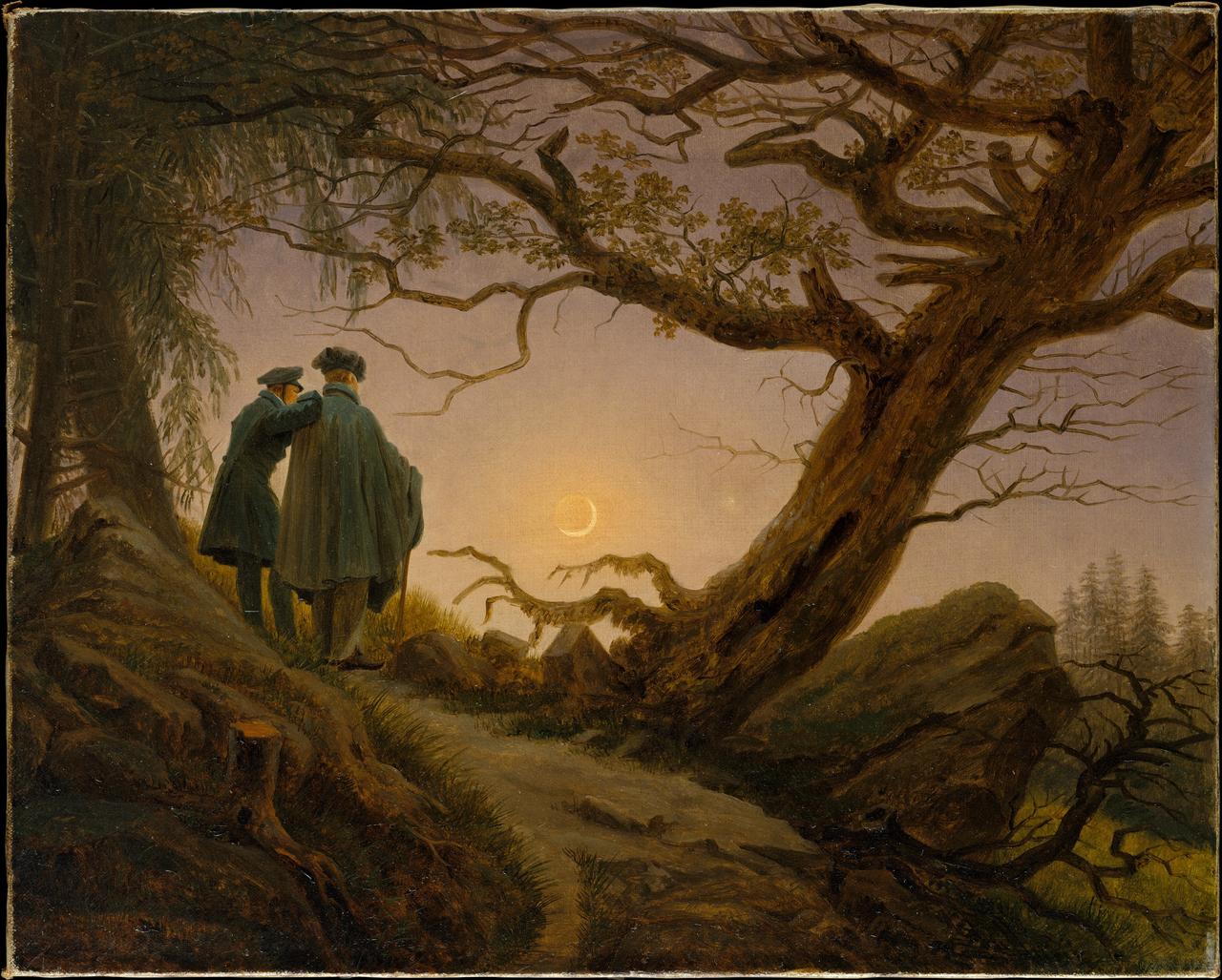
Caspar David Friedrich’s painting Two Men Contemplating the Moon (Rawpixel) reflects German Idealism and Romanticism.
Developed initially by Immanuel Kant and expanded by his successors, the transcendental method is the methodological cornerstone of German Idealism. Transcendental inquiry does not examine objects as they exist independently but questions what conditions must be presupposed for experience, knowledge, or value to be possible. Kant’s “Copernican Revolution” in philosophy shifted focus from external reality to the mind’s constitutive role: it is not the world itself but cognitive structures that determine how phenomena appear. For later idealists, this insight opened a new field of inquiry. Fichte transformed Kant’s transcendental critique into a dynamic account of the ego’s activity, arguing that the conditions of knowledge are rooted in the self-positing “I.” Schelling sought to show that these conditions extend beyond subjectivity and encompass nature as a self-organizing process governed by rational necessity. Hegel generalized the transcendental turn into a historical and social framework: Spirit realizes its own conditions of intelligibility through institutions, culture, and philosophy. Thus, in German Idealism, transcendental reflection becomes the study of reason’s self-generation.
German Idealism holds that reality is intelligible because it is fundamentally rational or spiritual. The human subject is not a neutral observer but a participant in the emergence of reason. For Fichte, the ego’s self-positing activity grounds both subject and object: consciousness and the world are two sides of a single process of self-determination. Schelling extended this view into an ontological monism in which nature and mind are expressions of a common absolute. This structure finds meaning as a living unity manifesting through polarity, evolution, and consciousness. Hegel articulated this thesis most fully: in his system, the Absolute (Geist or Spirit) is both subject and object. Reality is understood as the totality of self-realizing thought. Spirit attains self-consciousness through human history, art, religion, and philosophy. This doctrine dissolves the rigid dualism between mind and world: the knowing subject and the known object are parts of a single, evolving whole. Ultimately, German Idealism presents a vision of reality in which the rational and the real are ultimately identical — a reality realized as self-conscious reason.
The dialectical method represents the dynamic logic underlying the idealist vision. Although Hegel’s dialectic is often summarized as “thesis-antithesis-synthesis,” it is more complex. Each concept or form of consciousness contains internal tensions that propel it beyond itself. Contradiction is not an error but the motor of development, revealing reason’s capacity to transcend its own limits. This dialectical process applies to both thought and history. For Hegel, history is the record of Spirit’s self-realization — more precisely, the gradual emergence of freedom and rational self-consciousness through social institutions and cultural achievements. Earlier thinkers like Fichte described the ego’s striving as an infinite dialectic between freedom and limitation; Schelling viewed natural phenomena as dialectical expressions of an underlying unity. In all cases, dialectic reconciles opposites within a larger whole, transforming philosophy from a static reflection on truth into a science of living becoming.
All major idealists agreed that reason is a self-organizing power capable of grasping the unity of reality. Their systems attempt to integrate metaphysics, epistemology, ethics, aesthetics, religion, and political theory into a single coherent framework. Kant’s critical architecture already outlined this synthesis: theoretical reason (knowledge), practical reason (morality), and judgment (aesthetic and teleological reflection) form a unified whole. Fichte’s Science of Knowledge, Schelling’s System of Transcendental Idealism, and Hegel’s Encyclopedia of the Philosophical Sciences pursued this ambition on increasingly grand scales. The resulting view — that philosophy is a system of reason realizing itself — became a defining ideal of 19th-century thought, influencing not only metaphysical speculation but also scientific and historical inquiry.
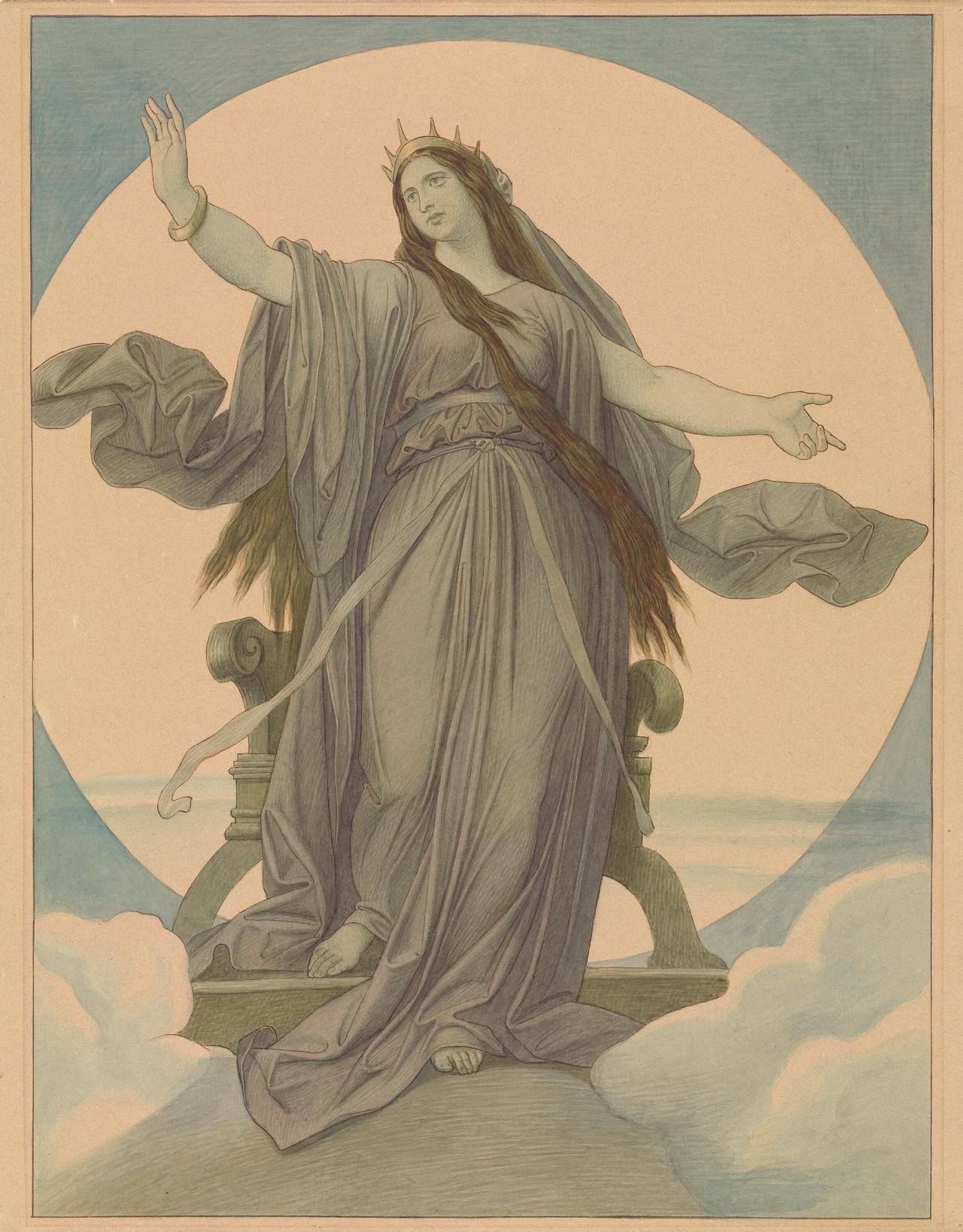
One of the Romantic works reflecting German Idealism, Queen of the Night represents the development and spirit of the German people (Getty).
German Idealism is a pivotal turning point in Western intellectual history. This movement, synthesizing epistemology, metaphysics, ethics, and aesthetics, provided the conceptual framework for much of 19th- and 20th-century philosophy. Karl Marx reinterpreted Hegel’s dialectic in materialist terms to develop historical materialism. Søren Kierkegaard and Friedrich Nietzsche laid the groundwork for existentialism and individualist philosophy by opposing Hegelian rationalism. In the 20th century, Husserl’s phenomenology and Heidegger’s existential ontology reengaged transcendental themes within new vocabularies of experience and being.
German Idealism also shaped political and cultural thought. Fichte’s writings contributed to concepts of civic education and national identity; Hegel’s Philosophy of Right influenced both liberal and communitarian traditions. Schelling’s philosophy of nature inspired Romantic science, ecology, and later process thought. Beyond philosophy, idealist conceptions of reason’s historical development shaped modern hermeneutics, theology, and aesthetics. In academic philosophy, contemporary scholars no longer treat German Idealism merely as a historical phenomenon but as a source of pressing conceptual problems concerning the relationship between normativity and nature, the social structure of reason, and the nature of freedom in historical contexts. Modern interpretations emphasize the ongoing relevance of this movement for debates in cognitive science, environmental philosophy, and critical theory.
Despite its broad influence, German Idealism has faced persistent criticism. Nineteenth-century empiricists and positivists rejected idealist metaphysical systems as detached from empirical reality, accusing them of constructing abstract structures based on speculation rather than observation. Later analytic philosophers criticized the obscurity of Hegelian logic and its ambiguous use of contradiction.
Political and ideological critiques have also been directed at the movement. Fichte’s nationalist rhetoric in Addresses to the German Nation and authoritarian interpretations of Hegel’s philosophy of the state were later employed — often selectively — in German political discourse. Marx and Engels accused Hegelianism of divorcing thought from its proper context, reducing social reality to a mere expression of ideas rather than material production.
However, defenders argue that such criticisms often stem from a misunderstanding of the dialectical and historical nature of idealist reasoning. For contemporary interpreters, the core insight of German Idealism — that knowledge and freedom cannot be separated from the structures that make them possible — remains vital. Modern science increasingly treats idealism not as a relic of metaphysical excess but as a sophisticated framework for understanding rationality, subjectivity, and history as interdependent phenomena.
Beiser, Frederick C. 2002. German Idealism: The Struggle Against Subjectivism, 1781–1801. Cambridge, MA: Harvard University Press.
Fichte, Johann Gottlieb. 1982. The Science of Knowledge (Wissenschaftslehre). Edited and translated by Peter Heath and John Lachs. Cambridge: Cambridge University Press.
Förster, Eckart. The twenty-five years of philosophy. Harvard University Press, 2012.
Hegel, G. W. F. 2018. The Phenomenology of Spirit. Translated by Terry Pinkard. Cambridge: Cambridge University Press.
Kant, Immanuel. 1998. Critique of Pure Reason. Translated and edited by Paul Guyer and Allen W. Wood. Cambridge: Cambridge University Press.
Pinkard, Terry. 2000. Hegel: A Biography. Cambridge: Cambridge University Press.
Rawpixel. n.d. “Two Men Contemplating the Moon by Caspar David Friedrich.” Rawpixel, free for personal and business use (public domain). https://www.rawpixel.com/image/9612696/two-men-contemplating-the-moon-caspar-david-friedrich
Schelling, F. W. J. 1978. System of Transcendental Idealism (1800). Translated by Peter Heath. Charlottesville: University Press of Virginia.
Sedgwick, Sally, ed. 2012. The Reception of Kant’s Critical Philosophy: Fichte, Schelling, and Hegel. Cambridge: Cambridge University Press.
Stanford Encyclopedia of Philosophy. 2015. “German Idealism.” *Stanford Encyclopedia of Philosophy.* Accessed October 20, 2025. https://plato.stanford.edu/entries/idealism-german/.
The J. Paul Getty Museum. n.d. “Queen of the Night.” Getty Museum Collection. https://www.getty.edu/art/collection/object/109E1M

Key Figures and Contributions
Immanuel Kant (1724–1804)
Johann Gottlieb Fichte (1762–1814)
Friedrich Wilhelm Joseph Schelling (1775–1854)
Georg Wilhelm Friedrich Hegel (1770–1831)
Core Doctrines and Themes
The Transcendental Method and Conditions of Possibility
The Primacy of Subject or Spirit
Dialectic and Historical Development
Systematic Ambition and the Unity of Reason
Impact and Significance
Critiques and Limitations