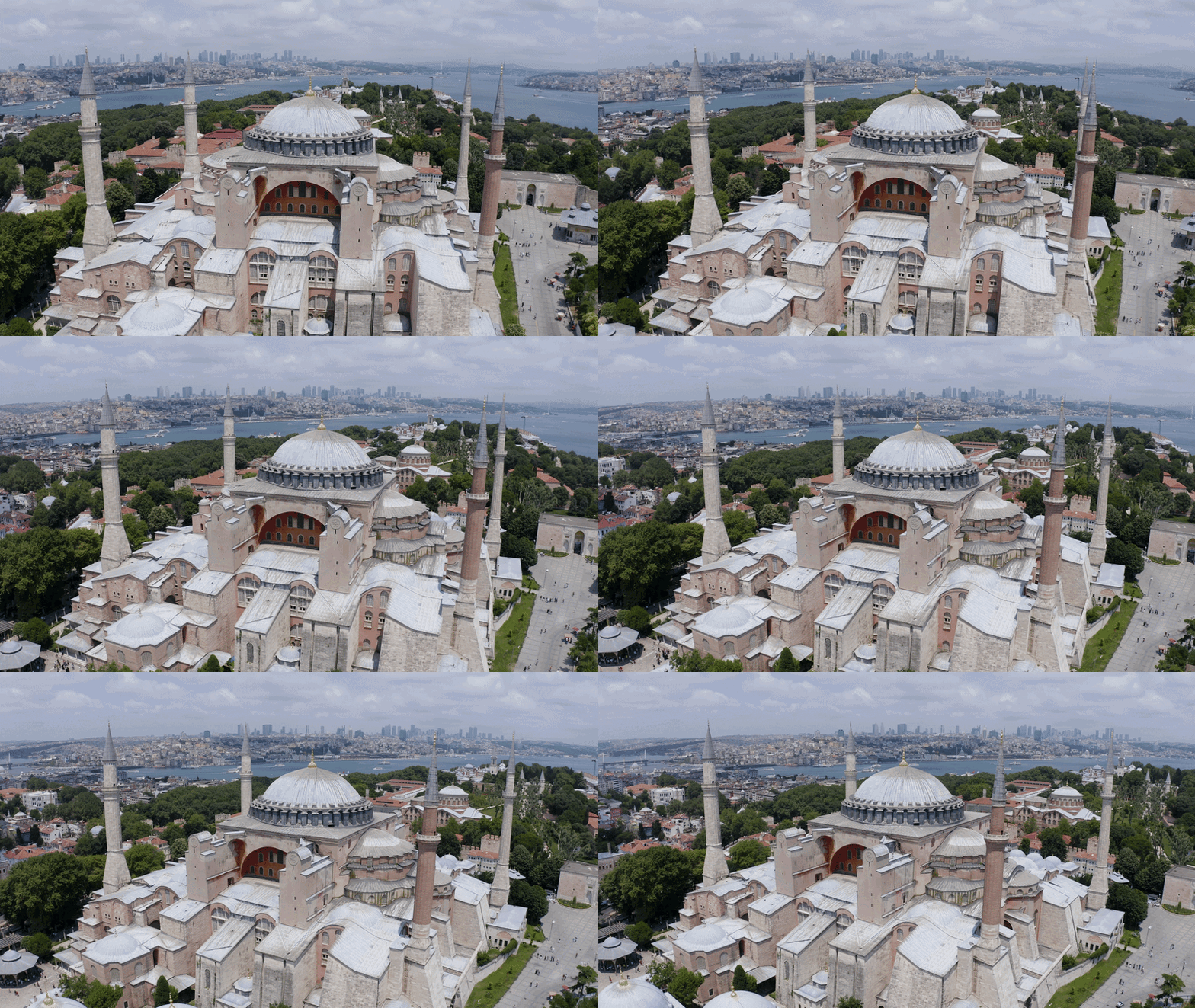
This article was automatically translated from the original Turkish version.
+2 More
Architect(s) | Anthemius of Tralles Isidore of Miletus | ||||||||
|---|---|---|---|---|---|---|---|---|---|
Official Name(s) | Hagia Sophia Grand Sacred Mosque | ||||||||
Ottoman Exterior Elements | sultan's pavilion timekeeping house imaret primary school sebil library madrasa tombs buttresses Minarets | ||||||||
Ottoman İnterior Elements | tile and penwork decorations dome inscription calligraphic panels sultan's loge muezzin galleries pulpit minbar Mihrab | ||||||||
Plan Schematic | apse arrangement at the east side naves and galleries on both sides central worship area Western exterior and interior narthex | ||||||||
Main Dome Diameter | Approximately 31–33 m | ||||||||
Main Worship Area | Approximately 79.30 × 69.50 m | ||||||||
Plan Type | Central-domed basilica | ||||||||
Historical Turning Points | restoration to mosque status in 2020 museum decision in 1934 conversion to mosque in 1453 Latin occupation of 1204 earthquake of 989 dome collapse in 558 opening in 537 Nika Revolt of 532 Fire of 404 | ||||||||
Meaning of the Name | Divine Wisdom Holy Wisdom | ||||||||
Historical Names | Hagia Sophia Museum Hagia Sophia Mosque Sancta Sophia Hagia Sophia Magna Ecclesia Megale Ekklesia | ||||||||
Ottoman Period Functions | religious education space structure associated with capital city ceremonies and Friday greetings charitable endowment symbol of conquest Grand mosque | ||||||||
Construction Phases | opened for worship on 27 December 537 III. Hagia Sophia: construction began in 532 burned down in the Nika Revolt of 532 II. Hagia Sophia: opened for worship in 415 wooden-roofed basilica I. Hagia Sophia: 4th century | ||||||||
Surrounding Structures | Sultanahmet Mosque Topkapı Palace Hagia Eirene Augustaion Square Hippodrome Great Palace | ||||||||
Roman Period Functions | religious-political symbol of Constantinople major feast and liturgical center coronation site imperial ceremonial space Patriarchal church | ||||||||
Website | https://www.ayasofyacamii.gov.tr/ | ||||||||
Material(s) | Ottoman-era wood and calligraphy elements mosaics spolia architectural elements porphyry columns colored stones marble cladding Brick-and-mortar construction | ||||||||
Banisi | Justinian I | ||||||||
Location | Istanbul Fatih district | ||||||||
Hagia Sophia (officially Hagia Sophia-i Kebir Cami-i Şerifi), is a multi-layered historical structure located in Istanbul’s Historic Peninsula that has served various religious, political, and cultural functions during the Roman, Ottoman, and Republican periods. The current building is the third Hagia Sophia constructed on the same site and was rebuilt by Emperor Justinian I after the previous church was destroyed in the Nika Revolt of 532. It was inaugurated for worship on 27 December 537.【1】 As the largest church in the capital of the Eastern Roman Empire, it became the seat of the patriarchate, the stage for imperial ceremonies, and one of the principal symbols of Constantinople. Contemporary writers described it not merely as a place of worship but as a visible manifestation of imperial power and religious order. Procopius’s description of its dome as “hanging from heaven by a golden chain” illustrates how Hagia Sophia was perceived in the 6th century not only for its architectural form but also for its symbolic impact.【2】
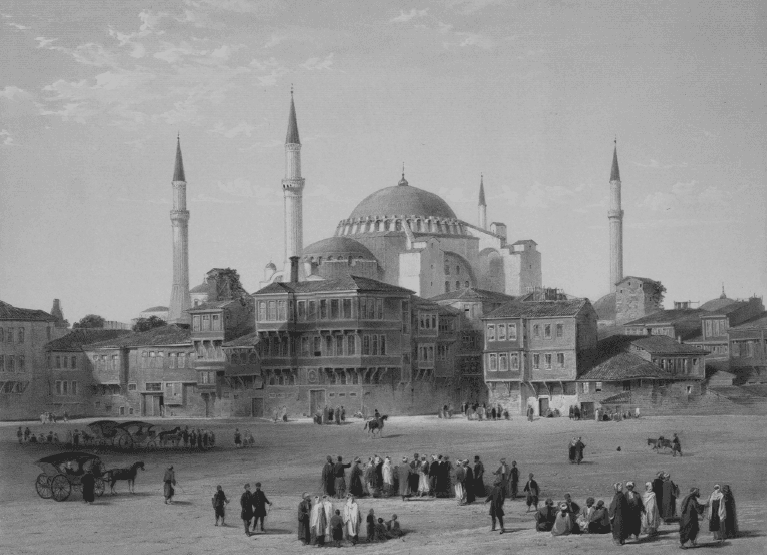
Exterior View of Hagia Sophia (Library of Congress)
The historical identity of Hagia Sophia is too broad to be reduced to a single period or function. After the conquest of Istanbul in 1453, the building was converted into a mosque and acquired the status of a non-transferable charitable endowment under the waqf of Fatih Sultan Mehmed, serving for approximately five centuries as one of the most important places of worship in the Ottoman capital. During this period, the structure was not limited to its function as a mosque; a complex of buildings including a madrasa, library, muvakkithane, sebil, primary school, imaret, public fountains, and tombs expanded around it, forming a külliye. Thus, during the Ottoman period, Hagia Sophia acquired the dual role of both a symbolic site of conquest and an institutional center operating within the waqf system.
During the Republican era, Hagia Sophia was converted into a museum by a decision of the Council of Ministers dated 24 November 1934, acquiring a new status within the frameworks of conservation, archaeology, art history, and cultural policy. The uncovering of mosaics, the joint exhibition of heritage elements from the Byzantine and Ottoman periods, and the cultural heritage policies of the Sultanahmet area became key factors shaping the building’s meaning during its time as a museum. Starting in the 2000s, debates regarding the irrevocable nature of Hagia Sophia’s waqf status and its intended use re-emerged through legal processes; following the decision of the Council of State’s 10th Chamber on 2 July 2020 and the Presidential Decree of 10 July 2020, the building was reopened for worship as a mosque once again. Today, under the name Hagia Sophia Grand Sacred Mosque, it continues to exist as both a central place of worship and a significant element of the world’s cultural heritage.
The naming of Hagia Sophia is directly linked to the religious, political, and cultural functions it has assumed throughout its history. The first church built on the site was known as “Megale Ekklesia,” one of the central places of worship in early Constantinople. This term, meaning “Great Church” in Greek, was rendered in Latin sources as “Magna Ecclesia.” 【3】 This name reflected not only the building’s physical scale but also its status as the principal religious structure and patriarchal center in Constantinople. The construction of the first building in the 4th century and the second in the early 5th century on the same site established the term “Great Church” as a designation not for a single structure but for the continuity of the sacred space itself.
The name “Hagia Sophia” is the primary designation that emerged from the 5th century onward and has defined the building’s subsequent history. The Greek expression “Hagia Sophia” means “Holy Wisdom” or “Divine Wisdom.”【4】 Contrary to a common misconception, this name does not refer to a saint named Sophia but alludes to the concept of divine wisdom in Christian theology. In its more explicit form, “Naos tēs Hagias tou Theou Sophias” means “Church of the Holy Wisdom of God.”【5】 In Latin usage, the form “Sancta Sophia” carries the same meaning.【6】 Therefore, the name Ayasofya does not refer directly to a person but expresses an abstract theological concept associated in Christian thought with the wisdom of God, the Logos, and the understanding of Christ.
The naming of Hagia Sophia becomes more apparent when considered alongside other sacred sites in Constantinople. Just as Hagia Eirene, meaning “Holy Peace,” is named after an abstract religious concept, so too is Hagia Sophia named through an abstract theological idea.【7】 This reflects that the great churches of the capital were not merely places of worship but also embodied the conceptual world of imperial ideology and Christian theology. Hagia Sophia’s transformation into the seat of the patriarchate and one of the primary venues for imperial ceremonies fused the meaning of its name—“Divine Wisdom”—with ritual, authority, and urban memory.
Early Roman Period Depiction of Hagia Sophia (Universitätsbibliothek Heidelberg)
In Turkish usage, the name “Hagia Sophia” gradually adopted the form “Ayasofya.” This transformation mirrors a broader pattern of phonetic adaptation seen in many place and building names transitioning from the Byzantine to the Ottoman period. During the Ottoman era, the structure was referred to by names such as “Ayasofya Camii,” “Ayasofya-i Kebîr Camii,” and “Ayasofya-i Kebîr Câmi-i Şerîfi.”【8】 The adjective “kebîr” here means “great” and aligns with the building’s identity as the former “Great Church” as well as its central status as a mosque in Ottoman Istanbul. The term “Câmi-i Şerîf” reflects its designation within Ottoman official and religious terminology as a revered place of worship, consistent with the honorific usage applied to other mosques.
During the Ottoman period, the name Ayasofya was not limited to the structure in Istanbul. The practice of referring to large churches converted into mosques in various cities after the conquest as “Ayasofya” demonstrates that this name held a special place in Ottoman memory of conquest.【9】 Some buildings were already known as Hagia Sophia, Sveti Sofia, or similar names during the Byzantine or local Christian periods, while others became known as Ayasofya only after their conversion into mosques. This usage reveals that the name Ayasofya evolved into a broader naming model associated not merely with a single structure in Istanbul but with the ideas of conquest, transformation, and central places of worship.
Nevertheless, the Ayasofya in Istanbul occupies the center of this naming tradition. During the Byzantine period, the structure, known as the “Great Church” and “Holy Wisdom,” stood at the heart of the patriarchal and imperial order. In the Ottoman period, it became one of the key elements of endowment, worship, and capital life under the name Ayasofya-i Kebîr Camii. During the Republican period, the name Ayasofya Müzesi became widespread with its status as a museum, and after 2020, the official designation Ayasofya-i Kebîr Câmi-i Şerîfi reemerged in formal usage. Thus, the various names of the building illustrate that Ayasofya is not merely an architectural or religious structure but a historical space continually redefined within changing frameworks of power, law, worship, preservation, and cultural heritage across different eras.
The present Hagia Sophia is not the first sacred structure built on this site; two earlier churches had been constructed on the same location during the 4th and 5th centuries.【10】 These early structures emerged during the period when Constantinople was being established as the new capital of the Roman Empire and played a decisive role in the formation of the city’s religious center. The area where Hagia Sophia stands was located near the core of ancient Byzantion and the imperial center of Constantinople. Hipodrom, together with the Great Palace Hagia Eirene and the patriarchal complex, formed a hub that was not only a center of worship but also the focal point of imperial ceremonies urban administration and public representation. For this reason the first Hagia Sophia structures and the later grand Hagia Sophia built under Justinian I remained among the foundational elements of Constantinople’s identity as a Christian capital until the end of the Middle Ages.
The first Hagia Sophia is generally referred to in contemporary sources as the “Megale Ekklesia” or “Great Church.”【11】 Although some traditions attribute its construction to Constantine I its completion and consecration are generally dated to the reign of his son Constantius II. The opening date is commonly given as 15 February 360.【12】 This first structure was designed as a wooden-roofed basilica. The basilica plan a common form of early Christian worship featured a longitudinal interior space divided by columns and an altar oriented toward the east making it suitable for the function of a patriarchal church. However it would be incorrect to assume that this initial building had the domed and centrally oriented architectural design characteristic of today’s Hagia Sophia; the first structure should instead be understood in the context of other large basilicas of early Constantinople.
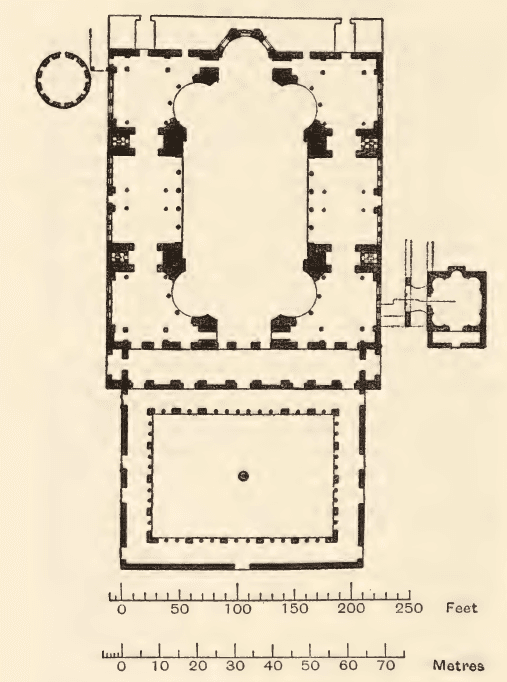
Early Hagia Sophia Plan (Procopius)
The history of the first Hagia Sophia was interrupted by the tension between church and palace in the early fifth century. The removal and exile of Patriarch John Chrysostom of Constantinople triggered a major social backlash in the capital; during the events of 20 June 404, the first church was destroyed by fire.【13】 This event, regarded as the first major destruction in Hagia Sophia’s history, reflected not only the physical loss of the building but also how tensions between the patriarchate, the imperial palace, and the populace could manifest in space. From its earliest phase, Hagia Sophia became not merely a church for religious ceremonies but a public space shaped by imperial politics and urban social dynamics.
Following the first structure, Hagia Sophia was rebuilt during the reign of Theodosius II. The second building, opened for worship on 10 October 415, retained a basilical character.【14】 While some sources describe it as having been reconstructed with a five-aisle layout, modern scholarship has examined separately the proposals for either a three-aisle or five-aisle plan.【15】 However, none of these reconstructions can be accepted with certainty. The limited physical remains of the first two Hagia Sophia structures have led scholars to rely heavily on written sources, later interpretations, and archaeological traces to reconstruct this period. Consequently, assessments regarding the plan, dimensions, and roofing system of Theodosius II’s Hagia Sophia remain cautious rather than definitive.
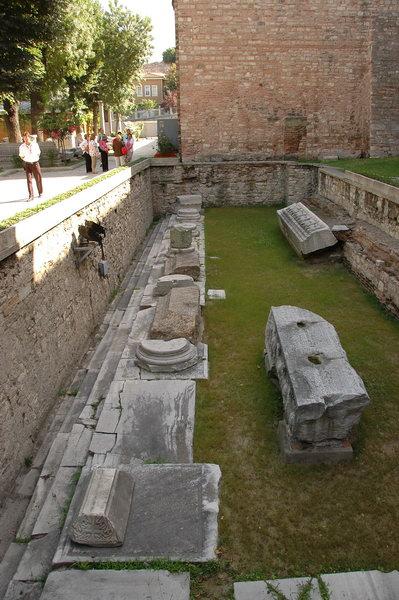
Remains of the Theodosian Hagia Sophia (Livius)
Archaeological investigations are particularly significant for understanding the remains of the second Hagia Sophia. Excavations conducted around Hagia Sophia in the first half of the 20th century increased knowledge of the early structures; during the excavations carried out between 1935 and 1939 on behalf of the German Archaeological Institute, Alfons Maria Schneider claimed to have identified the entrance section of the Theodosian Hagia Sophia.【16】 Although some walls and architectural fragments dated to the 4th and 5th centuries around Hagia Sophia have been interpreted, these remains are insufficient to reconstruct the full plan of the first two structures. This situation reveals that the earliest Hagia Sophia buildings now largely possess the status of “lost architecture,” yet their historical value remains high due to the continuity of the sacred site upon which the subsequent structure was erected.
The second church built during the reign of Theodosius II remained one of the principal churches of Constantinople until 532. However, the Nika Revolt during the reign of Justinian brought about its destruction.【17】 During the Nika Revolt, which began in January 532 at the Hippodrome and quickly spread to many parts of the capital, the second Hagia Sophia was burned down; the imperial palace complex, public buildings, and a significant portion of the city center were also destroyed. This devastation constituted the second major rupture in the history of Hagia Sophia and provided Justinian with the opportunity to construct on the same site a far larger, more ambitious, and more enduring structure than its predecessors.
The process of reconstruction during the reign of Justinian began with the Nika Revolt of 532, which shook Constantinople. This uprising was not merely a fire that destroyed the second structure of Hagia Sophia; it was a clear political crisis arising from the tensions between the imperial administration and the populace. The center of the events was the Hippodrome. Beyond being a venue for chariot races, the Hippodrome was one of the primary spaces where the emperor appeared before the public, where widespread discontent in the city was collectively expressed, and where the palace interacted directly with the public sphere. Consequently, the unrest that began here did not remain confined to the racing arena but quickly spread to the administrative, ceremonial, and religious centers of Constantinople.
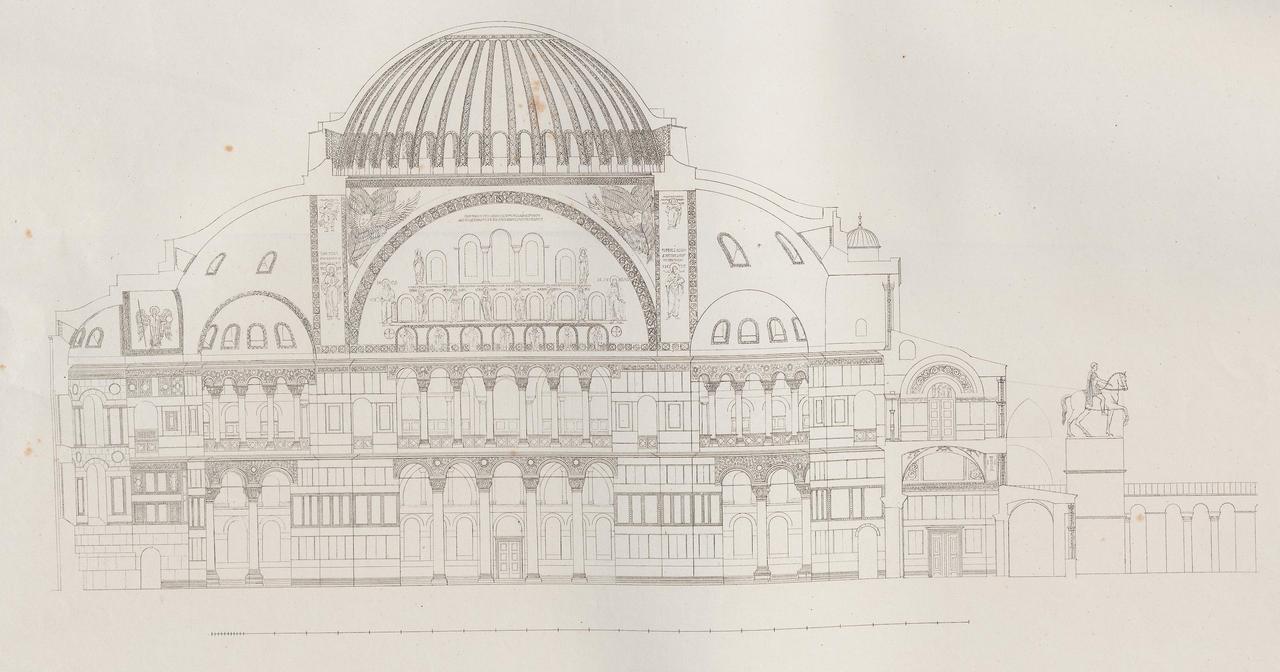
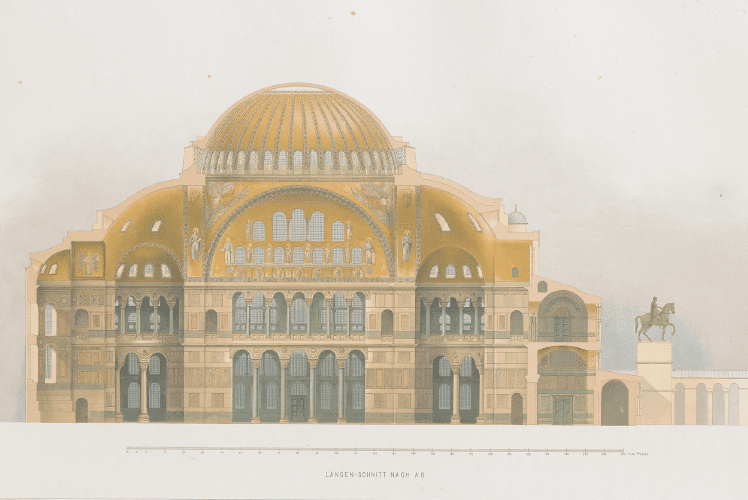
Hagia Sophia of the Justinian Era — Longitudinal Section (Universitätsbibliothek Heidelberg)
Behind the revolt were the chariot racing factions known as the Blues and the Greens, along with their respective supporter communities. These groups were not limited to mere sports fandom in the life of the Byzantine capital; they became vehicles for different social strata, urban rivalries, and at times, political dissent. During the events of 532, supporters of these two normally rival factions united, gathering in large crowds during the races at the Hippodrome around the slogan “Nika,” which means “victory” or “conquer” in Greek, and which gave its name to the revolt. 【18】 The spark for the unrest was lit when Justinian’s administration sentenced individuals associated with the Blues and the Greens to death following bloody incidents involving some of their supporters. Thus, the initial unrest centered on the racing factions and the punishment of the condemned quickly transformed into a widespread rebellion targeting Justinian’s rule.
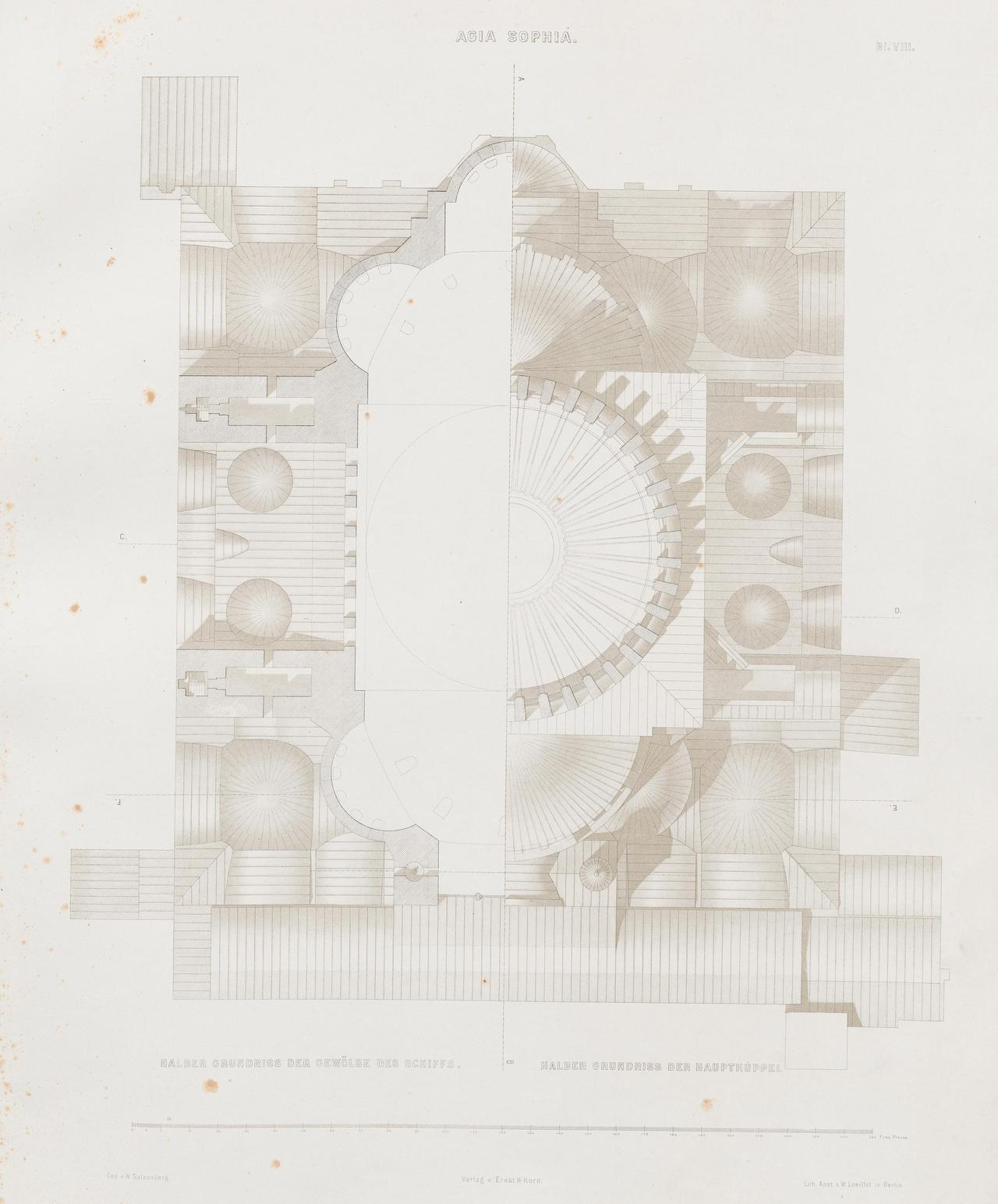
Hagia Sophia of the Justinian Era — Dome and Vault Plan (Universitätsbibliothek Heidelberg)
The rebels, after leaving the Hippodrome, attempted to seize control of the city center, attacked prisons to free prisoners, and destroyed the central area containing public buildings. The direct impact of this chaos on Hagia Sophia was due to its location. The second Hagia Sophia stood within the same ceremonial and power geography as the Great Palace, the Hippodrome, Hagia Eirene, the patriarchal complex, and the imperial administrative structures. Consequently, the fires that broke out during the revolt damaged not only the ordinary urban fabric but also the religious and political heart of the capital. The second Hagia Sophia, rebuilt by Theodosius II in 415, was completely destroyed in a fire that broke out on the night of January 13–14, 532, along with part of the palace and other public buildings.【19】 Thus, after the fire of 404, the great church on the same sacred site was destroyed for the second time during a political crisis within the city.
The Nika Revolt rapidly escalated over a few days to threaten Justinian’s rule. The rebels’ move to rally around an alternative candidate for emperor demonstrated that the event had transcended a simple public order issue. Although escape from the palace was considered, it was ultimately decided to suppress the revolt by military force. The rebellion was violently crushed when troops under Belisarius and Mundus entered the Hippodrome; sources report death tolls ranging from 30,000 to between 35,000 and 40,000.【20】 These figures underscore how the event was perceived as one of the most devastating ruptures in the history of Byzantium’s capital.
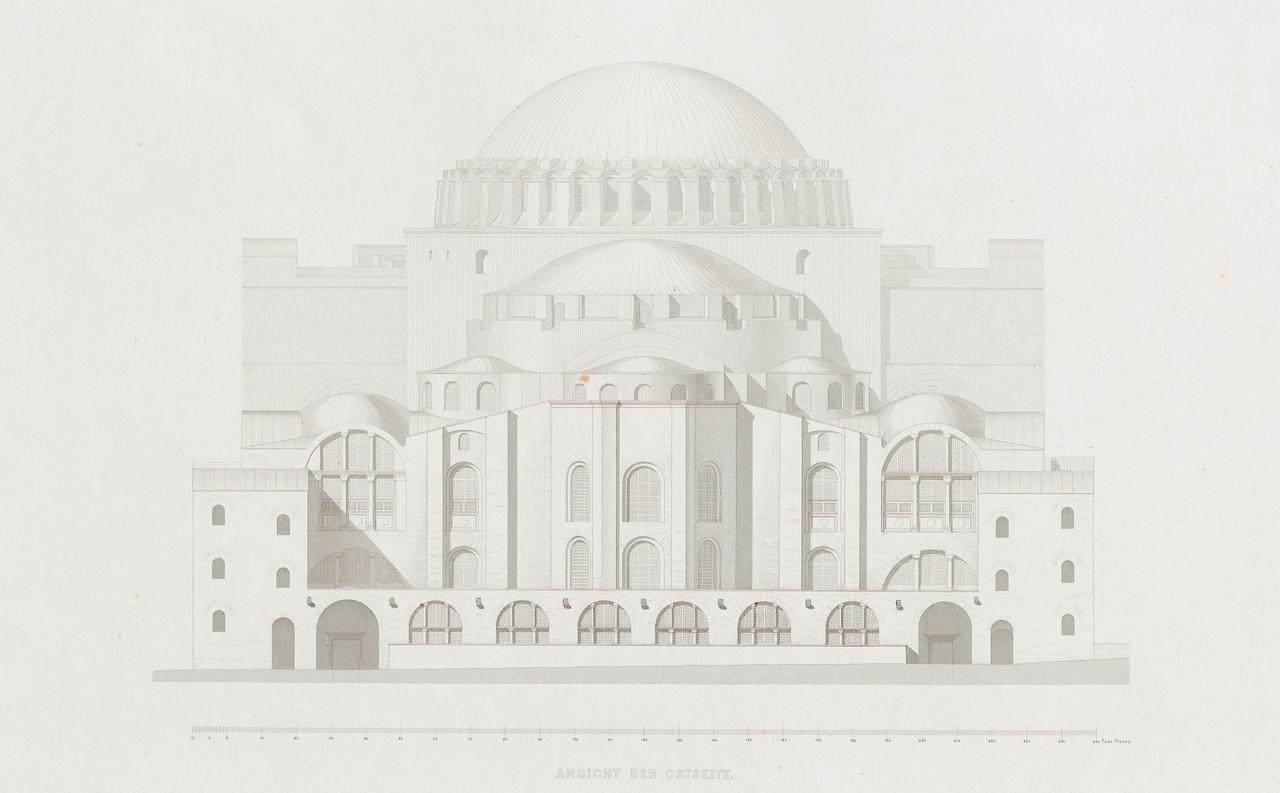
Justinian’s Hagia Sophia – East Facade (Universitätsbibliothek Heidelberg)
The suppression of the revolt provided Justinian not only with a victory in internal security but also an opportunity to launch a renewed urban reconstruction project in the capital. The destruction of the second Hagia Sophia by fire offered the emperor the chance to build a new church on the same site, larger and more ambitious than its predecessors, and one that would more powerfully represent the imperial order of the capital. Therefore, the construction of the third Hagia Sophia was not a simple repair effort following the damage caused by the Nika Revolt; it signified the religious and political reconstruction of the imperial center destroyed by fire. Preparations for the new building began shortly after the suppression of the revolt on 18 January, and according to Procopius’s chronology, work commenced on 23 February 532.【21】 This rapid start reveals that Justinian viewed Hagia Sophia as one of the symbolic pillars of his reign’s restorative and foundational mission.
The construction of the new Hagia Sophia was directly tied to Justinian’s religious and political objectives. The emperor positioned himself not merely as the ruler of the state but also as the guardian of the Christian Roman order. Thus, the rebuilding of Hagia Sophia was not merely about erasing the destruction left by the Nika Revolt; the empire’s most important sacred site was transformed into a structure that embodied Justinian’s claim to universal Rome and the Orthodox Christian order. This relationship is clearly articulated in Procopius’s account: Justinian initiated construction without regard for cost, God provided the necessary personnel for the task, and the technical expertise of Anthemius and Isidore resulted in a building of extraordinary beauty.【22】 It must not be forgotten that this narrative employs a courtly and laudatory tone; yet it remains a critical account for understanding how Hagia Sophia was perceived during Justinian’s reign.
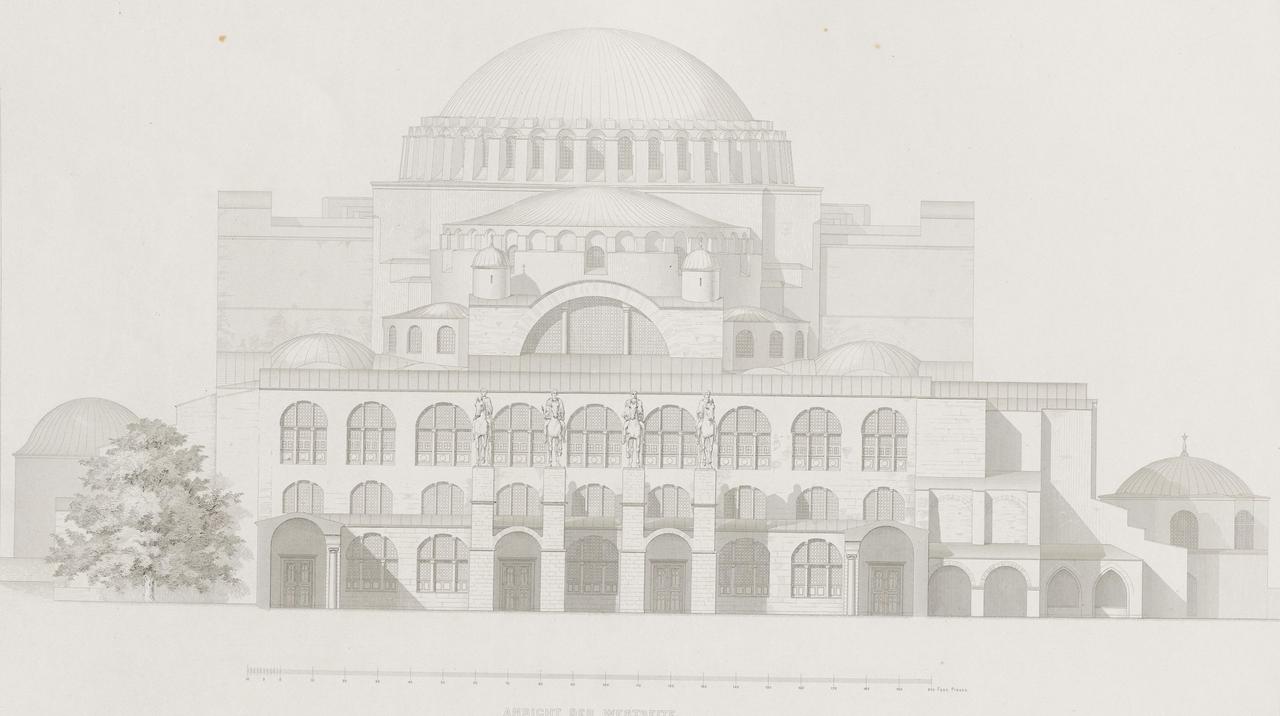
Hagia Sophia of Justinian’s Era – West Facade (Universitätsbibliothek Heidelberg)
The construction was entrusted to two expert architects from western Anatolia: Anthemius of Tralles and Isidore of Miletus. Procopius describes Anthemius as one of the most accomplished masters of architectural art of his time and of earlier ages; he characterizes Isidore as an architect endowed with the knowledge and intellect necessary to realize the emperor’s designs.【23】 The selection of these two figures demonstrates that Hagia Sophia was designed not merely as a large religious structure but also as an ambitious imperial project in technical terms. Numerous masters, architects, and laborers worked on the construction; some sources state that there were a hundred architects, each commanding a hundred workers, while other accounts report that the number of laborers reached ten thousand.【24】 These figures should not be taken as precise measurements but rather as indicators of the extraordinary scale of the construction and the state-organized labor force involved.
One of the most notable aspects of Justinian’s construction program was the collection of materials from various regions of the empire. The stones, marbles, and columns used in Hagia Sophia were not merely building materials but had become symbols representing the geographical extent of the empire. Evidence indicates that red porphyry columns were brought from Heliopolis in Egypt, while columns and marbles were sourced from the vicinity of Ephesus in western Anatolia, from Cyzicus, and from Baalbek in Syria. This demonstrates that the structure was assembled using materials drawn from across the Roman world.【25】 This practice carried both practical and symbolic significance: architectural elements taken from former monumental centers were incorporated into the imperial church in Constantinople, thereby enabling the building to encapsulate the physical traces of the broader Roman geography.
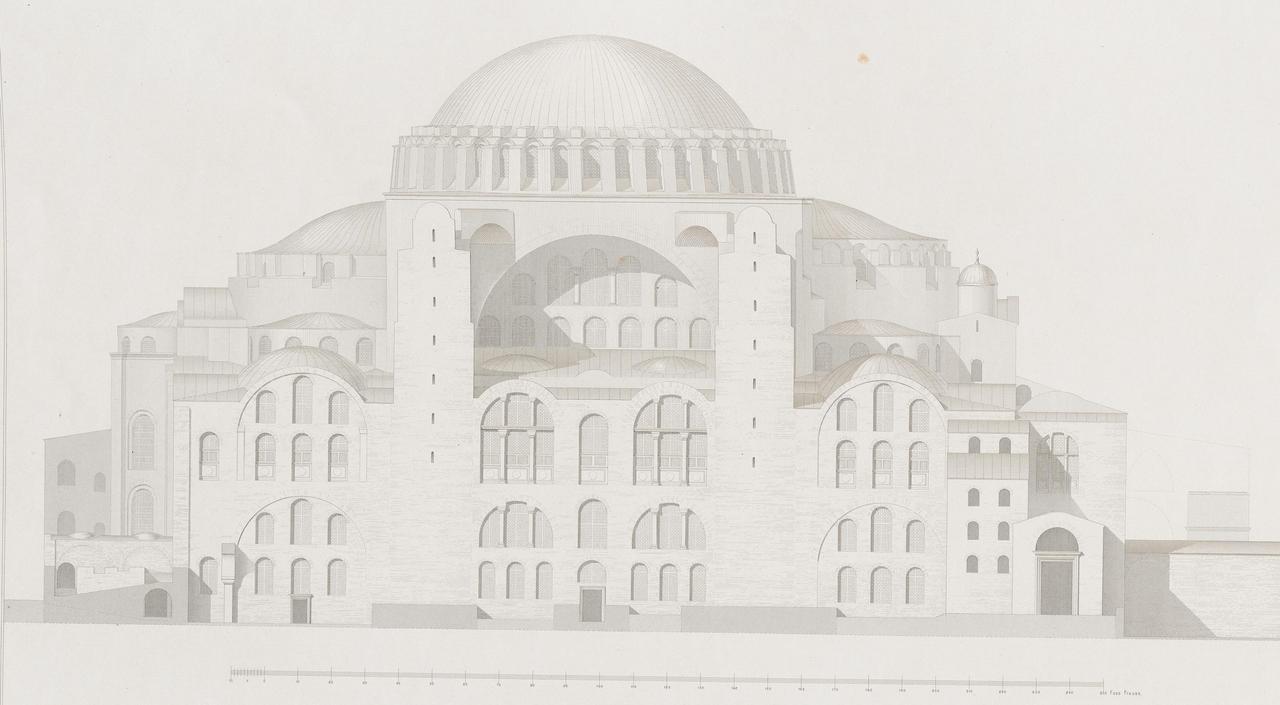
Hagia Sophia during the Justinian Era – North Facade (Universitätsbibliothek Heidelberg)
The architectural layout of the new Hagia Sophia combines the early Christian basilica tradition with a centralized dome-based spatial concept. While retaining its longitudinal basilical character, the structure achieves a distinct interior spatial effect through the large dome covering the main space and the half-domes supporting it. Procopius, when describing the impact of the dome, notes that it appears not to rest on a solid foundation but rather as if “suspended from heaven.”【26】 This description reflects not a technical explanation but the perceptual impression the building creates within its interior space. The same source also particularly emphasizes Hagia Sophia’s lighting scheme; according to Procopius, the church is so luminous that it seems as if the light does not enter from outside but originates from within the structure itself.【27】 Such descriptions reveal that Hagia Sophia left a powerful impression on contemporary observers not only through its dimensions but also through the combined effects of space, light, and the dome.
The completion of the construction in a remarkably short period is significant as it demonstrates the organizational capacity of the Justinian era. Construction, which began after the Nika Revolt, was finished in approximately five years and ten months, and Hagia Sophia was officially inaugurated on 27 December 537.【28】 The inauguration signified not merely the opening of a new church but the reenactment of the emperor’s authority and religious-political legitimacy in the capital. The famous anecdote of Justinian, reportedly saying upon its completion, “Solomon, I have surpassed you,” referring to the Temple of Solomon in Jerusalem, must be understood within this context.【29】 This statement carries significance not as a historically verifiable fact but as a symbolic narrative illustrating how Hagia Sophia was elevated in Byzantine and subsequent traditions.
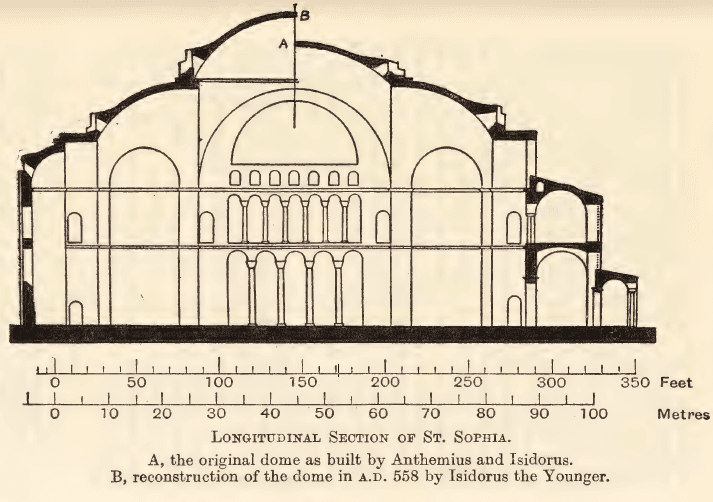
Ayasofya'nın Orijinal Planı (A) ve Genç Isidoros'un Kubbe Yükseltmesi (B) - (Procopius)
The original form of Hagia Sophia during Justinian’s reign established the foundation of the present structure, but it underwent repairs and modifications in subsequent centuries. The initial dome was flatter than the current one and suffered from static problems. After the earthquake of 557, the eastern portion of the dome collapsed in 558, triggering the first major structural crisis of the Justinian era. This crisis was resolved through the reconstruction of the dome by the architect Isidorus the Younger, who raised it to a broader and more stable form.
Justinian’s Hagia Sophia was represented from the moment of its construction as an extraordinary structure within the language of history, poetry, and legend. Procopius described the building in terms of Justinian’s will to build, the grace of God, and the skill of the architects; while Paulus Silentiarius’s poetic description, recited after the second inauguration in 562, reveals how the dome, light, and liturgical furnishings of Hagia Sophia were interpreted through a poetic and religious language.【30】 Later Byzantine narratives enriched the construction account with legendary elements, generating various traditions concerning the names of the architects and the emperor’s role. Thus, the reconstruction during Justinian’s reign was not merely an architectural event but also the foundational phase of the historical memory that would sustain Hagia Sophia for centuries to come.
After its inauguration in 537, Hagia Sophia assumed a central position in the religious life of Constantinople as the principal patriarchal church of the Eastern Roman capital. The organization of the patriarchate around Hagia Sophia transformed the building from a mere place of worship into one of the most visible institutional centers of the imperial capital. While the patriarch presided over major feasts, sermons, liturgies, and ecclesiastical rites within its walls, the emperor also appeared publicly within the religious ceremonial framework on specific occasions. Thus, the building became one of the primary spaces in Byzantine political culture where church and palace converged, and where imperial authority was symbolically represented within a religious context.
This function of Hagia Sophia was not independent of its urban context. The building was situated within a district linked to the Great Palace, the Hippodrome, the Augustaion Square, Hagia Eirene, the patriarchal complexes, and the city’s main ceremonial route. The processions from the Great Palace to Hagia Sophia removed the emperor’s participation in religious ceremonies from the realm of a private palace ritual and instead presented him visibly before the citizenry, palace officials, the clergy, and senior state officials, according to a defined protocol. The location of the patriarchal buildings on the southern side of Hagia Sophia and the direct connection from the southeast to the Great Palace demonstrate that the structure was positioned as both a religious and an administrative-ceremonial center.
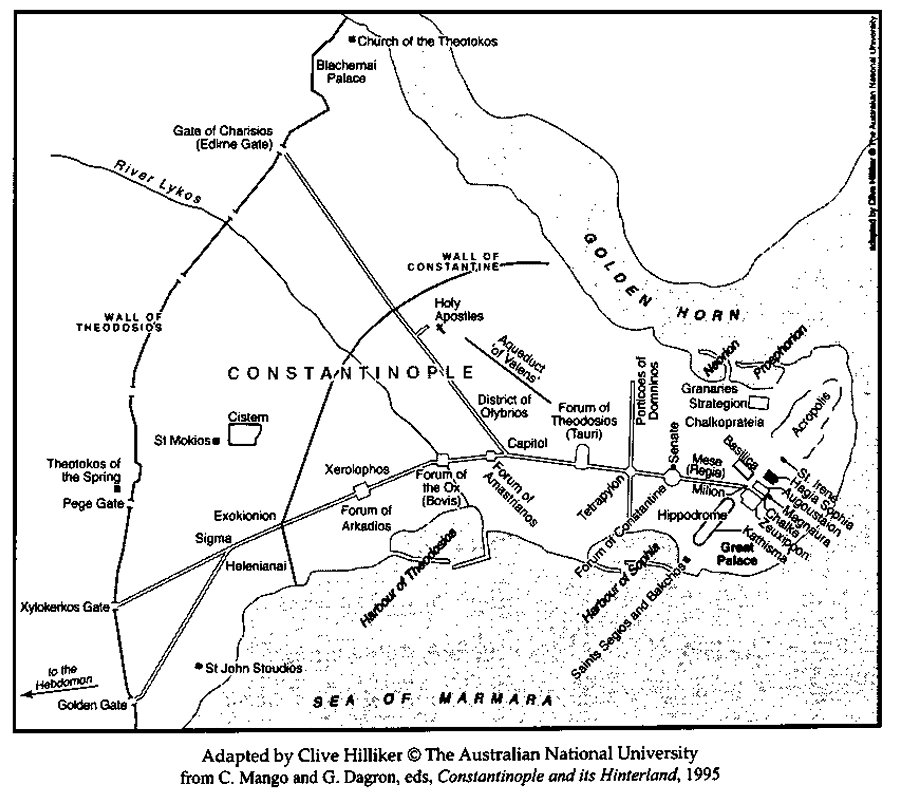
Map of Constantinople in the Period, Ceremonial Route, and Hagia Sophia (The Book of Ceremonies)
In Byzantine capital life, Hagia Sophia was one of the principal stops in ceremonial processions that began or ended especially on major religious holidays. During the early and middle Byzantine periods, processions largely followed the city’s colonnaded main avenues, departing from Hagia Sophia toward the Forum of Constantine, the Church of Theotokos in Chalkoprateia, the Church of the Apostles, or other sacred sites. The Forum of Constantine’s transformation into a ceremonial stop reveals how ancient imperial monuments in the city’s collective memory were reconnected with Christian liturgical practice. The fact that some processions originating from Hagia Sophia extended as far as the Church of Chalkoprateia, located north of the present-day Yerebatan Sarnıcı, and others reached the Church of the Apostles nearly four kilometers away, demonstrates that the building was not merely the central church of Constantinople but also one of the key starting points for liturgical movement across the entire urban scale.
Imperial participation in these ceremonies was not always consistent in intensity; however, the routes taken by emperors toward Hagia Sophia acquired special political significance when they were followed. According to the account of Harun b. Yahya relating to the year 912, the passage from the Great Palace to Hagia Sophia was adorned with grasses, plants, and brocade fabrics hung on either side; representatives of the racing factions dressed in red, white, green, and blue garments, palace officials, eunuchs, young members of the imperial retinue, the twelve patrikioi, and other high-ranking officials lined the route.【31】 This description reveals that even a brief palace-to-church procession was transformed into an imperial spectacle meticulously organized according to color, rank, seniority, and hierarchy. Here, Hagia Sophia was not merely a destination but the final focal point of a ceremonial route where the imperial order was visibly reasserted before the public.
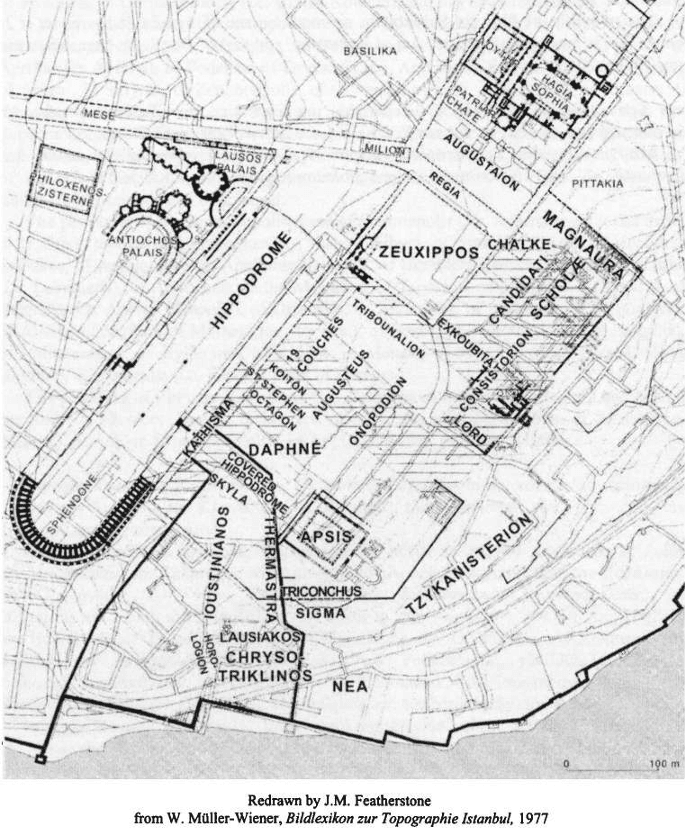
Plan of the Great Palace and Its Surroundings (The Book of Ceremonies)
One of the most prominent functions of imperial ceremonies in Hagia Sophia was the coronation and joint rule rituals. In the Byzantine world, the emperor’s authority was not explained solely by dynastic ties, military support, or courtly acceptance; the ritual performed within the church conferred divine and public legitimacy upon this power. The coronation ceremony conducted by the patriarch in Hagia Sophia symbolically expressed the idea that the emperor ruled under God’s protection. Acclamations, prayers, vestments, and the symbolism of the crown served to present the emperor as the legitimate ruler before both the congregation and the court. Thus, coronation ceremonies in Hagia Sophia created a space where ecclesiastical liturgy and state protocol were inseparable.
Hagia Sophia’s status as the patriarchal center also made it a stage for theological debates and internal church crises. The iconoclastic period of the 8th and 9th centuries generated a prolonged dispute over the use of figural imagery that shaped Byzantine religious life for decades. After the end of the iconoclastic era in 843, the return of figural images to church spaces was perceived not merely as an aesthetic change but as the public reassertion of Orthodox faith. One visible manifestation of this transformation in Hagia Sophia was the sermon delivered by Patriarch Photios on 29 March 867, in the presence of Emperor Michael III, co-emperor Basil I, and the court, on the occasion of the unveiling of the Theotokos image. Photios described the scars left by the iconoclastic period on the church’s walls as wounds; he interpreted the new image as the restoration of the church’s adornment and the visible reemergence of Orthodox belief. The phrase “the eye of the universe” used in the sermon is a striking characterization that encapsulates Hagia Sophia’s position in the Byzantine imagination.【32】
The visual arrangement of Hagia Sophia was shaped alongside its ceremonial and theological functions. The depiction of the Theotokos in the semidome of the apse, the angels on the bema arch, the scenes around the imperial door, and the imperial couple compositions in the galleries all demonstrate that within the building, not only sacred figures but also the imperial order were made visible. The portrayal of emperors in some mosaics as donors or supplicants before the Virgin Mary, Christ, or other holy figures illustrates how authority was hierarchically positioned within the church. These images transformed the interior space of Hagia Sophia into a site where imperial memory, theology, and ritual order converged.
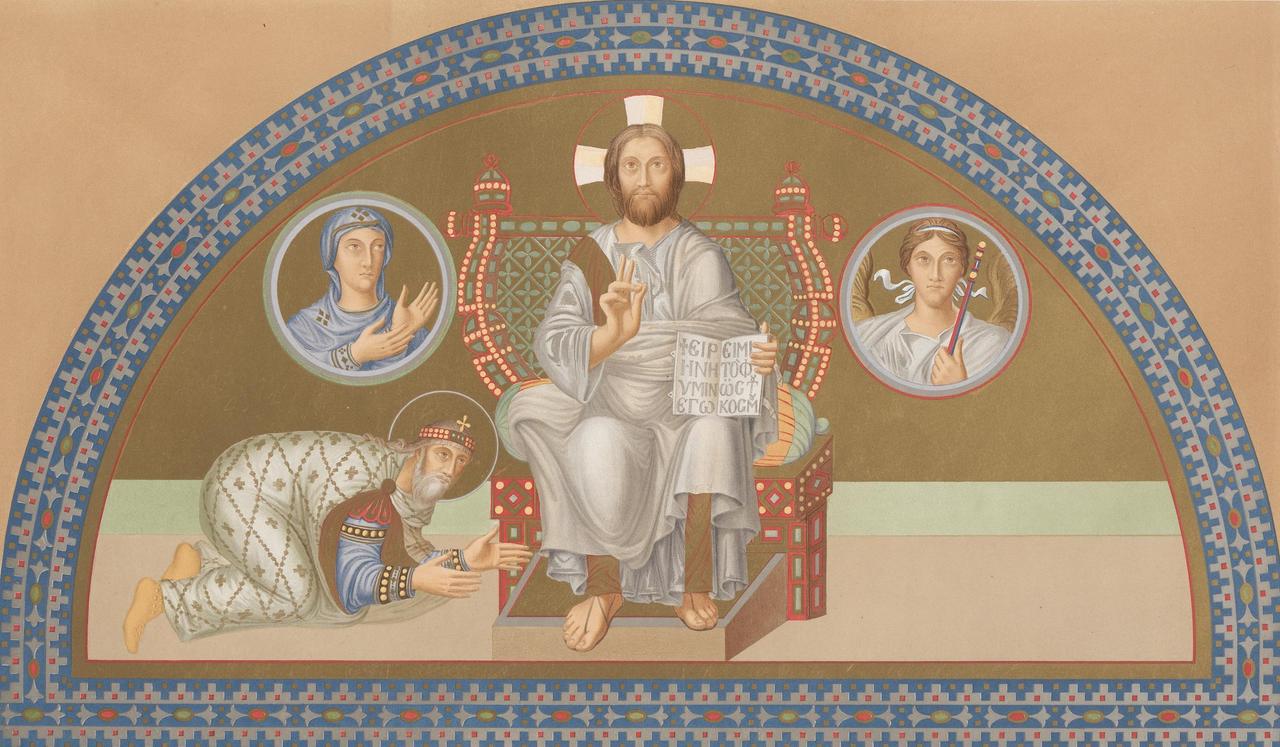
Mosaic Depiction on the Royal Door in the Nartex (Universitätsbibliothek Heidelberg)
Over time, the relocation of the imperial palace and the diversification of ceremonial routes did not eliminate Hagia Sophia’s function entirely; however, they altered the distribution of imperial ceremonies across the city. The rise of the Blachernae Palace from the Komnenian period onward diminished the emperor’s visibility along the traditional route linking the Great Palace, Hagia Sophia, and the Hippodrome; the processions for certain festivals and rituals shifted toward the northwest around the new palace. Nevertheless, Hagia Sophia continued to serve as the focal point of religious authority as the seat of the patriarchate. In the late Byzantine period, the narrowing of imperial resources, the weakening of the city’s urban fabric after the Latin occupation, and the simplification of court protocol reduced the intensity of ceremonies, yet Hagia Sophia’s place in Constantinople’s religious memory endured.
In these respects, Hagia Sophia was not merely a large church during the Byzantine era but a central nexus where power, faith, and urban order intersected in the capital. Patriarchal liturgies, imperial processions, coronation ceremonies, post-iconoclastic debates on imagery, and major feast-day rituals kept the building continuously visible in the religious and political life of Constantinople. Hagia Sophia’s enduring presence in Byzantine memory stems not only from its architectural grandeur but also from the fact that this ritual and representational system was produced over centuries within the same space.
The Byzantine history of Hagia Sophia was shaped by major destructions and repairs it underwent in different centuries. The third Hagia Sophia, constructed rapidly during the reign of Justinian, was an ambitious structure, yet it faced structural problems from its earliest years. The massive dome covering the main space provided a powerful central focus but simultaneously exerted considerable pressure on the building’s load-bearing system. The original dome’s flatter profile compared to the present one generated high stress on the east-west arches and semidomes; as a result, earthquakes, cracks, collapses, and reinforcement interventions largely defined Hagia Sophia’s subsequent history.
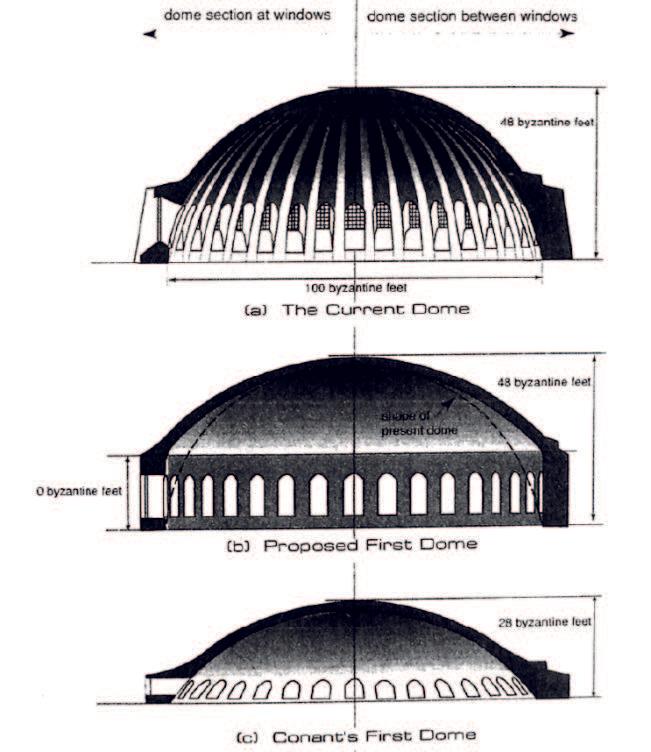
Plan for the First Repair of Hagia Sophia Following Its Initial Collapse (Directorate of Religious Affairs)
The building’s first major crisis occurred in 557 due to an earthquake, followed by a strong aftershock on 7 May 558. In this event, the eastern portion of the dome, the eastern main arch, and part of the eastern half-dome collapsed; the structure, which had opened for worship in 537, required extensive repairs less than twenty years after its completion. The nephew of one of the original architects, Isidorus the Younger, was appointed to oversee the repairs; the dome was rebuilt approximately 6.2 to 6.25 meters higher, and the north-south arches and pendentives were reinforced.【33】 The structure was reopened for worship on 24 December 562. In his poetic description written after the 562 reopening, Paulus Silentiarius recounts that after the collapse, “a portion of the dome had merged with the dust,” while another part “hung in the air as if unsupported.”【34】 This description reveals that the event was perceived not merely as a technical failure but as a profound collapse that left a deep impression on contemporary observers.
Isidorus the Younger’s intervention constituted the first major structural correction that defined Hagia Sophia’s existence in subsequent centuries. The elevation of the new dome was intended to reduce the horizontal thrust generated by the previous, flatter dome. This change also laid the foundation for the dome’s present-day perception. Nevertheless, due to its location within Constantinople’s seismic zone, the structure remained under constant risk in the following centuries. Earthquakes in the 9th century caused cracks particularly in the dome and tympanum walls; repairs were carried out during the reign of Emperor Basil I after the earthquake of 869. It is understood that during this repair, cracks in the dome were sealed, window openings were narrowed to strengthen the walls, and the building’s load-bearing system was made more secure.
The 10th century marked a new period of significant damage to Hagia Sophia. In 912, a fire caused extensive destruction in the patriarchal palace between the atrium and the Augustaion, where candle shops were located. However, the century’s major structural crisis emerged with the earthquake of 989. In this earthquake, the western portion of the dome, the western main arch, and the western half-dome suffered severe damage; some accounts state that the main dome split in two and that the western wing needed to be rebuilt.【35】 Thus, the collapse that had occurred on the eastern side in 558 was now repeated on the western side; the dome of Hagia Sophia had to be reconstructed from different directions in different centuries.
For this restoration during the reign of Basil II, the Armenian architect Trdat was appointed. Trdat’s known architectural activities in the region of Ani demonstrate that the restoration of Hagia Sophia drew not only on Constantinopolitan craftsmen but also on diverse architectural traditions within the empire. The restoration was carried out between 989 and 994; the western arch, the western half-dome, and the western ribs of the main dome were restructured. Some studies indicate that fifteen of the forty ribs of the main dome on the western side were replaced.【36】 This intervention was not limited to the structural system; the decorative program was also renewed alongside the repairs. The large angel depictions, the new figural arrangements in the dome and half-domes, and the images of prophets and Church Fathers on the walls demonstrate that the physical restoration of the building went hand in hand with the reestablishment of its visual order. Hagia Sophia was reopened for worship in 994.
During the 11th and 12th centuries, the history of Hagia Sophia’s restoration is less associated with major collapses and more with internal reconfigurations, decorative enhancements, and the continuity of ceremonial use. During the reign of Romanos III, the capitals of columns were adorned with gold and silver, the mosaic of Zoe on the southern wall of the western gallery was arranged, and later, the bema and its mosaics were renewed—all indicating that the building remained under imperial patronage. In the 12th century, imperial mosaics linked to the Komnenian period and conciliar decisions inscribed on marble slabs and placed around the church reveal that Hagia Sophia continued to serve not only as a physical structure but also as a carrier of legal, theological, and political memory.
One of the most severe political damages to Hagia Sophia during the Byzantine period occurred in 1204 during the Fourth Crusade, when Constantinople was occupied by the Latins. This occupation was not the result of a natural disaster such as an earthquake or fire, but the direct consequence of the military and political collapse of the capital. As the largest church in the city and the symbolic center of the imperial-patriarchal system, Hagia Sophia became a primary target for looting and destruction. Sacred objects, liturgical equipment, and valuable materials were damaged or removed from the city. The conversion of Hagia Sophia for Catholic use under Latin rule established it in Byzantine Orthodox memory as a site of occupation and rupture. After Constantinople was recaptured by Michael VIII Palaiologos in 1261, the building returned to Byzantine administration, but the material and symbolic damage left by the Latin occupation could not be fully reversed.
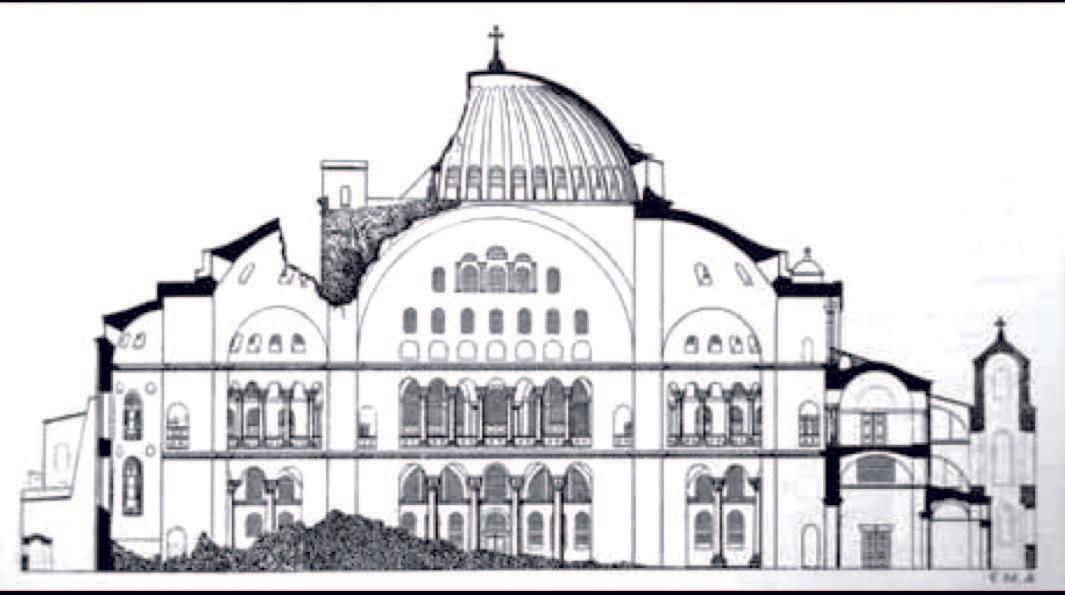
Hagia Sophia After the 1346 Earthquake (Directorate of Religious Affairs)
During the late Byzantine period, the maintenance and repair of Hagia Sophia were limited by the shrinking economic resources of the empire. In the reign of Andronikos II Palaiologos, a more comprehensive restoration was undertaken in 1317 to strengthen the structure from the outside; buttresses were constructed especially on the northeast and southwest sides to balance the load on the dome and walls. This intervention reveals that Hagia Sophia was now being addressed not merely as a space of interior decoration or ceremonial function, but as a structure facing existential survival challenges. Nevertheless, these buttresses were insufficient to fully secure the aging structure.
The earthquakes of 1343–1344 and the major collapse on 19 May 1346 constituted one of the most serious structural crises Hagia Sophia faced during the late Byzantine period. In this event, the eastern portion of the dome, along with the eastern half-dome and the surrounding apse, suffered severe damage. The repair process progressed slowly and with difficulty due to the political and financial weaknesses of the era. Sources indicate that the repairs were carried out in two phases by the architect Astras and the Italian architect Peralta.【37】 The eastern half-dome and the lower sections of the main dome were addressed first; after a long interval, work proceeded to complete the dome. This process, which lasted until approximately 1353–1354, demonstrates that Hagia Sophia was sustained during this period through the limited resources of the Byzantine state, contributions from the public, and the expertise of craftsmen brought from abroad.
By the 15th century, Hagia Sophia remained the most renowned sacred structure in Constantinople; however, its physical condition had deteriorated alongside the general decline of the empire. The Spanish ambassador Ruy González de Clavijo, who visited Istanbul in 1402, described the building as ruined and neglected. This observation indicates that although Hagia Sophia retained its ceremonial and religious significance during the Late Byzantine period, the maintenance system supported by the former imperial resources had largely weakened. Accounts suggesting that certain parts of the building had become hazardous due to earthquakes and aging are consistent with this broader picture.【38】 The crises Hagia Sophia endured during the Byzantine era did not interrupt its history; rather, each major destruction gave rise to a new phase of restoration and reinterpretation. The raised dome by Young Isidore in 558, the reinforcements under Basil I in the 9th century, Trdat’s interventions on the western arches and dome after 989, the buttresses added in 1317, and the Late Byzantine repairs after 1346 all demonstrate that Hagia Sophia was never a single, unaltered structure completed in one phase. The building preserved its existence through continuous interventions against earthquakes, fires, invasions, and economic contractions; each restoration reshaped both its physical form and its historical memory.【39】
The Ottoman period of Hagia Sophia encompasses a long historical phase beginning with the conquest of Istanbul in 1453 and involving the building’s redefinition as a mosque, endowment institution, capital sanctuary, and central component of a külliye. During this era, the structure did not remain merely a converted Byzantine church; it evolved into a multifaceted Ottoman institution linked to worship, education, endowment administration, restoration, sultanic ceremonies, vaaz-instruction activities, and urban memory. Hagia Sophia’s place in Ottoman history began with its initial transformation after the conquest; Fatih Sultan Mehmed’s endowment system, subsequent sultanic additions, and its continuous use over centuries as one of Istanbul’s most prominent places of worship ensured its enduring significance.
Istanbul’s incorporation into Ottoman rule on 29 May 1453 triggered one of the most decisive functional transformations in the history of Hagia Sophia.【40】 Prior to the conquest, Hagia Sophia was the largest church in the Byzantine capital and the principal structure of the patriarchate. In the final days of the siege, the building had become not merely a liturgical center but a space where the city’s population sought refuge and where hopes and fears converged. Byzantine sources recount that immediately before the conquest, the emperor, members of the imperial court, the clergy, and the populace all participated in a final grand ceremony at Hagia Sophia, while certain segments of the city turned toward the sanctuary expecting divine intervention.【41】 This depiction illustrates that on the eve of 1453, Hagia Sophia was perceived by the Byzantines not merely as a religious structure but as one of the final defensive and memorial spaces of the capital.
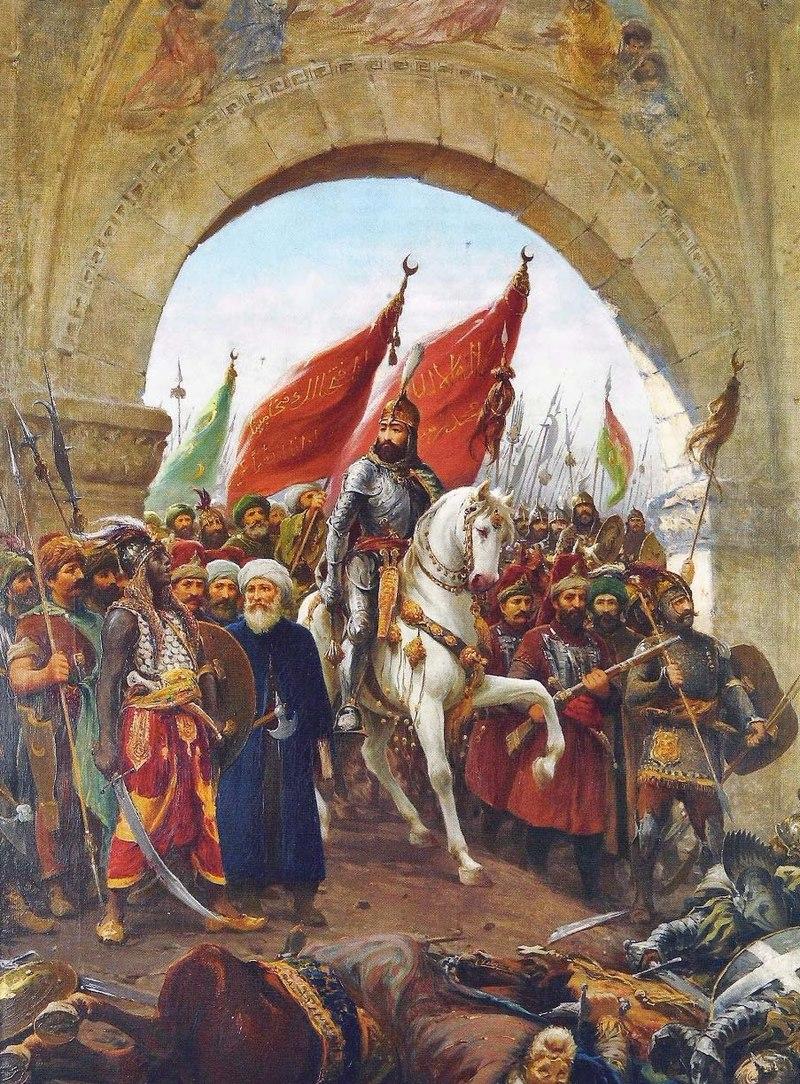
Fatih Sultan Mehmed’s March from Edirnekapı to Hagia Sophia Following the Conquest (World History)
Fatih Sultan Mehmed’s direct movement toward Hagia Sophia immediately after the conquest was one of the earliest demonstrations of how the Ottoman administration interpreted the city’s center. Contemporary accounts describe the sultan personally inspecting the building, ascending to the dome, and observing its ruined state. Tursun Bey’s narrative also identifies Hagia Sophia as one of the principal structures that Fatih carefully examined after the conquest; this account illustrates that in Ottoman historiography, the building was understood not merely as a captured structure but as one of the historical and symbolic centers of the new capital.【42】 The prevention of Hagia Sophia’s destruction immediately after the conquest must also be understood within this framework. According to Dukas, when Fatih saw a soldier damaging the building’s marble, he intervened, declaring, “Wealth and captives are sufficient for you; the buildings of the city belong to me.”【43】 This statement presents a striking scene that underscores how, in the aftermath of the conquest, Hagia Sophia and the city’s buildings generally came under the sultan’s protection.
The conversion of Hagia Sophia into a mosque was part of the Ottoman tradition of transforming the largest place of worship in a conquered city into the central place of worship for the new regime. After the conquest of a city, converting its largest church into a mosque and holding the first Friday prayer there was one of the ways in which Ottoman political and religious practice made the new authority visibly manifest. This practice did not merely satisfy a need for a place of worship; it proclaimed through the sermon, the congregation, and the spatial arrangement that the city now belonged to a new political authority. Therefore, the conversion of Hagia Sophia was not an isolated architectural intervention but a central step in the transformation of Byzantine Constantinople into Ottoman Istanbul.
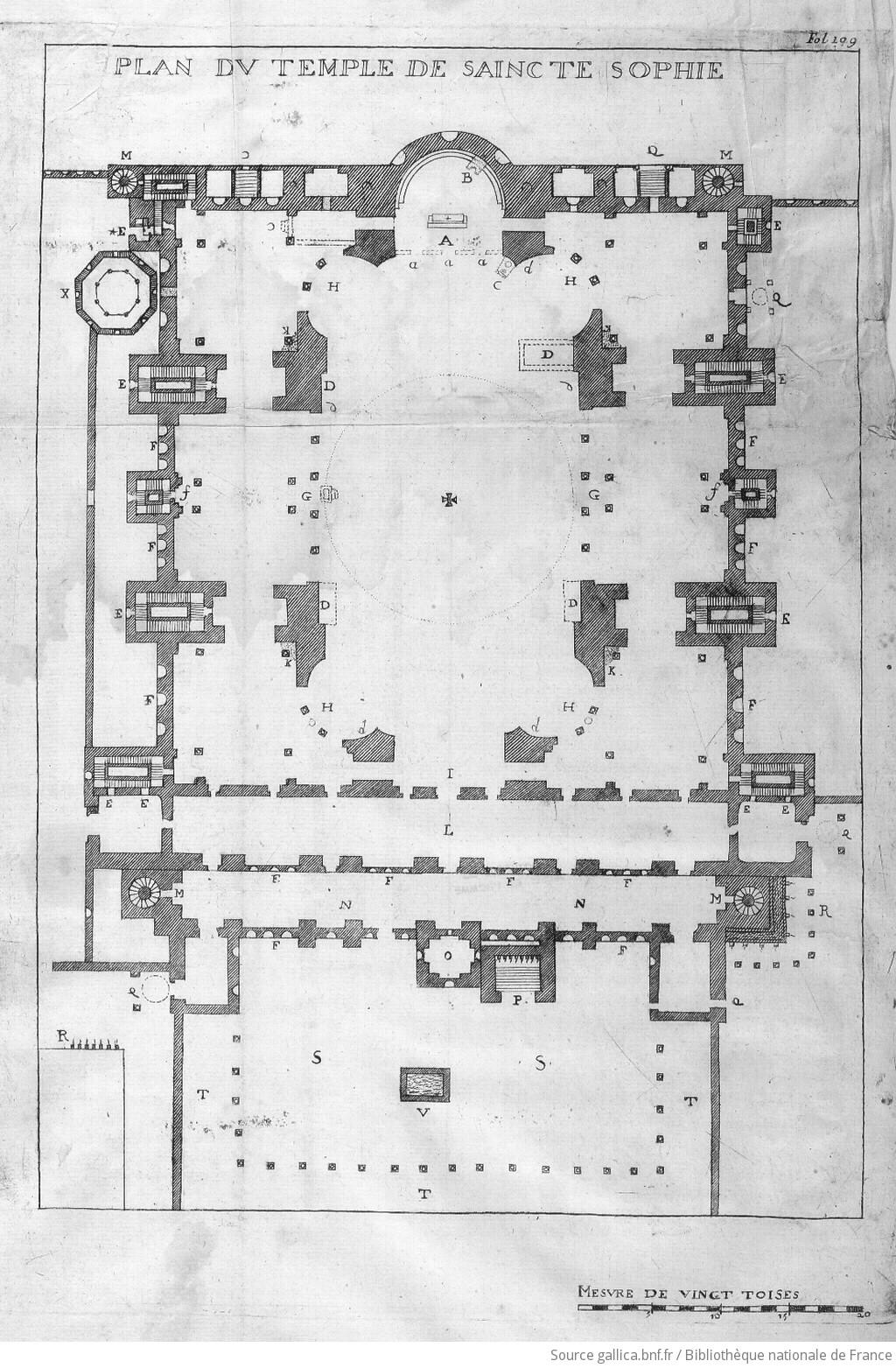
Plan of Hagia Sophia as Drawn by a Western Traveler in the Mid-17th Century (Gallica)
However, the conversion of Hagia Sophia into a mosque did not mean the immediate elimination of all Christian religious institutions in Istanbul. After the conquest, certain rules permitted the continuation of the Christian community’s religious organization, and a new patriarch was elected to ensure the patriarchate did not remain vacant. The church leaders, clergy, and the reassembled population of the city elected Georgios Skolarios Gennadios as patriarch. Fatih Sultan Mehmed granted Gennadios the patriarchal staff and crown and assigned the Church of the Holy Apostles as the new seat of the patriarchate.【44】 Thus, while Hagia Sophia was transformed into the central mosque of the Ottoman capital, the Greek Orthodox community’s patriarchate continued its existence through another site. This distinction demonstrates that Ottoman administration incorporated Hagia Sophia as the symbolic space of conquest into the new order, without reducing the entire religious structure of the city to a single practice.
The first step in converting Hagia Sophia into a mosque was to make the building suitable for Friday prayers within a short time. For this purpose, an intensive three-day preparation was carried out; sections of frescoes obstructing prayer, particularly around the mihrap, were covered using the technological means available at the time. Subsequently, a minber was installed to the right of the mihrap, a temporary hünkâr mahfili was constructed for the Ottoman sultan’s prayer area, and a wooden minaret was added to the structure. These modifications should be understood not as a comprehensive intervention aimed at altering Hagia Sophia’s entire architectural fabric but as the immediate and necessary adaptations required to enable its function as a mosque.【45】
The first worship in Hagia Sophia took place shortly after the conquest. It is reported that Fatih Sultan Mehmed prostrated in thanksgiving immediately after entering Hagia Sophia, performed two rak’ahs of conquest and thanksgiving prayers there, and that the first adhan was recited at this time. The first Friday prayer was held on 1 June 1453; according to some Ottoman sources, Fatih Sultan Mehmed himself delivered the khutbah while his teacher Akşemseddin led the prayer.【46】 In these accounts, the Friday prayer is not merely the first communal worship after the conquest but also carries the symbolic weight of a religious and public declaration of Istanbul’s entry into Ottoman sovereignty.
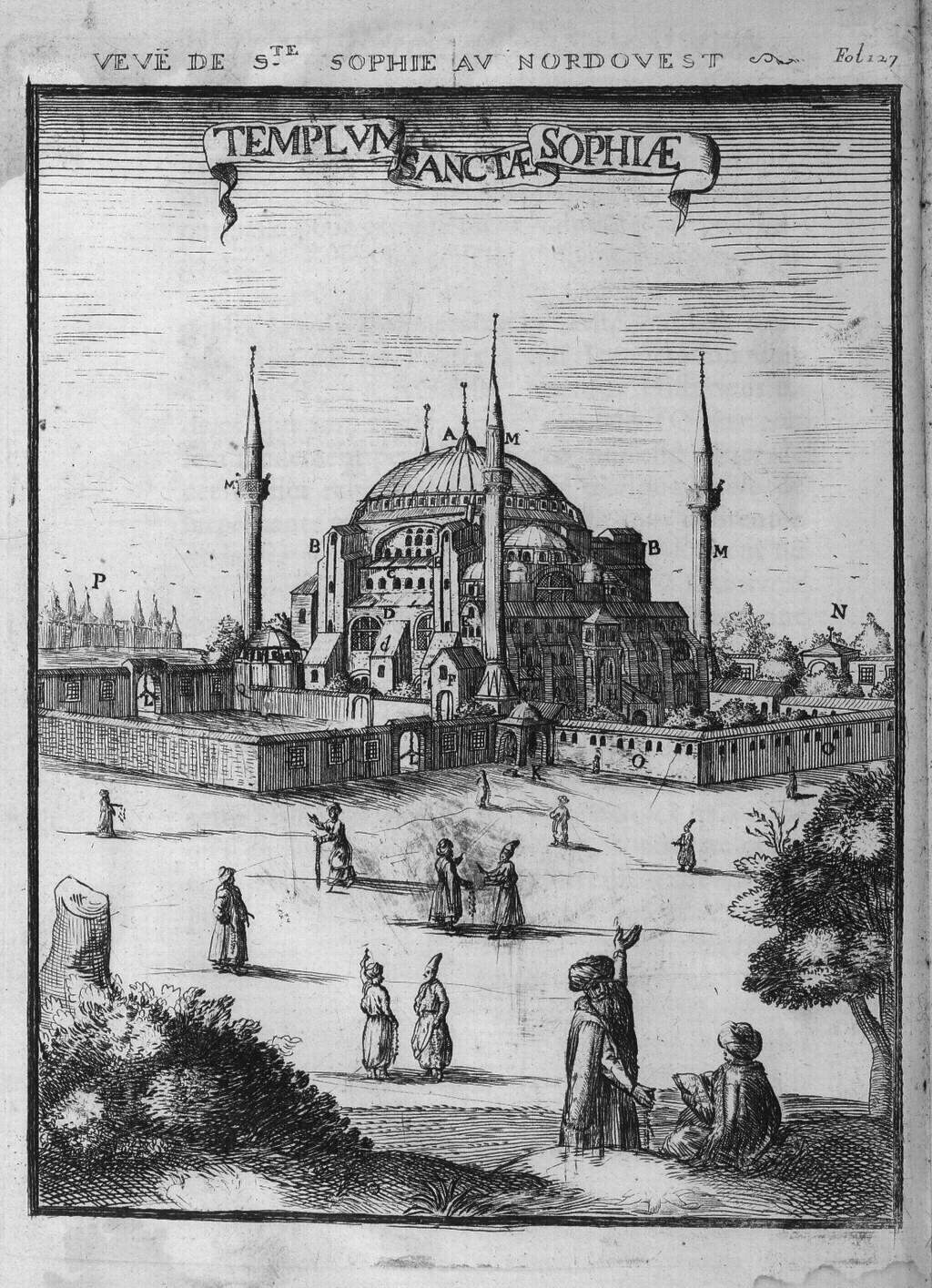
17. Yüzyılın Ortasında Ayasofya Tasviri (Gallica)
The first adjustments made after the conversion of Hagia Sophia into a mosque were not aimed at completely erasing its former identity but at adapting it to its new function as a place of worship. Elements such as the mihrab, minbar, temporary gallery, and wooden minaret constituted the essential additions enabling its use as a mosque. In contrast, the building’s main structure was preserved, and no large-scale destructive intervention was undertaken. This choice reflects that Hagia Sophia was perceived during the Ottoman period both as a symbol of conquest and as a monumental structure requiring protection. Indeed, the repairs, buttresses, minarets, and interior modifications carried out in subsequent centuries continued this early approach to preservation.
Among the initial adjustments following the conquest, education and endowment played a critical role. Shortly after the conquest, Hagia Sophia was incorporated into the charitable endowment of Fatih Sultan Mehmed, and a madrasa was established beside the mosque. It is understood that initially some existing rooms or spaces around the patriarchate were used as classrooms, and later the Hagia Sophia Madrasa was rebuilt within the endowment framework. Thus, the building became not merely a mosque of worship immediately after the conquest but also one of the earliest centers of learning and education in the Ottoman capital.
The transformation of Hagia Sophia in 1453 established the starting point for the meanings subsequently attributed to the building. Its conversion into a mosque, the first Friday prayer, the installation of the mihrab and minbar, the wooden minaret, the early use of the madrasa, and its endowment constituted the first steps in integrating Hagia Sophia into the religious and institutional framework of the new capital. During this process, the structure was preserved as the greatest legacy of the Byzantine past while simultaneously acquiring a new function as one of the central mosques of Ottoman Istanbul.
The enduring status of Hagia Sophia during the Ottoman period was defined within the endowment system established by Fatih Sultan Mehmed. After its conversion into a mosque, the building was not left merely as a place of worship under the sole authority of the sultan; instead, it was transformed into a formally constituted endowment institution with defined revenues, personnel, maintenance conditions, and administrative structure. This arrangement provided the fundamental framework ensuring Hagia Sophia’s continuity in Ottoman Istanbul. Thanks to the endowment system, the mosque’s worship services, staff salaries, maintenance and repair costs, lighting, cleaning, education, and associated charitable activities were supported by specific sources of income.
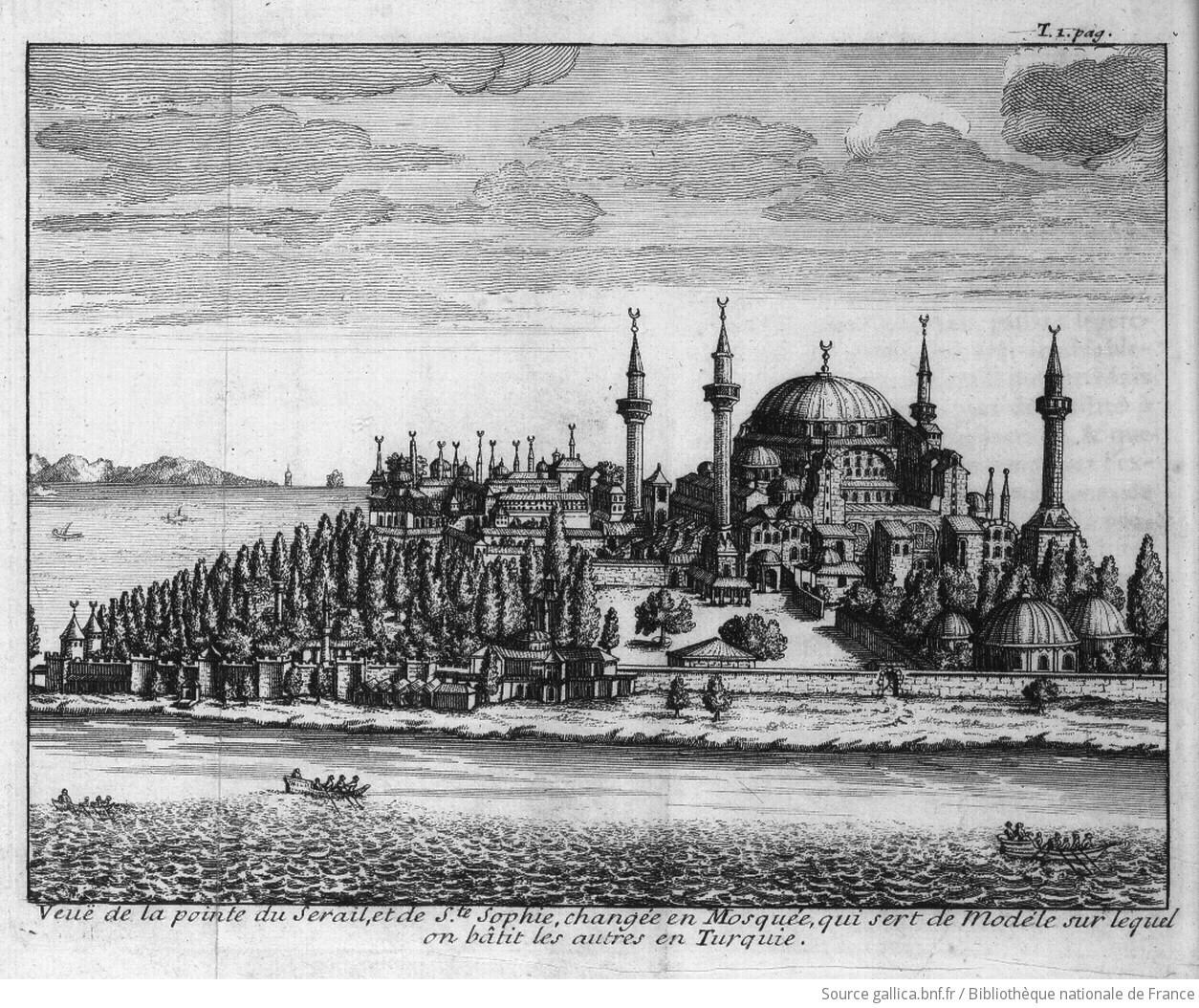
17th Century End of Hagia Sophia (Gallica)
Among the charitable foundations established by Fatih Sultan Mehmed in Istanbul, the Ayasofya-i Kebir Vakfı holds a special place. Following the conquest, the city was reorganized not only militarily and administratively but also through the establishment of charitable foundations. The Fatih Külliyesi and the Ayasofya-i Kebir Vakfı played a decisive role in shaping the institutional structure of the Fatih, Ayasofya and Vefa neighborhoods; their charitable buildings became the centers of neighborhood life, education, worship and social services. In this sense, the Ayasofya Vakfı functioned not merely as a narrow revenue institution covering the expenses of a single mosque, but as a fundamental component of the urbanization and institutionalization process of the new capital.
The foundation deed (vakfiye) regulates Ayasofya as a charitable endowment designated for use as a mosque. The term ‘hayrat’ refers to properties dedicated directly to public benefit and worship services; the income-generating elements necessary for sustaining these properties—such as shops, houses, land, markets, baths and similar assets—possess a revenue-producing character. This distinction is crucial for understanding the functioning of Ayasofya during the Ottoman period. The mosque, medrese and other charitable institutions directly provided their respective services, while the income sources supporting these institutions formed the economic foundation of the vakf. Thus, the worship and maintenance system of Ayasofya was tied not to temporary donations but to a permanent endowment economy generating continuous revenue.
Different copies of the vakfiye and subsequent records demonstrate that the Ayasofya-i Kebir Vakfı possessed an extensive revenue base. Shops, dwellings, commercial structures (hans, bedestens, etc.), market revenues, certain baths and some income sources outside the city were incorporated into the vakf’s financial structure. The allocation of movable and immovable properties acquired as war booty after the conquest, along with revenues from newly established bedestens and markets, to charitable foundations reveals how the Ottoman administration reorganized the city’s economy through these institutions. The substantial allocation of income to the Ayasofya-i Kebir Vakfı and the assignment of specific areas to it demonstrate that the mosque was designed not merely as a symbolic monument but as a powerful institutional center with a robust economic infrastructure.
The staff of Süleymaniye Camii were explicitly defined in the foundation deed. The provision stating, “A khatib shall be appointed to Süleymaniye Camii so that he may deliver the Friday sermon and lead the Friday prayer,” demonstrates the special status of the Friday sermon within the waqf mosque system. A daily stipend of 15 akçe was allocated to the khatib, and another 15 akçe per day was assigned to the person who would lead the five daily prayers. 【47】 The imam also assumed the role of reisü’l-huffâz and was responsible for ensuring the regular recitation and supervision of the Qur’an. Five akçe per day were allocated to each of the nine hafiz other than the reisü’l-huffâz. 【48】
The personnel structure outlined in the foundation deed reveals that Ayasofya operated under a multilayered service system. The chief hafiz, hafizlar, cüzhanlar, müsebbih and mühelliller, muarrif, muezzins, kandilciler, clockmaker, kayyımlar, repairers, saka and muallim all undertook religious, technical, maintenance and social services of the mosque. The assignment of twenty cüzhan to recite one juz of the Qur’an daily, along with the daily presence of fourteen müsebbih and mühellil performing dhikr, demonstrates that the prayer regimen extended beyond the five daily prayers. The appointment of six muezzins, each receiving a daily stipend, confirms that the call to prayer and muezzin services at Ayasofya were conducted with a large staff commensurate with the status of a major mosque.
The foundation deed also specified separate duties for maintaining the physical structure of the mosque. Two kandilciler were assigned responsibility for the mosque’s lighting, with a daily allocation of oil for the lamps and the procurement of reed mats covered by waqf revenues, indicating that daily operational conditions were systematically planned. The clockmaker’s role was tied to monitoring prayer times and maintaining the schedule. Four kayyımlar were responsible for cleanliness and order, while two meremmetçiler handled repairs and maintenance. Thus, it was recognized within the foundation system of the Fatih era that Ayasofya, as a large and ancient structure, required continuous upkeep as an institutional matter.
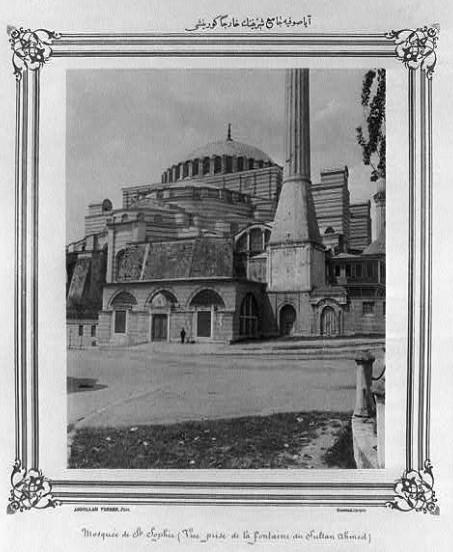
The Exterior of Hagia Sophia in the Late 19th Century (Library of Congress)
The social service dimension was also not neglected in the foundation deed. The appointment of a teacher to educate orphaned children illustrates the diversity and inclusiveness of the services surrounding Hagia Sophia. Although later foundation deeds established the Hagia Sophia Darüttalimi as an independent charitable institution, in the early waqf structure this educational service was integrated among the mosque’s assigned duties. Furthermore, the appointment of two attendants indicates that the water needs of the congregation and the mosque’s surroundings were addressed as a regular service. The inclusion of regulations concerning the guards of the Grand Bazaar among the personnel and allocations of Hagia Sophia Mosque highlights a significant detail: the mosque’s endowment was interconnected with the city’s economy, security, and commercial regulation.
The administration of the Hagia Sophia-i Kebir Waqf was conducted within the fundamental principles of Ottoman waqf law. The founder’s conditions, the qualifications and salaries of staff, the allocation of revenues, and the principles of governance were all defined by the terms of the foundation deed. This structure separated the daily operations of Hagia Sophia from personal discretion by embedding them in a written and binding institutional framework. The salaries paid to staff in akçe and dirhem denominations demonstrate that the services were organized in a hierarchical and systematic structure.
This waqf status provided the foundation for the emergence of new institutions around Hagia Sophia in subsequent centuries. Structures such as the madrasa, library, imaret, primary school, sebil, şadırvan, and muvakkithane were added in different periods; each operated under its own endowment conditions, staff, and revenue sources, thereby expanding Hagia Sophia’s institutional environment. Thus, during the Ottoman period, Hagia Sophia did not remain merely a structure converted into a mosque after the conquest but continued to function as a major urban institution sustained by waqf law, revenue sources, appointed personnel, and social services.
During the Ottoman period, Hagia Sophia functioned as one of Istanbul’s central mosques, embedded within the religious, ceremonial, and social rhythms of the capital. Its designation as a congregational mosque after the conquest revealed that the building was not used solely for daily prayers; it became a regular point of contact between the palace, the ulema, the congregation, and the urban populace through Friday prayers, holiday rituals, ceremonies on Laylat al-Qadr, mevlid recitations, preaching and guidance activities, and ceremonies attended by the sultan. In this regard, Hagia Sophia was one of the key structures in Ottoman Istanbul where the daily, weekly, and annual rhythms of religious life could be observed.
Friday prayers were one of the primary acts of worship that defined the role of Hagia Sophia in the life of the Ottoman capital. Because the sermon was linked to the religious legitimacy of sovereignty within the Ottoman political order, Friday prayers held in central mosques such as Hagia Sophia were not merely congregational acts of worship but also public ceremonies that visibly manifested the authority structure of the city. The sultan’s attendance at Friday salutations constituted one of the direct forms of contact between the palace and the urban populace. During these ceremonies, the sultan’s arrival at the mosque, his retinue, the procession route, security arrangements, and reception protocols all reinforced the public dimension of the prayer. Hagia Sophia’s proximity to the Topkapı Sarayı positioned it as an ideal venue for such ceremonies.
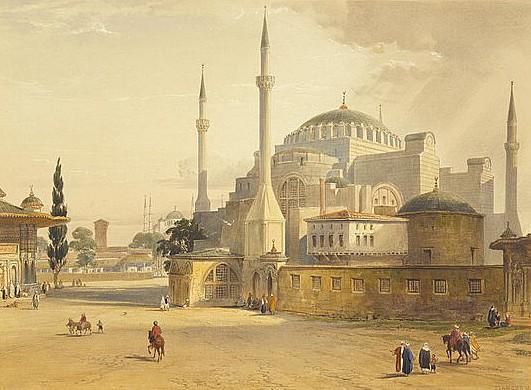
View of Hagia Sophia from Bâb-ı Hümâyûn (Library of Congress)
The use of Hagia Sophia during Ramadan further highlighted its capacity to accommodate large congregations and its bond with the capital’s population. During Ramadan nights, especially the tarawih prayers, the mosque was attended by vast crowds. The Night of Qadr was one of the most significant ceremonial occasions in the Ottoman religious calendar, and Hagia Sophia served as one of its primary venues. It was a longstanding practice for the sultans to perform tarawih prayers in Hagia Sophia on the 27th night of Ramadan and then participate in the subsequent supplication. The formal petition presented to the sultan to attend these prayers demonstrated that the Night of Qadr observance held a formal place within palace protocol. As with Friday salutations, the sultan would proceed to the mosque accompanied by his retinue; the route from the palace gate to Hagia Sophia’s salutation gate was illuminated by torchbearers.【49】 Thus, nighttime worship became integrated into a ceremonial procession extending from the palace to the mosque.
Eid prayers also reinforced Hagia Sophia’s role as a center for communal worship and social cohesion in the life of the capital. On Eid mornings, the mosque became one of the central places of worship to which not only the surrounding populace but also state officials and members of the palace circle turned. In Eid prayers attended by the sultan, the spatial arrangement within the mosque—the hünkâr mahfili, officials, preachers, sermonizers, muezzins, and the congregation’s positioning—reflected the religious and social structure of the capital within the physical space of the mosque.
Sermons and guidance activities at Hagia Sophia were an essential component of the mosque’s role in religious education and public outreach in the capital. The appointment of positions such as hatip and vaiz to carry out these duties was directly under the authority of the Shaykh al-Islam. Special attention was paid to the qualifications of personnel assigned to major mosques like Hagia Sophia, and extensive investigations were conducted. After completing the full research and approval process, the appointed hatips and vaizes delivered sermons at Hagia Sophia and conducted regular public educational programs. Vaizes sometimes delivered Friday sermons in the form of Qur’anic exegesis. It is recorded that during the reign of Bayezid II, Muhyiddin Mehmed b. Ibrahim b. Hasan Niksârî completed the recitation of the entire Qur’an through his sermons at Hagia Sophia.【50】 This example demonstrates that the pulpit of Hagia Sophia was not merely a venue for brief sermons but also functioned as a continuous and systematic center for religious instruction and guidance.
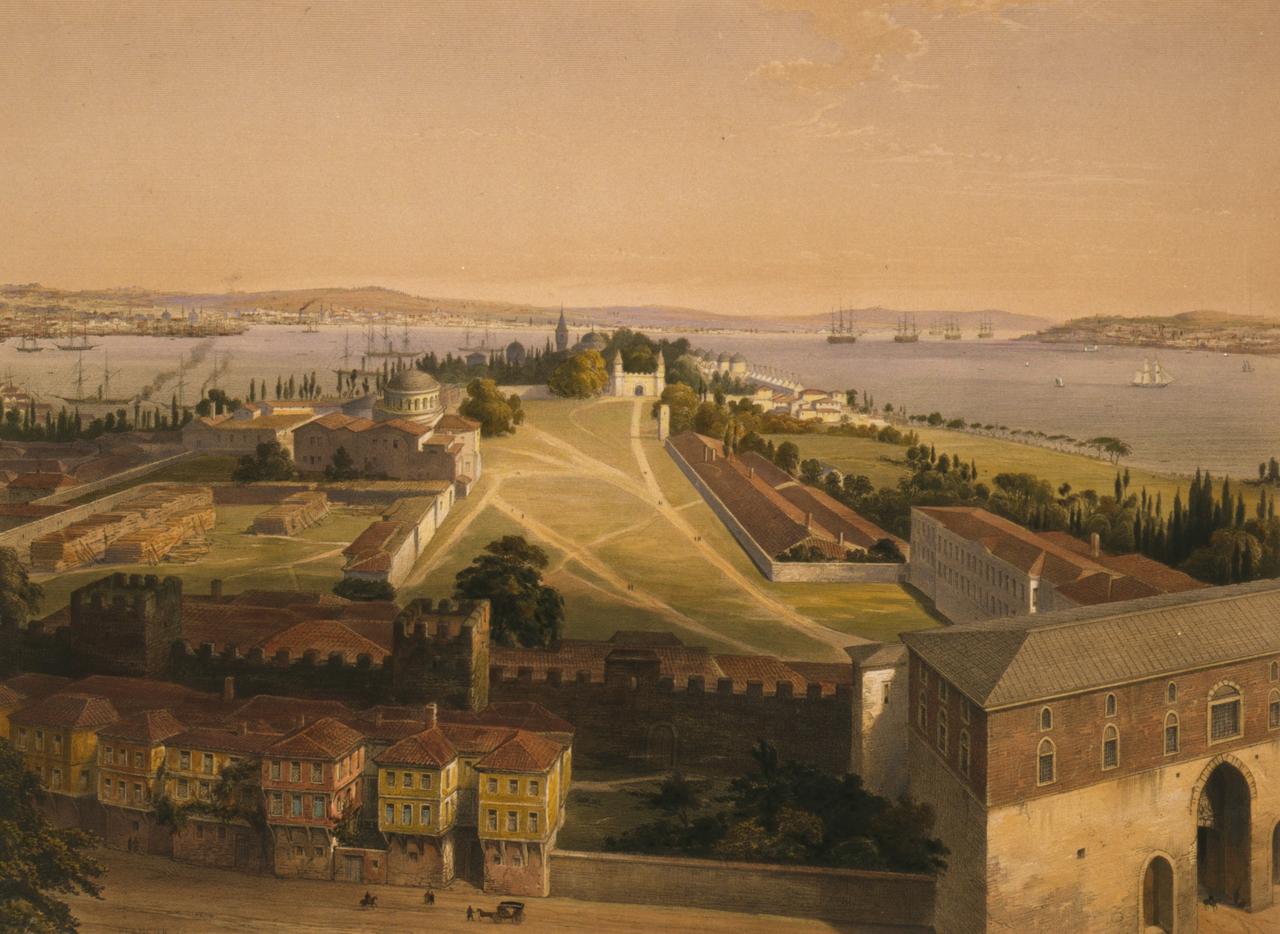
Panorama of Istanbul from the Minaret of Hagia Sophia (Library of Congress)
Sermon activities at Hagia Sophia were not limited to Fridays. Records from the 18th century indicate that vaizlik duties were also carried out on specific days of the week. A document dated 1 Rebîülevvel 1133 / 31 December 1720 records a request for the appointment of a vaiz to deliver a sermon at Hagia Sophia after the afternoon prayer on a Tuesday.【51】 The existence of a dedicated vaizlik position for Kadir Night further illustrates how the mosque’s religious program was divided into distinct service areas within its annual calendar. The occasional bestowal of gifts and honors upon vaizes by the sultan or grand vizier reveals that the pulpit of Hagia Sophia was regarded as a prestigious and esteemed position within the imperial and state circles.
The preachers and sheikhs of Hagia Sophia played a visible role in the mevlit ceremonies held in Istanbul. The mevlit, a ritual involving the recitation of literary and religious texts recounting the birth of the Prophet Muhammad, according to specific maqams and methods, held a prominent place in Ottoman religious life. The mevlits recited at Hagia Sophia and in ceremonies associated with it were part of ceremonies where the palace and the public gathered in the same religious space. In some mevlit ceremonies held in Istanbul, after the recitation by the muezzins’ gallery was completed, the Sheikh of Hagia Sophia would first deliver a sermon, followed by the Sheikh of Sultan Ahmed; it is recorded that afterward, both preachers were dressed in samur fur coats and given money.【52】
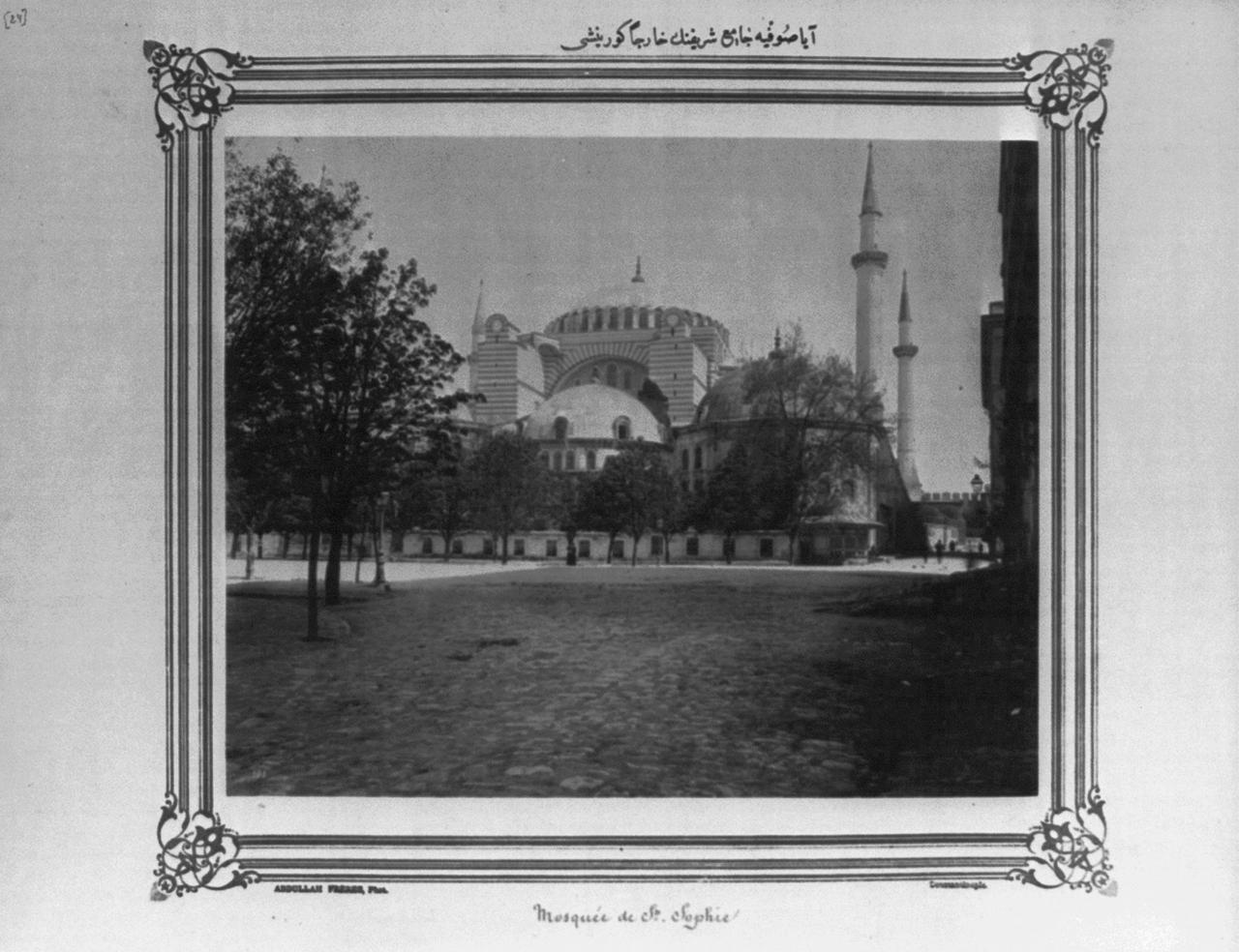
Exterior View of Hagia Sophia (Library of Congress)
The place of Hagia Sophia in the life of the Ottoman capital was also reflected in popular narratives and urban memory. Alongside traditions inherited from the Byzantine period, new legends, anecdotes, and stories emerged during the Ottoman era. An example of such narratives is the account of Fatih Sultan Mehmed seeing the Kaaba during his first Friday prayer in Hagia Sophia. According to the tradition, Fatih wished for the person leading the prayer to be someone who had never missed the sunna prayers of the afternoon prayer; when no such person could be found, he himself assumed the role of imam. After the first two takbirs, he interrupted the prayer, explaining that he could not see the Kaaba. During the third takbir, Hızır, as seen by Akşemseddin in the spiritual realm, approached the vacant spot at the rear of the congregation and inserted his finger into the Terler Direği, thereby reorienting Hagia Sophia toward the qibla; immediately afterward, Fatih saw the Kaaba before him and completed the prayer.【53】
Such narratives reveal that Hagia Sophia was understood not only in state and waqf records but also in popular imagination as a space alive with themes of conquest, worship, and miracle. Collective worship days such as Ramadan, Laylat al-Qadr, festival prayers, and mevlids were moments when this memory was repeatedly renewed. Thus, in Ottoman Istanbul, Hagia Sophia became a multifaceted capital institution, serving as the palace’s representative space, the ulama’s pulpit of guidance, the congregation’s place of worship, and the carrier of popular narratives.
The history of Hagia Sophia during the Ottoman period was shaped not only by its use as a mosque but also by efforts to preserve, reinforce, and adapt the structure to new functions. The large domed building, inherited from the Byzantine era, with its load-bearing system and prior repairs, required continuous maintenance. The Ottoman administration did not merely use the structure as a place of worship; it expanded its surroundings by adding minarets, mihrabs, pulpits, mahfills, turbes, a library, a fountain, a soup kitchen, and other additions, while simultaneously undertaking interventions to ensure the building’s structural survival. Therefore, Ottoman-era restorations aimed at preservation, functional adaptation, and the creation of an institutional environment befitting the capital’s mosque.
The earliest interventions after the conquest were primarily aimed at enabling the building’s function as a mosque. The addition of elements such as the mihrab, minbar, mahfill, and wooden minaret allowed the structure to open for congregational worship in a short time. However, due to the age and monumental scale of Hagia Sophia, the need for reinforcement became apparent from the early period onward. It is reported that the first minaret was constructed on top of the southern small buttress tower beside the western half-dome, using wood; it remained standing for a long time before being removed during the 1573–1574 restoration under Sultan Selim II.【54】 Although there are differing opinions regarding whether the brick minaret in the southwest corner dates to the reign of Fatih or II. Bayezid, it is clear that it was one of the primary additions during the early Ottoman period that visibly established the building’s identity as a mosque.【55】
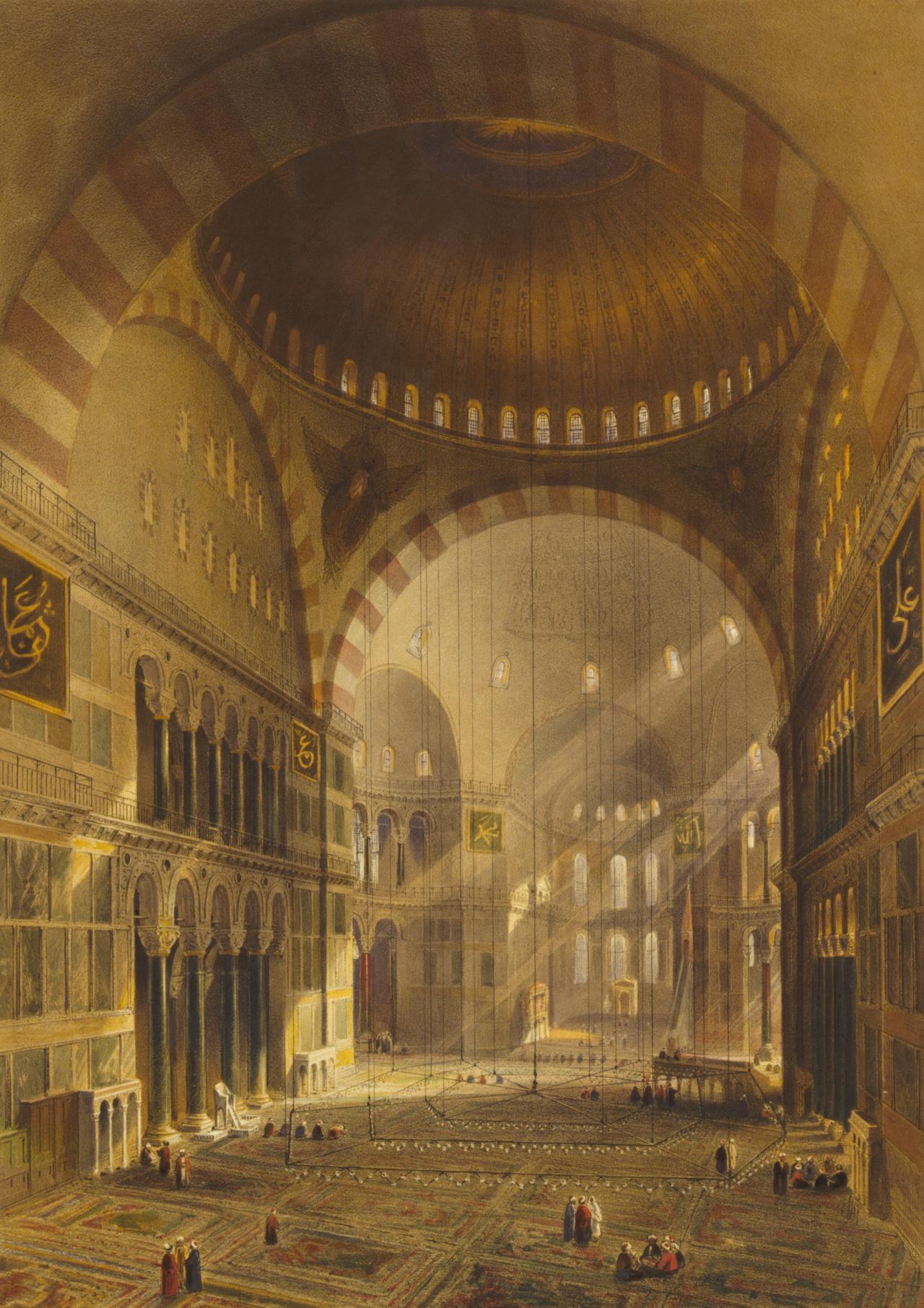
Interior of Hagia Sophia During the Fossati Restoration (Library of Congress)
The 16th century was one of the most significant phases of intervention in Hagia Sophia during the Ottoman period. Following the conquest of Buda, two large bronze chandeliers were brought to Hagia Sophia and installed on either side of the mihrab in 1526. This addition not only introduced a functional lighting element into the interior space but also linked Ottoman memory of conquest to the mosque’s internal design. In the same century, the re-registration of Hagia Sophia’s endowments demonstrated that efforts extended beyond mere physical maintenance to strengthening its income and administrative structure.
The reign of Selim II marked a decisive phase in the preservation of Hagia Sophia. During this period, houses and unauthorized constructions surrounding the building were demolished on the grounds that they distorted its appearance and threatened its structural integrity. It is recorded that Mimar Sinan, together with the sultan, conducted an on-site inspection and that decisions were made to clear the area around the mosque, repair sections requiring roofing or restoration, and install buttresses at points needing reinforcement.【56】 These interventions reveal that during the Ottoman period, Hagia Sophia was regarded not merely as an active mosque but as an ancient and delicate structure requiring active preservation. The buttresses installed by Mimar Sinan provided external support to the building’s load-bearing system and played a crucial role in its survival into subsequent centuries.
Interventions during the reign of Selim II were not limited to structural reinforcement. The area around Hagia Sophia also began to take shape as a necropolis housing the dynasty’s tombs during this period. The construction of a tomb for Selim II near Hagia Sophia transformed the building from a mere imperial mosque into a space intrinsically linked to the dynastic burial ground. This character was further strengthened with the later construction of tombs for Murad III, Mehmed III, and other princes.
During the reign of Murad III, the interior arrangement of the Ayasofya Camii was further enriched. Elements such as the pulpit, lectern, galleries, and muezzin galleries became more prominent during this period, and new structures were added to accommodate the prayer and recitation rituals within the mosque. Two large Hellenistic-era marble cubes, discovered in Bergama, were brought to Ayasofya and repurposed as fountains, each capable of holding 1,250 liters of water. The transformation of ancient monolithic marble artifacts into water features within an Ottoman mosque is one of the most striking examples of the layered material use in Ayasofya.【57】 Additions made during the 16th and 17th centuries—including the mihrab, minbar, muezzin galleries, sermon pulpits, and maksures—demonstrate the gradual evolution of Ayasofya’s interior use in accordance with Ottoman worship practices.
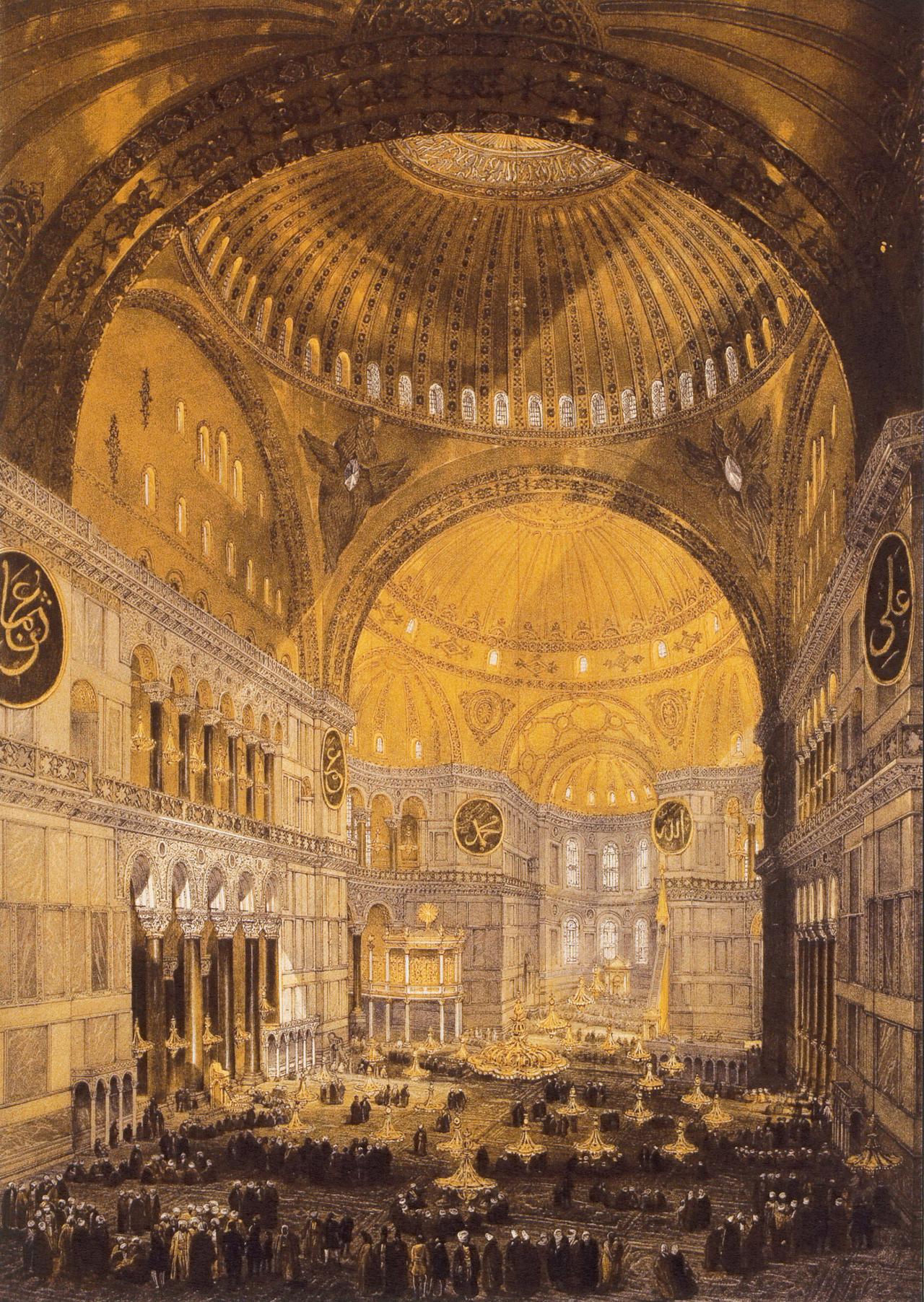
General View of the Central Nave During the Fossati Restoration (Library of Congress)
In the 17th century, calligraphic inscriptions and decorative elements became prominent within the interior of Hagia Sophia. The placement of the Bismillah in ceramic tile on the mihrab wall in 1607 was one of the measures taken to strengthen the mosque’s Islamic visual identity. It is known that during the reign of Murad IV, the interior was adorned with calligraphic panels, and in 1651, large panels executed by the calligrapher Teknecizâde İbrâhim Efendi were installed. These panels were removed during the Fossati restoration in the 19th century; later, large circular calligraphic panels with a diameter of 7.5 meters by Kazasker Mustafa İzzet Efendi were hung inside the interior.【58】 Thus, the Ottoman-period interior arrangement of Hagia Sophia bears traces of evolving calligraphic, decorative, and devotional practices across different centuries.
In the 18th century, interventions around Hagia Sophia integrated the structure more distinctly into a comprehensive külliye complex. It is recorded that during the reign of Ahmed III, the sultan’s loge was renovated, a large chandelier was suspended in the center of the mosque, and general maintenance works were carried out.【59】 The reign of Mahmud I represents one of the most comprehensive phases of this process. Between 1730 and 1754, a library, fountain, elementary school, soup kitchen, and associated service buildings were added around Hagia Sophia. The library occupied a distinct place within the mosque not merely as a book repository but as an independent scholarly institution with its own staff, curriculum, and endowment deed. The fountain and sebils provided water services, the elementary school delivered basic education, and the soup kitchen fulfilled social welfare and sustenance functions. Thus, in the 18th century, Hagia Sophia attained a fully developed character as a multifunctional Ottoman külliye centered on the mosque.
The most comprehensive Ottoman intervention of the 19th century was the major restoration carried out by the Fossati brothers during the reign of Sultan Abdülmecid. This restoration, conducted between 1847 and 1849, addressed the building’s structural system, interior surfaces, plasters, decorations, calligraphic program, and certain additional structures.【60】 It is evident that the initial survey report expanded over time, costs increased, and the restoration was completed with a substantial budget. The restoration was not confined to a mere architectural maintenance effort; a grand preparatory ceremony involving state officials was organized for the mosque’s reopening. This underscores that in the late Ottoman period, Hagia Sophia remained closely associated with state prestige and the patronage of the sultan.
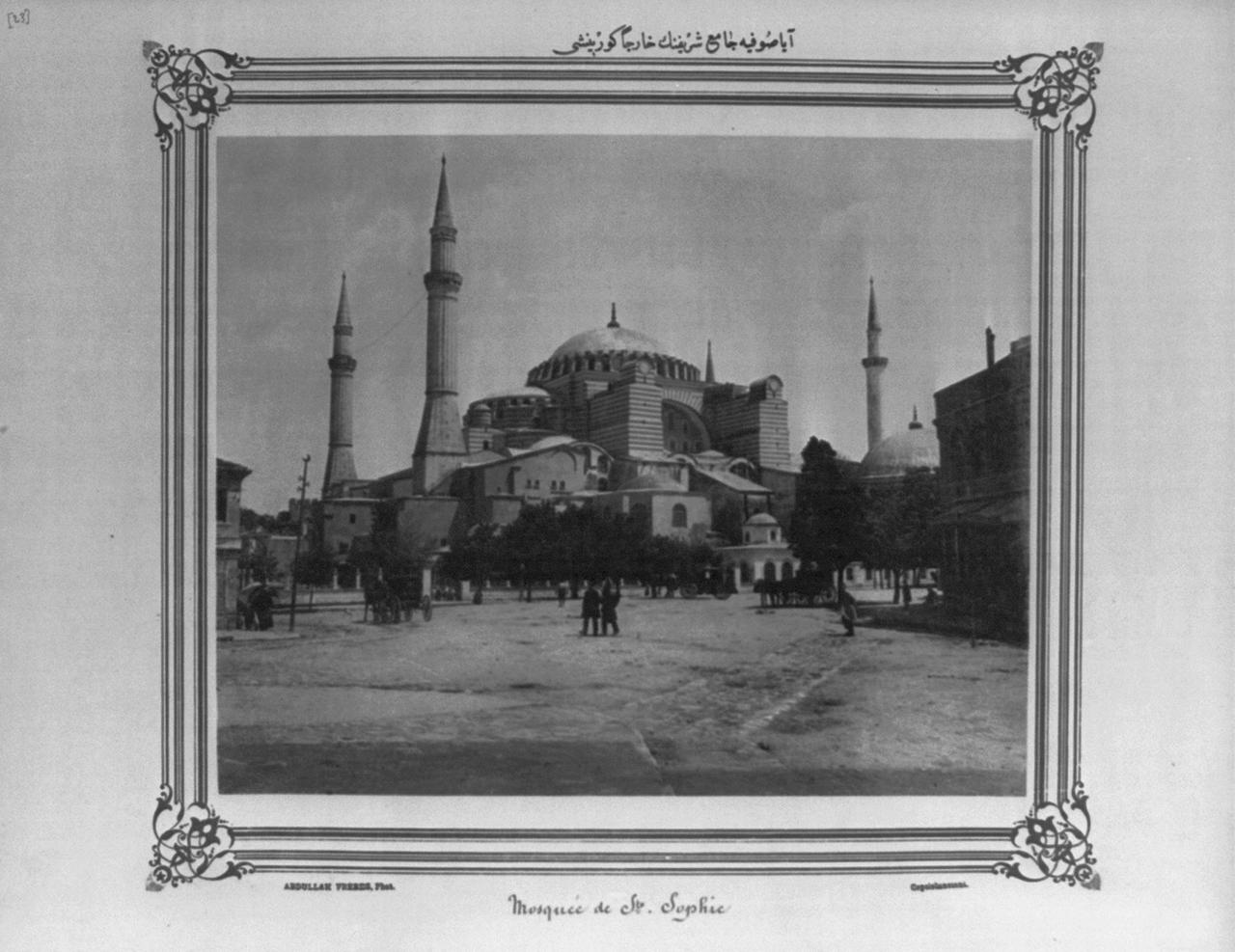
19. Yüzyılda Ayasofya'nın Dışarıdan Görümü (Library of Congress)
During the Fossati restoration, some of the mosaics inside the mosque were uncovered, documented, and then resealed. This practice demonstrates that the Byzantine heritage of Hagia Sophia was not entirely erased within the 19th-century Ottoman restoration context; rather, the building was treated while preserving its function as a mosque. During the same period, large calligraphic panels were commissioned by Kazasker Mustafa İzzet Efendi, the 35th verse of Surah Nur was inscribed on the main dome, and arrangements were made for imperial use, including the hünkâr mahfili and kasr-ı hümâyun.【61】 The Fossati restoration aimed to preserve the structural integrity of Hagia Sophia while endowing it with an appearance befitting a mosque according to late Ottoman aesthetic and ceremonial norms.
After the reign of Abdülmecid, maintenance of Hagia Sophia continued intermittently. Between 1839 and 1923, Hagia Sophia-i Kebir Camii underwent numerous minor and major repairs. Following the Fossati restoration of 1847–1849, various repairs were carried out in 1855, 1858, 1859, 1860, 1861, 1880, 1882, 1894, 1896, 1899, 1904, and 1905.【62】 These records demonstrate that Hagia Sophia was not left to deteriorate through a single major restoration; rather, it was regarded throughout the 19th century as a structure requiring regular monitoring and intervention.
The 1894 earthquake was one of the most significant instances of damage to Hagia Sophia during the late Ottoman period. After the earthquake, cracks appeared in the building’s walls, and some mosaic surfaces collapsed along with their plaster backing. During the Constitutional Era, Western architects including Marangoni, Jackson, Propper, and Prost were commissioned to assess the building’s condition, and restoration preparations were undertaken under the supervision of Mimar Kemaleddin Bey. However, the political and economic conditions at the beginning of the 20th century made it difficult to implement the anticipated comprehensive interventions. Despite inspection reports prepared in 1910, no major restoration was carried out; the expected repairs were only partially addressed during the Republican period, limited to reinforcement and restoration work completed in 1926.
The repairs and interventions during the Ottoman period constitute one of the primary factors ensuring Hagia Sophia’s historical continuity. Mimar Sinan’s buttresses, the construction of minarets, imperial tombs, I. Mahmud’s külliye additions, the Fossati restoration under Abdülmecid, and late 19th- to early 20th-century maintenance efforts illustrate how the structure was addressed according to evolving needs in different eras. These interventions reveal that during the Ottoman period, Hagia Sophia was not preserved merely as a relic inherited from the past; rather, it was actively maintained as a multi-layered capital structure tied to worship, representation, dynastic memory, education, social services, and state prestige.
The history of Hagia Sophia in the Republican era has been shaped around the transformation of its identity from a mosque inherited from the Ottoman period into a museum, the conservation and research activities carried out under this status, the ongoing debates regarding its status throughout the museum period, and its reopening for worship as a mosque again in 2020. This period marks an era in which Hagia Sophia was redefined not only in terms of its religious function but also in relation to cultural heritage, antiquities law, museology, archaeology, restoration, international scholarly interest, and the administrative decisions of the Republic of Türkiye. The museum period initiated by the 1934 decision laid the groundwork for a new approach to conservation and display that aimed to make visible both the Byzantine and Ottoman heritage of Hagia Sophia; the most recent status change in 2020 constituted the second major administrative-legal transformation of the building in Republican history.
The conversion of Hagia Sophia into a museum was enacted by a decision of the Council of Ministers dated 24 November 1934; however, this decision did not emerge as an abrupt administrative act.【63】 Institutional awareness regarding the preservation of antiquities, museology, and archaeology that had developed in the late Ottoman Empire continued into the early years of the Republic through new cultural policies, historical research, and approaches to the protection of monumental structures. During this transitional phase, Hagia Sophia, as a structure embodying both Byzantine and Ottoman pasts, became one of the foremost buildings in the early Republican period whose religious, historical, and cultural meanings were simultaneously brought to the forefront of public discourse.
In the early years of the Republic, Hagia Sophia first entered public discourse due to its urgent needs for maintenance and repair. The building had already undergone various restoration efforts during the final years of the Ottoman period; however, wars, financial difficulties, and the state’s broader transformation left comprehensive conservation challenges to the Republic. Throughout the 1920s and 1930s, Hagia Sophia’s architectural condition, interior decorations, surrounding structures, mosaics, and the possibility of its conversion into a museum were discussed together. In this context, Hagia Sophia gradually came to be regarded not merely as a place of worship but as a multi-layered historical structure whose status as an antiquity was increasingly emphasized.
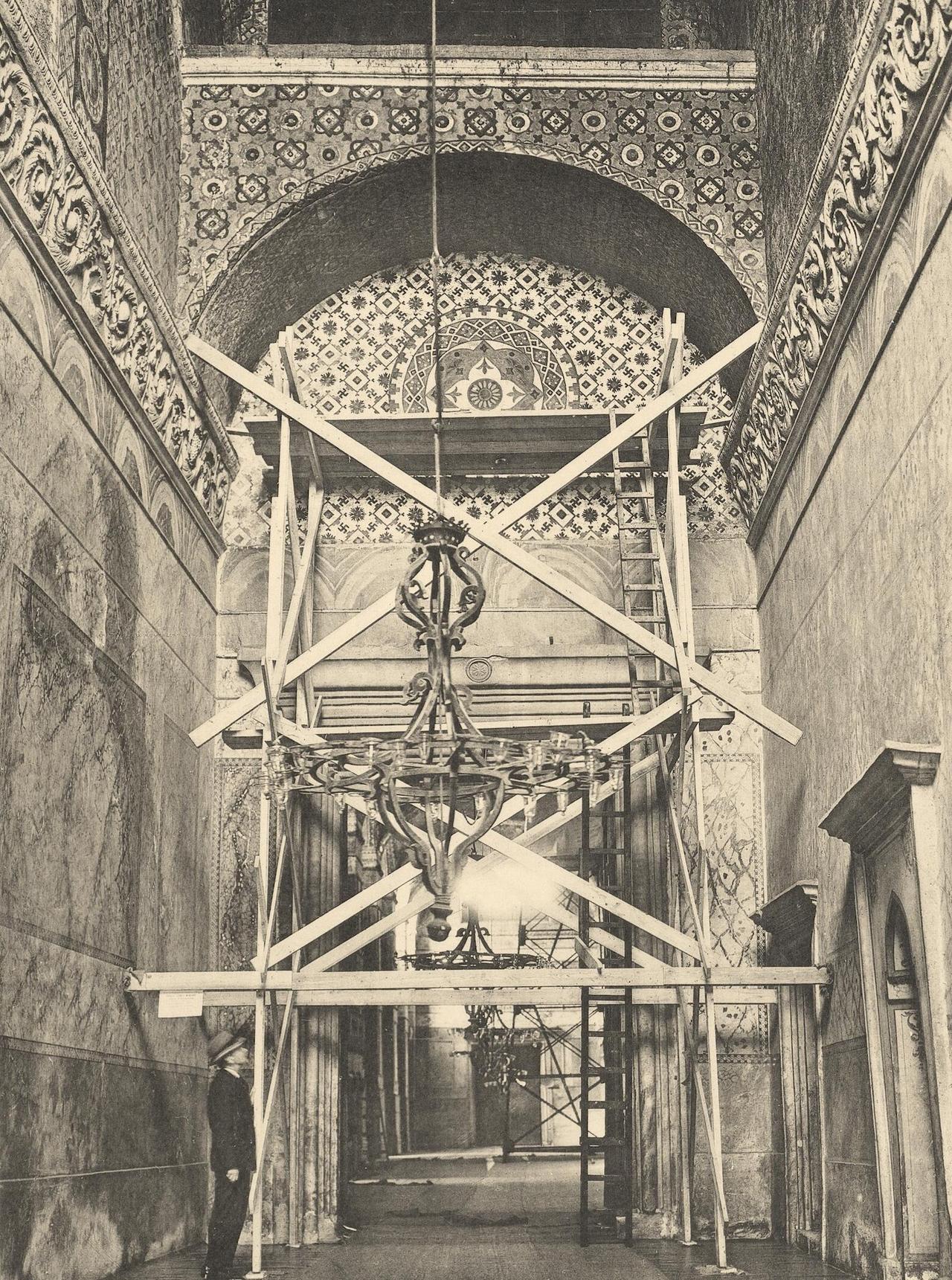
A frame taken during Thomas Whittemore's work (Universitätsbibliothek Heidelberg)
The exposure of mosaics during the process of conversion into a museum constituted a significant stage. In 1931, permission was granted to Thomas Whittemore on behalf of the American Institute of Byzantine Studies to conduct work on the mosaics of Hagia Sophia, and the studies began in 1932. This permission enabled the scientific examination of figural and non-figural decorations from the Byzantine period within Hagia Sophia.【64】 The uncovering of certain figural mosaics, which had remained largely concealed during the Ottoman period due to the building’s function as a mosque, laid the groundwork for evaluating the historical layers of the structure within a museum framework.
The administrative process toward converting Hagia Sophia into a museum accelerated during 1934. Prior to the decision, preparations concerning the building’s restoration, interior arrangement, and surrounding area were brought to the agenda, and media reports announced that Hagia Sophia would become a museum. On 24 November 1934, by Council of Ministers Decision No. 2/1589, Hagia Sophia was removed from its status as a mosque and placed under the administration of the General Directorate of Museums, subordinate to the Ministry of National Education.【65】 The decision foresaw the removal of Hagia Sophia from its role as a place of worship and its opening to public visitation as a historical monument and museum. Thus, Hagia Sophia acquired a new status within the Republic administration’s policies regarding heritage preservation and museum practice.
During the early Republican period, ancient monuments were addressed alongside museology, archaeology, and heritage policies; monumental structures began to be viewed not merely in terms of their original functions but as cultural heritage elements requiring preservation, exhibition, and integration into the new national cultural narrative.【66】 The conversion of Hagia Sophia into a museum was also framed within this context, aiming to preserve and display traces from both the Byzantine and Ottoman periods within the same structure. However, the 1934 decree later became a subject of debate, particularly due to the form of Atatürk’s signature and its non-publication in the Official Gazette. In response to these claims, Erkin Akan argued that the decree of 24 November 1934 was authentic and that Atatürk’s signature had not been forged; Abdullah İkinci also provided a detailed analysis of the debates concerning the decree’s form, signature, and publication.【67】
The conversion of Hagia Sophia into a museum also necessitated certain modifications within its interior space. Carpets and other items associated with its function as a mosque were removed; large calligraphic panels were temporarily taken down and later rehung. The medrese established around Hagia Sophia during the reign of Fatih Sultan Mehmed was used for a time during the Republican period as an orphanage; after being emptied in 1935, it was demolished between 1935 and 1936 under the justification of clearing the area around Hagia Sophia.【68】 These practices demonstrate that the process of museumification was not merely a change of name or administrative status but had direct consequences for the building’s internal layout, surroundings, and mode of use. Therefore, the 1934 decision marks the first major turning point in the history of Hagia Sophia during the Republican period, affecting both its function and spatial organization.
Preparations for the museum opening were completed within a short period. Funds were allocated for the restoration of the first narthex of Hagia Sophia and for identifying the artifacts to be transferred to the museum; following these preparations, the building was opened to the public and foreign tourists as a monument museum on 1 February 1935. The museum admission fee was set at 11 kurus, tickets were prepared, and a visitation system was established. On the first day of opening, sources report approximately 750 visitors; it is recorded that on 6 February 1935, Mustafa Kemal Atatürk visited the Hagia Sophia Museum and conducted inspections.【69】
The opening of Hagia Sophia as a museum in 1935 not only changed its mode of use but also initiated a new phase in research, exhibition, and conservation practices. The structure, which had been preserved during the Ottoman period as a mosque, was now treated as a monument museum in the Republican era; Byzantine, Ottoman, and earlier architectural layers began to be studied together. During this period, Hagia Sophia became not merely a site for visitation but also a research area where archaeological excavations, mosaic cleaning efforts, architectural documentation, and conservation measures were carried out.
The uncovering of mosaics stands as one of the most notable achievements of the Hagia Sophia Museum period. These efforts began just before the decision to convert the building into a museum. The American Byzantine Institute granted Thomas Whittemore permission to work on the mosaics of Hagia Sophia, and from 1932 onward, systematic examination and cleaning activities were conducted within the building. These efforts enabled the rediscovery and partial revelation of Byzantine mosaics. In fact, the existence of the mosaics had been known since the Fossati restoration of the 19th century; Gaspare and Giuseppe Fossati had uncovered certain mosaics during repairs commissioned by Sultan Abdülmecid, made drawings of them, and then resealed them since the building continued to function as a mosque. In the Republican era, however, this same heritage was now regarded as an exhibitable element within the museum framework.
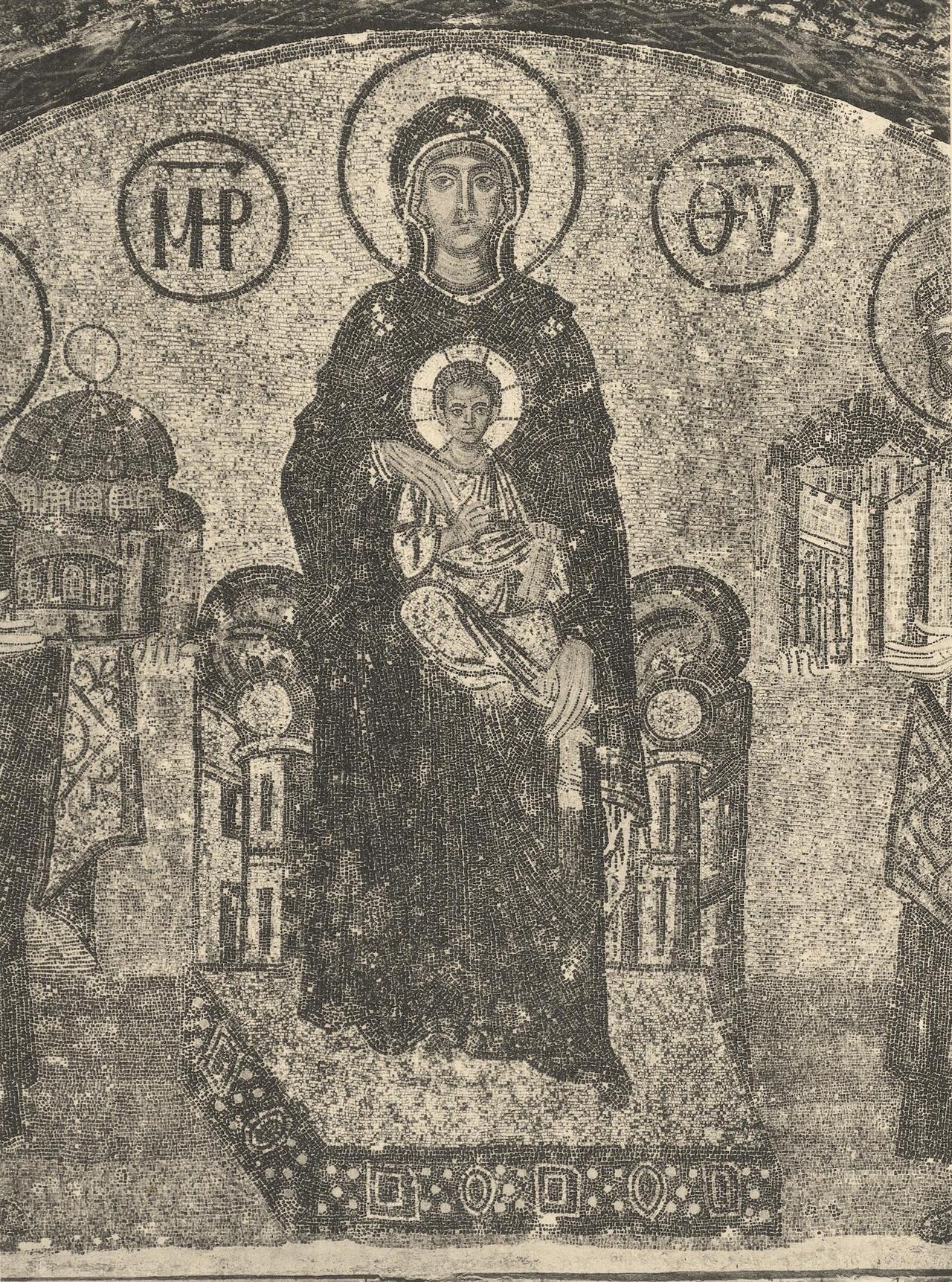
A Mosaic Discovered During Thomas Whittemore’s Work (Universitätsbibliothek Heidelberg)
As a result of Whittemore and his team’s work, significant figural mosaics in various parts of Hagia Sophia were uncovered or documented in greater detail. Among these are the depiction of the Virgin Mary, Constantine, and Justinian in the southwest vestibule; the composition showing Emperor Leo VI prostrating before Christ above the Imperial Door; the image of the Virgin Mary and the Child Christ in the semidome of the apse; and one of the archangel figures on the bema arch. On the gallery level, the portrait of Emperor Alexander in the north gallery, the saintly figures surrounding the north tympanum wall, the Deesis scene in the south gallery, the mosaics of Empress Zoe and Emperor Constantine IX Monomachos, as well as those of Emperor John II Komnenos, his wife Irene, and their children, have provided a detailed insight into Hagia Sophia’s Byzantine visual program.
The impact of the mosaic restoration work extended beyond the field of art history. The revelation of figural imagery made Hagia Sophia’s Byzantine identity more visible, while simultaneously raising the question of how to preserve the building’s Islamic identity acquired during the Ottoman period. Large calligraphic panels, removed from their original positions during the conversion of Hagia Sophia into a museum, were taken outside the building. However, as these panels with a diameter of 7.5 meters could not pass through the doorways, they were stored on the floor of the mosque for an extended period before being rehung in their original locations. This episode exemplifies the practical and symbolic uncertainty surrounding the placement of Ottoman-era mosque elements during the museum conversion process.【70】 In this regard, the Hagia Sophia Museum became central to the debate over how traces from different historical periods could be exhibited within a single structure.
The museumification process has also been supported by archaeological excavations around the structure. Excavations conducted by the German Archaeological Institute in the grounds of Hagia Sophia began during the period when its identity as a museum was taking shape. Following permissions granted by the Council of Ministers, these investigations, which commenced in 1935 and continued until 1939, were led on-site by Alfons Maria Schneider with the support of Institute Director Martin Schede. The aim of the excavations was to investigate the atrium dating to the Justinianic period, courtyard elements such as the phiale, and remnants of earlier Hagia Sophia structures. Research focused particularly on the western facade and the surrounding courtyard, uncovering large marble architectural fragments believed to belong to the reign of Theodosius II, remains related to the entrance, and traces of the courtyard floor. Based on the finds uncovered during the excavations carried out on behalf of the German Archaeological Institute between 1935 and 1939, Schneider argued that he had discovered the entrance section of the Theodosian Hagia Sophia.【71】
These excavations directly contributed to the museum’s presentation by making the physical traces of early Hagia Sophia structures visible. The fragments uncovered at the excavation site were not only published in scholarly works but also displayed within the gardens of Hagia Sophia, becoming an integral part of the visitor experience. Thus, museumification was realized not only within the building’s interior but also in its surrounding archaeological space. Visitors to Hagia Sophia could now encounter not only the Byzantine and Ottoman layers of the main structure but also architectural elements from the earlier Theodosian building. This approach expanded the narrative of Hagia Sophia’s history beyond the 537 Justinianic structure to incorporate earlier phases of construction on the same site into the museum’s interpretive framework.
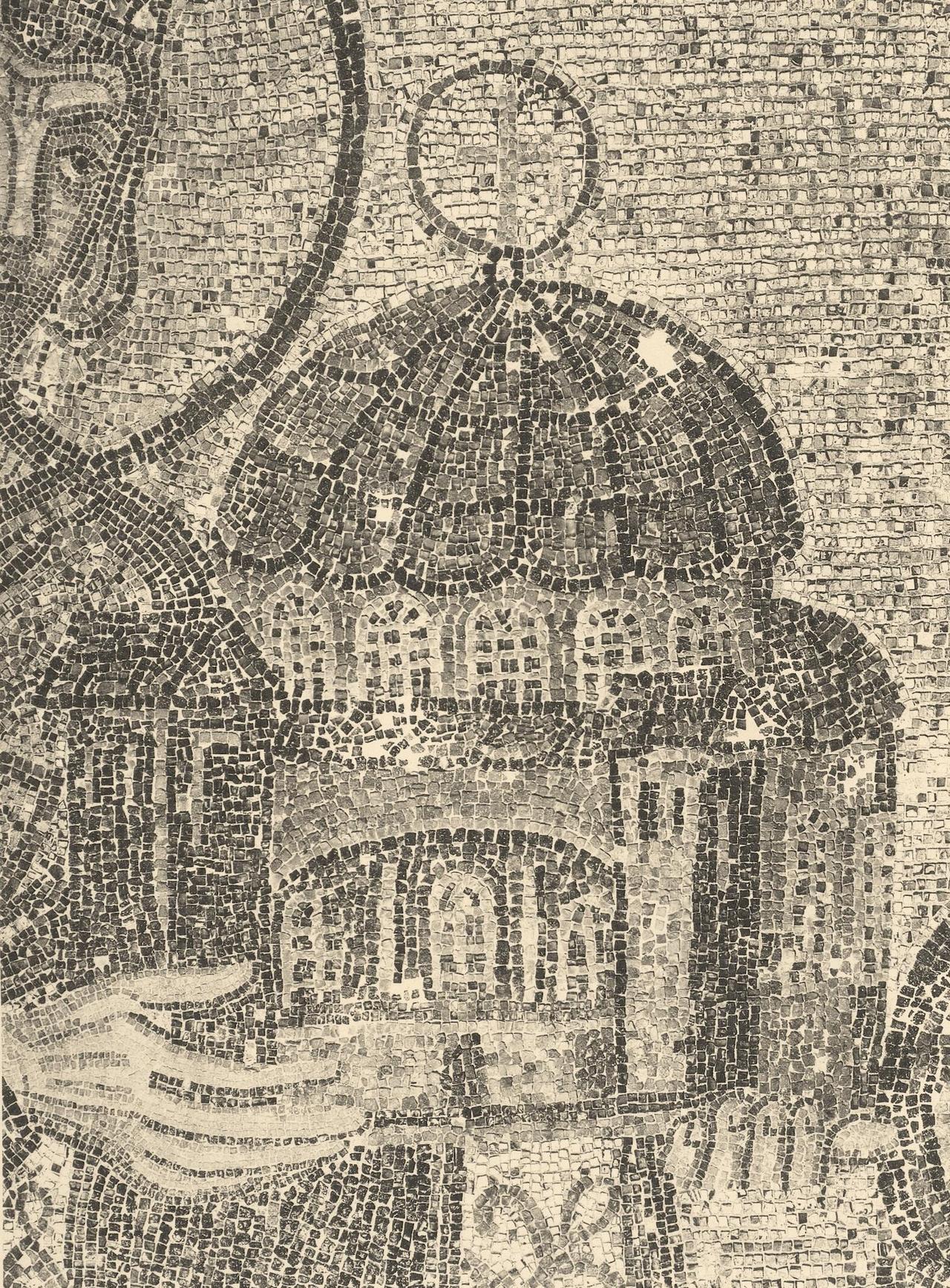
One of the Mosaics Uncovered by Thomas Whittemore (Universitätsbibliothek Heidelberg)
Research during the Hagia Sophia Museum period was not limited to the work of foreign institutions. It is reported that Muzaffer Ramazanoğlu, director of the Hagia Sophia Museum between 1944 and 1950, conducted several investigations within and around the building.【72】 These efforts demonstrate that the museum administration continued activities aimed at understanding the historical layers and architectural features of Hagia Sophia. Preservation of the structure during the museum period remained an ongoing concern requiring constant maintenance. The massive load-bearing system, seismic risk, humidity issues, conservation of mosaics, preservation of Ottoman-era additions, and increasing visitor density were the primary factors determining the need for regular examination, maintenance, and restoration at Hagia Sophia.
The preservation of Hagia Sophia during the museum period necessitated the simultaneous recognition of both Byzantine and Ottoman heritage within the same structure. The decision to retain and preserve the I. Mahmud Library in its original location is one example of this multi-layered approach to heritage. The library, one of the most significant Ottoman additions from the mosque period, continued to exist within the museum’s framework; although the books were later moved to the Süleymaniye Library, the architectural integrity of the structure was maintained. Similarly, the şadırvan, the sıbyan mektebi, the imaret, the muvakkithâne, the türbes, and other additions persisted as Ottoman elements contributing to the environmental unity of Hagia Sophia during the museum period.
The museum status of Hagia Sophia has also defined its position within the realm of international cultural heritage. With the Historic Areas of Istanbul being inscribed on the UNESCO World Heritage List in 1985, Hagia Sophia became more visible within the global heritage discourse as one of the most recognized structures in the area.【73】 This status has led to Hagia Sophia being evaluated not only within the framework of the Republic of Türkiye’s museum policies but also within international protection principles and cultural heritage debates.
The conversion of Hagia Sophia into a museum in 1934 has been a subject of debate from various perspectives throughout the Republican era. While some discussions centered on cultural policies and museum practices, others focused on the building’s endowment status, property records, and the legal nature of the 1934 Council of Ministers decision. As a result, the Hagia Sophia issue has become a multidimensional topic intersecting fields such as endowment law, heritage conservation principles, administrative authority, and the intended use of historical structures—not merely a religious or symbolic debate.
One of the earliest areas of debate concerning the 1934 decision relates to its historical context and administrative process. The transformation of Hagia Sophia into a museum was linked to the early Republic’s policies of preserving antiquities and exhibiting historical heritage within a museum framework. However, in subsequent years, various claims emerged regarding the manner in which the decision was reached, the official publication process, the signatures on the decree, and the political conditions of the period. The 1934 decision has been particularly contested in relation to the form of Atatürk’s signature, its non-publication in the Official Gazette, its legal status, and allegations of external pressure. Erkin Akan argues that the decree dated 24 November 1934 is authentic, that Atatürk’s signature was not forged, and that claims of external coercion are inconsistent with the political and social conditions of the 1930s.【74】
At the center of the legal debate is the waqf status of Hagia Sophia, inherited from the Ottoman period. The foundation deed of Fatih Sultan Mehmed serves as the primary basis for the argument that Hagia Sophia was endowed as a mosque and that this status was determined by the founder’s intent. When it is accepted in Türkiye that foundation deeds of waqfs established before 1926 possess the character of founding documents and that the founder’s intent must be preserved, the question arises as to whether converting Hagia Sophia into a museum is compatible with its original waqf purpose. Within this framework, Hagia Sophia has been regarded as a movable asset belonging to the Fatih Sultan Mehmed Waqf with a fixed waqf status.
One of the documents frequently cited in the debate is the land registry entry dated 19 November 1936. This record clearly states that Hagia Sophia was registered under the name of the Fatih Sultan Mehmed Waqf as the “Hagia Sophia Grand Mosque Complex consisting of a Mausoleum, Rental Houses, Timekeeper’s House, and Madrasa.”【75】 This description has become one of the key legal grounds for the argument that, despite its conversion to a museum in 1934, the property remains registered in the land registry as a mosque under waqf ownership. Furthermore, the inclusion of Hagia Sophia in the General Directorate of Foundations’ records as a movable asset has been further examined from the perspective of waqf law in discussions concerning its intended use.【76】
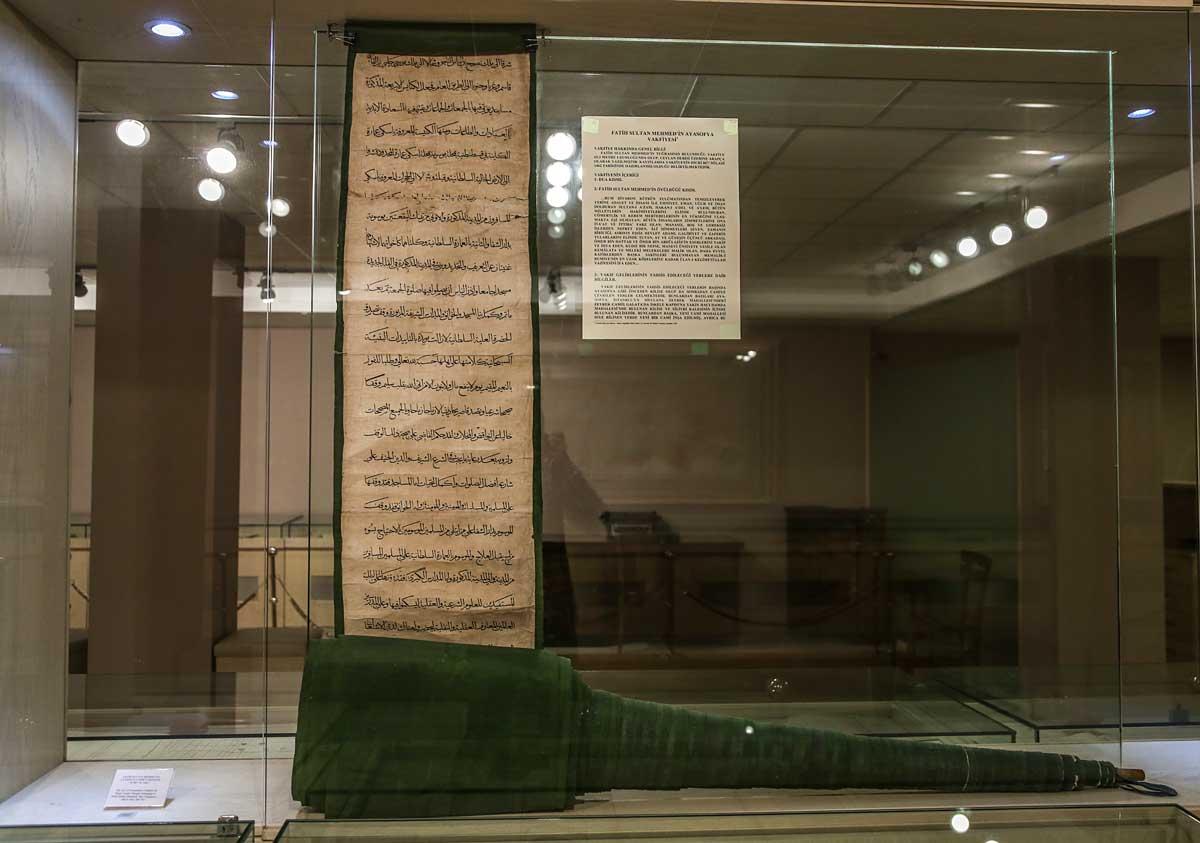
Fatih Sultan Mehmet’s Endowment Record (Ayasofya Camii)
Under the law of foundations, pious immovables are properties directly dedicated to charitable purposes. Places of worship, soup kitchens, hospitals and similar institutions fall within this category. The principle that such immovables cannot be sold, mortgaged, seized or used for purposes other than those specified by the founder has served as one of the key legal grounds in the Ayasofya debate. According to this approach, foundation property must be protected not only against third parties but also against administrative actions that seek to override the founder’s intent. For this reason, the 1934 decision was regarded in legal analysis as an act altering the designated purpose of a pious immovable.
In contrast, approaches that defend Ayasofya’s museum status or evaluate it within its historical context have emphasized the building’s layered heritage, the coexistence of Byzantine and Ottoman traces, and the cultural policies and former monument status of the Republic. According to this view, the conversion of Ayasofya into a museum does not signify the elimination of a religious structure but rather the public preservation and display of its historical and artistic layers from different periods.<kure-citation citation-content='<p class="paragraph"><span style="white-space: pre-wrap;">Ümran Keskin, “Afterlives of Hagia Sophia: The Change in the Official Attitudes Towards Preserving Antiquities in the Late Ottoman and Early Republican Periods” (Master’s Thesis, Middle East Technical University, 2011), pp vi-vii, 68, 71-72.</span></p>'>【77】 The exposure of mosaics, archaeological research and museum activities have been regarded as concrete manifestations of this approach. Thus, the debate has evolved into a status issue between, on one side, the founder’s intent and the function of worship and on the other, the function of a museum.
Legal initiatives concerning the status of Hagia Sophia became prominent in the 2000s. In 2005, a case was filed at the Council of State's 10th Chamber seeking the annulment of the 1934 Council of Ministers decision. This case was dismissed on substantive grounds on 31 March 2008; upon appeal, the Council of State Administrative Litigation Chambers Board upheld the dismissal on 10 December 2012. A request for correction of the decision made in 2013 was also rejected on 6 April 2015.【78】 This process demonstrated that Hagia Sophia’s status had not been altered at the initial judicial stage, but that the legal debate had not been fully closed.
In the 2010s, the legal debate gained new context with the ruling on the Chora Mosque. The Chora Mosque, considered one of the charitable immovable properties belonging to the Fatih Sultan Mehmed Foundation, had been converted into a museum by a 1945 Council of Ministers decision. In 2019, the Council of State Administrative Litigation Chambers Board annulled this action, finding it unlawful. The ruling held that using a charitable immovable property with the status of a foundation asset for a purpose other than that specified in its foundation deed raised issues regarding authority, grounds and intent. This decision was regarded as precedent-setting in the Hagia Sophia debate and strengthened legal arguments based on foundation status.【79】
A new legal process regarding Hagia Sophia was revived in 2016 with a lawsuit filed by the Association of Permanent Foundations for Service to Historical Monuments and the Environment.【80】 In this case, the annulment of the 1934 Council of Ministers decision was sought; the central issues became the Fatih Sultan Mehmed Foundation, its foundation deed provisions, the status of the property as a charitable immovable asset, and the land registry record dated 1936. The lawsuit was not merely a request concerning Hagia Sophia’s current use but entailed a reassessment of the position of a republican-era administrative decision in relation to the Ottoman-era foundation law and property status it inherited.
During this process, the legal status of Hagia Sophia became an issue requiring the simultaneous interpretation of documents from different periods. The foundation deed of Fatih, the 1934 Council of Ministers decision, the 1936 land registry record, Law No. 5737 on Foundations, previous court rulings, the decision regarding the Chora Mosque, and the Council of State’s jurisprudence were all evaluated within the same analytical framework. Thus, the debate over Hagia Sophia’s status during the Republic era was shaped not only by political and social demands but also by historical foundation documents, property records, administrative procedure law, and cultural heritage approaches.
The second major status change of Hagia Sophia during the Republic era occurred in 2020. This process began with a lawsuit seeking the annulment of the 1934 Council of Ministers decision, which was concluded by the Council of State’s Tenth Chamber. Subsequently, a presidential decree transferred the management of Hagia Sophia to the Directorate of Religious Affairs and reopened it as a mosque. Thus, the building that had been used as a museum since 1935 regained its status as a place of worship under the name Hagia Sophia Grand Mosque after 86 years.
The legal process leading to the 2020 decision centered on the question of Hagia Sophia’s foundation status and the position of the 1934 administrative act in relation to that status. The Tenth Chamber of the Council of State issued its ruling on 2 July 2020, which was published on 10 July 2020, annulling the 1934 Council of Ministers decision. The ruling noted that in the land registry entry dated 19 November 1936, Hagia Sophia Grand Mosque, including its mausoleum, rental properties, timekeeper’s house, and madrasa, was registered under the name of the Foundation of Sultan Mehmet the Conqueror.【81】 This registration formed the core of the legal assessment that the building is a non-transferable charitable asset belonging to the Foundation of Fatih Sultan Mehmet Han.
At this point, it is appropriate to note that Fatih Sultan Mehmed’s foundation deed constitutes the primary historical document underlying the legal debate. In the Turkish transcription of the deed, Hagia Sophia is defined as “the fine church known as Hagia Sophia, located near the Kal’a-i Sultaniye-i Cedide, within the settlement of Constantinople, preserved for the sultanate”. 【82】 The same text states that Fatih converted several churches along with this structure into endowed institutions with new functions, stating: “Ebül-Feth Muhammad has transformed the aforementioned four churches into mosques where Friday prayers and the five daily prayers are performed with the congregation, and where eternal happiness is attained through worship and obedience.” This statement demonstrates that in the Ottoman endowment system, Hagia Sophia was recorded not merely as a historical structure but as a charitable institution defined by its function as a mosque/mescid. 【83】 In the final section of the deed, it is emphatically stated that these conditions may not be altered; the endowment may not be diminished, damaged, modified, left unused, or redirected toward any purpose other than its original intent. Following this provision, a severe curse is invoked against those who alter these conditions: “May the curse of God, the angels, and all humanity be upon them.” Additionally, the phrase “and let the harm and sin rest upon those who change it” assigns direct religious and legal responsibility for any violation of the deed to those who undertake such alterations. 【84】
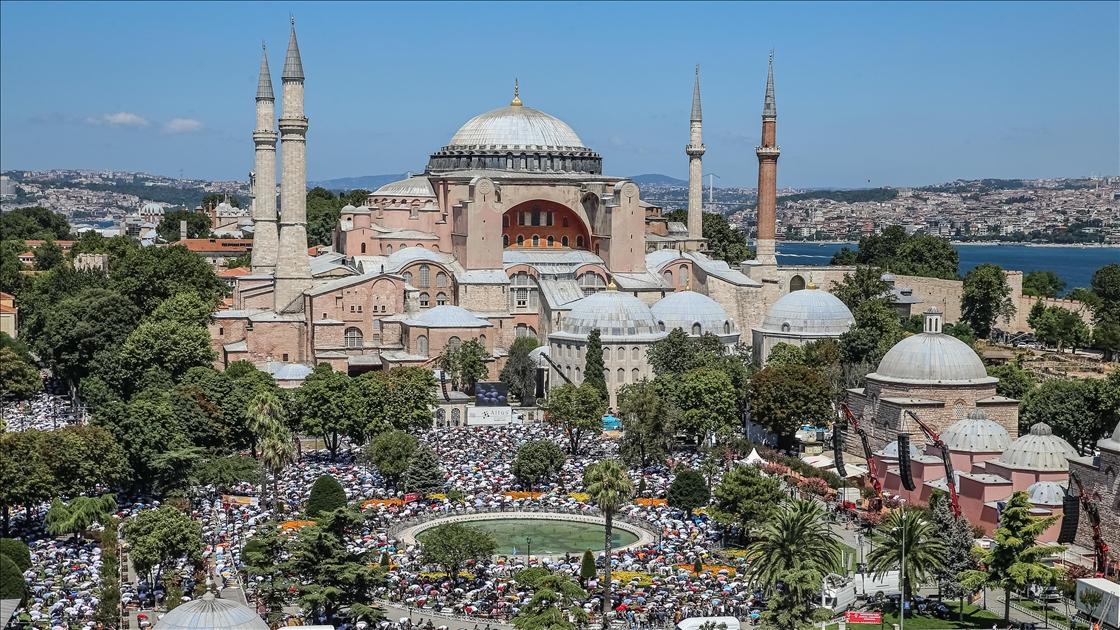
First Friday Prayer Held 86 Years After Ayasofya Cami-i Şerifi Became a Museum (Anadolu Ajansı)
The Council of State ruling established its fundamental principle on the preservation of the founder’s intent under waqf law. According to this approach, Hagia Sophia, which was endowed during the Ottoman period under private law provisions, must be utilized in accordance with the purpose specified in its endowment deed. It was accepted that immovable properties dedicated to waqf are directly allocated for public benefit and the intended waqf purpose, and that such properties cannot be diverted to any other purpose contrary to the founder’s intent. Therefore, the 1934 Cabinet decision was found to be contrary to the law with respect to its waqf status and intended use. Similar to the case of Kariye, the conversion of an immovable property belonging to a specific waqf into a museum was regarded as problematic in terms of the founder’s intent and the designated purpose of the waqf property.
The same ruling also addressed Hagia Sophia’s status as international cultural heritage. Hagia Sophia was inscribed on the UNESCO World Heritage List in 1985 under the designation “Historic Areas of Istanbul.” At the time of inscription, no specific designation regarding its use was made; Hagia Sophia was considered part of the cultural heritage area alongside other monuments within the historic peninsula. The ruling further examined provisions of the Convention for the Protection of World Cultural and Natural Heritage that emphasize respect for state sovereignty. Thus, no direct contradiction was established between Hagia Sophia’s status as a World Heritage site and its domestic waqf status; it was accepted that the obligation to protect the site continues, while its mode of use is determined within the framework of domestic law.
Following the Council of State decision, a Presidential Decree dated 10 July 2020 and numbered 2729 was published. The decree recalled that the Council of State’s 10th Chamber had annulled the 1934 Cabinet decision that had converted Hagia Sophia Mosque into a museum; it further decided, in accordance with Article 35 of Law No. 633 on the Establishment and Duties of the Directorate of Religious Affairs, to transfer the administration of Hagia Sophia to the Directorate of Religious Affairs and to reopen it for worship. With this action, Hagia Sophia’s status as a museum ended and the building was officially reopened for use as a mosque.【85】 The Friday prayer held on 24 July 2020 was recorded as the first collective worship since the 1934 decision to reopen Hagia Sophia fully as a mosque.【86】 Alongside President of the Republic of Türkiye Recep Tayyip Erdoğan, numerous state officials and citizens attended this prayer.
The 2020 status change generated widespread international反响 due to Hagia Sophia’s symbolic position in global public opinion. Greece, the United States, France, and various Western institutions responded critically to the decision; the issue was debated around themes of cultural heritage, religious symbolism, and Türkiye’s sovereignty. In contrast, reactions from Russia followed a markedly different trajectory. Before the decision, Patriarch Kirill of Moscow and All Rus’ called for the preservation of its museum status, while Kremlin spokesperson Dmitry Peskov stated that the decision was an internal matter for Türkiye and would not harm Turkish-Russian relations.【87】 These statements reveal that religious circles in Russia attribute great importance to Hagia Sophia in terms of Orthodox memory, while the official state stance was shaped more within the framework of bilateral relations and sovereignty.
Following the status change, the continued use of Hagia Sophia as both a place of worship and a visited historical structure became one of the central issues of the new era. The building was transferred to the Directorate of Religious Affairs; however, responsibility for preserving its historical layers, mosaics, and Ottoman additions was not eliminated. Consequently, in the post-2020 period, Hagia Sophia’s status is not limited solely to the decision to reopen it as a mosque; it has transitioned to a new operational framework that simultaneously addresses worship, tourism, preservation, cultural heritage management, and international visibility.
Interior and Exterior Views of Ayasofya-i Kebir Cami-i Şerifi (Anadolu Ajansı)
Ayasofya-i Kebir Cami-i Şerifi is a monumental structure that unites the basilical plan tradition with the search for a centralized domed space within a single architectural framework. The current building was commissioned by Emperor Justinian I after the Nika Revolt of 532 to the architects Anthemius of Tralles and Isidore of Miletus, and opened for worship in 537.【88】 Over its history, the structure has served as a church, a mosque, a museum, and again as a mosque; these functional changes have left visible traces on its plan, interior spatial organization, decoration, additional structures, and restoration interventions.
In this regard, Ayasofya-i Kebir Cami-i Şerifi is not viewed merely as the architectural product of a single era, but as a monumental architectural unity that preserves layers of construction, technique, material, decoration, and restoration from multiple historical periods. The main dome and pendentive system, the schematic integration of the basilical plan with the centralized space, the use of light, marble and mosaic surfaces, Ottoman-era additions, and its continuous history of restoration are the principal elements defining its architectural identity.
Ayasofya is situated on the Historic Peninsula of Istanbul, within the area that constitutes the city’s historical and ceremonial center. The site on which the building stands was the central location of ancient Constantinople, positioned atop the first hill.
During the Byzantine period, the area where Hagia Sophia stands was situated at the heart of Constantinople’s urban fabric. Constantine I established the Mese axis during the foundation of the city; the primary temple located at the beginning of this main road, which extended toward Europe, was regarded as the center of the city.【89】
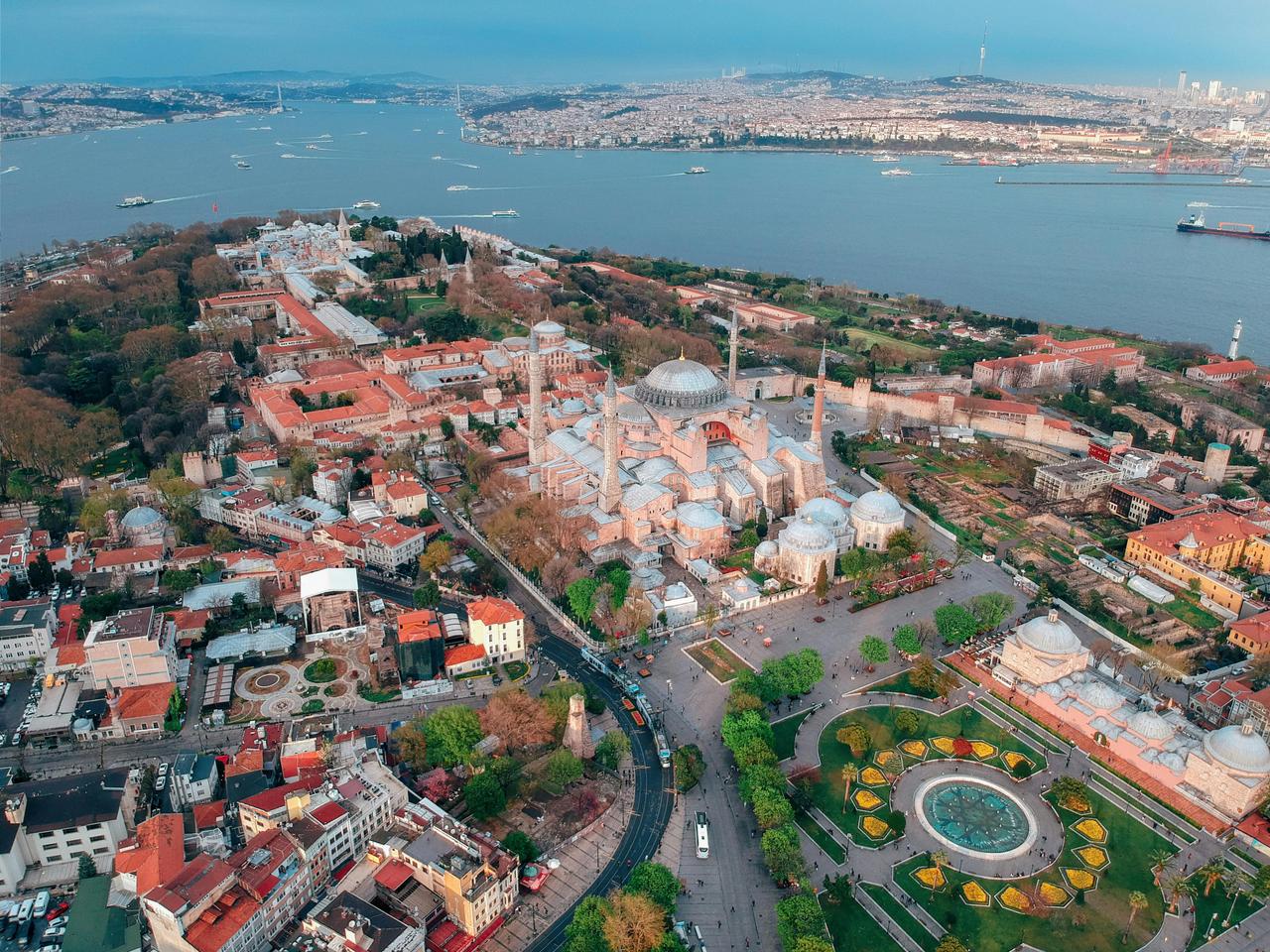
Hagia Sophia and Its Surroundings (pexels)
Hagia Sophia’s proximity to this axis positioned it as a defining landmark both religiously and urbanistically. The selection of its site was influenced by Istanbul’s acropolis-like geography, topographical features, dominance in the urban skyline, recognition as sacred ground, and its character as a space of memory.
During the Byzantine period, Hagia Sophia developed within a central environment linked to the imperial palace, the Hippodrome, Hagia Irene, cisterns, and other public buildings of the city. Its joint designation with Hagia Irene as the “Megale Ekklesia” (Great Church) reflects one of the elements underscoring the religious and institutional character of this precinct.【90】 Within this urban arrangement, Hagia Sophia occupied the role of a major temple connected to the imperial center, forming with structures such as the palace, the Senate, the law courts, and the Hippodrome a ceremonial, administrative, and religious focal point.
During the Ottoman period, Hagia Sophia and its surroundings retained their status as the urban center. After the Conquest, the building was converted into a mosque, and a külliye developed around it. The Mese axis continued to function during this period, its significance reinforced by surrounding structures, and the immediate vicinity of Hagia Sophia, due to its location, also influenced the emergence of new Ottoman architectural developments.
Over time, structures such as Topkapı Sarayı, Gülhane Parkı, Çinili Köşk, Firuz Ağa Camii, Sadrazam İbrahim Paşa Sarayı, Haseki Hürrem Hamamı, Caferağa Medresesi, Sultan Ahmet Camii, III. Ahmed Çeşmesi, Arkeoloji Müzesi, and Alman Çeşmesi have been situated around Hagia Sophia.【91】 The presence of these structures demonstrates that Hagia Sophia’s location in the Historic Peninsula is not confined to its own parcel but forms an urban focal point together with surrounding palaces, squares, mosques, baths, madrasas, fountains, and museums.
The area around Sultanahmet Meydanı and the Hippodrome holds a special place in Hagia Sophia’s urban relationships. During the Byzantine period, the Hippodrome was one of the key public spaces in the immediate vicinity of the building. In the Ottoman period, the space between Hagia Sophia and Sultan Ahmet Camii was reconfigured through urban interventions. After the Ishak Paşa fire of 1912, the square between Hagia Sophia and Sultan Ahmet Camii was planned in 1913. This arrangement strengthened the visual perception of the square as a unified space linking Hagia Sophia with Sultan Ahmet Camii across from it.
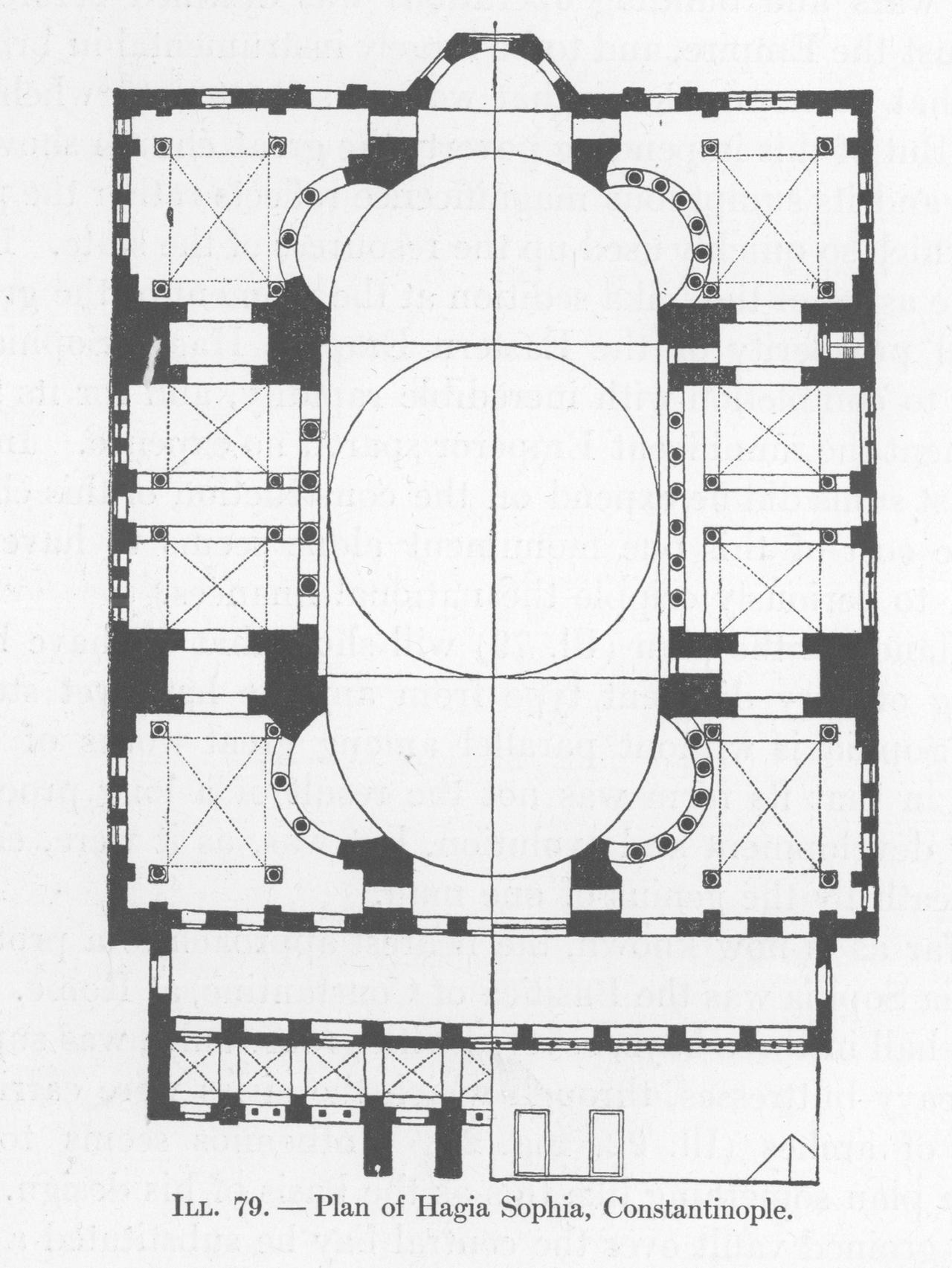
First Plan (flickr)
The plan of Hagia Sophia is based on the integration of a longitudinal basilical layout with a centralized domed spatial concept within a single structure. The building follows a primary east-west axis. To the west are the outer and inner narthexes and the entrance arrangement; at the center is the large main space; to the north and south are side naves and galleries; and to the east is the apse. This schema continues the early Christian basilica tradition but differs from the classical basilica form due to the concentration of the central space beneath a massive dome.
Hagia Sophia’s current structure represents the third phase of construction on the same site, following two earlier churches. The first church is believed to have been a three- or five-aisled building with wooden roofing and stone walls, featuring an atrium and narthex at the front and galleries on an upper level. The second church is thought to have been a five-aisled basilica with stone and brick walls, a columned atrium at the west, followed by a narthex and a monumental triple-arched entrance. The third Hagia Sophia built upon this basilical tradition but established a new spatial organization through the introduction of a central dome, pendentives, half-domes, and lateral spaces.
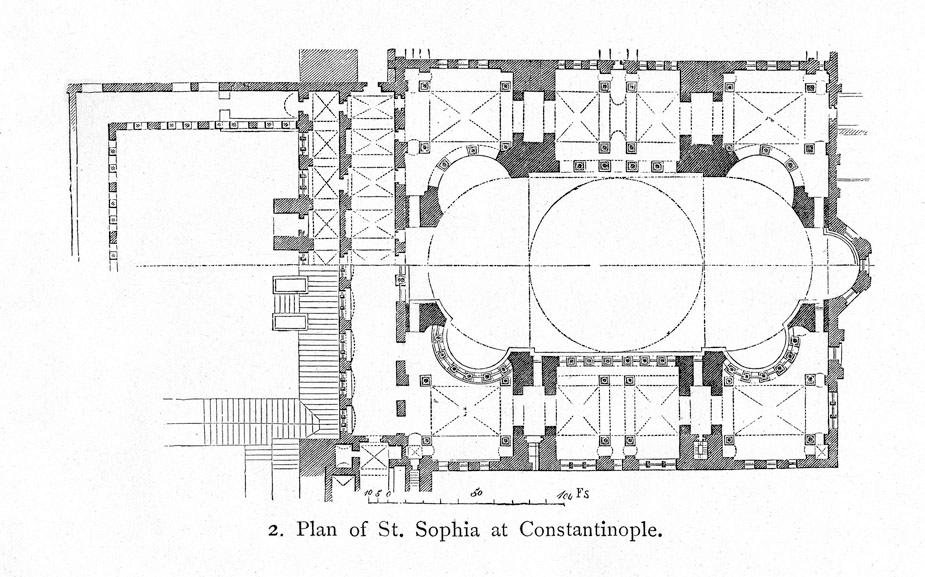
Second Plan (flickr)
The main worship space consists of a large central volume flanked by side aisles on both sides. The prayer area measures approximately 79.30 by 69.50 metres; including the narthexes the entire structure is about 100 by 70 metres in size; the width of the side aisles is 18.20 and 18.70 metres respectively.【92】
At the center of the plan lies the expansive central space gathered beneath the main dome. Half-domes have been added to the east and west of this central volume, and these half-domes are further extended by smaller half-domes and exedras. Thus, the building preserves a basilical axis extending from west to east while achieving a centralized, stepped spatial composition at its core.
The plan of Hagia Sophia can also be explained through the distinction between inner and outer shells. The inner shell comprises the central dome, pendentives, two main half-domes, the associated exedras, and the eight vertical supports that define the oval form of the main space. The outer shell includes the side aisles, galleries, and the support system that transfers thrusts to the ground.【93】
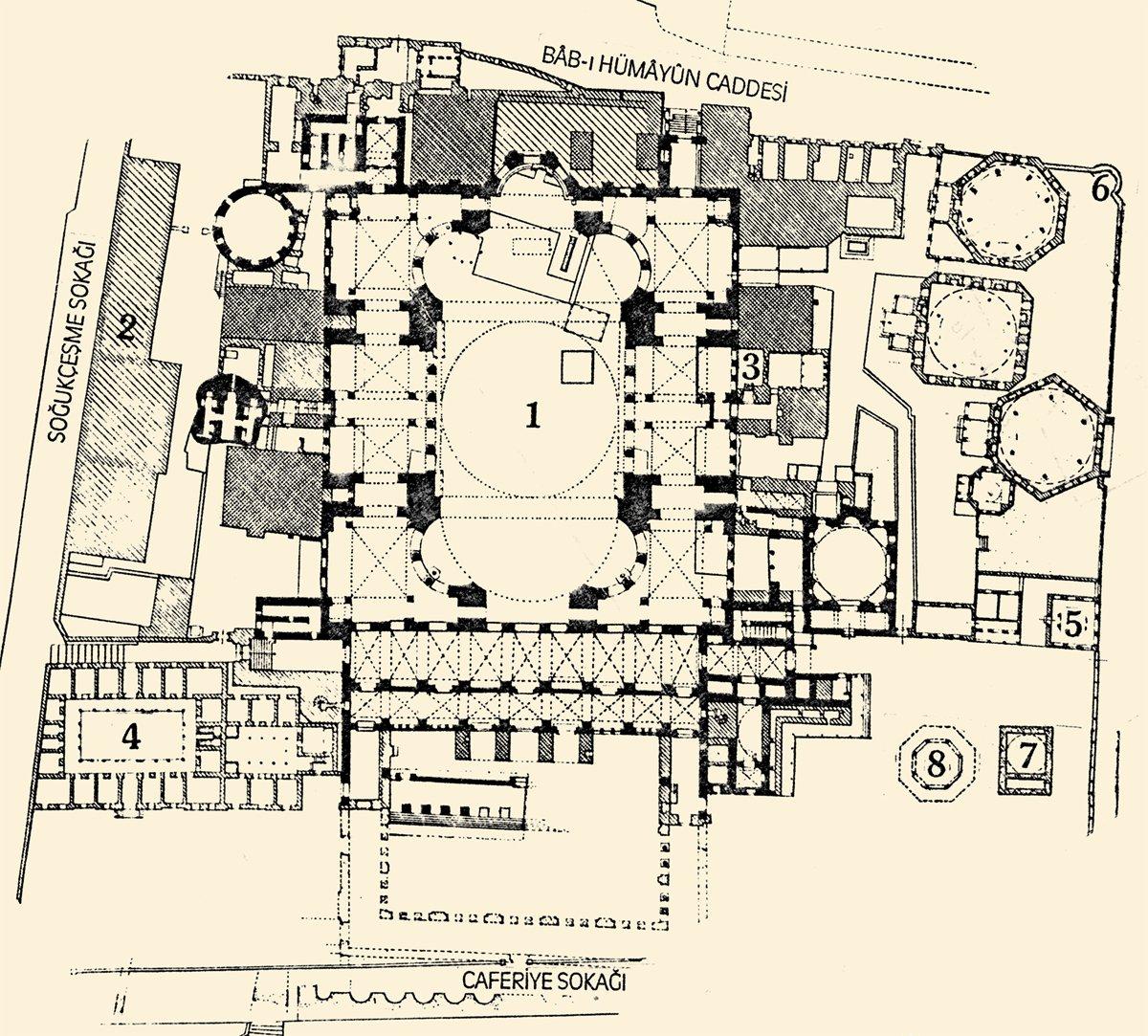
General Plan of Hagia Sophia: Mosque, Imaret, Library, Madrasa, Muvakkithane, Sebil, Sıbyan Mektebi, Şadırvan (TDV İslam Ansiklopedisi)
The side aisles bound the main space to the north and south but do not form a completely enclosing wall system. Rows of columns and arched openings establish visual and spatial connections between the main space and the side volumes. The upper galleries open similarly toward the main volume. The columns are understood as elements that divide the wide spans between the massive piers into units perceivable at human scale.【94】 Therefore, the side aisles and galleries are not merely circulation routes or secondary spaces in the plan but architectural components that scale the main volume.
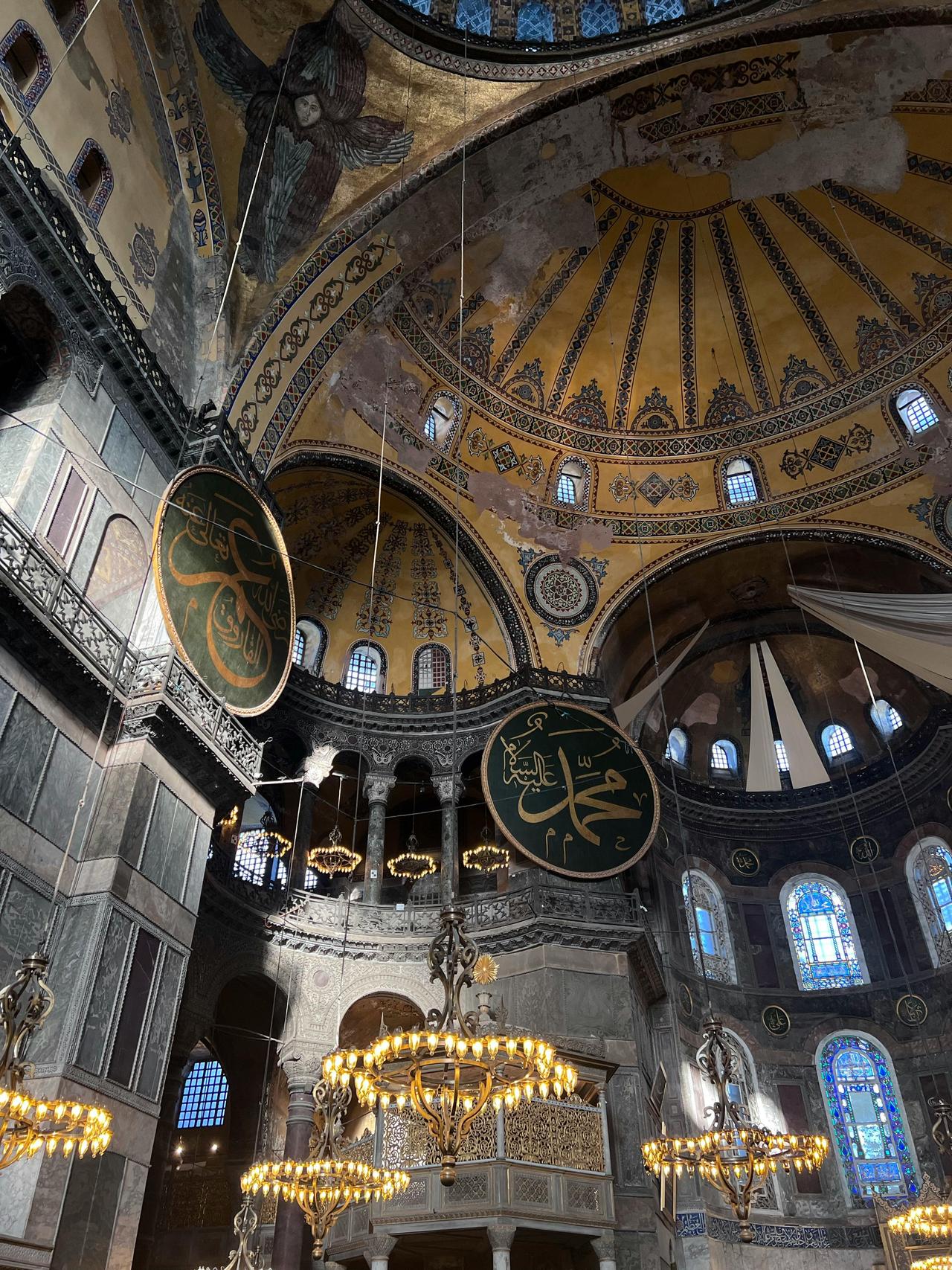
Ottoman Period Additions and the Area Around the Apse (pexels)
The western narthex arrangement constitutes the building’s entrance scheme. The inner narthex is divided into nine bays, each covered by a barrel vault, through which access is gained into the mosque interior. The nine-bay layout of the narthex functions as an intermediate space that organizes the transition from the western facade to the main volume.
At the eastern end lies the apse. The apse, the liturgical focus of the plan, projects outward from the eastern extremity of the central axis. It extends more than six meters beyond the main structure. When the building was converted into a mosque during the Ottoman period, a mihrab was added due to the change in the direction of prayer, transforming the area around the apse into a space that bears spatial traces from both the Byzantine and Ottoman periods.
Access to the upper galleries in the building is provided by ramps. These ramps demonstrate that the plan is organized not only along the horizontal axis but also in terms of vertical circulation. The galleries, situated above the side aisles, create a second level of use facing the main space.
In the plan schema of Hagia Sophia, the central and longitudinal characteristics operate in tandem. The basilical arrangement defines the axis extending from west to east, establishing the narthexes, aisles, and apse. The centralizing character is expressed through the main dome, semi-domes, and exedrae, which together form the focal point of the interior space.
During the Ottoman period, new elements were incorporated into the mosque’s plan schema in accordance with its function as a place of worship. The mihrab, minbar, kürsü, muezzin galleries, hünkâr gallery, and hünkâr access passage were integrated into the existing plan layout.【95】 These additions did not eliminate the original schema; rather, they redefined the building’s functional orientation and its internal centers of activity.
The structural system was designed to cover a vast central space with a dome. The building’s primary structure is defined by massive piers that support the weight and lateral thrusts of the central dome, arches connecting these piers, pendentives facilitating the transition to the dome, semi-domes oriented east-west, barrel vaults covering the side spaces, and buttresses added to the building’s outer mass.
The main dome rises on four large piers and the primary arches that link them. The transition from the nearly square central opening to the circular base of the dome is achieved through pendentives. These pendentives are not merely technical transitional elements; they are formal components that create visual and spatial continuity between the dome, arches, and gallery planes. At Hagia Sophia, the pendentives realize on a grand scale the principle of transition from square to circle; the same geometric relationship is repeated on a smaller scale at the capitals of the nave columns.【96】
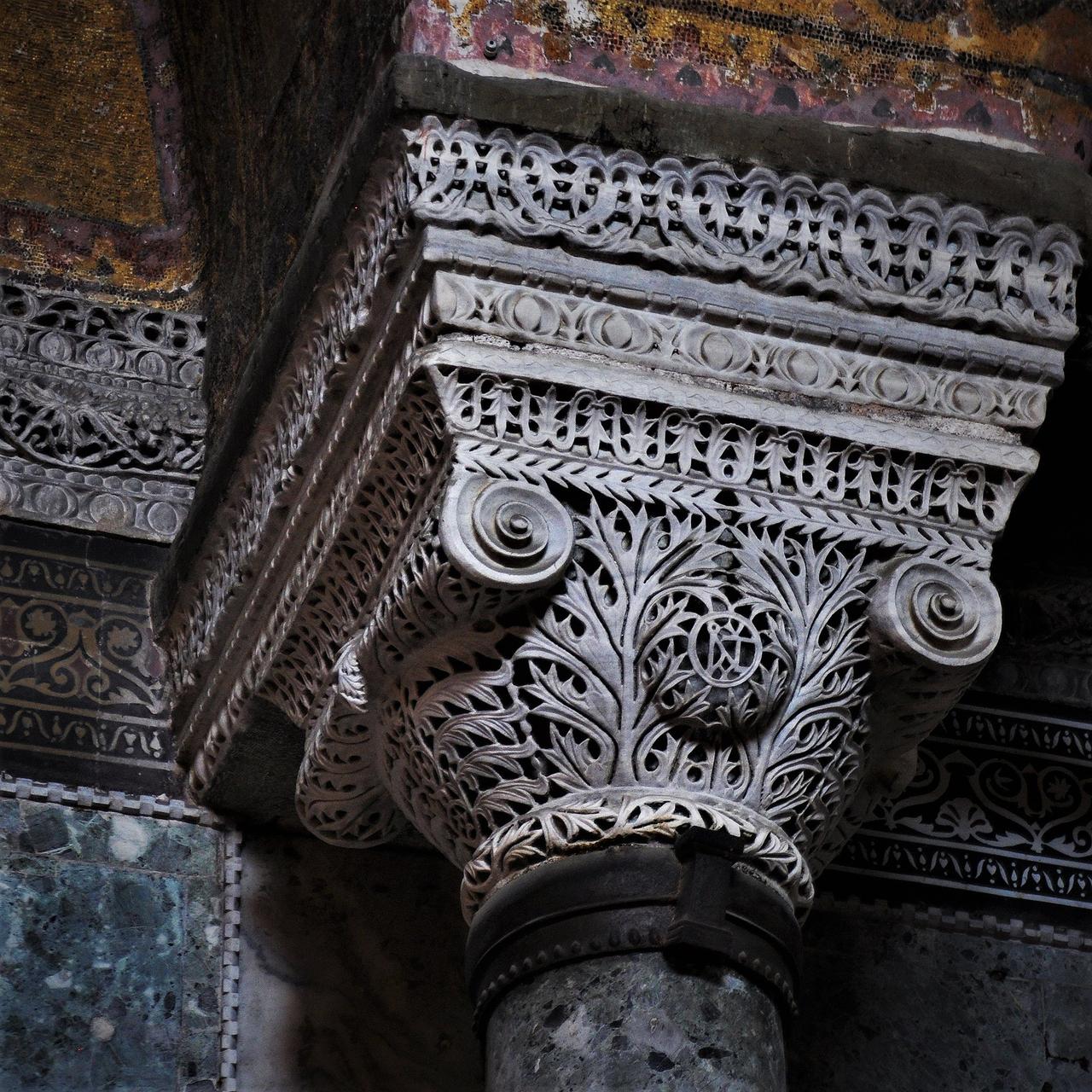
Byzantine Marble Capital from One of the Nave Columns (flickr)
The load of the main dome is not transferred directly to the walls but to the system of piers, arches, and pendentives. The arches define the central space from four directions; the pendentives carry the dome as curved triangular surfaces formed between these arches. This system distinguishes the central space of the building from the flat wooden roof structures typical of classical basilicas.
One of the most distinctive features of the structural system is the support of the main dome by semi-domes on its eastern and western sides. These semi-domes contribute to the transfer and resistance of loads and lateral forces originating from the main dome. The smaller semi-domes and exedras surrounding the main semi-domes create a fragmented and gradual structural transition. Consequently, the roof system of Hagia Sophia is not simply a single dome resting on walls; rather, it constitutes a cohesive structural network composed of interconnected domes, semi-domes, and barrel vaults.
Lateral naves and galleries form the peripheral components of the structural system. The columns, arches, and vaults in these areas contribute to the transfer of loads within the outer shell enclosing the central volume. The ceilings of the galleries and the lateral vaults play a role in directing the forces from the main dome and semi-domes toward the outer buttresses.
One of the most significant external elements of the structural system in Hagia Sophia is the buttresses. The building has been supported from the outside since both the Byzantine and Ottoman periods. Structurally, it struggled to bear the weight of the large dome and was kept standing through the addition of massive external buttresses. In 1317 during the reign of Andronikos II, the walls were reinforced with external buttresses, and during the Ottoman period, additional buttresses were constructed by Mimar Sinan to prevent the structure from collapsing.【97】
An important feature of the structural system is that the main load-bearing mass is not fully exposed within the interior space. The piers and buttress masses are partially concealed within walls, colonnades, and lateral volumes; as a result, the load-support relationship is not perceived in the interior as clearly as in classical buildings.【98】
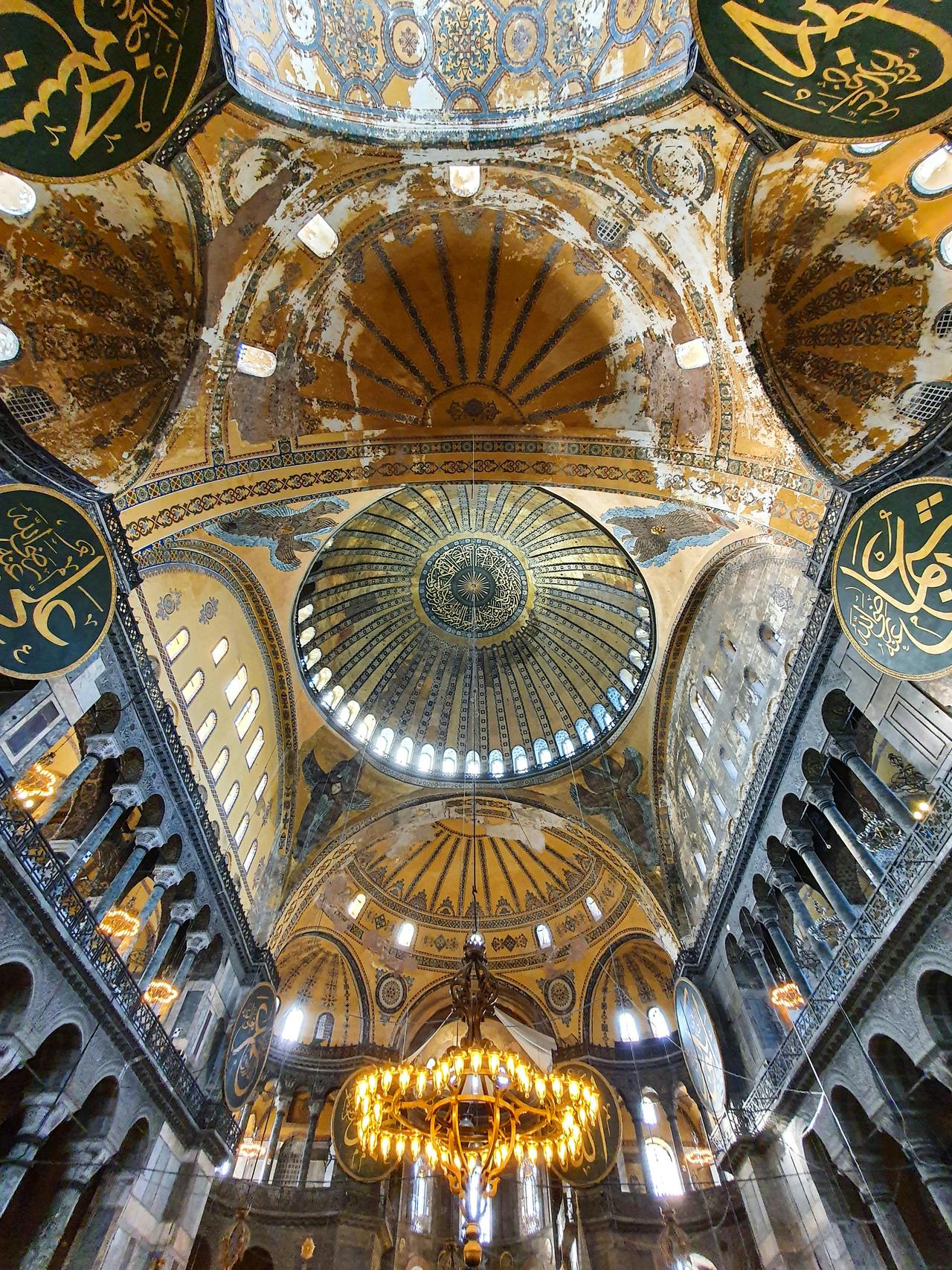
The Main Dome, Semi-Domes and Central Interior Layout of Hagia Sophia (pexels)
The main dome is the defining covering element of the central volume. Its diameter ranges between approximately 31 and 33 metres. The flattened dome shape creates a sense of spaciousness within the interior, and it is part of a system that collectively resists the horizontal and vertical forces exerted by the upper cover together with other architectural elements.
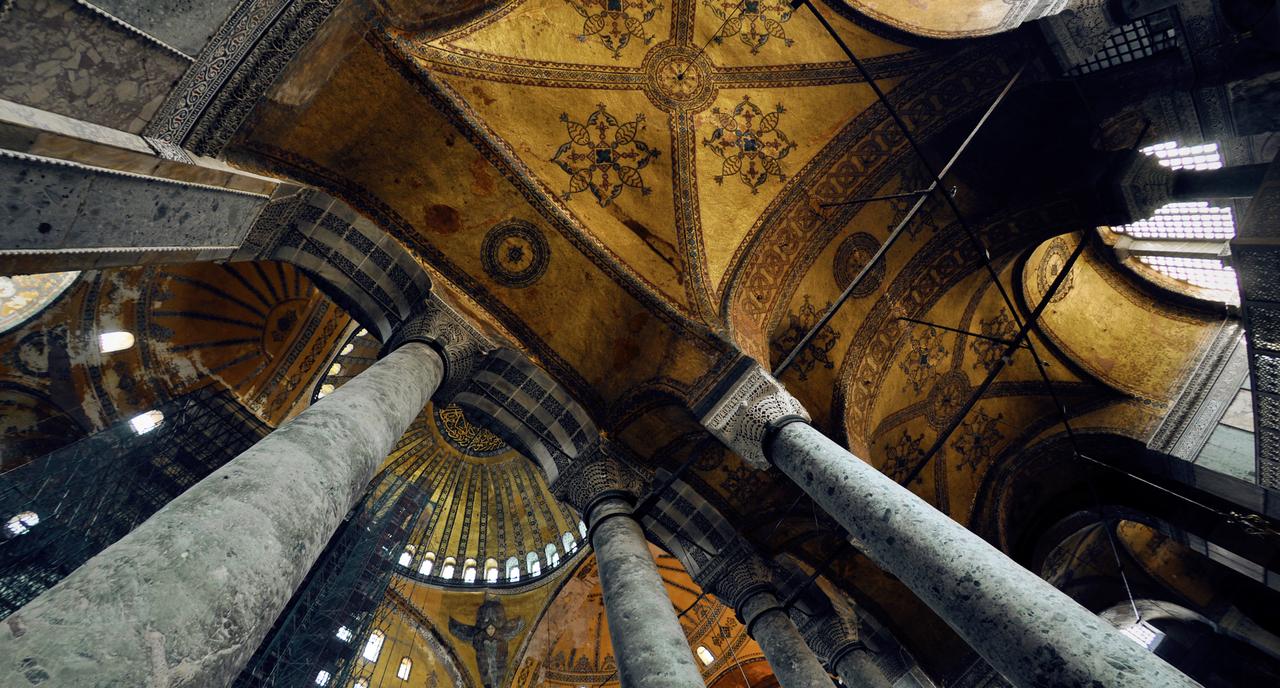
Pendants, Arches, Columns, and Barrel-vaulted Side Coverings (flickr)
The current form of the dome is linked to the reconstruction process that followed its initial design. The first dome collapsed after the earthquake of 557; the second dome, designed by Isidorus the Younger, was constructed approximately 6.25 meters higher than its predecessor.【99】 The dome consists of forty inner ribs separated by forty windows. These ribs divide the inner surface of the dome and, from the exterior, appear like legs around the drum.【100】
The forty windows at the base of the main dome are among the primary elements defining the spatial impact of the upper covering. This series of windows softens the boundary between the dome’s surface and its supporting structure, causing the dome to appear visually detached from the masses beneath it.
The half-domes located on the eastern and western sides of the main dome enable the upper covering to expand gradually. The smaller half-domes and exedrae surrounding these half-domes allow the upper structure to be composed not through abrupt transitions but through a sequential and graduated series of volumes. This arrangement preserves the basilical orientation of the building while extending the influence of the central dome toward the east and west.
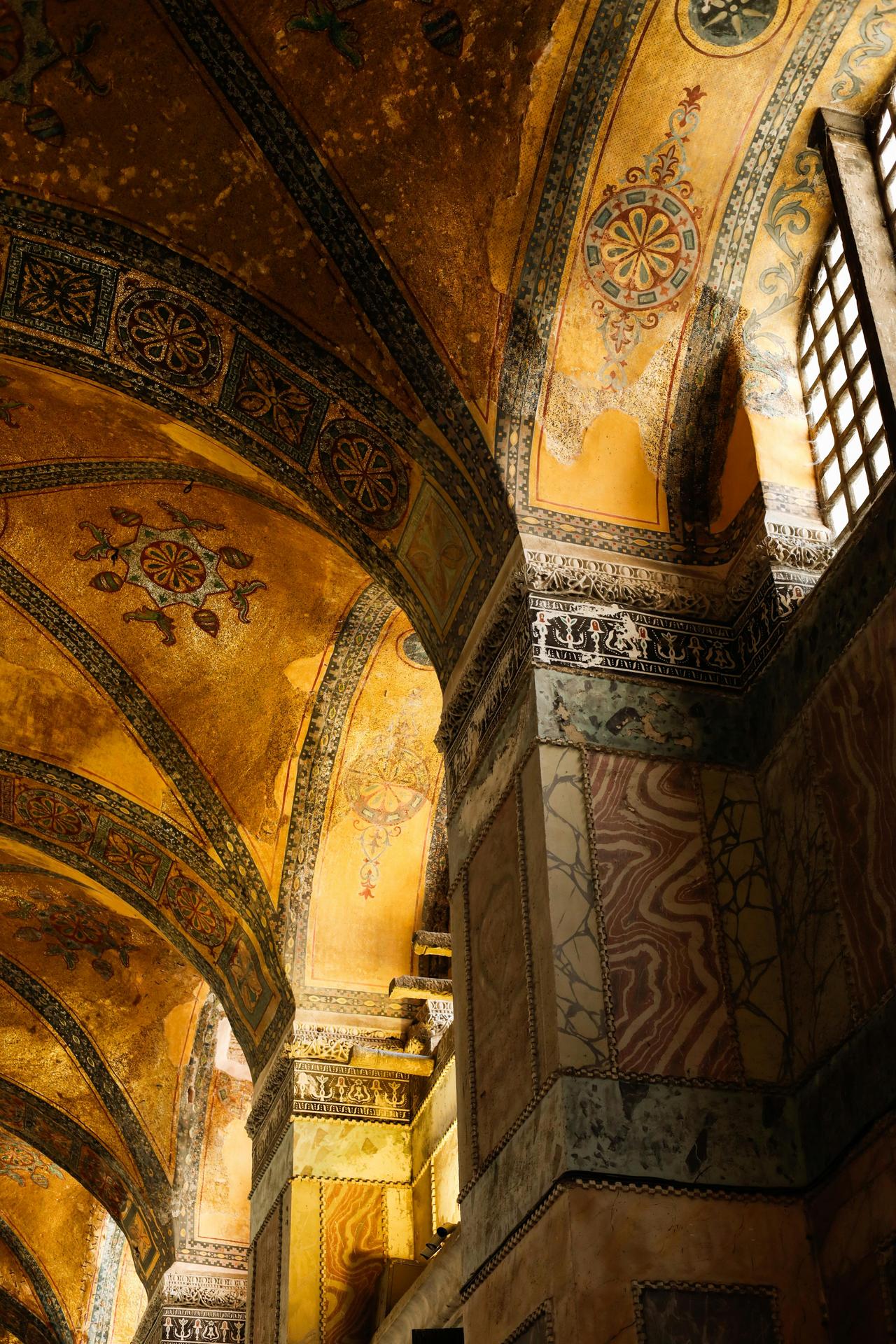
Barrel-vaulted Covering (pexels)
Barrel vaults are complementary elements of the upper covering system in side spaces, galleries, and narthexes. While the main dome and half-domes establish the central elevated volume, the side naves and galleries are enclosed by lower barrel-vaulted ceilings. In the nine-section arrangement of the inner narthex, each section is covered by a barrel vault.【101】
The transition to the dome is achieved through pendentives. This transition creates a curved ceiling system that not only fulfills a structural function but also establishes visual continuity between the dome, arches, and half-domes.
The interior spatial organization is shaped by the width of the main worship area, the multi-layered volume enclosed by gallery levels, the circulation pattern directing movement from the narthexes toward the center, the floor and surface finishes, and the perceptual effect of light within the space. Although the structure contains interventions from different periods—liturgical, mosque-use, and museum-phase—the fundamental character of the main space rests on the impression of a vast, lofty, and centrally concentrated volume.
Within the interior, rows of columns and arched openings separate the main worship area from the side naves. This arrangement demarcates the central volume from the lateral spaces without entirely disrupting visual continuity. The column rows divide the wide intervals between the major structural supports into human-scaled units, making the immense scale of the main space comprehensible.【102】 Therefore, the columns within the interior are not merely boundary-defining elements; they are architectural components that define the spatial perception of scale.
The gallery levels create a second tier of use and viewing within the interior spatial organization of Hagia Sophia. Access to the upper galleries is provided via four ramps. The galleries encircle the main space from upper levels, reinforcing the vertical perception of the space and enabling the worship area to be observed from multiple vantage points.
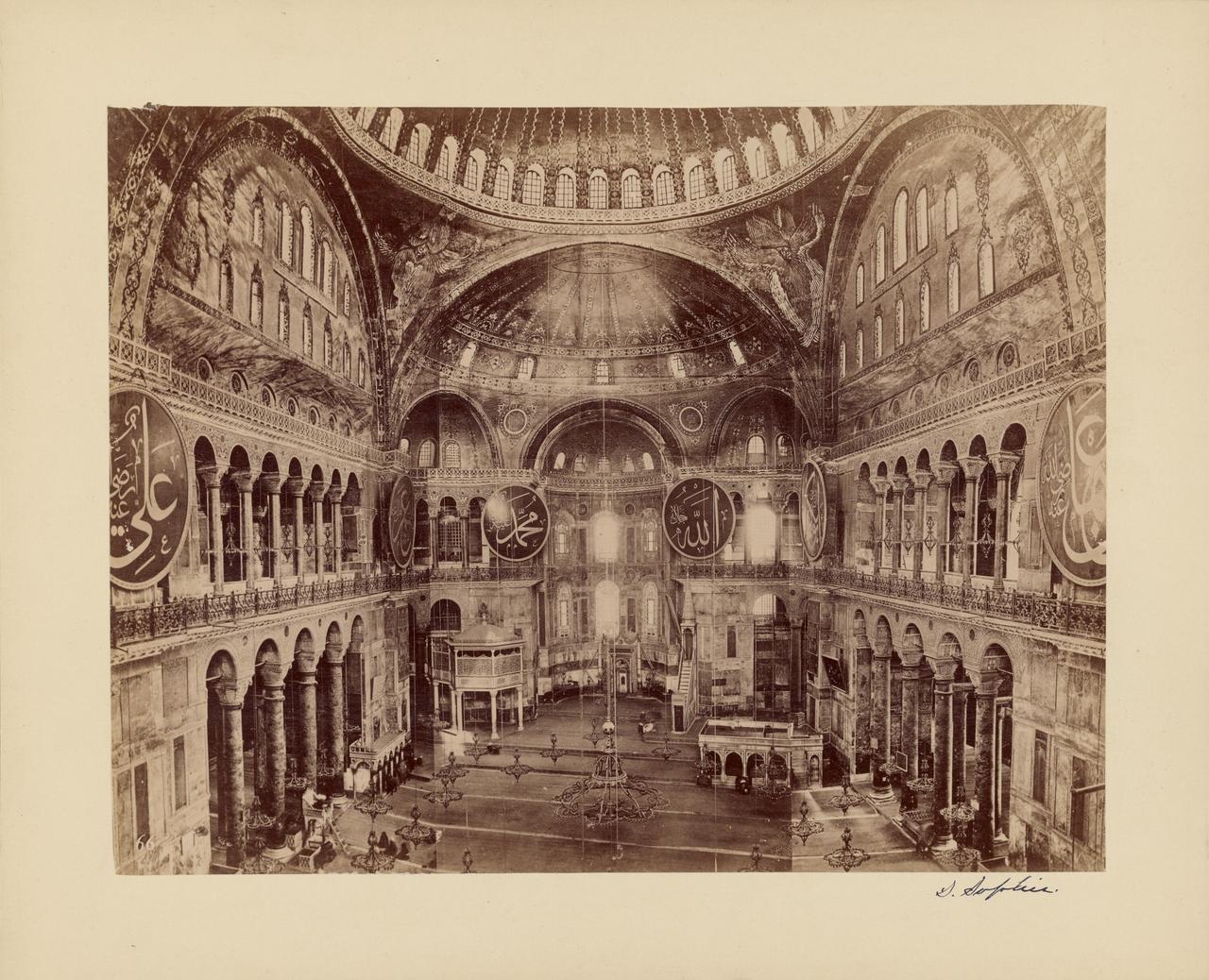
Interior, 1823 - 1886 (rawpixel)
The circulation pattern directs movement from the western entrance sections toward the main volume. The nine-bay vaulted arrangement of the inner narthex creates a more fragmented and controlled transitional space before entering the main area. Opening from this segmented entrance into the main space heightens the sense of scale within the interior experience. Connections established between the narthex, side naves, galleries, and ramps organize the interior circulation of Hagia Sophia not only along a linear axis but also through horizontal and vertical movements.
During the Ottoman period, elements such as the mihrab, minbar, pulpit, muezzin galleries, and the sultan’s loge were added to accommodate its function as a mosque. These additions did not significantly alter the existing interior volume but redefined its use, worship layout, and focal points within the space.
Material usage is directly related to the structure’s structural integrity, surface effect, and perception of interior space. The building incorporates brick-and-mortar masonry, marble claddings, colored stones, porphyry columns, spolia architectural elements, stone pavements, mosaic surfaces, and Ottoman-period wooden, ceramic, calligraphic, and metal components.
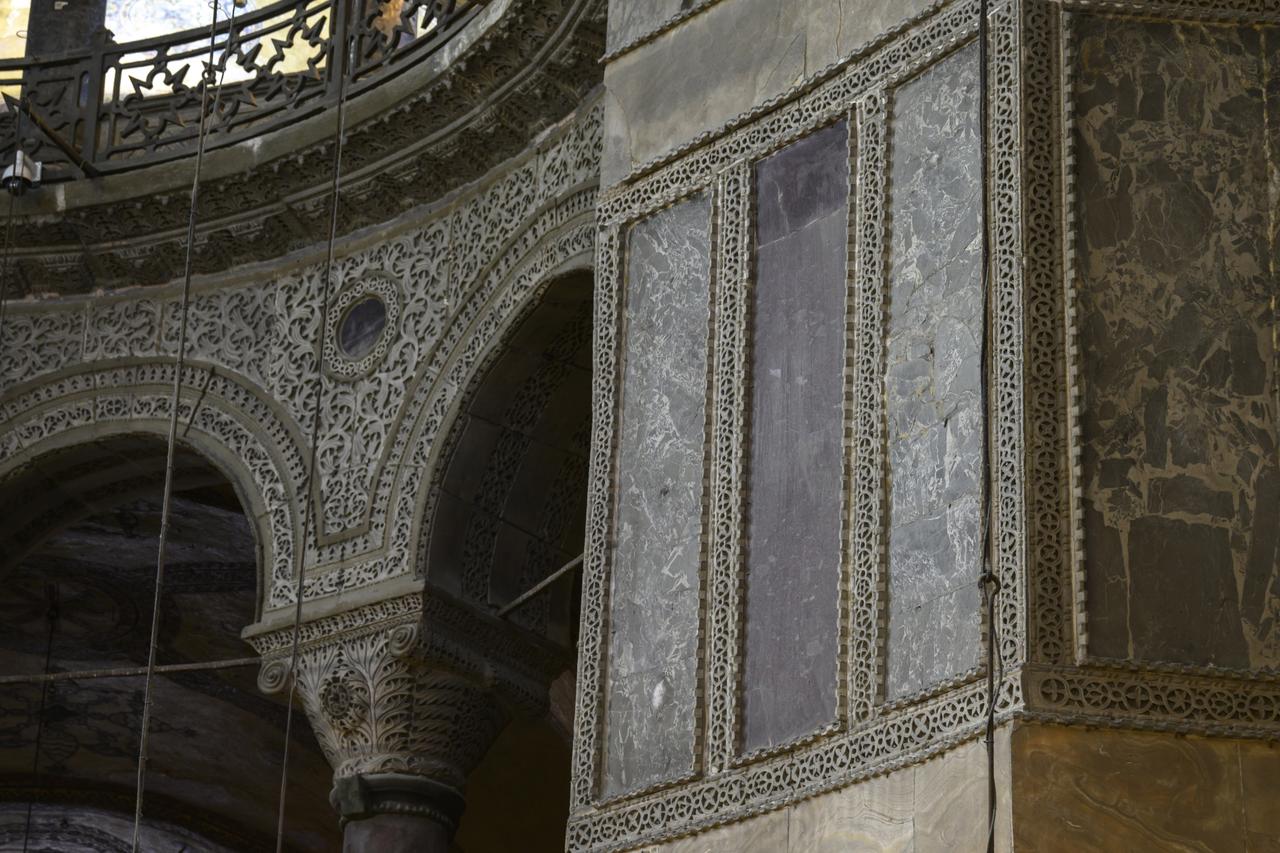
Example of Stone Material Use in the Interior (Anadolu Ajansı)
During the construction phase under Emperor Justinian I, materials were sourced from various regions of the empire. Eight large red porphyry columns were brought from Heliopolis in Egypt, columns from the Temple of Artemis in Ephesus in Western Anatolia, from the ancient city of Cyzicus, and from Baalbek in Syria; additionally, marbles of different types and colors were used from other regions.【103】 This selection of materials constitutes one of the fundamental elements that generate color, texture, and surface variety within the interior space.
Brick and mortar play a central role in the building’s primary structure. The use of brick-and-mortar provides a plastic quality that enables the realization of curved plans and vault forms.【104】 This characteristic made it possible to construct the dome, half-domes, and barrel vaults as part of a lightweight upper covering system in Hagia Sophia.
Marble and colored stone claddings play a decisive role in interior surfaces. Marble has been used for the flooring and walls of the structure, while wood materials have been avoided due to their susceptibility to damage.【105】 This preference is significant both for resistance to fire risk and for creating durable and reflective surfaces within the interior space.
The stone claddings in Hagia Sophia are not merely decorative surfaces but architectural elements installed through a technical system. The cladding panels were mounted with a gap of approximately 5–10 cm from the wall surface and secured using metal reinforcements and marble wedges.【106】 This gap between the wall and the cladding is one of the technical details that allow the cladding to function as an independent system separate from the wall surface.
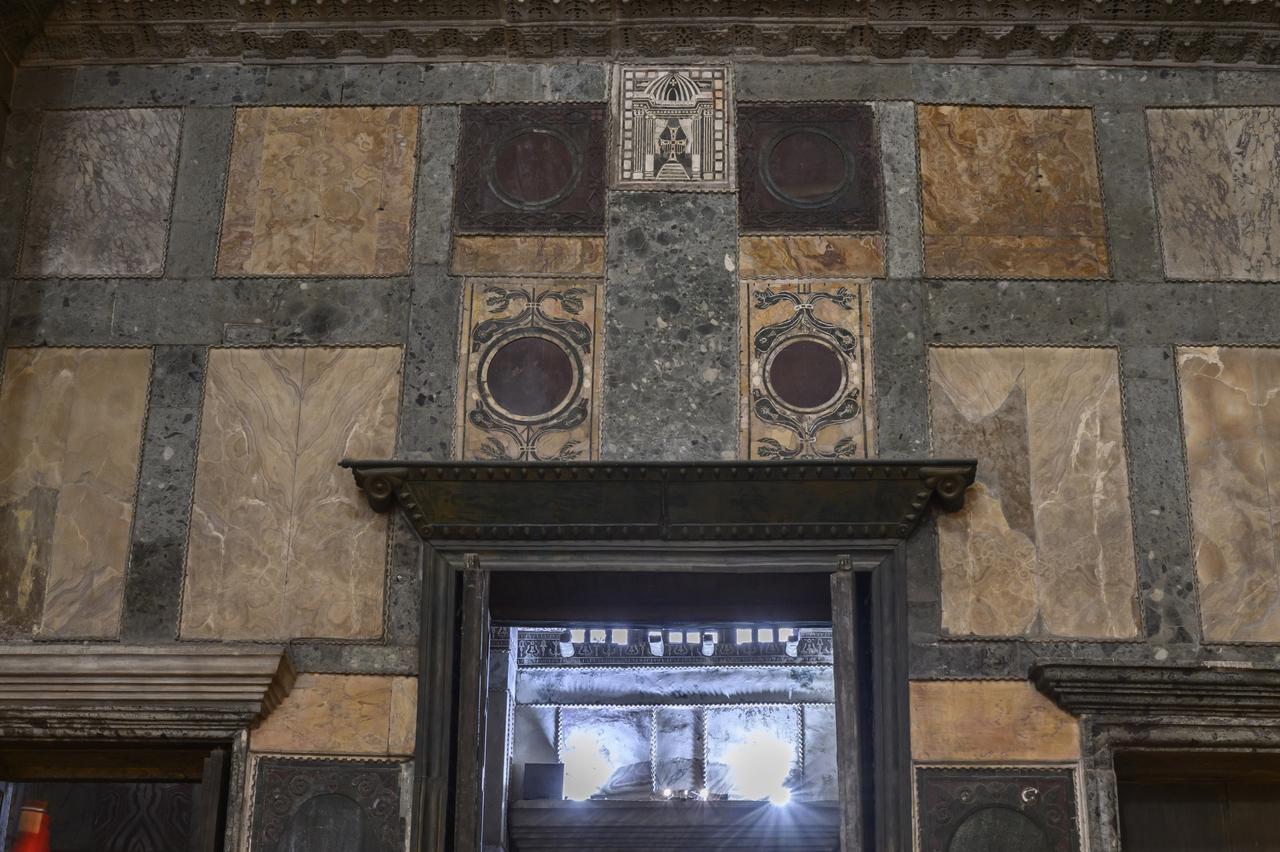
Marbles Using the Skoutlosis Technique (Anadolu Ajansı)
The Skoutlosis technique is regarded as a key method for explaining the stone cladding arrangement in Hagia Sophia. In this technique, stone panels are cut and installed so that their veins and color patterns align reciprocally, creating symmetrical and mirror-like patterns on the wall surfaces.【107】
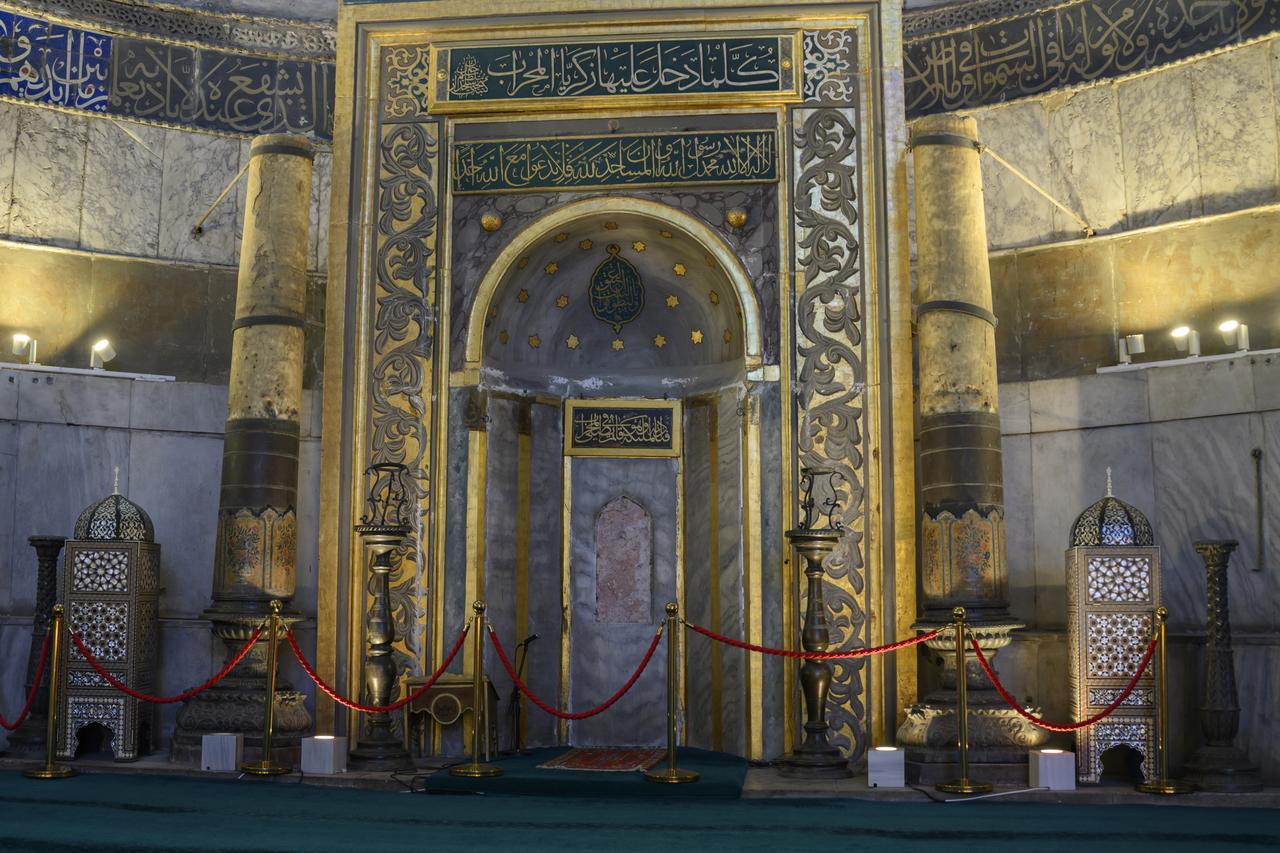
Mihrab (Anadolu Ajansı)
The material layers added to the structure during the Ottoman period developed in accordance with its function as a mosque. Different materials—including stone, marble, ceramic, wood, and metal—were used in the mihrab, minbar, kursi, mahfil, hünkâr mahfili, library, şadırvan, sebil, and türbes. Bronze candelabra brought from Budin during the reign of Kanuni Süleyman were placed beside the mihrab; two large single-piece marble cubes brought from Bergama were installed inside the mosque during the reign of III. Murad.【108】
Traces of stone cladding and repair materials can also be observed on the building’s exterior surfaces. Evidence of Marmara marble cladding has been identified on the western exterior facade.【109】
The ornamental and inscriptional elements of Ayasofya reflect its religious, aesthetic, and functional layers from different periods. The mosaics, together with stone and marble surfaces, constitute the principal decorative program of the Byzantine period; during the Ottoman period, the mihrab, minbar, mahfils, calligraphic panels, dome inscriptions, penwork, ceramics, and other inscriptional elements established a new visual order aligned with the building’s identity as a mosque.
The decoration program of Hagia Sophia in the 6th century is largely aniconic. During the reign of Justinian I, the figural mosaics that today constitute some of the building’s most prominent features had not yet been created; instead, abstract motifs, geometric patterns, vegetal scrolls, and cross forms were used.【110】 With the exception of the later figural mosaic in the lunette of the imperial gate, the majority of the naos decoration belongs to this early period.【111】 In this early program, crosses appeared in the form of Latin crosses and christograms within medallions.
The naos decorations hold a significant place among the surviving examples of the early mosaic program. The mosaics covering the vaults and arch surfaces in the nine-part structure of the naos are largely associated with the reign of Justinian I.【112】 On the ceilings of Hagia Sophia, large floral motifs are found, while wheel- and mill-shaped ornaments adorn the transverse arches. These decorative elements have been compared with 6th-century Coptic textiles and garment patterns.【113】 The early decoration program of Hagia Sophia demonstrates a preference for rhythmic, geometric, and textile-inspired surface ornamentation over figural narrative.
The development of figural mosaics is associated with the period following the end of Iconoclasm. The earliest examples of mosaics depicting icons in Hagia Sophia date to the late ninth century, corresponding to the period after Iconoclasm was defeated in 843.【114】 According to this, the mosaic program of Hagia Sophia bears traces of different theological and aesthetic approaches, with aniconic decorations preceding figural representations. During the Iconoclast period, crosses and abstract symbols dominated, while in the Iconodule period, depictions of Jesus Christ, the Virgin Mary, and other holy figures were introduced into the interior space.【115】
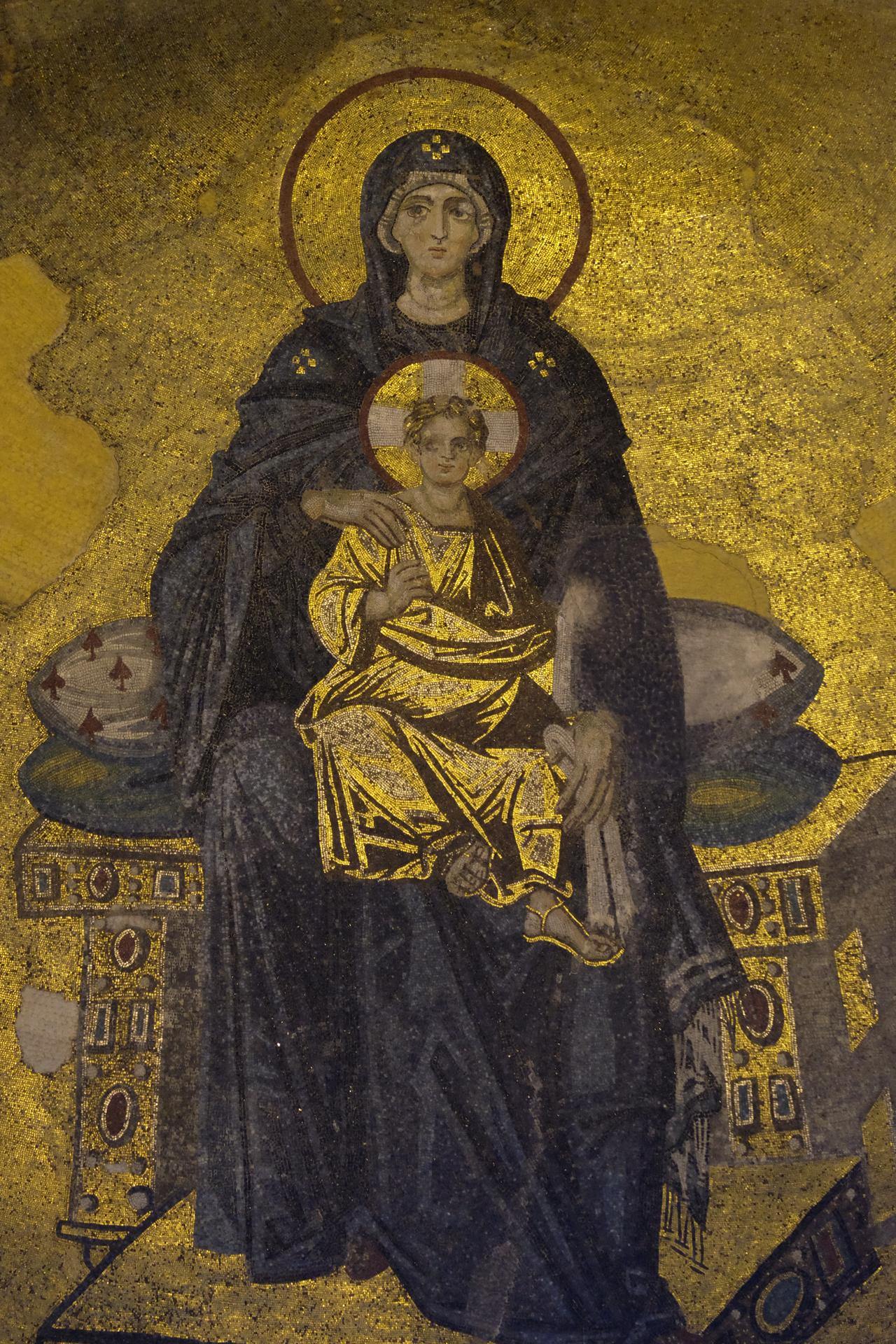
The Mosaic of the Virgin and Child Jesus (flickr)
Contrary to claims that all mosaics in Hagia Sophia were entirely destroyed during the Iconoclast period, the overall program remained largely unchanged. As material evidence, it is only suggested that two medallions previously containing icons on the southwest ramp in the patriarchal assembly hall may have been replaced by crosses.【116】
One of the most important examples of the post-Iconoclast figural program is the mosaic of the Virgin and Child Jesus in the apse semidome. This mosaic was unveiled in 867 during a speech by Patriarch Photios.【117】 During the same period, the large cross in the dome was replaced by an icon of Christ, figural decorations were introduced into the central nave, and scenes from the Old and New Testaments were depicted in the south gallery.
The mosaic in the lunette of the Imperial Door is one of the principal examples of figural decoration marking the transition from the inner narthex to the main space. In this scene, Christ seated on a throne is shown before a crowned emperor in prostration, with medallions of the Virgin Mary and the Archangel Gabriel on either side. This emperor has been identified as Leo VI.【118】
The gallery mosaics are also significant components of Hagia Sophia’s figural decoration program. In the southern gallery, depictions include Zoe and Emperor Constantine IX, Emperor John II Komnenos, his wife Irene, and their sons Alexios, along with a Deesis composition and other imperial portraits. These mosaics occupy space within the interior not merely as figural decoration but as visual layers tied to imperial representation, endowment, and religious hierarchy.
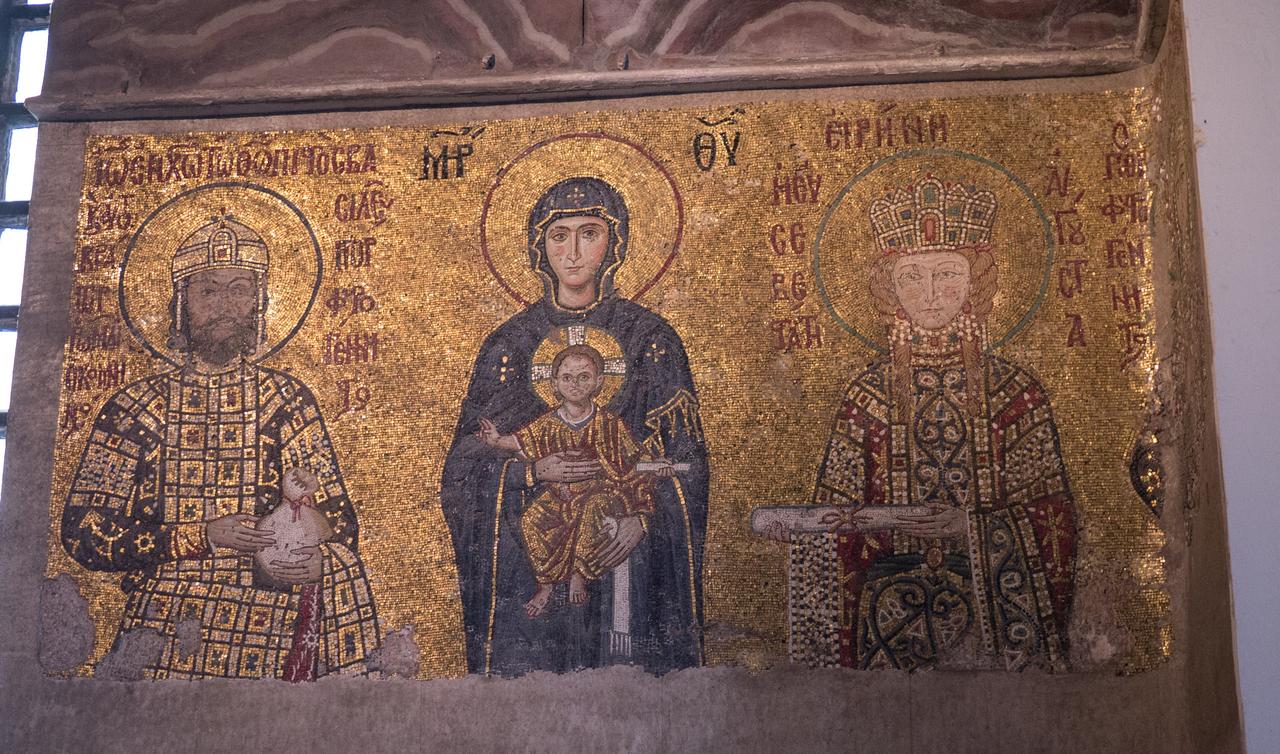
Komnenos Mosaic: Emperor John II Komnenos, Empress Irene, and the Virgin and Child Jesus (flickr)
During the Ottoman period, new calligraphic and decorative elements were added to Hagia Sophia’s interior decoration scheme. Alongside the mihrab, minbar, pulpit, muezzin galleries, and the sultan’s loge, calligraphic and penwork arrangements were introduced. The phrase Bismillah was inscribed in tiles on the mihrab wall in 1607, and tiles depicting the Kaaba and Medina from the 17th century are located in the corridor to the right of the mihrab.【119】
The dome and half-dome inscriptions are key elements of Ottoman-period interior decoration. The calligraphy of Surah Al-Nur on the eastern half-dome, the penwork restoration of lost mosaic surfaces, and the veiling of seraphim faces stand out as prominent practices.
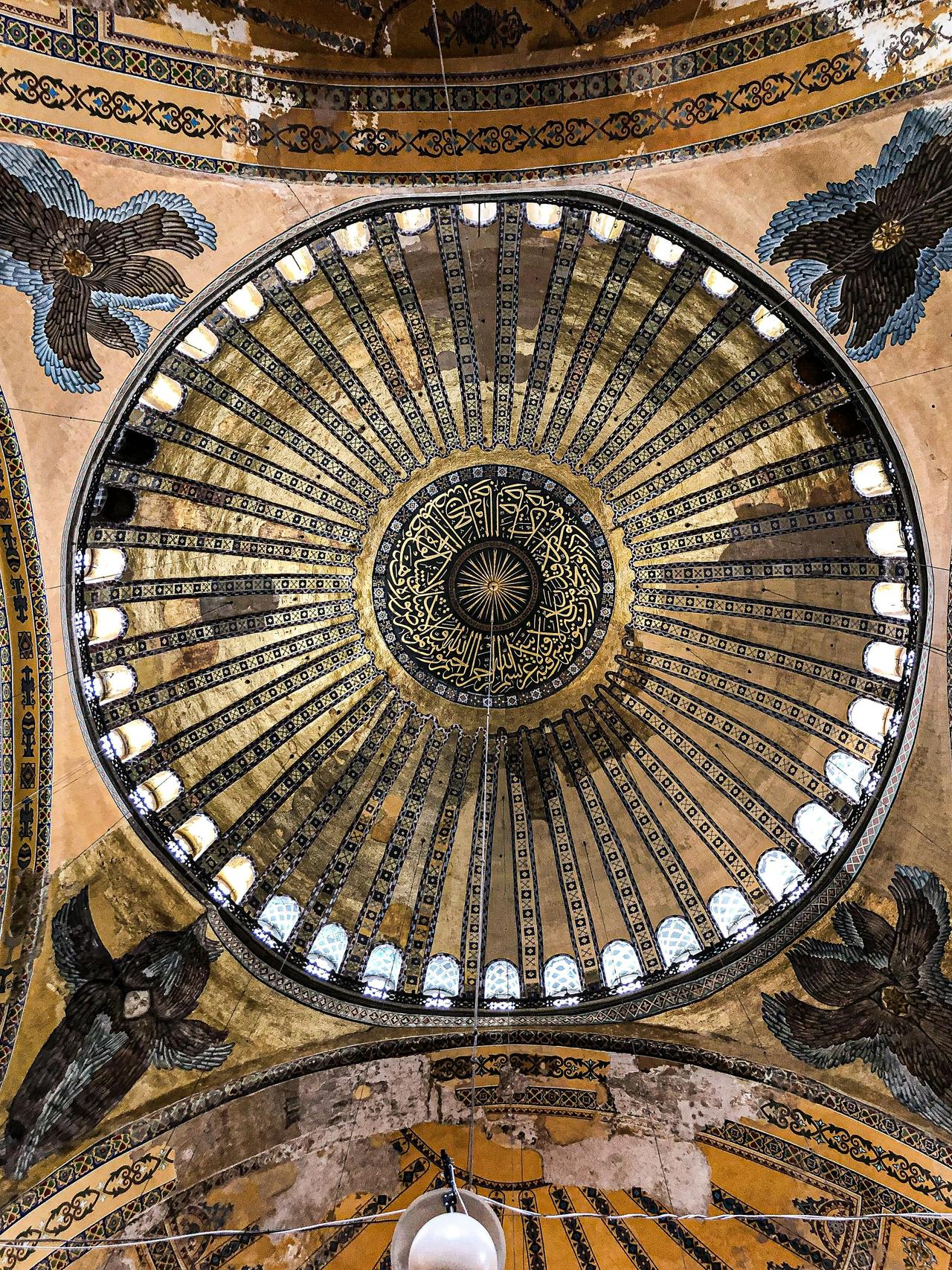
Surah Al-Nur Calligraphy (pexels)
The calligraphic panels in Hagia Sophia are among the most prominent textual elements of the Ottoman period. From the 17th century onward, rectangular panels attributed to Teknecizâde İbrahim Efendi were mounted on the columns. These six panels bore the inscriptions Lafzatullah, İsm-i Nebi, and çehar yâr-ı güzîn.【120】 Sources such as Evliya Çelebi, Ayvansarâyî Hüseyin Efendi, and Müstakimzâde Süleyman Efendi mention these panels. The 1711 drawings by Cornelius Loos are among the earliest known visual records of the Teknecizâde panels.【121】
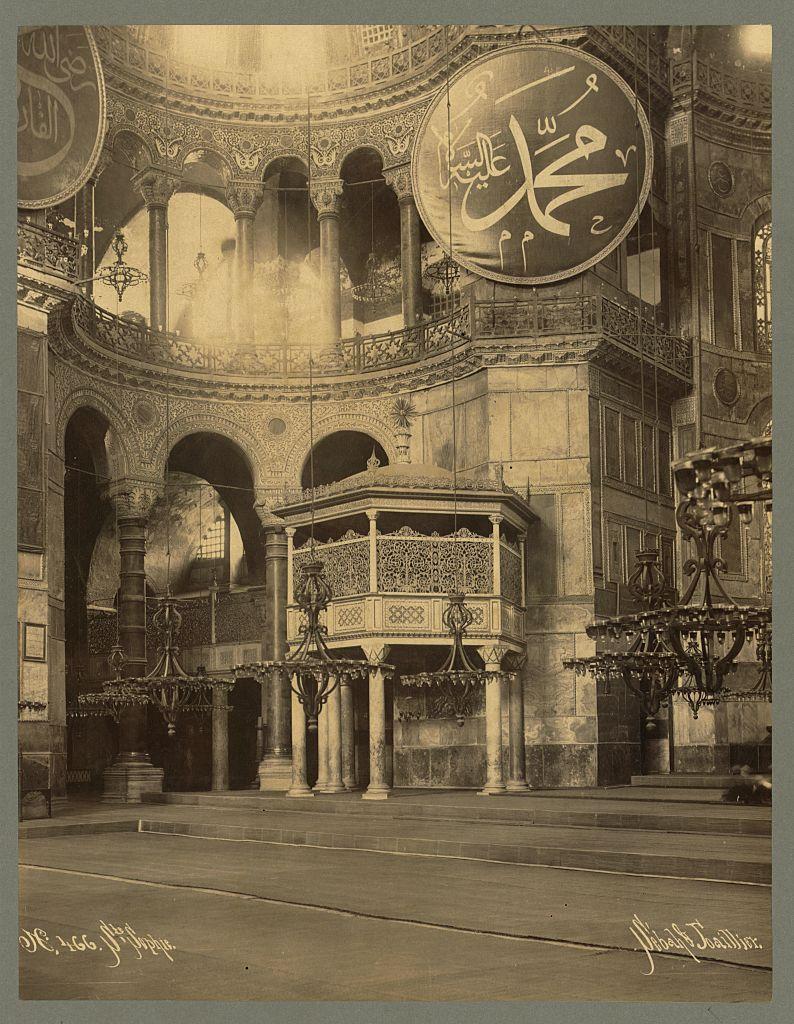
Kazasker Mustafa İzzet Efendi’s Panel of Muhammad (peace be upon him) (LOC)
During the Fossati restoration under Sultan Abdülmecid, the Teknecizâde panels were replaced by large circular panels commissioned by Kazasker Mustafa İzzet Efendi. These panels bear the names Allah, Muhammad, the Four Caliphs, Hasan, and Hüseyin. The panels have a diameter of 7.5 metres, a height of 13 metres from the floor, a pen width of 35 centimetres for the main script, and 10 centimetres for the decorative flourishes.【122】 These dimensions reflect the panels’ design in relation to the vast interior scale of Hagia Sophia. Beneath the Hüseyin panel is the signature of Mustafa İzzet Efendi dated 1849.【123】
After the building was converted into a museum in 1934, Kazasker Mustafa İzzet Efendi’s panels were removed from their original positions. There was consideration to relocate them to Sultanahmet Camii, but their size prevented them from being passed through the doorway. After being stored on the floor for an extended period, they were rehung in their original locations on 28 January 1949.
The Fossati brothers’ restoration work between 1847 and 1849 constitutes a significant phase in the documentation of mosaics and inscriptive elements. The Fossati brothers attempted to preserve the nave mosaics, arch interiors, lunettes, and acanthus ornamentation; they inserted plaster fills and used clamps and nails to reinforce missing areas. During this process, some mosaics were uncovered, drawn, and then resealed. During the American Institute of Byzantine Studies’ work in 1931–1932, the nave mosaics were cleaned and documented without any removal or addition.
The decorative program of Hagia Sophia has been preserved in its usage since 2020. During prayer times, certain mosaics are covered by a curtain system, and the imperial coronation area has not been incorporated into the prayer space.
The architectural history of Hagia Sophia Grand Mosque has been shaped by continuous interventions involving repair, reinforcement, renewal, and functional changes since its construction.
The first major intervention during the Byzantine period occurred shortly after the completion of the structure by Justinian I. Following the earthquake of 557, the eastern portion of the main dome collapsed on 7 May 558; the repair task was entrusted to Isidorus the Younger, nephew of the original architect Isidorus. Isidorus the Younger rebuilt the dome approximately twenty steps, or 6.25 meters, higher than its original form; the church was reopened for worship on 24 December 562.【124】
Subsequent Byzantine repairs were largely related to earthquake damage. Cracks that appeared in the dome after the earthquake of 869 were repaired the following year by Emperor Basil I. In the reign of Basil II, a portion of the dome collapsed again during the earthquake of 26 October 986; after a six-year restoration led by the Armenian architect Tiridates, the building was reopened on 13 May 994.【125】
During the Fourth Crusade of 1204, Hagia Sophia suffered extensive damage; limited repairs were carried out after Constantinople returned to Byzantine control.【126】 A more comprehensive restoration was undertaken in 1317 during the reign of Andronikos II, with walls externally reinforced by buttresses. On 19 May 1346, a section of the dome along with the eastern pier collapsed; due to the economic difficulties facing the Byzantine Empire, repairs were not completed until 1354.【127】 After the collapse of the eastern pier in 1347, two Greek architects and one Italian were assigned to the work; the pier was largely reconstructed using bricks salvaged from the fallen masonry, while the dome shell was rebuilt with smaller new bricks.
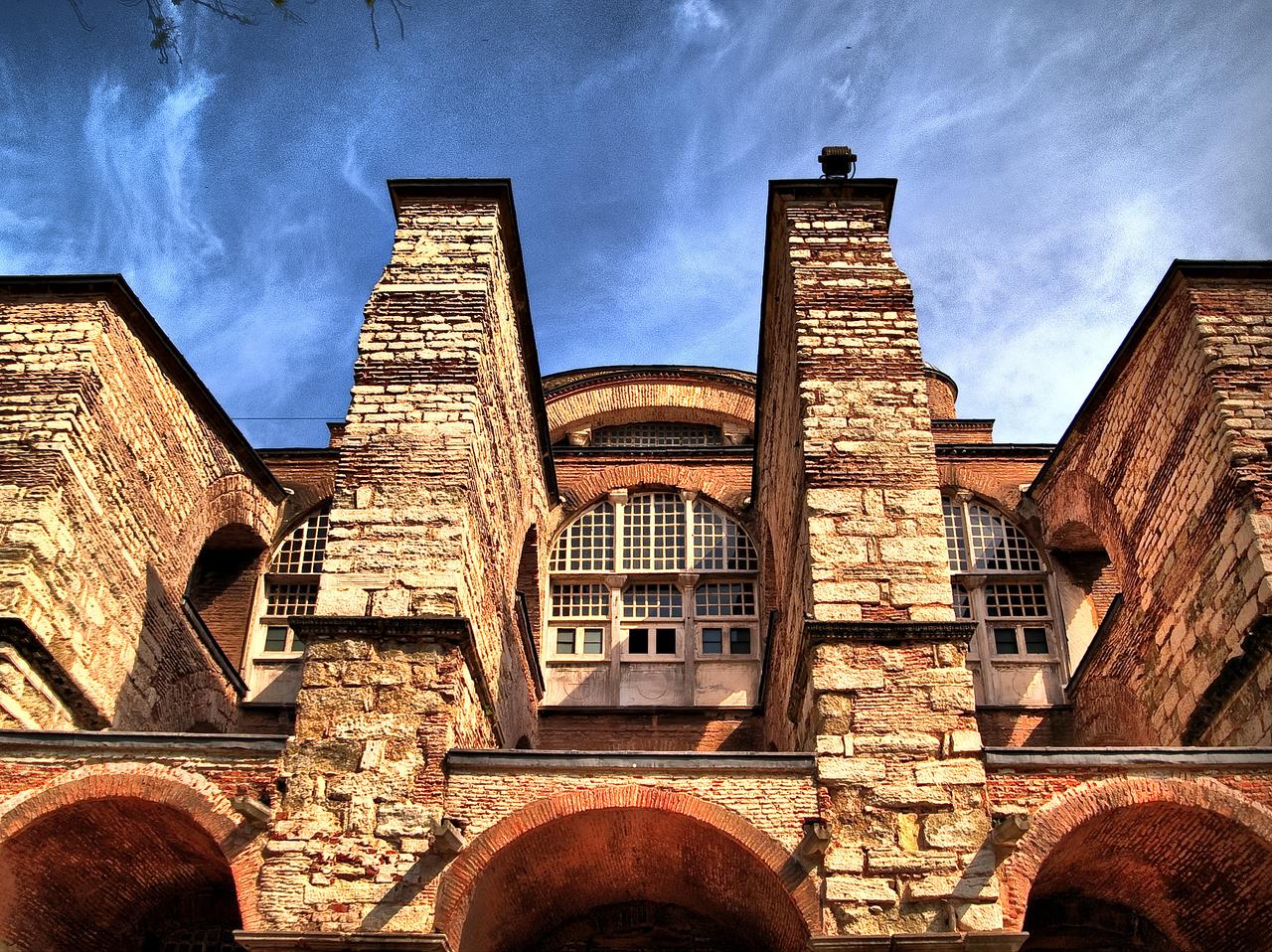
Braces Added by Mimar Sinan (flickr)
During the Ottoman period, the preservation of Hagia Sophia evolved through adaptations to its function as a mosque and structural reinforcement measures. After the conquest, the building was converted into a mosque; liturgical elements were removed, and mosque features such as the mihrab, minbar, and other components were added. It is recorded that the first minaret was constructed of wood above the southern buttress adjacent to the half-dome on the western side, and that this minaret was removed during the 1574 restoration.【128】 In subsequent phases, brick and stone minarets were added, forming an Ottoman-era layer on the building’s exterior appearance.
The most significant structural interventions of the Ottoman period are associated with Mimar Sinan. During the reign of Selim II, buildings surrounding Hagia Sophia that posed a threat to its structure were cleared away; Mimar Sinan installed reinforcing braces to prevent the building from collapsing. This intervention represents one of the principal phases of the Ottoman-era buttress system that supported Hagia Sophia’s load-bearing structure. A minaret was also constructed during this period; it is strongly believed that this minaret occupied the southeastern corner of the building.
Ottoman-era repairs were not limited to structural reinforcement. Additional interior spaces and külliye components were also introduced to accommodate the building’s function as a mosque. During the reign of Murad III, the minbar, kürsü, and mahfil were added alongside the two northern minarets. During the reign of Mahmud I, further additions were made including a library, şadırvan, sıbyan mektebi, and aşhane-imaret; the skeuophylakion structure was repurposed as a food storage depot.【129】 These additions expanded the architectural unity that developed around Hagia Sophia during the Ottoman period.
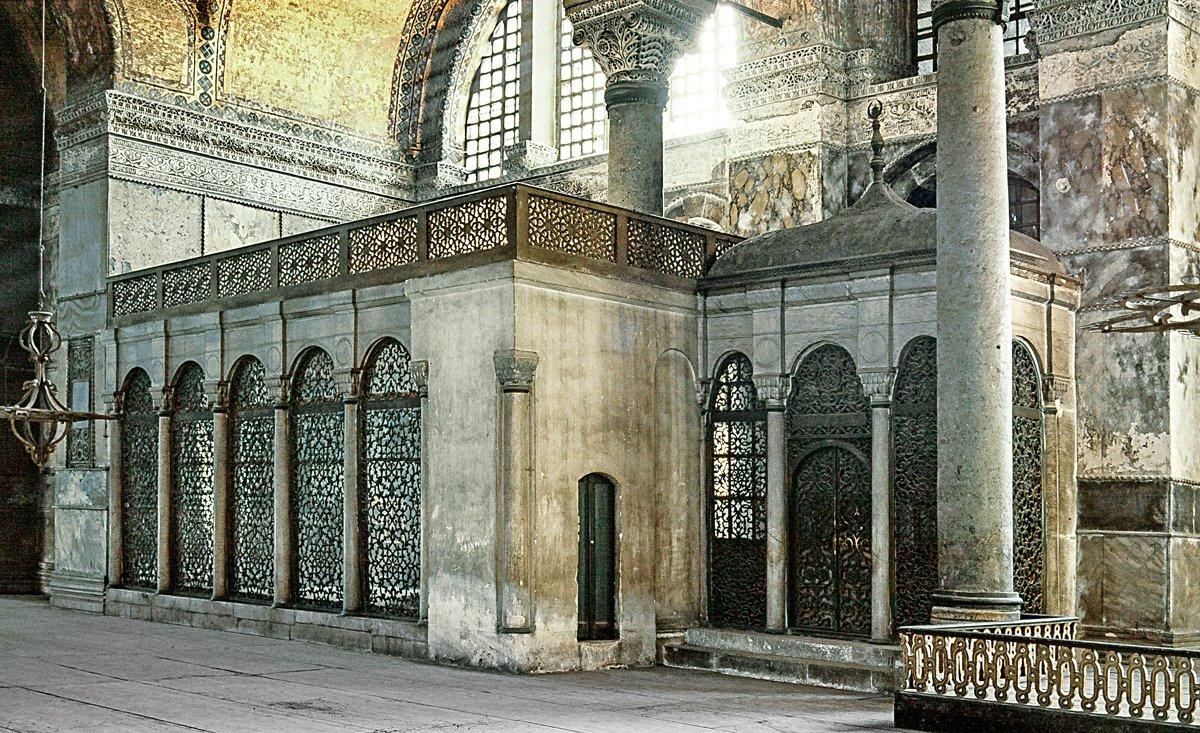
Hagia Sophia Library (TDV İslam Ansiklopedisi)
The inscription of the Bismillah in tile on the mihrab wall in 1607, the conversion of the baptistery into a tomb in the 17th century, and the subsequent addition of a sebil, fountain, tomb, and cemetery area are examples of functional transformations within and around the building. The tombs of Selim II, Murad III, Mehmed III, and the princes formed a significant layer of Ottoman dynastic architecture around Hagia Sophia; these tombs followed the tradition of double-walled domes.
The restoration carried out between 1847 and 1849 under the orders of Sultan Abdülmecid by Gaspare Trajano Fossati represents the most comprehensive intervention in Hagia Sophia during the 19th century. During this restoration, a new imperial loge, a hünkâr mahfili imitating Byzantine style, and a courtyard gate were constructed alongside a muvakkithane; the wall surrounding the courtyard was renewed. During Fossati’s restoration, the mosaics on the walls and vaults were uncovered and drawn by Fossati and W. Salzenberg. The main dome, half-domes, dome drum, structural assessments, seraphim figures, the Nūr surah calligraphy in the eastern half-dome, penwork completions, exterior facade color, and lead coverings were among the primary concerns of this restoration phase.【130】
The 1894 earthquake caused new damage to Hagia Sophia. Cracks appeared in the walls, and large mosaic surfaces fell along with their plaster backing. During the Constitutional Era, Western architects including Marangoni, Jackson, Propper, and Prost were commissioned to assess the building’s condition; restoration preparations were undertaken under the supervision of architect Kemâleddin Bey. In the early years of the Republic, minor restoration and reinforcement work was carried out in 1926.
By a decision of the Council of Ministers dated 1934, Hagia Sophia was removed from service as a mosque and placed under the General Directorate of Museums.【131】 During this process, the madrasa was demolished, and some objects, carpets, and plaques belonging to the mosque were removed from inside.
One of the most important projects during the Republican period was the uncovering of the mosaics. In 1931, permission was granted to Thomas Whittemore on behalf of the American Institute of Byzantine Studies to uncover the mosaics of Hagia Sophia; work began in 1932. A steel scaffold 13 meters high was erected in the narthex; mosaic surfaces on the vaults and walls were photographed between December 1931 and April 1932, followed by cleaning operations under the technical supervision of Venetian craftsmen and engineer Marangoni. The mosaics were not removed from their original positions, no new additions were made, and the visible surfaces were cleaned and documented.
In 1936, A. M. Schneider conducted excavations west of Hagia Sophia; between 1944 and 1950, Museum Director Muzaffer Ramazanoğlu carried out research inside and outside the building.
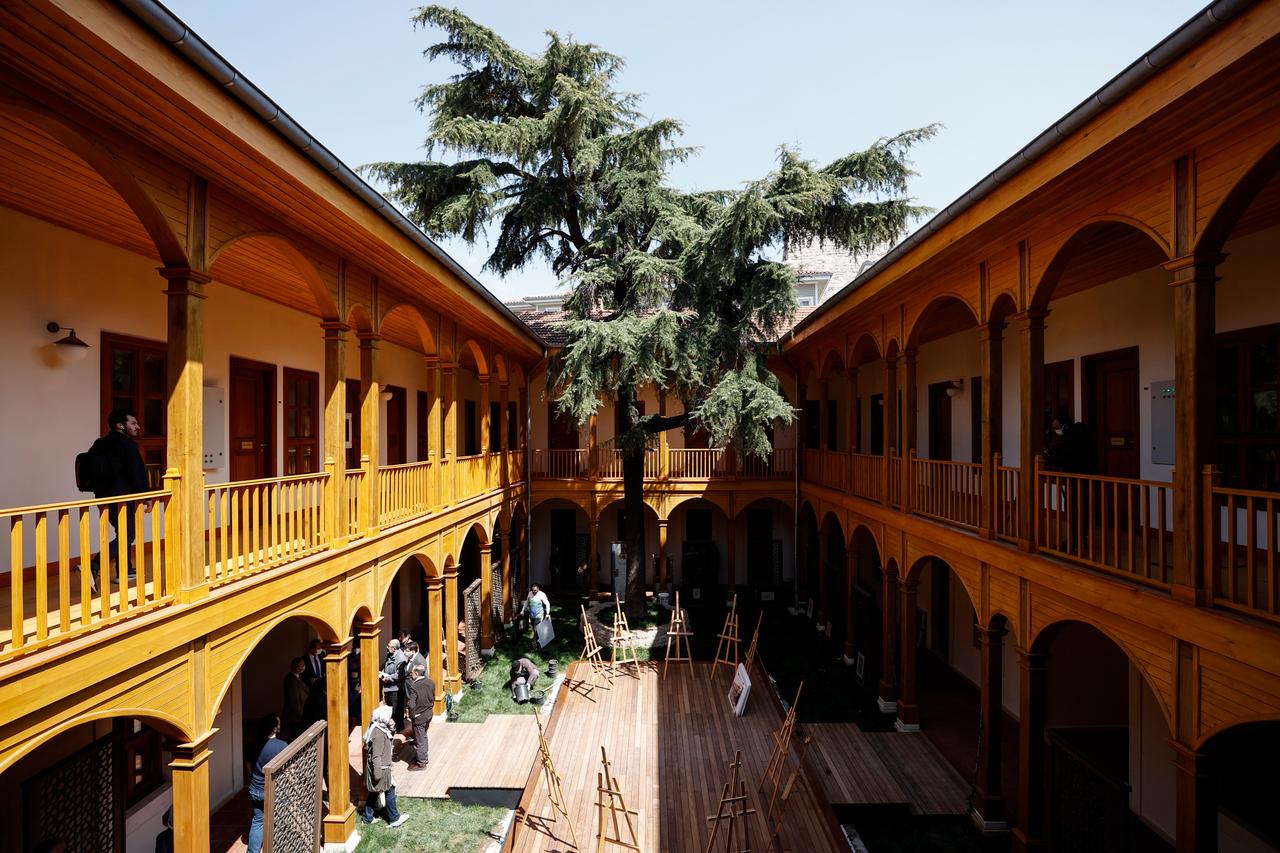
Ayasofya Medresesi (Anadolu Ajansı)
Research has also been conducted on the surroundings and substructure of the building during the Republican period. It has been reported that in 1935 the madrasa was demolished and A. M. Schneider uncovered remains belonging to the second church; between 1947 and 1950, Muzaffer Ramazanoğlu’s excavations yielded new findings related to the first church; and in 1955, Alpaslan Koyunlu made discoveries concerning the second church.【132】 In 1959–1960, Rüstem Duyuran discovered remnants of four supporting walls; in 1983, borehole surveys identified a water cistern, remains of the patriarchal palace, and passageways connected to the Hippodrome.【133】 Studies begun in 2005 recorded findings related to underground tunnels, wells, and subterranean connections.
At the end of the 20th century and the beginning of the 21st century, earthquake risk and structural safety became important components of the restoration agenda. Reports were prepared in 1992–1993, 2002, 2003, and 2007 to assess the potential impact of earthquakes on Hagia Sophia.
The madrasa area was also one of the sites reconsidered during the Republican period. The land of the madrasa, originally built by Fatih Sultan Mehmed but later altered and demolished in 1936, was cleared and its foundations exposed between 1985 and 1986. In 2017, work began to reconstruct the madrasa in accordance with its original form, and by 2020 these efforts had reached their final stage.【134】
Hagia Sophia possesses a multifaceted character as a place of worship, a cultural heritage site, a major tourist attraction, and a locus for the implementation of conservation policies. Following its reclassification as a mosque in 2020, the Hagia Sophia Grand Mosque has continued to serve its religious function while remaining open to both domestic and international visitors. This dual use necessitates the integrated management of prayer schedules, visitor flow, security, restoration, interpretation, and principles of world heritage conservation. Therefore, the current assessment of Hagia Sophia must consider not only its status change but also its visitation regime, its role in tourism, its relationship with the Sultanahmet surroundings, and its conservation practices.
The current official status of Hagia Sophia was established following a Council of State decision dated 10 July 2020 and the subsequent Presidential Decree No. 2729 issued on the same day. This decision annulled the 24 November 1934 Cabinet Decision No. 2/1589, which had converted Hagia Sophia in the Fatih district of Istanbul into a museum, as ruled by the Tenth Chamber of the Council of State. Subsequently, management of the building was transferred to the Directorate of Religious Affairs in accordance with Article 35 of Law No. 633 on the Establishment and Duties of the Directorate of Religious Affairs, and it was reopened for worship. Since then, the building has been officially referred to as the Hagia Sophia Grand Mosque and has been operational as a mosque for religious services.【135】
Today, as a mosque, Hagia Sophia continues to host daily prayers, Friday prayers, and religious observances. At the same time, due to its historical and cultural significance, it remains open to visitors. This dual function places Hagia Sophia within a unique management model distinct from ordinary places of worship. On one hand, worshippers require a quiet, orderly, and spiritually undisturbed environment; on the other, visitors seeking to engage with the site for cultural purposes must be able to examine its historical layers, mosaics, Ottoman additions, and architectural elements. Consequently, the current status is based on the coordinated management of both worship and visitation functions within the same structure.
The management structure of Hagia Sophia has been shaped since 2020 by a functional division between the Directorate of Religious Affairs and the Ministry of Culture and Tourism. The prayer regimen as a mosque is administered by the Directorate of Religious Affairs, while the preservation of the historical structure, restoration efforts, visitor management, and its status as cultural heritage fall under the purview of the Ministry of Culture and Tourism and its protective councils. The visitor management plan implemented in 2024 emerged as a result of this multi-administrative necessity. Under this system, access for those arriving for worship and foreign visitors coming for cultural purposes has been separated, aiming to preserve the prayer秩序 while ensuring more controlled management of tourism visits.【136】
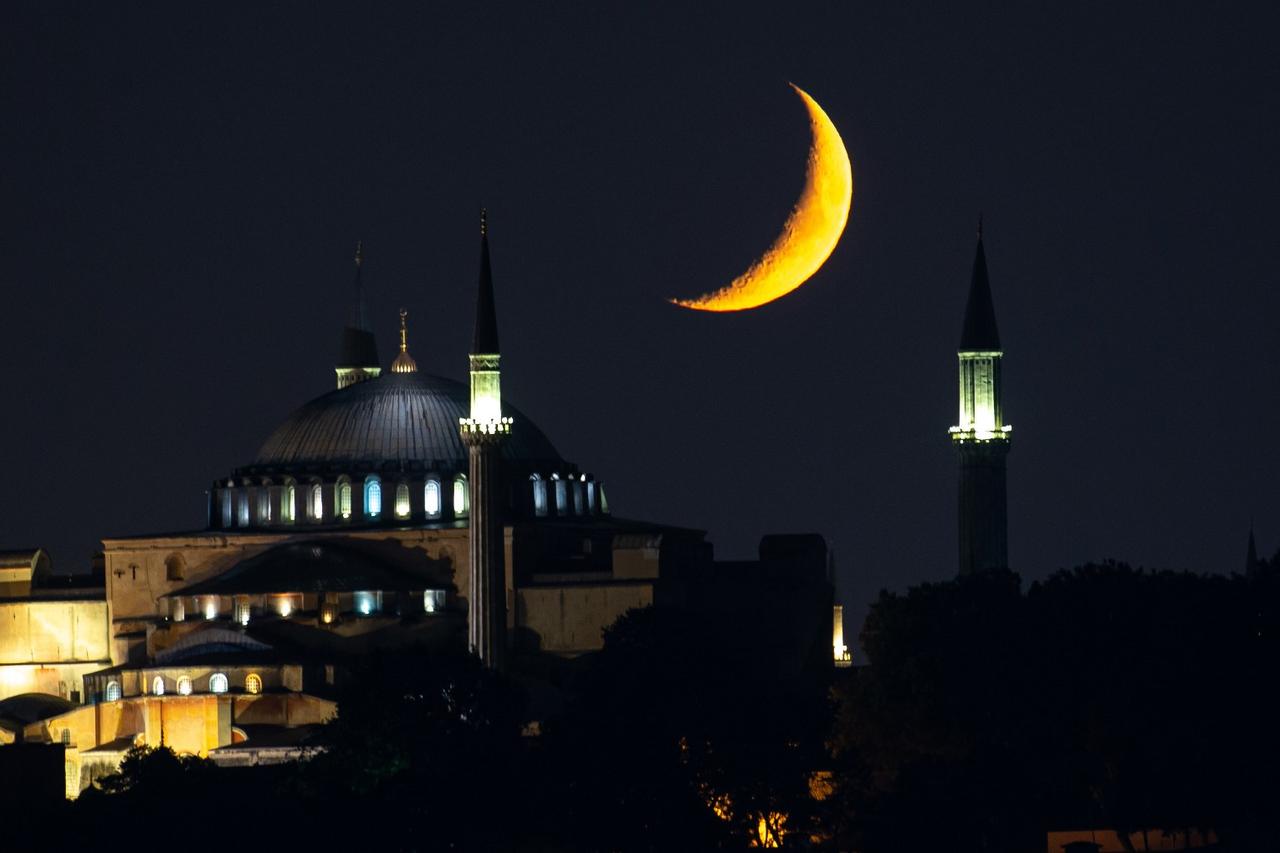
Ayasofya-i Kebir Cami-i Şerifi'nden Bir Gece Görseli (Ayasofya Camii)
The current status of Hagia Sophia has not been considered independently of its context as a world heritage site. The building is one of the principal monuments included in the UNESCO World Heritage List under the Historic Areas of Istanbul. In UNESCO records, Hagia Sophia is regarded as a central example of the architectural heritage of Istanbul from both the Byzantine and Ottoman periods. Therefore, its use as a mosque does not negate its cultural heritage character; however, its physical access, structure, movable heritage elements, management model, and conservation practices are separately monitored in accordance with world heritage principles. Following the status change in 2020, UNESCO emphasized in its statement that the impact of the change on its outstanding universal value must be taken into account and that dialogue must be maintained within the conservation process.【137】
In its current use, the accessibility of Hagia Sophia is managed alongside its function as a place of worship. While the existing prayer area continues to be used for worship by Turkish citizens, tourist and cultural visits by foreign visitors have been regulated since 15 January 2024 through a new route and ticketing system.【138】 This system aims to manage the high demand arising from Hagia Sophia’s dual role as an active mosque and a historic monument attracting international visitors. Under the visitor management plan, the opening of the gallery level to visitors, separation of entry and exit points, installation of security and fire detection systems, and implementation of QR code and headset-based information services demonstrate that the current status has been redefined not only legally but also in terms of practical visitation protocols.
Within this framework, Hagia Sophia’s current status cannot be confined to a single definition. Officially it is a mosque; its worship services are managed by the Directorate of Religious Affairs; as a historical and cultural heritage asset it is subject to conservation and visitation policies; as a tourist attraction it is among the most visited monuments in Istanbul; and within the context of world heritage, it is a cultural property under international conservation responsibility. This multi-layered current status reveals that the functional transformations Hagia Sophia has undergone throughout history continue today through practices of management, visitation, and conservation.
Following its reclassification as a mosque in 2020, Hagia Sophia was reopened for worship; at the same time, measures were implemented to facilitate visits by both domestic and international tourists to the historic structure. This dual-use arrangement created a new need for regulation, particularly concerning visitor density, preservation of the worship environment, security, information provision, and protection of historical elements. In this context, a visitor management plan prepared by the Ministry of Culture and Tourism came into effect on 15 January 2024.
The primary objective of the new regulation is to separate the entry flows of those visiting for worship from those visiting for cultural and tourist purposes. According to ministry statements, no changes were made to the entry process for Turkish citizens visiting for worship; they continue to perform their prayers in the existing worship area. In contrast, a separate entry route has been established for foreign nationals visiting for tourism and cultural purposes.【139】 This arrangement aims to prevent overlap between the worship activities inside the mosque and the flow of tourist visitors.
The route designated for tourist visits has been organized via the upper level and gallery floor of the building. A ticket office has been operationalized opposite the III. Ahmed Fountain to serve visitors entering the gallery. Tourists are directed in a controlled manner to the gallery level through a tunnel and entrance ramp located beneath the II. Bayezid Minaret on the southern facade of the historic mosque. Exit is facilitated via a ramp on the northeast side of the structure. This arrangement reduces direct contact between visitors and the main worship area while enabling them to observe the interior spaces and historical layers from the upper gallery.
The gallery level has been designated as the primary tourist observation area under the current visit regime. From this level, visitors can view the mosque’s prayer hall, Ottoman-era additions, and Byzantine-era mosaics. Additionally, the gallery route passes through the section known as the “Gate of Heaven and Hell,” and includes visits to certain historical structures on the upper level.
With the new application, an entrance fee has been introduced for foreign visitors arriving for tourism purposes. The ministry’s announcement specifies this fee as 25 euros. This policy is based on making a functional distinction between foreign visitors who come for worship and those who visit for cultural purposes. Sources emphasize that Turkish citizens entering for worship continue to do so free of charge, while foreign visitors undertaking tourism or cultural visits are now required to purchase tickets.【140】
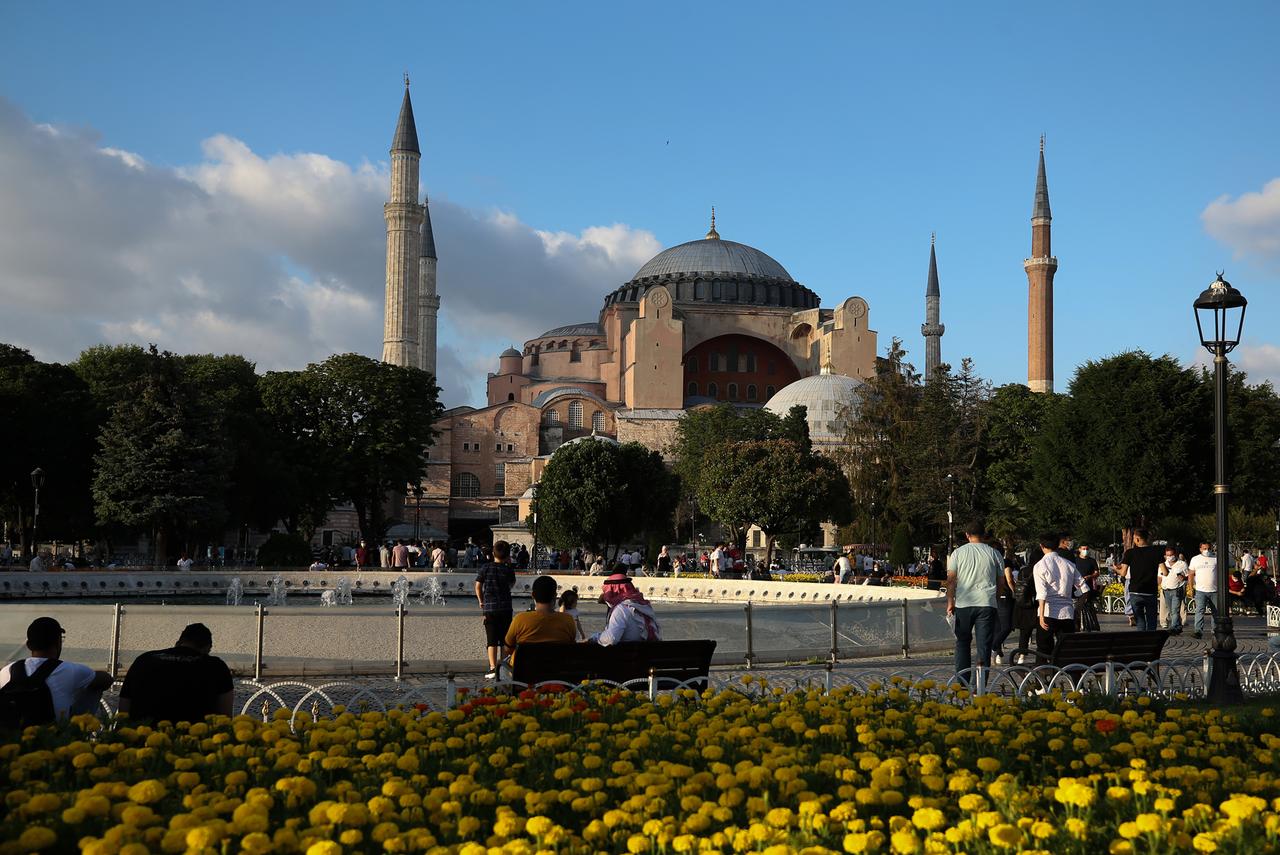
Ayasofya-i Kebir Cami-i Şerifi'nden Bir Kare (Ayasofya Camii)
The visitor management system has also been restructured. The prohibition of guided verbal tours inside Ayasofya-i Kebir Camii is intended to preserve the quiet atmosphere required for worship. Instead, visitors are expected to obtain information via QR codes and audio headsets. The ministry’s announcement states that visitors can access information in 23 languages through their mobile phones and headsets without disturbing those engaged in prayer. This system aims to reduce the acoustic congestion associated with traditional guided tours and to sustain the visitor experience through a quieter, more discreet method of information delivery.【141】
Security and protection measures are also essential components of the visitation system. Protective measures have been implemented along the visitor route, including the installation of security cameras, fire detection systems, and emergency announcement systems. Cleaning and conservation work on the marble claddings and wooden railings on the gallery level has been carried out by restorers and conservators under the approval and guidance of the Science Board. These practices demonstrate that visitor flow is managed not merely as an administrative arrangement but as an integrated management plan linked to the physical preservation of the historical structure.
The visitation system at Hagia Sophia is carried out in conjunction with restoration efforts. The Ministry of Culture and Tourism has stated that work is underway to replace and repair the upper covering of Hagia Sophia’s main dome, but that the building will remain open to both visitors and worshippers during these restoration activities. The same statement also indicates that the restoration will proceed in phases and that a digital copy of the structure has been created.【142】
Current practices regarding Hagia Sophia’s visiting hours must be evaluated in conjunction with prayer schedules and institutional announcements. The main structure, functioning as a mosque, prioritizes worship during prayer times and religious holidays. Therefore, tourist visits are managed in harmony with prayer times, security decisions, and restoration activities. The Hagia Sophia History and Experience Museum, established as a separate structure supporting the historical narrative of Hagia Sophia, is located in the Defter-i Hakani Nezareti building. It is open from 09:00 to 19:00, with ticket office closing at 18:30. This museum provides a distinct experiential space by presenting the historical periods of Hagia Sophia through audiovisual narratives, complementing the visitation experience of the main building.【143】
As a result, the current visitation system of Hagia Sophia is based on a phased management model designed to ensure that worship and cultural tourism can proceed without harming each other. Key elements of this model include preserving the prayer area, establishing a ticketed gallery route for foreign visitors, separating entry and exit points, providing multilingual audio guidance, limiting guided tours, installing security systems, and continuing restoration work without fully halting visits. Thus, Hagia Sophia today functions within a structured visitation framework that accommodates different user groups, serving simultaneously as an active mosque and a culturally significant heritage site.
As one of Istanbul’s most renowned historical structures, Hagia Sophia holds a unique position in both cultural tourism and faith-based tourism. Its construction in the 6th century as the principal church of the Eastern Roman Empire, its transformation after 1453 into one of the most important mosques of the Ottoman capital, its use as a museum between 1935 and 2020, and its reclassification as a mosque after 2020 have all prevented it from being confined to a single-period visitation context. The primary factor that makes Hagia Sophia compelling from a tourism standpoint is the visible layering of historical elements from the Byzantine, Ottoman, and Republican periods within the same structure. Consequently, the building is not merely an architectural monument but also a multilayered historical document that reveals the coexistence of different religious, political, and cultural traditions in a single space.
Istanbul’s prominence in international tourism is one of the main factors directly influencing Hagia Sophia’s visitor potential. Istanbul ranks among Türkiye’s most significant tourism centers due to its historic peninsula, the Bosphorus shoreline, museums, religious structures, palaces, bazaars, and transportation links. According to data from the Istanbul Provincial Directorate of Culture and Tourism, the number of foreign visitors entering Istanbul in 2025 reached 18,972,699. In February 2026 alone, the number of foreign visitors entering Istanbul was recorded at 1,233,088.【144】 This scale demonstrates that Hagia Sophia must be evaluated not in isolation but within the broader context of Istanbul’s extensive international visitor movement.
The district in which Hagia Sophia is located also plays a decisive role in its tourist value. Fatih district is one of the main concentration areas for cultural tourism in Istanbul because it houses the central historical areas of the peninsula. According to 2025 accommodation data, Fatih district recorded the highest number of overnight stays among all officially registered facilities in Istanbul. In the same year, the number of arrivals at officially registered facilities in Fatih was 5,105,768 and the number of overnight stays was 12,597,854.【145】 This situation demonstrates that Hagia Sophia is situated in an environment that attracts not only day-trippers but also cultural tourists who stay overnight in Istanbul.
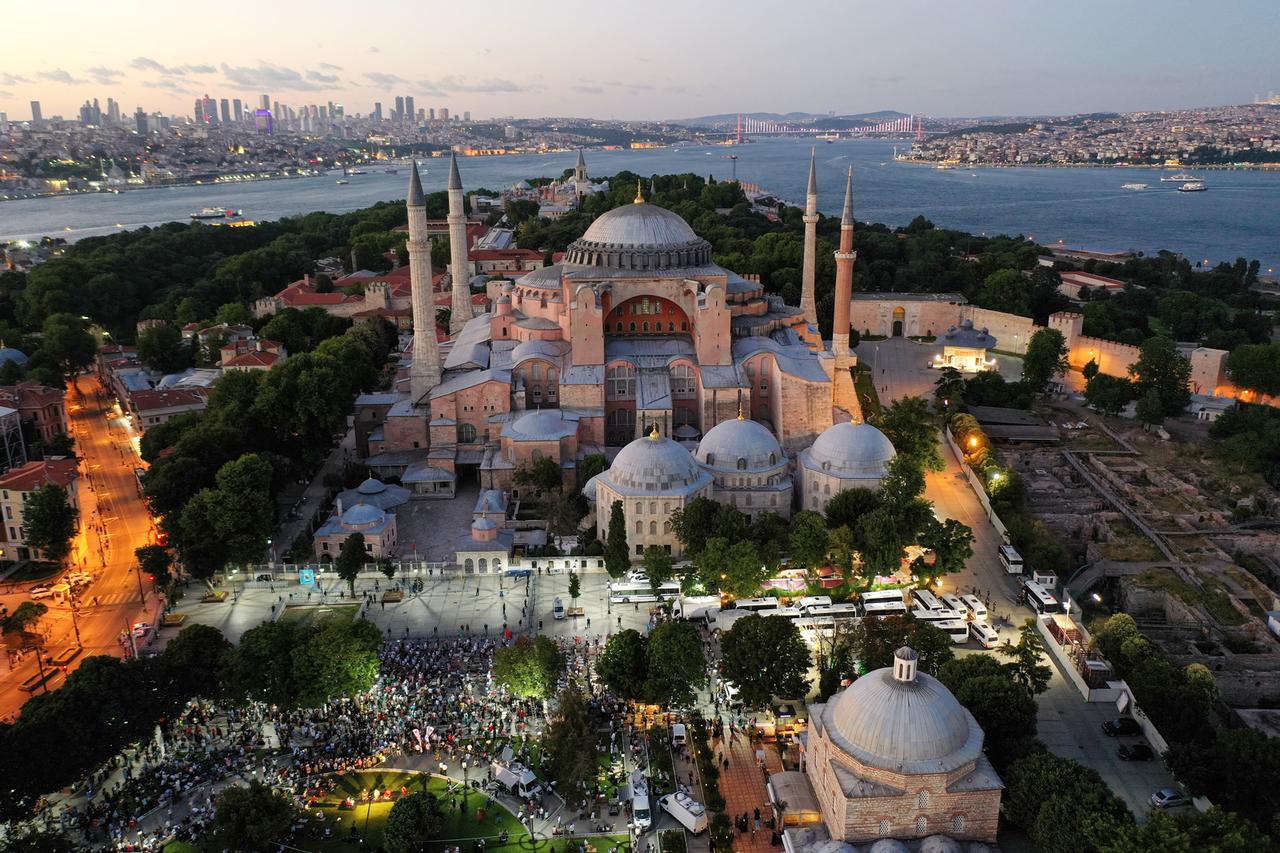
Evening Prayer at Hagia Sophia (Hagia Sophia Mosque)
Hagia Sophia’s international recognition has been further strengthened within the context of its designation as a UNESCO World Heritage Site. The Historic Areas of Istanbul were inscribed on the World Heritage List in 1985, and Hagia Sophia is regarded as one of the most prominent structures within this area. In UNESCO’s description of Istanbul’s outstanding universal value, Hagia Sophia is listed alongside the Hippodrome of Constantinople, Topkapı Sarayı, Süleymaniye Camii, Sultanahmet Camii and other monuments as one of the key buildings representing the city’s historical skyline and layered architectural heritage.【146】 This framework highlights not only Hagia Sophia’s tourist significance within Türkiye but also its global recognition as a World Heritage landmark.
The significance of Hagia Sophia in cultural tourism stems from the diversity of its architectural and artistic layers. The building’s massive dome, its central spatial effect, Byzantine mosaics, and the additions made during the Ottoman period—including the mihrab, minbar, mahfil galleries, calligraphic panels, minarets, tombs, library, şadırvan, and other külliye elements—offer visitors the opportunity to read multiple historical periods within a single space. This characteristic transforms Hagia Sophia from merely a “site to be seen” into a multidimensional field of study encompassing the history of architecture, art, religions, Ottoman urban development, and conservation history. Visitors can simultaneously observe the spatial design of the Justinianic era, the mosaic tradition following iconoclasm, the Ottoman mosque layout, and the traces of its transformation into a museum during the Republican period.
In terms of faith-based tourism, Hagia Sophia’s position is more complex and layered. For centuries it served as the patriarchal church of Eastern Christianity and one of the central venues for imperial ceremonies; during the Ottoman period it functioned as one of Istanbul’s principal mosques. Its current status as an active mosque has reasserted its religious function, particularly for Muslim visitors. At the same time, its Byzantine heritage—the mosaics, former liturgical spaces, and its place in Christian history—render Hagia Sophia a meaningful historical site for visitors from diverse religious and cultural backgrounds. Therefore, Hagia Sophia is not a narrow pilgrimage site dedicated to a single faith community but a space where different memories intersect, shaped by its evolving religious functions throughout history.
Hagia Sophia’s role in tourism is not limited to the main structure alone. The Hagia Sophia History and Experience Museum, housed in the Defter-i Hakani Nezareti building, operates as a separate institution that complements the primary visit through audiovisual narratives of the building’s nearly 1700-year history. Spread across 13 halls covering approximately 3200 square meters, the museum presents the Byzantine, Ottoman, museum, and reconverted mosque periods, demonstrating that Hagia Sophia’s tourist presentation extends beyond physical site visitation to include digital storytelling, curated exhibitions, and multilingual interpretation.【147】 Such approaches are part of contemporary tourism strategies aimed at conveying historical knowledge alongside visitor flow at heavily visited monuments.
Hagia Sophia is located in Istanbul’s Historic Peninsula, situated at one of the most intense historical and tourist axes surrounding Sultanahmet. The tourism value of the building stems not only from its own historical legacy but also from the urban coherence it forms together with nearby monuments. When considered alongside the Sultanahmet Camii, Topkapı Sarayı, Hippodrome/Atmeydanı, Yerebatan Sarnıcı, İstanbul Arkeoloji Müzeleri, Hagia Eirene, and other historical structures in the vicinity, Hagia Sophia transcends its role as a singular attraction to become one of the central elements of a multi-period historical environment. This area represents one of Istanbul’s most concentrated cultural itineraries, bringing together traces of the Byzantine, Ottoman, and Republican periods within short walking distances.
The relationship between Hagia Sophia and Sultanahmet Camii is one of the most prominent encounters in the region’s contemporary visitor experience. On one side stands the great domed basilica of 6th-century Byzantine architecture; on the other, one of the grandest examples of 17th-century Ottoman mosque architecture. These two structures, positioned in mutual view around Sultanahmet Meydanı, offer visitors the opportunity to assess Byzantine and Ottoman architectural traditions within a single visual field. The conversion of Hagia Sophia into a mosque after 1453 and the subsequent construction of Sultanahmet Camii during the later Ottoman period illustrate how the area’s significance evolved not only architecturally but also religiously and politically over time.
Topkapı Sarayı is another key element that completes Hagia Sophia’s position within the Sultanahmet tourism zone. During the Byzantine era, Hagia Sophia functioned as the patriarchal church adjacent to the Great Palace and the Hippodrome; during the Ottoman period, it served as a central mosque near Topkapı Sarayı. In the current visitor arrangement, the upper elevation facing Topkapı Sarayı has gained importance in terms of Hagia Sophia’s tourist access routes. As part of the visitor management plan implemented in 2024, foreign visitors arriving for cultural and tourism purposes were directed to the upper-level route, thereby more clearly integrating Hagia Sophia’s visitor flow with the broader circulation pattern in the Sultanahmet-Topkapı area.
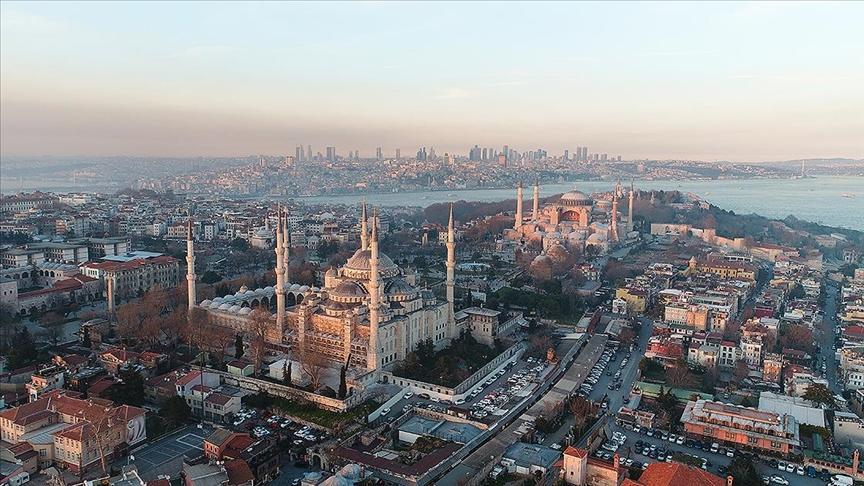
Hagia Sophia and Sultanahmet Mosques (Anadolu Ajansı)
The Basilica Cistern and other cisterns in the surrounding area demonstrate that the Sultanahmet district must be understood not only through its religious and palace structures but also through its urban infrastructure heritage. While Hagia Sophia served as the religious and ceremonial center of Byzantine Constantinople, the nearby cisterns were integral components of the city’s water supply system. From this perspective, the inclusion of both Hagia Sophia and the Basilica Cistern within the same visitor circuit reveals that Constantinople can be understood not only through its monumental places of worship but also through its water structures and underground architecture. This unity transforms the Sultanahmet surroundings into a multi-layered open-air narrative space encompassing architectural history urban history and infrastructure history.
The Istanbul Archaeology Museums further strengthen the museum dimension of the tourist environment surrounding Hagia Sophia. While Hagia Sophia is visited as a monument embodying both Byzantine and Ottoman layers the Istanbul Archaeology Museums offer visitors the opportunity to trace the broader ancient and historical heritage of Istanbul and its surroundings through their collections. Thus the visitor experience in the Sultanahmet area is not confined to monumental architecture alone; different types of heritage—including archaeological artifacts museum displays palace structures places of worship cisterns and square fabric—converge along the same route. This convergence positions the area as a focal point where classical city tours cultural tourism religious tourism and museum tourism operate in tandem.
The Sultanahmet area is also a prominent center not only due to the density of monuments but also because of the organization of tourism services. The presence of the Istanbul Provincial Directorate of Culture and Tourism’s Sultanahmet Tourism Advisory Office at Atmeydanı/Sultanahmet confirms that this is one of the primary tourist information points serving both local and international visitors with guidance orientation and promotional services. Such advisory and directional services play a complementary role in managing the high volume of visitors to Hagia Sophia Sultanahmet Camii Topkapı Sarayı and other nearby structures. Consequently the area is not merely a repository of historical buildings but also a visible hub of contemporary tourism management.
In conclusion the relationship between Hagia Sophia and the Sultanahmet tourism zone is not a simple adjacency of structures. Hagia Sophia is part of Byzantine Constantinople together with the Hippodrome and cisterns; it is part of Ottoman Istanbul alongside Topkapı Sarayı Sultanahmet Camii and Ottoman additions; and it is also part of contemporary cultural tourism through museums advisory offices visitor routes and digital information applications. Therefore the structure holds a central position within the historical and contemporary functioning of the Sultanahmet tourist unity.
The visitor experience at Hagia Sophia is based on a dual system arising from its simultaneous use as a place of worship and a cultural heritage site. Consequently the experience differs from a conventional museum visit or a simple mosque tour. Visitors encounter an active place of worship on one hand while observing a multi-period monument that encompasses Byzantine Ottoman and Republican-era layers on the other. This duality directly shapes the practices of silence guidance crowd management security information provision and preservation that define the visitor experience at Hagia Sophia.
The visitor management plan implemented in 2024 aims to reduce the issue of overcrowding, one of the most visible aspects of the experience. Due to Hagia Sophia being one of Istanbul’s most visited historical structures, long queues frequently formed around the square and entrance areas. The new system was designed to separate visitors arriving for worship from those visiting for cultural purposes, thereby preventing congestion from concentrating at a single point. This allows worshippers to avoid long waiting times during prayer hours, while tourist visitors are guided along a more structured route through the building.
Another critical aspect of the visitor experience is the preservation of the prayer environment. Hagia Sophia’s status as a mosque necessitates control over noise levels, movement, and group behavior within the interior. As a result, tour guides are no longer permitted to speak loudly in the visitor areas, a rule that has become one of the core guidelines of the experience. Instead, visitors are directed to obtain information via headphones using an augmented reality application downloaded on their smartphones or through a QR code system. This approach enables visitors to learn about the historical and artistic elements of the site without disturbing those engaged in worship. Thus, the mode of information delivery has shifted from group guided tours to individual, silent digital guidance.
The multilingual information system is an adaptation tailored to Hagia Sophia’s international visitor profile. Ministry statements indicate that visitors can access information in 23 languages through headphones.【148】 This system allows visitors to better understand the various historical layers of the structure. Since the gallery level offers views of the harem, Ottoman additions, and Byzantine mosaics, visitors do not merely walk through the space; they are guided through a structured interpretation of its distinct historical strata. In this way, digital information provision transforms the Hagia Sophia visit from a purely visual experience into one enriched by a clear historical narrative.
Security and protection measures are also integral components of the visitor experience. The placement of security cameras, fire detection systems, and emergency announcement systems along the new visitor route is aimed at managing high volumes of foot traffic. These practices are designed not only to ensure visitor safety but also to safeguard the structure itself. In a historic and fragile monument such as Hagia Sophia, visitor density can exert pressure on floors, marble claddings, wooden railings, mosaics, and other historic surfaces. Therefore, the cleaning and conservation work carried out on the marble claddings and wooden railings on the gallery level, under the guidance of the Science Board by restorers and conservators, demonstrates that the visitor experience is planned in alignment with preservation principles.
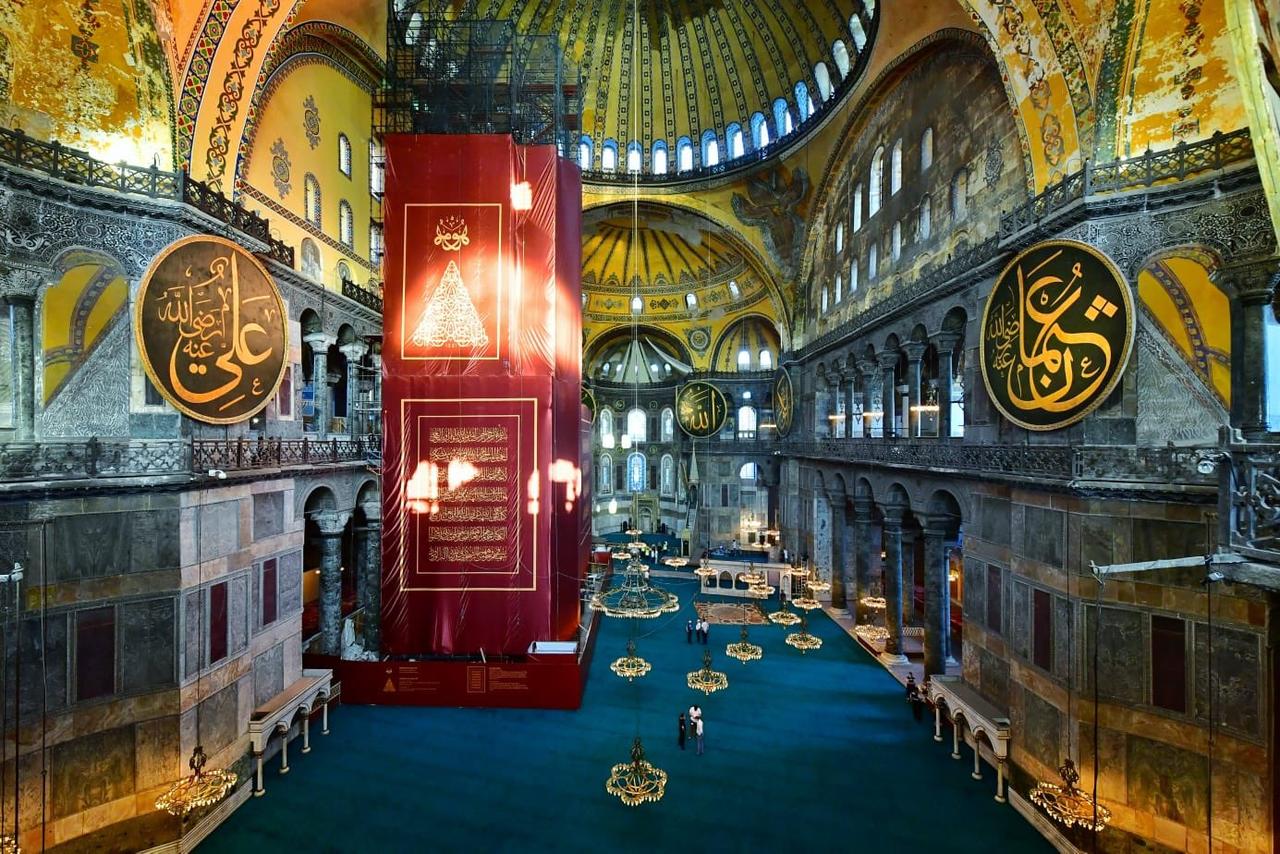
Interior of the Hagia Sophia Grand Mosque (Hagia Sophia Mosque)
Another element that completes the visitor experience is the Hagia Sophia History and Experience Museum. Opened in the Defter-i Hakani Nezareti building in Sultanahmet, this museum presents the history of Hagia Sophia in a dedicated exhibition space, as the main structure offers limited scope for extended narratives. Spread across approximately 3200 square meters in thirteen halls, the museum uses audiovisual methods to convey Hagia Sophia’s periods as a Byzantine church, an Ottoman mosque, a museum, and a mosque once again. This arrangement, which includes sections titled “Church, Mosque, Museum and Mosque Again,” provides visitors who undertake a brief and controlled tour of the main building with a broader historical context. The tourism infrastructure surrounding Sultanahmet further supports the visitor experience.
The Tourism Information Office located in Atmeydanı/Sultanahmet is an official advisory point offering brochures, maps, and directional assistance to both domestic and international visitors. The proximity of Hagia Sophia to other major historic sites such as the Sultanahmet Mosque, Topkapı Palace, and the Basilica Cistern places it within a concentrated tourism zone, enabling visitors to experience not just a single structure but an entire historic environment. As a result, a visit to Hagia Sophia is often planned as part of a broader Sultanahmet itinerary that includes other nearby monuments.
Nevertheless, the visitor experience at Hagia Sophia is not always easily manageable due to high levels of interest and congestion. Prayer times, security protocols, ticketed entry, designated routes for foreign visitors, gallery capacity, ongoing restoration works, and peak crowd periods can all affect visitor flow. Consequently, current practices expect not only that visitors show interest in the historic space but also that they behave respectfully in accordance with the site’s religious function and conservation rules. The value of the Hagia Sophia experience depends on maintaining this delicate balance: the building is simultaneously a living place of worship and a globally visited cultural heritage site.
In conclusion, the visitor experience at Hagia Sophia is composed of the integration of elements such as visual engagement, learning, respect for the place of worship, and adherence to preservation guidelines. Practices such as separate entry routes, the gallery-level circulation path, multilingual audio guidance, restricted guided tours, security systems, the visitation regime maintained alongside restoration efforts, and the Experience Museum represent contemporary adaptations of this multifaceted structure. This model aims to convey Hagia Sophia’s historical significance not merely as a displayed monument but as a controlled, living, and protected space.
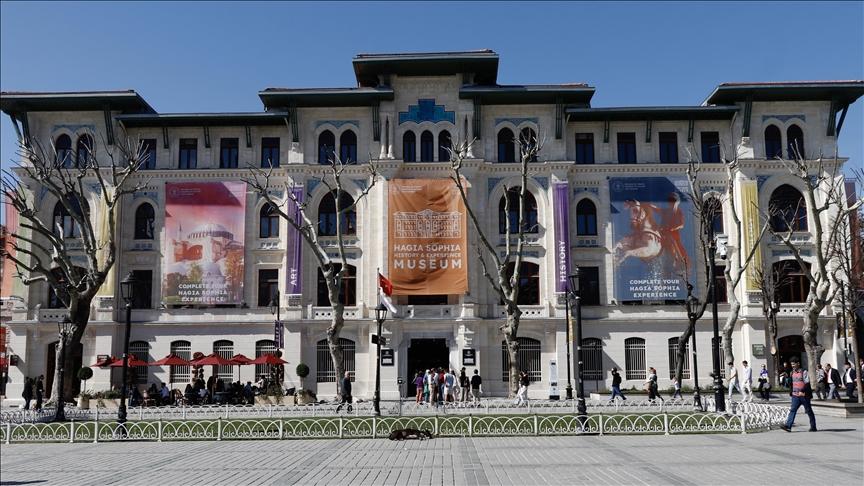
Hagia Sophia History and Experience Museum (Anadolu Ajansı)
The Hagia Sophia History and Experience Museum is a contemporary museum and experiential space that conveys the historical journey of Istanbul and Hagia Sophia through audiovisual technologies. Located in the Defter-i Hakani Nezareti building, one of Istanbul’s iconic structures, the museum opened in 2023. Spread across approximately 3,200 square meters and comprising thirteen halls, the museum presents Hagia Sophia’s 1,700-year history through a hybrid museum approach supported by advanced technology.【149】
The museum consists of three floors. The third and second floors house the experience museum focusing on the history of Hagia Sophia, while the first floor contains a collection section displaying approximately 300 historical artifacts related to Hagia Sophia. Within the experience area, the historical development of Hagia Sophia and Istanbul is presented across thirteen rooms using high-tech methods to immerse visitors in the narrative of history. The presentation is available in 23 different languages.【150】
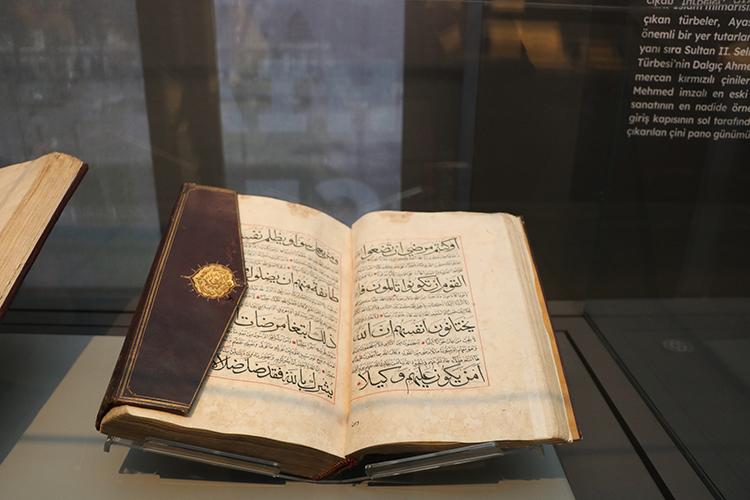
“Museum of Historical Artifacts Collection” includes the Qur’an (Anadolu Ajansı)
The museum tour encompasses the phases of Hagia Sophia’s history, beginning with the foundation of the Byzantine Empire, its construction, and its condition to the present day. In the Byzantine period narrative, figures such as Constantine, Theodosius, the mathematician Isidore, and Emperor Justinian are discussed in relation to their roles in Hagia Sophia’s history. The Ottoman section begins with Sultan Mehmed the Conqueror’s profound regard for Hagia Sophia, followed by an audiovisual presentation of the contributions made by Ottoman sultans to the structure and the preservation philosophy of Mimar Sinan that helped carry Hagia Sophia to the present.
In the museum’s exhibition hall, Hagia Sophia’s historical journey from the 4th century to the present is displayed through approximately 300 original artifacts. The “Museum of Historical Artifacts Collection” includes a 15th-century Qur’an, individual folios of the Qur’an, rare candelabra, and liturgical objects associated with Christianity. Additionally, a historical brick used in the construction of Hagia Sophia, bearing ancient Greek inscriptions, and one of the bronze medallions created by the Fossati brothers to cover the faces of the four Seraphim angels on the dome are also on display.【151】
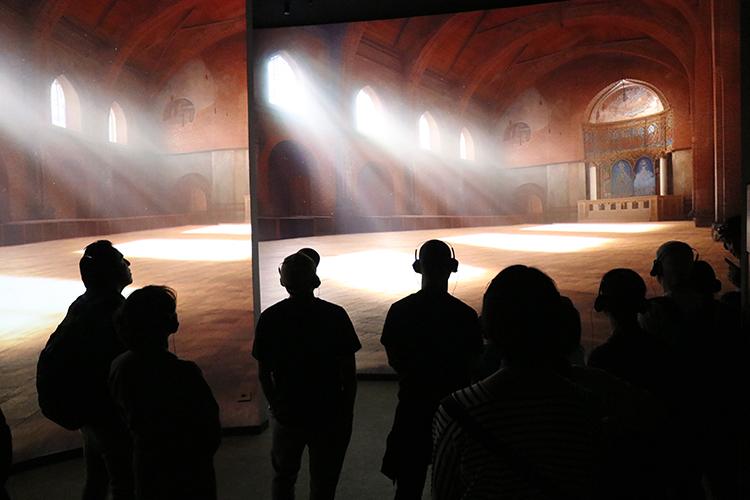
Interior (Anadolu Ajansı)
The museum also features technology-enhanced artworks. One such piece is the Mimar Sinan installation, composed of 12,000 cubes and displayed using mapping technology. Additionally, the “infinite mirrors,” created using various reflective techniques to present the Ayasofya-i Kebir Cami-i Şerifi in three-dimensional form, are among the applications that integrate technology, art, and historical narrative.
Hagia Sophia is one of the principal monuments within the Historic Areas of Istanbul, inscribed on the UNESCO World Heritage List. The structure has served over time as the principal church of the Byzantine Empire, one of the most important mosques of the Ottoman period, a museum during the Republic era, and since 2020 has been reinstated as a mosque. This continuity and transformation of function are fundamental to defining Hagia Sophia’s multilayered identity within Istanbul’s historic core.【152】
In its evaluation, UNESCO described Hagia Sophia as an architectural masterpiece and a witness to centuries of interaction between Europe and Asia.【153】 The value of Hagia Sophia within the World Heritage framework is linked to its architectural uniqueness, historical continuity, traces from different eras, and its central role in Istanbul’s cultural landscape.
The status of Hagia Sophia has not been confined to domestic decisions within Türkiye; it has also been the subject of international debate within the frameworks of cultural heritage, religious representation, historical memory, and preservation principles. Its use as a church during the Byzantine period, a mosque during the Ottoman period, a museum during the Republic, and its reversion to a mosque after 2020 has rendered Hagia Sophia a space imbued with historical and symbolic meaning for diverse communities.
The reinstatement of Hagia Sophia as a mosque in 2020 marked the current phase of these debates. Following the decision, the building was reopened for worship on 24 July 2020 with a Friday prayer, after 86 years. In response, UNESCO expressed regret that the change in status had been carried out without prior consultation and emphasized that Hagia Sophia is part of the World Heritage property of the Historic Areas of Istanbul.【154】
Another dimension of international debates concerning Hagia Sophia relates to its historical memory and symbolic meaning. The conversion of Hagia Sophia into a mosque after 1453 has been interpreted as a symbol of conquest and Ottoman dominion over Istanbul, while some Christian communities associate it with concepts of loss and historical trauma.
The conservation challenges of Hagia Sophia Grand Mosque are linked to its long historical trajectory, multiple functional transformations, structural complexity, sensitivity of its interior decorations, moisture effects, and heavy visitor use. The building has undergone various interventions and uses spanning from the Byzantine era to the Ottoman period, and from its time as a museum to its current function as a mosque. Consequently, a conservation approach must address not only the physical integrity of the main structure but also its mosaics, marble claddings, roof covering, load-bearing system, Ottoman-era additions, archaeological surroundings, and visitor management collectively.
In UNESCO’s 1993 mission report on Istanbul, it was noted that the original light and color effects within Hagia Sophia’s interior had been significantly diminished.【155】The report highlighted that moisture-induced color changes had occurred in 19th-century painted vault decorations, plaster had detached in some areas, and the marble claddings at lower levels had become soiled, giving the building a “weary” appearance.
The structural condition of the building is one of the primary conservation concerns. Hagia Sophia’s load-bearing system has been inherently complex since its initial construction. Over its long history, added infills, partial reconstructions, buttresses, and connecting elements have increased this complexity. Some of the cracks and deformations in the structure are attributed to the rapid loading during the initial construction phase, while later cracks are linked to settlement, thermal movements, and earthquakes.
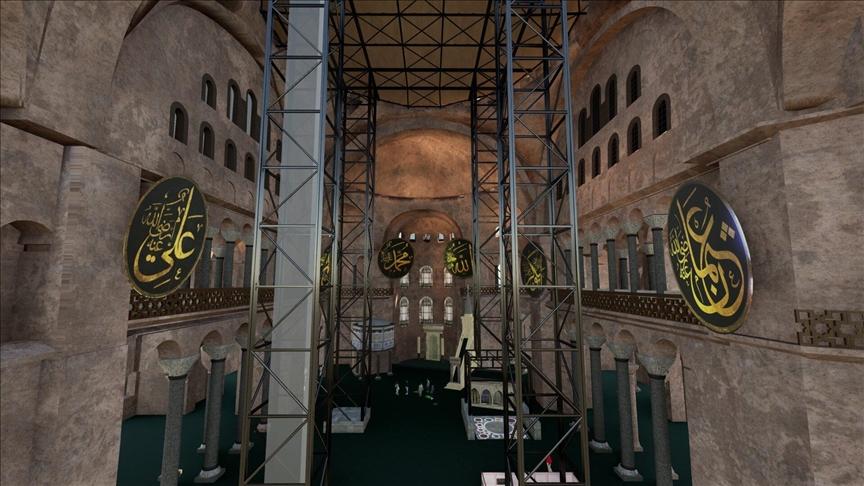
Representative Visual of the Restoration to Be Carried Out on the Main Dome (Anadolu Ajansı)
Current usage and visitor density constitute another key factor affecting the balance between preservation and use. On 24 July 2020, following its reopening for worship, there was massive public participation around Hagia Sophia Square and its surroundings; prayer areas filled before their scheduled times and visitor flow was managed at security checkpoints. A study on faith-based tourism also assessed issues such as visitor density, environmental pollution, entry organization, noise levels and the overall visitor experience after its reclassification as a mosque.【156】
Ayasofya-i Kebir Cami-i Şerifi is regarded as a structure that does not reference a single historical period but reflects the transformation of religious, historical, architectural and urban layers.
The symbolic nature of the building is also linked to its location within Istanbul’s historic center. During the Byzantine era, Hagia Sophia occupied a central position within a complex connected to the imperial palace, the Hippodrome, Hagia Irene, cisterns and other public structures. In this context, Hagia Sophia functioned as a grand temple tied to the imperial seat, forming a ceremonial, administrative and religious focal point alongside structures such as the palace, the senate, the court and the Hippodrome.
During the Ottoman period, Hagia Sophia and its surroundings retained their status as the urban center. After the conquest, the building was converted into a mosque and, together with the külliye that developed around it, acquired a new architectural and religious identity as an Islamic center. Additions such as minarets, the mihrab, the minbar, the kursi, the mahfils, the library, the şadırvan, the sıbyan mektebi, the aşhane-imaret, the sebil, the çeşme, the türbe and the hazire expanded both the functional use and symbolic meaning of the structure during the Ottoman era.
The cultural value of Hagia Sophia also stems from the ability to read spatial traces from both the Byzantine and Ottoman periods within the same structure. The apse located at the eastern end formed the liturgical focus during the Byzantine period, while during the Ottoman period, a mihrab arrangement was added in response to the change in the direction of prayer. Thus, the area around the apse has become a space that carries the traces of two distinct religious and architectural periods together.
The sultan tombs in the immediate vicinity of the building are among the Ottoman-era layers that reinforce the symbolic value of Hagia Sophia. The tombs of Selim II, Murad III, Mehmed III, and the Princes constitute an important part of Ottoman dynastic architecture surrounding Hagia Sophia.
"Ayasofya Narteks Mozaikleri: 1932 de Yapılan İş." *Türk Tarih, Arkeologya ve Etnografya Dergisi*, no. 3 (1936): 199–202. Accessed May 25, 2026. https://makale.isam.org.tr/items/b783cd08-9764-4b33-82cd-10dbb0e27c2b
Akan, Erkin. "Ayasofya Camisi’nin Müzeye Çevrilmesi Üzerine Bir Araştırma." *Türk Dünyası Araştırmaları* 125, no. 247 (July–August 2020): 313–328. Accessed May 28, 2026. https://dergipark.org.tr/tr/download/article-file/1184889
Akan, Erkin. "Cumhuriyet Döneminde Ayasofya." Master's thesis, Çanakkale Onsekiz Mart Üniversitesi, 2008. Accessed May 28, 2026. https://tez.yok.gov.tr/UlusalTezMerkezi/tezDetay.jsp?id=svUmPQBaC9aQQoZeoxQ-kA&no=wO1vwNtOInrHGEJ4A0v8pA
Akdoğmuş, Sedat, and Bilge Ar. "Ayasofya’yı Tarihselleştirmek: Erken Klasik Dönem Osmanlı Kroniklerinde Ayasofya Kavrayışı (1451-1512)." *İslam Tetkikleri Dergisi* 15, no. 1 (2025): 263–292. Accessed May 28, 2026. https://dergipark.org.tr/tr/pub/iuislamtd/article/1568326
Akdoğmuş, Sedat. "Erken Klasik Dönem Osmanlı Kroniklerinde Ayasofya Anlatısının Tarihsel Değişimi." PhD thesis, İstanbul Teknik Üniversitesi, 2025. Accessed May 28, 2026. https://tez.yok.gov.tr/UlusalTezMerkezi/TezGoster?key=5NNqZKwwGohPh6_KCcfp-i-OIvO5U1rZ0kvGC50noCl_9n-_K1ZEtP26Ij1uPw-6
Anadolu Ajansı. "Ayasofya Tarih ve Deneyim Müzesi, İstanbul'un ve Ayasofya'nın tarihine ışık tutuyor." Accessed May 30, 2026. https://www.aa.com.tr/tr/kultur/ayasofya-tarih-ve-deneyim-muzesi-istanbulun-ve-ayasofyanin-tarihine-isik-tutuyor/3510254
Anadolu Ajansı. "Ayasofya'nın ana kubbesinde tarihi restorasyon başlıyor." Accessed May 31, 2026. https://www.aa.com.tr/tr/kultur/ayasofyanin-ana-kubbesinde-tarihi-restorasyon-basliyor/3537779
Anadolu Ajansı. "Ayasofya, yapımında kullanılan 30 farklı tür ve kökenden taşla 'doğal taş müzesi' gibi." Accessed May 31, 2026. https://www.aa.com.tr/tr/kultur/ayasofya-yapiminda-kullanilan-30-farkli-tur-ve-kokenden-tasla-dogal-tas-muzesi-gibi/2785805
Anadolu Ajansı. "Ayasofya-i Kebir Cami-i Şerifi 86 yıl sonra kılınan cuma namazıyla ibadete açıldı." Accessed May 30, 2026. https://www.aa.com.tr/tr/ayasofya-camii/ayasofya-i-kebir-cami-i-serifi-86-yil-sonra-kilinan-cuma-namaziyla-ibadete-acildi/1921197
Anadolu Ajansı. "İçeriden dışarıdan tüm yönleriyle Ayasofya Camii." YouTube, 5:40. Accessed May 30, 2026. https://www.youtube.com/watch?v=nC-Q35QfIx8&t=145s
Aslan, Ferhat. "Ayasofya Efsaneleri (Tespit-İnceleme)." PhD thesis, İstanbul Üniversitesi, 2009. Accessed May 28, 2026. https://tez.yok.gov.tr/UlusalTezMerkezi/TezGoster?key=ZeTyprYuef2HkaF3xt4wYtMsEXXmJFjrILMo3SsbbKeiMJRBECcoel1rhfPAAjy5
Attar, Khaoula. "Ayasofya'nın iç görünümü, süslü tavan ve avizelerle dikkat çekiyor." *pexels.* Accessed May 30, 2026. https://www.pexels.com/tr-tr/fotograf/avizelerle-ayasofya-nin-muhtesem-ic-mekani-34748544/
Ayasofya Camii. "Ayasofya Sanal Tur." Resmî Sanal Tur Sayfası, Ayasofya Camii Resmî Web Sitesi. Accessed May 28, 2026. https://www.ayasofyacamii.gov.tr/sanaltur/index.html.
Ayasofya Camii. "Ayasofya’nın Hukuki Statüsü." Ayasofya Camii Resmi Web Sitesi. Accessed May 28, 2026. https://www.ayasofyacamii.gov.tr/tr/ayasofyanin-statusu.
Ayasofya Camii. "Günümüzde Ayasofya." Online Photo Gallery. Accessed May 28, 2026. https://www.ayasofyacamii.gov.tr/tr/galeri/gunumuzde-ayasofya
Aykaç, Pınar. "Kentsel Bağlamda Müzeleşme: Sultanahmet Bölgesi’nin Müze Alanına Dönüşümü." *TÜBA-KED* 21 (2020): 113–128. https://doi.org/10.22520/tubaked.2020.21.008.
Baş, Bilal. "Ayasofya Mozaiklerinin Teolojisi." *Ayasofya-i Kebir Cami-i Şerifi Sempozyumu (2-4 Ekim 2020)*, pp. 523–531. Ankara: T.C. Cumhurbaşkanlığı Diyanet İşleri Başkanlığı, 2021. Accessed May 25, 2026. https://makale.isam.org.tr/items/540f7441-8047-4629-92b8-4f0cea84718a
Baş, Yaşar. "Fatih Sultan Mehmed’den II. Bayezid’e Ayasofya Vakıfları ve 1489-1491 Tarihli Vakıf Muhasebeleri." *Tarih Dergisi*, no. 41 (2012): 25–42. Accessed May 28, 2026. https://dergipark.org.tr/tr/pub/iutarih/article/120122
Berger, Albrecht. "Imperial and Ecclesiastical Processions in Constantinople." *History of Istanbul*. Volume 3. 2020. Accessed May 28, 2026. https://istanbultarihi.ist/455-imperial-and-ecclesiastical-processions-in-constantinople
Biber, Semanur. "sanat-mimari-kubbe." Pexels. Accessed May 30, 2026. https://www.pexels.com/tr-tr/fotograf/sanat-mimari-kilise-eski-8080685/
Buzlu, Fırat, and Can Şakir Binan. "Ayasofya’nın 6.yy Duvar Taş Kaplamaları ve Yapım Tekniğindeki Detaylar." *Türk Arkeoloji ve Etnografya Dergisi*, no. 84 (2022/2): 85–103. Accessed May 25, 2026. https://dergipark.org.tr/en/download/article-file/2188815
Constantine Porphyrogennetos. *The Book of Ceremonies*. Translated by Ann Moffatt and Maxeme Tall. 2 vols. Byzantina Australiensia 18. Leiden/Boston: Brill, 2012. Internet Archive Digital Library. Accessed May 28, 2026. https://archive.org/details/constantine-porphyrogennetos-the-book-of-ceremonies-brill
Council of State, T.C., Tenth Chamber. Case No: 2016/16015, Decision No: 2020/2595. Decision date: July 2, 2020. Accessed May 28, 2026. https://danistay.gov.tr/assets/pdf/guncelKararlar/10_07_2020_060019.pdf
Cutler, Anthony. “Structure and Aesthetic at Hagia Sophia in Constantinople.” *The Journal of Aesthetics and Art Criticism* 25, no. 1 (1966): 27–35. Accessed May 25, 2026. https://doi.org/10.2307/428881
DEM. "Ayasofya Tarih ve Deneyim Müzesi." demmuseums.com. Accessed May 30, 2026. https://www.demmuseums.com/tr/projeler/detay/ayasofya-tarih-ve-deneyim-muzesi
Decoster, Rym. "Hagia Sophia.” flickr. Accessed May 31, 2026. https://flic.kr/p/i1HscN
Deniz, Yavuz Selim, and Muharrem Avcı. “İnanç Turizminde Mekânsal Değişimin Ziyaret Motivasyonuna Etkisi: Ayasofya Cami Örneği.” *Journal of Humanities and Tourism Research* 13, no. 3 (2023): 472–87. Accessed May 30, 2026. https://izlik.org/JA96KZ85US
Diker, Hasan Fırat. "Belgeler Işığında Ayasofya'nın Geçirdiği Onarımlar." PhD thesis, Mimar Sinan Güzel Sanatlar Üniversitesi, 2010. Accessed May 28, 2026. https://tez.yok.gov.tr/UlusalTezMerkezi/TezGoster?key=NtBAevXNhYaNqJFoAcdBdlP5Ed_Ik1Bul3xhNLzDWBOLe1nuNJy-u_U8HlRe4kKW
Diker, Hasan Fırat. "Fossati Onarımları Öncesi ve Sonrası Ayasofya." In *Anadolu ve Çevresinde Ortaçağ 4*, 169–186. Ankara: AKVAD Yayınları, 2010. https://www.academia.edu/57257183/Fossati_Onar%C4%B1mlar%C4%B1_%C3%96ncesi_ve_Sonras%C4%B1_Ayasofya
Emerson, William, and Robert L. Van Nice. “Hagia Sophia: A Unique Architectural Achievement of the Sixth Century.” *Bulletin of the American Academy of Arts and Sciences* 4, no. 2 (1950): 2–3. Accessed May 25, 2026. http://www.jstor.org/stable/3822741
Eyice, Semavi, and İsmail E. Erünsal. "Ayasofya." *İslâm Ansiklopedisi*, Volume 4, 202–258. İstanbul, 1991. Accessed May 28, 2026. https://islamansiklopedisi.org.tr/ayasofya
Hostetler, Brad. "Hagia Sophia, bema.” flickr. Accessed May 31, 2026. https://flic.kr/p/28QfsTd
Kala, Eyüp Sabri. "Fatih Külliyesi ve Ayasofya-i Kebir Vakfı (Hayır Müesseseleri, Hizmetleri, Görevlileri ve Yönetimi)." *FSM İlmi Araştırmalar İnsan ve Toplum Bilimleri Dergisi*, no. 15 (2020): 99–130. Accessed May 28, 2026. https://dergipark.org.tr/tr/pub/fsmia/article/758040
Kandemir, İsmail. *Ulu Mâbed Ayasofya*. İstanbul: Ekip Matbaa, 2004. Internet Archive digital library. Accessed May 28, 2026. https://ia903207.us.archive.org/28/items/ulu-mabed-ayasofya/Ulu%20Mabed%20Ayasofya.pdf
Kaya, Nilay. "Evliyâ Çelebi Seyahatnâme’sinde Ayasofya Camii ve Ekfrastik Yaklaşım." *Millî Folklor* 28, no. 110 (2016): 101–114. Accessed May 28, 2026. https://repository.bilkent.edu.tr/server/api/core/bitstreams/88bc16b5-1374-4a2f-9830-bf47827edacf/content
Keskin, Ümran. "Afterlives of Hagia Sophia: The Change in the Official Attitudes Towards Preserving Antiquities in the Late Ottoman and Early Republican Periods." Master's thesis, Orta Doğu Teknik Üniversitesi, 2011. Accessed May 28, 2026. https://open.metu.edu.tr/bitstream/handle/11511/21075/index.pdf
Korkmaz, Esra. "Ayasofya." pexels. Accessed May 30, 2026. https://www.pexels.com/tr-tr/fotograf/kent-simgesi-gorulecek-yer-ic-ic-mekan-26844176/
Kıran, Yavuz Selim. “Hagia Sophia: Symbol of Peace and Diversity.” *Insight Turkey* 22, no. 3 (2020): 67–74. Accessed May 25, 2026. https://www.jstor.org/stable/26956177
Kızılelma, Sema. "Ayasofya-i Kebir Cami-i Şerifi Mimari Özellikleri ve Dönemsel Değişimler." *Ayasofya-i Kebir Camii Şerifi Sempozyumu Bildirileri (01-07 Ekim 2020)*, Ankara: Diyanet İşleri Başkanlığı Yayınları. Accessed May 25, 2026. https://www.researchgate.net/publication/357017962_Ayasofya-i_Kebir_Camii_Serifi_Mimari_Ozellikleri_ve_Donemsel_Degisimler
Library Of Congress. "Ste. Sophie / Sébah & Joaillier. digital file from original." loc.gov. Accessed May 30, 2026. https://www.loc.gov/resource/ppmsca.03666/
Library of Congress. "Views of Istanbul, Chiefly Hagia Sophia, and Other Locations in Turkey." II. Abdul-Hamid II Collection. Photograph Collection, LOT 13554. Folder and Album Series, ca. 1880–1893. Accessed May 28, 2026. https://www.loc.gov/pictures/search/?q=LOT+13554+turkey&sp=5&st=gallery.
MacDonald, William. “Design and Technology in Hagia Sophia.” *Perspecta* 4 (1957): 20–27. Accessed May 25, 2026. https://doi.org/10.2307/1566853
Michael Gottwald. "Hagia Sophia.” flickr. Accessed May 31, 2026. https://flic.kr/p/81YMHT
Ministry of Culture and Tourism of the Republic of Turkey. "New Arrangement at Hagia Sophia Grand Mosque Begins on January 15." Press Release, January 12, 2024. *Ministry of Culture and Tourism of the Republic of Turkey Press Bulletin*. Accessed May 28, 2026. https://basin.ktb.gov.tr/TR-364045/ayasofya-i-kebir-camiinde-yeni-duzenleme-15-ocakta-basliyor.html
Ministry of Culture and Tourism of the Republic of Türkiye. "Ayasofya Tarih ve Deneyim Müzesi." *Müze Kart / muze.gov.tr*. Accessed May 28, 2026. https://muze.gov.tr/muze-detay?DistId=MRK&SectionId=YSM01.
Ministry of Environment, Urbanization and Climate Change of the Republic of Turkey, General Directorate of Land Registry and Cadastre. *Ebu’l-Feth Sultan Mehmed Han Vakfiyesi (Ayasofya Vakfiyesi)*. Ankara: General Directorate of Land Registry and Cadastre, Archive of Old Records. Accessed May 28, 2026. https://www.erhanuludag.com/wp-content/uploads/2024/05/ayasofya_vakfiyesi_defter-35339641-a0db-42de-a761-8fa0a28d5c32.pdf
Morey, Charles Rufus. “The Mosaics of Hagia Sophia.” *The Metropolitan Museum of Art Bulletin* 2, no. 7 (1944): 201–10. Accessed May 25, 2026. https://doi.org/10.2307/3257129
Naz, Yasemin. "Kolektif Hafızanın Derin Dehliz Mabedi: Ayasofya." *Stratejik ve Sosyal Araştırmalar Dergisi*, Türk-Yunan İlişkileri Özel Sayısı, 5 (2021): 219-31. Accessed May 30, 2026. https://doi.org/10.30692/sisad.930239
Necipoğlu, Gülru. “The Scrutinizing Gaze In The Aesthetics of Islamic Visual Cultures: Sight, Insight, and Desire.” *Muqarnas* 32 (2015): 23–61. Accessed May 25, 2026. http://www.jstor.org/stable/44657311
Neftçi, Aras. "Ayasofya Camii Sultan Türbeleri Çift Cidarlı Kubbeleri." In *Uluslararası Ayasofya Sempozyumu Bildiriler Kitabı 24-25 Eylül 2020*, 707–734. İstanbul: Fatih Sultan Mehmet Vakıf Üniversitesi Yayınları, 2021. https://makale.isam.org.tr/items/ad0093c1-146b-48bf-af27-7e99798d09a0
Neumeier, Emily, and Benjamin Anderson, eds. *Hagia Sophia in the Long Nineteenth Century*. 1st ed. Edinburgh: Edinburgh University Press, 2024. JSTOR. Accessed May 28, 2026. https://www.jstor.org/stable/10.3366/jj.9941223
Nohut, Said. "Ayasofya-i Kebir Medresesi (15-19. Yüzyıllar)." PhD thesis, Fatih Sultan Mehmet Vakıf Üniversitesi, 2024. Accessed May 28, 2026. https://tez.yok.gov.tr/UlusalTezMerkezi/TezGoster?key=weFMBHaUra8rsS5wi2bmHCkIw3l6Cyry--nmBxpMWk8Qw4g6fBwYTYO3aVHHUOhl
Paulus Silentiarius. *Descriptio Sanctae Sophiae*. MS 563. Accessed May 28, 2026. https://www.pallasweb.com/deesis/hagia-sophia-poem-of-paul-the-silentiary.html.
Penn State University Libraries Architecture and Landscape. "Hagia Sophia: Plan.” flickr. Accessed May 31, 2026. https://flic.kr/p/9NRYgD
Penn State University Libraries Architecture and Landscape. "Hagia Sophia: Plan.” flickr. Accessed May 31, 2026. https://flic.kr/p/9TLaa9
Photios. "On the Beginning of Lent and on the Image of the Mother of God in Hagia Sophia." MS 867. Accessed May 28, 2026. https://www.pappaspatristicinstitute.com/post/photios
Plambeck, Nermin. "İstanbul Ayasofya Müzesi'nde Bulunan Maden İkonalar." PhD thesis, Hacettepe Üniversitesi, 2024. Accessed May 28, 2026. https://tez.yok.gov.tr/UlusalTezMerkezi/TezGoster?key=KMB79M3N7zK1UR2WYeRgQmVCPtPYpHIuwH5te1adSdXVQwak1XSMXjGAD8teWkGI
Procopius. "Description of Hagia Sophia." *Buildings*. MS 537. Accessed May 28, 2026. https://www.pallasweb.com/deesis/procopius-description-of-hagia-sophia.html
Procopius. *Procopius*. Translated by Henry Bronson Dewing. 7 vols. Loeb Classical Library. Cambridge, MA: Harvard University Press, 1914. Internet Archive digital library. Accessed May 28, 2026. https://archive.org/details/procopius00proc_0
Qi, Yueming. “Hagia Sophia: The Epitome Of Sacred Lighting.” *International Journal of Arts Humanities and Social Sciences Studies* 9, no. 6 (2024): 13–23. Accessed May 25, 2026. https://www.ijahss.com/Paper/09062024/1179451933.pdf
Rakipoğlu, Zeynep. "Ayasofya'nın Yeniden Cami Statüsüne Kavuştuğu Cumhurbaşkanlığı Kararnamesi'nin Üzerinden 5 Yıl Geçti." Anadolu Ajansı. July 10, 2025. Accessed May 28, 2026. https://www.aa.com.tr/tr/gundem/ayasofyanin-yeniden-cami-statusune-kavustugu-cumhurbaskanligi-kararnamesinin-uzerinden-5-yil-gecti/3626789
Rawpixel. "Interior of Hagia Sophia by Pascal Sébah." Rawpixel. Accessed May 30, 2026. https://www.rawpixel.com/image/14278491/interior-hagia-sophia-pascal-sebah
T.C. Presidency of Religious Affairs. *Ayasofya-i Kebir Cami-i Şerifi Sempozyumu Bildiri Kitabı (2-4 Ekim 2020 / Çevrim İçi)*. Prepared by: General Directorate of Religious Services. Ankara: Diyanet İşleri Başkanlığı Yayınları, 2021. Accessed May 28, 2026. https://dijital.diyanet.gov.tr/File/Download?path=4221_1.pdf&id=4221.
Topçuoğlu, Bünyamin. "Osmanlı ve Cumhuriyet Döneminde Ayasofya-i Kebîr Camii’nde Tebliğ ve İrşat Faaliyetleri." Master's thesis, İstanbul Sabahattin Zaim Üniversitesi, 2024. Accessed May 28, 2026. https://openaccess.izu.edu.tr/entities/publication/701a6bcb-89b8-4e51-8f9e-cf3da2e77edf
Toumpouri, Marina. "Cathedral of Hagia Sophia Also Known as 'Cathedral of Saint Sophia', 'Cathedral of Holy Wisdom'." *Database of Religious History*. Nicosia: Centre for Medieval Arts and Rituals, University of Cyprus / The University of British Columbia, 2022. Accessed May 28, 2026. https://open.library.ubc.ca/media/stream/pdf/52387/1.0422124/2
Turkish Ministry of Culture and Tourism, General Directorate of Foundations. Istanbul Foundations First Regional Directorate. "Ayasofya-i Kebir Cami-i Şerifi Ziyaret Alanları Hk." Official Document, No. E-55001114-160.04.06-575579, January 15, 2024. Accessed May 28, 2026. https://www.tursab.org.tr/apps//Files/Content/1acdefa9-f5e0-424a-a83a-b9350527de8f.pdf
Turkish Museums. "Ayasofya Tarih ve Deneyim Müzesi." Turkish Museums Portal. Accessed May 28, 2026. https://www.turkishmuseums.com/museum/detail/2068-ayasofya-tarihi-muzesi/2068/1.
Turkish Republic Presidency of Communication. "Presidential Decision on the Opening of Hagia Sophia for Worship Published in the Official Gazette." *Official Gazette Announcement.* July 10, 2020. Accessed May 28, 2026. https://www.iletisim.gov.tr/turkce/haberler/detay/ayasofyanin-ibadete-acilmasina-iliskin-cumhurbaskani-karari-resmi-gazetede
Tuğ, Yunus. "Ayasofya." pexels. Accessed May 30, 2026. https://www.pexels.com/tr-tr/fotograf/kent-sehir-binalar-yapilar-8049690/
Türkiye Kültür Portalı. "Ayasofya-i Kebir Camii Şerifi - İstanbul." Çevrimiçi Kültür Envanteri. Accessed May 28, 2026. https://www.kulturportali.gov.tr/turkiye/istanbul/gezilecekyer/ayasofya-muzesi.
Türkiye Kültür Portalı. "Ayasofyai Kebir Camii Şerifi - İstanbul." T.C. Kültür ve Turizm Bakanlığı. Accessed May 30, 2026. https://www.kulturportali.gov.tr/turkiye/istanbul/gezilecekyer/ayasofya-muzesi
Türkiye Seyahat Agencies Union. "Announcement Regarding Visits to the Hagia Sophia Grand Mosque." *TÜRSAB Kurumsal News*. Accessed May 28, 2026. https://www.tursab.org.tr/duyurular/ayasofya-i-kebir-cami-i-serifi-ziyaretleri-hakkinda-duyuru.
UNESCO. "Historic Areas of Istanbul." *Official World Heritage List Registration Certificate, ID 356.* December 6, 1985. Accessed May 28, 2026. https://whc.unesco.org/document/157978.
UNESCO. "UNESCO MISSION TO ISTANBUL NOVEMBER 1993." whc.unesco.org. Accessed May 30, 2026. https://whc.unesco.org/document/140369
UNESCO. "UNESCO Statement on Hagia Sophia, Istanbul." UNESCO World Heritage Centre / UNESCO News. Accessed May 28, 2026. https://www.unesco.org/en/articles/unesco-statement-hagia-sophia-istanbul.
UNESCO. "UNESCO Statement on Hagia Sophia, Istanbul." wc.unesco.org. Accessed May 30, 2026. https://whc.unesco.org/en/news/2156
Yosmaoǧlu, İpek Kocaömer. “History, Memory, and the Hagia Sophia Controversy.” *Journal of the Ottoman and Turkish Studies Association* 8, no. 1 (2021): 235–42. Accessed May 30, 2026. https://www.jstor.org/stable/48680074
Yüksel, Burçin Nur, and Yasemen Say Özer. "Temporality and Memory in Architecture: Hagia Sophia." In *CONARCH III International Congress of Architecture: Memory of Place in Architecture and Planning Congress Proceedings (11–13 May 2017, Konya)*, 115–125. Trabzon: Karadeniz Teknik Üniversitesi Yayınları, 2017. Accessed May 25, 2026. https://iconarch.ktun.edu.tr/index.php/iconarch/article/view/167/137
Yılmaz, Volkan. "Ayasofya-i Kebir Cami-i Şerifi." Pexels. Accessed May 30, 2026. https://www.pexels.com/tr-tr/video/kent-peyzaj-su-bina-19808032/
fusion-of-horizons. "Hagia Sophia - Ayasofya - Αγία Σοφία." *flickr.* Accessed May 31, 2026. https://flic.kr/p/2fKbeYQ
fusion-of-horizons. "unfurl all sails.” *flickr.* Accessed May 31, 2026. https://flic.kr/p/FFr4Dn
Çam, Mevlüt, and Beyhan Hacıömeroğlu. "Tarihçe-i Ayasofya." *Vakıflar Dergisi*, no. 53 (2020): 247–263. Accessed May 28, 2026. https://dergipark.org.tr/tr/pub/vakiflar/article/759710
Çelebi, Ahmed Zahid. "Ayasofya Büyük Levhalarının Fotoğraf ve Gravürler Üzerinden Geçmişten Günümüze Durumu." *İslam Tetkikleri Dergisi - Journal of Islamic Review* 11, no. 1 (2021): 209–242. Accessed May 29, 2026. https://makale.isam.org.tr/server/api/core/bitstreams/66dc8c7b-4365-4f37-ad2d-075b0e047a9b/content
Çoruhlu, Yakup Emre, Bayram Uzun, and Okan Yıldız. "Conflict over the Use of Hagia Sophia: The Legal Case." *Land* 9, no. 10 (2020): 350. https://doi.org/10.3390/land9100350.
Özkan, Naz. "Bizans’ın Unutulmaz Aşıkları: Theodora ve Jüstinyen." Koç Üniversitesi ANAMED. Accessed May 28, 2026. https://anamed.ku.edu.tr/bizansin-unutulmaz-asiklari-theodora-ve-justinyen/.
İkinci, Abdullah. "Osmanlı'dan Cumhuriyet'e Ayasofya." Master's thesis,Atatürk Üniversitesi, 2014. Accessed May 28, 2026. https://tez.yok.gov.tr/UlusalTezMerkezi/tezDetay.jsp?id=VpVsJT-qibT_15Q7386_cA&no=U17Po53u0HlAmk0ANdmoaQ
İstanbul İl Kültür ve Turizm Müdürlüğü. "Tourism Information Offices." İstanbul İl Kültür ve Turizm Müdürlüğü Portal. Accessed May 28, 2026. https://istanbul.ktb.gov.tr/EN-284752/tourism-information-offices.html.
Şahin, Mehmet. "Alman Arkeoloji Enstitüsünün Ayasofya Kazıları." *Türk Arkeoloji ve Etnografya Dergisi*, no. 87 (2024): 98–121. Accessed May 28, 2026. https://dergipark.org.tr/tr/pub/arkeolojiveetnografya/article/1207361
[1]
Erkin Akan, “Hagia Sophia in the Republican Era” (Master’s Thesis, Çanakkale Onsekiz Mart University, 2008), p. 5.
[2]
Procopius, Buildings, trans. Henry Bronson Dewing, Procopius, vol. 7, Loeb Classical Library (Cambridge, MA: Harvard University Press, 1971), p. 21. Additionally, the editorial notes of this translation indicate that the phrase “suspended from heaven with the golden chain” alludes to Homer, Iliad VIII.19; this note appears on p. 398B.
[3]
Ferhat Aslan, “Ayasofya Efsaneleri (Tespit-İnceleme)” (Doktora Tezi, İstanbul Üniversitesi, 2009), s. 14.
[4]
Ömer Şimşek, “Osmanlı Devleti’nin Son Dönem Âlimlerinden ve Ayasofya-i Kebîr Câmi-i Şerîfi Kürsü Şeyhlerinden Manastırlı İsmail Hakkı ve Mevâiz Adlı Eserinin İncelenmesi,” içinde Ayasofya-i Kebir Cami-i Şerifi Sempozyumu Bildiri Kitabı (Ankara: Diyanet İşleri Başkanlığı Yayınları, 2021), s. 189.
[5]
Naz Özkan, "Bizans’ın Unutulmaz Aşıkları: Theodora ve Jüstinyen," Koç Üniversitesi ANAMED, erişim tarihi: 28 Mayıs 2026, https://anamed.ku.edu.tr/bizansin-unutulmaz-asiklari-theodora-ve-justinyen/.
[6]
Constantine Porphyrogennetos, The Book of Ceremonies, trans. Ann Moffatt and Maxeme Tall, 2 volumes, Byzantina Australiensia 18 (Leiden/Boston: Brill, 2012), xxxvi.
[7]
Emily Neumeier ve Benjamin Anderson, eds., Hagia Sophia in the Long Nineteenth Century (Edinburgh: Edinburgh University Press, 2024), s. 6.
[8]
Semavi Eyice and İsmail E. Erünsal, “Ayasofya,” İslâm Ansiklopedisi, Türkiye Diyanet Vakfı, accessed 28 May 2026, https://islamansiklopedisi.org.tr/ayasofya; Murat Akgündüz, “Osmanlı Döneminde Ayasofya-i Kebîr Camii Hatipliği ve Vâizliği,” in Ayasofya-i Kebir Cami-i Şerifi Sempozyumu Bildiri Kitabı (Ankara: Diyanet İşleri Başkanlığı Yayınları, 2021), p. 385; Hasan Fırat Diker, “Belgeler Işığında Ayasofya’nın Geçirdiği Onarımlar” (PhD thesis, Mimar Sinan Güzel Sanatlar Üniversitesi, 2010), p. 88.
[9]
Semavi Eyice and İsmail E. Erünsal, “Ayasofya,” İslâm Ansiklopedisi, Türkiye Diyanet Vakfı, accessed 28 May 2026, https://islamansiklopedisi.org.tr/ayasofya; Erkin Akan, “Ayasofya in the Republican Period” (Master’s Thesis, Çanakkale Onsekiz Mart University, 2008), p. 3.
[10]
Mehmet Şahin, “Alman Arkeoloji Enstitüsü’nün Ayasofya Kazıları,” Türk Arkeoloji ve Etnografya Dergisi, sy. 87 (2024): s.92.
[11]
Semavi Eyice ve İsmail E. Erünsal “Ayasofya” İslâm Ansiklopedisi, Türkiye Diyanet Vakfı erişim 28 Mayıs 2026 https://islamansiklopedisi.org.tr/ayasofya.
[12]
İsmail Ceran “Bizans Döneminde Ayasofya’nın Tahrip Olması” içinde Ayasofya-i Kebir Cami-i Şerifi Sempozyumu Bildiri Kitabı (Ankara: Diyanet İşleri Başkanlığı Yayınları 2021) s. 124.
[13]
Ferhat Aslan, “Ayasofya Efsaneleri (Tespit-İnceleme)” (PhD Thesis, Istanbul University, 2009), p. 6.
[14]
Semavi Eyice and İsmail E. Erünsal, “Ayasofya,” İslâm Ansiklopedisi, Türkiye Diyanet Vakfı, accessed 28 May 2026, https://islamansiklopedisi.org.tr/ayasofya.
[15]
Mehmet Şahin, “Alman Arkeoloji Enstitüsü’nün Ayasofya Kazıları,” Türk Arkeoloji ve Etnografya Dergisi, no. 87 (2024): p. 92.
[16]
Mehmet Şahin, “Alman Arkeoloji Enstitüsü’nün Ayasofya Kazıları,” Türk Arkeoloji ve Etnografya Dergisi, sy. 87 (2024): s. 91-92.
[17]
Ümran Keskin, “Afterlives of Hagia Sophia: The Change in the Official Attitudes Towards Preserving Antiquities in the Late Ottoman and Early Republican Periods” (Master’s Thesis, Middle East Technical University, 2011), pp. 53-54.
[18]
Abdullah İkinci, “Hagia Sophia from the Ottoman Empire to the Republic” (Master’s Thesis, Atatürk University, 2014), p. 42.
[19]
Semavi Eyice ve İsmail E. Erünsal, “Ayasofya,” İslâm Ansiklopedisi, Türkiye Diyanet Vakfı, erişim 28 Mayıs 2026, https://islamansiklopedisi.org.tr/ayasofya.
[20]
Abdullah İkinci, “Osmanlı’dan Cumhuriyet’e Ayasofya” (Yüksek Lisans Tezi, Atatürk Üniversitesi, 2014), s. 42-43; Aliye Öten, “Sultanahmet Îmârında Ayasofya’nın Rolü,” içinde Ayasofya-i Kebir Cami-i Şerifi Sempozyumu Bildiri Kitabı (Ankara: Diyanet İşleri Başkanlığı Yayınları, 2021), s. 354.
[23]
Procopius, “Description of Hagia Sophia,” Buildings, accessed 28 May 2026, https://www.pallasweb.com/deesis/procopius-description-of-hagia-sophia.html.
[24]
Procopius, Buildings, trans. Henry Bronson Dewing, Procopius, vol. 7, Loeb Classical Library (Cambridge, MA: Harvard University Press, 1971), pp. 11-13; Türkiye Kültür Portalı, “Ayasofya-i Kebir Camii Şerifi - İstanbul,” accessed 28 May 2026, https://www.kulturportali.gov.tr/turkiye/istanbul/gezilecekyer/ayasofya-muzesi; Semavi Eyice and İsmail E. Erünsal, “Ayasofya,” İslâm Ansiklopedisi, Türkiye Diyanet Vakfı, accessed 28 May 2026, https://islamansiklopedisi.org.tr/ayasofya.
[25]
İsmail Kandemir, Ulu Mâbed Ayasofya (İstanbul: Ekip Matbaa, 2004), s. 15.
[26]
Procopius, Buildings, trans. Henry Bronson Dewing, Procopius, vol. 7, Loeb Classical Library (Cambridge, MA: Harvard University Press, 1971), p. 21.
[27]
Procopius, Buildings, trans. Henry Bronson Dewing, Procopius, vol. 7, Loeb Classical Library (Cambridge, MA: Harvard University Press, 1971), p. 17.
[28]
Semavi Eyice ve İsmail E. Erünsal, “Ayasofya,” İslâm Ansiklopedisi, Türkiye Diyanet Vakfı, erişim 28 Mayıs 2026, https://islamansiklopedisi.org.tr/ayasofya.
[29]
Gürsoy Solmaz, “Taş Ustası Tridat’ın Ayasofya’yı Tamir Safahatı (989-994),” içinde Ayasofya-i Kebir Cami-i Şerifi Sempozyumu Bildiri Kitabı (Ankara: Diyanet İşleri Başkanlığı Yayınları, 2021), s. 152.
[30]
Procopius, Buildings, trans. Henry Bronson Dewing, Procopius, vol. 7, Loeb Classical Library (Cambridge, MA: Harvard University Press, 1971), pp. 11-13; Paulus Silentiarius, "Descriptio Sanctae Sophiae [MS 563]," Pallas Web: Byzantine Art and History, accessed 28 May 2026, https://www.pallasweb.com/deesis/hagia-sophia-poem-of-paul-the-silentiary.html.
[31]
Albrecht Berger, “Imperial and Ecclesiastical Processions in Constantinople,” History of Istanbul, vol. 3, 2020, accessed 28 May 2026, https://istanbultarihi.ist/455-imperial-and-ecclesiastical-processions-in-constantinople.
[32]
Photios, “Homily 17: On the Image of the Mother of God in Hagia Sophia,” translated and adapted from Cyril Mango, Pappas Patristic Institute, accessed 28 May 2026, https://www.pappaspatristicinstitute.com/post/photios.
[33]
Hasan Fırat Diker, “Belgeler Işığında Ayasofya’nın Geçirdiği Onarımlar” (PhD Thesis, Mimar Sinan Fine Arts University, 2010), pp. 245-246.
[34]
Paulus Silentiarius, "Descriptio Sanctae Sophiae [MS 563]," Pallas Web: Byzantine Art and History, accessed 28 May 2026, https://www.pallasweb.com/deesis/hagia-sophia-poem-of-paul-the-silentiary.html.
[35]
Hasan Fırat Diker, “Belgeler Işığında Ayasofya’nın Geçirdiği Onarımlar” (Doktora Tezi, Mimar Sinan Güzel Sanatlar Üniversitesi, 2010), s. 27, 246.
[36]
Hasan Fırat Diker, “Belgeler Işığında Ayasofya’nın Geçirdiği Onarımlar” (Doktora Tezi, Mimar Sinan Güzel Sanatlar Üniversitesi, 2010), s. 27, 246; Ümran Keskin, “Afterlives of Hagia Sophia: The Change in the Official Attitudes Towards Preserving Antiquities in the Late Ottoman and Early Republican Periods” (Yüksek Lisans Tezi, Orta Doğu Teknik Üniversitesi, 2011), s. 55.
[37]
İsmail Ceran, “Bizans Döneminde Ayasofya’nın Tahrip Olması,” içinde Ayasofya-i Kebir Cami-i Şerifi Sempozyumu Bildiri Kitabı (Ankara: Diyanet İşleri Başkanlığı Yayınları, 2021), s. 142.
[38]
Aliye Öten, “Sultanahmet Îmârında Ayasofya’nın Rolü,” içinde Ayasofya-i Kebir Cami-i Şerifi Sempozyumu Bildiri Kitabı (Ankara: Diyanet İşleri Başkanlığı Yayınları, 2021), s. 356.
[39]
Semavi Eyice ve İsmail E. Erünsal, “Ayasofya,” İslâm Ansiklopedisi, Türkiye Diyanet Vakfı, erişim 28 Mayıs 2026, https://islamansiklopedisi.org.tr/ayasofya.
[40]
T.C. Cumhurbaşkanlığı Diyanet İşleri Başkanlığı, Ayasofya-i Kebir Cami-i Şerifi Sempozyumu Bildiri Kitabı (Ankara: Diyanet İşleri Başkanlığı Yayınları, 2021), s. 13.
[41]
Abdullah İkinci, “Osmanlı’dan Cumhuriyet’e Ayasofya” (Yüksek Lisans Tezi, Atatürk Üniversitesi, 2014), s. 53; Ayşe Bedir, “Geçmişten Günümüze Belgelerle Ayasofya,” içinde Ayasofya-i Kebir Cami-i Şerifi Sempozyumu Bildiri Kitabı (Ankara: Diyanet İşleri Başkanlığı Yayınları, 2021), s. 47.
[42]
Ayşe Bedir, “Geçmişten Günümüze Belgelerle Ayasofya,” içinde Ayasofya-i Kebir Cami-i Şerifi Sempozyumu Bildiri Kitabı (Ankara: Diyanet İşleri Başkanlığı Yayınları, 2021), s. 47; İsmail Ceran, “Bizans Döneminde Ayasofya’nın Tahrip Olması,” aynı eser içinde, s. 119, 144; Abdullah İkinci, “Osmanlı’dan Cumhuriyet’e Ayasofya” (Yüksek Lisans Tezi, Atatürk Üniversitesi, 2014), s. 55-56; Sedat Akdoğmuş ve Bilge Ar, “Ayasofya’yı Tarihselleştirmek: Erken Klasik Dönem Osmanlı Kroniklerinde Ayasofya Kavrayışı (1451-1512),” İslam Tetkikleri Dergisi 15, no. 1 (2025): s. 271.
[43]
Sedat Akdoğmuş, “Erken Klasik Dönem Osmanlı Kroniklerinde Ayasofya Anlatısının Tarihsel Değişimi” (Doktora Tezi, İstanbul Teknik Üniversitesi, 2025), s. 49.
[44]
Abdullah İkinci, “From the Ottoman Empire to the Republic: Hagia Sophia” (Master’s Thesis, Atatürk University, 2014), p. 56.
[45]
Mustafa S. Küçükaşcı, “İslâm Fetih Geleneği İçinde İstanbul’un Fethi ve Ayasofya’nın Camiye Tahvili,” içinde Ayasofya-i Kebir Cami-i Şerifi Sempozyumu Bildiri Kitabı (Ankara: Diyanet İşleri Başkanlığı Yayınları, 2021), s. 289.
[46]
Abdullah İkinci, “Osmanlı’dan Cumhuriyet’e Ayasofya” (Yüksek Lisans Tezi, Atatürk Üniversitesi, 2014), s. 56; Mustafa S. Küçükaşcı, “İslâm Fetih Geleneği İçinde İstanbul’un Fethi ve Ayasofya’nın Camiye Tahvili,” içinde Ayasofya-i Kebir Cami-i Şerifi Sempozyumu Bildiri Kitabı (Ankara: Diyanet İşleri Başkanlığı Yayınları, 2021), s. 284, 289-290.
[47]
T.C. Cumhurbaşkanlığı Diyanet İşleri Başkanlığı, Ayasofya-i Kebir Cami-i Şerifi Sempozyumu Bildiri Kitabı (Ankara: Diyanet İşleri Başkanlığı Yayınları, 2021), s. 768-769.
[48]
T.C. Cumhurbaşkanlığı Diyanet İşleri Başkanlığı, Ayasofya-i Kebir Cami-i Şerifi Sempozyumu Bildiri Kitabı (Ankara: Diyanet İşleri Başkanlığı Yayınları, 2021), s. 769.
[49]
T.C. Cumhurbaşkanlığı Diyanet İşleri Başkanlığı, Ayasofya-i Kebir Cami-i Şerifi Sempozyumu Bildiri Kitabı (Ankara: Diyanet İşleri Başkanlığı Yayınları, 2021), s. 711.
[50]
Murat Akgündüz, “Osmanlı Döneminde Ayasofya-i Kebîr Camii Hatipliği ve Vâizliği,” içinde T.C. Cumhurbaşkanlığı Diyanet İşleri Başkanlığı, Ayasofya-i Kebir Cami-i Şerifi Sempozyumu Bildiri Kitabı (Ankara: Diyanet İşleri Başkanlığı Yayınları, 2021), s. 392.
[51]
Murat Akgündüz, “Osmanlı Döneminde Ayasofya-i Kebîr Camii Hatipliği ve Vâizliği,” içinde T.C. Cumhurbaşkanlığı Diyanet İşleri Başkanlığı, Ayasofya-i Kebir Cami-i Şerifi Sempozyumu Bildiri Kitabı (Ankara: Diyanet İşleri Başkanlığı Yayınları, 2021), s. 392. Ayrıca bknz. BOA, Cevdet-Maarif, No. 4248 (1 Rebîülevvel 1133 / 31 Aralık 1720).
[52]
Murat Akgündüz, “Osmanlı Döneminde Ayasofya-i Kebîr Camii Hatipliği ve Vâizliği,” içinde T.C. Cumhurbaşkanlığı Diyanet İşleri Başkanlığı, Ayasofya-i Kebir Cami-i Şerifi Sempozyumu Bildiri Kitabı (Ankara: Diyanet İşleri Başkanlığı Yayınları, 2021), s. 392; Tayyarzâde, Tarih-i Atâ, c. 1, s. 239.
[53]
Ferhat Aslan, “Ayasofya Efsaneleri (Tespit-İnceleme)” (Doktora Tezi, İstanbul Üniversitesi, 2009), s. 208, 339.
[54]
Semavi Eyice ve İsmail E. Erünsal, “Ayasofya,” İslâm Ansiklopedisi, Türkiye Diyanet Vakfı, erişim 28 Mayıs 2026, https://islamansiklopedisi.org.tr/ayasofya; Hasan Fırat Diker, “Belgeler Işığında Ayasofya’nın Geçirdiği Onarımlar” (Doktora Tezi, Mimar Sinan Güzel Sanatlar Üniversitesi, 2010), s. 48, 401.
[55]
Hasan Fırat Diker, “Belgeler Işığında Ayasofya’nın Geçirdiği Onarımlar” (Doktora Tezi, Mimar Sinan Güzel Sanatlar Üniversitesi, 2010), s. 50.
[56]
Hasan Fırat Diker, “Belgeler Işığında Ayasofya’nın Geçirdiği Onarımlar” (PhD Thesis, Mimar Sinan University of Fine Arts, 2010), p. 48.
[57]
Hasan Fırat Diker, “Belgeler Işığında Ayasofya’nın Geçirdiği Onarımlar” (Doktora Tezi, Mimar Sinan Güzel Sanatlar Üniversitesi, 2010), s. 51.
[58]
Semavi Eyice and İsmail E. Erünsal, “Ayasofya,” İslâm Ansiklopedisi, Türkiye Diyanet Vakfı, accessed 28 May 2026, https://islamansiklopedisi.org.tr/ayasofya; Süleyman Berk, “Ayasofya Camii Levhaları Üzerine Bazı Mülâhazalar,” in T.C. Cumhurbaşkanlığı Diyanet İşleri Başkanlığı, Ayasofya-i Kebir Cami-i Şerifi Sempozyumu Bildiri Kitabı (Ankara: Diyanet İşleri Başkanlığı Yayınları, 2021), pp. 458-459, 462.
[59]
Ferhat Aslan, “Ayasofya Efsaneleri (Tespit-İnceleme)” (PhD Thesis, Istanbul University, 2009), p. 57.
[60]
Esengül Yıldız Altunbaş, “Ayasofya Camii’nin Restorasyon Tarihi,” içinde T.C. Cumhurbaşkanlığı Diyanet İşleri Başkanlığı, Ayasofya-i Kebir Cami-i Şerifi Sempozyumu Bildiri Kitabı (Ankara: Diyanet İşleri Başkanlığı Yayınları, 2021), s. 109.
[61]
Süleyman Berk, “Ayasofya Camii Levhaları Üzerine Bazı Mülâhazalar,” içinde T.C. Cumhurbaşkanlığı Diyanet İşleri Başkanlığı, Ayasofya-i Kebir Cami-i Şerifi Sempozyumu Bildiri Kitabı (Ankara: Diyanet İşleri Başkanlığı Yayınları, 2021), s. 458-459, 462.
[62]
Muhammed Köse, “Arşiv Belgelerine Göre Osmanlı Devleti’nin Son Döneminde Ayasofya-i Kebir Cami-i Şerifi Tamiratları (1839-1923),” içinde T.C. Cumhurbaşkanlığı Diyanet İşleri Başkanlığı, Ayasofya-i Kebir Cami-i Şerifi Sempozyumu Bildiri Kitabı (Ankara: Diyanet İşleri Başkanlığı Yayınları, 2021), s. 184-185.
[63]
Erkin Akan, “Ayasofya Camisi’nin Müzeye Çevrilmesi Üzerine Bir Araştırma,” Türk Dünyası Araştırmaları 125, sy. 247 (2020): s. 313.
[64]
Erkin Akan, “Cumhuriyet Döneminde Ayasofya” (Master’s Thesis, Çanakkale Onsekiz Mart Üniversitesi, 2008), p. 33.
[65]
Erkin Akan, “Ayasofya Camisi’nin Müzeye Çevrilmesi Üzerine Bir Araştırma,” Türk Dünyası Araştırmaları 125, no. 247 (2020): pp. 322-323.
[66]
Ümran Keskin, “Afterlives of Hagia Sophia: The Change in the Official Attitudes Towards Preserving Antiquities in the Late Ottoman and Early Republican Periods” (Master’s Thesis, Middle East Technical University, 2011), pp. iv-vii, 4-5, 30-31.
[67]
Erkin Akan, “A Study on the Conversion of Hagia Sophia into a Museum,” Türk Dünyası Araştırmaları 125, no. 247 (2020): p. 313; Abdullah İkinci, “Hagia Sophia from the Ottoman Empire to the Republic” (Master’s Thesis, Atatürk University, 2014), pp. 136-143.
[68]
Abdullah İkinci, “Hagia Sophia from the Ottoman Empire to the Republic” (Master’s Thesis, Atatürk University, 2014), pp. 165-166.
[69]
Erkin Akan, “Cumhuriyet Döneminde Ayasofya” (Yüksek Lisans Tezi, Çanakkale Onsekiz Mart Üniversitesi, 2008), s. 43-44.
[70]
Abdullah İkinci, “Hagia Sophia from the Ottoman Empire to the Republic” (Master’s Thesis, Atatürk University, 2014), pp. 168-169.
[71]
Mehmet Şahin, “Alman Arkeoloji Enstitüsü’nün Ayasofya Kazıları,” Türk Arkeoloji ve Etnografya Dergisi, sy. 87 (2024): s. 91-92.
[72]
Semavi Eyice and İsmail E. Erünsal, “Ayasofya,” İslâm Ansiklopedisi, Türkiye Diyanet Vakfı, accessed 28 May 2026, https://islamansiklopedisi.org.tr/ayasofya; Mehmet Şahin, “Alman Arkeoloji Enstitüsü’nün Ayasofya Kazıları,” Türk Arkeoloji ve Etnografya Dergisi, no. 87 (2024): p. 100.
[73]
UNESCO, “Historic Areas of Istanbul,” accessed 28 May 2026, https://whc.unesco.org/en/list/356/.
[74]
Erkin Akan, “A Study on the Conversion of Hagia Sophia Mosque into a Museum,” Turk Dunyasi Arastirmalari 125, no. 247 (2020): p. 313.
[75]
T.C. Danıştay Onuncu Daire, Esas No: 2016/16015, Karar No: 2020/2595, 2 Temmuz 2020, s. 3.
[76]
Ayasofya Camii, “Ayasofya’nın Hukuki Statüsü,” erişim 28 Mayıs 2026, https://www.ayasofyacamii.gov.tr/tr/ayasofyanin-statusu; T.C. Danıştay Onuncu Daire, Esas No: 2016/16015, Karar No: 2020/2595, 2 Temmuz 2020, s. 17; Fatih Okumuş, “İslam Vakıflar Hukuku Açısından Ayasofya-i Kebir Cami-i Şerîfi Evkâfının Statüsü,” içinde T.C. Cumhurbaşkanlığı Diyanet İşleri Başkanlığı, Ayasofya-i Kebir Cami-i Şerifi Sempozyumu Bildiri Kitabı (Ankara: Diyanet İşleri Başkanlığı Yayınları, 2021), s. 777.
[78]
Semavi Eyice ve İsmail E. Erünsal, “Ayasofya,” İslâm Ansiklopedisi, Türkiye Diyanet Vakfı, erişim 28 Mayıs 2026, https://islamansiklopedisi.org.tr/ayasofya.
[79]
T.C. Danıştay Onuncu Daire, Esas No: 2016/16015, Karar No: 2020/2595, 2 Temmuz 2020, s. 9; Fatih Okumuş, “İslam Vakıflar Hukuku Açısından Ayasofya-i Kebir Cami-i Şerîfi Evkâfının Statüsü,” içinde T.C. Cumhurbaşkanlığı Diyanet İşleri Başkanlığı, Ayasofya-i Kebir Cami-i Şerifi Sempozyumu Bildiri Kitabı (Ankara: Diyanet İşleri Başkanlığı Yayınları, 2021), s. 775-776.
[80]
T.C. Danıştay Onuncu Daire, Esas No: 2016/16015, Karar No: 2020/2595, 2 Temmuz 2020, s. 1, 17.
[81]
T.C. Danıştay Onuncu Daire, Esas No: 2016/16015, Karar No: 2020/2595, 2 Temmuz 2020, s. 3; Semavi Eyice ve İsmail E. Erünsal, “Ayasofya,” İslâm Ansiklopedisi, Türkiye Diyanet Vakfı, erişim 28 Mayıs 2026, https://islamansiklopedisi.org.tr/ayasofya.
[82]
T.C. Ministry of Environment, Urbanization and Climate Change, General Directorate of Land Registry and Cadastre, Ebu’l-Feth Sultan Mehmed Han Vakfiyesi (Ayasofya Vakfiyesi) (Ankara: General Directorate of Land Registry and Cadastre, Kuyûd-ı Kadîme Archive), p. 6.
[83]
T.C. Ministry of Environment, Urbanization and Climate Change, General Directorate of Land Registry and Cadastre, Ebu’l-Feth Sultan Mehmed Han Vakfiyesi (Ayasofya Vakfiyesi) (Ankara: General Directorate of Land Registry and Cadastre, Kuyûd-ı Kadîme Archive), p. 7.
[84]
T.C. Ministry of Environment, Urbanization and Climate Change, General Directorate of Land Registry and Cadastre, Ebu’l-Feth Sultan Mehmed Han Vakfiyesi (Ayasofya Vakfiyesi) (Ankara: General Directorate of Land Registry and Cadastre, Kuyûd-ı Kadîme Archive), pp. 45-46.
[85]
T.C. Cumhurbaşkanlığı İletişim Başkanlığı, “Ayasofya’nın İbadete Açılmasına İlişkin Cumhurbaşkanı Kararı Resmi Gazete’de,” 10 Temmuz 2020, erişim 28 Mayıs 2026, https://www.iletisim.gov.tr/turkce/haberler/detay/ayasofyanin-ibadete-acilmasina-iliskin-cumhurbaskani-karari-resmi-gazetede.
[86]
Zeynep Rakipoğlu, “Ayasofya’nın Yeniden Cami Statüsüne Kavuştuğu Cumhurbaşkanlığı Kararnamesi’nin Üzerinden 5 Yıl Geçti,” Anadolu Ajansı, 10 Temmuz 2025, erişim 28 Mayıs 2026, https://www.aa.com.tr/tr/gundem/ayasofyanin-yeniden-cami-statusune-kavustugu-cumhurbaskanligi-kararnamesinin-uzerinden-5-yil-gecti/3626789.
[87]
Nur Çetin, “Ayasofya’nın Rus Kültürü İçin Önemi ve Ayasofya-i Kebir Camii’nin Açılışına Rusya’nın Tepkisi,” içinde T.C. Cumhurbaşkanlığı Diyanet İşleri Başkanlığı, Ayasofya-i Kebir Cami-i Şerifi Sempozyumu Bildiri Kitabı (Ankara: Diyanet İşleri Başkanlığı Yayınları, 2021), s. 628, 638-639.
[88]
Sema Kızılelma, "Ayasofya-i Kebir Cami-i Şerifi Mimari Özellikleri ve Dönemsel Değişimler," Ayasofya-i Kebir Camii Şerifi Sempozyumu Bildirileri (01-07 Ekim 2020) (Ankara: Diyanet İşleri Başkanlığı Yayınları), 13. https://www.researchgate.net/publication/357017962_Ayasofya-i_Kebir_Camii_Serifi_Mimari_Ozellikleri_ve_Donemsel_Degisimler
[89]
Burçin Nur Yüksel ve Yasemen Say Özer, "Temporality and Memory in Architecture: Hagia Sophia," CONARCH III International Congress of Architecture: Memory of Place in Architecture and Planning Congress Proceedings Book (11-13 May 2017, Konya) (Trabzon: Karadeniz Teknik Üniversitesi Yayınları, 2017), 119. https://iconarch.ktun.edu.tr/index.php/iconarch/article/view/167/137
[90]
Yueming Qi, “Hagia Sophia: The Epitome Of Sacred Lighting,” International Journal of Arts Humanities and Social Sciences Studies 9, no. 6 (2024): 13. https://www.ijahss.com/Paper/09062024/1179451933.pdf
[91]
Yüksel ve Say Özer, "Temporality and Memory in Architecture: Hagia Sophia,” 119.
[92]
Yüksel ve Say Özer, "Temporality and Memory in Architecture: Hagia Sophia," 121.
[93]
William MacDonald, “Design and Technology in Hagia Sophia.” Perspecta 4 (1957): 25. https://doi.org/10.2307/1566853
[94]
Anthony Cutler, “Structure and Aesthetic at Hagia Sophia in Constantinople.” The Journal of Aesthetics and Art Criticism 25, no. 1 (1966): 31. https://doi.org/10.2307/428881
[95]
Kızılelma, "Ayasofya-i Kebir Cami-i Şerifi Mimari Özellikleri ve Dönemsel Değişimler," 22.
[96]
Cutler, “Structure and Aesthetic at Hagia Sophia in Constantinople.” 31-33.
[97]
Semavi Eyice, “Ayasofya,” TDV İslam Ansiklopedisi, Access date: 25 May 2026, https://islamansiklopedisi.org.tr/ayasofya
[98]
William MacDonald, “Design and Technology in Hagia Sophia.” Perspecta 4 (1957): 23. https://doi.org/10.2307/1566853
[99]
Eyice, “Ayasofya.”
[100]
Qi, “Hagia Sophia: The Epitome Of Sacred Lighting,” 19.
[101]
"Ayasofya Narteks Mozaikleri: 1932 de Yapılan İş." Türk Tarih, Arkeologya ve Etnografya Dergisi, no. 3 (1936): 199. https://makale.isam.org.tr/items/b783cd08-9764-4b33-82cd-10dbb0e27c2b
[102]
Cutler, “Structure and Aesthetic at Hagia Sophia in Constantinople.” 29.
[103]
Eyice, “Ayasofya.”
[104]
MacDonald, “Design and Technology in Hagia Sophia.” 25.
[105]
Yüksel ve Say Özer, "Temporality and Memory in Architecture: Hagia Sophia," 121.
[106]
Fırat Buzlu ve Can Şakir Binan, "Ayasofya’nın 6.yy Duvar Taş Kaplamaları ve Yapım Tekniğindeki Detaylar," Türk Arkeoloji ve Etnografya Dergisi, sa. 84 (2022/2): 90. https://dergipark.org.tr/en/download/article-file/2188815
[107]
Buzlu ve Binan, "Ayasofya’nın 6.yy Duvar Taş Kaplamaları ve Yapım Tekniğindeki Detaylar," 88.
[108]
Eyice, “Ayasofya.”
[109]
Buzlu ve Binan, "Ayasofya’nın 6.yy Duvar Taş Kaplamaları ve Yapım Tekniğindeki Detaylar," 90.
[110]
Bilal Baş, "Ayasofya Mozaiklerinin Teolojisi," Ayasofya-i Kebir Cami-i Şerifi Sempozyumu (2-4 Ekim 2020) (Ankara: T.C. Cumhurbaşkanlığı Diyanet İşleri Başkanlığı, 2021), 523. https://makale.isam.org.tr/items/540f7441-8047-4629-92b8-4f0cea84718a
[111]
Baş, "Ayasofya Mozaiklerinin Teolojisi," (Ankara: T.C. Cumhurbaşkanlığı Diyanet İşleri Başkanlığı, 2021), 530.
[112]
"Ayasofya Narteks Mozaikleri: 1932 de Yapılan İş." 200.
[113]
"Ayasofya Narteks Mozaikleri: 1932 de Yapılan İş." 200.
[114]
Baş, "Ayasofya Mozaiklerinin Teolojisi,” (Ankara: T.C. Cumhurbaşkanlığı Diyanet İşleri Başkanlığı, 2021), 523.
[115]
Baş, "Ayasofya Mozaiklerinin Teolojisi,” (Ankara: T.C. Cumhurbaşkanlığı Diyanet İşleri Başkanlığı, 2021), 526.
[116]
Baş, "Ayasofya Mozaiklerinin Teolojisi,” (Ankara: T.C. Cumhurbaşkanlığı Diyanet İşleri Başkanlığı, 2021), 528.
[117]
Baş, "Ayasofya Mozaiklerinin Teolojisi,” (Ankara: T.C. Cumhurbaşkanlığı Diyanet İşleri Başkanlığı, 2021), 529.
[118]
"Ayasofya Narteks Mozaikleri: 1932 de Yapılan İş." 202.
[119]
Eyice, “Ayasofya.”
[120]
Ahmed Zahid Çelebi, "Ayasofya Büyük Levhalarının Fotoğraf ve Gravürler Üzerinden Geçmişten Günümüze Durumu," İslam Tetkikleri Dergisi - Journal of Islamic Review 11, no. 1 (2021): 213. https://makale.isam.org.tr/server/api/core/bitstreams/66dc8c7b-4365-4f37-ad2d-075b0e047a9b/content
[121]
Çelebi, "Ayasofya Büyük Levhalarının Fotoğraf ve Gravürler Üzerinden Geçmişten Günümüze Durumu," 216.
[122]
Çelebi, "Ayasofya Büyük Levhalarının Fotoğraf ve Gravürler Üzerinden Geçmişten Günümüze Durumu," 219.
[123]
Çelebi, "Ayasofya Büyük Levhalarının Fotoğraf ve Gravürler Üzerinden Geçmişten Günümüze Durumu," 219.
[124]
Eyice, “Ayasofya."
[125]
Eyice, “Ayasofya."
[126]
Eyice, “Ayasofya."
[127]
Eyice, “Ayasofya."
[128]
Eyice, "Ayasofya."
[129]
Eyice, "Ayasofya."
[130]
Hasan Fırat Diker, "Fossati Onarımları Öncesi ve Sonrası Ayasofya," Anadolu ve Çevresinde Ortaçağ 4 içinde (Ankara: AKVAD Yayınları, 2010), 170-173. https://www.academia.edu/57257183/Fossati_Onar%C4%B1mlar%C4%B1_%C3%96ncesi_ve_Sonras%C4%B1_Ayasofya
[131]
Eyice, “Ayasofya.”
[132]
Yüksel ve Özer, "Temporality and Memory in Architecture: Hagia Sophia,” 122.
[133]
Yüksel ve Özer, "Temporality and Memory in Architecture: Hagia Sophia,” 122.
[134]
Eyice, “Ayasofya.”
[135]
T.C. Cumhurbaşkanlığı İletişim Başkanlığı, “Ayasofya’nın İbadete Açılmasına İlişkin Cumhurbaşkanı Kararı Resmi Gazete’de,” 10 Temmuz 2020, erişim 28 Mayıs 2026, https://www.iletisim.gov.tr/turkce/haberler/detay/ayasofyanin-ibadete-acilmasina-iliskin-cumhurbaskani-karari-resmi-gazetede.
[136]
T.C. Kültür ve Turizm Bakanlığı, “Ayasofya-i Kebir Camii’nde Yeni Düzenleme 15 Ocak’ta Başlıyor,” 12 Ocak 2024, erişim 28 Mayıs 2026, https://basin.ktb.gov.tr/TR-364045/ayasofya-i-kebir-camiinde-yeni-duzenleme-15-ocakta-basliyor.html; Aişe Hümeyra Akgün, “Ayasofya-i Kebir Cami-i Şerifi Yabancı Ziyaretçilere Biletli Olacak,” Anadolu Ajansı, 31 Ekim 2023, erişim 28 Mayıs 2026. https://www.aa.com.tr/tr/gundem/ayasofya-i-kebir-cami-i-serifi-yabanci-ziyaretcilere-biletli-olacak/3038766.
[137]
UNESCO, “Historic Areas of Istanbul,” accessed 28 May 2026, https://whc.unesco.org/en/list/356/; UNESCO, “UNESCO Statement on Hagia Sophia, Istanbul,” 10 July 2020, accessed 28 May 2026, https://whc.unesco.org/en/news/2156.
[138]
Republic of Türkiye Ministry of Culture and Tourism, “New Regulation at Hagia Sophia Grand Mosque Begins on 15 January,” 12 January 2024, accessed 28 May 2026, https://basin.ktb.gov.tr/TR-364045/ayasofya-i-kebir-camiinde-yeni-duzenleme-15-ocakta-basliyor.html.
[139]
Aişe Hümeyra Akgün, “Ayasofya-i Kebir Cami-i Şerifi Yabancı Ziyaretçilere Biletli Olacak,” Anadolu Ajansı, 31 October 2023, accessed 28 May 2026, https://www.aa.com.tr/tr/gundem/ayasofya-i-kebir-cami-i-serifi-yabanci-ziyaretcilere-biletli-olacak/3038766.
[140]
T.C. Kültür ve Turizm Bakanlığı, “Ayasofya-i Kebir Camii’nde Yeni Düzenleme 15 Ocak’ta Başlıyor,” 12 Ocak 2024, erişim 28 Mayıs 2026, https://basin.ktb.gov.tr/TR-364045/ayasofya-i-kebir-camiinde-yeni-duzenleme-15-ocakta-basliyor.html.
[141]
T.C. Kültür ve Turizm Bakanlığı Vakıflar Genel Müdürlüğü İstanbul Vakıflar I. Bölge Müdürlüğü, “Ayasofya-i Kebir Cami-i Şerifi Ziyaret Alanları Hk.,” Sayı: E-55001114-160.04.06-575579, 15 Ocak 2024, erişim 28 Mayıs 2026, https://www.tursab.org.tr/apps//Files/Content/1acdefa9-f5e0-424a-a83a-b9350527de8f.pdf; T.C. Kültür ve Turizm Bakanlığı, “Ayasofya-i Kebir Camii’nde Yeni Düzenleme 15 Ocak’ta Başlıyor,” 12 Ocak 2024, erişim 28 Mayıs 2026, https://basin.ktb.gov.tr/TR-364045/ayasofya-i-kebir-camiinde-yeni-duzenleme-15-ocakta-basliyor.html.
[142]
T.C. Kültür ve Turizm Bakanlığı, “Ayasofya’da Cumhuriyet Tarihinin En Kapsamlı Restorasyonu,” 27 Şubat 2026, erişim 28 Mayıs 2026, https://basin.ktb.gov.tr/TR-448358/ayasofyada-cumhuriyet-tarihinin-en-kapsamli-restorasyonu.html.
[143]
T.C. Kültür ve Turizm Bakanlığı, “Ayasofya Tarih ve Deneyim Müzesi,” Müze Kart / muze.gov.tr, erişim 28 Mayıs 2026, https://muze.gov.tr/muze-detay?DistId=MRK&SectionId=YSM01; Turkish Museums, “İstanbul Ayasofya Tarih ve Deneyim Müzesi,” erişim 28 Mayıs 2026, https://www.turkishmuseums.com/museum/detail/2068-ayasofya-tarihi-muzesi/2068/1.
[144]
İstanbul İl Kültür ve Turizm Müdürlüğü, Turizm İstatistikleri Raporu (Şubat 2026), s. 4, 10-11, erişim 28 Mayıs 2026, https://istanbul.ktb.gov.tr/Eklenti/145942,s-bat-2026-t-rizm-istatistik-rapor-pdf.pdf?0=.
[145]
Istanbul Provincial Directorate of Culture and Tourism, Tourism Statistics Report (February 2026), p. 17, accessed 28 May 2026, https://istanbul.ktb.gov.tr/Eklenti/145942,s-bat-2026-t-rizm-istatistik-rapor-pdf.pdf?0=.
[146]
UNESCO, “Historic Areas of Istanbul,” accessed 28 May 2026, https://whc.unesco.org/en/list/356/.
[147]
T.C. Kültür ve Turizm Bakanlığı, “Ayasofya Tarih ve Deneyim Müzesi,” Müze Kart / muze.gov.tr, erişim 28 Mayıs 2026, https://muze.gov.tr/muze-detay?DistId=MRK&SectionId=YSM01.
[148]
T.C. Kültür ve Turizm Bakanlığı, “Ayasofya Tarih ve Deneyim Müzesi,” Müze Kart / muze.gov.tr, erişim 28 Mayıs 2026, https://muze.gov.tr/muze-detay?DistId=MRK&SectionId=YSM01.
[149]
DEM, "Hagia Sophia History and Experience Museum,” demmuseums.com, Access date: 30 May 2026, https://www.demmuseums.com/tr/projeler/detay/ayasofya-tarih-ve-deneyim-muzesi
[150]
DEM, "Hagia Sophia History and Experience Museum.”
[151]
Anadolu Ajansı, "Ayasofya Tarih ve Deneyim Müzesi, İstanbul'un ve Ayasofya'nın tarihine ışık tutuyor,” Anadolu Ajansı. Access date: 30 May 2026, https://www.aa.com.tr/tr/kultur/ayasofya-tarih-ve-deneyim-muzesi-istanbulun-ve-ayasofyanin-tarihine-isik-tutuyor/3510254
[152]
UNESCO, "UNESCO MISSION TO ISTANBUL NOVEMBER 1993,” whc.unesco.org, Access date: 30 May 2026, https://whc.unesco.org/document/140369
[153]
UNESCO, "UNESCO statement on Hagia Sophia, Istanbul,” whc.unesco.org, Access date: 30 May 2026, https://whc.unesco.org/en/news/2156
[154]
UNESCO, "UNESCO statement on Hagia Sophia, Istanbul.”
[155]
UNESCO, "UNESCO MISSION TO ISTANBUL NOVEMBER 1993,” 2.
[156]
Anadolu Ajansı, "Ayasofya-i Kebir Cami-i Şerifi 86 yıl sonra kılınan cuma namazıyla ibadete açıldı,” Anadolu Ajansı. Access date: 30 May 2026, https://www.aa.com.tr/tr/ayasofya-camii/ayasofya-i-kebir-cami-i-serifi-86-yil-sonra-kilinan-cuma-namaziyla-ibadete-acildi/1921197


Architect(s) | Anthemius of Tralles Isidore of Miletus | ||||||||
|---|---|---|---|---|---|---|---|---|---|
Official Name(s) | Hagia Sophia Grand Sacred Mosque | ||||||||
Ottoman Exterior Elements | sultan's pavilion timekeeping house imaret primary school sebil library madrasa tombs buttresses Minarets | ||||||||
Ottoman İnterior Elements | tile and penwork decorations dome inscription calligraphic panels sultan's loge muezzin galleries pulpit minbar Mihrab | ||||||||
Plan Schematic | apse arrangement at the east side naves and galleries on both sides central worship area Western exterior and interior narthex | ||||||||
Main Dome Diameter | Approximately 31–33 m | ||||||||
Main Worship Area | Approximately 79.30 × 69.50 m | ||||||||
Plan Type | Central-domed basilica | ||||||||
Historical Turning Points | restoration to mosque status in 2020 museum decision in 1934 conversion to mosque in 1453 Latin occupation of 1204 earthquake of 989 dome collapse in 558 opening in 537 Nika Revolt of 532 Fire of 404 | ||||||||
Meaning of the Name | Divine Wisdom Holy Wisdom | ||||||||
Historical Names | Hagia Sophia Museum Hagia Sophia Mosque Sancta Sophia Hagia Sophia Magna Ecclesia Megale Ekklesia | ||||||||
Ottoman Period Functions | religious education space structure associated with capital city ceremonies and Friday greetings charitable endowment symbol of conquest Grand mosque | ||||||||
Construction Phases | opened for worship on 27 December 537 III. Hagia Sophia: construction began in 532 burned down in the Nika Revolt of 532 II. Hagia Sophia: opened for worship in 415 wooden-roofed basilica I. Hagia Sophia: 4th century | ||||||||
Surrounding Structures | Sultanahmet Mosque Topkapı Palace Hagia Eirene Augustaion Square Hippodrome Great Palace | ||||||||
Roman Period Functions | religious-political symbol of Constantinople major feast and liturgical center coronation site imperial ceremonial space Patriarchal church | ||||||||
Website | https://www.ayasofyacamii.gov.tr/ | ||||||||
Material(s) | Ottoman-era wood and calligraphy elements mosaics spolia architectural elements porphyry columns colored stones marble cladding Brick-and-mortar construction | ||||||||
Banisi | Justinian I | ||||||||
Location | Istanbul Fatih district | ||||||||
Naming and Etymology
History
Hagia Sophia in the Eastern Roman (Byzantine) Period
The First Hagia Sophia Structures
Reconstruction During the Reign of Justinian
Hagia Sophia as the Patriarchal Center and in Imperial Ceremonies
Crisises, Destructions, and Repairs in the Byzantine Period
Hagia Sophia in the Ottoman Period
Conquest, Conversion to a Mosque, and Initial Reorganizations
Endowment Status and Institutional Structure
Hagia Sophia in the Life of the Ottoman Capital
Ottoman Period Restorations and Interventions
Hagia Sophia in the Republican Era
The Path to Museum Status and the 1934 Decision
Hagia Sophia Museum: Conservation, Excavations, and Mosaic Studies
Status Debates and Legal Processes
Status Change After 2020
Architecture
Urban Location
Technical Features
Plan Schema
Structural System
Dome and Upper Cover System
Interior Spatial Organization
Material Usage
Ornamental and Inscriptional Elements
Restorations and Conservation Processes
Tourism, Current Use and Conservation
Current Status
Visit Regime
Importance from a Tourism Perspective
Relationship with the Sultanahmet Tourism Zone
Visitor Experience
Hagia Sophia History and Experience Museum
Context of World Heritage
International Debates
Conservation Issues
Cultural and Symbolic Significance