
+2 More

İbrahim Kalın
Eş | Neriman Kalın (1992) | ||||||||
|---|---|---|---|---|---|---|---|---|---|
Birth | 15 September 1971 Türkiye Istanbul | ||||||||
Education | George Washington University International Islamic University Malaysia Istanbul University Alanya High School | ||||||||
Profession(s) | Academic diplomat and intelligence officer writer and researcher | ||||||||
Çocuk | Dilruba Zeynep Kalın Rumeysa Kalın | ||||||||
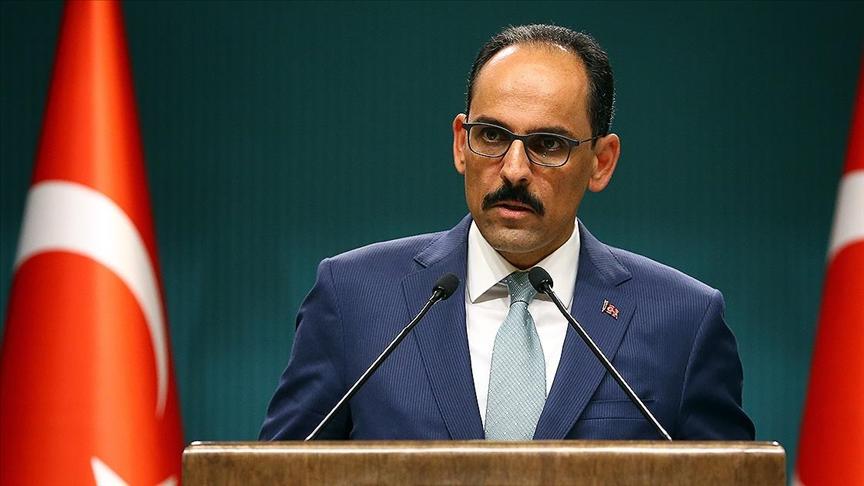
Ibrahim Kalın, Turkish academic, bureaucrat and diplomat, was born on 15 September 1971 in Istanbul into a family from the İspir district of Erzurum. He completed his undergraduate studies at Istanbul University, his master’s at the International Islamic University, and his doctorate at George Washington University. Throughout his academic career, he has focused particularly on Islamic philosophy, intercivilizational relations, and epistemology, delivering lectures at various universities in Türkiye and USA. He was ranked 23rd in 2025 on the list of the world’s 500 most influential Muslims published by the Royal Islamic Strategic Studies Centre. Public He has held critical roles in government positions including Chief Advisor to the Prime Minister, Spokesperson of the Presidency, and Director of the National Intelligence Organization like. At the same time, Kalın, who has signed numerous academic publications and translations, has emerged as a prominent figure in Türkiye’s domestic and foreign policy.
Undergraduate Education: He graduated from the Department of History at the Faculty of Letters, Istanbul University, in 1992.
Master’s Education: Seeking deeper engagement with Islamic thought and philosophy, he pursued his master’s at the International Islamic University in Malaysia. There, in 1994, he completed his master’s degree with a thesis titled “Molla The Theory of Substantial Motion in Sadra.”
Doctoral Education: He continued his academic work in the United States, earning his doctorate in human sciences and comparative philosophy at George Washington University. In 2002, he received his doctorate with a thesis titled “Mulla Sadra’s Information Theory and the Possibility of an Anti-Subjectivist Epistemology.”
Ibrahim Kalın married Neriman Kalın in 1992, and the couple has three daughters. In addition to his academic work, he is also engaged with music, playing the bağlama and what. He is known for his interest in Turkish people music and has participated in various musical projects. His interest in music began in the middle school years, during which he learned to play the guitar and bağlama. Kalın has composed several pieces inspired by Turkish folk music, including the folk songs “Seni Mene Vermez İse” and “Elif Bacı.” Additionally, Ibrahim Kalın speaks English, Arabic, Persian, and French.
Kalın, İbrahim. İslam ve West. Istanbul: İSAM, 2007.
Nightingale, Power, Bekir Berat Özipek and İbrahim Kalın, eds. Love Turkey’s Perception of the West Between Hate and Understanding. Ankara: SETA, 2008.
Kalın, İbrahim. Knowledge in Later Islamic Philosophy: Mulla Sadra on Existence, Intellect and Intuition. New York: Oxford University Press, 2010.
Kalın, İbrahim. Akıl ve Erdem. Istanbul: Sphere Publications, 2013.
M. Ghazi bin Muhammad, İbrahim Kalın and M. Hashim Kamali, eds. War and Peace in Islam: The Uses and Abuses of Jihad. Amman: MABDA, 2013.
Kalın, İbrahim, ed. The Oxford Encyclopedia of Philosophy, Science, and Technology in Islam. New York: Oxford University Press, 2014.
Sadra, Mulla. The Book of Metaphysical Penetrations, A Parallel English-Arabic Text of Kitab al-Masha’ir. Ed. İbrahim Kalın. Utah: Brigham Young University Press, 2014.
Kalın, İbrahim. Existence and Perception: Mulla Sadra’s Concept of Knowledge. Trans. Nurullah Koltaş. Istanbul: Classical Publications, 2015.
Kalın, İbrahim. I, Self, and the Other: An Introduction to the History of Islamic-Western Relations. Istanbul: İnsan Publications, 2016.
Kalın, İbrahim. Barbar, Savage, Civilized: Notes on Civilizations. Istanbul: İnsan Publications, 2018.
Kalın, İbrahim. Veil and Meaning: An Analysis of Reason. Istanbul: İnsan Publications, 2020.
Kalın, İbrahim. Açık Horizon: On the Good, the True and the Beautiful Thinking. Istanbul: İnsan Publications, 2021.
Kalın, İbrahim. Sky Under the Dome. Istanbul: Medium Books, 2022.
Kalın, İbrahim. Öze Yolculuk. Istanbul: İnsan Publications, 2023.
Kalın, İbrahim. İslam, Aydınlanma ve Gelecek. Istanbul: İnsan Publications, 2024.
Kalın, İbrahim. “The Sacred Versus the Secular: Nasr on Science.” Library of Living Philosophers: Seyyed Hossein Nasr. Ed. L. E. Hahn, R. E. Auxier and L. W. Stone. Chicago: Open Court Press, 2001, 445–462.
Kalın, İbrahim. “Three Views of Science in the Islamic World.” God, Life, and the Cosmos: Christian and Islamic Perspectives. Ed. Ted Peters, Muzaffar Iqbal and Syed Nomanul Haq. Oxford: Routledge, 2002, 19–53.
Kalın, İbrahim. “Roots of Misconception: Euro-American Perceptions of Islam Before and After September 11.” Islam, Fundamentalism, and the Betrayal of Tradition. Ed. Joseph E. B. Lumbard. Indiana: World Wisdom, 2009, 143–187.
Kalın, İbrahim. “Islamophobia and the Limits of Multiculturalism.” Islamophobia and the Challenges of Pluralism in the 21st Century. Washington DC: Georgetown University Press, 2011, 50–61.
Kalın, İbrahim. “The Ak Party in Turkey.” The Oxford Handbook of Islam and Politics. Ed. John L. Esposito and Emad El-Din Shahin. New York: Oxford University Press, 2013, 423–439.
Kalın, İbrahim. “An Annotated Bibliography of the Works of Mullâ Sadrâ with a Brief Account of His Life.” Islamic Studies. 42/1 (2003): 21–62.
Kalın, İbrahim. “Islam and Peace: A Survey of the Sources of Peace in the Islamic Tradition.” Islamic Studies. 44/3 (2005): 327–362.
Kalın, İbrahim. “Debating Turkey in the Middle East: the Dawn of a New Geo-Political Imagination?” Insight Turkey. (2009): 83–96.
Kalın, İbrahim. “Modern Dünyada Geleneksel İslâm’ın İzini Süren Bir Hakim: Seyyid Hüseyin Nasr.” İş Ahlakı Dergisi. 2/3 (2009): 135–142.
Kalın, İbrahim. “US-Turkish Relations under Obama: Promise, Challenge and Opportunity in the 21st Century.” Journal of Balkan and Near Eastern Studies. 12/1 (2010): 93–108.
Kalın, İbrahim. “Soft Power and Public Diplomacy in Turkey.” Perceptions: Journal of International Affairs. 16/3 (2011): 5–23.
Kalın, İbrahim. “Turkish Foreign Policy: Framework, Values, and Mechanisms.” International Journal. 67/1 (2012): 7–21.
Kalın, İbrahim. “After the Coup Attempt, Turkey’s Success Story Continues.” Insight Turkey. 18/3 (2016): 11–17.
Kalın, İbrahim. “Teacher Ahmed Yesevi, Rule and Wisdom.” Bilig. 80 (2017): 1–14.
Anadolu Ajansı. “Millî İstihbarat Teşkilatı Başkanlığına İbrahim Kalın Atandı.” aa.com.tr. Accessed March 26, 2025. Accessed Adresi.
National Intelligence Organization. "Head of MİT." mit.gov.tr. Accessed March 26, 2025. Accessed Adresi.
SETA. "İbrahim Kalın." SETA | Siyaset, Ekonomi ve Toplum Araştırmaları Vakfı. Accessed March 26, 2025. Accessed Adresi.
The Royal Islamic Strategic Studies Centre. *The Muslim 500: The World’s 500 Most Influential Muslims 2025*. Amman, Jordan: RISSC Publishing, 2025. Accessed April 5, 2025. Accessed Adresi.
“Ibrahim Kalın.” Biography. Accessed April 5, 2025. Accessed Adresi.

İbrahim Kalın
Eş | Neriman Kalın (1992) | ||||||||
|---|---|---|---|---|---|---|---|---|---|
Birth | 15 September 1971 Türkiye Istanbul | ||||||||
Education | George Washington University International Islamic University Malaysia Istanbul University Alanya High School | ||||||||
Profession(s) | Academic diplomat and intelligence officer writer and researcher | ||||||||
Çocuk | Dilruba Zeynep Kalın Rumeysa Kalın | ||||||||
Education and Academic Career
Academic Appointments:
Academic Interests
Public Offices
Personal Life
Research and Publications
BOOKS
BOOK CHAPTERS
ARTICLES