


This article was automatically translated from the original Turkish version.
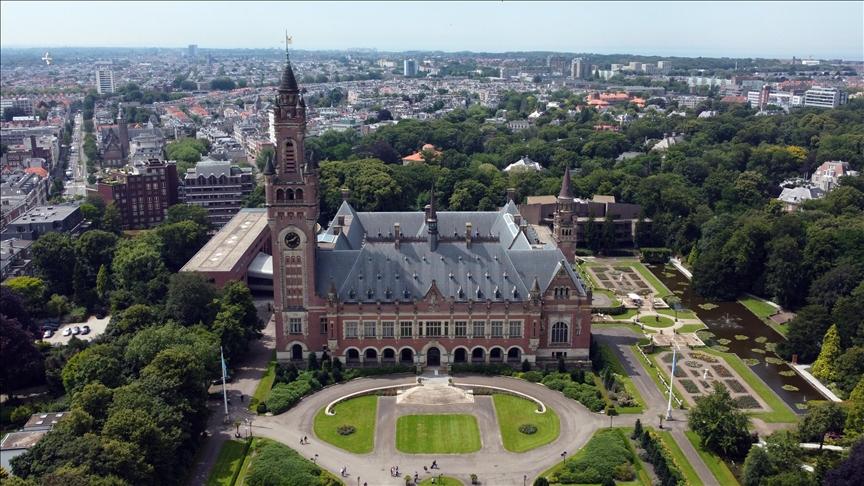
International Court of Justice
Establishment Date | 1945 | ||||||||
|---|---|---|---|---|---|---|---|---|---|
Seat | The Hague | ||||||||
Number of Judges | Fifteen | ||||||||
Term of Office of Judges | Nine Years | ||||||||
Official Language(s) | English French | ||||||||
International Court of Justice (ICJ), is the principal judicial organ of the United Nations (UN), tasked with resolving disputes between states in accordance with international law and providing advisory opinions on legal matters at the request of UN organs and authorized specialized agencies. The Court was established by the UN Charter and its operation is governed by the Statute of the International Court of Justice, an integral part of the UN Charter.
The ICJ was established in 1945 as the UN’s principal “court of justice” alongside the UN Charter, with its Statute entering into force at the same time. Prior to the ICJ, the Permanent Court of International Justice (PCIJ) operated within the League of Nations; the establishment of the ICJ led to the dissolution of the PCIJ. The first judges of the ICJ were elected on 6 February 1946 during the first sessions of the UN General Assembly and the Security Council, and the Court’s official opening took place on 18 April 1946.
The seat of the Court is in The Hague, Netherlands. However, the Court may sit elsewhere if it deems it appropriate. The President and the Registrar carry out their duties at the Court’s seat. On 6 February 2024, the Court elected Judge Nawaf Salam (Lebanon) as its President. The Registrar of the Court is Philippe Gautier, who has held the position since 1 August 2019 for a seven-year term.
The Court consists of 15 independent judges. Judges are elected regardless of nationality from among persons who possess the qualifications required in their respective countries for appointment to the highest judicial offices or who are recognized for their competence in international law and possess high moral character. No state may have more than one of its nationals serving simultaneously as a judge on the Court. Members of the Court are elected by the UN General Assembly and the Security Council from lists of candidates nominated by national groups in the Permanent Court of Arbitration. Electors consider not only whether candidates meet the required qualifications but also ensure that the Court as a whole represents the main forms of civilization and legal systems of the world. Judges are elected for nine-year terms and may be re-elected. The Court elects from among its members a President and a Vice-President for a term of three years; both may be re-elected.
Unless otherwise provided in the Statute, the Court sits in plenary session. A quorum for the Court is nine judges. The Court may constitute chambers of three or more judges to deal with specific types of cases. It may also constitute a special chamber to deal with a particular case, with the number of judges in that chamber determined by the Court with the consent of the parties. All judgments rendered by such chambers are considered as rendered by the Court. Additionally, to expedite proceedings, the Court annually constitutes a chamber of five judges to handle summary proceedings upon request of the parties.
Only states may be parties to cases before the Court. The ICJ is open to states that are parties to its Statute. UN member states are automatically parties to the ICJ Statute by virtue of the UN Charter and may therefore appear before the Court. The conditions under which a state that is not a member of the UN may become a party to the ICJ Statute are determined by the UN General Assembly upon the recommendation of the Security Council. The conditions under which states not party to the Statute may bring cases before the Court are determined by the Security Council, subject to any special provisions in existing treaties; however, these conditions may never place the parties in an unequal position before the Court.
The jurisdiction of the Court is voluntary; the ICJ is only empowered to examine disputes that the parties have agreed to submit to it. The Court’s jurisdiction covers all cases submitted to it by the parties as well as all situations specifically provided for in the UN Charter or in existing treaties and conventions. States that do not recognize the compulsory jurisdiction of the ICJ may accept its jurisdiction in the following ways:
In the event of a dispute regarding whether the Court has jurisdiction, the Court itself decides.
The ICJ may also issue advisory opinions on legal questions at the request of the UN General Assembly, the Security Council, and other UN organs and specialized agencies authorized by the General Assembly.
The official languages of the Court are French and English. If the parties cannot agree on which language to use, they may use either of the two in their pleadings, and the Court’s judgment shall be rendered in both languages. The procedure consists of two stages: written and oral. The written stage includes the submission of pleadings, counter-pleadings, and, if necessary, replies. The oral stage involves the hearing of witnesses, experts, representatives, advisers, and counsel by the Court. Hearings are open to the public unless the Court decides otherwise or the parties request that they be closed.
Decisions of the Court are made by a majority of the judges present. In the event of an equal division of votes, the vote of the President or the judge acting in his place is decisive. The judgment is reasoned and includes the names of the judges who voted in favor. If the judgment does not reflect the unanimous opinion of the judges, each judge has the right to append a separate opinion. The Court’s judgment is binding only on the parties to the dispute and only in respect of that particular case. The judgment is final and without appeal. In the event of a dispute regarding the meaning or scope of the judgment, the Court may interpret it upon the request of either party. Under certain conditions, a judgment may be revised if a new fact of decisive character is discovered.
As a member state of the UN, Türkiye is automatically a party to the ICJ Statute by virtue of the UN Charter and may therefore appear before the Court. However, Türkiye has not accepted the compulsory jurisdiction of the ICJ.
Any amendments to the ICJ Statute shall be made in accordance with the procedure provided for in the UN Charter. The Court has the authority to propose amendments to the Statute to the Secretary-General in writing whenever it considers such changes necessary.
Ministry of Foreign Affairs of the Republic of Türkiye. "Uluslararası Adalet Divanı ve Türkiye." Accessed May 28, 2025.
T.C. Ministry of Justice. *UluslararasıAdalet Bakanlığı. https://inhak.adalet.gov.tr/Resimler/Dokuman/2312020093041bm_02.pdf. Accessed May 28, 2025.
United Nations. Statute of the International Court of Justice. https://www.un.org/en/about-us/un-charter/statute-of-the-international-court-of-justice. Accessed May 28, 2025.
United Nations. International Court of Justice. https://www.icj-cij.org/home. Accessed June 14, 2025.

International Court of Justice
Establishment Date | 1945 | ||||||||
|---|---|---|---|---|---|---|---|---|---|
Seat | The Hague | ||||||||
Number of Judges | Fifteen | ||||||||
Term of Office of Judges | Nine Years | ||||||||
Official Language(s) | English French | ||||||||
No Discussion Added Yet
Start discussion for "International Court of Justice" article
History
Organizational Structure
Right of Access to the Court
Jurisdiction of the Court
Procedure
Türkiye’s Position
Amendments to the Statute