

+1 More


İzmir is one of the cities that played an important role in the modernization process of Türkiye and is a city associated with the life and activities of Mustafa Kemal Atatürk, the founder of the Republic of Türkiye. As a concrete reflection of this relationship, the Izmir Atatürk House Museum, located on 1st Kordon (Atatürk Street) in the Alsancak district of İzmir, is striking in terms of architecture and history. Built between 1875 and 1880 by carpet merchant Takfor Efendi, this neoclassical structure entered the stage of history as a venue used by Atatürk during his visits to Izmir and has been serving as a museum since 1941. Covering an area of 852 m², this masonry building reflects the civil architecture of Izmir at the end of the 19th century with its aesthetic features that combine Ottoman and Levantine architectural elements.
Izmir Atatürk House Museum (Reference: ataturkansiklopedisi)
The İzmir Atatürk House Museum was built as a residence by carpet merchant Takfor Efendi between 1875-1880. This rectangular-plan building with a rear facade and a courtyard is one of the rare examples reflecting the neoclassical architectural style of the 19th century. When İzmir was liberated from the Greek occupation on September 9, 1922, the building was abandoned by its owner and became the property of the treasury. The Turkish army used this building as a headquarters after entering the city, and thus the building assumed a strategic role in the final stages of the War of Independence.
The building's relationship with Atatürk began with the İzmir Economic Congress held on February 17, 1923. During this congress, which shaped the economic policies of the young republic, Mustafa Kemal Atatürk carried out his personal work in this building. After the congress ended, the headquarters were moved from here, and the treasury rented the building to Naim Bey as a hotel. The building known as “Naim Palas” became a place where Atatürk stayed with İsmet İnönü on June 16, 1926. Atatürk, who visited İzmir after leaving Latife Hanım on October 11, 1925, addressed the public from the balcony of this building and said, “I love all of İzmir and all the people of İzmir. I am sure that the pure-hearted people of beautiful İzmir love me too.”
On October 13, 1926, the İzmir Municipality purchased the building from the treasury and furnished it with new furniture and presented it to Atatürk as a gift. Atatürk stayed in this house during his five visits to İzmir between 1930 and 1934, which made the building known as the “Gazi Mansion.” The Shah of Iran, Reza Pahlavi, who visited Turkey in 1934, was hosted in this building with Atatürk and stayed here as a symbol of Turkish-Iranian friendship. During his visit, Shah expressed his satisfaction with the warm welcome he received in Izmir with the following words: “The sincerity and love shown to me since the day I entered the borders of the Turkish nation is so great that it defies description.”
After Atatürk’s death on November 10, 1938, the building was inherited by his sister, Makbule Atadan (Baysan), but on September 25, 1940, it was nationalized by the Izmir Municipality to be turned into a museum. The idea of a museum was put into practice on September 11, 1941, which coincided with the 19th anniversary of Atatürk’s arrival in Izmir, and the building was opened to visitors as the “Izmir Atatürk Museum” with an official ceremony. İzmir Governor Fuad Tuksal and Mayor Dr. Behçet Uz, as well as prominent figures from the city, attended the opening.
The transformations the museum has undergone reflect the cultural policies of the republic. In 1952, the lower floor was arranged as the “Atatürk General Library” and from October 5, 1962, it served as the “Atatürk Provincial Public Library and İzmir City Atatürk Museum”. On December 28, 1972, the ownership of the building was transferred to the İzmir Archaeological Museum by the Prime Ministry Undersecretariat of Culture. The museum, which was restored and reopened as the “Atatürk and Ethnography Museum” on October 29, 1978, was given the name “Atatürk Museum” only when the ethnographic artifacts were moved to the new Ethnography Museum on May 13, 1988. The building, which was brought into line with the modern museum approach with the restoration works in 1999-2000 and 2013, was opened to visitors for the last time on May 19, 2015.
İzmir Atatürk House Museum was built in neoclassical style as a synthesis of Ottoman and Levantine architecture. Covering an area of 852 m², the building consists of a basement, ground floor, first floor, and attic. The rectangular planned structure has a portico and courtyard on the back and an elegant bay window on the first floor on the front. The entire ground floor is paved with large marble slabs, reflecting the aesthetic understanding of the period. The exterior of the building has the typical features of 19th-century Kordon houses, with its simple but elegant lines.
In the interior, the double-sided marble stairs leading to the first floor are decorated with two bronze knight statues that serve as wall lamps. There is a large portrait of Atatürk on the landing. On the ground floor, a 34.5 m² Uşak carpet, marble statues in the right and left niches, a large crystal mirror, and a bronze bust of Atatürk attract attention. There are exquisite fireplaces in the small living room and rooms in the 19th-century style. The first floor consists of rooms allocated to Atatürk’s use. There is a meeting room, study, bedroom, guest room, barber room, aide’s room, waiting-reception room, library, dining room, and bathroom. These rooms have been preserved in their original form with the furniture and decorative elements of the period.
The courtyard of the building has been arranged as a “children’s education room” and stands out as an area reflecting Atatürk’s love of children. Both the interior and exterior design of the building reveal the cosmopolitan structure of late 19th-century Izmir and the process of westernization.
İzmir Atatürk House Museum houses personal belongings used by Atatürk during his visits to Izmir and objects documenting historical events of the period. The museum is organized in a two-story exhibition layout.
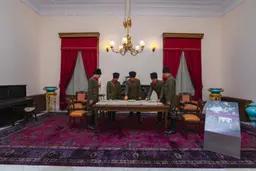
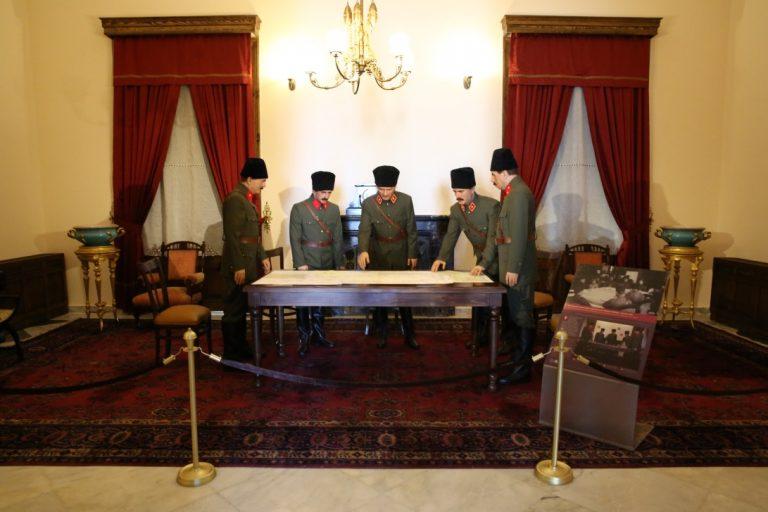
Ground Floor: In the entrance hall, there is a bronze bust of Atatürk, a crystal mirror and marble statues, as well as a 34.5 m² Uşak carpet. In the “Atatürk Hall”, there are information boards and documentary films depicting his life from birth to death. In the cinema room, a documentary about the occupation and liberation of Izmir is shown. In the meeting room, Atatürk and his comrades-in-arms (Fevzi Çakmak, İsmet İnönü, Kazım Karabekir, and Fahrettin Altay) are represented with silicone statues. Between the stairs, the rowboat that Atatürk used in Izmir is exhibited.
First Floor: This floor contains Atatürk's rooms:
The exhibition area on the first floor displays Atatürk's clothes and oil paintings. The rooms are enriched with bronze statues, vases, and Isparta and Uşak carpets. The children's education room in the courtyard contains panels and documentaries explaining the importance Atatürk gave to children.
The İzmir Atatürk House Museum is currently located in the Konak district and is open to visitors free of charge. Visiting hours are between 08:30-19:00 in the summer and 08:30-17:30 in the winter. The museum is open to visitors every day and is organized in accordance with the contemporary museum approach. The 2013-2015 restorations have integrated modern exhibition techniques while preserving the historical texture of the building.
The museum is a center that documents Atatürk's ties to İzmir and historical events from the early period of the republic. Events such as the İzmir Economic Congress, the visit of the Shah of Iran, and Atatürk's public meetings have made this structure a part of the national memory. In terms of architecture, it is one of the few 19th-century structures left standing on the Kordon, providing an important testimony to İzmir's Levantine past.
The museum is also valuable in terms of education and cultural awareness. While the children's education room conveys Atatürk's vision to the younger generations, the cinevision and information panels provide visitors with the opportunity to take a historical journey. This structure, which bears the traces of İzmir's liberation and the foundation of the republic, is a center of attraction for both locals and tourists.
The museum is also valuable in terms of education and cultural awareness. While the children's education room conveys Atatürk's vision to the younger generations, the cinevision and information panels provide visitors with the opportunity to take a historical journey. This structure, which bears the traces of the liberation of Izmir and the foundation of the republic, is a visiting center for both local people and tourists.

No Discussion Added Yet
Start discussion for "Izmir Ataturk House Museum" article
History
Architectural Features
Collections and Exhibition Areas
Current Status and Cultural Importance


