

This article was automatically translated from the original Turkish version.
+1 More
Entry into Service | 1948 | ||||||||
|---|---|---|---|---|---|---|---|---|---|
Length(s) | 10.11 m | ||||||||
Engine(s) | 1 × Klimov VK-1 centrifugal flow turbojet | ||||||||
First Flight(s) | 30 December 1947 | ||||||||
Range(s) | 1 900 km (with external tanks) 1 200 km (internal fuel) | ||||||||
Heavy Guns | 1 × 37 mm Nudelman N-37 (40 rounds) | ||||||||
Wingspan | 10.08 m | ||||||||
Service Ceiling | 15,500 m (50,850 ft) | ||||||||
Maximum Speed | 1.059 km/s | ||||||||
Thrust | 26.5 kN | ||||||||
Crew | 1 (2 in training version) | ||||||||
Production Quantity | 18,000+ | ||||||||
Design Office | Mikoyan-Gurevich (OKB-155) | ||||||||
NATO Report Name | Fagot (Single-seat model), Midget (Two-seat training model) | ||||||||
Mikoyan-Gurevich MiG-15 (NATO reporting name: Fagot) is a single-engine, single-seat jet fighter aircraft developed by the Soviet Union shortly after World War II. It features a swept-wing design and was employed in aerial combat against Western allied forces during the Korean War in the early 1950s, significantly influencing military aviation doctrine of the era. With over 18,000 units produced, the MiG-15 ranks among the most produced jet aircraft in history and served in the air forces of more than 40 countries.【1】

Mikoyan Mig-15 (Tony Hisgett)
The aircraft’s design philosophy centered on combining high climb rate with sufficient firepower to neutralize heavy bombers at high altitudes. By integrating German aerodynamic research on swept wings with centrifugal-flow jet engine technology licensed from the United Kingdom, the MiG-15 achieved higher speed and maneuverability than contemporary straight-wing jet fighters. These advancements contributed to a temporary air superiority advantage for the Soviet Union until the development of the U.S. F-86 Sabre.
The fuselage was designed in a cylindrical shape to accommodate the engine’s large air intake, giving the aircraft a barrel-like appearance. Equipped with an ejection seat and pressurized cockpit for pilot safety, the MiG-15 not only served as a combat platform but also established an engineering foundation for subsequent Soviet jet fighters such as the MiG-17 and MiG-19.
The development of the MiG-15 paralleled the Soviet aviation industry’s efforts to overcome speed and altitude limitations encountered with early jet aircraft after World War II. In 1947, the Mikoyan-Gurevich design bureau (OKB-155) adopted a 35-degree swept-wing configuration based on German aerodynamic research, particularly from the Focke-Wulf Ta 183 design. This modification reduced drag near sonic speeds and enabled significantly higher performance than earlier straight-wing models such as the MiG-9 and Yak-15.

Mikoyan Mig-15 Technical Drawing (generated by artificial intelligence)
The critical issue of engine procurement was resolved through a strategic move by the Soviet leadership, which purchased 25 Rolls-Royce Nene centrifugal-flow jet engines from the United Kingdom. These engines were reverse-engineered under the leadership of Vladimir Klimov and produced domestically as the Klimov RD-45. The engine’s large centrifugal compressor necessitated a wide, circular fuselage design — the so-called “barrel” shape.【2】
Mikoyan-Gurevich MiG-15’s technical capabilities represented an engineering achievement pushing the upper limits of subsonic aircraft design. The primary thrust was provided by the Klimov RD-45F centrifugal-flow turbojet engine (later replaced in bis variants by the Klimov VK-1), generating approximately 26.5 kN (2,700 kgf) of thrust to achieve a maximum speed of 1,059 km/h (Mach 0.86) at sea level. A service ceiling of approximately 15,500 meters enabled operations well above contemporary propeller-driven and early jet bombers. With a climb rate of about 2,800 meters per minute, the MiG-15 provided a critical time advantage in interception missions.【3】
The technical capabilities of the Mikoyan-Gurevich MiG-15 reflect an engineering standard approaching the upper limits of subsonic aircraft performance. The primary thrust is provided by the Klimov RD-45F engine (later replaced in bis variants by the Klimov VK-1), a centrifugal-flow turbojet engine producing approximately 26.5 kN (2,700 kgf) of thrust, enabling a maximum speed of 1,059 km/h (Mach 0.86) at sea level. A service ceiling of approximately 15,500 meters allowed operations at altitudes far above contemporary propeller-driven and early jet bombers. With a climb rate of approximately 2,800 meters per minute, the aircraft provided a significant time advantage in interception roles.【4】
The aircraft’s physical dimensions were designed to balance aerodynamic efficiency with the engine’s volumetric requirements. With a wingspan of 10.08 meters and a fuselage length of 10.11 meters, the MiG-15 has an empty weight of approximately 3,500 kilograms and a maximum takeoff weight exceeding 5,000 kilograms. The 35-degree swept-wing configuration delayed the effects of shock waves near sonic speeds, preserving structural integrity at high velocities. However, the absence of hydraulic flight controls created a technical limitation, making aircraft handling increasingly difficult above Mach 0.90.【5】
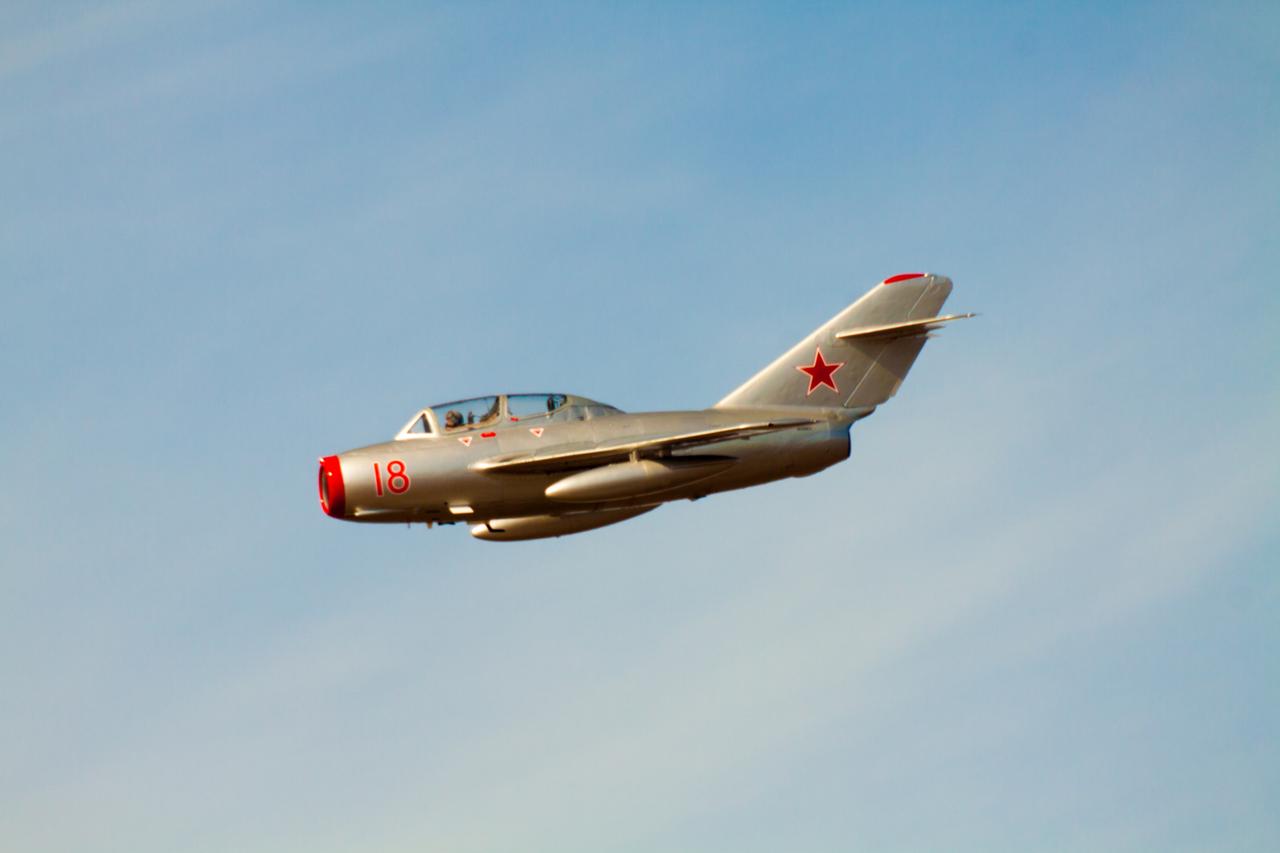
Mikoyan Mig-15 Airshow (Jim Ramsay)
In operational range, the MiG-15 has an internal fuel capacity providing a combat radius of approximately 1,200 kilometers. With two external 450-liter drop tanks mounted under the wings, this range can be extended to about 1,900 kilometers. The landing gear design, developed in accordance with Soviet doctrine, is robust enough to operate from unpaved or minimally prepared runways. This feature enabled deployment across diverse geographic and operational environments.【6】
The armament configuration of the Mikoyan-Gurevich MiG-15 was tailored for its operational role: engaging heavy bombers at high altitudes. Instead of machine guns, it was equipped with higher-caliber cannon systems. The standard armament consisted of two 23 mm Nudelman-Rikhter NR-23 cannons (or NS-23 in early models) mounted beneath the lower left side of the nose and a single 37 mm Nudelman N-37 cannon on the right. The 37 mm cannon delivered high destructive power against bombers, while the 23 mm cannons offered a higher rate of fire for engaging diverse targets.
【7】
The weapon layout was based on a system known as the “gun tray,” designed to accelerate maintenance and ammunition loading. The cannons and their ammunition boxes, located beneath the nose, could be lowered as a single platform using steel cables and a winch. This arrangement allowed ground crews to quickly replace or repair weapon components.

Mikoyan Mig-15 Bottom View (Andrew Luyten)
Fire control was managed by the ASP-1N (or its improved variant, the ASP-3N) 【8】gyroscopic optical sight. This system allowed the pilot to manually input target range and speed data to calculate the firing solution. However, due to differing muzzle velocities and ballistic characteristics between the 23 mm and 37 mm cannons, effective simultaneous use required considerable marksmanship skill. Additionally, the MiG-15 could carry two 100 kg bombs or additional fuel tanks on underwing pylons, enabling limited fighter-bomber missions.【9】
One of the foundational elements of the Mikoyan-Gurevich MiG-15’s technical design is its centrifugal-flow turbojet engine, reflecting the Soviet aviation industry’s progress in jet propulsion. After delays in domestic axial-flow engine development (such as the Lyulka TR-1), the Soviet Union acquired 25 Rolls-Royce Nene engines from the United Kingdom in 1946. These engines were reverse-engineered by a team led by Vladimir Klimov, resulting in the Klimov RD-45, which incorporated different alloys. The RD-45’s centrifugal compressor design was a primary reason for the aircraft’s wide cylindrical fuselage.【10】

MiG-15 Engine Section (pilot_micha)
The Klimov VK-1 engine, used in the MiG-15’s most advanced variants, was developed by enlarging and optimizing the combustion chambers and turbine blades of the RD-45. The VK-1 generated approximately 26.5 kN (2,700 kgf) of static thrust, enhancing the aircraft’s climb rate and high-altitude performance. Although centrifugal compressors require a larger frontal area than axial-flow designs, they offered advantages in durability, ease of maintenance, and resistance to foreign object damage under the production conditions of the era. These qualities enabled operations from diverse airfield conditions.【11】
The engine’s technical architecture consists of nine individual combustion chambers and a single-stage turbine. Air enters through a circular intake at the nose and is directed through channels on either side of the cockpit to a double-sided centrifugal compressor at the engine’s center. This design enabled stable operation at high rotational speeds and provided acceptable fuel efficiency by contemporary standards. The Klimov VK-1 engine was also used in early versions of the MiG-17 and various bomber aircraft.
The aerodynamic structure of the Mikoyan-Gurevich MiG-15 reflects a design approach bridging low-subsonic to high-subsonic flight regimes. Its 35-degree swept wings were designed to reduce wave drag as the aircraft approached sonic speed. This configuration lowered the effective airflow velocity across the wing, increasing the critical Mach number. The thin airfoil profile and sweep angle enabled higher speed and climb performance compared to straight-winged predecessors.【12】

Mikoyan Mig-15 (D. Miller)
The control surfaces and fuselage balance were designed to manage aerodynamic effects at high speeds. Vertical plates known as “wing fences,” mounted on the upper wing surfaces, were added to mitigate boundary layer separation on swept wings. These structures limited the spanwise flow of air toward the wingtips, reducing early stall and associated control loss at low speeds and high angles of attack. The horizontal stabilizer was positioned near the upper portion of the vertical stabilizer to minimize exposure to turbulent airflow from the main wing.
However, the MiG-15’s aerodynamic design included operational limitations. At speeds above Mach 0.92, the aircraft exhibited a directional instability known as “snaking.” Additionally, the rearward shift of the center of pressure near sonic speed — known as “mach tuck” — combined with the absence of hydraulic flight controls, made pilot control increasingly difficult. These aerodynamic limitations were mitigated in the subsequent MiG-17 through an increased wing sweep angle and a redesigned tail assembly.
Throughout its production, various variants of the Mikoyan-Gurevich MiG-15 were developed to enhance operational capabilities and adapt the aircraft to different mission profiles. The initial production model, the MiG-15 (S), embodied the core design features. The improved MiG-15bis, introduced in 1950, featured the Klimov VK-1 engine, strengthened wing structure, and redesigned flight control surfaces for improved stability at higher speeds. It also incorporated upgraded navigation systems and enhanced armor protection compared to earlier models.

MiG-15bis Variant (Tomás Del Coro)
The two-seat training variant, MiG-15UTI (NATO reporting name: Midget), became one of the most enduring and widely used variants of the series. With an extended fuselage to accommodate a second cockpit for pilot training, this model served for many years in the air forces of the Soviet Union and other nations for jet transition training. It is historically notable as the aircraft involved in the fatal crash that killed Soviet cosmonaut Yuri Gagarin. Variants with no or limited armament were preferred for military pilot training due to their flight characteristics.【13】
Other specialized variants were developed for strategic needs, including the MiG-15P, equipped with the RP-1 Izumrud radar in the nose for night and all-weather interception missions, and the MiG-15R, fitted with camera systems for reconnaissance. Licensed production outside the Soviet Union used different designations: in Poland as the Lim-1 and Lim-2, in Czechoslovakia as the S-102 and S-103, and in China as the J-2 (fighter) and JJ-2 (trainer). These variants incorporated minor technical modifications based on local production conditions but retained the core MiG-15 design features.

Polish-produced Lim-2 Model (Alan Wilson)
One of the most significant military uses of the MiG-15 occurred during the Korean War from 1950 to 1953. Deployed to provide air support to North Korean and Chinese forces, MiG-15s encountered United Nations (UN) air units. American straight-wing jet fighters such as the P-80 Shooting Star and the Gloster Meteor, along with propeller-driven aircraft, faced operational challenges against the MiG-15’s superior speed, climb rate, and high-altitude performance. Soviet pilots operating under various pseudonyms further complicated enemy assessments and analysis of the aircraft.【14】
During the Korean War, the airspace near the Yalu River became known as “MiG Alley,” the site of intense jet-versus-jet combat. MiG-15s were deployed against UN strategic bombers, particularly the B-29 Superfortress. The MiG-15’s 37 mm and 23 mm cannons proved effective at longer engagement ranges. In response, the United States deployed swept-wing F-86 Sabre fighters to the region.【15】

U.S. F-86 Sabre Aircraft (Abdus Samad Khan)
The aerial engagements between the MiG-15 and the F-86 Sabre remain among the most significant jet-versus-jet dogfights of the Korean War. The MiG-15 excelled in high-altitude performance and vertical climb, while the F-86 Sabre offered superior dive stability, sighting systems, and pilot ergonomics. These encounters contributed to the evolution of aerial combat tactics. After the Korean War, the MiG-15 became widely used in Eastern Bloc countries and saw service in various conflicts through the 1960s.
The Mikoyan-Gurevich MiG-15 was among the first aircraft developed during the transition from propeller-driven to jet-powered military aviation. Its swept-wing configuration and centrifugal-flow engine integration were later adopted in numerous Soviet and Eastern Bloc jet fighters. 【16】The modular “gun tray” system and fuselage design facilitating maintenance improved logistical practices in field operations and were carried forward in the MiG-17 and MiG-19 models.
One of the aircraft’s impacts on the aviation industry relates to the evolution of flight control systems. The aerodynamic stiffness and control difficulties observed at high speeds in the MiG-15 influenced research into hydraulic-assisted control surfaces and flight automation systems. Furthermore, its combat use in the Korean War spurred design changes among manufacturers and accelerated research and development in radar-guided sighting systems and air-to-air missile technology.

MiG-15 at the San Diego Air & Space Museum Exhibit (Sam Wise)
The MiG-15 was among the aircraft used to popularize aviation training and pilot practices. The two-seat MiG-15UTI training variant was employed for jet transition training by Warsaw Pact and non-aligned nations from the 1950s through the 1980s. Due to its high production numbers and widespread deployment, the MiG-15 remains a frequently referenced model in aviation studies. Today, it is displayed in numerous national aviation museums as a representative example of early jet-powered aircraft.【17】
Abdus Samad Khan. "F-86 Sabre." Flickr, January 1, 2004. Accessed March 21, 2026. https://www.flickr.com/photos/49628224@N00/400936117/.
Alan Wilson. "PZL-Mielec SBLim-2 ’18 red’ (N104CJ)." Flickr. September 22, 2019. Accessed March 21, 2026. https://www.flickr.com/photos/ajw1970/50584595517/.
Andrew Luyten. "MiG-15." Flickr, August 25, 2018. Accessed March 21, 2026. https://www.flickr.com/photos/aluytenuk/48023998442/.
Aviation History Online Museum. "The MiG-15: The Soviet Union's First Great Jet Fighter." Accessed March 21, 2026. http://www.aviation-history.com/mikoyan/mig15.html.
Bernard Spragg. "Mikoyan-Gurevich MiG-15." Flickr. Accessed March 21, 2026. https://flic.kr/p/2gaHxB9.
D. Miller. "Mig 15 UTI." Flickr, July 28, 2006. Accessed March 21, 2026. https://www.flickr.com/photos/fun_flying/246253169/.
Gary Henderson. "MIG 15." Flickr, September 19, 2015. Accessed March 21, 2026. https://www.flickr.com/photos/gary2/20978399873/.
Henderson, Gary. "MIG 15." Flickr. September 19, 2015. Accessed March 21, 2026. https://www.flickr.com/photos/gary2/20978399873/.
Hisgett, Tony. "Mig 15 6." Flickr. June 19, 2016. Accessed March 21, 2026. https://www.flickr.com/photos/hisgett/27364923313/.
Hisgett, Tony. "Mig 15 9." Flickr. June 19, 2016. Accessed March 21, 2026. https://www.flickr.com/photos/hisgett/27365445424/.
National Museum of the United States Air Force. "MiG-15 Jet Fighter." Accessed March 21, 2026. https://www.nationalmuseum.af.mil/Visit/Museum-Exhibits/Fact-Sheets/Display/Article/196115/mikoyan-gurevich-mig-15bis/.
National Naval Aviation Museum. "Mikoyan-Gurevich MiG-15 (Fagot)." Accessed March 21, 2026. https://www.history.navy.mil/content/history/museums/nnam/explore/collections/aircraft/m/mig-15.html.
Planes of Fame Air Museum. "Mikoyan-Gurevich MiG-15 'Lim-2'." Accessed March 21, 2026. https://planesoffame.org/aircraft/MiG-15-Lim-2.
Ramsay, Jim. "MIG 15 - Scottish Airshow 2017 - [4K/UHD]." YouTube, 07:03. September 3, 2017. Accessed March 21, 2026. https://youtu.be/AVzUPLFQqv8.
Rob Schlieffert. "Soviet MiG-15 Fighter." Flickr. Accessed March 21, 2026. https://flic.kr/p/2hiAYLv.
Sam Wise. "MiG-15." Flickr, March 22, 2008. Accessed March 21, 2026. https://www.flickr.com/photos/sortingoutscience/2372001988/.
Skytamer Museum. "Mikoyan-Gurevich UTI MiG-15 Midget." Accessed March 21, 2026. https://www.skytamer.com/Mikoyan-Gurevich_MiG-15UTI.html.
Smithsonian National Air and Space Museum. "Mikoyan-Gurevich MiG-15 (Fagot) Nose." Accessed March 21, 2026. https://airandspace.si.edu/collection-objects/mikoyan-gurevich-mig-15-fagot/nasm_A19910065000.
Smithsonian National Air and Space Museum. "Mikoyan-Gurevich MiG-15 Ji-2 (Fagot-B)." Accessed March 21, 2026. https://airandspace.si.edu/collection-objects/mikoyan-gurevich-mig-15-ji-2-fagot-b/nasm_A19860066000
Tomás Del Coro. "N87CN Mikoyan-Gurevich MiG-15bis Fagot C/N 910-51." Flickr, November 8, 2014. Accessed March 21, 2026. https://www.flickr.com/photos/tomasdelcoro/50179348642/.
[1]
Skytamer Museum. "Mikoyan-Gurevich UTI MiG-15 Midget." Accessed 21 March 2026.https://www.skytamer.com/Mikoyan-Gurevich_MiG-15UTI.html.
[2]
National Museum of the United States Air Force. "MiG-15 Jet Fighter." Accessed 21 March 2026.https://www.nationalmuseum.af.mil/Visit/Museum-Exhibits/Fact-Sheets/Display/Article/196115/mikoyan-gurevich-mig-15bis/.
[3]
Planes of Fame Air Museum. "Mikoyan-Gurevich MiG-15 'Lim-2'." Accessed 21 March 2026.https://planesoffame.org/aircraft/MiG-15-Lim-2.
[4]
National Museum of the United States Air Force. "MiG-15 Jet Fighter." Accessed 21 March 2026.https://www.nationalmuseum.af.mil/Visit/Museum-Exhibits/Fact-Sheets/Display/Article/196115/mikoyan-gurevich-mig-15bis/.
[5]
National Naval Aviation Museum. "Mikoyan-Gurevich MiG-15 (Fagot)." Accessed 21 March 2026.https://www.history.navy.mil/content/history/museums/nnam/explore/collections/aircraft/m/mig-15.html.
[6]
National Naval Aviation Museum. "Mikoyan-Gurevich MiG-15 (Fagot)." Accessed 21 March 2026.https://www.history.navy.mil/content/history/museums/nnam/explore/collections/aircraft/m/mig-15.html.
[7]
Skytamer Museum. "Mikoyan-Gurevich UTI MiG-15 Midget." Accessed 21 March 2026.https://www.skytamer.com/Mikoyan-Gurevich_MiG-15UTI.html.
[8]
National Museum of the United States Air Force. "MiG-15 Jet Fighter." Accessed 21 March 2026.https://www.nationalmuseum.af.mil/Visit/Museum-Exhibits/Fact-Sheets/Display/Article/196115/mikoyan-gurevich-mig-15bis/.
[9]
Planes of Fame Air Museum. "Mikoyan-Gurevich MiG-15 'Lim-2'." Accessed 21 March 2026.https://planesoffame.org/aircraft/MiG-15-Lim-2.
[10]
Aviation History Online Museum. "The MiG-15: The Soviet Union's First Great Jet Fighter." Accessed 21 March 2026.http://www.aviation-history.com/mikoyan/mig15.html.
[11]
Smithsonian National Air and Space Museum. "Mikoyan-Gurevich MiG-15 Ji-2 (Fagot-B)." Accessed 21 March 2026.https://airandspace.si.edu/collection-objects/mikoyan-gurevich-mig-15-ji-2-fagot-b/nasm_A19860066000.
[12]
National Museum of the United States Air Force. "MiG-15 Jet Fighter." Accessed 21 March 2026.https://www.nationalmuseum.af.mil/Visit/Museum-Exhibits/Fact-Sheets/Display/Article/196115/mikoyan-gurevich-mig-15bis/.
[13]
National Museum of the United States Air Force. "MiG-15 Jet Fighter." Accessed 21 March 2026.https://www.nationalmuseum.af.mil/Visit/Museum-Exhibits/Fact-Sheets/Display/Article/196115/mikoyan-gurevich-mig-15bis/.
[14]
Aviation History Online Museum. "The MiG-15: The Soviet Union's First Great Jet Fighter." Accessed 21 March 2026.http://www.aviation-history.com/mikoyan/mig15.html.
[15]
Planes of Fame Air Museum. "Mikoyan-Gurevich MiG-15 'Lim-2'." Accessed 21 March 2026.https://planesoffame.org/aircraft/MiG-15-Lim-2.
[16]
National Museum of the United States Air Force. "MiG-15 Jet Fighter." Accessed 21 March 2026.https://www.nationalmuseum.af.mil/Visit/Museum-Exhibits/Fact-Sheets/Display/Article/196115/mikoyan-gurevich-mig-15bis/.
[17]
Smithsonian National Air and Space Museum. "Mikoyan-Gurevich MiG-15 Ji-2 (Fagot-B)." Accessed 21 March 2026.https://airandspace.si.edu/collection-objects/mikoyan-gurevich-mig-15-ji-2-fagot-b/nasm_A19860066000.

Entry into Service | 1948 | ||||||||
|---|---|---|---|---|---|---|---|---|---|
Length(s) | 10.11 m | ||||||||
Engine(s) | 1 × Klimov VK-1 centrifugal flow turbojet | ||||||||
First Flight(s) | 30 December 1947 | ||||||||
Range(s) | 1 900 km (with external tanks) 1 200 km (internal fuel) | ||||||||
Heavy Guns | 1 × 37 mm Nudelman N-37 (40 rounds) | ||||||||
Wingspan | 10.08 m | ||||||||
Service Ceiling | 15,500 m (50,850 ft) | ||||||||
Maximum Speed | 1.059 km/s | ||||||||
Thrust | 26.5 kN | ||||||||
Crew | 1 (2 in training version) | ||||||||
Production Quantity | 18,000+ | ||||||||
Design Office | Mikoyan-Gurevich (OKB-155) | ||||||||
NATO Report Name | Fagot (Single-seat model), Midget (Two-seat training model) | ||||||||
No Discussion Added Yet
Start discussion for "Mikoyan-Gurevich MiG-15" article
Design and Technical Development Process
Technical Specifications
Armament and Equipment
Engine Technology and the Klimov VK-1
Aerodynamic Design and Flight Characteristics
Variants
Korean War and Operational History
Industrial Legacy and Place in Aviation Technology