


This article was automatically translated from the original Turkish version.
+1 More
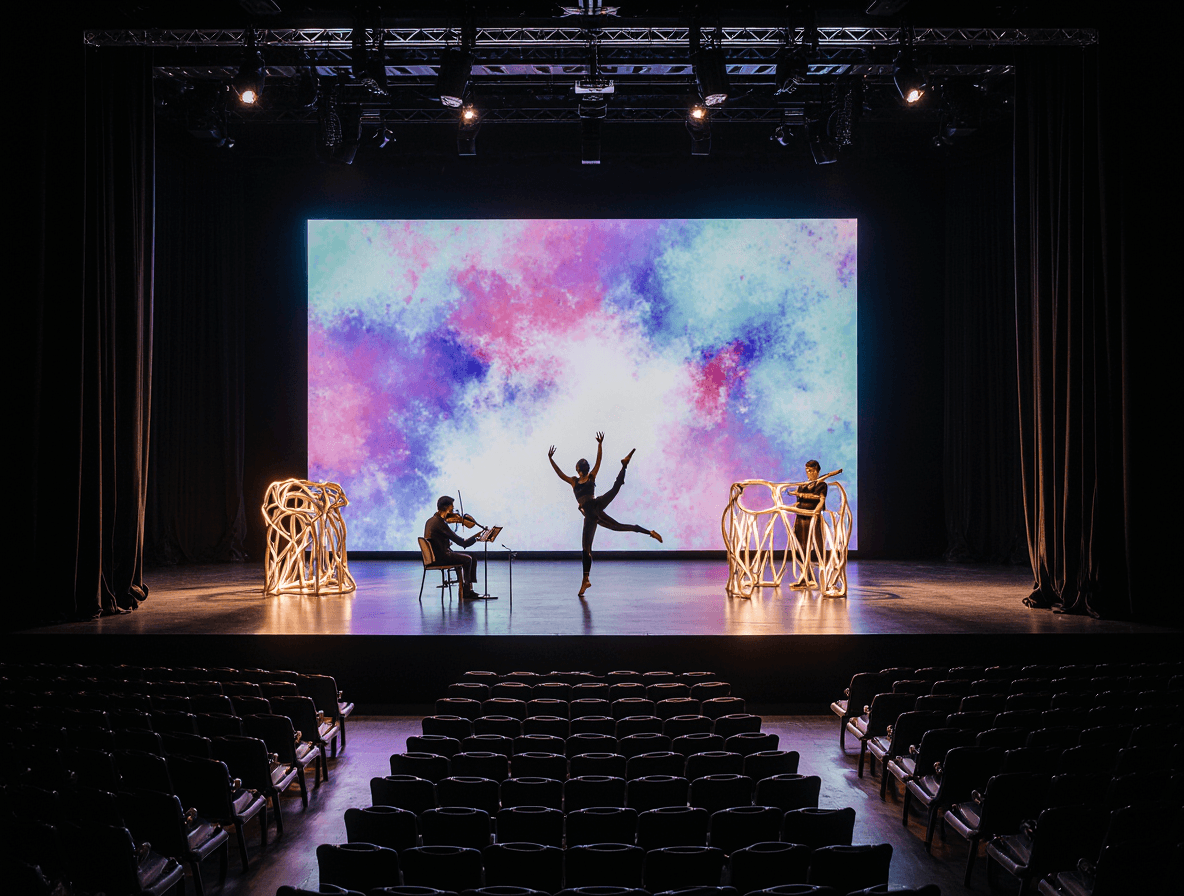
Multidisciplinary Scene Generation (Generated with Artificial Intelligence)
Related Concept(s) | Interdisciplinary Cyber Theatre Multimedia Theatre Digital Performance Transdisciplinary | ||||||||
|---|---|---|---|---|---|---|---|---|---|
Historical Origin | Bauhaus, László Moholy-Nagy's idea of 'Total Theatre', avant-garde movements | ||||||||
Technologies Used | Projection, Video, Computer, Artificial Intelligence, Augmented Reality, Interactive Systems | ||||||||
Purpose(s) | To create an inclusive multi-layered and sensory-engaging viewing experience | ||||||||
Multidisciplinary staging refers to an artistic approach that integrates different art disciplines—such as theater, dance, music, performance art, and digital arts—together with technological elements within a single structure. This method enables each discipline to retain its unique mode of expression while uniting under a shared narrative, conceptual framework, or aesthetic purpose. As a result, it produces a staging form that is multi-layered and appeals to multiple senses rather than a single-dimensional narrative.
Multidisciplinary staging is closely linked to the softening and increasing fluidity of boundaries between art forms. In this context, it bears strong connections to interdisciplinary and transdisciplinary approaches. Interdisciplinary interaction allows different fields to coexist and mutually enrich one another, while the transdisciplinary approach contributes to the emergence of new modes of expression by transcending the boundaries between art and technology.
This approach, which questions and often transforms traditional theatrical narrative forms, offers audiences a holistic experience that engages not only visual and auditory senses but also bodily, spatial, and digital perceptions. The integration of lighting design, stage space construction, digital projections, sound arrangements, and bodily performances creates for the audience a multidimensional and immersive environment.
Especially with the advancement of digital technologies, the possibilities of multidisciplinary staging have expanded further. Video projections, augmented reality applications, interactive stage designs, and artificial intelligence-assisted artistic productions are frequently employed in contemporary examples of this approach. As a result, staging is no longer limited to the mere fusion of traditional art forms but also provides a foundation for innovative modes of expression supported by technological tools.
In conclusion, multidisciplinary staging can be defined as a staging concept that brings together different disciplines in artistic production processes, facilitates their interaction, challenges aesthetic boundaries, and offers the audience a multi-layered experience.
The origins of the idea of multidisciplinary staging extend back to the avant-garde art movements of the early 20th century. During this period, the concept of “Total Theatre” or “Integral Theatre” developed by László Moholy-Nagy, a leading figure of the Bauhaus school, emerged as one of the first theoretical frameworks in the field. Moholy-Nagy argued that theater should not be confined solely to dramatic narrative or acting but should integrate all artistic forms and theatrical practices, incorporating technological tools to create a comprehensive experience that engages all the audience’s senses. This approach developed alongside the avant-garde art movements of the time; experiments were conducted by integrating film into the stage, employing light effects and spatial constructions, thus laying the groundwork for the emergence of the concept of “Multimedia Theatre.”
Multimedia Theatre, as its name suggests, denotes a staging form in which different media tools are integrated on stage. Visual-auditory projections, film clips, sound recordings, and interactive use of stage sets became significant innovations in theatrical experience from the mid-20th century onward. However, this approach took on a new dimension after the 1990s with the widespread adoption of the internet and the advancement of computer technologies. The most prominent change in this new era was the interactive possibilities offered by digital technologies. The mutual interaction established between live performance and digital tools became not merely a visual supplement but a dynamic component of the performance itself. This transformation transcended the boundaries of Multimedia Theatre and gave rise to the broader concept known as “Digital Performance.”
The field of Digital Performance was institutionalized through the scholarly work of researchers such as Steve Dixon. Dixon examined the historical development, theoretical framework, and philosophical underpinnings of this performance form, thereby introducing the concept into academic literature. In addition, with contributions from various artists and theorists, Digital Performance has been divided into several subcategories. For instance, Fahrudin Nuno Salihbegovic’s “Cyber Theatre” defines the integration of digital networks into theater, while Jennifer Parker-Starbuck’s “Cyborg Theatre” explores the interactions between the body, technology, and biological existence. Gabriella Giannachi’s “Virtual Theatre” links the stage experience to the concepts of virtual reality and simulation.
Each of these concepts addresses the relationship between technology and performing arts from distinct perspectives, contributing to the diversification of aesthetic possibilities and the expansion of theater’s experimental horizon. Thus, multidisciplinary staging has become not only an expression of the convergence of different art disciplines but also a representation of the new dimensions introduced by technological innovations into staging practices.

Multidisciplinary Staging (Generated by Artificial Intelligence)
In multidisciplinary staging, technology functions not merely as a tool or decorative element but as a fundamental component that defines the language, aesthetics, and structural fabric of performance. Projections displayed on stage, video installations, fixed or moving cameras, interactive sensors, and digital screens transform both spatial and temporal perception. This transformation enables the audience not only to observe but, at times, to become an integral part of the performance itself.
Marshall McLuhan’s notion that “every new technology becomes an extension of the human being and creates a new medium” is highly explanatory in this context. According to McLuhan, who argued that electrical technology expanded the human central nervous system, contemporary media tools signify a technological simulation of consciousness. This situation fundamentally transforms not only the formal arrangements in performing arts but also the philosophical underpinnings, dramaturgical structures, and modes of communication established between the performance and the audience.
Digital performance opens a new theatrical expression field by connecting the language of technology—zeros and ones—with the multi-layered narrative forms of performing arts. In this approach, technology is not viewed merely as a tool or effect generator; rather, through the dialogue established with it, the boundaries of new expressive possibilities are explored. Thus, digital performance provides a contemporary continuity to theater’s historical relationship with technology. The influence of technology on theater has been observable in every historical period. In ancient Greek theater, the “Deus ex Machina” mechanism presented a dramatic resolution through a divine figure lowered onto the stage; during the Middle Ages, traveling “pageant wagons” enabled spatial mobility in theater; in Roman Empire-era “Naumachia” spectacles, the stage was transformed to accommodate real naval battles. These examples reveal how technological innovations have historically shaped the form, narrative, and modes of audience interaction in performing arts.
Today, this historical continuity is being carried into a new dimension through more complex and advanced technologies. Artificial intelligence, augmented reality, virtual reality, holographic projections, and biosensors do not merely offer technical contributions to the staging process; they directly intervene in the dramaturgical structure of performance. Thanks to these technologies, the audience transforms into an active participant who is immersed in the performance and experiences a stronger bodily and emotional impact.
In conclusion, the role of technology in multidisciplinary staging has moved beyond being a superficial element that transforms the stage to becoming one of the fundamental components of performance. This development both continues a historical trend in the evolution of performing arts and elevates the interaction between art and technology to unprecedented aesthetic dimensions.
Multidisciplinary staging is based on the synergy created when different art disciplines and modes of expression come together within a single structure. Music, dance, visual arts, theatrical text, performance art, and digital technologies are positioned within a unified aesthetic whole. While each discipline maintains its unique contribution, the resulting structure cannot be reduced to the categorical boundaries of any single art form. In this integrated approach, the interaction between art forms opens up a new experiential field at both aesthetic and perceptual levels.
For example, in a performance, an actor’s bodily movements can engage in simultaneous dialogue with electronically generated music and an interactive video installation projected onto the space. Such a structure invites the audience not only to follow a dramatic narrative but also to navigate between different sensory and perceptual layers. In this context, the audience moves beyond the role of a passive observer to become an active participant in a multi-layered aesthetic experience.
One important example of this approach is the “devised theatre” method, which employs the body, voice, and text through collective processes. In such works, artists do not adhere to a pre-written script; instead, they gather around a specific theme, question, or conceptual framework and construct the performance through bodily, auditory, and visual research. Thus, the resulting work is grounded not in the vision of a single author but in collective experiences and the interaction of multiple disciplines.
A more advanced form of interdisciplinary approaches manifests in transmedia projects. These projects simultaneously utilize live performance, documentary film, digital media, artificial intelligence applications, virtual or augmented reality, and social media technologies to create multi-layered narrative universes. In these universes, different platforms not only complement one another but also introduce a new dramaturgical dimension to the staging process. For instance, while an actor’s bodily performance unfolds on stage, the audience can simultaneously interact with the performance through online platforms, or additional visual-auditory layers can be added via artificial intelligence.
These experiences reveal not only the blurring of boundaries between art disciplines but also the multi-functional nature of the audience’s perceptual processes. The relationship between language, expression, body, sound, and technology generates a multidimensional viewing experience analogous to how the human brain processes multiple layers simultaneously. Thus, multidisciplinary staging presents a field of inquiry not only from an aesthetic perspective but also from cognitive and philosophical standpoints.
In Türkiye, various projects and original works have been produced using the concept of multidisciplinary staging. These works aim to establish a contemporary stage language by relating local issues to the aesthetic and intellectual frameworks of global art movements. Productions that emphasize the interaction of different disciplines make visible local cultural dynamics while establishing connections with international staging practices.
One notable example is the production Khôra, staged by MA Platform. The performance was shaped through a collective process that integrates body, voice, and text. Khôra centers on the question, “What does it mean to live together in a country?” and draws on the concept of “khôra,” defined as a space that brings together opposites yet prevents their integration. Through anti-synchronized movements, escalating tension, and the combined use of interdisciplinary layers, the performance explores themes of migration, belonging, identity, and otherness. In this regard, Khôra stands out as one of the examples of multidisciplinary and multivisionary approaches in Turkish theater.
Another significant work is ENDOPHASIA, a transmedia live performance and documentary film project. This project centers on the recovery process of Sinan Uygun, who suffers from aphasia, guided by his daughter Gökçe Uygun. During its production, artificial intelligence applications, social media technologies, audio recordings, and individual exercises were integrated to bring together diverse disciplines. ENDOPHASIA not only narrates a personal healing story but also presents a comprehensive research field encompassing neurological, linguistic, and technological dimensions. Live performance, documentary film segments, digital exercise materials, and dialogues on stage were used simultaneously, enabling the concepts of language, expression, body, and performance to be interrogated through multiple media.
Such productions demonstrate that multidisciplinary staging in Türkiye is not merely an aesthetic preference but a vital method for bringing social issues, individual experiences, and technological innovations onto the stage. Both Khôra and ENDOPHASIA can be regarded as examples that explore new expressive possibilities through the convergence of disciplines and contribute to contemporary staging practices in Turkish theater.
Multidisciplinary staging does not merely involve the convergence of disciplines on stage; it fundamentally transforms the relationship between the audience and the performance. In traditional theater, the audience typically remains a passive observer, whereas in multidisciplinary approaches, the audience can become an active participant or interpreter. This transformation blurs the boundaries between stage and audience, and in some cases, eliminates them entirely.
The opportunities provided by technology have become a decisive factor in reshaping audience experience. Projections, interactive screens, augmented reality applications, sensor-based systems, and AI-supported platforms offer immersive and customizable experiences that directly affect the audience’s senses and body. Thus, the audience no longer merely witnesses the stage but ascends to the position of an active participant capable of navigating between multiple sensory layers.
Changing perceptual patterns of today’s audiences play a significant role in the development of these new staging models. It has been observed that younger generations, raised with digital technologies, possess the ability to simultaneously use multiple technological devices or different functions within a single device. This tendency, termed “parallel processing,” has prompted theater theorists to reconsider new viewing strategies.
In this context, Elmas Eliçe Çetinöz’s theory of “Personalized Multi-Spectating” proposes an original model responsive to the expectations of today’s audiences. Çetinöz’s approach argues that the theater experience can be designed to appeal to this multi-perceptual capacity, drawing from young people’s habits of simultaneous multi-device usage. This theory introduces flexible and personalized viewing practices in which the audience can focus on different narrative layers according to their own interests and preferences.
In conclusion, multidisciplinary staging continues to exist not only as a space for artists’ aesthetic and technical experiments but also as a dynamic field responding to the perceptual and cognitive transformations of audiences. New explorations centered on audience experience offer important insights into how theater can forge deeper, multidimensional, and more interactive connections with its digital-age spectators. Thus, multidisciplinary staging remains a continuously evolving field that offers innovative possibilities for both artists and audiences.
Endophasia. "Endophasia." Accessed September 2, 2025. https://www.endophasia.com/blank-1.
Fenske, M. “Interdisciplinary Terrains of Performance Studies.” *Text and Performance Quarterly* 27, no. 4 (2007): 351–368. https://doi.org/10.1080/10462930701587584.
Gonzalez-Lopez, Jose A., Alejandro Gomez-Alanis, Juan M. Martin Donas, Jose L. Perez-Cordoba, and Angel M. Gomez. “Silent Speech Interfaces for Speech Restoration: A Review.” IEEE Access 8 (2020): 177995–178021. https://doi.org/10.1109/access.2020.3026579.
Guo, Yina, Xiaofei Zhang, Zhenying Gong, Anhong Wang, and Wenwu Wang. “End-to-End Translation of Human Neural Activity to Speech with a Dual-Dual Generative Adversarial Network.” *arXiv* (2022). https://arxiv.org/abs/2110.06634.
McKinnie, Michael. "Interdisciplinary Acts: Learning about Theatre from the Social Sciences." Chapter. In The Cambridge Guide to Mixed Methods Research for Theatre and Performance Studies, edited by Tracy C. Davis and Paul Rae, 72–86. Cambridge: Cambridge University Press, 2024.
Rozik, Eli. *Theatre Sciences: A Plea for a Multidisciplinary Approach to Theatre Studies*. Liverpool: Liverpool University Press, 2015. https://doi.org/10.2307/jj.18824254.

Multidisciplinary Scene Generation (Generated with Artificial Intelligence)
Related Concept(s) | Interdisciplinary Cyber Theatre Multimedia Theatre Digital Performance Transdisciplinary | ||||||||
|---|---|---|---|---|---|---|---|---|---|
Historical Origin | Bauhaus, László Moholy-Nagy's idea of 'Total Theatre', avant-garde movements | ||||||||
Technologies Used | Projection, Video, Computer, Artificial Intelligence, Augmented Reality, Interactive Systems | ||||||||
Purpose(s) | To create an inclusive multi-layered and sensory-engaging viewing experience | ||||||||
No Discussion Added Yet
Start discussion for "Multidisciplinary Staging" article
Historical Background and Conceptual Development
The Role of Technology and Digitization
Interdisciplinary Approaches and the Convergence of Art Forms
Multidisciplinary Staging Examples in Türkiye
Audience Experience and New Explorations