


This article was automatically translated from the original Turkish version.
United States–Australia Critical Minerals Framework Agreement (2025) is an economic, industrial, and strategic cooperation agreement signed in Washington on 20 October 2025. The agreement was designed to ensure supply security for critical minerals and rare earth elements through joint mining and processing efforts, increase collaborative investments, and reduce dependence on China in global supply chains.
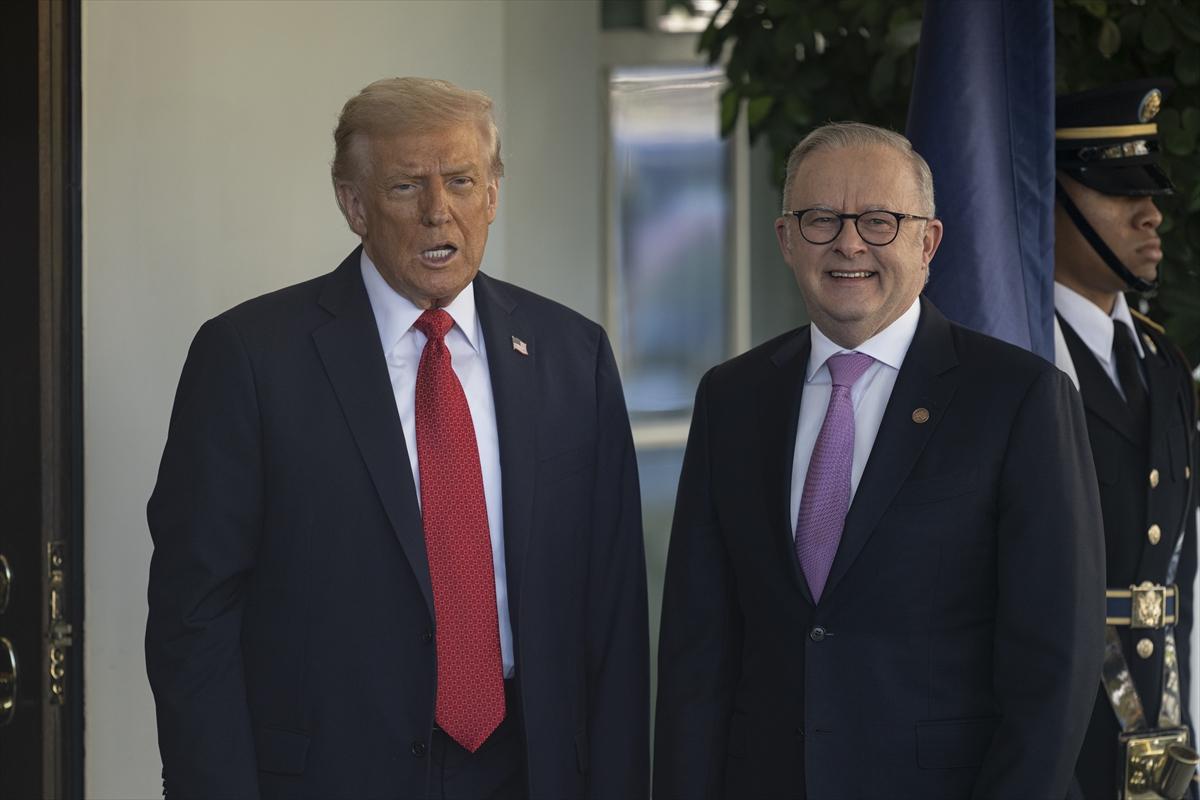
United States President Donald Trump meets with Australian Prime Minister Anthony Norman Albanese at the White House during his official visit, 20 October 2025 – (Anadolu Agency)
The agreement was signed by United States President Donald Trump and Australian Prime Minister Anthony Albanese at the White House. The parties aim to secure the mining, processing, and supply of rare earth elements and critical minerals through this framework. According to the White House statement, the primary objective of the agreement is “to create a diversified, fair, and reliable market for critical minerals using economic policy tools and coordinated investments.”
This agreement was signed at a time when China increased restrictions on exports of rare earth elements in 2025. The Washington administration stated that Beijing’s policies risk creating monopolization within the global technology supply chain. The fundamental rationale for the agreement is to establish for the United States and its allies “an independent and resilient supply chain network” against risks associated with Chinese sourcing.
According to the official text published by the White House, the governments of both countries have committed to making joint investments of over three billion dollars in mining and processing projects within six months. These projects are estimated to contain extractable resources valued at approximately 53 billion dollars.
The U.S. Export-Import Bank (EXIM) has issued seven letters of intent providing over 2.2 billion dollars in financing, supporting projects that will mobilize a total investment of five billion dollars. Projects supported by EXIM include those by Arafura Rare Earths, Northern Minerals, Graphinex, Latrobe Magnesium, VHM, RZ Resources, and Sunrise Energy Metals.
Under the agreement, a state-of-the-art gallium refinery with an annual production capacity of 100 metric tons is planned for construction in Western Australia. This investment will be funded by the U.S. Department of Defense. Gallium was among the strategic elements whose export to the United States was halted by China at the end of 2024.
The official document titled United States–Australia Framework for Securing of Supply in the Mining and Processing of Critical Minerals and Rare Earths serves as a joint action plan between the two countries.
Alongside the mining agreement, several defense-related accords were reached at the summit. Australia has committed to purchasing 1.2 billion dollars’ worth of unmanned underwater vehicles and 2.6 billion dollars’ worth of Apache helicopters. Since February 2025, Australia has contributed one billion dollars toward expanding U.S. submarine industrial capacity and plans to make an additional one billion dollars in payments by year-end.
AUKUS (the security agreement between the United States, Australia, and the United Kingdom) was also discussed. The Trump administration affirmed its support for the AUKUS agreement signed during the Biden administration, which envisages delivery of Virginia-class nuclear submarines to Australia by 2032. U.S. Secretary of the Navy John Phelan stated that the agreement has been transformed into a framework that “resolves previous uncertainties” for all three parties.
The agreement encompasses not only mining and defense but also economic growth and technological collaboration. The parties have launched a new initiative called the “Technology Prosperity Deal” to pursue joint investments in artificial intelligence, quantum technology, and other critical fields. Additionally, a framework agreement was signed between NASA and the Australian Space Agency, with Australia set to provide a lunar exploration vehicle for use in NASA’s Artemis Moon Program.
Australian superannuation funds are expected to increase their investments in the United States to 1.44 trillion dollars by 2035, representing an expansion of approximately one trillion dollars over current levels. Mutual agreement was also reached on expanding market access for U.S. beef exports. According to the White House, this economic cooperation constitutes “a long-term investment strategy aimed at supporting mutual prosperity and industrial capacity.”
The agreement anticipates new investment mechanisms to become operational from 2026. The parties have announced the establishment of a ministerial-level investment forum, the Mining, Minerals and Metals Investment Ministerial, which will be responsible for identifying investment projects, monitoring permitting processes, and promoting international partnerships.
In addition, a crisis response group named the “U.S.–Australia Critical Minerals Supply Security Response Group” has been created. Co-chaired by the U.S. Secretary of Energy and the Australian Minister for Resources, this group aims to coordinate supply security, production scheduling, and processing procedures for strategic minerals.
The agreement also foresees cooperation with third-party countries and the joint updating of geological resource maps. Both parties have agreed to develop a standards-based model for international pricing systems and to adopt a unified stance against market manipulation.
The agreement was signed in Washington on 20 October 2025. The text explicitly states that the agreement has no legal binding force and constitutes a programmatic and policy-level framework for cooperation. Both parties retain the right to withdraw from the agreement by providing written notice with a 30-day notice period. According to the document, this framework is “a shared political understanding to be implemented in accordance with the national laws of the participants.”
ABC News. “US, Australia Sign Critical Minerals Agreement to Counter China.” ABC News. Accessed October 21, 2025. https://abcnews.go.com/Business/wireStory/us-australia-sign-critical-minerals-agreement-counter-china-126708070
Al Jazeera. “US, Australia Sign Rare Earth Mineral Agreement as China Tightens Supply.” Al Jazeera English. Accessed October 21, 2025. https://www.aljazeera.com/economy/2025/10/20/us-australia-sign-rare-earth-mineral-agreement-as-china-tightens-supply
Anadolu Ajansı. “ABD Başkanı Trump, Çin’in Tayvan’ı İşgal Etmek İstemediğine İnandığını Söyledi.” Accessed October 21, 2025. https://www.aa.com.tr/tr/dunya/abd-baskani-trump-cinin-tayvani-isgal-etmek-istemedigine-inandigini-soyledi/3722173#
Associated Press (AP). “US and Australia sign critical-minerals agreement as a way to counter China.” AP News. Accessed October 21, 2025. https://apnews.com/article/donald-trump-anthony-albanese-submarine-australia-trade-7db18e2b942176623dcad283bfad3a6c
Reuters. “Trump, Australia's Albanese sign critical minerals agreement to counter China.” Reuters. Accessed October 21, 2025. https://www.reuters.com/world/asia-pacific/australias-albanese-discuss-rare-earths-security-first-trump-summit-2025-10-20/
The White House. “Fact Sheet: President Donald J. Trump Closes Billion-Dollar Deals with Australia.” The White House Briefing Room. Accessed October 21, 2025. https://www.whitehouse.gov/fact-sheets/2025/10/fact-sheet-president-donald-j-trump-closes-billion-dollar-deals-with-australia/
The White House. “United States–Australia Framework for Securing of Supply in the Mining and Processing of Critical Minerals and Rare Earths.” The White House Statements & Releases. Accessed October 21, 2025. https://www.whitehouse.gov/briefings-statements/2025/10/united-states-australia-framework-for-securing-of-supply-in-the-mining-and-processing-of-critical-minerals-and-rare-earths/

No Discussion Added Yet
Start discussion for "U.S.–Australia Critical Minerals Framework Agreement (2025)" article
Signing and Purpose of the Agreement
Financing and Joint Investment Plans
Content and Provisions of the Agreement
Defense and AUKUS Cooperation
Economic and Technological Cooperation
Implementation Mechanisms and Institutional Structure