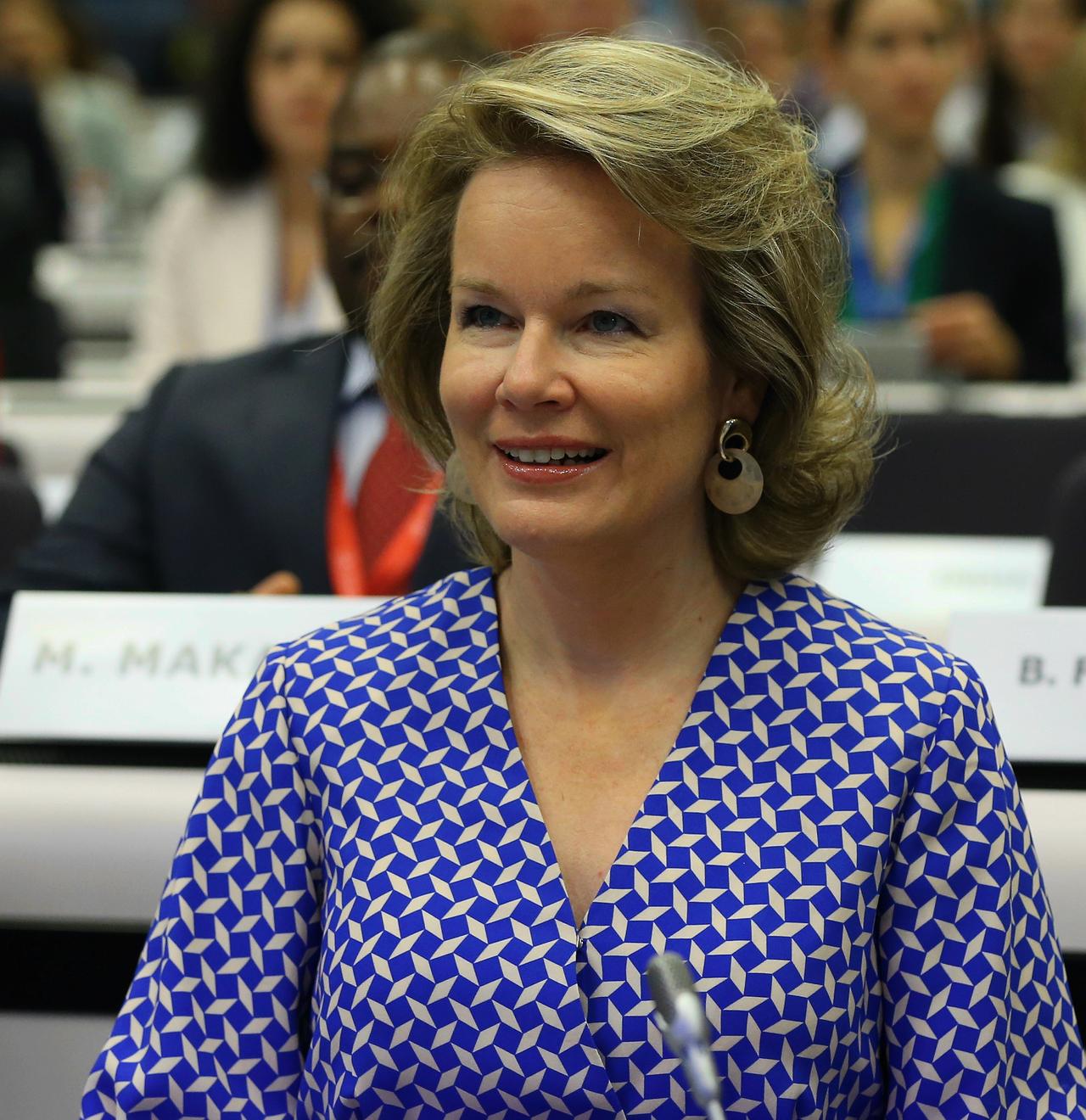

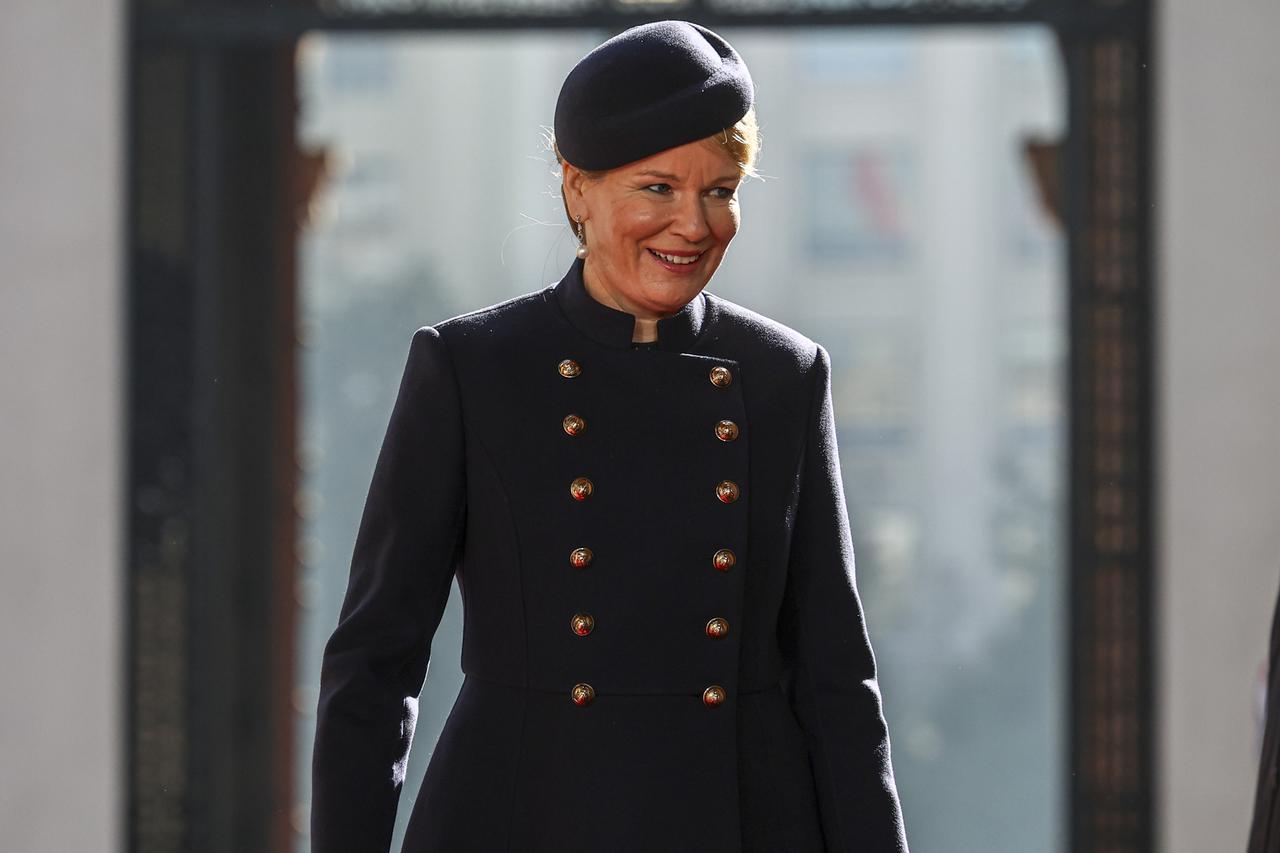

Mathilde Marie Christine Ghislaine d'Udekem d'Acoz became Queen of Belgium on 21 July 2013 following the accession of King Philippe; she has undertaken various national and international roles in the fields of education, child welfare, poverty alleviation, mental health, and sustainable development.
Mathilde Marie Christine Ghislaine d'Udekem d'Acoz was born on 20 January 1973 in Uccle (Ukkel), Belgium. She is the daughter of Count Patrick d'Udekem d'Acoz and Countess Anna Maria Komorowska. Her mother is connected to the Polish-Lithuanian princely nobility, while her father belongs to the French-speaking Walloon aristocracy of Belgium. Following Mathilde’s marriage in 1999, her father was honored by King Albert II with the title Count d'Udekem d'Acoz.
Mathilde is the eldest of five siblings. Her siblings include Jonkvrouw Marie-Alix d'Udekem d'Acoz (1974–1997), who died in a traffic accident in 1997, Countess Elisabeth d'Udekem d'Acoz (b. 1977), Countess Hélène d'Udekem d'Acoz (b. 1979), and Count Charles-Henri d'Udekem d'Acoz (b. 1985).
She completed her primary education in Bastogne and her secondary education in Brussels. Between 1991 and 1994, she received training in speech therapy at Haute École Léonard de Vinci.【1】 Some sources list the institution where she studied as Institut Libre Marie Haps. From 1995 to 1999, she worked as a speech therapist in her own practice in Brussels.
She later studied psychology at Université Catholique de Louvain and obtained a master’s degree in psychology in 2002. In addition to Dutch and French, she speaks English and Italian, and has basic knowledge of Spanish.【2】 She participated in leadership programs at Harvard Kennedy School and Yale University as part of the World Economic Forum’s Young Global Leaders initiative.
Mathilde d'Udekem d'Acoz married Prince Philippe, son of King Albert II, in a civil ceremony on 4 December 1999 at the Brussels City Hall, followed by a religious ceremony at the Cathedral of St Michael and St Gudula. Through this marriage, she acquired the titles Duchess of Brabant and Princess of Belgium. Upon King Albert II’s abdication on 21 July 2013, Prince Philippe became King of Belgium, and Mathilde became Queen of Belgium.【3】 Mathilde is the first Queen of Belgium to be born in the country. Previous queens consort were of French, Austrian, German, Swedish, Spanish and Italian origin.
The couple has four children: Princess Elisabeth, Duchess of Brabant (b. 25 October 2001), Prince Gabriel (b. 20 August 2003), Prince Emmanuel (b. 4 October 2005), and Princess Eléonore (b. 16 April 2008). Following the 1991 amendment to the Belgian Constitution, female heirs were granted succession rights; accordingly, Princess Elisabeth became the first female heir apparent in Belgian monarchy history. The royal family resides at Laeken Castle.
Queen Mathilde assists King Philippe in his duties as head of state. These duties include visits to institutions and organizations, interactions with the public, domestic and international ceremonies, official state visits, promoting Belgium internationally, meetings with representatives of various social groups, and numerous travels across the country.
According to the official website of the Belgian Royal Family in 2026, from 2026 onwards the Queen leads Belgian economic missions abroad on behalf of the King.【4】
The main institutional responsibilities undertaken or supported by the Queen include:
Koningin Mathilde Fonds (Princess Mathilde Fund): In 2001, the Queen established the Princess Mathilde Fund using gifts received as a wedding present. Its primary focus is on the most vulnerable segments of society, especially children.
UNICEF Belgium: Since 2009, the Queen has served as Honorary President of UNICEF Belgium.
Child Focus: Since 2014, she has continued to serve as Honorary President of the Child Focus Foundation, which supports children who are missing or victims of sexual abuse.
King Baudouin Foundation: She accepted the role of Honorary President of this foundation in 2015.
Queen’s Assistance Fund (Hulpfonds van de Koningin / 1964): It provides support to citizens unable to meet their basic needs due to financial hardship. The fund also supports vulnerable young people aged 18 to 25 who have grown up in youth care or foster families during their transition to independence.
Breast International Group: Since 2010, she has served as Honorary President of this organization, which is the world’s largest network of academic research groups supporting breast cancer research.
Schwab Foundation for Social Entrepreneurship Board: In 2010, she became an Honorary Member of the Board of the Schwab Foundation for Social Entrepreneurship.
Queen Elisabeth Music Competition: Since 2014, she has supported this competition with the status of High Patronage.
Koninklijke Academie voor Geneeskunde van België (KAGB) and Académie Royale de Médecine de Belgique (ARMB): In 2019, she was appointed Honorary Member of both medical academies in accordance with royal tradition.
Queen Mathilde participated as a member of the Belgian delegation at the UN’s major conference on Children’s Rights. In 2005, she served as UN Ambassador for the International Year of Microcredit, visiting projects worldwide in this context. For several years, she served as Special Representative of UNICEF and UNAIDS. From 2011 to 2013, she served as Special Representative for Immunization within WHO Europe.【5】
In 2007, she joined the World Economic Forum’s Young Global Leaders program and participated in the Global Leadership and Public Policy for the 21st Century program in Boston. She attends the annual World Economic Forum in Davos.
The Queen has participated in various humanitarian missions focusing on children’s rights, health, poverty reduction, quality education, good governance, women’s economic empowerment, and non-communicable diseases, particularly in Africa.
In 2016, at the invitation of the UN Secretary-General, she joined the UN Sustainable Development Goals (SDG) Advocates Group. This group supports the UN in mobilizing the international community to achieve the SDGs by 2030.
In 2017, she was awarded the German National Sustainability Honor Award for her longstanding social and humanitarian engagement and her contributions to discussions on implementing the UN SDGs.
Since 2018, she has served as Honorary President of the Federal Council for Sustainable Development (FRDO-CFDD), which advises the Belgian federal government on sustainable development policies.
In 2021, she participated in the event 'Sustainable Development Goals: A Tool for Transition to Responsible Organizations – Myth or Reality?', which involved young academics, using this platform to engage youth in SDG discussions.
On 30 May 2023, UHasselt (Hasselt University) awarded the Queen an honorary doctorate in recognition of her social work.【6】 The university justified this decision by highlighting the Queen’s visibility on major contemporary issues such as education, equal access to education, child poverty, the status of women in society, financial literacy, and mental health.
The Queen’s interests include culture, art, and dance. She enjoys listening to classical and modern music, playing the piano, and reading literature. In her free time, she participates in outdoor activities such as walking, cycling, and tennis.
Belgian Monarchy. “De Koningin.” *De Belgische Monarchie*. Accessed May 10, 2026. https://www.monarchie.be/nl/koninklijke-familie/de-koningin
Belgian Monarchy. “The King, the Queen and Their Family.” The Belgian Monarchy. Accessed May 10, 2026. https://www.monarchie.be/en/for-children/the-king-the-queen-and-their-family
Belgian Monarchy. “The Queen.” The Belgian Monarchy. Accessed May 10, 2026. https://www.monarchie.be/en/royal-family/the-queen
Columbia University World Leaders Forum. “Queen Mathilde.” Columbia World Leaders Forum. Accessed May 10, 2026. https://worldleaders.columbia.edu/directory/queen-mathilde
Focus on Belgium. “Koningin Mathilde.” Accessed May 10, 2026. https://focusonbelgium.be/nl/print/Kent%20u%20deze%20Belgen/koningin-mathilde
Focus on Belgium. “Queen Mathilde.” Accessed May 10, 2026. https://focusonbelgium.be/en/print/Do%20you%20know%20these%20Belgians/queen-mathilde
United Nations Partnerships Office. "Her Majesty Queen Mathilde." United Nations Partnerships. Accessed May 10, 2026. https://unpartnerships.un.org/her-majesty-queen-mathilde
Unofficial Royalty. “January 20, 1973: Birth of Mathilde d’Udekem d’Acoz, Wife of King Philippe of the Belgians.” Unofficial Royalty. Accessed May 10, 2026. https://www.unofficialroyalty.com/january-20-1973-birth-of-mathilde-dudekem-dacoz-wife-of-king-philippe-of-the-belgians/
[1]
The Belgian Monarchy “The Queen,” The Belgian Monarchy, accessed 10 May 2026. https://www.monarchie.be/en/royal-family/the-queen
[2]
The Belgian Monarchy, "The Queen."
[3]
UN Office for Partnerships “Her Majesty Queen Mathilde,” UN Office for Partnerships, accessed 10 May 2026. https://unpartnerships.un.org/her-majesty-queen-mathilde
[4]
The Belgian Monarchy “The Queen,” The Belgian Monarchy, accessed 10 May 2026. https://www.monarchie.be/en/royal-family/the-queen
[5]
UN Office for Partnerships “Her Majesty Queen Mathilde,” UN Office for Partnerships, accessed 10 May 2026. https://unpartnerships.un.org/her-majesty-queen-mathilde
[6]
UN Office for Partnerships “Her Majesty Queen Mathilde,”

Henüz Tartışma Girilmemiştir
"Queen Mathilde of Belgium" maddesi için tartışma başlatın
Life and Education
Joining the Royal Family and Becoming Queen
Public Duties
Social and Humanitarian Work
Institutional Responsibilities
International Roles
Work in Sustainable Development
Academic Honors
Personal Life and Interests