


This article was automatically translated from the original Turkish version.
+2 More
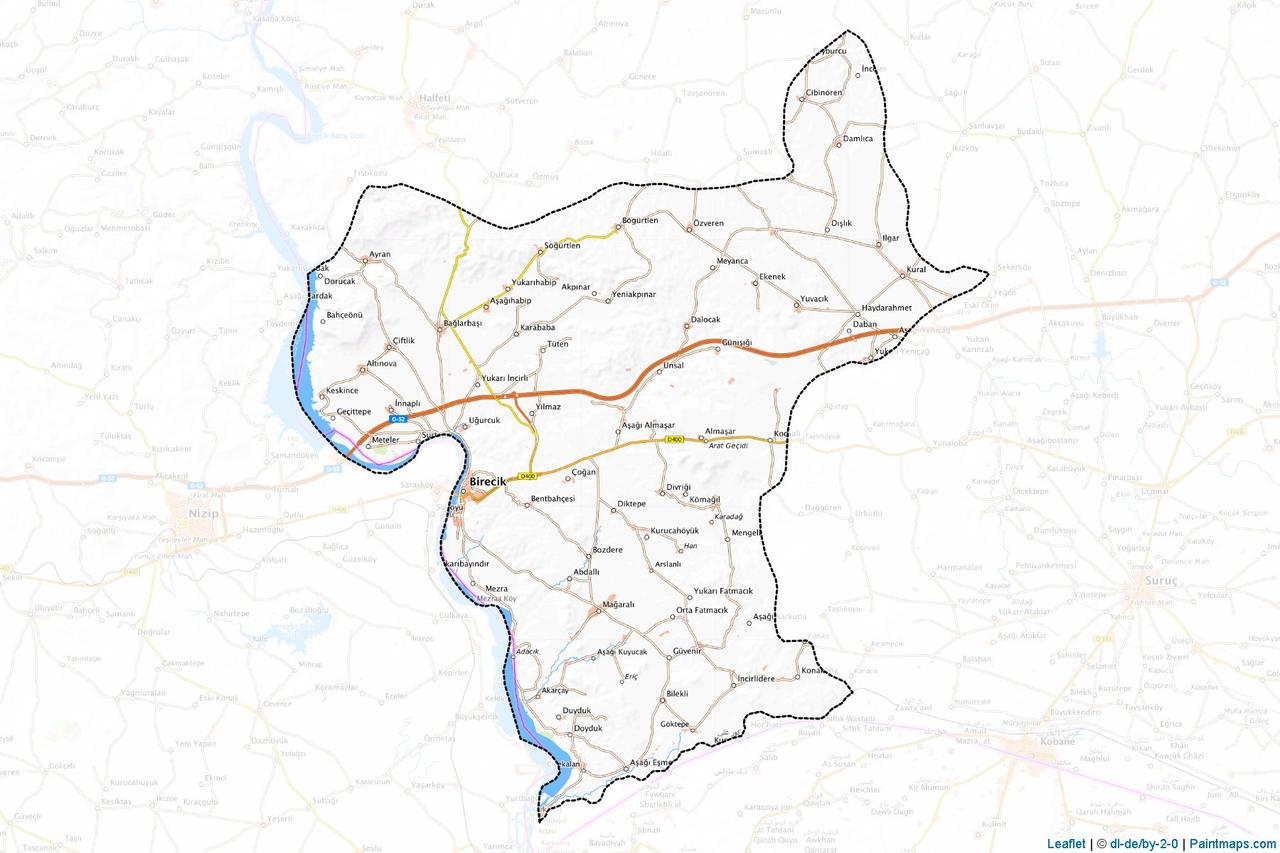
Birecik (District)
Location | Southeastern Anatolia Region Şanlıurfa Province | ||||||||
|---|---|---|---|---|---|---|---|---|---|
Area(s) | 852 km² | ||||||||
Population (2024) | 92,833 (Male: ~47,900, Female: ~47,783 - 2020 data) | ||||||||
Elevation(s) | 340-450 m | ||||||||
Geographical Features | Wavy plains on the left bank of the Euphrates River, southwest of the Şanlıurfa Plateau; Şeyhbekir Hill (660 m), Karadağ (576 m) | ||||||||
Climate(s) | Temperate steppe vegetation | ||||||||
Birecik is a district and district center town in the Southeastern Anatolia Region, linked to the province of Şanlıurfa. Located on the left bank of the Euphrates River at an elevation of 340–450 meters above sea level, place area city has been a settlement center throughout history due to its strategic location and natural features. According to 2024 TÜİK data, the district has a population of 92,833 and covers an area of 852 km².
The history of Birecik extends back to the 2000s BCE. Known as “Birthe” during the Hittite period, the city came under Assyrian control in the 9th century BCE. Successively ruled by the Persians, Macedonia, Romans and Byzantines, Birecik became part of Islamic lands in 637 during the time of Hz. Omar. During the Abbasids period it gained importance as a river port on the Euphrates. After being captured by Seljuks in the 11th century, Birecik came under the dominion of the Byzantines, Artuqids, Ayyubids, Mamluk, Akkoyunlu and Karakoyunlu states. In 1516, during the Ottoman campaign in Egypt, Birecik was incorporated into Ottoman territory and became the center of the Urfa sanjak within the Aleppo province. At the end of the 19th century it was a kaza under the Urfa sanjak of Aleppo Vilayet; upon the proclamation of the Republic it was attached to Şanlıurfa Province. The city suffered occupation by British and French forces in 1919 and regained its independence in 1920. The construction of the Birecik Bridge over the Euphrates in 1956 accelerated the district’s development during the modern period.
Birecik lies on the southwestern edge of the Şanlıurfa Plateau, on a rolling plain. The district’s territory is bordered by fertile plains sloping toward the Euphrates River. The main elevations are Şeyhbekir Hill (660 m) in the northwest and Montenegro (576 m) in the south. The Euphrates River forms a natural boundary to the west and serves as the primary irrigation source for agricultural lands. The town is built on a narrow plain along the riverbank and the slopes behind it. Birecik Castle stands on a white limestone hill rising from these slopes.
Birecik’s climate exhibits the mild characteristics of the Lower Euphrates Basin. This moderate climate supports agricultural diversity and enables the cultivation of olive and Antep pistachio such as crops. The dominant vegetation type in the district is steppe plant; however, fertile plains along the Euphrates River host cultivated farmland. Rocky areas selected as breeding grounds by the griffon vultures indicate the district’s geological composition of alkaline and soft rock formations.
The social structure of Birecik has been shaped over centuries by the influence of various civilizations. Although tribal relations still persist to some extent, modernization and together urbanization has increased. People maintains a traditional lifestyle, while the cultural significance attributed to the griffon vultures stands out as a cultural symbol. The local population regards these birds as “abundance omens” and supports their protection. Mosques in the town, especially the restored Cave Camii, are important elements of social and cultural life.
Birecik’s economy is based on agriculture and agro-based small industries. Crops such as Wheat, barley, lentils, cotton and Antep pistachios are intensively cultivated. Approximately 6.67 million Antep pistachio trees exist in the district, forming one of the pillars of its economy. Birecik, where olive cultivation is most developed in Şanlıurfa, hosts 360,000 of the province’s 660,000 olive trees. Small-scale livestock farming is also a significant income source, yielding products such as butter, cheese, wool and mohair. The industrial sector consists of small enterprises focused on processing agricultural products in the Industry, weaving and food sectors. Historically, Birecik served as a commercial center due to its river transport on the Euphrates and caravan trade. In the 16th century, dockyard activities and port revenues supported the economy; today, the Birecik Bridge plays a vital role in revitalizing commerce.
Birecik possesses significant tourism potential due to its natural and historical richness. Natural beaches along the Euphrates River serve as recreational areas with facilities such as motels and casinos. Birecik Castle is an important historical structure built during the Assyrian period and restored during the Roman, Frankish and Mamluk eras. It is notable for its walls reaching 30–40 meters in height and its 12 towers. The Cave Mosque, after its restoration, has become another historical site attracting visitors. The griffon vultures are among the district’s most important tourist attractions. These birds, whose populations are endangered, are protected at the Griffon Vulture Breeding Station under the Ministry of Agriculture and Forest, and are presented to visitors through educational programs. The Birecik Bridge is both a functional and symbolic gravity point.
Birecik’s population in 2024 was 92,833. According to 2020 data, the male population was 47,900 and the female population was 47,783. In addition to the center subdistrict, the district includes Blackberry borough and 39 village. Of the district’s 85 neighborhoods, 10 are directly linked to the center. Population density was 69 persons per km² in 1990; in recent years, urban population growth toward agricultural areas has become noticeable. The population rose from 9,100 in 1927 to 58,907 in 1990 and reached 95,683 in 2020. Between 1960 and 1985, population growth reached 100 percent, supported by improved transportation due to the Birecik Bridge and agricultural development.
Birecik is one of the important centers of Southeastern Anatolia, distinguished by the geographical advantages provided by the Euphrates River, its rich historical heritage and unique natural values such as the griffon vultures.
Birecik Kaymakamlığı. "Birecik Kalesi." Accessed April 8, 2025. http://www.birecik.gov.tr/birecik-kalesi2019.
Birecik Kaymakamlığı. "Birecik Köprüsü." Accessed April 8, 2025. http://www.birecik.gov.tr/birecik-koprusu2019.
Birecik Kaymakamlığı. "Birecik Nüfusu." Accessed April 8, 2025. http://www.birecik.gov.tr/birecik-nufusu.
Birecik Kaymakamlığı. "Birecik Tarihçesi." Accessed April 8, 2025. http://www.birecik.gov.tr/birecik-tarihcesi.
Birecik Kaymakamlığı. "Kelaynak Kuşları." Accessed April 8, 2025. http://www.birecik.gov.tr/kelaynak-kuslari3.
Birecik Kaymakamlığı. "Mağara Camii." Accessed April 8, 2025. http://www.birecik.gov.tr/magara-camii.
Birecik Ticaret ve Sanayi Odası. "Tarihçe." Accessed April 8, 2025. https://www.bireciktso.org.tr/birecik/tarihce/.
Şanlıurfa Büyükşehir Municipality. “Birecik.” Accessed April 8, 2025. https://www.sanliurfa.bel.tr/icerik/1016/45/birecik.

Birecik (District)
Location | Southeastern Anatolia Region Şanlıurfa Province | ||||||||
|---|---|---|---|---|---|---|---|---|---|
Area(s) | 852 km² | ||||||||
Population (2024) | 92,833 (Male: ~47,900, Female: ~47,783 - 2020 data) | ||||||||
Elevation(s) | 340-450 m | ||||||||
Geographical Features | Wavy plains on the left bank of the Euphrates River, southwest of the Şanlıurfa Plateau; Şeyhbekir Hill (660 m), Karadağ (576 m) | ||||||||
Climate(s) | Temperate steppe vegetation | ||||||||
History
Geographical Structure
Climate and Vegetation
Social Structure
Economic Structure
Tourism Potential
Demographic Structure