

This article was automatically translated from the original Turkish version.
+1 More
International Day of Human Space Flight is observed on 12 April, the anniversary of the first human spaceflight carried out by Soviet citizen Yuri Gagarin, as established by United Nations General Assembly resolution A/RES/65/271 adopted on 7 April 2011. This special day aims to celebrate internationally the beginning of the space age for humanity, highlight the contribution of space science and technology to sustainable development goals and societal well-being, and reaffirm the commitment to the peaceful exploration and use of outer space for the benefit of all humanity.【1】

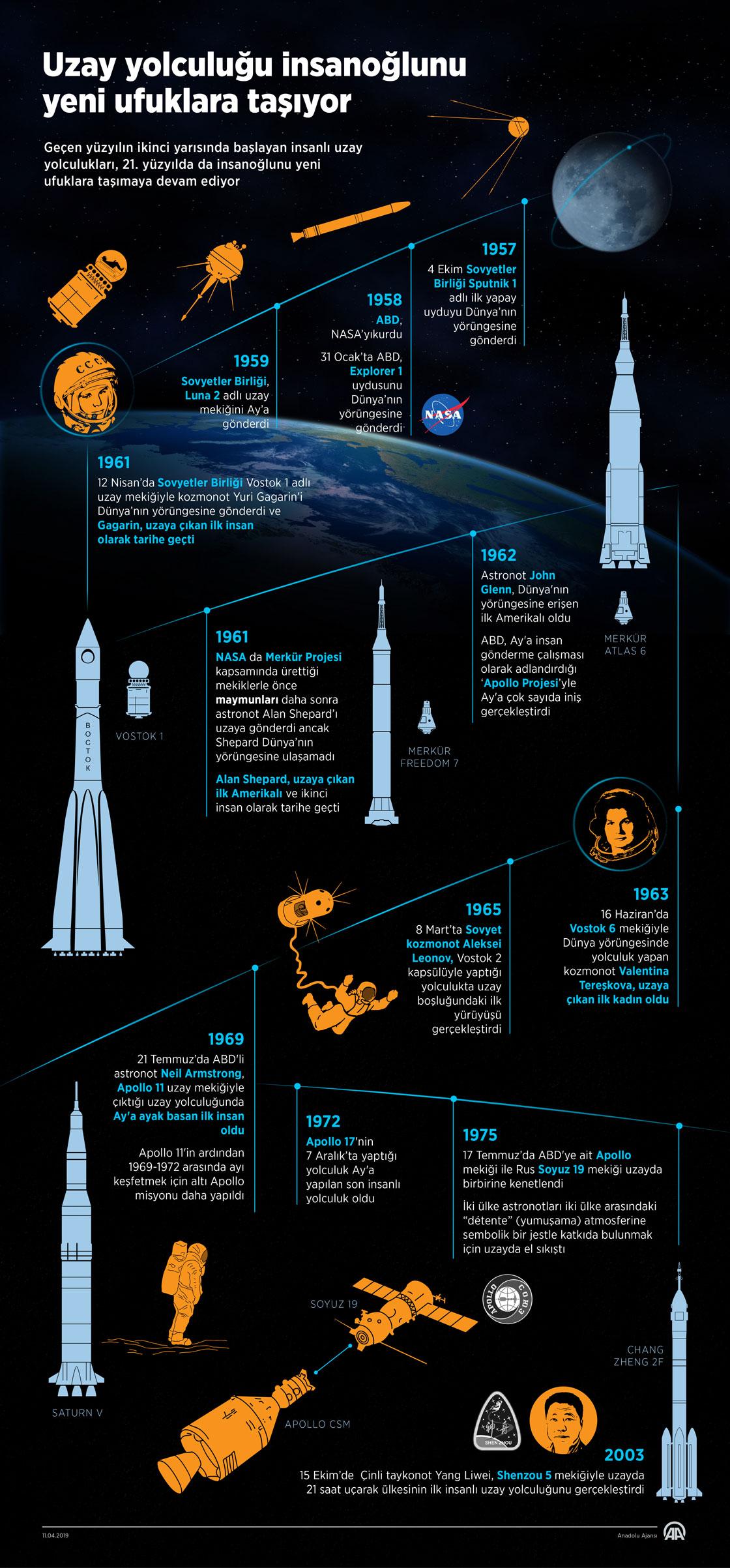
Infographic of Humanity’s Space Journey from Past to Present (Anadolu Ajansı)
Humanity’s space journey developed not primarily from scientific curiosity but as a reflection of the global struggle for dominance that began after World War II between the United States of America (USA) and the Soviet Union (USSR).【2】 During the Cold War, the two superpowers focused on developing intercontinental ballistic missile systems capable of carrying nuclear warheads. This technological infrastructure also enabled the launch of artificial satellites into low Earth orbit.
The space race first materialized as a competition over satellites. The USSR achieved the first milestone by launching Sputnik 1, the world’s first artificial satellite, on 4 October 1957.【3】 The USA responded approximately four months later, on 31 January 1958, by placing Explorer 1 into orbit.【4】 During this period, both nations began developing single-person spacecraft to enable human spaceflight.
Human space exploration consists of critical phases where technological risk and human courage converge.

Yuri Gagarin’s Capsule and Space Suit (Flickr)
On 12 April 1961, Soviet cosmonaut Yuri Gagarin became the first human in space by completing one orbit of Earth in 108 minutes aboard the Vostok 1 spacecraft.【5】 Launched from the Baikonur Cosmodrome in Kazakhstan, the spacecraft reached a speed of 27,400 kilometres per hour and an altitude of approximately 327 kilometres.【6】 Gagarin began his flight with the words “Poyekhali!” (Let’s go!); he did not intervene with the control systems during the mission but maintained communication with ground control and observed Earth’s appearance.【7】 During re-entry, a dangerous situation arose because the cables designed to separate the service module from the capsule failed to burn away as planned; however, the modules eventually separated and Gagarin parachuted safely to the ground near the Volga River.【8】
The Soviet Union also pioneered efforts regarding the representation of women in space and spacewalks. On 16 June 1963, Valentina Tereshkova became the first woman in space aboard the Vostok 6 spacecraft. On 8 March 1965, cosmonaut Aleksey Leonov made history by performing the first spacewalk during his mission aboard the Voskhod 2 capsule.【9】
Infographic of Spaceflight (Anadolu Ajansı)
Following U.S. President John F. Kennedy’s announcement on 12 September 1962 of the goal to send humans to the Moon, the United States implemented the Gemini and subsequently the Apollo programs.【10】 In December 1968, the Apollo 8 spacecraft successfully completed ten orbits around the Moon. The first human landing on the lunar surface, one of the most significant milestones in human history, occurred on 21 July 1969. The Apollo 11 spacecraft, carrying Neil Armstrong, Buzz Aldrin, and Michael Collins, reached the Moon; Armstrong became the first person to step onto the lunar surface, uttering the historic phrase: “That’s one small step for [a] man, one giant leap for mankind.”【11】 By 1972, the United States had sent a total of ten astronauts to the lunar surface.【12】
Over time, space activities evolved from competition to cooperation. The Outer Space Treaty, which entered into force on 10 October 1967, established the principle that outer space shall be explored for the benefit of all countries.【13】 As a symbolic gesture of diplomatic thaw, on 17 July 1975, the American Apollo spacecraft docked with the Soviet Soyuz 19 spacecraft in orbit, and the astronauts shook hands in space.【14】 Today, this cooperation continues through the International Space Station (ISS), jointly operated by the United States, Russia, the European Union, Japan, and Canada.【15】
Voyager Golden Record (United Nations)
Humanity’s messages of peace and friendship to the cosmos were embodied in the “Golden Record” aboard the 1977-launched Voyager spacecraft. Prepared by NASA in cooperation with the United Nations, this recording contains messages of hope for peace from the then UN Secretary-General and greetings in multiple languages. A copy of this record is exhibited at the UN Headquarters, serving as a symbol reminding humanity of its origins and shared bonds in the universe.【16】

Humanity’s Space Journey(Anadolu Ajansı)
In the modern era, space exploration has acquired a new dimension through the participation of new nations and the growing role of the private sector.
China’s Rise: On 15 October 2003, China became the third nation, after the United States and Russia, to conduct human spaceflight when taikonaut Yang Liwei orbited Earth aboard the Shenzhou 5 spacecraft.【17】 China has also opened its space station program to international cooperation.
Private Sector Initiatives: In 2011, NASA ended its government-funded space shuttle program and began promoting commercial partnerships. SpaceX became the first private company to send humans to space when it launched its Crew Dragon spacecraft on 30 May 2020.【18】 Companies such as Blue Origin are organizing suborbital tourist flights.
Artemis Program: NASA’s Artemis program aims to return humans to the lunar surface and use a future lunar station as a stepping stone for missions to Mars.【19】
The history of space exploration has also been marked by significant risks and tragedies. On 1971, the Soyuz 11 spacecraft suffered a pressure loss during re-entry, resulting in the deaths of its three crew members—the first fatalities in space.【20】 Additionally, the first Soviet cosmonaut Yuri Gagarin died in 1968 at the age of 34 when his training aircraft crashed during a routine flight.【21】 More recently, technical malfunctions aboard the Boeing Starliner spacecraft have led to astronauts being stranded aboard the ISS, continuing to pose operational challenges.【22】
[1]
United Nations. "International Day of Human Space Flight." Erişim tarihi: 3 Nisan 2026. https://www.un.org/en/observances/human-spaceflight-day
[2]
TRT Haber, "İnsanlığın uzay macerası," 12 Nisan 2019, erişim 3 Nisan 2026, https://www.trthaber.com/haber/bilim-teknoloji/insanligin-uzay-macerasi-411679.html
[3]
Anadolu Ajansı, "Uzay yolculuğu insanoğlunu yeni ufuklara taşıyor," Erişim 3 Nisan 2026, https://www.aa.com.tr/tr/bilim-teknoloji/uzay-yolculuklari-insanligi-yeni-ufuklara-tasiyor/1801547
[4]
TRT Haber, "İnsanlığın uzay macerası." Erişim 3 Nisan 2026,https://www.trthaber.com/haber/bilim-teknoloji/insanligin-uzay-macerasi-411679.html
[5]
TRT Haber, "İnsanlığın uzay macerası." erişim 3 Nisan 2026, https://www.trthaber.com/haber/bilim-teknoloji/insanligin-uzay-macerasi-411679.html
[6]
NASA, "April 1961 - First Human Entered Space," 1 April 1961, access 3 April 2026,https://www.nasa.gov/image-article/april-1961-first-human-entered-space/
[7]
NASA, "Remembering Yuri Gagarin 50 Years Later," John Uri, 27 March 2018, access 3 April 2026, https://www.nasa.gov/history/remembering-yuri-gagarin-50-years-later/
[8]
BBC News Türkçe, "Yuri Gagarin, 63 yıl önce ilk insanlı uzay uçuşunu hangi şartlar altında gerçekleştirdi?," 12 April 2024, access 3 April 2026, https://www.bbc.com/turkce/haberler-dunya-56716051
[9]
Anadolu Ajansı, "Uzay yolculukları insanlığı yeni ufuklara taşıyor," Emre Aytekin, 12 April 2020, access 3 April 2026, https://www.bbc.com/turkce/haberler-dunya-56716051
[10]
TRT Haber, "İnsanlığın uzay macerası." Erişim 3 Nisan 2026, https://www.trthaber.com/haber/bilim-teknoloji/insanligin-uzay-macerasi-411679.html
[11]
Anadolu Ajansı, "İnsanlığın uzay yolculuğu," erişim 3 Nisan 2026, https://www.aa.com.tr/tr/bilim-teknoloji/insanligin-uzay-yolculugu/2205042
[12]
TRT Haber, "İnsanlığın uzay macerası." erişim 3 Nisan 2026, https://www.trthaber.com/haber/bilim-teknoloji/insanligin-uzay-macerasi-411679.html
[13]
United Nations, "International Day of Human Space Flight." access 3 April 2026, https://www.un.org/en/observances/human-spaceflight-day
[14]
Anadolu Ajansı, "Uzay yolculuğu insanoğlunu yeni ufuklara taşıyor," Erişim 3 Nisan 2026, https://www.aa.com.tr/tr/bilim-teknoloji/uzay-yolculuklari-insanligi-yeni-ufuklara-tasiyor/1801547
[15]
TRT Haber, "İnsanlığın uzay macerası." Erişim 3 Nisan 2026, https://www.trthaber.com/haber/bilim-teknoloji/insanligin-uzay-macerasi-411679.html
[16]
United Nations, "International Day of Human Space Flight." access 3 April 2026, https://www.un.org/en/observances/human-spaceflight-day
[17]
TRT Haber, "İnsanlığın uzay macerası." erişim 3 Nisan 2026, https://www.trthaber.com/haber/bilim-teknoloji/insanligin-uzay-macerasi-411679.html
[18]
Anadolu Ajansı, "İnsanlığın uzay yolculuğu," erişim 3 Nisan 2026, https://www.aa.com.tr/tr/bilim-teknoloji/insanligin-uzay-yolculugu/2205042
[19]
Anadolu Ajansı, "İlk insanlı uzay yolculuğundan beri ülkeler keşif yarışında birbirini geçmek için rekabet ediyor." erişim 3 Nisan 2026, https://www.aa.com.tr/tr/bilim-teknoloji/ilk-insanli-uzay-yolculugundan-beri-ulkeler-kesif-yarisinda-birbirini-gecmek-icin-rekabet-ediyor/3534786#:~:text=Uzaya%20giden%20ilk%20insanlar,17%20Mart%201992'de%20yap%C4%B1ld%C4%B1.
[20]
Anadolu Ajansı, "İlk insanlı uzay yolculuğundan beri ülkeler keşif yarışında birbirini geçmek için rekabet ediyor." erişim 3 Nisan 2026, https://www.aa.com.tr/tr/bilim-teknoloji/ilk-insanli-uzay-yolculugundan-beri-ulkeler-kesif-yarisinda-birbirini-gecmek-icin-rekabet-ediyor/3534786#:~:text=Uzaya%20giden%20ilk%20insanlar,17%20Mart%201992'de%20yap%C4%B1ld%C4%B1.
[21]
NASA, "Remembering Yuri Gagarin 50 Years Later." access 3 April 2026, https://www.nasa.gov/history/remembering-yuri-gagarin-50-years-later/
[22]
Anadolu Ajansı, "İlk insanlı uzay yolculuğundan beri ülkeler keşif yarışında birbirini geçmek için rekabet ediyor." erişim 3 Nisan 2026, https://www.aa.com.tr/tr/bilim-teknoloji/ilk-insanli-uzay-yolculugundan-beri-ulkeler-kesif-yarisinda-birbirini-gecmek-icin-rekabet-ediyor/3534786#:~:text=Uzaya%20giden%20ilk%20insanlar,17%20Mart%201992'de%20yap%C4%B1ld%C4%B1.

No Discussion Added Yet
Start discussion for "International Day of Human Space Flight" article
Origins of the Space Race and Technological Competition
Historical Milestones in Human Spaceflight
Yuri Gagarin and Vostok 1
Women in Space and Spacewalks
The Exploration of the Moon and the Apollo Program
International Cooperation and Legal Foundations
Cultural Messages in Space Exploration: The Voyager Golden Record
The 21st Century: New Actors and the Private Sector
Losses and Risks