


 Recently Added:
This article was automatically translated from the original Turkish version.
Israel’s Attacks on Gaza and Developments in Gaza (2026) encompass military humanitarian and demographic developments in the Gaza Strip during the third year of the large-scale offensive launched by the Israeli military in October 2023.
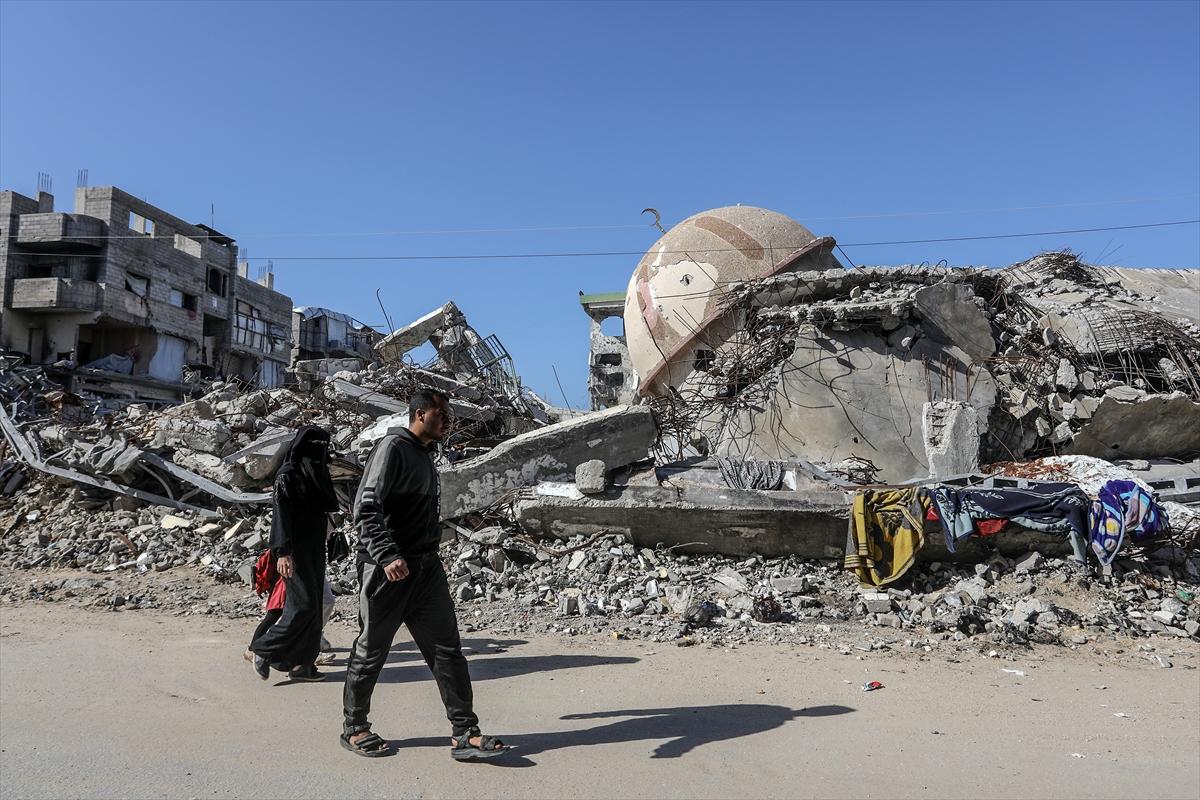
Daily life in Han Yunus 5 January 2026 – (Anadolu Ajansı)
The Israeli military launched large-scale air and ground attacks on the Gaza Strip on 7 October 2023. These attacks have continued for more than two years resulting in the extensive destruction of civilian settlements health facilities and infrastructure. The Palestinian Central Bureau of Statistics reported in its report dated 31 December 2025 that since October 2023 a total of over 72000 Palestinians have lost their lives in Gaza the West Bank and East Jerusalem. Ninety-eight percent of these fatalities occurred in the Gaza Strip.
The year 2025 was marked by intensified hostilities. It was reported that 90 percent of homes in Gaza had been destroyed and over 1.5 million Palestinians were forced to survive in makeshift tents. During the same period over 100000 Palestinians were compelled to flee Gaza.
According to the Palestinian Central Bureau of Statistics end-of-year 2025 report only 19 of Gaza’s 36 hospitals remained partially operational due to Israeli attacks. Approximately 18000 injured in Gaza are awaiting medical treatment and 60000 pregnant women face severe risks in accessing healthcare. Ninety-five percent of Gaza’s population lacks access to clean drinking water. Educational institutions were largely destroyed: 179 schools were completely demolished and 218 schools were bombed or damaged. All 63 universities in the region were destroyed. In Israeli attacks 18979 students lost their lives of whom 18863 were killed in Gaza.
It was reported that the total bed capacity of Gaza’s hospitals was approximately 2000 and insufficient to meet the region’s healthcare needs. Access to basic necessities such as clean water electricity food and medicine was nearly completely cut off.
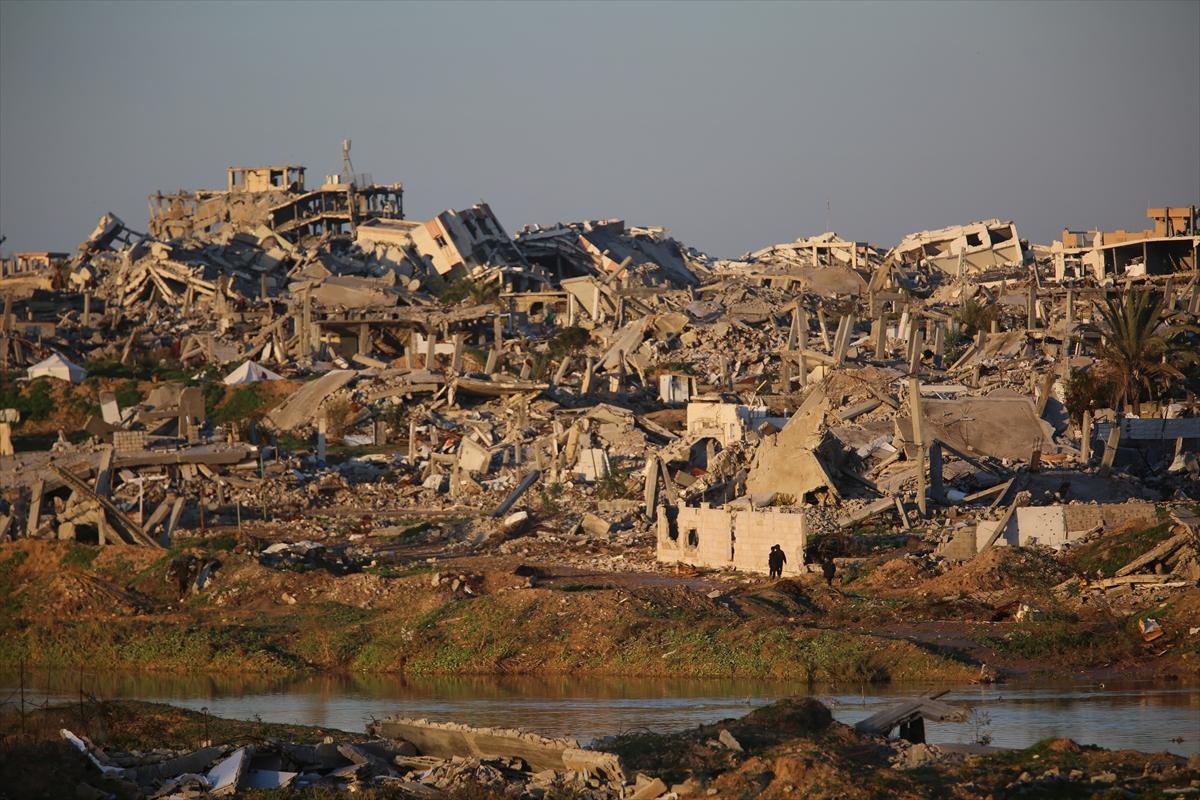
Homes destroyed in Israeli attacks in Nuseyrat 3 January 2025 – (Anadolu Ajansı)
A ceasefire came into effect in Gaza on 19 January 2025 implemented one day before U.S. President Donald Trump assumed office following pressure from the United States on Tel Aviv. During the ceasefire period mutual prisoner exchanges took place for six weeks. Tens of thousands of displaced Palestinians returned to their areas within Gaza. During the ceasefire weeks mass graves were discovered in the courtyard of Shifa Hospital and in the northern area of Beit Lahiya. Evidence was found indicating that some victims had their hands bound and were shot at close range. Some corpses were recorded as having been crushed by armored vehicles.
Israel refused to participate in negotiations for the second phase of the ceasefire scheduled to begin on 3 February 2025. On 2 March 2025 it completely halted humanitarian aid entry into Gaza and on 18 March it broke the ceasefire and launched renewed attacks on Gaza. In the first 48 hours of these attacks over 500 Palestinians lost their lives most of them women and children.
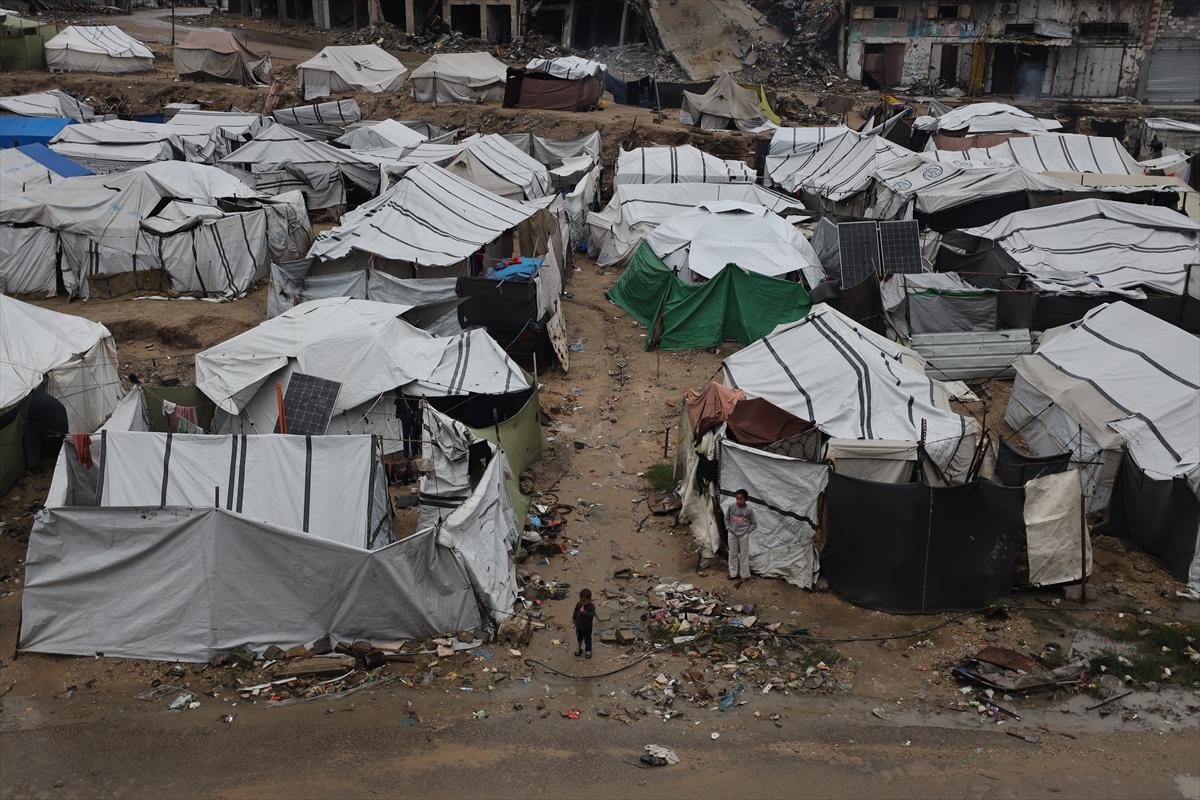
Daily life in Gaza 2 January 2026 – (Anadolu Ajansı)
The Israeli military expanded its ground occupation from 18 March 2025. Regional evacuation threats were issued forcing civilians to relocate to smaller areas within Gaza. Simultaneously Israel’s suspension of humanitarian aid triggered famine and scarcity in Gaza. According to UN data between May and October 2025 2615 Palestinians attempting to access aid at Gaza Humanitarian Fund (GHF) centers lost their lives.
The GHF centers established through a joint initiative by Israel and the United States were presented to the international community as humanitarian aid points yet incidents were recorded of attacks using tanks and rifles near these centers. Armed attacks on aid trucks and civilians gathered outside food distribution points were also documented. Israel was reported to have monopolized aid distribution. In August 2025 the UN officially declared the city of Gaza a famine zone.
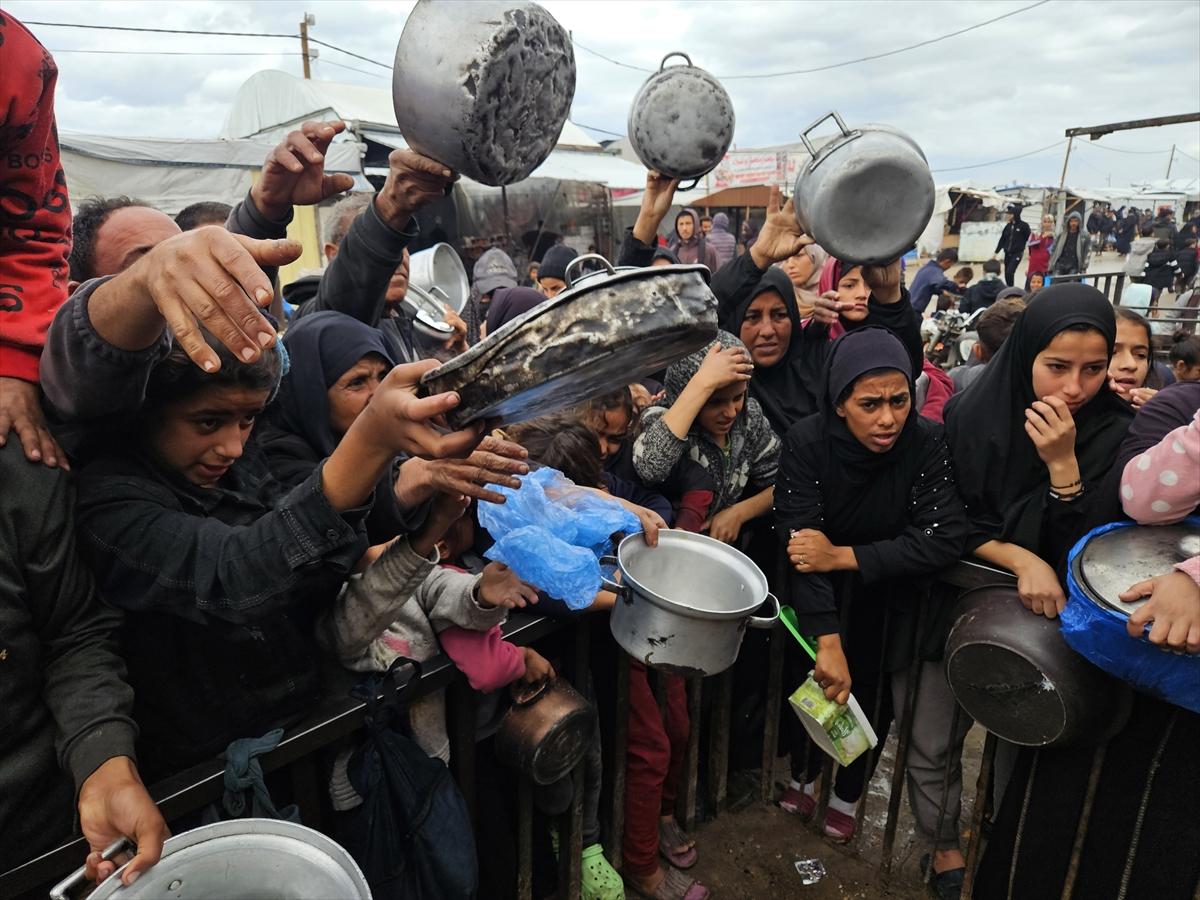
Hot meals are distributed to displaced people in Gaza 2 January 2026 – (Anadolu Ajansı)
On 23 March 2025 an Israeli air strike in the Rafah area killed 15 healthcare workers. After no contact could be established with the first team the Palestinian Red Crescent sent a second ambulance group which also came under attack. Footage showed workers in medical vests being directly targeted as they exited their vehicles. Israeli forces buried the ambulances and medical personnel in mass graves. Autopsy findings confirmed that some healthcare workers were killed by close-range gunfire to the head and chest.
Throughout 2025 international media access to Gaza was denied and only Palestinian journalists reported on developments on the ground. During this period journalists were targeted and numerous media personnel were killed.
A total of over 50 Palestinian journalists were killed. It was reported that from 7 October 2023 to the end of 2025 over 250 media workers lost their lives.
On 10 October 2025 a ceasefire agreement was signed under the guarantees of Turkey Egypt and Qatar. Despite the ceasefire remaining in force Israel violated it approximately 1000 times during this period. These violations resulted in 414 Palestinians killed and over 1100 injured.
During the ceasefire process the area known as the “Yellow Line” covering 52 percent of Gaza came under Israeli occupation. On 13 October mutual prisoner exchanges took place with Hamas releasing 20 Israeli prisoners and Israel releasing 1900 Palestinians. However Palestinian political leaders Marwan Barghouti and Ahmed Saadat and Dr. Husam Abu Safiye Chief of Staff at Kemal Adnan Hospital were not released.
By the end of this period the humanitarian crisis in Gaza worsened due to infrastructure destruction and winter conditions. Over 1.5 million of the 2.3 million Palestinians in Gaza continued to live in tents.
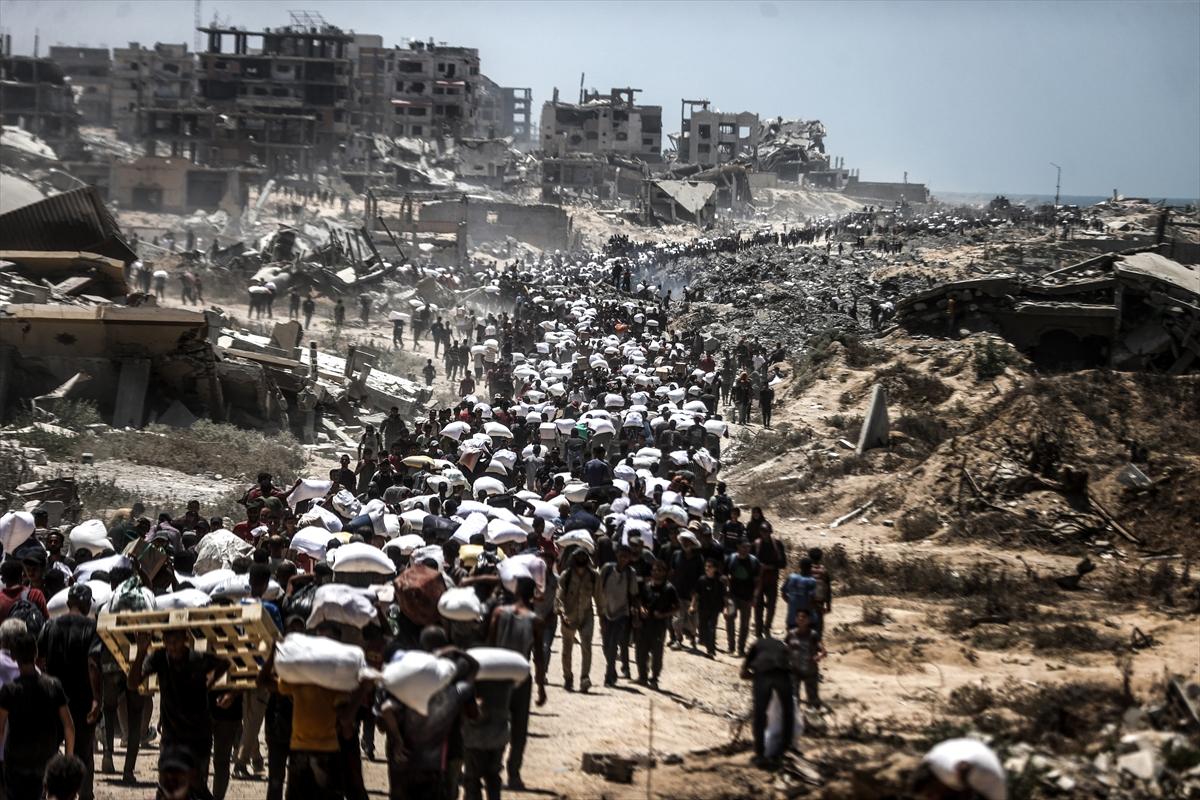
Thousands of forcibly displaced Palestinians return from the south to their northern lands 2025 – (Anadolu Ajansı)
Throughout 2025 Israel carried out numerous targeted assassination operations against military and political figures in Gaza. On 24 March 2025 Hamas political bureau member Ismail Berhum was killed in an Israeli air strike on Nasser Hospital in Han Yunus. On 15 July 2025 Hamas member of the Palestinian Legislative Council Muhammad Faraj al-Goul was killed in a targeted assassination in Gaza. On 19 July 2025 Colonel Omar Said Akl Director of the Nuseirat Police Center in central Gaza was killed in another Israeli attack. On 13 December 2025 Kassam Brigades commander Raid Saad (Abu Muaz) was killed in an Israeli air strike that violated the ceasefire.
According to the Palestinian Central Bureau of Statistics end-of-year 2025 report over 72000 Palestinians have lost their lives since 7 October 2023 in Gaza the West Bank and East Jerusalem. Ninety-eight percent of these deaths occurred in the Gaza Strip. Among those killed in Gaza were 18592 children and 12400 women. Additionally over 171000 Palestinians were injured and approximately 11000 were reported missing. Due to Israeli attacks over 100000 Palestinians were forced to flee Gaza. As a result of forced displacement and fatalities Gaza’s population declined by 10.6 percent. At the end of 2025 the Palestinian population stood at approximately 5.56 million of whom 3.43 million lived in the West Bank and 2.13 million in Gaza.
According to 2025 statistics released by the Gaza government’s Media Office direct economic losses across 15 vital sectors exceeded 33 billion U.S. dollars. Agriculture livestock and fishing sectors were nearly entirely wiped out. Approximately 178000 dunums of agricultural land representing over 80 percent of total farmland were damaged. 1000 water wells and 500 agricultural and livestock farms were destroyed.
In infrastructure terms over 700 water wells 3080 kilometers of power lines and 400 kilometers of water and sewage networks were destroyed. Throughout 2025 the Israeli military conducted attacks on Gaza using over 112000 tons of explosives. As a result 90 percent of Gaza’s infrastructure was destroyed and 55 percent of the territory was occupied by military force.
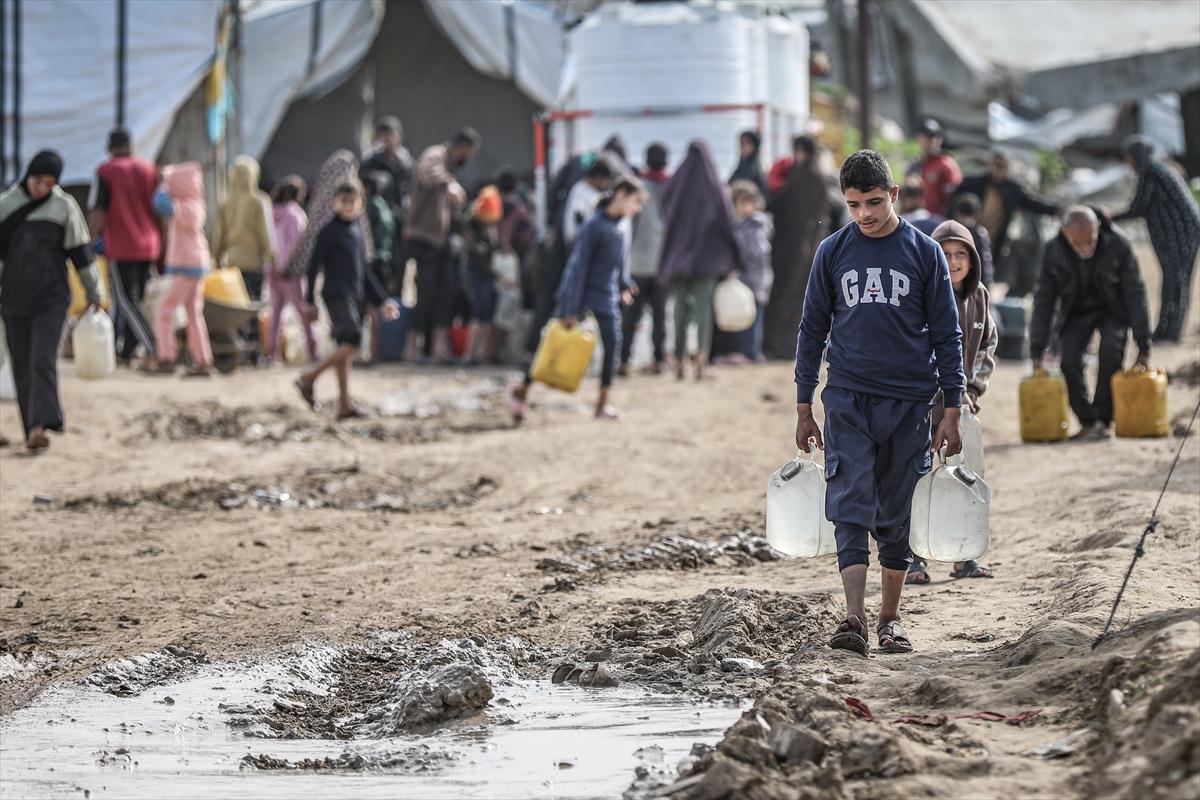
Water crisis in Gaza under Israeli attacks 1 January 2026 – (Anadolu Ajansı)
During Israeli operations in Gaza throughout 2025 106400 homes were completely destroyed 66000 homes rendered unusable and 41000 homes partially damaged. 213000 Palestinians were displaced from their homes. In total approximately 2 million people were displaced in Gaza. The Israeli military also targeted 87 shelters.
As a result of Israeli attacks 22 hospitals in Gaza have been taken out of service. 211 ambulances and 23 civil defense vehicles were targeted. The remaining hospitals have a capacity of approximately 2000 beds which is insufficient for the over 18000 injured in the region. In the attacks over 1000 students 88 teachers and 45 academics lost their lives. Ninety-five percent of educational institutions were damaged; 30 educational buildings were completely destroyed and 39 partially destroyed.
In Gaza 34 mosques were completely destroyed and 100 mosques partially damaged. Three churches were targeted multiple times. Additionally 21 of 60 cemeteries were completely obliterated in the attacks.
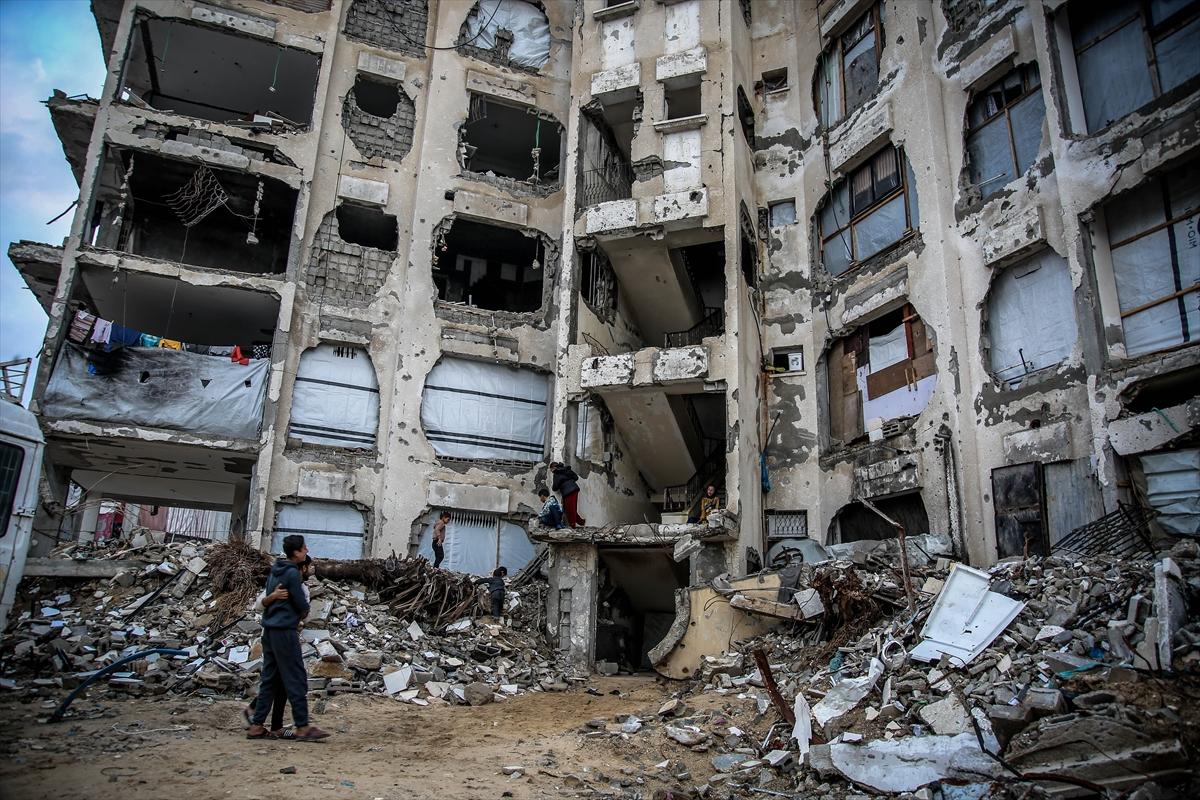
Daily life in Gaza 2 January 2026 – (Anadolu Ajansı)
The ceasefire agreement signed on 10 October 2025 under the guarantees of Turkey Egypt and Qatar remained in effect. It was announced that U.S. President Donald Trump would reveal his “Day After Gaza” plan on 15 January 2026. Initial public information about the plan focused on deploying an International Stability Force in Gaza and reorganizing the region’s administrative structure. The composition of military forces and governance model remain unclear. Uncertainty persists regarding the transition process the mechanism for implementing the ceasefire and the governance structure of Gaza.
According to a statement by the Gaza Ministry of Health on 1 January 2026 the number of Palestinians killed in Israeli attacks on the Gaza Strip since October 2023 reached 71271 and the number of injured reached 171233.
Since the ceasefire began 416 people have been killed and 1153 injured in attacks. On 1 January the Ministry reported that in the previous 24 hours two Palestinians were killed and six injured. The eastern part of Gaza City the Bureij Refugee Camp the eastern part of Rafah and the neighborhoods of Zeitoun and Shuja’iyya were subjected to artillery and aerial bombardment. Eyewitnesses reported that Israeli unmanned aerial vehicles conducted reconnaissance flights in tandem with the bombardments.
Cibaliya al-Nazla region saw the death of a child named Ahmed al-Shindaghi from Israeli gunfire. Several other civilians were reported injured. According to military sources the Israeli military continues to maintain control over areas in the north east and south of the Gaza Strip. This indicates that more than 50 percent of Gaza’s territory is effectively under occupation. Local authorities in Gaza reported that Israeli aerial attacks have focused particularly on residential areas infrastructure and main transportation routes making evacuation and humanitarian access more difficult.
On 2 January 2026 the Israeli military targeted the northern part of the Gaza Strip the Bureij Refugee Camp in the central region and the eastern areas of the city of Han Yunus with aerial and ground attacks. According to eyewitnesses Israeli artillery units conducted heavy bombardments on the Zeitoun and Shuja’iyye neighborhoods in eastern Gaza City. At the same time Israeli fighter jets carried out two aerial attacks on the eastern side of the Bureij Refugee Camp.
Han Yunus’ eastern districts were also subjected to Israeli artillery fire with explosion sounds heard across different parts of the city. No information on casualties or injuries was available because the targeted areas were under Israeli military occupation.
Gaza government officials announced that the Israeli military had violated the ceasefire agreement that entered into force on 10 October 2025 969 times. These attacks resulted in 418 Palestinians killed and numerous injuries.
On the same days an Israeli Unmanned Aerial Vehicle (UAV) targeted a tent housing displaced Palestinians in the Beit Lahiya area. The Gaza Civil Defense General Directorate reported that four people were injured three of whom were in critical condition. Other injured individuals were also reported at the site.
On 1 January 2026 Israeli authorities decided to suspend the operations of 53 international non-governmental organizations (NGOs) for failing to renew their registration. Under this decision these organizations were required to close their offices in Gaza and East Jerusalem and submit personal information of their staff to Israeli authorities for a “security investigation.”
The United Nations Spokesperson’s Office responded to this decision stating “The Secretary-General expresses deep concern over the Israeli authorities’ decision to suspend the operations of various international NGOs operating in occupied Palestinian territories.” The statement emphasized that humanitarian aid work is “indispensable” and warned that such restrictions could “undermine the fragile progress in Gaza.”
Despite the ongoing ceasefire the Israeli military carried out aerial bombardments and artillery attacks on many areas of the Gaza Strip on 7 January 2026. According to eyewitness accounts Israeli artillery targeted neighborhoods in eastern Gaza City while military vehicles simultaneously opened fire on the area. The southern Gaza city of Han Yunus and the central city of Deir al-Balah were also bombed by warplanes.
The Israeli military carried out an airstrike on the Tuffah neighborhood in eastern Gaza City. Local sources reported that two Palestinians were killed and three injured in an attack on a house. The Israeli military claimed in its statement that “Hamas-affiliated forces fired at Israeli troops stationed in the northern Gaza Strip.” The statement further asserted that in a joint operation with the Israeli internal intelligence service Shin Bet a “leading figure in Hamas was targeted and was planning attacks against Israeli soldiers.”
A person was injured by a bomb dropped from a Quadcopter-type Israeli unmanned aerial vehicle in the Tuffah neighborhood of eastern Gaza City. Health sources confirmed the injured person was taken to Baptist Hospital. Eyewitnesses stated that the bomb struck a home belonging to the Battash family and that after the attack civil defense teams intervened to extinguish the resulting fire.
It was reported that the area where the attack occurred was one of the zones from which the Israeli military was supposed to withdraw under the ceasefire agreement that entered into force on 10 October 2025. The Gaza Ministry of Health announced that as of 7 January the death toll had risen to 71391 and the number of injured to 171279. On the same day the Israeli military also demolished numerous buildings in areas under its control in eastern Gaza City.
On 8 January 2026 the Israeli military launched attacks targeting tents and schools in various areas of the Gaza Strip. According to eyewitnesses and health sources the attacks were concentrated in the Han Yunus and Cibaliya regions. In the Cibaliya Refugee Camp in northern Gaza Israeli fighter jets struck an area where displaced civilians were sheltered. Seven Palestinians including two children were killed and 11 injured. The injured were transported to local hospitals.
Han Yunus’ eastern tent areas were also hit by aerial attacks resulting in widespread destruction. Gaza Ministry of Health officials stated that civil defense teams were working to reach people trapped under rubble. On the same day 11-year-old Hamsa Nidal Husu was killed by Israeli gunfire in the city of Cibaliya. The area where the incident occurred lies within northern neighborhoods previously targeted by Israeli ground operations.
As of 8 January the Gaza Ministry of Health reported a total death toll of 71395 and 171287 injured. The ministry stated that in the previous 24 hours four people were killed and eight injured.
9 January 2026 Palestinian President Mahmoud Abbas spoke at the opening session of the 13th term of the Fatah Movement Revolutionary Council in Ramallah. In his address Abbas rejected any division of Gaza and emphasized that the Palestinian state is a single and indivisible geographical and political entity encompassing Gaza the West Bank and East Jerusalem. He stated that his priorities were ensuring a lasting ceasefire in Gaza and immediate access for humanitarian aid.
The Palestinian leader noted that the second phase of U.S. President Donald Trump’s plan must be implemented and that this phase envisages Israel’s complete withdrawal from Gaza Hamas transferring governance and the establishment of a temporary administrative committee under the Palestinian Authority. Abbas explained that this process aims for “reconstruction without forced displacement” and to “launch a political process based on the Arab Peace Initiative with international legitimacy.”
Abbas also declared that 2026 would be the “Year of Palestinian Democracy” and announced that local elections would be held in April and that elections for the Fatah Congress and the Palestinian National Council would take place later in the year. He stated that general elections would be held simultaneously in Gaza the West Bank and East Jerusalem “when suitable conditions are established.”
On the same day Jonathan Fowler Senior Communications Manager of the United Nations Relief and Works Agency for Palestine Refugees in the Near East (UNRWA) commented on Israel’s restrictions on international NGOs’ access to Gaza. Fowler said “There was great hope at the start of the ceasefire. (...) This did not happen and it is tragic shocking and unacceptable.”
Fowler stated that the situation in Gaza remains “still catastrophic” and that Israel’s new registration rules for international organizations have “complicated humanitarian operations rather than facilitated them.” Fowler emphasized “This is not Israeli territory but an occupied territory.”
Fowler also addressed the plight of children in Gaza noting that “The situation of children in Gaza continues to be horrifying in every respect.” He stated that children are the most affected group under famine-like conditions and that “Gaza is the region in the world with the highest number of children suffering limb loss.”
Fowler further noted that UNRWA’s direct operations were not affected by Israel’s new registration rules for international NGOs but added “This is part of a broader context aimed not at facilitating humanitarian operations but at making them more complex.” He stressed the importance of international NGOs on the ground stating “What Gaza needs now is not restrictions but an increase in humanitarian aid as hoped for at the start of the ceasefire.”
UNRWA officials warned that such restrictions could have “global consequences” and stated that Israel’s continued application of these measures “constitutes a critical turning point in terms of international law.”
9 January 2026 morning saw the Israeli military continuing aerial and artillery attacks targeting the northern part of Gaza City the eastern part of the Bureij Refugee Camp in the central region and the eastern areas of the city of Han Yunus. It was reported that Israeli fighter jets attacked the Tuffah neighborhood in eastern Gaza City and that unmanned aerial vehicles (UAVs) were flying intensively in the area. Two separate aerial attacks were also carried out on the eastern side of the Bureij Refugee Camp where agricultural land is located.
Han Yunus’ eastern areas were subjected to intense artillery fire in the early morning. A series of explosions were heard in the region and Israeli military vehicles were observed firing intermittently. The Gaza Ministry of Health reported that in the previous 24 hours 14 Palestinians were killed and 17 injured. Including bodies recovered from the rubble the total death toll rose to 71409 and the number of injured to 171304. Since the ceasefire began it was reported that 439 people have been killed 1223 injured and 688 bodies recovered from the rubble.
On 10 January 2026 a large demonstration was held in Stockholm Sweden protesting Israeli attacks on Gaza and U.S. military intervention in Venezuela. Hundreds gathered at Odenplan Square condemning the Israeli military’s violations of the ceasefire that began on 10 October 2025. The protest was organized at the call of numerous civil society organizations.
Demonstrators carried banners reading “Children are being killed in Gaza” “End food shortages in Palestine” “No war in Venezuela yes to peace” and “Stop American imperialism.” Participants demanded an end to Israeli attacks on Gaza and the release of Venezuelan President Nicolas Maduro and his wife Cilia Flores. Swedish activist Sigrun Meder told Anadolu Ajansı “While a so-called ceasefire exists in Gaza we see bombs falling and many people dying.” She added “While we witness this horrific genocide unfolding before our eyes in Palestine we see tents being destroyed in storms.
In her assessment of international law Meder said “We are living in a period where international law is not respected. (...) The only country ever forced to comply with international law is Russia but when it comes to the U.S. the West or Israel they do whatever they want.
In the same statement Meder declared “We are the ones who defend international law in the streets and squares. We defend democracy and human rights. We stand with Palestine and we stand with Venezuela.
During the demonstration participants called for an end to Israeli attacks in Gaza and protested U.S. policies regarding Venezuela. The event was organized with support from various human rights groups and solidarity platforms and ended peacefully in the evening.
Anadolu Ajansı. "Abbas: Gazze’nin Bölünmesini Kabul Etmiyoruz, İsrail’in Gazze’de Meşruiyeti Yok." Accessed January 13, 2026. https://www.aa.com.tr/tr/dunya/abbas-gazzenin-bolunmesini-kabul-etmiyoruz-israilin-gazzede-mesruiyeti-yok/3794275
Anadolu Ajansı. “Gazze 2025’te İsrail’in İnsanlığa Karşı İşlediği Savaş Suçlarının Sahnesi Oldu.” Accessed January 1, 2026. https://www.aa.com.tr/tr/2025-boyle-gecti/gazze-2025-te-israil-in-insanliga-karsi-isledigi-savas-suclarinin-sahnesi-oldu/3786146
Anadolu Ajansı. “Gazze’deki Filistinlileri Zorlu ve Belirsiz Bir Yıl Bekliyor.” Accessed January 1, 2026. https://www.aa.com.tr/tr/dunya/gazzedeki-filistinlileri-zorlu-ve-belirsiz-bir-yil-bekliyor-/3785703
Anadolu Ajansı. “UNRWA: İsrail’in Uluslararası STK’ların Gazze’ye Erişimini Kısıtlamasının Risklerini Vurguluyor.” Accessed January 13, 2026. https://www.aa.com.tr/tr/dunya/unrwa-israilin-uluslararasi-stklarin-gazzeye-erisimini-kisitlamasinin-risklerini-vurguluyor/3794479
Anadolu Ajansı. “İsrail 2025’te Bölgeyi İstikrarsızlaştıran Çok Sayıda Suikast Düzenledi.” Accessed January 1, 2026. https://www.aa.com.tr/tr/dunya/israil-2025te-bolgeyi-istikrarsizlastiran-cok-sayida-suikast-duzenledi/3785767
Anadolu Ajansı. “İsrail 2025’te Filistin ve Bölge Ülkelerinde Neden Olduğu Ölüm ve Yıkımlarla Övünüyor.” Accessed January 1, 2026. https://www.aa.com.tr/tr/dunya/israil-2025te-filistin-ve-bolge-ulkelerinde-neden-oldugu-olum-ve-yikimlarla-ovunuyor/3786442
Anadolu Ajansı. “İsrail Ateskese Rağmen Gazze’de Saldırılar Sürdürüyor.” Accessed January 13, 2026. https://www.aa.com.tr/tr/dunya/israil-ateskese-ragmen-gazzede-saldirilarini-surduruyor/3792031
Anadolu Ajansı. “İsrail Gaza’da Hava ve Topçu Saldırılarını Sürdürüyor.” Accessed January 13, 2026. https://www.aa.com.tr/tr/dunya/israil-gazze-seridine-hava-ve-topcu-saldirilarini-surdurdu/3794430
Anadolu Ajansı. “İsrail Gazze’de İşgal Ettiği Bölgelere Saldırılarını Sürdürüyor.” Accessed January 13, 2026. https://www.aa.com.tr/tr/dunya/israil-gazze-de-isgal-ettigi-bolgelere-saldirilarini-surduruyor/3787476
Anadolu Ajansı. “İsrail’in Gazze Ordusunun Çadırları ve Okulları Hedef Aldığı Saldırıda 7 Filistinli Hayatını Kaybetti.” Accessed January 13, 2026. https://www.aa.com.tr/tr/dunya/israil-ordusunun-gazzede-cadirlari-ve-okullari-hedef-aldigi-saldirida-7-filistinli-hayatini-kaybetti/3793106
Anadolu Ajansı. “İsrail’in Gazze’de 2025’te Hayati Sektörlere Verdiği Doğrudan Zarar 33 Milyar Doları Aştı.” Accessed January 1, 2026. https://www.aa.com.tr/tr/dunya/israilin-gazzede-2025te-hayati-sektorlere-verdigi-dogrudan-zarar-33-milyar-dolari-asti/3786317
Anadolu Ajansı. “İsrail’in Uyguladığı Soykırım Nedeniyle Gazze’nin Nüfusu Yüzde 10’dan Fazla Azaldı.” Accessed January 1, 2026. https://www.aa.com.tr/tr/dunya/israilin-uyguladigi-soykirim-nedeniyle-gazzenin-nufusu-yuzde-10dan-fazla-azaldi/3786153
Anadolu Ajansı. “İsrail’in, Gazze’ye Saldırılarında Can Kaybı 71 Bin 271’e Yükseldi.” Accessed January 13, 2026. https://www.aa.com.tr/tr/dunya/israilin-gazzeye-saldirilarinda-can-kaybi-71-bin-271-e-yukseldi/3786760
Anadolu Ajansı. “İsveç’te ABD’nin Venezuela’ya Askerî Müdahalesi ve İsrail’in Gazze’ye Saldırıları Protesto Edildi.” Accessed January 13, 2026. https://www.aa.com.tr/tr/dunya/isvec-te-abd-nin-venezuela-ya-askeri-mudahalesi-ve-israil-in-gazzeye-saldirilari-protesto-edildi/3795838
On 11 January 2026, the Israeli military launched simultaneous air, land and sea attacks on various areas of the Gaza Strip. According to the Palestinian official agency WAFA, the neighborhoods of Tuffah and Zeytun in eastern Gaza City were targeted by artillery fire. On the same day, Israeli warplanes bombed areas east of the Bureyc Refugee Camp in central Gaza, and carried out air strikes in the southern town of Refah and the northern areas of Jabalia and Beit Lahiya. Additionally, Israeli naval vessels fired numerous artillery shells at the northern coastline of Gaza.
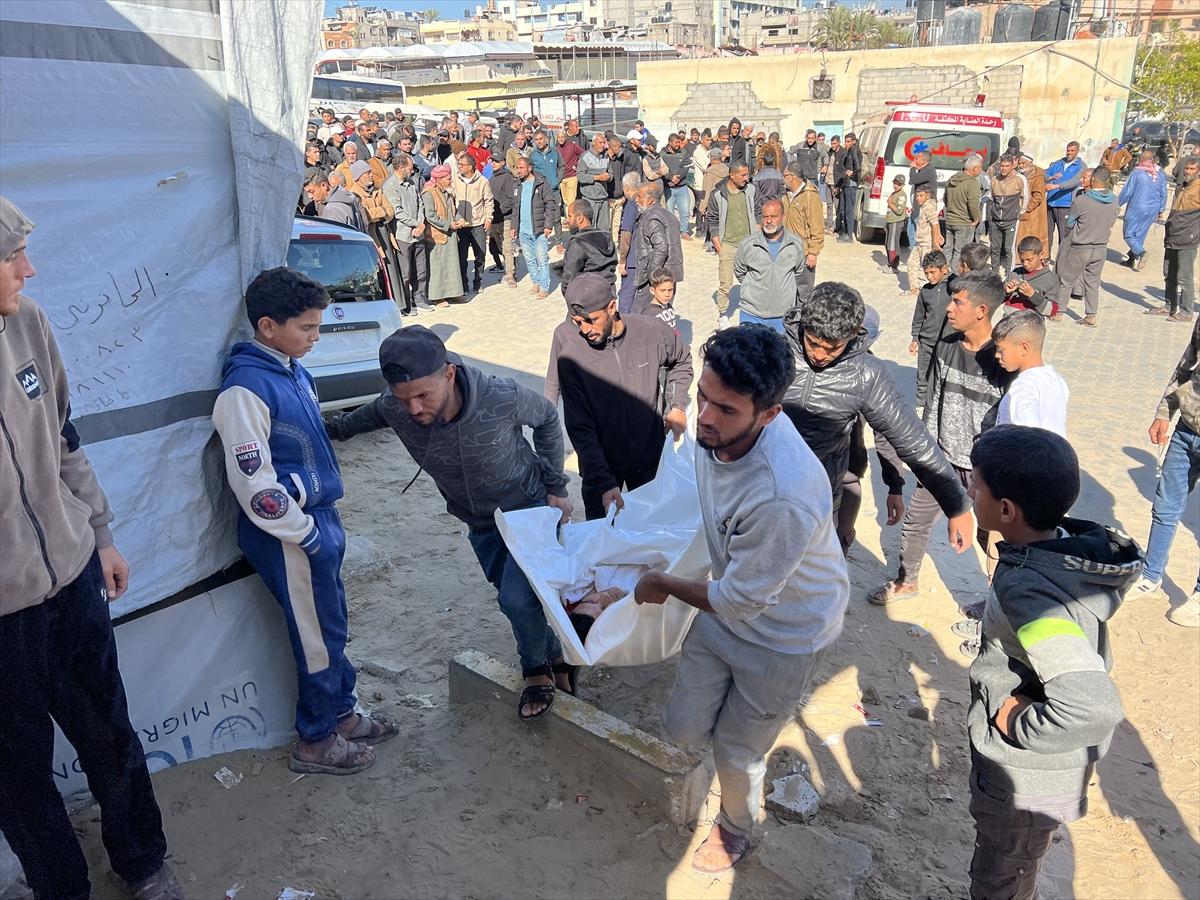
Israel continues its attacks on Gaza despite the ceasefire, 11 January 2026 - (Anadolu Ajansı)
In these attacks across different parts of the Gaza Strip, four Palestinians were killed and many others were injured. According to health sources, in the southern Gaza area of Beni Suheyla, Muhammad and Enes Abu Asi were killed in an Israeli drone strike. In the eastern Tuffah neighborhood of Gaza City, 31-year-old Muhammad Majid al-Jabari was shot in the chest and killed by Israeli soldiers. In an attack on the Megazi Refugee Camp, Palestinian Muhammad al-Harazin was killed and four others were injured.
Despite the ceasefire that came into effect on 10 October 2025 in Gaza, Israeli military operations have continued. Between October 2025 and 11 January 2026, 439 Palestinians were killed and 1,223 were injured.
With the onset of winter in Gaza, extreme cold conditions have intensified. The Government Media Office reported that since the beginning of the genocide in Gaza, 21 people have died due to cold, 18 of whom were children. The same statement warned that due to the ongoing fuel shortage in the Gaza Strip, lack of shelter materials and restrictions on humanitarian aid, the risk of death is rising. The government also warned that upcoming cold weather fronts could “increase mortality, especially among children, the elderly and the sick”.
On 12 January 2026, the Israeli military launched new attacks targeting the southern areas of Khan Yunis and Refah and regions in central Gaza. According to local sources, the eastern part of Khan Yunis and the southern part of the Mevasi area west of Refah were hit by artillery fire. On the same day, the Tuffah neighborhood in eastern Gaza City was bombed by warplanes. Israeli military vehicles opened fire toward the east of the Megazi Refugee Camp, while artillery units targeted eastern Gaza City.
In attacks by the Israeli military that violated the ceasefire, three Palestinians were killed and one woman was injured. According to hospital sources, the Beled area in central Khan Yunis was targeted by a “Quadcopter” type drone; the bodies of those killed were taken to Nasser Hospital. Additionally, it was reported that a woman was injured in the Batn Semin area of Khan Yunis after Israeli soldiers opened fire. The Gaza Strip’s Ministry of Health announced that in the past 24 hours, the bodies of seven Palestinians had been recovered, five of whom were pulled from under rubble, and four injured persons had been transported to hospitals.
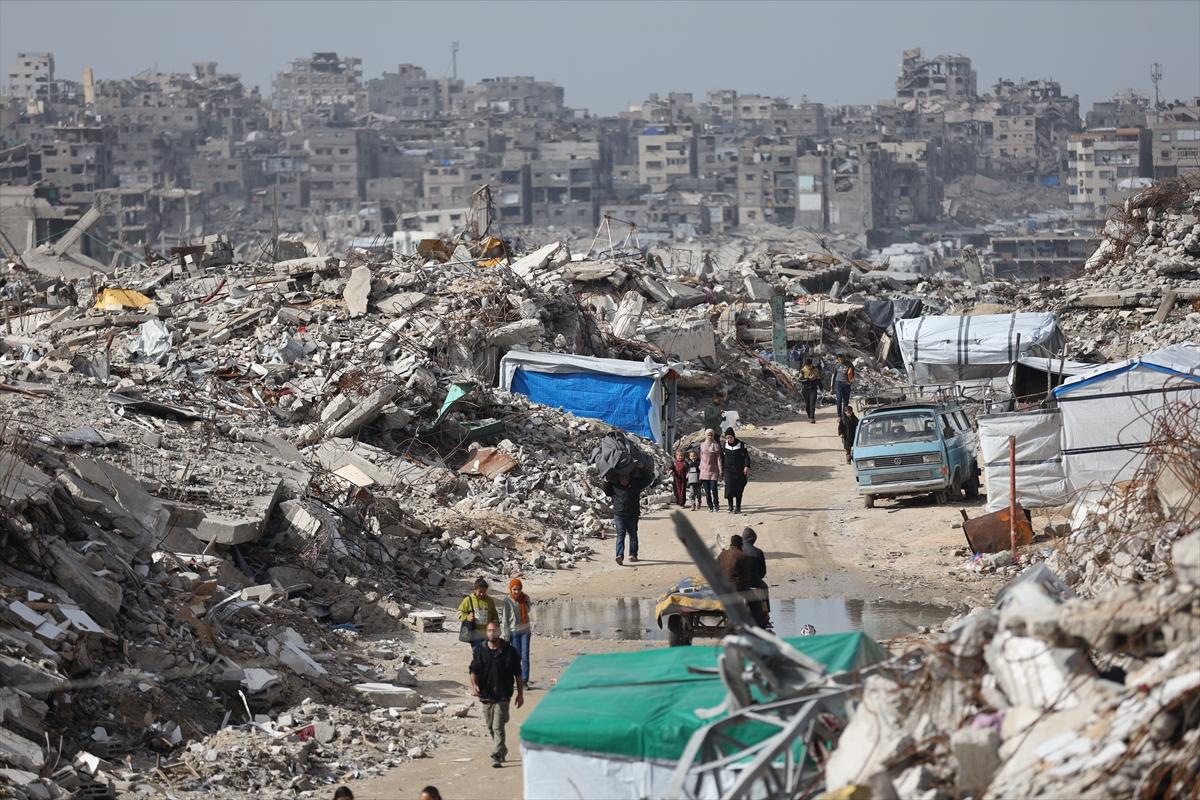
Daily life in Jabalia, destroyed by Israel, 12 January 2026 - (Anadolu Ajansı)
Since the ceasefire entered into force on 10 October 2025, as of 12 January 2026, 442 Palestinians have been killed and 1,236 injured.
UN Office for the Coordination of Humanitarian Affairs (OCHA) spokesperson Stephane Dujarric reported during his daily press briefing that severe weather conditions are endangering humanitarian aid efforts. Dujarric stated, “Harsh weather conditions are jeopardizing progress in meeting the massive shelter needs”.
Dujarric also noted that 1,600 tents and 27,000 blankets have been distributed to 28,000 families, yet 1.1 million people still require urgent assistance. UN humanitarian partners reported that in December, more than 76,000 children were screened for health, and 4,900 cases of acute malnutrition were identified, 820 of them severe. A total of 95,000 cases of acute malnutrition were recorded throughout 2025.
According to UN data, 440 temporary learning spaces have been established to serve approximately 268,000 children in Gaza. However, Israeli authorities have continued to block the entry of educational materials into the area, claiming they were not considered critical activities during the first phase of the ceasefire.
As of 13 January 2026, a polar storm has affected the Gaza Strip. Heavy rain and strong winds have caused fatalities and destroyed tents in areas inhabited by displaced Palestinians. The Government Media Office in Gaza reported that since the onset of winter until 13 January, the number of people who died from cold has risen to seven, and since October 2023, the total has reached 24, 21 of whom were children.
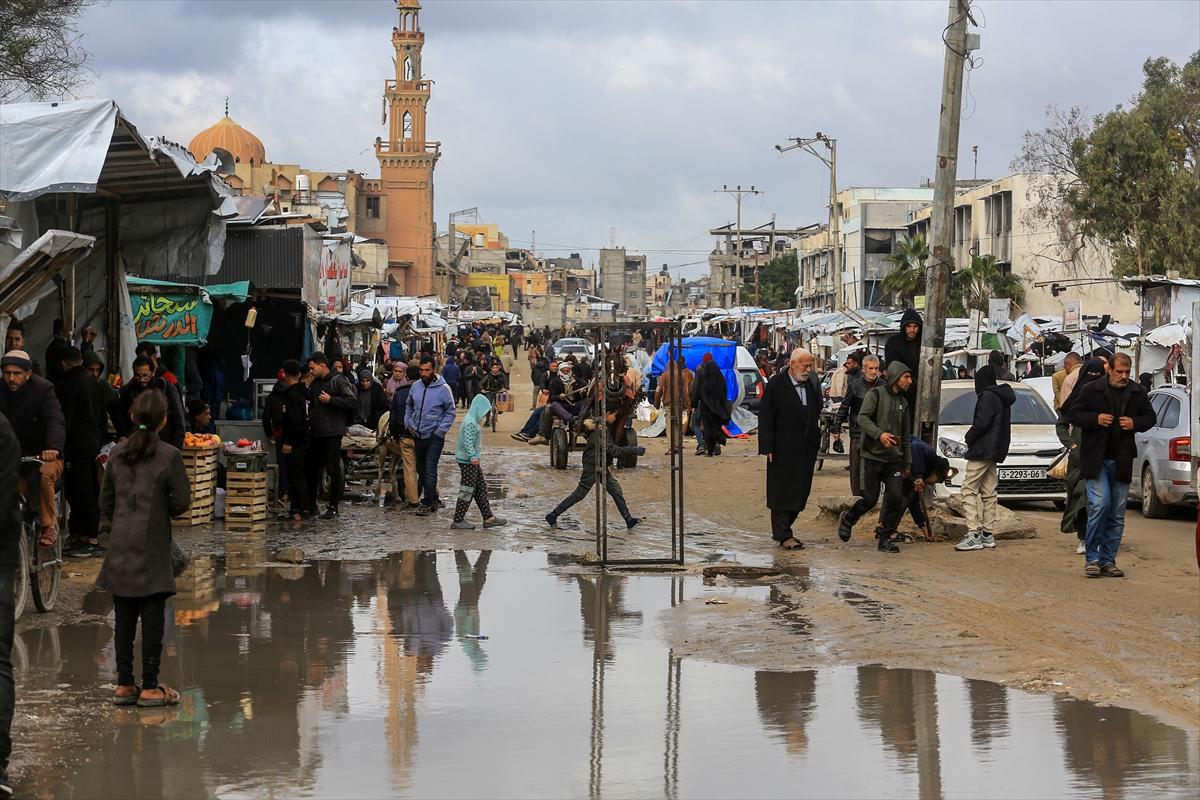
Severe rainfall and storms in Gaza are negatively affecting Palestinians living in tents, 13 January 2026 - (Anadolu Ajansı)
The Gaza Civil Defense Administration reported that four Palestinians were killed due to partially collapsed buildings caused by heavy rain and wind. Health sources confirmed that an elderly Palestinian man living in a tent in Gaza City died after being buried under debris from a fallen mosque minaret.
Gaza City spokesperson Husni Muhenna stated, “Strong winds and heavy rainfall have blown away and submerged thousands of tents housing displaced families who lost their homes, especially in western areas and low-lying regions.” Muhenna further noted that due to the extensive destruction of infrastructure, water and sewage networks and roads, every storm has turned into a secondary humanitarian crisis.
On 14 January 2026, the Israeli military launched new air and artillery strikes against central and southern areas of the Gaza Strip. The Israeli military targeted areas in the southwest of Refah with air strikes and eastern areas with artillery fire.
Local sources reported that Israeli helicopters opened machine gun fire on northern Refah. On the same day, the northeast sections of the Bureyc Refugee Camp were also hit by artillery fire.
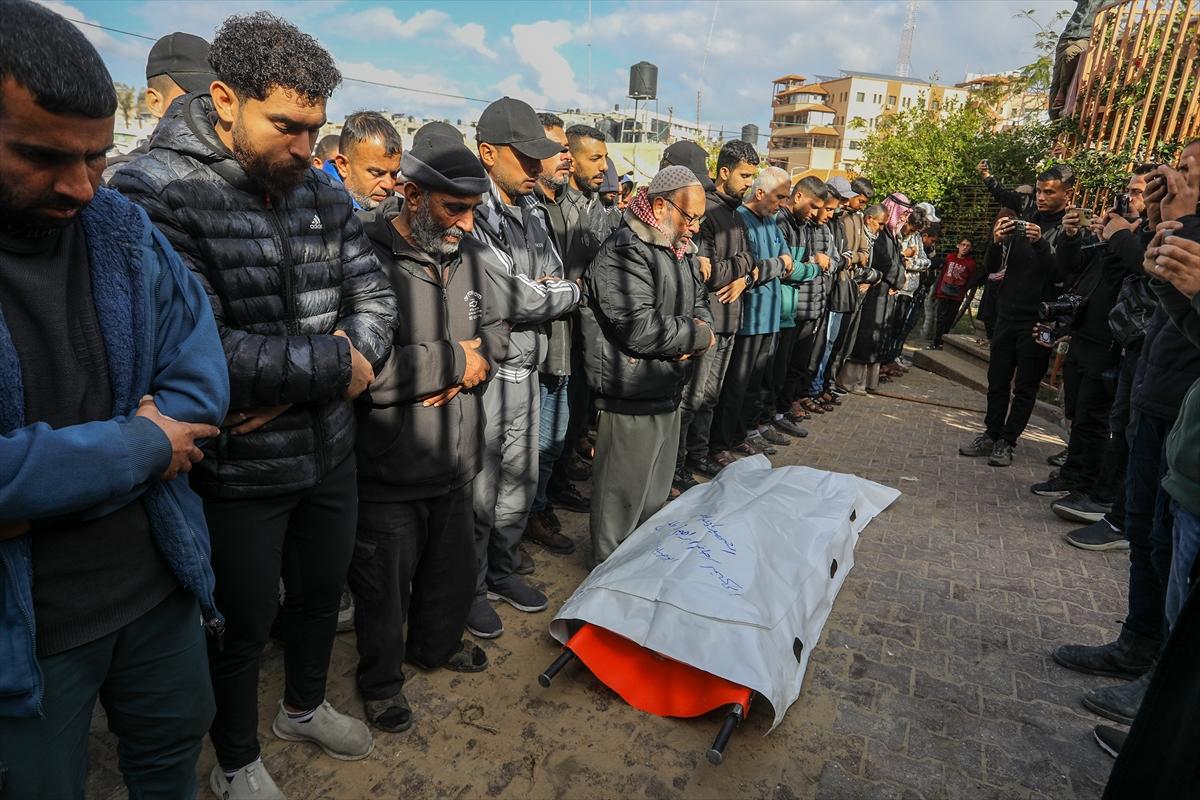
The body of Palestinian health worker Hatem Abu Salih, killed in an Israeli drone strike in Khan Yunis, southern Gaza Strip, 14 January 2026 - (Anadolu Ajansı)
Following these attacks that violated the ceasefire agreement that came into force on 10 October 2025, the Israeli military reported that “two Palestinians were killed and two Israeli soldiers wounded in clashes in Refah.” In an Israeli drone strike conducted in the southern Gaza city of Khan Yunis, Palestinian health worker Hatem Abu Salih was killed. According to health sources, the attack occurred in the Beni Suheyla area, and Abu Salih’s body was taken to the Nasser Medical Center in Khan Yunis.
On the same day, intense air and artillery strikes were carried out against Refah, with machine gun fire from helicopters targeting the northern part of the city.
As of 14 January 2026, a total of 71,424 Palestinians have been killed and 171,324 injured in the Gaza Strip. Approximately 90 percent of civilian infrastructure has been destroyed, and around 70 million tons of rubble have accumulated.
Anadolu Ajansı. “Gazze Şeridi’nde Bugüne Kadar 21’i Çocuk 24 Filistinli Soğuk Nedeniyle Hayatını Kaybetti.” Accessed January 14, 2026. https://www.aa.com.tr/tr/dunya/gazze-seridinde-bugune-kadar-21i-cocuk-24-filistinli-soguk-nedeniyle-hayatini-kaybetti/3797704
Anadolu Ajansı. “Gazze’de Yağış ve Fırtına İsrail Saldırılarının Neden Olduğu Felaketi Derinleştiriyor.” Accessed January 14, 2026. https://www.aa.com.tr/tr/dunya/gazze-de-yagis-ve-firtina-israil-saldirilarinin-neden-oldugu-felaketi-derinlestiriyor/3798271
Anadolu Ajansı. “İsrail Ateşkese Rağmen Gazze’de Hava ve Topçu Saldırıları Düzenledi.” Accessed January 14, 2026. https://www.aa.com.tr/tr/dunya/israil-ateskese-ragmen-gazzede-hava-ve-topcu-saldirilari-duzenledi/3798736
Anadolu Ajansı. “İsrail Ateşkese Rağmen Gazze’de Topçu ve Hava Saldırılarını Sürdürdü.” Accessed January 14, 2026. https://www.aa.com.tr/tr/dunya/israil-ateskese-ragmen-gazze-de-topcu-ve-hava-saldirilarini-surdurdu/3796795
Anadolu Ajansı. “İsrail Ordusu Gazze’nin Çeşitli Bölgelerine Hava ve Kara Saldırılarını Sürdürüyor.” Accessed January 14, 2026. https://www.aa.com.tr/tr/dunya/israil-ordusu-gazzenin-cesitli-bolgelerine-hava-ve-kara-saldirilarini-surduruyor/3796209
The Guardian. “Gaza Storms Kill Palestinians in Makeshift Camps.” The Guardian. Accessed January 14, 2026. https://www.theguardian.com/world/2026/jan/14/gaza-storms-kill-palestinians-makeshift-camps
UNICEF. “During Gaza’s Ceasefire, Children Keep Being Killed.” UNICEF Press Release. Accessed January 14, 2026. https://www.unicef.org/press-releases/during-gazas-ceasefire-children-keep-being-killed
The ceasefire process in Gaza entered its second phase as of 15 January 2026. This development was announced in a press briefing conducted by U.S. President Donald Trump’s administration via teleconference.
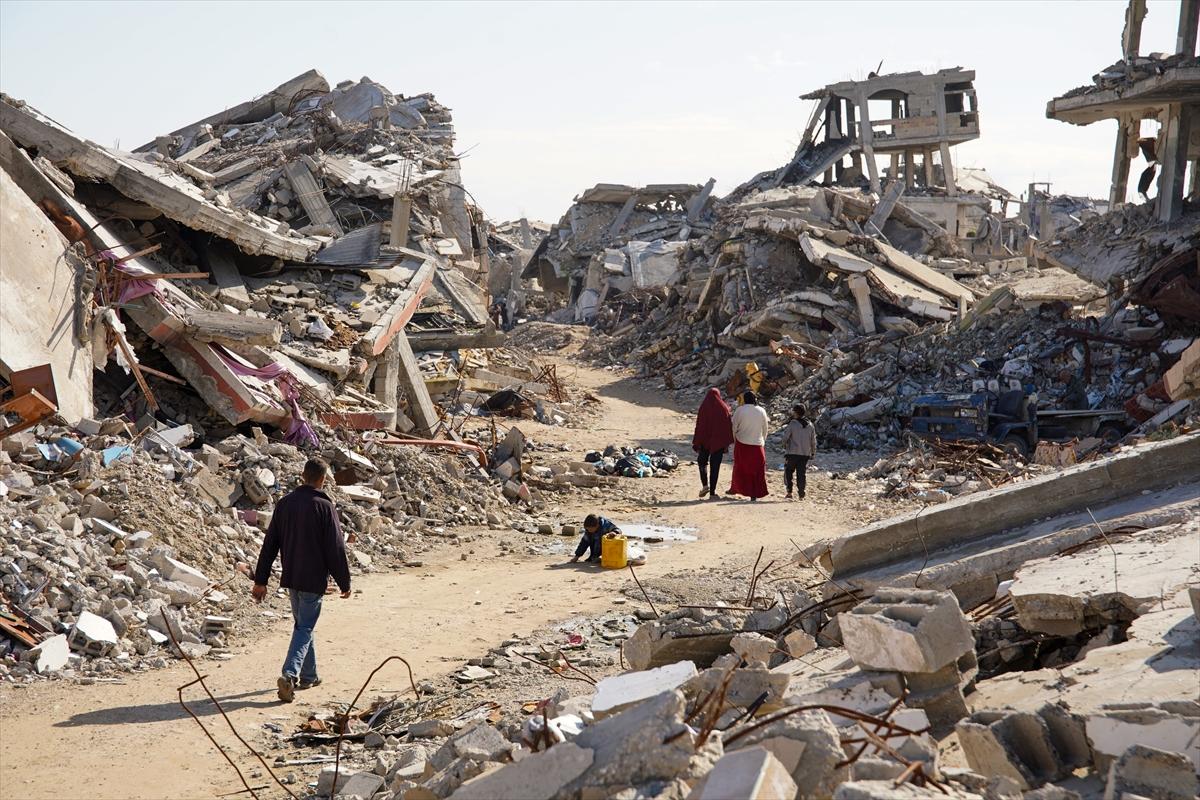
Daily life in the Jabaliya Refugee Camp, destroyed by Israel, 20 January 2026 – (Anadolu Agency)
A U.S. official described Türkiye’s role in facilitating the process as follows: “President (Recep Tayyip) Erdoğan, Foreign Minister (Hakan) Fidan, and Intelligence Director (Head of the National Intelligence Organization) Ibrahim Kalın were deeply involved in this process and did an incredible job alongside us. We believe their participation was crucial.” The same official also stated: “President Trump is very grateful on this matter.”
In the statement from the Trump administration, in addition to acknowledging Türkiye’s contribution to the Gaza ceasefire plan, it was emphasized that the process of rebuilding relations between Türkiye and Israel was being supported.
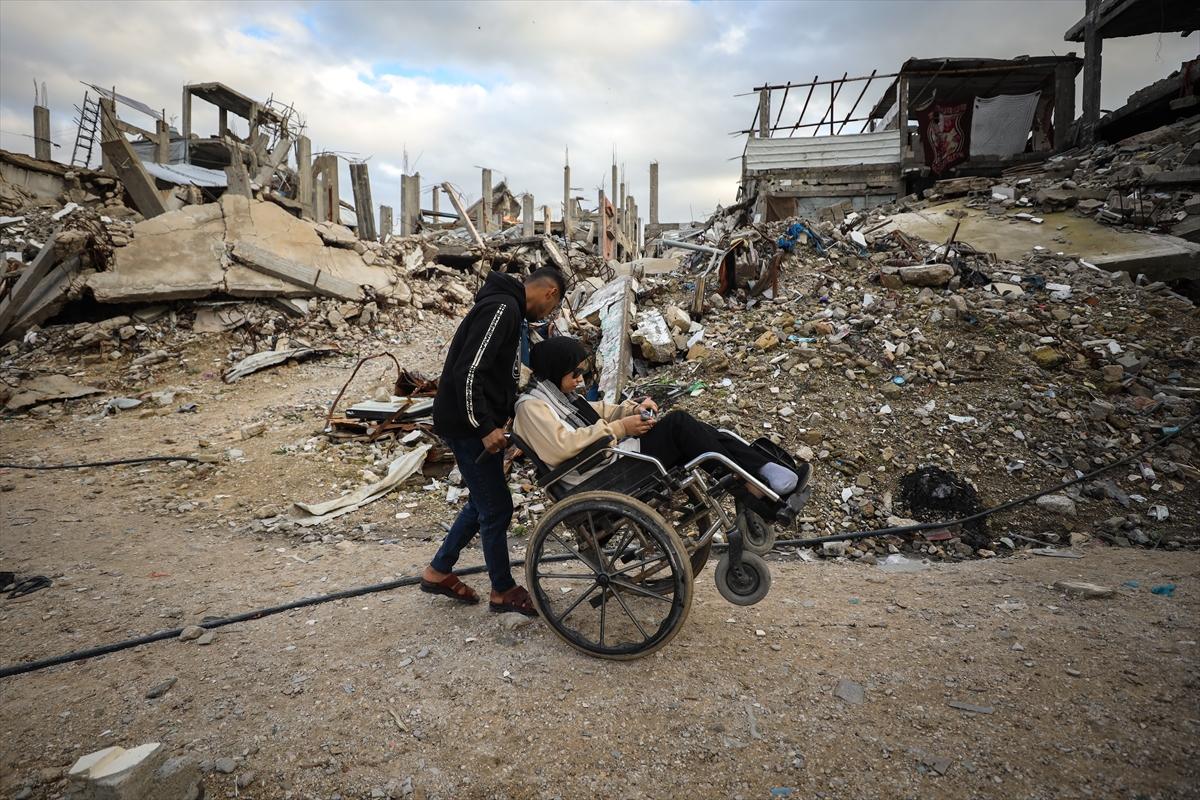
Farah, who lost her parents and one leg in an Israeli attack, 20 January 2026 – (Anadolu Agency)
Steve Witkoff, U.S. President Donald Trump’s Special Representative for the Middle East, announced in a written statement on the same day that the process had moved into its second phase and defined this phase as follows: “Today, on behalf of President Trump, we announce the initiation of the second phase of the President’s 20-point plan to end the conflict in Gaza. This phase includes disarmament, technocratic governance, and reconstruction following the ceasefire.”
Witkoff’s statement indicated that the second phase includes the establishment of a Gaza Administration National Committee (GANC) as a temporary technocratic Palestinian administration in Gaza, the complete disarmament of Gaza, and the region’s reconstruction.
Following these announcements, the Palestinian government in Gaza released data regarding the first phase of the ceasefire. According to the report issued by the Gaza Government Media Office, Israel committed 1,244 violations during the first phase of the ceasefire between 10 October 2025 and 15 January 2026, resulting in 449 Palestinian deaths, 1,246 injuries, and 50 detentions.
The report further stated that humanitarian aid deliveries were obstructed during the ceasefire process, with only 24,611 of the 57,000 trucks stipulated in the agreement reaching Gaza. While a daily average of 600 trucks was required, the number was limited to 259 trucks, meaning that compliance with the ceasefire reached only 43 percent.
Regarding fuel deliveries, only 601 trucks entered Gaza instead of the planned 4,750 trucks, representing a compliance rate of only 12 percent. As a result, most hospitals, bakeries, and water purification centers in Gaza were rendered non-operational, according to the report.
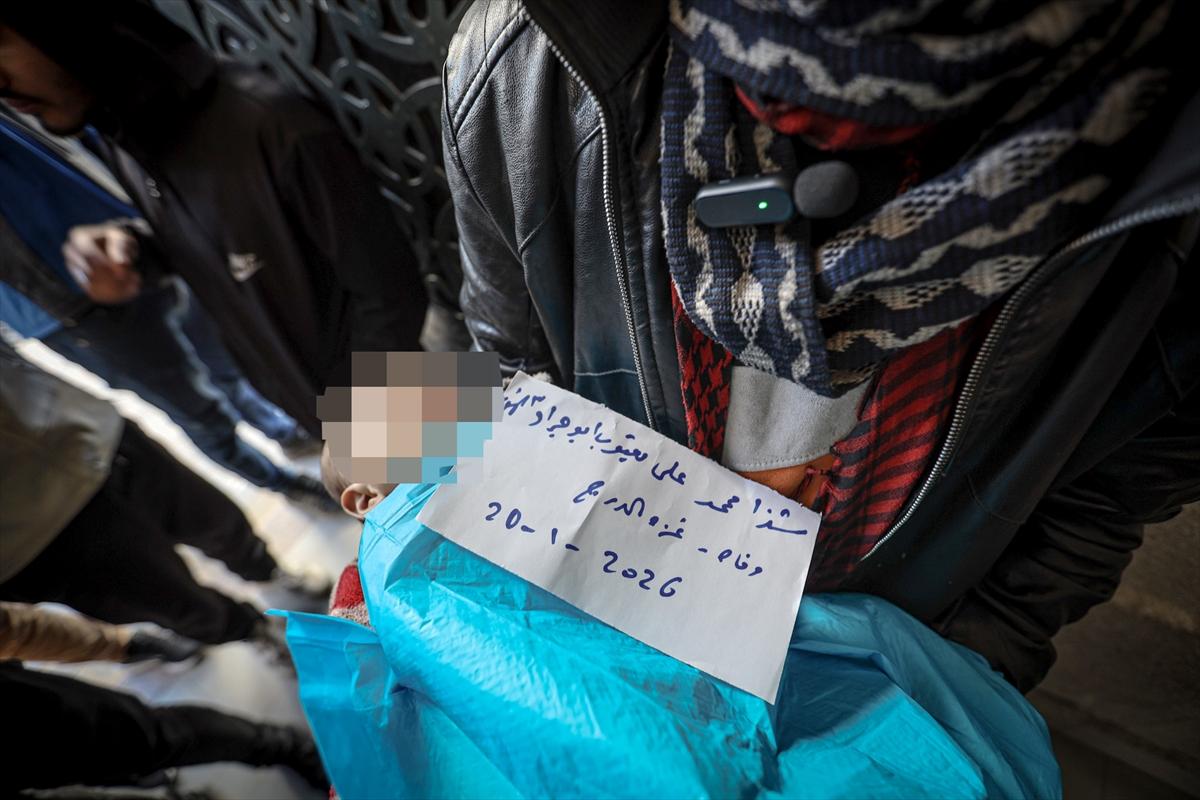
A baby who died due to cold weather conditions in Gaza, 20 January 2026 – (Anadolu Agency)
As winter conditions worsened, it was reported that numerous tents collapsed due to cold weather, more than 127,000 shelters became unusable, and over 1.5 million displaced people were left without minimum shelter conditions.
The details of the local and international governance structure established under the Gaza peace plan were finalized on 17 January 2026. According to diplomatic sources, the configuration process is proceeding on the basis of United Nations Security Council Resolution 2803, dated 17 November 2025. This resolution endorsed the “Comprehensive Plan to End the Gaza Conflict”, announced by U.S. President Donald Trump on 29 September 2025.
The new governance model has three main organs: Board of Peace, Executive Board of the Board of Peace, and Gaza Administration Council.
The Board of Peace is defined as the highest political body established for Gaza. U.S. President Donald Trump serves as its chair. President Recep Tayyip Erdoğan has been invited as a founding member responsible for Gaza’s reconstruction and security. Burhanettin Duran, Head of the Presidency Communications Directorate, stated on his social media account: “The United Nations Security Council, through Resolution 2803, has decided to endorse the Comprehensive Plan to End the Gaza Conflict announced by U.S. President Donald Trump. In this framework, the Board of Peace has been established to restore security in Gaza.”
The members of the Executive Board, tasked with formulating the strategic vision of the Board of Peace, have been disclosed. The board includes U.S. Secretary of State Marco Rubio, President Trump’s Special Representative for the Middle East Steve Witkoff, former Trump advisor Jared Kushner, former British Prime Minister Tony Blair, businessman Marc Rowan, World Bank Group President Ajay Banga, and U.S. National Security Advisor Robert Gabriel.
The chair of the Gaza Administration National Committee (National Committee for the Administration of Gaza – GANC) has been appointed as Dr. Ali Shaas, former Deputy Minister of Transport of Palestine. The committee consists entirely of 15 Palestinian technocrats from Gaza. The structure will operate with the support of Türkiye, the United States, Qatar, and Egypt, alongside the Palestine Liberation Organization (PLO), the Palestinian Authority, and other Palestinian political entities.
The High Representation Office, established to coordinate the transition process in Gaza, has been headed by former UN Special Coordinator for the Middle East Peace Process Nikolay Mladenov. Mladenov is also a member of the Executive Board of the Board of Peace. The command of the International Stability Force, deployed to ensure security in Gaza, has been assumed by U.S. Major General Jasper Jeffers.
The Gaza Administration Council is responsible for monitoring activities between the High Representation Office and the Gaza Administration National Committee. Its members include Steve Witkoff, Jared Kushner, Foreign Minister Hakan Fidan, Qatari diplomat Ali Al-Thawadi, Egyptian General Hassan Rashad, Tony Blair, Marc Rowan, UAE Minister of State Reem Al-Hashimy, Nikolay Mladenov, Yakir Gabay, and UN Special Coordinator for the Middle East Peace Process Sigrid Kaag.
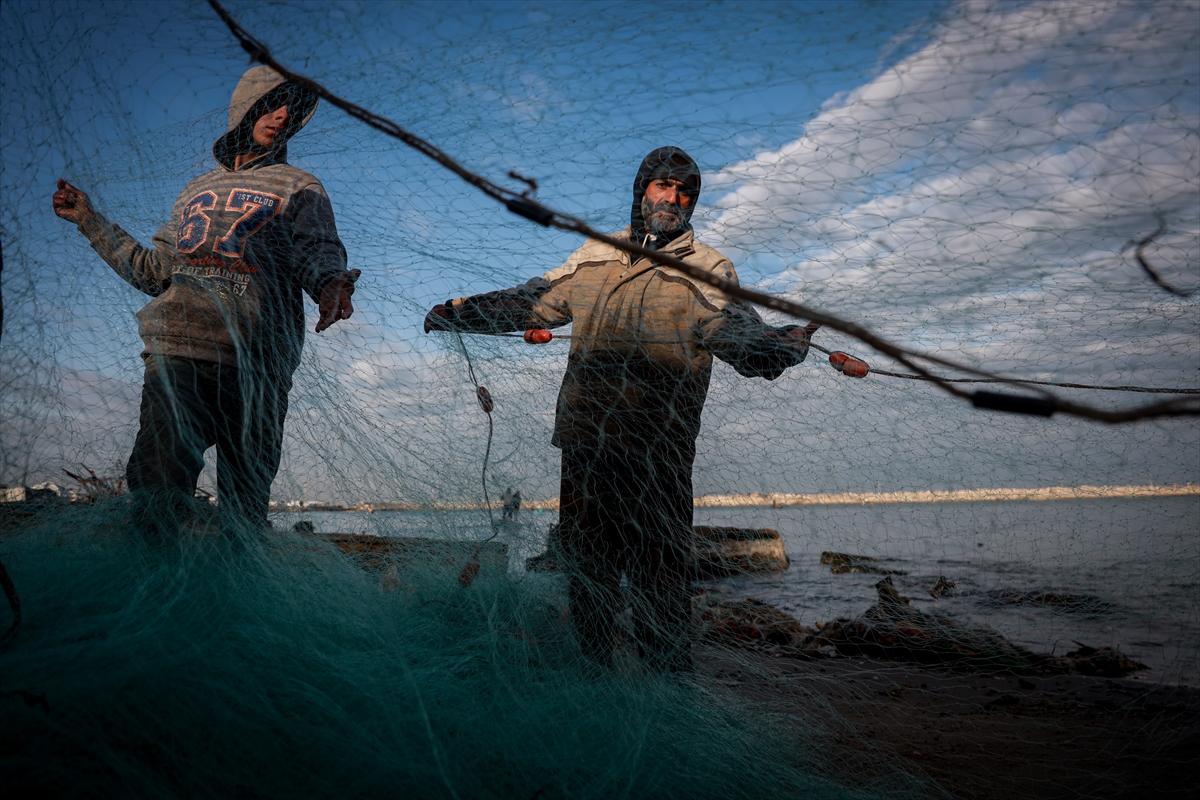
Fishermen fishing under difficult conditions in Gaza, 20 January 2026 – (Anadolu Agency)
On 17 January 2026, the Israeli military launched air and ground attacks on various areas of the Gaza Strip. According to local sources, the Tuffah neighborhood in eastern Gaza City, the Jabaliya Refugee Camp in northern Gaza, and the city of Deir al-Balah in the central region were targeted by Israeli warplanes. Additionally, helicopter and ground fire was directed at the eastern part of Khan Yunis and the northern part of Rafah.
According to ministry data, between October 2023 and 17 January 2026, 71,548 Palestinians were killed and 171,353 were injured in these attacks. It was also announced that 92 newly confirmed deaths have been added to the total by the government-affiliated Martyr Accreditation Committee.
A 27-day-old baby living in Khan Yunis in southern Gaza died due to extreme cold. Health sources reported that with this death, the number of children killed by the cold since the start of winter has risen to eight.
Israeli Defense Minister Yisrael Katz, in a post on the U.S.-based X platform, referenced satellite images from The New York Times showing over 2,500 buildings destroyed in Gaza despite the ceasefire, and stated: “I congratulate Israeli soldiers for their operations.” Katz added in his statement: “Israel will continue to ensure its security against all immediate and distant threats.”
Hamas spokesperson Hazem Qassem, in a written statement, described Katz’s boasting about the destruction in Gaza as “an unprecedented level of audacity against international law and humanitarian norms.” Qassem stated: “What is happening in Gaza is a genocide war and ethnic cleansing.”
On 19 January 2026, the Israeli military launched further air and artillery attacks on various areas of the Gaza Strip. According to local sources, parts of eastern Khan Yunis, the city of Deir al-Balah, and the Tuffah neighborhood in eastern Gaza City were targeted by artillery fire. Additionally, indiscriminate firing occurred in the Jabaliya area.
Health sources reported that three Palestinians were killed in the attacks on this date. In the Mevasi area of Rafah, a child named Hussein Ziya Abu Armana died; in Khan Yunis, 17-year-old Hussein Tawfiq Abu Sible was killed by a drone strike; and in the Sheikh Nasir region, 20-year-old Shahir Adem Abu Hadid lost his life.
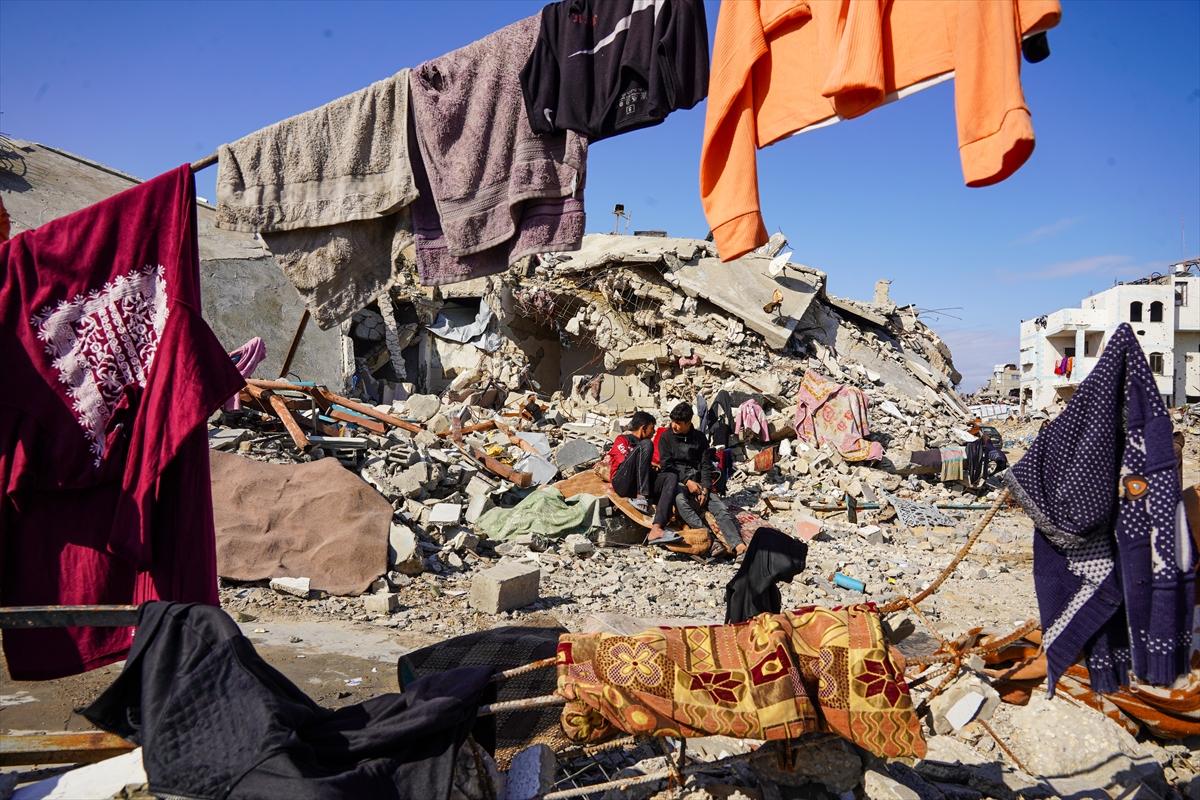
Daily life in the Jabaliya Refugee Camp, destroyed by Israel, 20 January 2026 – (Anadolu Agency)
On 19 January, 7-month-old Sheza Abu Jarrad, a resident of Gaza City, died due to extreme cold. With this death, the number of children who have died from the cold during the winter months has risen to nine
According to data released by the Gaza Ministry of Health on 20 January 2026, the number of Palestinians killed in attacks since October 2023 has risen to 71,551, and the number of injured to 171,372. The ministry also reported that 466 people were killed and 1,294 injured since the ceasefire came into effect on 10 October 2025. It was further stated that thousands of bodies remain buried under rubble in the Gaza Strip.
On 21 January 2026, the Israeli military targeted Gaza City in northern Gaza and Deir al-Balah in the central region with aerial attacks, despite the ceasefire that came into effect on 10 October 2025. It also destroyed remaining buildings and facilities in the northern city of Sheikh Zayid. Explosions were felt in Gaza City and northern areas. Israeli naval vessels fired machine guns toward the shoreline of Gaza City, and eastern districts of the city were targeted both from air and ground. In southern Khan Yunis, eastern areas were struck by intense fire from military vehicles.
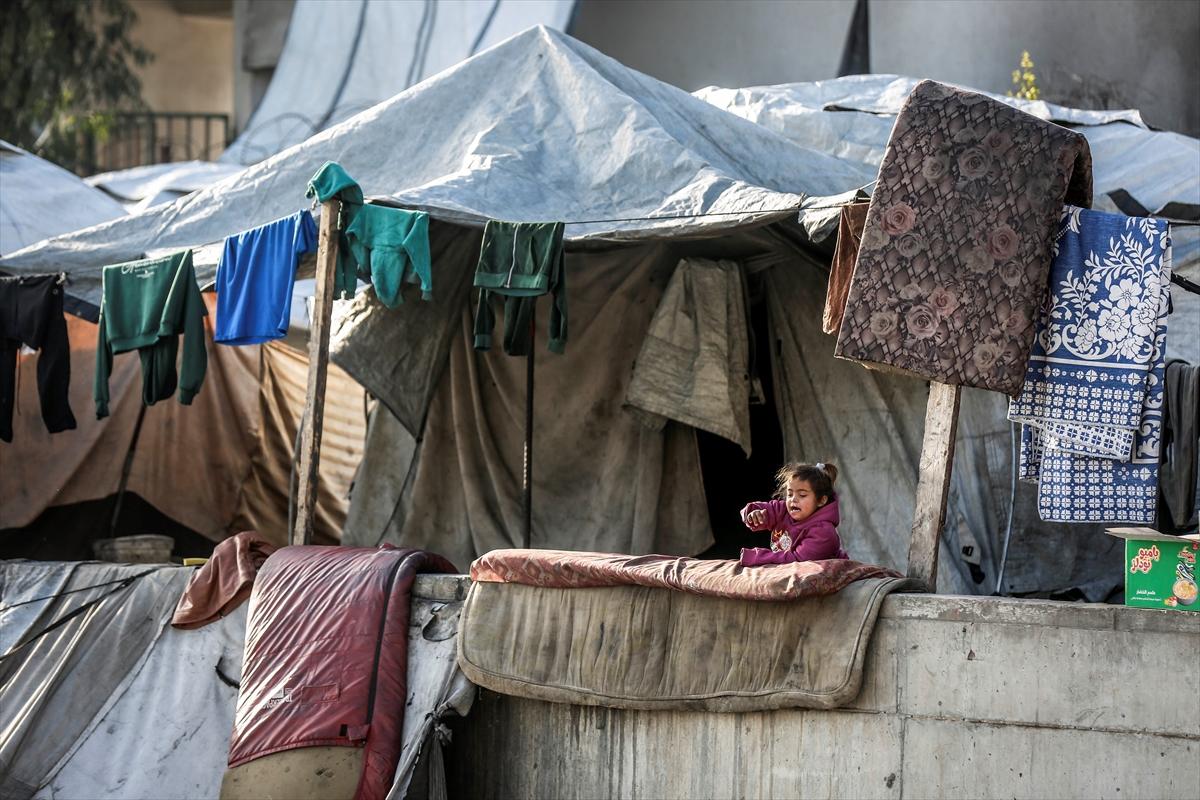
Daily life in the Shu’aiyya neighborhood of Gaza, 20 January 2026 – (Anadolu Agency)
According to hospital sources, on the same day, the city of Deir al-Balah in central Gaza was targeted by artillery fire, resulting in the deaths of three Palestinians, including one child. Three Palestinians were killed in a bombardment targeting the southern part of Gaza City. Munir al-Bursh, Director General of the Gaza Strip Ministry of Health, stated that “the three Palestinians killed in the bombardment of southern Gaza City were journalists”. It was announced that the total number of journalists killed had reached 260 with these deaths.
In a statement on 22 January, the Gaza Ministry of Health reported that 11 Palestinians were killed and 7 injured in the last 48 hours. The statement noted that “since the ceasefire came into effect, 477 people have been killed and 1,301 injured in Israeli attacks.” It further recorded that “the number of Palestinians killed since the Israeli offensive began in October 2023 has risen to 71,562, and the number of injured to 171,379.”
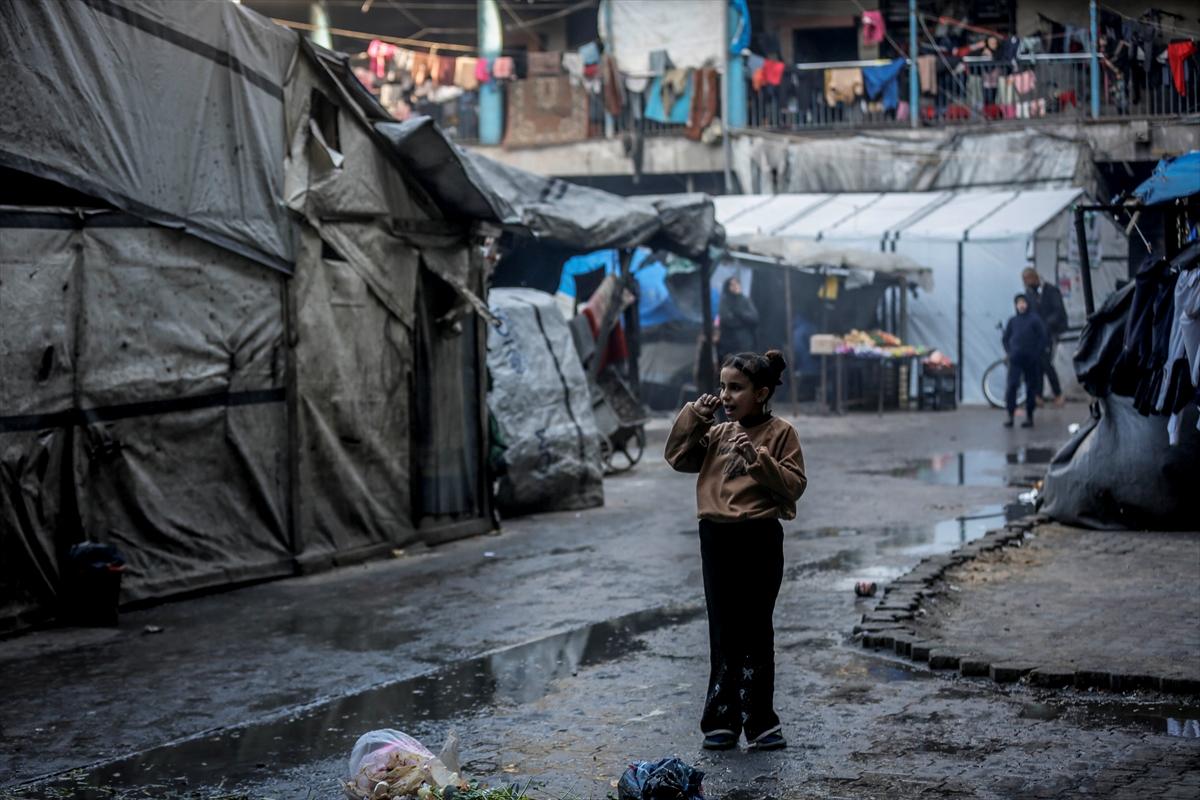
Daily life in the Shu’aiyya neighborhood of Gaza, 20 January 2026 – (Anadolu Agency)
On 24 January 2026, the Gaza Strip Ministry of Health announced that, since the start of winter, 10 children have died due to cold weather caused by Israel’s obstruction of fuel and humanitarian aid deliveries. The statement included: “Three-month-old Ali Abu Zur died of extreme cold at Al-Aqsa Martyrs Hospital.” It was also stated that 6-month-old Yusuf Omar Abu Hamala, who lived in the Mevasi area of Khan Yunis, also died due to cold weather. The number of children unable to be protected from the cold since winter began has reached 10.
On the same day, the Israeli military bombed the Jabaliya area in northern Gaza despite the ceasefire, injuring many Palestinians in an attack targeting Gaza Street. Additionally, Palestinian Mecdi Ibrahim Belavi was injured by gunfire in the Salatin area of Beit Lahiya, and Palestinian Muayyid Abu Muammer was injured in southern Khan Yunis.
Eyewitnesses reported that an explosion occurred near the Ammara Casir intersection in central Khan Yunis due to fire from a drone. Aerial attacks were launched against areas in the southeast of Khan Yunis, and Israeli naval vessels targeted the city’s coastal strip. On the same day, artillery fire was directed at the eastern side of the Meghazi Refugee Camp, and eastern areas of Gaza were struck.
Health sources reported that in northern Gaza’s Beit Lahiya, 14-year-old Selman Zakaria and 15-year-old Muhammad Yusuf were killed when a bomb exploded near Kemal Advan Hospital. Eyewitnesses stated that a bomb was dropped from an Israeli drone onto the location where children were present. It was also recorded that the Kiz el-Neccar area in southern Khan Yunis was targeted in a bombardment, resulting in the death of one Palestinian.
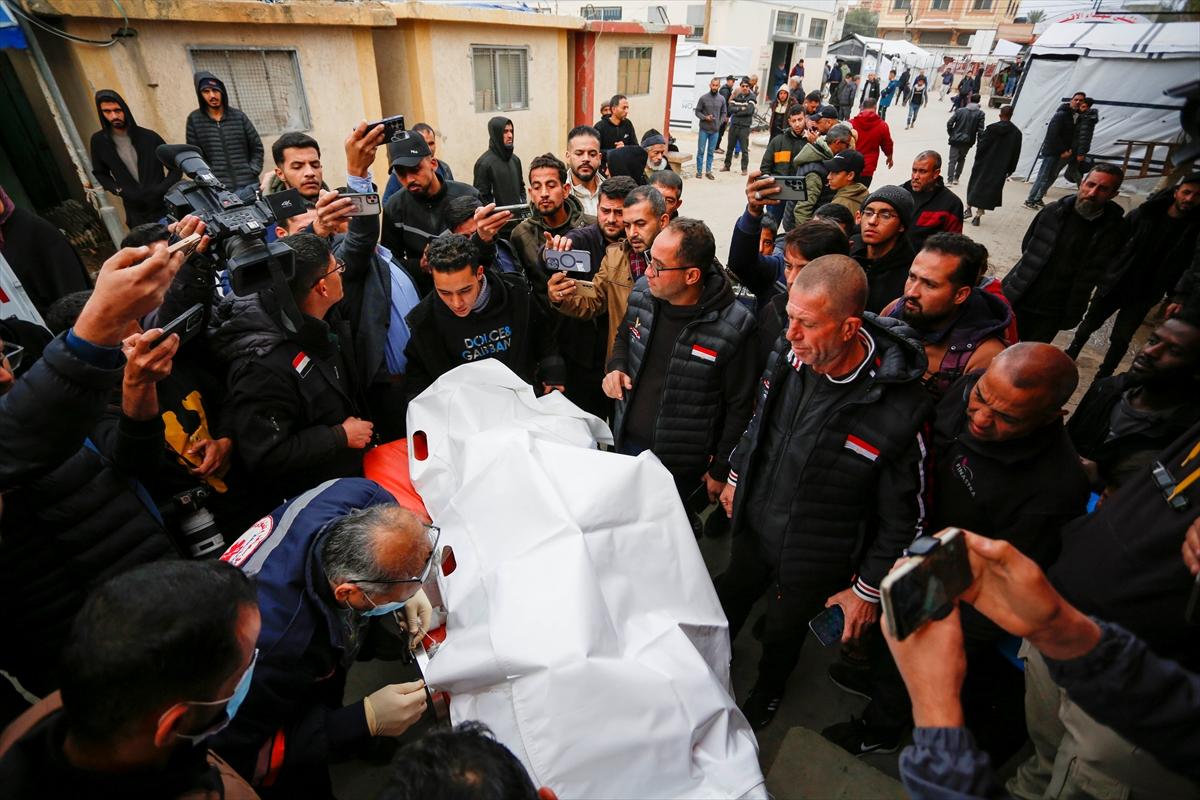
Journalists killed in Israeli attacks despite the ceasefire in Gaza, 21 January 2026 – (Anadolu Agency)
In a written statement issued by the Gaza Ministry of Health as of 24 January, it was reported that “four Palestinians were killed and 12 injured in the last 48 hours.” The statement noted that “since the ceasefire came into effect, 481 people have been killed and 1,313 injured in Israeli attacks.” Total fatalities have risen to 71,654 and injuries to 171,391.
On 25 January, the Israeli military launched aerial attacks and artillery fire on various areas of the Gaza Strip from early morning. In the eastern part of Tuffah neighborhood in eastern Gaza City, particularly around El-Battish Cemetery, numerous buildings were destroyed by explosives. Demolition activities occurred simultaneously with aerial bombardments.
On the same day, the eastern side of the Jabaliya Refugee Camp in northern Gaza and the Beni Suheyla village in eastern Khan Yunis were targeted by artillery fire. In the Khan Yunis area, fire was opened against Palestinian fishermen, with no casualties reported. Health sources reported that in Israeli attacks violating the ceasefire, three Palestinians were killed and six injured.
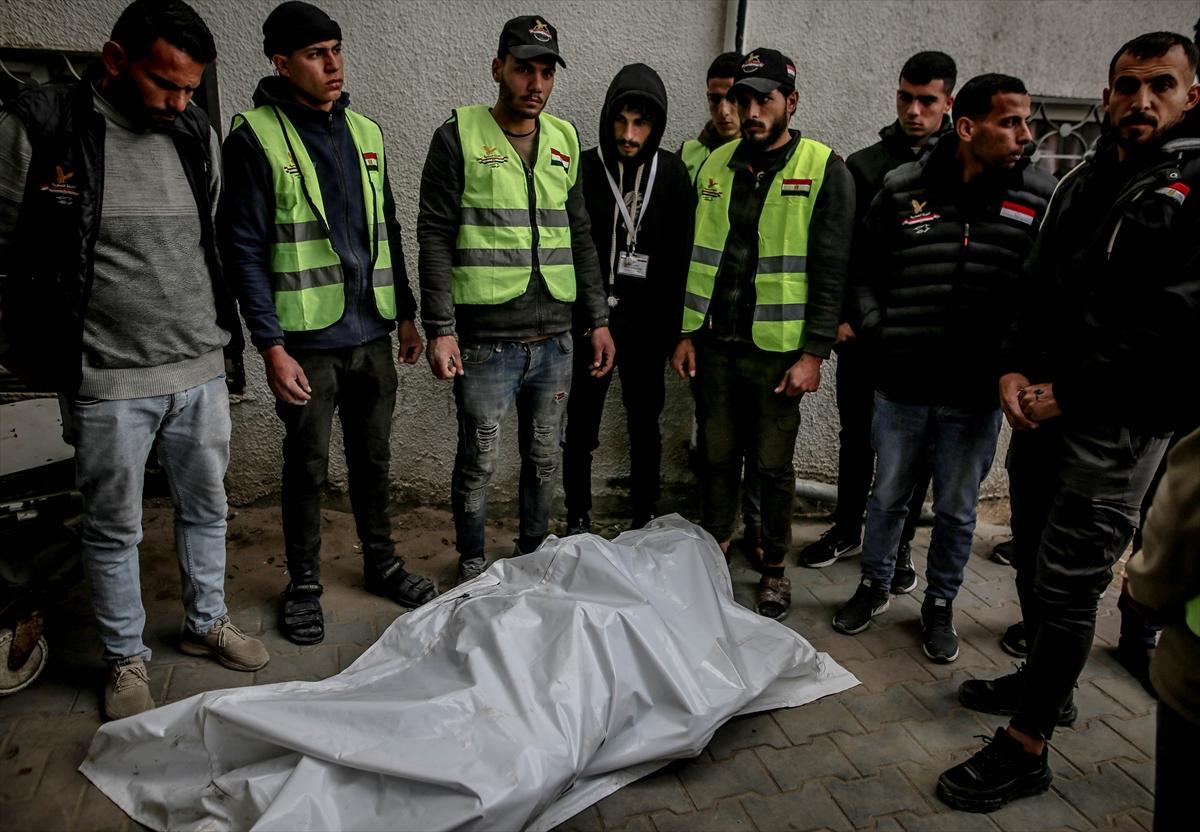
Journalists killed in Israeli attacks despite the ceasefire in Gaza, 21 January 2026 – (Anadolu Agency)
On 26 January, the Gaza Ministry of Health stated in its statement that “in the last 24 hours, the bodies of three Palestinians, one of whom was recovered from under rubble, and 20 injured were brought to hospitals.” The statement noted that “since the ceasefire came into effect, 486 people have been killed and 1,341 injured.” Total fatalities have reached 71,660.
On 21 January, the foreign ministers of Türkiye, Egypt, Indonesia, Jordan, Pakistan, Qatar, Saudi Arabia, and the United Arab Emirates issued a joint statement. The statement read: “The ministers announce their countries’ joint decision to join the Board of Peace. Each country, including Egypt, Pakistan, and the United Arab Emirates, which have already announced their participation, will sign the relevant documentation in accordance with their own legal and other necessary procedures.” The statement further indicated that this mission aims to “strengthen a lasting ceasefire, support the reconstruction of Gaza, and enable the Palestinian people to exercise their right to self-determination and statehood under international law.”

Signing ceremony of the Board of Peace Charter for Gaza in Davos, 22 January 2026 – (Anadolu Agency)
On 22 January, at the “Board of Peace Charter for Gaza” signing ceremony held in Davos, Switzerland, U.S. President Donald Trump stated in his speech: “We have carefully maintained the ceasefire in Gaza and will continue to do so.” In the same speech, Trump announced that “59 countries are participating in the Gaza Peace Board” and added: “Fifty-nine countries have joined the peace process in the Middle East. Most are not from the Middle East but from nearby regions, not within it.”
On 26 January 2026, the Israeli military announced that it had located the body of Israeli hostage Ran Gvili during a search in a cemetery in eastern Gaza City. The statement read: “During a search in eastern Gaza City, the body of the Israeli hostage was found and identified through testing.” It was reported that the remains would be transported back to Israel.
U.S. President Donald Trump posted on Truth Social: “We recovered the body of the last hostage in Gaza. Thus, we have retrieved all 20 living hostages and all deceased ones! An incredible job. Most people thought this was impossible.”
Hamas, in its written statement on the matter, said: “In accordance with our commitment to the ceasefire that came into effect in October and our national obligations, we made efforts to locate the body of the last Israeli hostage.” The statement added: “Thus, as Palestinian resistance fighters, we have fulfilled our commitment to the first phase of the ceasefire agreement.”
Hamas also called on Israel to “fully implement all provisions of the ceasefire agreement” and demanded the opening of the Rafah Crossing in both directions. The statement said: “Since the issue of the Israeli hostage’s body has been resolved, we demand full implementation of all provisions Israel has failed to fulfill.”
On 27 January 2026, the Israeli military targeted eastern Khan Yunis, western Rafah, and the Tuffah neighborhood in eastern Gaza. On the same day, helicopters fired on areas around the Bureyc Refugee Camp in central Gaza, and a series of explosions occurred in parts of Rafah city.
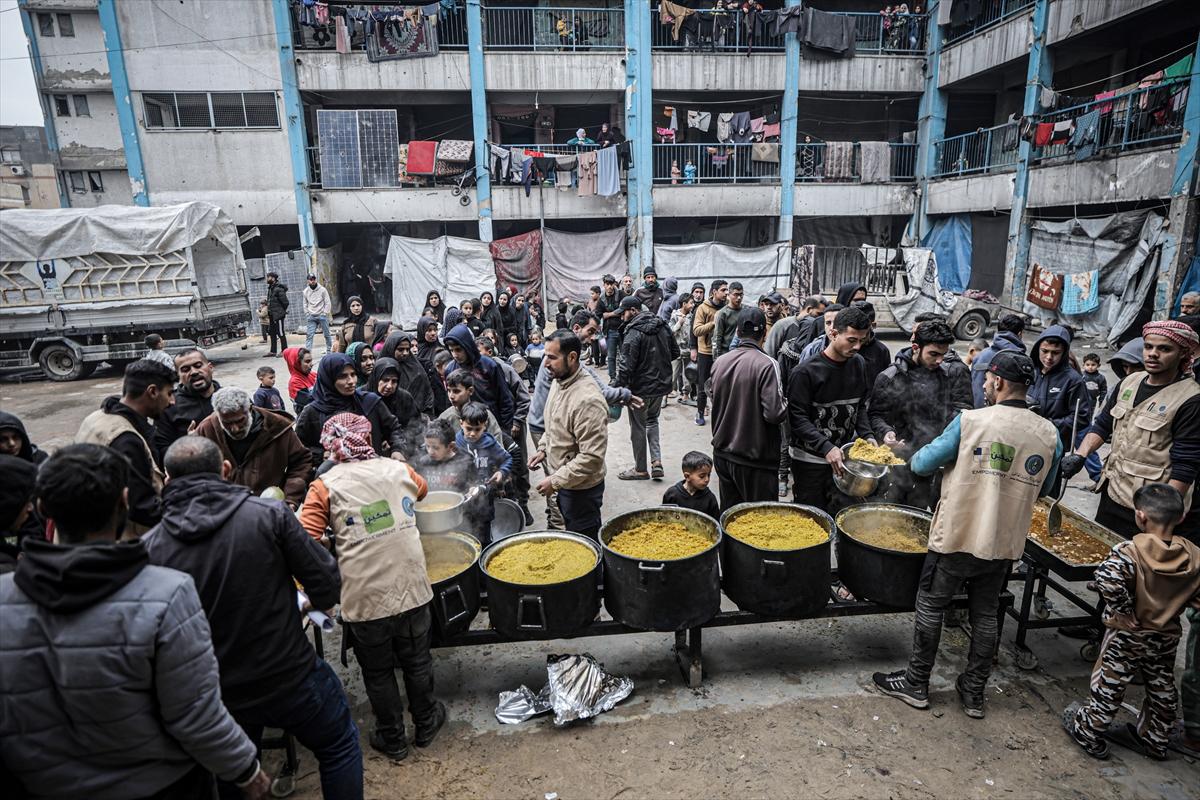
Hot meals are distributed to displaced Palestinians in Gaza, 22 January 2026 – (Anadolu Agency)
Gaza Ministry of Health, in its written statement, reported that “in the last 48 hours, eight Palestinians were killed, two of them children, and 19 injured.” The statement noted that “since the ceasefire came into effect, 494 people have been killed and 1,377 injured in Israeli attacks.” Total fatalities have risen to 71,662, and injuries to 171,410.
On the same day, the Tuffah neighborhood in eastern Gaza, the western side of the Jabaliya Refugee Camp, and eastern areas of Khan Yunis were targeted by artillery fire. Eyewitnesses reported that tents housing displaced civilians in northern Rafah were also hit. Civilian casualties occurred in Israeli attacks, with children among the dead.
In another statement on the same date, the Gaza Ministry of Health announced that “the number of children who have died from the cold during winter in Gaza has risen to 11”. The statement noted that “a 12-day-old baby died due to lack of fuel and heating materials”. The ministry also reported that “more than 20,000 patients are waiting for treatment abroad and 1,268 patients have died while awaiting permission to leave”.
On 28 January, the Israeli military conducted intense aerial attacks around Jabaliya in northern Gaza, Deir al-Balah in the central region, and Khan Yunis in the south. The Bureyc and Meghazi refugee camps were also subjected to bombardment.
On 29 January, the Gaza Ministry of Health reported in its statement that “71,667 people have been killed and 171,458 injured”. According to the statement, since the ceasefire came into effect on 10 October 2025, 499 Palestinians have been killed and 1,393 injured.
On the same day, the Zeytun neighborhood in eastern Gaza, the Rimal area, Shu’aiyya, and the Esda neighborhood in western Khan Yunis were hit by aerial attacks. Israeli artillery units targeted Beit Hanun and its surroundings in northern Gaza. The wounded and dead from these attacks were transported to Shifa, Nasir, and Al-Aqsa Martyrs hospitals in Gaza.
On the same day, European Union officials issued a statement regarding the Rafah Crossing. El Anouni, speaking on behalf of the EU Rafah Aid Mission (EUBAM Rafah), said: “We are ready to move immediately as soon as the crossing opens.”
On 30 January 2026, the Israeli military, in attacks targeting the eastern side of the Meghazi Refugee Camp in central Gaza, reported the deaths of 21-year-old Yasir Muhammad Abu Shahadeh and 20-year-old Walid Hasan Darwish. According to eyewitnesses, the attack was carried out by a drone near the Abu Namus Intersection. On the same day, three Palestinians were killed in another aerial attack in Rafah city.
On the same date, two Palestinian children, aged 15 and 16 respectively, were injured in the El-Celezon Refugee Camp in northern Ramallah due to Israeli gunfire. According to the Palestinian news agency WAFA, Israeli forces conducted raids on the camp area and carried out operations in several villages around Ramallah.
On the morning of 31 January 2026, the Gaza Civil Defense Directorate announced that 37 Palestinians were killed in Israeli attacks launched from early morning across various areas of the Gaza Strip. The statement indicated that children and women were among the dead. The deaths of 32 people were confirmed in the initial hours, and the total number rose to 37 in subsequent hours.
The Israeli military targeted a tent housing displaced civilians in the Esda area of Khan Yunis with a drone. Health officials from Nasir Hospital reported that “seven members of the same family were killed and six injured in the attack.” On the same day, an apartment building in the Rimal neighborhood in western Gaza City was targeted, killing five people, including three children and two women.
One person was killed in Israeli attacks in the Jabaliya area of northern Gaza, and the police station in the Sheikh Rizwan neighborhood was also targeted. Thirteen people were killed in the attack on the police station, with many others injured.
In a bombing targeting an apartment in the Tuffah neighborhood in eastern Gaza City, several Palestinians were injured. The central street of Gaza City, Cela Street, and the eastern side of the El-Bureyc Refugee Camp were also targeted in aerial attacks. Injured individuals from these areas were taken to hospitals.
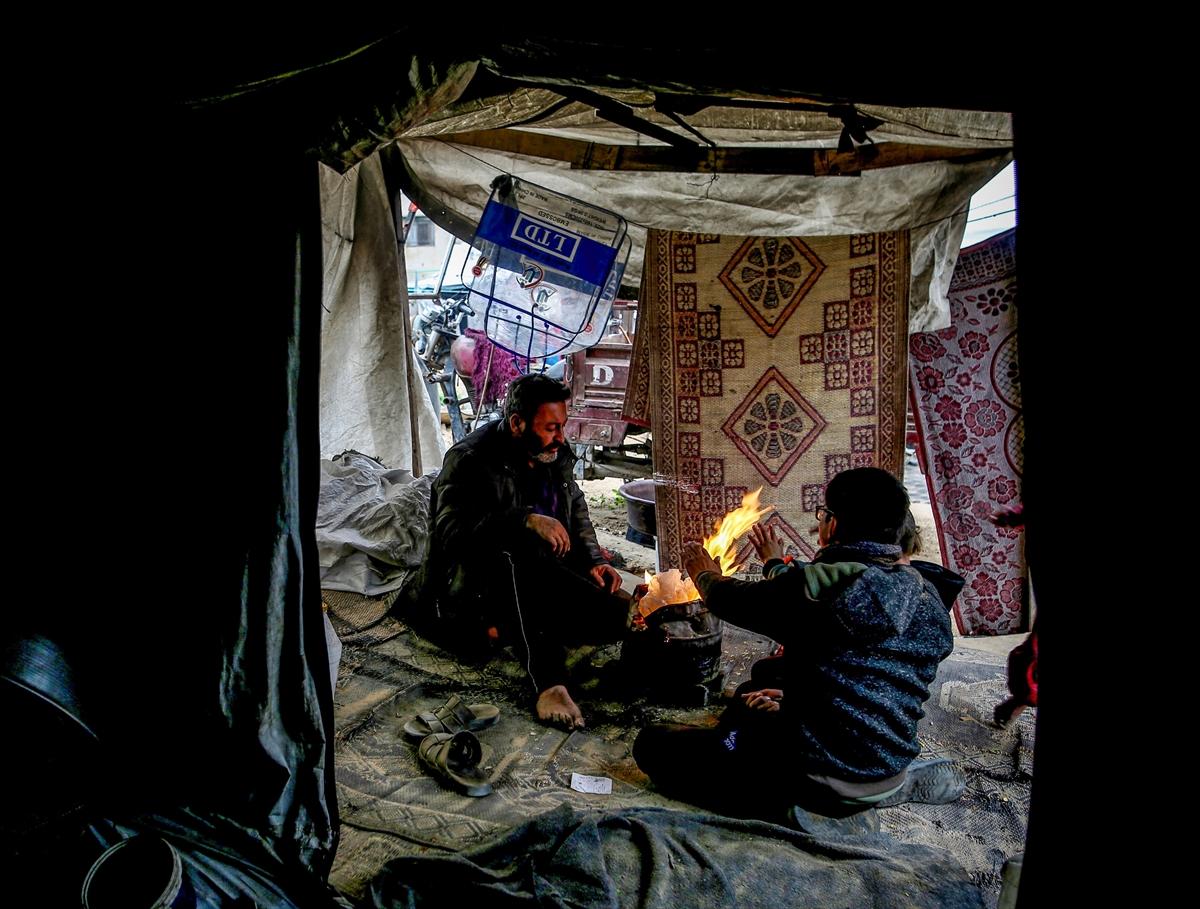
Daily life in the destroyed Jabaliya area, 22 January 2026 – (Anadolu Agency)
In its statement as of 31 January, the Gaza Ministry of Health reported that “in the last 48 hours, 28 bodies and 49 injured were brought to hospitals, 12 of the dead being from today.” The statement noted that “since the ceasefire came into effect on 10 October 2025, 509 people have been killed and 1,405 injured”. Total fatalities have risen to 71,769, and injuries have exceeded 171,480.
In its written statement regarding the attacks, the Israeli military claimed that “Hamas has violated the ceasefire.” On the same day, the eastern neighborhoods of Gaza City—Tuffah, Rimal, Zeytun, and Nasir—and the western areas of Khan Yunis—Esda—and the surrounding areas of Rafah were subjected to successive bombardments.
The bodies of those killed in the attacks were transported to Shifa and Nasir hospitals. Palestinian sources reported that women and children were among the dead.
Among the bodies brought to hospitals after the attacks were those of seven members of the same family from the Rimal and Esda areas. Health officials reported that the occupancy rate of Nasir Hospital in Khan Yunis had reached 140 percent and that morgues had exceeded their capacity.
European Union (EU) officially condemned Israel on 1 February 2026 for repeatedly violating the ceasefire in Gaza. EU Commissioner for Equality, Preparedness and Crisis Management Hadja Lahbib stated on her account on the U.S.-based X platform: “We condemn the repeated violations of the ceasefire in Gaza, where hundreds of Palestinians were killed and injured over the weekend due to Israeli attacks.”
Lahbib further emphasized that “international humanitarian law must be respected and civilians must be protected everywhere and at all times.”
On the same day, the foreign ministers of Türkiye, Egypt, Jordan, Indonesia, Pakistan, Qatar, Saudi Arabia, and the United Arab Emirates (UAE) issued a joint statement condemning Israel’s repeated ceasefire violations that have resulted in over a thousand Palestinian deaths and injuries.
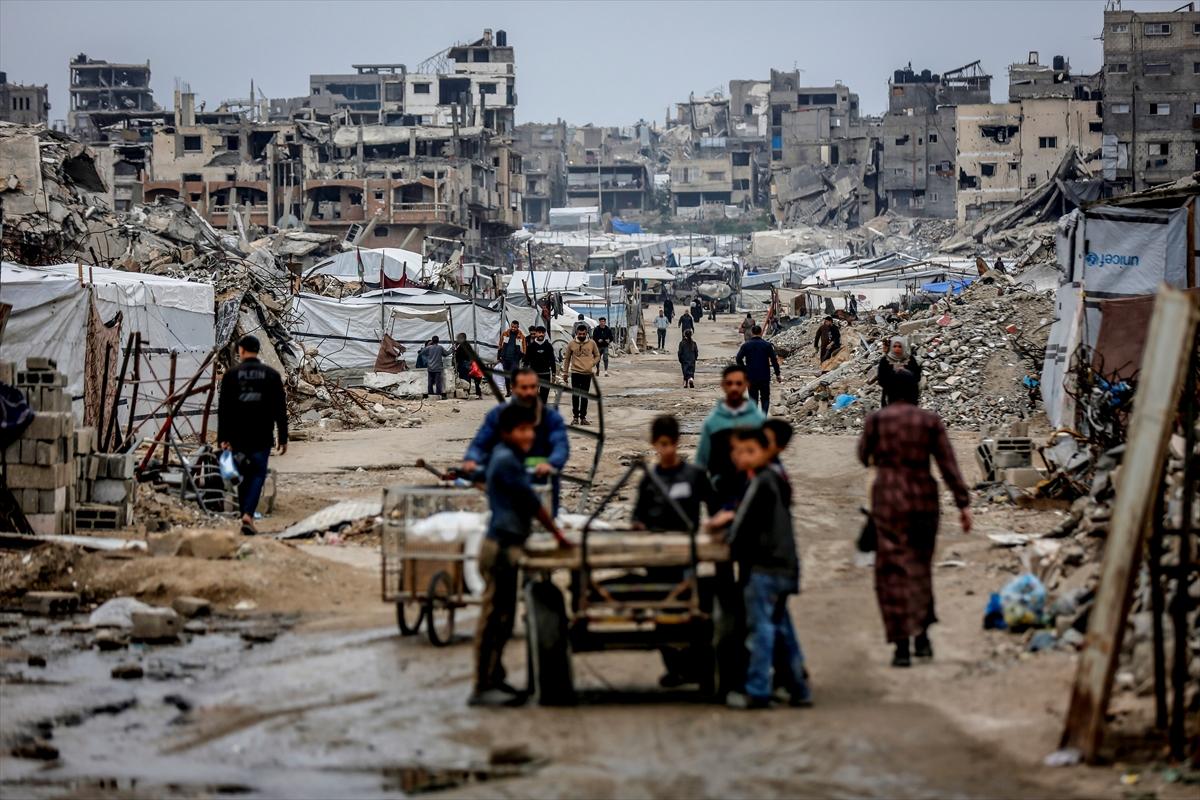
Daily life in the destroyed Jabaliya area, 22 January 2026 – (Anadolu Agency)
The statement further noted: “These actions risk undermining the efforts of regional and international actors who are working together to advance the second phase of the plan proposed by U.S. President Donald Trump and implement United Nations Security Council Resolution 2803, thereby escalating tensions and weakening the consolidation of calm and the restoration of stability.”
The statement emphasized that these repeated violations directly threaten the political process and obstruct ongoing efforts to create a conducive environment for transitioning to a more stable phase in terms of both security and humanitarian conditions in the Gaza Strip. It stressed that full adherence to Trump’s Peace Plan is essential for its second phase to succeed.
The statement added: “The ministers further call on all parties to fully fulfill their responsibilities and exercise maximum restraint during this critical period, in order to preserve and sustain the ceasefire, avoid any action that could undermine the current process, and create favorable conditions to advance early recovery and reconstruction, in line with international law, relevant UN Security Council resolutions, and the Arab Peace Initiative, toward the promotion of a just and lasting peace based on the Palestinian people’s right to self-determination and statehood.”
Anadolu Ajansı. "ABD Başkanı Trump: Gazze’deki Ateşkesi Büyük Bir Titizlikle Sürdürdük ve Sürdürmeye Devam Edeceğiz." Accessed February 3, 2026. https://www.aa.com.tr/tr/dunya/abd-baskani-trump-gazzedeki-ateskesi-buyuk-bir-titizlikle-surdurduk-ve-surdurmeye-devam-edecegiz/3807804
Anadolu Ajansı. "Türkiye, Mısır, Endonezya, Ürdün, Pakistan, Katar, Suudi Arabistan ve BAE’den Ortak Açıklama." Accessed February 3, 2026. https://www.aa.com.tr/tr/gundem/turkiye-misir-endonezya-urdun-pakistan-katar-suudi-arabistan-ve-baeden-ortak-aciklama/3806963
Anadolu Ajansı. “AB, İsrail’in Ateşkesi İhlal Ederek Gazze’ye Yaptığı Saldırıları Kınadı.” Accessed February 3, 2026. https://www.aa.com.tr/tr/dunya/ab-israilin-ateskesi-ihlal-ederek-gazzeye-yaptigi-saldirilari-kinadi/3817304
Anadolu Ajansı. “AB: Refah Sınır Kapısı Açılır Açılmaz Harekete Geçmeye Hazırız.” Accessed February 3, 2026. https://www.aa.com.tr/tr/dunya/ab-refah-sinir-kapisi-acilir-acilmaz-harekete-gecmeye-haziriz/3811124
Anadolu Ajansı. “BM: Gazze’de Kış Mevsiminin Başından Bu Yana 11 Çocuk Soğuktan Donarak Hayatını Kaybetti.” Accessed February 3, 2026. https://www.aa.com.tr/tr/dunya/bm-gazzede-kis-mevsiminin-basindan-bu-yana-11-cocuk-soguktan-donarak-hayatini-kaybetti/3815896
Anadolu Ajansı. “Hamas: İsrail, Gazze’de Yerinden Edilmiş Sivillerin Çadırlarını Vurarak Ateşkesi Hedef Alıyor.” Accessed February 3, 2026. https://www.aa.com.tr/tr/dunya/hamas-israil-gazze-de-yerinden-edilmis-sivillerin-cadirlarini-vurarak-ateskesi-hedef-aliyor/3816268
Anadolu Ajansı. “Mısır, İsrail’in Gazze’den Tamamen Çekilmesini ve Refah Sınır Kapısı’nın Yeniden Açılmasını İstedi.” Accessed February 3, 2026. https://www.aa.com.tr/tr/dunya/misir-israil-in-gazze-den-tamamen-cekilmesini-ve-refah-sinir-kapisi-nin-yeniden-acilmasini-istedi/3810194
Anadolu Ajansı. “Türkiye ve 7 Ülkeden İsrail’in Gazze’deki Ateşkes İhlallerine Kınama.” Accessed February 3, 2026. https://www.aa.com.tr/tr/gundem/turkiye-ve-7-ulkeden-israilin-gazzedeki-ateskes-ihlallerine-kinama/3816974
Anadolu Ajansı. “İsrail Medyasına Göre Netanyahu, Refah Sınır Kapısı’nı Açmadan Önce Zaman Kazanmaya Çalışıyor.” Accessed February 3, 2026. https://www.aa.com.tr/tr/dunya/israil-medyasina-gore-netanyahu-refah-sinir-kapisini-acmadan-once-zaman-kazanmaya-calisiyor/3811165
Anadolu Ajansı. “İsrail Ordusu, Gazze Şeridi’nin Çeşitli Bölgelerini Topçu Atışlarıyla Vurdu.” Accessed February 3, 2026. https://www.aa.com.tr/tr/dunya/israil-ordusu-gazze-seridinin-cesitli-bolgelerini-topcu-atislariyla-vurdu/3808469
Anadolu Ajansı. “İsrail Ordusu, Refah Sınır Kapısı’nı 1 Şubat’ta Sınırlı Sayıda Yayanın Çift Yönlü Geçişine Açacak.” Accessed February 3, 2026. https://www.aa.com.tr/tr/dunya/israil-ordusu-refah-sinir-kapisi-1-subatta-sinirli-sayida-yayanin-cift-yonlu-gecisine-acilacak/3815578
Anadolu Ajansı. “İsrail Ordusunun Gazze Şeridi’ne Düzenlediği Saldırılarda Son 24 Saatte 37 Filistinli Hayatını Kaybetti.” Accessed February 3, 2026. https://www.aa.com.tr/tr/dunya/israil-ordusunun-gazze-seridine-duzenledigi-saldirilarda-son-24-saatte-37-filistinli-hayatini-kaybetti/3816018
Anadolu Ajansı. “İsrail, Ateşkese Rağmen Gazze Şeridi’ne Saldırılarını Sürdürdü.” Accessed February 3, 2026. https://www.aa.com.tr/tr/dunya/israil-ateskese-ragmen-gazze-seridine-saldirilarini-surdurdu/3805984
Anadolu Ajansı. “İsrail, Ateşkese Rağmen Gazze Şeridi’nin Çeşitli Bölgelerine Topçu ve Hava Saldırılarını Sürdürüyor.” Accessed February 3, 2026. https://www.aa.com.tr/tr/dunya/israil-ateskese-ragmen-gazze-seridinin-cesitli-bolgelerine-topcu-ve-hava-saldirilarini-surduruyor/3811724
Anadolu Ajansı. “İsrail, Ateşkese Rağmen Gazze’nin Farklı Bölgelerini Bombalamayı Sürdürdü.” Accessed February 3, 2026. https://www.aa.com.tr/tr/dunya/israil-ateskese-ragmen-gazze-nin-farkli-bolgelerini-bombalamayi-surdurdu/3810116
Anadolu Ajansı. “İsrail’in Gazze Şeridi’ne Saldırılarında Can Kaybı 71 Bin 562’ye Yükseldi.” Accessed February 3, 2026. https://www.aa.com.tr/tr/dunya/israilin-gazze-seridine-saldirilarinda-can-kaybi-71-bin-562ye-yukseldi/3807399
Anadolu Ajansı. “İsrail’in Gazze Şeridi’ne Saldırılarında Can Kaybı 71 Bin 654’e Yükseldi.” Accessed February 3, 2026. https://www.aa.com.tr/tr/dunya/israilin-gazze-seridine-saldirilarinda-can-kaybi-71-bin-654e-yukseldi/3809538
Anadolu Ajansı. “İsrail’in Gazze Şeridi’ne Saldırılarında Can Kaybı 71 Bin 660’a Yükseldi.” Accessed February 3, 2026. https://www.aa.com.tr/tr/dunya/israilin-gazze-seridine-saldirilarinda-can-kaybi-71-bin-660a-yukseldi/3810817
Anadolu Ajansı. “İsrail’in Gazze Şeridi’ne Saldırılarında Can Kaybı 71 Bin 667’ye Yükseldi.” Accessed February 3, 2026. https://www.aa.com.tr/tr/dunya/israilin-gazze-seridine-saldirilarinda-can-kaybi-71-bin-667ye-yukseldi/3812764
Anadolu Ajansı. “İsrail’in Gazze Şeridi’nin Orta Kesimindeki Saldırısında 2 Filistinli Hayatını Kaybetti.” Accessed February 3, 2026. https://www.aa.com.tr/tr/dunya/israilin-gazze-seridi-nin-orta-kesimindeki-saldirisinda-2-filistinli-hayatini-kaybetti/3814992
Anadolu Ajansı. “İsrail’in Yakıt ve İnsani Yardım Girişini Kısıtladığı Gazze’de Şu Ana Kadar 10 Çocuk Soğuktan Hayatını Kaybetti.” Accessed February 3, 2026. https://www.aa.com.tr/tr/dunya/israilin-yakit-ve-insani-yardim-girisini-kisitladigi-gazzede-su-ana-kadar-10-cocuk-soguktan-hayatini-kaybetti/3809780
Israel’s Attacks on Gaza and Developments in Gaza (2026) encompass military, humanitarian, and demographic developments in the Gaza Strip during the third year of the large-scale offensive launched by the Israeli military in October 2023.
Daily life in Han Yunus, 5 January 2026 – (Anadolu Ajansı)
The Israeli military launched large-scale air and ground attacks on the Gaza Strip on 7 October 2023. These attacks have continued for over two years, resulting in the widespread destruction of civilian settlements, healthcare facilities, and infrastructure.Palestinian Central Bureau of Statistics reported in its report dated 31 December 2025 that since October 2023, a total of over 72,000 Palestinians have lost their lives in Gaza, the West Bank, and East Jerusalem. 98 percent of these fatalities occurred in the Gaza Strip.
The year 2025 was marked by intensified hostilities. It was reported that 90 percent of homes in Gaza had been destroyed and over 1.5 million Palestinians were struggling to survive in makeshift tents. During the same period, over 100,000 Palestinians were forced to flee Gaza.
According to the Palestinian Central Bureau of Statistics’ end-of-year 2025 report, Israeli attacks left only 19 of 36 hospitals in Gaza partially operational. Approximately 18,000 injured in Gaza are awaiting treatment, and 60,000 pregnant women face severe risks in accessing healthcare. Ninety-five percent of Gaza’s population lacks access to clean drinking water. Educational institutions were largely destroyed: 179 schools were completely demolished, and 218 schools were bombed or damaged. All 63 universities in the region were destroyed. In Israeli attacks, 18,979 students lost their lives, of whom 18,863 were killed in Gaza.
It was reported that the total bed capacity of Gaza’s hospitals is approximately 2,000, insufficient to meet the region’s healthcare needs. Access to basic necessities such as clean water, electricity, food, and medicine has been almost entirely cut off.
Homes destroyed in Israeli attacks in Nuseyrat, 3 January 2025 – (Anadolu Ajansı)
A ceasefire came into effect in Gaza on 19 January 2025, implemented under pressure from the United States on Tel Aviv and one day before U.S. President Donald Trump assumed office. During the ceasefire, mutual prisoner exchanges took place over six weeks. Tens of thousands of displaced Palestinians returned to their areas within Gaza. During the ceasefire weeks, mass graves were discovered in the courtyard of Shifa Hospital and in the northern area of Beit Lahiya. Evidence was found indicating that bodies had hands bound and were shot at close range. Some corpses were recorded as having been crushed by armored vehicles.
Israel refused to participate in negotiations for the second phase of the ceasefire, scheduled to begin on 3 February 2025. On 2 March 2025, it completely halted humanitarian aid entry into Gaza and on 18 March, it broke the ceasefire and launched renewed attacks on Gaza. In the first 48 hours of these attacks, over 500 Palestinians, mostly women and children, lost their lives.
Daily life in Gaza, 2 January 2026 – (Anadolu Ajansı)
The Israeli military expanded its ground occupation from 18 March 2025. Area evacuation threats were issued, forcing civilians to relocate to smaller areas within Gaza. Simultaneously, Israel’s suspension of humanitarian aid triggered famine and scarcity in Gaza. According to UN data, between May and October 2025, 2,615 Palestinians died near Gaza Humanitarian Fund (GHF) centers while attempting to receive aid.
These GHF centers, established through a joint initiative by Israel and the United States, were presented to the international community as humanitarian aid points. However, incidents occurred where these centers were attacked with tanks and rifles. Armed attacks on civilians gathered near aid trucks and food distribution points were also documented. Israel was accused of monopolizing aid distribution. In August 2025, the United Nations officially declared the city of Gaza a “famine zone”.
Hot meals are distributed to displaced people in Gaza, 2 January 2026 – (Anadolu Ajansı)
On 23 March 2025, an Israeli air strike in the Rafah area killed 15 healthcare workers. After no contact could be established with the first team, the Palestinian Red Crescent sent a second ambulance group, which was also attacked. Footage showed that workers in medical vests were directly targeted as they exited their vehicles. Israeli forces buried ambulances and medical personnel in mass graves. Autopsy findings revealed that some healthcare workers were killed by close-range shots to the head and chest.
Throughout 2025, no international media access was permitted to Gaza; only Palestinian journalists reported on developments on the ground. During this period, journalists were targeted, and many media personnel were killed.
A total of over 50 Palestinian journalists were killed. It was reported that from 7 October 2023 to the end of 2025, over 250 media workers lost their lives.
On 10 October 2025, a ceasefire agreement was signed under the guarantees of Turkey, Egypt, and Qatar. Despite the ceasefire remaining in effect, Israel violated it approximately 1,000 times during this period. These violations resulted in 414 Palestinians killed and over 1,100 injured.
During the ceasefire, the “Yellow Line” area, covering 52 percent of Gaza, remained under Israeli occupation. On 13 October, a mutual prisoner exchange took place: Hamas released 20 Israeli prisoners, and Israel released 1,900 Palestinians. However, Palestinian political leaders Marwan Barghouti and Ahmed Saadat, as well as Dr. Husam Abu Safiye, Director of Kemal Adnan Hospital, were not released.
By the end of this period, the humanitarian crisis in Gaza had worsened due to infrastructure destruction and winter conditions. Over 1.5 million of the 2.3 million Palestinians in Gaza continue to live in tents.
Tens of thousands of displaced Palestinians return from the south to their northern lands, 2025 – (Anadolu Ajansı)
Throughout 2025, Israel conducted numerous targeted assassination operations against military and political figures in Gaza. On 24 March 2025, Hamas political bureau member Ismail Berhum was killed in an Israeli air strike on Nasser Hospital in Han Yunus. On 15 July 2025, Hamas member of the Palestinian Legislative Council Muhammad Ferac al-Gul was killed in a targeted assassination in Gaza. On 19 July 2025, Colonel Omar Said Akl, Director of the Nuseyrat Police Center in central Gaza, was killed in another Israeli attack. On 13 December 2025, Qassam Brigades commander Raid Saad (Abu Muaz) lost his life in an Israeli air strike that violated the ceasefire.
According to the Palestinian Central Bureau of Statistics’ end-of-year 2025 report, since 7 October 2023, over 72,000 Palestinians have been killed in Gaza, the West Bank, and East Jerusalem. 98 percent of these deaths occurred in the Gaza Strip. Among those killed in Gaza were 18,592 children and 12,400 women. Additionally, over 171,000 Palestinians were injured, and approximately 11,000 people were reported missing. Due to Israeli attacks, over 100,000 Palestinians were forced to flee Gaza. As a result of forced displacement and deaths, Gaza’s population decreased by 10.6 percent. At the end of 2025, the Palestinian population stood at approximately 5.56 million, of whom 3.43 million lived in the West Bank and 2.13 million in Gaza.
According to 2025 statistics published by the Government Media Office in Gaza, direct economic losses across 15 vital sectors due to Israeli attacks exceeded $33 billion. Agriculture, livestock, and fishing sectors have been almost entirely wiped out. Approximately 178,000 dunums of agricultural land, or more than 80 percent of total farmland, was damaged. 1,000 water wells and 500 agricultural and livestock farms were destroyed.
In infrastructure, over 700 water wells, 3,080 kilometers of power lines, and 400 kilometers of water and sewage networks were damaged. Throughout 2025, the Israeli military launched attacks on Gaza using over 112,000 tons of explosives. As a result, 90 percent of Gaza’s infrastructure was destroyed, and 55 percent of the region was occupied by military force.
Water crisis in Gaza under Israeli attacks, 1 January 2026 – (Anadolu Ajansı)
During Israeli operations in Gaza throughout 2025, 106,400 homes were completely destroyed, 66,000 homes rendered unusable, and 41,000 homes partially damaged. 213,000 Palestinians lost their homes. In total, approximately 2 million people have been displaced in Gaza. The Israeli military also targeted 87 shelter centers.
As a result of Israeli attacks, 22 hospitals in Gaza have been taken out of service. 211 ambulances and 23 civil defense vehicles were targeted. The remaining hospitals have a capacity of approximately 2,000 beds, insufficient for the over 18,000 injured in the region. In attacks, over 1,000 students, 88 teachers, and 45 academics lost their lives. 95 percent of educational institutions were damaged; 30 educational buildings were completely destroyed and 39 partially destroyed.
In Gaza, 34 mosques were completely destroyed and 100 mosques partially damaged. Three churches were targeted multiple times. Additionally, 21 of 60 cemeteries were completely destroyed in attacks.
Daily life in Gaza, 2 January 2026 – (Anadolu Ajansı)
The ceasefire agreement signed on 10 October 2025, under the guarantees of Turkey, Egypt, and Qatar, remains in effect. It was announced that U.S. President Donald Trump will unveil his “Day After Gaza” plan on 15 January 2026. Initial public information about the plan focuses on the deployment of an International Stability Force in Gaza and the restructuring of the region’s administrative framework. The composition of military forces and governance model remain unclear. Uncertainty persists regarding the transition process, the mechanism for implementing the ceasefire, and the governance structure of Gaza.
According to a statement by the Gaza Ministry of Health on 1 January 2026, the number of Palestinians killed in Israeli attacks on the Gaza Strip since October 2023 reached 71,271, and the number of injured reached 171,233.
Since the ceasefire began, 416 people have been killed and 1,153 injured in attacks. On 1 January, the Ministry of Health reported that two Palestinians were killed and six injured in the past 24 hours. The eastern part of Gaza City, the Bureij Refugee Camp, the eastern part of Rafah, Zaytoun, and Shu’ayya neighborhoods were subjected to artillery and aerial bombardment. Eyewitnesses reported that Israeli unmanned aerial vehicles conducted reconnaissance flights in tandem with the bombardments.
Cibaliya al-Nazla region: A child named Ahmed al-Shendaghi was killed by Israeli gunfire. Several civilians were also reported injured. According to military sources, the Israeli military maintains control over areas in the north, east, and south of the Gaza Strip. This indicates that more than 50 percent of Gaza’s territory is effectively under occupation. Local authorities in Gaza reported that Israeli aerial attacks are concentrated on residential areas, infrastructure, and main transportation routes, making evacuation and aid access more difficult for civilians.
On 2 January 2026, the Israeli military targeted the northern Gaza Strip, the Bureij Refugee Camp in the central region, and the eastern areas of the city of Han Yunus with aerial and ground attacks. According to eyewitness accounts, Israeli artillery units conducted heavy bombardments on the Zaytoun and Shu’ayya neighborhoods in eastern Gaza City. At the same time, Israeli fighter jets carried out two aerial attacks on the eastern side of the Bureij Refugee Camp.
In the eastern areas of Han Yunus, Israeli artillery units were observed firing, with explosion sounds heard across different parts of the city. Since the targeted areas are under Israeli military occupation, no information on casualties or injuries has been confirmed.
Gaza government officials reported that the Israeli military has violated the ceasefire agreement, which came into effect on 10 October 2025, 969 times. These attacks have resulted in 418 Palestinian deaths and numerous injuries.
On the same days, an Israeli Unmanned Aerial Vehicle (UAV) targeted a tent camp housing displaced Palestinians in the Beit Lahiya region. The Gaza Civil Defense General Directorate reported that four people were injured in the attack, three of whom were in critical condition. Other injured individuals were also reported at the scene.
On 1 January 2026, Israeli authorities decided to suspend the operations of 53 international non-governmental organizations (NGOs) that had not renewed their registration. Under this decision, these organizations were required to close their offices in Gaza and East Jerusalem and submit personal information of their staff to Israeli authorities for a “security investigation.”
In response to this decision, the United Nations Spokesperson stated: “The Secretary-General expresses deep concern over the Israeli authorities’ decision to suspend the operations of various international NGOs operating in occupied Palestinian territories.” The statement emphasized that humanitarian aid work is “indispensable” and warned that such restrictions could “undermine the fragile progress in Gaza.”
Despite the ongoing ceasefire, the Israeli military conducted aerial bombardments and artillery attacks on many areas of the Gaza Strip on 7 January 2026. According to eyewitnesses, Israeli artillery targeted neighborhoods in eastern Gaza City, while military vehicles simultaneously opened fire on the area. The southern Gaza city of Han Yunus and the central city of Deir al-Balah were also bombed by Israeli warplanes.
The Israeli military carried out an aerial attack on the Tuffah neighborhood in eastern Gaza City. Local sources reported that two Palestinians were killed and three injured in the strike on a house. In an Israeli military statement, it was claimed that “Hamas-affiliated forces fired on Israeli troops stationed in northern Gaza.” The statement further alleged that, as part of a joint operation with the Israeli internal security agency Shin Bet, “a leading figure within Hamas was targeted, who was planning attacks against Israeli soldiers.”
A person was injured by a bomb dropped from a Quadcopter-type Israeli unmanned aerial vehicle in the Tuffah neighborhood of eastern Gaza City. Health sources confirmed the injured person was taken to Baptist Hospital. Eyewitnesses stated that the bomb struck a home belonging to the Battash family and that civil defense teams responded to a fire that broke out after the attack.
It was reported that the area where the attack occurred was one of the zones from which the Israeli military was supposed to withdraw under the ceasefire agreement of 10 October 2025. The Gaza Ministry of Health reported that as of 7 January, the death toll had risen to 71,391 and the number of injured to 171,279. On the same day, the Israeli military also demolished numerous buildings in areas under its control in eastern Gaza City.
On 8 January 2026, the Israeli military launched attacks targeting tents and schools in various areas of the Gaza Strip. According to eyewitnesses and health sources, attacks were concentrated in the Han Yunus and Cibaliya regions. In the Cibaliya Refugee Camp in northern Gaza, Israeli fighter jets struck a zone where displaced civilians were living. Seven Palestinians, including two children, were killed and 11 injured. The injured were transported to local hospitals.
Aerial attacks were also carried out on tent areas in the eastern part of Han Yunus, resulting in widespread destruction. Gaza Ministry of Health officials stated that civil defense teams were working to reach people trapped under rubble. On the same day, 11-year-old Hamsa Nidal Husu in the city of Cibaliya was killed by Israeli gunfire. The area where the incident occurred lies within northern neighborhoods previously targeted by Israeli ground operations.
As of 8 January, the Gaza Ministry of Health reported a total death toll of 71,395 and 171,287 injured. The ministry also stated that in the past 24 hours, four people were killed and eight injured.
On 9 January 2026, Palestinian President Mahmoud Abbas spoke at the opening session of the 13th term of the Fatah Movement Revolutionary Council in Ramallah. In his address, Abbas rejected any division of Gaza. He emphasized that the Palestinian state is a single, indivisible geographic and political entity encompassing Gaza, the West Bank, and East Jerusalem. He stated that his top priorities are ensuring a lasting ceasefire in Gaza and immediate access for humanitarian aid.
The Palestinian leader, referring to U.S. President Donald Trump’s plan, stated that the second phase of the plan requires Israel’s full withdrawal from Gaza, Hamas relinquishing governance, and the establishment of a temporary administrative committee under the Palestinian Authority. Abbas explained that this process aims for “reconstruction without forced displacement” and “launching a political process based on the Arab Peace Initiative with international legitimacy.”
Abbas also declared 2026 the “Year of Palestinian Democracy,” announcing that local elections will be held in April, the Fatah 8th Congress and elections for the Palestinian National Council will take place later this year, and general elections will be held simultaneously in Gaza, the West Bank, and East Jerusalem “when conditions are suitable.”
On the same day, Jonathan Fowler, Senior Communications Manager of the United Nations Relief and Works Agency for Palestine Refugees in the Near East (UNRWA), commented on Israel’s restrictions on international NGOs’ access to Gaza. Fowler said: “There was great hope at the beginning of the ceasefire. (...) This did not happen, and it is tragic, shocking, and unacceptable.”
Fowler stated that the situation in Gaza remains “still catastrophic,” and that Israel’s new registration rules for international organizations have “complicated humanitarian operations rather than facilitating them.” Fowler emphasized, “This is not Israeli territory; it is an occupied territory.” He also addressed the plight of children in Gaza, stating:
“The situation of children in Gaza continues to be horrifying in every respect.” Fowler noted that children are the most affected group under famine-like conditions and that “Gaza is the region in the world with the highest number of child amputations.”
Fowler, the UNRWA spokesperson, also stated that these restrictions on international NGOs’ access to Gaza do not directly affect the United Nations, but are “part of a broader context aimed not at facilitating humanitarian operations but at complicating them.” He emphasized the critical importance of international NGOs on the ground, saying: “What Gaza needs now is not restrictions, but an increase in humanitarian aid as envisioned at the start of the ceasefire.”
UNRWA officials warned that such restrictions could have “global consequences” and stated that Israel’s continued implementation of these measures constitutes “a critical turning point in terms of international law.”
On the morning of 9 January 2026, the Israeli military continued aerial and artillery attacks targeting the northern part of Gaza City, the eastern part of the Bureij Refugee Camp in the central region, and the eastern areas of the city of Han Yunus. It was reported that Israeli fighter jets attacked the Tuffah neighborhood in eastern Gaza City, where unmanned aerial vehicles (UAVs) were flying intensively. Two separate aerial attacks were also carried out on the eastern side of the Bureij Refugee Camp, an area containing agricultural land.
Han Yunus’s eastern areas were subjected to intense artillery fire in the early morning. A series of explosions were heard in the region, and Israeli military vehicles were observed firing intermittently. The Gaza Ministry of Health reported that in the past 24 hours on 9 January, 14 Palestinians were killed and 17 injured. Including bodies recovered from the rubble, the total death toll was updated to 71,409 and the number of injured to 171,304. Since the ceasefire began, it was reported that 439 people have been killed, 1,223 injured, and 688 bodies recovered from the rubble.
On 10 January 2026, a large demonstration was held in Stockholm, Sweden, protesting Israeli attacks on Gaza and U.S. military intervention in Venezuela. Hundreds gathered at Odenplan Square, condemning Israel’s violations of the ceasefire that began on 10 October 2025 and its targeting of Gaza. The protest was organized at the call of numerous civil society organizations.
Demonstrators carried banners reading: “Children are being killed in Gaza,” “End food shortages in Palestine,” “No war in Venezuela, yes to peace,” and “Stop American imperialism.” Participants demanded an end to Israel’s attacks on Gaza and the release of Venezuelan President Nicolas Maduro and his wife Cilia Flores. Swedish activist Sigrun Meder told Anadolu Ajansı: “While witnessing this horrific genocide unfolding before our eyes in Palestine, we see how tents are being destroyed in storms.” Meder added: “Despite a so-called ceasefire in Gaza, bombings continue and many people are dying.”
In her assessment of international law, Meder said: “We are living in a period where international law is not respected. (...) The only country ever forced to comply with international law is Russia, but when it comes to the U.S., the West, or Israel, they can do whatever they want.”
In the same statement, Meder said: “We are the ones who defend international law in the streets and squares. We defend democracy, we defend human rights. We stand with Palestine, we stand with Venezuela.” The demonstration, supported by various human rights groups and solidarity platforms, ended peacefully in the evening.
On 11 February 2026, during Israeli attacks in the Gaza Strip, eight Palestinians were killed and 20 others injured within the last 24 hours. A written statement from Gaza’s Ministry of Health provided updated figures regarding Israeli attacks that have continued since October 2023.
The statement indicated that from the ceasefire declared on 10 October 2025 until 11 February, 591 Palestinians were killed and 1,578 injured. It was recorded that since October 2023, Israeli attacks on the Gaza Strip have resulted in a total of 72,045 deaths and 171,686 injuries.
On 13 February 2026, the Israeli military continued its destruction by demolishing structures in the southern Gaza city of Khan Yunis. Israeli unmanned aerial vehicles dropped explosives onto the roofs of Palestinian homes in the eastern part of the Zaytun neighborhood in Gaza City, areas outside the military’s designated deployment zones under the ceasefire agreement. It was also recorded that the Israeli navy fired randomly off the coast of Gaza City.
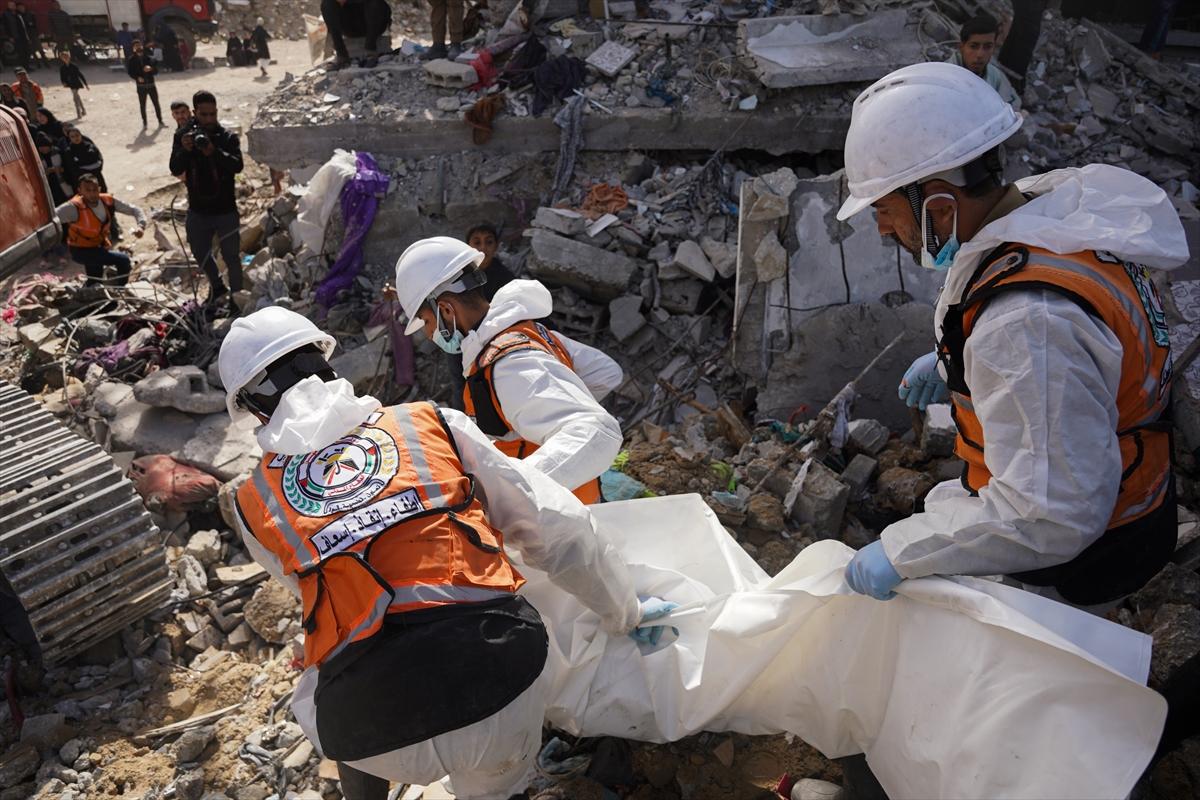
Corpses of Palestinians under rubble in northern Gaza, 15 February 2026 – (Anadolu Agency)
On 14 February 2026, it was reported that the Israeli military continued attacks on different areas of the Gaza Strip despite the ceasefire. According to health sources, two Palestinians, one a child and one an elderly person, were injured by Israeli gunfire in Khan Yunis in southern Gaza.
Israeli forces opened intense and indiscriminate fire east of Khan Yunis,随后 carried out large-scale destruction in an area densely populated with residential buildings. Israeli soldiers also opened fire in the eastern part of the Bureij Refugee Camp in central Gaza and in the Zaytun neighborhood east of Gaza City.
It was recorded that Israeli warplanes conducted a series of air strikes targeting the southern city of Rafah and the eastern areas of Gaza City.
On 14 February, the Gaza Ministry of Health issued a written statement providing updated figures on Israeli attacks since October 2023. The statement noted that the bodies of two Palestinians recovered from rubble and 15 injured persons were transported to hospitals in Gaza within the last 48 hours. It was recorded that since the ceasefire came into effect on 10 October 2025, Israeli attacks had killed 591 people, injured 1,598, and recovered 726 bodies from under the rubble.
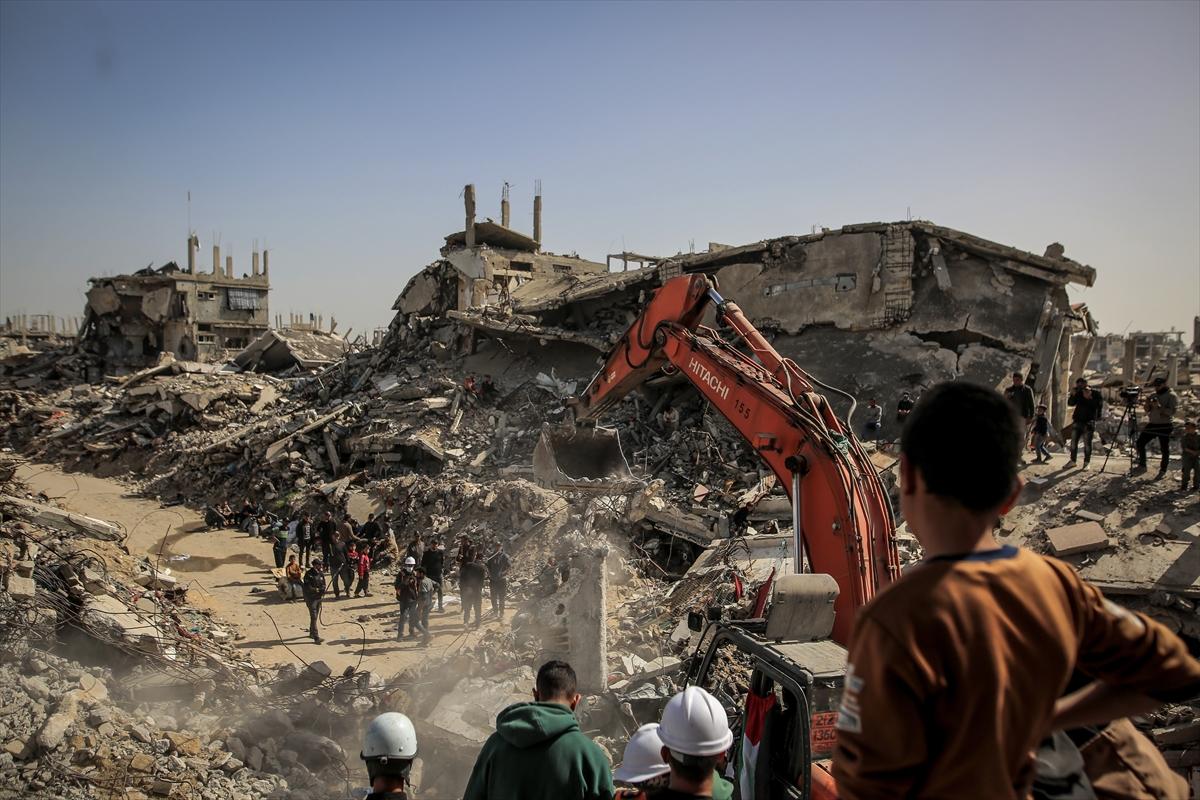
Search operations to recover bodies buried under rubble in Gaza following Israeli attacks, 15 February 2026 – (Anadolu Agency)
On 16 February 2026, it was reported that attacks continued. Artillery shelling was directed at various locations in the southern Gaza city of Khan Yunis. It was reported that certain areas of the Jabalia Refugee Camp in northern Gaza were subjected to intense gunfire and occasionally shelled with artillery.
It was stated that the Israeli Navy targeted specific points along the Gaza City coastline and the Bureij Refugee Camp from the sea. Since the ceasefire came into effect on 10 October 2025, Israeli attacks have resulted in 601 deaths and 1,607 injuries.
According to data from Gaza’s Ministry of Health, Israeli attacks on the Gaza Strip since October 2023 have resulted in a total of 72,061 deaths and 171,715 injuries.
On 13 February, Marta Hurtado Gomez, spokesperson for the United Nations Office of the High Commissioner for Human Rights, made statements during the UN Geneva Office’s weekly press briefing.
Gomez emphasized that Israeli attacks, despite the so-called ceasefire declared in October 2025, have continued to claim Palestinian lives, stating, “Since the ceasefire was announced, 591 Palestinians have been killed in Israeli attacks. These deaths demonstrate Israel’s continued disregard for its obligations under international humanitarian law and international human rights law.”
Gomez recalled that the UN Human Rights Office had recently published a report highlighting Israel’s failure to fulfill its obligations as an occupying power in the occupied West Bank and how its policies threaten the two-state solution.
On 13 February 2026, it was reported that 65 Palestinians exited through the Rafah Border Crossing on the Egyptian border. A Palestinian government official stated that these individuals, including 28 patients and 37 attendants, had crossed into Egypt. On the same day, 43 Palestinians returned to the Gaza Strip from abroad and were transported to Nasser Hospital in Khan Yunis.
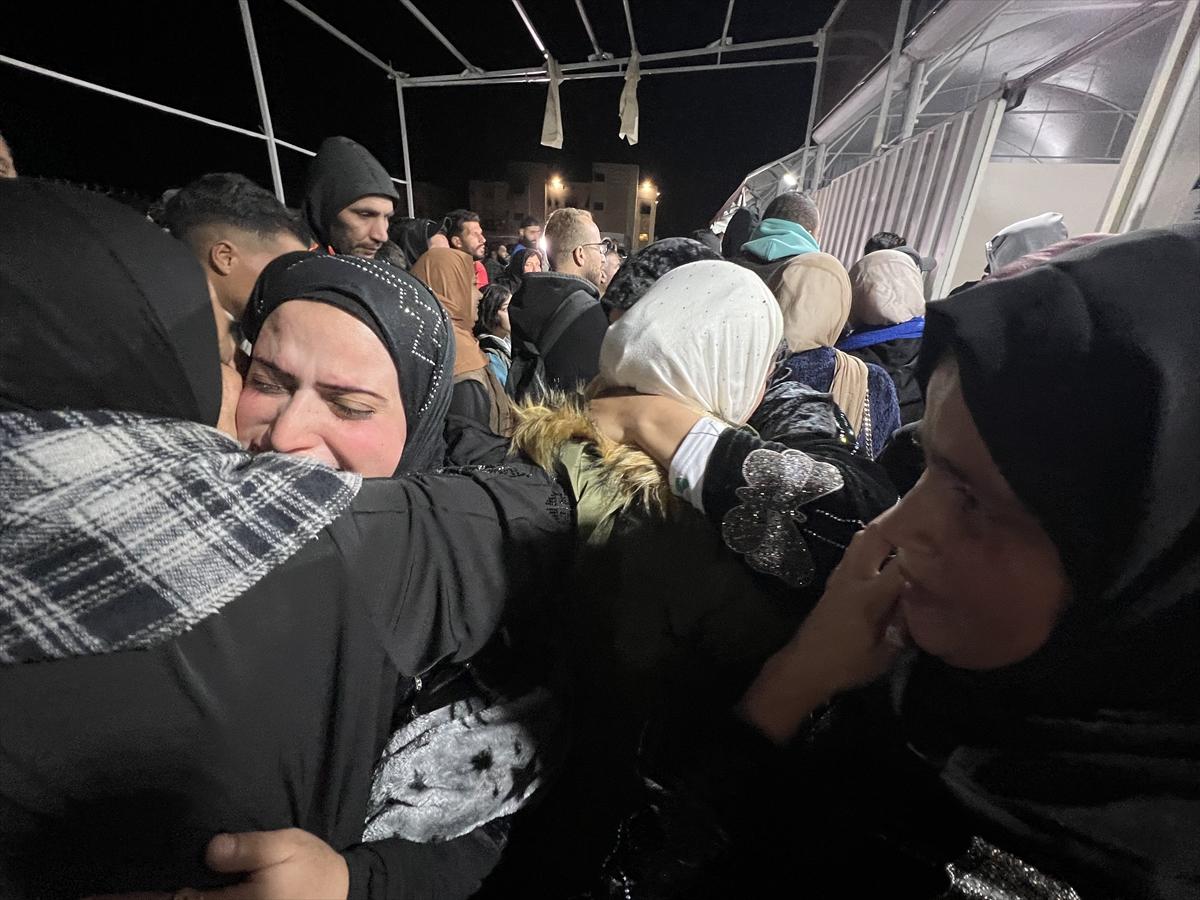
Palestinians crossing through the Rafah Border Crossing with limited permission, returning to Gaza, 12 February 2026 – (Anadolu Agency)
The Rafah Border Crossing, the only gateway connecting Gaza to the outside world, was opened for limited two-way crossings on 2 February 2026 after a gap of 21 months.
According to a statement from the Gaza government’s Media Office on 11 February, between 2 and 10 February, 275 Palestinians left Gaza via the Rafah Crossing and 213 entered Gaza. It was noted that Israel has permitted only those who left Gaza after October 2023 to return.
Approximately 22,000 patients and injured persons in Gaza remain outside the territory awaiting medical evacuation. Some Palestinians returning through the Rafah Crossing reported they were subjected to torture and mistreatment by Israeli soldiers and underwent prolonged interrogations.
On 11 February, Teresa Zakaria, Head of the World Health Organization’s Risk Reduction, Humanitarian Operations and Climate Change Unit, and WHO Director-General Tedros Adhanom Ghebreyesus, made statements during a weekly press briefing.
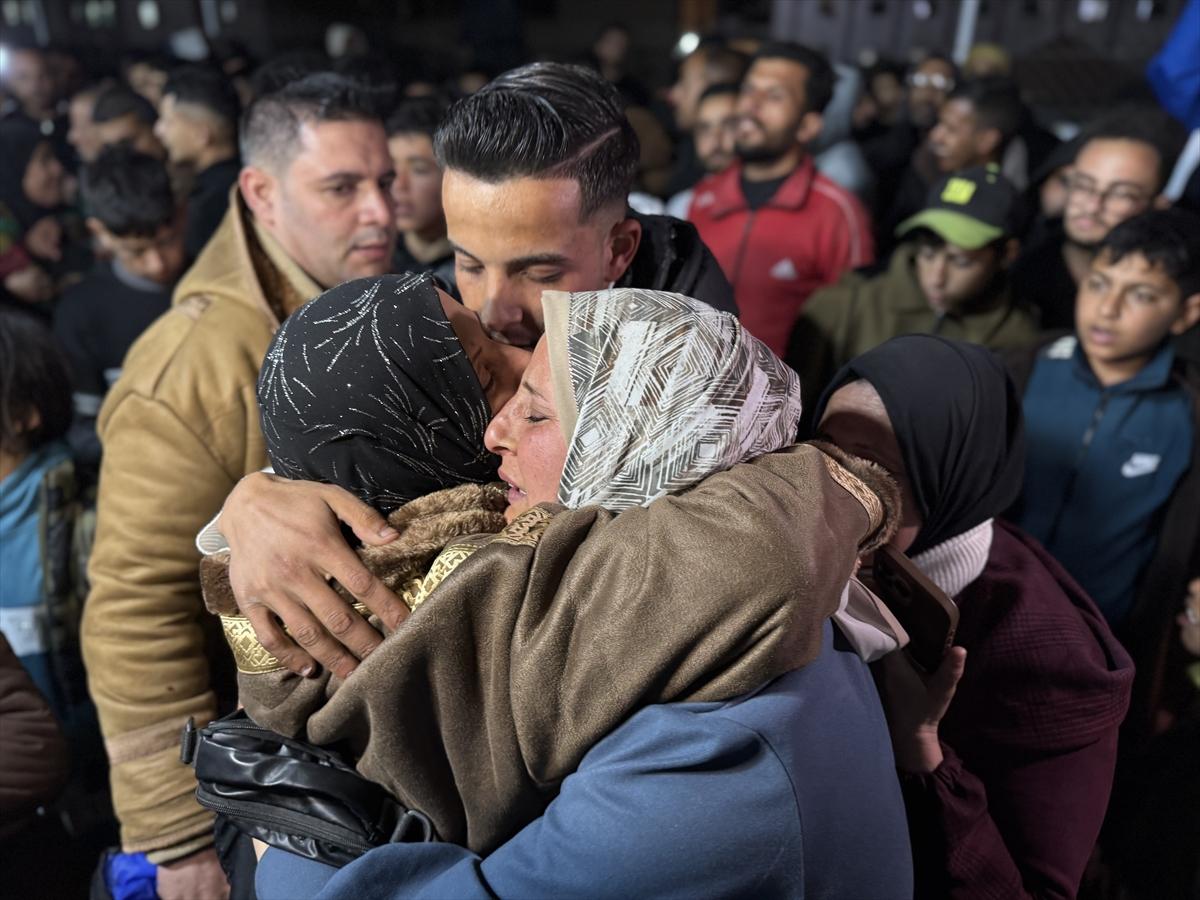
Palestinians crossing through the Rafah Border Crossing with limited permission, returning to Gaza, 12 February 2026 – (Anadolu Agency)
Zakaria stated that more than 90 patients have been medically evacuated since the opening of the Rafah Border Crossing. She also indicated that over 18,000 patients are still awaiting medical evacuation.
Zakaria noted that while the opening of the Rafah Crossing is significant for delivering humanitarian aid to Gaza, the volume of aid remains severely inadequate when measured against needs and weather conditions. The statement emphasized that living conditions inside Gaza are extremely dire and health risks remain at a high level.
The Gaza Municipality has launched efforts to reduce the health and environmental hazards caused by accumulated solid waste in the city center, due to Israeli attacks. Gaza City Mayor Yahya al-Serraj announced, in cooperation with the United Nations Development Programme (UNDP), that over 300,000 cubic meters of solid waste accumulated at the historic Firas Market are being transported to a temporary site in the Abu Jarrad area in southern Gaza.
Serraj stated that the waste buildup stems from the blockade of municipal teams’ access to the main landfill in eastern Gaza since the attacks began in October 2023. He noted that even if operations proceed regularly, the process of relocating waste away from populated areas could take between four and six months.
Abdurrahim Abu al-Kumbuz, Executive Director of the Joint Solid Waste Management Services Council for Gaza and North Gaza Governorates, confirmed that the volume of waste accumulated at Firas Market is approximately 300,000 cubic meters. He noted that the daily volume of waste generated within the municipality’s jurisdiction is approximately 2,000 cubic meters, and that this waste will be transported directly to the new temporary facility.
Abu al-Kumbuz stated that environmental measures have been taken to reduce contamination at the alternative site, but emphasized that this solution remains temporary until the main waste disposal site in Cuhr al-Dik in eastern Gaza is reopened.
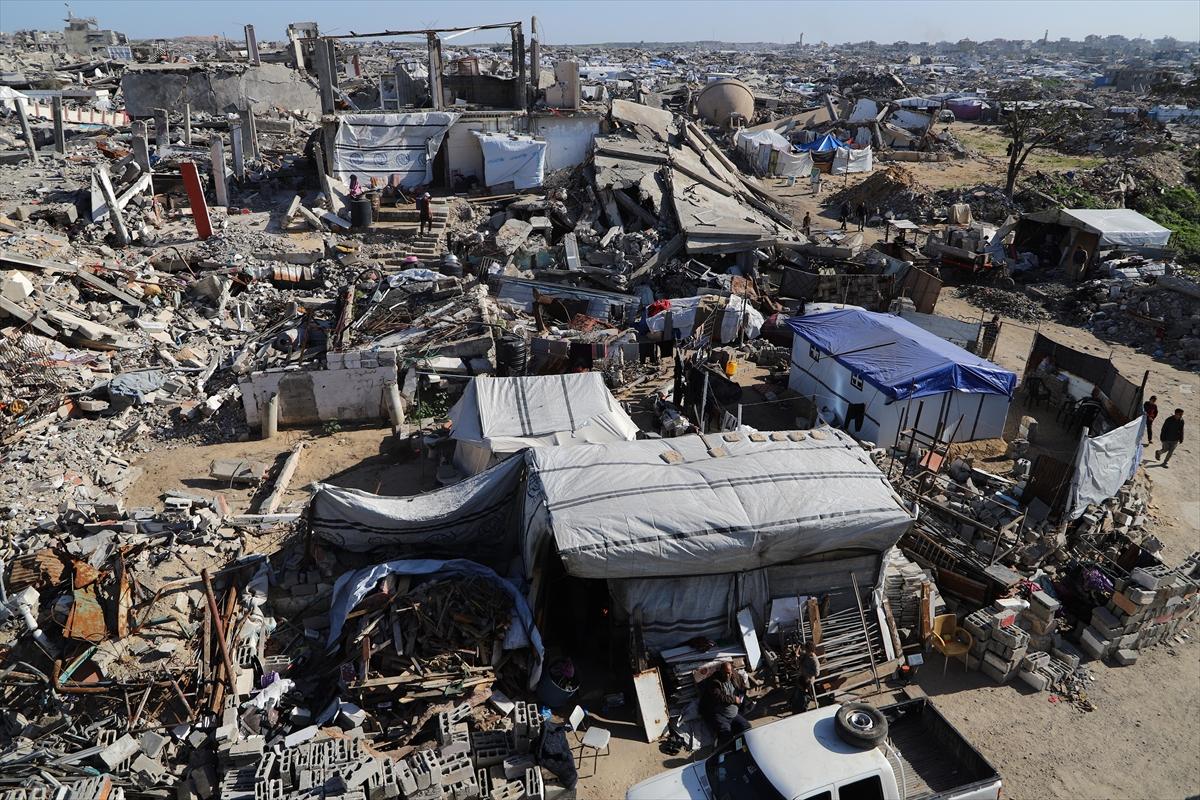
Daily life in Gaza, 10 February 2026 – (Anadolu Agency)
A statement from the Gaza government’s Media Office reported that Al-Aqsa Martyrs Hospital in Deir al-Balah, central Gaza Strip, is at risk of being taken offline due to failure of its main generators.
The statement noted that the first main generator failed three months ago and that the necessary spare parts and fuel for maintenance could not be obtained. It was stated that with the second main generator also now out of service, the hospital’s ability to continue operations is under threat.
The hospital is currently operating on two small generators in a fragile state, which cannot guarantee the sustainability of medical services. It was stated that hundreds of patients and injured persons in critical units, including intensive care and neonatal units and operating theaters, are at risk of losing their lives.
The statement warned that if this situation continues, hospital services may cease entirely, and called for urgent intervention to supply the necessary fuel and spare parts for generator maintenance.
A fire in tents housing displaced Palestinians in the central Gaza city of Deir al-Balah resulted in loss of life. According to health sources, 16-year-old Shahd Mahmoud al-Madhoun died at the scene of the fire.
It was reported that 2-year-old Adam also died after being admitted to hospital with severe injuries. The fire injured 43-year-old mother Enam al-Madhoun and her 1-year-old daughter Sidra, who were transported to Al-Aqsa Martyrs Hospital.
Eyewitnesses reported that the fire broke out while the mother was preparing food for her children and spread rapidly. Flames jumped to an adjacent tent, and both tents were completely consumed. It was stated that power outages and fuel shortages have increased fire risks due to the methods used for heating and cooking.
Anadolu Ajansı. "Aylar Sonra Kısıtlamalarla Açılan Refah Kapısı’ndan Filistinlilerin Sınırlı Geçişleri Sürüyor." Accessed February 16, 2026. https://www.aa.com.tr/tr/dunya/aylar-sonra-kisitlamalarla-acilan-refah-kapisindan-filistinlilerin-sinirli-gecisleri-suruyor/3829023
Anadolu Ajansı. “Ateşkesi İhlal Eden İsrail Ordusu Gazze Şeridi’ne Yönelik Saldırılarını Sürdürüyor.” Accessed February 16, 2026. https://www.aa.com.tr/tr/dunya/ateskesi-ihlal-eden-israil-ordusu-gazze-seridine-yonelik-saldirilarini-surduruyor/3827574
Anadolu Ajansı. “Ateşkesi İhlal Eden İsrail’in Gazze’de Sürdürdüğü Saldırılarda 2 Filistinli Yaralandı.” Accessed February 16, 2026. https://www.aa.com.tr/tr/dunya/ateskesi-ihlal-eden-israiin-gazze-de-surdurdugu-saldirilarda-2-filistinli-yaralandi/3829810
Anadolu Ajansı. “İsrail Ateşkesi İhlal Ederek Gazze Şeridi’ne Saldırılarını Sürdürdü.” Accessed February 16, 2026. https://www.aa.com.tr/tr/dunya/israil-ateskesi-ihlal-ederek-gazze-seridine-saldirilarini-surdurdu/3831151
Anadolu Ajansı. “İsrail Gazze’ye Dönüşü Engellemek İçin Para Teklifi ve Tehditlere Başvuruyor.” Accessed February 16, 2026. https://www.aa.com.tr/tr/dunya/israil-gazzeye-donusu-engellemek-icin-para-teklifi-ve-tehditlere-basvuruyor/3829865
Anadolu Ajansı. “İsrail Ordusu Ateşkese Rağmen Gazze’nin Kuzeyini Bombaladı.” Accessed February 16, 2026. https://www.aa.com.tr/tr/dunya/israil-ordusu-ateskese-ragmen-gazzenin-kuzeyini-bombaladi-/3830280
Anadolu Ajansı. “İsrail Ordusu Gazze’de Filistinlilere Ait Yapıları Patlatarak Yıkmaya Devam Ediyor.” Accessed February 16, 2026. https://www.aa.com.tr/tr/dunya/israil-ordusu-gazze-de-filistinlilere-ait-yapilari-patlatarak-yikmaya-devam-ediyor/3828958
Anadolu Ajansı. “İsrail’in Ateşkesi İhlal Ederek Gazze’ye Düzenlediği Saldırılarda 12 Filistinli Hayatını Kaybetti.” Accessed February 16, 2026. https://www.aa.com.tr/tr/dunya/israilin-ateskesi-ihlal-ederek-gazze-ye-duzenledigi-saldirilarda-12-filistinli-hayatini-kaybetti/3830385
Anadolu Ajansı. “İsrail’in Gazze’de Düzenlediği Saldırılarda 8 Filistinli Hayatını Kaybetti.” Accessed February 16, 2026. https://www.aa.com.tr/tr/dunya/israilin-gazzede-duzenledigi-saldirilarda-8-filistinli-hayatini-kaybetti/3827025
The Israeli military continued violating the ceasefire, which came into effect on 10 October 2025, on the first day of Ramadan. On 18 February, two Palestinians were killed in attacks on the Gaza Strip.
According to information provided by Al-Nasir Hospital in the city of Han Yunus in southern Gaza, intense fire was opened from Israeli military vehicles in the eastern districts of Han Yunus starting in the early hours of 18 February. Israeli military vehicles opened fire near the Morag Corridor close to the town of Refah, while artillery units bombed the eastern areas of the Bureyc Refugee Camp. Israeli military vehicles also opened fire on the eastern districts of the town of Beit Lahiya, and artillery units bombed the eastern part of the Zeytun neighborhood in the southeast of Gaza City.

Gaza, 18 February 2026 - (Anadolu Agency)
On the second day of Ramadan, the Israeli military launched intense attacks on the northern and southern parts of the Gaza Strip. Israeli warplanes carried out intense airstrikes on the eastern neighborhoods of Gaza City, while artillery fire was simultaneously conducted in surrounding areas. The Israeli military fired illumination flares into the eastern districts of the Sucaiyye neighborhood and carried out at least two airstrikes in the towns of Han Yunus and Refah. The Mevasi area west of Refah was also targeted by artillery units.
According to data from Gaza’s Ministry of Health, from the ceasefire’s entry into force on 10 October 2025 until 19 February 2026, Israeli attacks resulted in 611 people killed, 1,630 injured, and 726 bodies recovered from under the rubble.
Since October 2023, the total number of people killed in Israeli attacks on the Gaza Strip has reached 72,069, with the number of injured rising to 171,728.
On 20 February, Argentine President Javier Milei reiterated his support for the Gaza Peace Council, led by U.S. President Donald Trump and announced that Argentina is ready to send a peace force to Gaza. Speaking at the council’s meeting in Washington, Milei stated that lasting peace can only be achieved through an arrangement grounded in fundamental human rights.
Milei emphasized that Argentina’s experience in peace operations serves as a strong reference and that this capacity could be utilized within an international stability force framework. It was also announced that Argentina’s “White Helmets” (Cascos Blancos) teams, operating under the Ministry of Foreign Affairs, are prepared to support humanitarian efforts in Gaza.
The Israeli military carried out airstrikes and artillery fire across the northern, central, and southern areas of the Gaza Strip. Two airstrikes were conducted in the eastern parts of the Sucaiyye and Tuffah neighborhoods in eastern Gaza City. Intense fire was opened against homes of civilians and tents of displaced persons in the Zeytun neighborhood in the southeast of the city, along with intermittent artillery fire.
Buildings and facilities in the eastern part of the Bureyc Refugee Camp in central Gaza were destroyed by explosives.
It was reported that intense fire was opened from Israeli military vehicles in the eastern areas of Han Yunus in southern Gaza.
In Israeli attacks, one Palestinian was killed and one child was injured. It was reported that one person was killed after being shot while allegedly crossing the “Red Line” in southern Gaza. In the northern town of Jabaliya, a child was injured after Israeli forces opened fire on tents housing displaced civilians. Additionally, it was reported that the body of a previously killed Palestinian was recovered in the Netzarim area.
UNRWA announced that humanitarian conditions in Gaza are severe and access to aid remains restricted. The statement noted that healthcare, education, shelter, and food assistance continue to be provided to displaced Palestinians, but that the amount of aid permitted to enter falls far below actual needs. It was stated that Israel’s restrictions on humanitarian aid deliveries continue and that this situation has worsened living conditions across Gaza.
It was reported that approximately 90 percent of homes in the Gaza Strip have been destroyed and that over one million Palestinians are forced to live in makeshift tents. It was reported that civilians living in tents without electricity or water are enduring Ramadan under harsh conditions. A significant portion of the tents have been erected on the ruins of mosques and homes, and families unable to find shelter are trying to live among the debris of collapsed buildings. It was recorded that access to food, water, and fuel is severely limited due to restrictions on their entry.
The Israeli military arrested 14 Palestinians, including one child, during raids on the West Bank cities of Jenin, Tulkarem, and Salfit. In an attack on the village of Malih in the northeastern Aghwar region of the West Bank, one Palestinian was injured, vehicles were set on fire, and property was damaged.
It was reported that the Village Council Chairman, Mehdi Diragme, was beaten and injured during the attack. In the Masafer Yatta region of Hebron, a Palestinian woman was beaten and injured, and in the Ramallah area, eight container homes belonging to a Bedouin community were set on fire.
Hamas stated that in its attack on the Ayn al-Hilweh camp in Sidon, Lebanon, Israeli forces targeted the headquarters of joint security forces within the camp. The statement emphasized that the attack constituted a violation of Lebanese sovereignty and called on the international community to take action against Israel.
On 21 February, it was reported that in the central Gaza city of Deir al-Balah, the displaced Salman family was sheltering under the remaining dome of the Osman Mosque, which was destroyed in Israeli attacks. It was noted that the family broke their fast amid rubble, accompanied by the sounds of warplanes and gunfire. The family stated that they were forcibly displaced from Jabaliya approximately four months ago and, having found no alternative shelter, are using the mosque’s dome as a refuge.
It was reported that across Gaza, civilians face severe difficulties accessing basic needs due to restrictions on food, water, and fuel and that finding even a single meal for iftar is difficult.
The Israeli military continued its attacks on various areas of the Gaza Strip on 21 February, despite the ceasefire agreement that came into effect on 10 October 2025. Israeli warplanes carried out an airstrike on the town of Beni Suheyla, located east of Han Yunus, with the attack occurring simultaneously with intense naval fire from Israeli naval vessels off the coast of Han Yunus.
Additionally, the Tuffah neighborhood in eastern Gaza City was targeted by artillery fire, and intense fire was opened from armored vehicles toward the northeastern regions. It was reported that since the ceasefire began on 10 October 2025, over 600 people have been killed and more than 1,600 injured in Israeli attacks in Gaza.
It was reported that in Israeli attacks on Gaza, at least two Palestinians were killed and five were injured. Usame Ahmed al-Najjar (46) was killed in an airstrike on the Kizan al-Najjar area of Han Yunus. In the Jabaliya region of northern Gaza, Macid Abu al-Awf was killed by munitions fired from an Israeli drone.
In the Sucaiyye neighborhood in eastern Gaza City, three people were injured, one seriously, due to gunfire, and numerous other injuries were recorded in various areas.
According to data from Gaza’s Ministry of Health, the number of people killed in Israeli attacks since October 2023 has risen to 72,070, with the number of injured reaching 171,738. Since the ceasefire began on 10 October 2025, 612 people have been killed, 1,640 injured, and 726 bodies recovered from under the rubble. It was stated that thousands of bodies remain buried under rubble across Gaza.
The Israeli military injured and arrested numerous Palestinians, including one child, during raids across various areas of the West Bank. During a raid on the Amari Refugee Camp near Ramallah, two Palestinians were injured, and in the eastern town of Beit Furik near Nablus, two people, including a 16-year-old child, were injured by gunfire.
Additionally, it was reported that a Palestinian was beaten and injured in the Masafer Yatta region of Hebron and that Palestinian Red Crescent teams were obstructed in their work. It was reported that the Israeli military issued a demolition order for a football field built for children in the Hirbet Um al-Hayr village of Masafer Yatta.
It was reported that 11 Palestinian families from the Halayil Bedouin community near Ramallah in eastern West Bank were forcibly displaced following attacks. The families, totaling 55 people, were forced to leave the area due to pressure from the Israeli military and Israeli settlers occupying Palestinian land. It was stated that this community had previously been forcibly displaced in a similar manner and that settlement activities and daily attacks continue.
The 21st “Ship of Kindness,” prepared by the Turkish Red Crescent, arrived at Egypt’s El Arish Port carrying approximately 3,300 tons of humanitarian supplies and 175,000 food parcels. It was stated that the shipment is planned to be delivered to Gaza via the Refah Border Crossing.
Turkey’s Ambassador to Cairo, Salih Mutlu Sen announced that the total amount of humanitarian aid sent by Turkey to Gaza has reached 110,000 tons. He also stated that various humanitarian support plans, including the provision of 20,000 mobile homes and the establishment of a field hospital, are ready.
On 22 February, the Israeli military carried out airstrikes and artillery fire on various areas of the Gaza Strip, in violation of the ceasefire agreement in effect since 10 October 2025. Israeli warplanes targeted the eastern areas of the town of Refah in southern Gaza. Additionally, Israeli military vehicles opened fire on the eastern areas of Han Yunus, and Israeli naval forces conducted intense fire toward the Han Yunus coastline.
In Gaza City, airstrikes were carried out on eastern areas, with these areas simultaneously hit by artillery fire. In the northern town of Beit Lahiya, Besme Azzam Bennat (27) was killed by Israeli gunfire. The attacks occurred in an area outside the zone designated for Israeli military control under the ceasefire agreement.
Gaza’s Ministry of Health released updated casualty figures regarding Israeli attacks. The statement noted that in the past 24 hours, two dead and three injured were brought to hospitals in Gaza. Accordingly, since the ceasefire began on 10 October 2025, 614 people have been killed, 1,643 injured, and 726 bodies recovered from under the rubble.
Additionally, it was reported that since October 2023, the total number of people killed in attacks on the Gaza Strip has reached 72,072, with the number of injured rising to 171,741. It was stated that thousands of bodies remain buried under rubble in the Gaza Strip.
It was reported that two-year-old Nidal Abu Rabi, who was scheduled to be evacuated abroad for medical treatment, could not be taken out of the region due to closed border crossings and limited patient exits, and died.
According to the family’s statement, Nidal’s evacuation for advanced testing and treatment had been arranged, but the necessary exit permit was not granted. Nidal’s mother, Iman Hamduna, stated that her child had been diagnosed with an enlarged spleen and liver, that evacuation procedures had been ongoing for over nine months, yet no exit permit was issued.
It was reported that another child from the same family, Rital, is currently receiving treatment at the Al-Aqsa Martyrs Hospital in Gaza. Palestinian Ministry of Health spokesperson Khalil al-Darhan stated that there are over 20,000 patients in Gaza waiting to be evacuated abroad for treatment, and that severe difficulties are being experienced in evacuating critically ill patients. Darhan emphasized that opening the Refah Border Crossing is vital. The statement also noted that approximately 22,000 patients and injured persons in Gaza are waiting to leave the area for treatment.
Israeli Security Cabinet Minister Zeev Elkin announced that Israel will not provide financial contributions to the Peace Council established for Gaza’s reconstruction. Speaking to Israel’s state television channel KAN, Elkin said the Tel Aviv government had informed the United States of this decision. Elkin stated that Israel sees no reason to fund reconstruction activities in Gaza.
The report indicated that this decision was made to appease far-right Finance Minister Bezalel Smotrich and National Security Minister Itamar Ben-Gvir, who had objected to Israel’s membership in the Peace Council.
The first meeting of the Peace Council, whose founding members include Turkey, was held in Washington on 19 February 2026 under the presidency of U.S. President Donald Trump. Trump announced at the meeting that the United States will contribute $10 billion to the Peace Council and that Kazakhstan, Azerbaijan, the United Arab Emirates, Morocco, Bahrain, Qatar, Saudi Arabia, Uzbekistan, and Kuwait have collectively pledged over $7 billion in donations.
Germany’s Christian Democratic Union (CDU), led by Chancellor Friedrich Merz, called for the suspension of aid payments made through the United Nations Relief and Works Agency for Palestine Refugees in the Near East (UNRWA) in Gaza.
At a party congress held in Stuttgart, a resolution was adopted calling for the termination of financial support for UNRWA in Gaza. According to the resolution, German and European Union funds will not be released unless the Palestinian administration meets specified conditions. Furthermore, future aid is requested to be delivered through the United Nations High Commissioner for Refugees (UNHCR) and other international organizations.
On 23 February, European Union High Representative for Foreign Affairs and Security Policy Kaja Kallas announced that the EU wants to be part of the peace process in Gaza. Speaking to the press before the EU Foreign Ministers’ Meeting in Brussels, Kallas stated that the EU seeks a more visible and active role in the Gaza process.
Kallas indicated that, in this context, the EU particularly needs Israel’s approval for the training of Palestinian police officers. The statement constituted a diplomatic declaration expressing the EU’s desire to join the process following the first meeting of the Gaza Peace Council in Washington.
Gaza’s Ministry of Health announced that the number of people killed in Israeli attacks on the Gaza Strip has risen to 72,073. According to the ministry’s written statement, in the past 24 hours, one dead and eight injured were brought to hospitals in Gaza. Accordingly, since the ceasefire began on 10 October 2025, 615 people have been killed, 1,651 injured, and 726 bodies recovered from under the rubble.
On 23 February, Hamas official Mahmud Mardawi warned that the treatment of Palestinian prisoners held in Israeli prisons could lead to “an explosion”. In his written statement, Mardawi expressed strong condemnation of the treatment of Palestinians in prisons, particularly in the Negev Prison in southern Israel. The statement indicated that the Israeli government is pursuing aggressive policies aimed at breaking the will and weakening the determination of Palestinian prisoners, that medical neglect has increased during Ramadan, and that prisoners are being deprived of basic needs such as food and drink.
Mardawi emphasized that Israel is fully responsible for the consequences of these developments, particularly for the lives of sick and elderly Palestinian prisoners. He also called on Palestinians in Jerusalem and the West Bank and the Islamic world to organize demonstrations and events in support of the prisoners held in Israeli prisons.
Palestinians returning to the Gaza Strip through the Refah Border Crossing have been subjected to lengthy interrogations and delays on the Palestinian side of the border. The Refah Border Crossing, closed since May 2024, was opened in a limited manner on 2 February 2026, but crossings remain highly restricted. Regarding 23 February, it was stated that 50 Palestinians returned to the Gaza Strip the previous evening.
Palestinian Abu Said al-Hubeyl said that the Israeli military summoned certain individuals for questioning and that returning individuals were kept waiting in buses for approximately five hours. Hubeyl said that only one person at a time was summoned for questioning and that the process lasted between 30 and 45 minutes.
Palestinian Ummu Abdulaziz Sersak said she traveled for approximately 20 hours from Egypt to Han Yunus and that the United Nations bus carrying returnees stopped at the Al-Nasir Hospital. Sersak described the procedures on the Palestinian side of the border as “provocative”, stating that fasting adults and children were kept waiting in buses for hours.
In the same context, Hamas stated that Israel is carrying out systematic violations involving physical and psychological harm and harsh interrogation methods against those returning to Gaza. The statement indicated that Israel is violating the operational mechanisms at the Palestinian side of the border and failing to comply with agreed numbers for two-way crossings.
On 25 February, Gaza’s Ministry of Health announced that the number of people killed in Israeli attacks on the Gaza Strip has risen to 72,082. According to the ministry’s written statement, in the past 24 hours, three Palestinians were killed and four injured in Israeli military attacks. Additionally, it was stated that the bodies of six Palestinians killed in previous attacks were recovered, but that bodies remain buried under rubble. The statement also noted that civil defense teams conducting rubble clearance operations are experiencing equipment shortages.
According to the figures, since October 2023, total casualties in Gaza have reached 72,082 killed and 171,761 injured. Since the ceasefire declared on 10 October 2025, 618 Palestinians have been killed, 1,663 injured, and 732 bodies recovered from under the rubble.
On 25 February, at least three Palestinians were killed in Israeli military attacks on various areas of the Gaza Strip. According to hospital sources, one Palestinian was killed and many others injured in an attack by an Israeli drone targeting a group of civilians in the Bi’r 19 area of the Mevasi region of Han Yunus. The body of the deceased and the injured were transferred to Al-Nasir Hospital.
In the central Gaza city of Deir al-Balah, one civilian was killed in an Israeli military attack. Additionally, it was reported that a Palestinian was injured after Israeli forces opened fire near a school housing displaced persons in the Jabaliya Refugee Camp.
Local sources reported that Israeli warplanes carried out airstrikes on the eastern part of the Zeytun neighborhood in Gaza City, and that artillery fire and armed attacks were carried out in northern areas of the Gaza Strip, particularly in the eastern part of Gaza City. It was also reported that Israeli forces targeted areas east of the Bureyc Refugee Camp.
London-based independent research organizations Earshot and Forensic Architecture published a joint report revealing that Israeli forces killed first aid and civil defense personnel in the Tel es-Sultan region of southern Gaza on 23 March 2025 by firing 910 rounds.
The report included analysis based on audio recordings, mobile phone footage, satellite imagery, and testimonies from two surviving Palestinians. According to the findings, Israeli soldiers fired at least 910 rounds at health and civil defense workers. In the first five minutes and 30 seconds, 844 rounds were fired, and it was determined that 93 percent of the gunfire recorded in the first minutes of the two-hour attack was directly aimed at ambulances and fire trucks.
The report indicated that Israeli soldiers were positioned on a raised sand dune beside the road, clearly visible to the ambulances and fire trucks with their roof lights on. After firing from this position for a time, soldiers moved toward the vehicles and killed some aid workers at close range. According to witness accounts, approximately 30 Israeli soldiers were present at the scene, of whom at least five fired simultaneously at health and civil defense workers.
According to the report, on 23 March 2025, Israeli soldiers directly opened fire on 14 health and civil defense personnel and one United Nations worker, killing them in ambulances and a fire truck in the Tel es-Sultan region of southern Gaza.
It was reported that of those killed in the attack, eight were from the Palestinian Red Crescent, six were civil defense personnel, and one was a UN worker. Some of the bodies recovered from the targeted area in Refah had their hands tied, others had been shot in the head and chest, one had his head severed, and others were found with dismembered bodies buried in a deep pit. The Palestinian Red Crescent medical worker Esad Nasasra, who survived the attack, was detained and taken to a detention center by Israeli soldiers.
While international criticism continues over Israel’s systematic targeting of health and civil defense personnel in attacks on the Gaza Strip, Israel has continued to issue denials and defenses. Israeli Defense Minister Gideon Saar claimed that Israeli soldiers “did not target an ambulance at random” and that the vehicle in question “approached soldiers in a suspicious manner”.
On the other hand, the Israeli military, in a statement implying admission of targeting the vehicles, said: “Following the initial investigation, some of the suspect vehicles were determined to be ambulances and fire trucks.”
Following Israel’s revocation of operating licenses for 37 international organizations delivering humanitarian aid to the Gaza Strip, 57 personnel from these organizations left the region through the Kerem Abu Salim Border Crossing on 26 February. According to information from aid organizations operating in the Gaza Strip, Israel’s imposed new conditions include comprehensive security screenings of staff, submission of additional information, and strict monitoring mechanisms that could impede emergency response speed. Some organizations have labeled these conditions as “arbitrary” and refused to comply.
It was reported that the reduction in the number of international aid organizations will disrupt programs in the areas of health, food security, water, hygiene, sanitation, and psychological support, at a time when hundreds of thousands depend on humanitarian aid to survive.
Médecins Sans Frontières Gaza Emergency Coordinator Claire Nicolet stated that Israel has banned them from continuing operations in Gaza, forcing international staff to leave the region. Nicolet highlighted the scale of MSF’s support to Gaza’s health system, noting that they support one in every five hospital beds, assisted one in every three mothers giving birth in Gaza in 2025, and conducted over 800,000 medical consultations. She also stated that more than 7,000 people have undergone amputations, that care for these patients must continue, and that Gaza’s health system is completely destroyed.
Nicolet said X-ray machines cannot be brought into the region, that medication imports have severely declined in recent days, and that the system is struggling to meet needs due to existing barriers. Nevertheless, she stated they will continue seeking ways to support Palestinians.
Under Israel’s new international civil society organization law, organizations that do not renew their registration will have their operations terminated as of 1 January 2026 and must leave the country by 1 March 2026.
The law, adopted in March 2025, requires aid organizations operating in the region to renew their licenses and, in doing so, submit the identity information of all Palestinian staff for “security investigations”. International aid organizations have expressed concern that Israel may arbitrarily misuse these lists in violation of personal data protection principles.
Organizations whose licenses were revoked are required to close their offices in Israel and occupied East Jerusalem and will be unable to send international experts, doctors, or humanitarian aid to Gaza. Among the affected organizations are numerous international entities including MSF, Oxfam, Norwegian Refugee Council (NRC), Caritas, CARE, and International Rescue Committee (IRC).
The Israeli military, in an attack violating the ceasefire and targeting an area in northern Gaza where civilians had gathered, killed three Palestinians and injured four. According to hospital sources, an Israeli drone targeted civilians gathered in a park in the Tuffah neighborhood in eastern Gaza City. In this attack, two Palestinians were killed and four injured.
On the same day, in an attack by another Israeli drone in the eastern part of the southern Gaza city of Han Yunus, one person was killed. In an Israeli military statement, it was announced that a Palestinian was killed in the southern Gaza Strip while allegedly crossing the “Red Line”, claiming the individual was armed and advancing toward military units.
On 27 February, the Israeli military, in violation of the ceasefire that came into effect on 10 October 2025, carried out attacks on various areas of the Gaza Strip, killing seven Palestinians. According to hospital sources, 36-year-old Ahmed Sa’d Gabn, who was wounded in the abdomen and taken to Shifa Hospital, died there. In the central part of Han Yunus, 37-year-old Iyad al-Attal was killed when a tent in the courtyard of a school near Al-Nasir Hospital was bombed, and a woman and a child were injured in the attack.
In another attack on the northern Gaza town of Beit Lahiya, one more Palestinian was killed. In an airstrike targeting civilians who had gathered for suhoor in the Mevasi region west of Han Yunus, three Palestinians were killed and many others injured.
Additionally, according to a statement by Gaza’s Ministry of Interior, an Israeli attack targeted a police checkpoint on Salahaddin Street at the entrance to the Bureyc Refugee Camp. In the attack, one police officer was killed and another was seriously injured.
Hamas spokesperson Hazem Kassam stated that ongoing Israeli attacks in the Gaza Strip represent open indifference to the efforts of mediators and the role of the Peace Council. In a written statement, Kassam said that Israel’s war against the Palestinian people has changed its methods and form, while statements by guarantor countries regarding the ceasefire have not been matched by concrete action on the ground.
It was reported that Palestinians living in the “Red Line” area, where the Israeli military has withdrawn but continues attacks, have continued to be killed despite the ceasefire.
In this context, 28-year-old Besme Benat Versha Agha, who lives in Beit Lahiya in northern Gaza, was seriously injured by Israeli gunfire after leaving her home to go to work and later died at Shifa Hospital in Gaza City. Her body was buried in the Beit Lahiya cemetery under the surveillance of Israeli military vehicles and snipers. According to family accounts, intense gunfire was opened at the time of the attack, and the injured woman was barely transported to the hospital but could not be saved. She left behind four children.
According to Palestinians living in the same area, the Israeli military fires from behind the Red Line, conducts artillery fire, carries out airstrikes, and in some areas demolishes homes. The Israeli military has established military positions on high hills overlooking residential areas, and Palestinians’ movements are monitored and targeted by military vehicles, snipers, machine gun-equipped cranes, and “Quadcopter”-type drones. Palestinians in the area report that despite these areas being labeled as “safe zones” after the ceasefire, they remain under constant threat of attack.
Gaza Government Media Office Director Ismail Sevabite stated that Israel is using the ceasefire not to halt attacks but to create a new de facto situation in Gaza. Sevabite said Israel is abusing the ceasefire to impose a new security and control regime rather than strengthen stability on the ground. He noted that of the more than 600 Palestinians killed since the ceasefire, 96 were directly targeted and killed by Israeli tanks, drones, and snipers stationed along and around the “Red Line”.
Sevabite also stated that 99 percent of those killed died in areas Israel falsely labeled as “safe” and outside the buffer zone. The statement emphasized that these events are not accidental but constitute a repeated and calculated pattern of violence, calling for an end to targeting civilians, the establishment of a clear monitoring mechanism on the ground, and the implementation of accountability mechanisms for those responsible.
On 28 February 2026, the Israeli military closed all border crossings into the Gaza Strip, including the Refah Border Crossing, citing Iran’s missile strikes as justification. The Coordination of Government Activities in the Occupied Palestinian Territories (COGAT), a unit under the Israeli military, announced that all crossings into the Gaza Strip will remain closed until further notice. It was specified that this decision includes the Refah Border Crossing, Gaza’s only link to the outside world.
The Refah Border Crossing had been closed by Israel for approximately two years before being opened on 2 February 2026 for limited two-way pedestrian crossings. The 28 February decision suspended even this limited access.
Israel claimed that closing all border crossings would not affect the humanitarian situation in Gaza. In contrast, the United Nations has pointed out that even after the ceasefire, Israel’s restrictions have prevented sufficient humanitarian aid from entering Gaza. The current situation is described as a severe humanitarian crisis marked by widespread hunger and shortages of water, medicine, medical supplies, and hygiene materials.
On 28 February, the Israeli military carried out airstrikes, artillery fire, and demolition operations in various areas of the Gaza Strip. Witnesses reported that various areas of the Zeytun neighborhood in eastern Gaza City were targeted by artillery fire and airstrikes. On the same day, the Israeli navy targeted fishing boats and opened fire on the waters off Gaza City and northern Gaza Strip.
It was reported that the Israeli military demolished several buildings in the eastern areas of Han Yunus in southern Gaza using explosives and opened intense fire in the Mevasi region northwestern of Refah.
According to health officials, two Palestinians were injured after the Israeli navy targeted fishing boats and opened fire on the Sheikh Aclin area in southwestern Gaza City. Additionally, a Palestinian woman was injured in the foot after Israeli soldiers opened fire in the Mevasi region west of Han Yunus.
In one of the day’s prominent attacks, during an artillery strike by the Israeli military near the Yusatre area in the eastern part of Gaza City’s Zeytun neighborhood, 15-year-old Abid Raid Radi was killed and 16-year-old Selman Yahya al-Melalha was injured.
Gaza’s Ministry of Health released updated figures regarding Israeli attacks on the Gaza Strip. According to its written statement on 28 February, nine dead and 19 injured were brought to hospitals in Gaza in the past 24 hours. According to the statement, since the ceasefire began on 10 October 2025, 628 people have been killed, 1,686 injured, and 735 bodies recovered from under the rubble.
Meanwhile, since October 2023, the total number of people killed in attacks on the Gaza Strip has reached 72,095, with the number of injured rising to 171,784.
According to the Gaza Ministry of Health, the total number of people killed in Israeli attacks since October 2023 has risen to 72,096, with the number of injured reaching 171,791. Since the ceasefire began on 10 October 2025, 629 people have been killed, 1,693 injured, and 735 bodies recovered from under the rubble.
The Palestinian Ministry of Agriculture reported that between 19 and 27 February, agricultural damage in the occupied territories exceeded $1.3 million. It was reported that 618 trees were uprooted, 76 livestock animals were killed or burned, and 100 livestock animals were stolen. The damage was concentrated most heavily in the cities of Hebron and Beit Lahia. The ministry emphasized that these violations threaten the livelihoods of thousands of Palestinian families.
The Israeli military targeted various areas of the Gaza Strip with airstrikes and artillery fire despite the ceasefire. Han Yunus’s east, the east of Deir al-Balah, and the eastern neighborhoods of Gaza City—Zeytun, Sucaiyye, and Tuffah—as well as the east and north of Beit Lahiya were bombed.
On 2 March, total casualties rose to 72,097 killed and 171,796 injured. Since the ceasefire, 630 people have been killed and 1,698 injured.
Israel, citing the risk of Iranian retaliation, decided to gradually reopen the Kerem Abu Salim Border Crossing, which it had closed on 28 February for humanitarian aid.
On 3 March, the bodies of 18 Palestinians recovered from rubble and two injured persons were brought to hospitals. Total casualties rose to 72,116 killed and 171,798 injured. Since the ceasefire, 631 people have been killed and 1,700 injured.
Basim Nacih al-Saka was killed by Israeli gunfire in the “Satr al-Sharqi” region north of Han Yunus. Witnesses stated that the area was outside the zone designated for Israeli military presence and control under the agreement. It was reported that Israeli warplanes carried out airstrikes on the east of Han Yunus and that Israeli naval forces bombarded the city’s coastline.
On 4 March, total casualties rose to 72,117 killed and 171,801 injured. Since the ceasefire, 633 people have been killed and 1,703 injured.
On 5 March 2026, total casualties rose to 72,120 killed and 171,802 injured. Since the ceasefire, 636 people have been killed and 1,704 injured.
According to the Palestinian Football Association (PFA), 1,007 athletes, 45 of them women, have been killed in Israeli attacks. Of those killed, 565 were football players and 317 competed in Olympic sports; the Palestinian Scouts and Guidance Union has also lost 125 athletes. Of 265 sports facilities, 184 were completely destroyed and 81 partially damaged.
A 12-year-old child was killed by gunfire near the Khalifa School in northern Gaza. A 54-year-old Palestinian was killed in a bombing in Tuffah neighborhood, and another Palestinian was shot dead with live ammunition in Sucaiyye neighborhood. A 22-year-old youth was injured in a drone attack on Tuffah.
WHO Eastern Mediterranean Regional Director Hanan Balkhy stated that medical supply stocks have dropped critically, and fuel shortages are restricting hospital operations. Medical evacuations through the Refah and Kerem Abu Salim border crossings have been suspended since 28 February.
UN spokesperson Dujarric reported that over 900 of the 1,500 shelters in Gaza are at risk of flooding and noted that the entry of shelter materials remains largely restricted.
On 6 March, a 12-year-old child near the Khalifa School in northern Gaza, a 54-year-old Palestinian in Tuffah neighborhood, and another Palestinian in Sucaiyye neighborhood were killed in Israeli attacks. Six people were injured in attacks in Tubas. It was reported that Israeli settlers attempted to steal dozens of livestock animals in Akaba village, opened live fire on villagers, and detained seven for a period.
Kosovo Defense Minister Ejup Maqedonci announced that Kosovar soldiers are expected to be deployed to Gaza within a few months as part of the “International Stability Force.” Maqedonci emphasized that Kosovo, despite not being a UN member, will participate for the first time in a mission authorized by the UN, noting that FSK Commander Bashkim Jashari met with International Stability Force Commander Jasper Jeffers.
On 7 March 2026, Israeli warplanes carried out airstrikes on the Tuffah neighborhood. The navy opened random fire on Gaza’s coastline, and artillery units bombarded the area. In a bombing attack in the center of Han Yunus, Ahmed Muhammad al-Kudra (34) was killed and his daughter seriously injured. Witnesses stated the attack occurred in an area outside the Israeli military’s designated control zone.
Total casualties rose to 72,123 killed and 171,805 injured. Since the ceasefire, 640 people have been killed and 1,707 injured.
UN rapporteurs reported that the genocide in Gaza has spread to the West Bank, noting that 144 Palestinians were killed in Jerusalem Governorate between 2021 and 2025 and that 73,871 settler incursions were carried out at the Al-Aqsa Mosque complex in 2025 alone.
Indonesia’s Foreign Minister Sugiono announced that all discussions regarding the U.S.-led Peace Council for Gaza have been suspended due to military tensions in the region. In the Ras al-Ahmar region of Tubas, 10 people, including two women, were injured in an attack by Israeli settlers.
On 8 March, total casualties rose to 72,126 killed and 171,809 injured. Since the ceasefire, 641 people have been killed and 1,711 injured.
In a joint statement by the Palestinian Prisoners Society on International Women’s Day, it was reported that since Israel launched its genocide in Gaza, it has arrested 700 Palestinian women. Of the 72 women still imprisoned, most are held in Damon Prison; 19 are ill, 32 are mothers, and three are minors. Seventeen women have been detained without charge as “administrative detainees.” It was reported that 60 Palestinians from 11 families have begun evacuating their homes in eastern Nablus due to increasing attacks by Israeli settlers.
On 9 March, total casualties rose to 72,133 killed and 171,826 injured. Since the ceasefire, 648 people have been killed and 1,728 injured.
The Israeli military killed three Palestinians, including two children and injured 10 people, including three children in an attack on tents of displaced persons in the Suvarha area of Nusayrat Refugee Camp. In a second attack on the same area, Nur Salih al-Shalalife (30), Selsebil Enver Ferrac (12), and journalist Amal Muhammad Shamali (46) were killed. In an airstrike on a gathering of civilians near the Ketibe Mosque, three Palestinians were killed, including a health worker, and three others were injured. In Tuffah neighborhood, Imad Fulful (30) was killed in a drone attack and two others were injured. Witnesses stated the attack occurred in an area outside Israeli control under the ceasefire agreement.
The number of journalists killed in Gaza since 7 October 2023 has reached 261. Hamas spokesperson Hazim Kassam stated that Israel is exploiting the focus on Iranian attacks to escalate massacres and has tightened the siege by closing the Refah border crossing.
The Israeli military heavily bombed the Zeytun and Sucaiyye neighborhoods and carried out airstrikes on central areas of the Strip. The navy opened random fire on Gaza City’s coastline. Three of four people crossing the Red Line in the north were shot dead; the fate of the fourth remains unreported. Three Palestinians were killed in a tunnel in Refah. In Han Yunus, a house belonging to the Kudra family and a tent with internet access in Sheikh Aclin were targeted by airstrikes. In Zuwayda, the Telbani family home was targeted by a missile, killing one person and injuring two.
On 10 March, total casualties in Gaza rose to 72,134 killed and 171,828 injured. Since the ceasefire, 649 people have been killed, 1,730 injured, and 756 bodies recovered from under the rubble.
Israeli prison authorities launched simultaneous raids on Palestinian prisoner cells in all prisons. Clubs, sound bombs, and pepper gas were used; some prisoners were injured and taken to hospitals. Hamas labeled the raids a “new war crime.”
Gaza government media office director Ismail Sevabite stated that Israel has reduced aid deliveries to Gaza by 10 percent following its war with Iran. Of the 6,000 aid trucks required, only 640 were allowed in; of 7,400 fuel trucks, only 1,081 were permitted. So far, only 36,720 of the 88,800 required trucks have reached Gaza, meeting only about 41 percent of actual needs. It was stated that restrictions threaten the food security of over 1.5 million people. Only 50 people were allowed to enter the Ibrahim Khalil Mosque in Hebron for prayers.
According to the Gaza Ministry of Health’s 11 March statement, in the past 24 hours, one body recovered from rubble and two injured persons were brought to hospitals. Since the ceasefire began on 10 October 2025, 650 people have been killed, 1,732 injured, and 756 bodies recovered from under the rubble. Since Israel began attacks on the Gaza Strip in October 2023, total casualties have reached 72,135 killed and 171,830 injured.
On 11 March, an Israeli drone attacked a stall selling household goods in western Gaza City, killing one Palestinian and injuring five. The injured were transferred to Shifa Hospital. According to Palestinian authorities, over 650 people have been killed in Israeli attacks since the ceasefire began.
On the same day, Israeli warplanes carried out airstrikes on a government building housing dozens of displaced families in Gaza City. After the attack, a fire broke out in the building, and flames spread to nearby tents housing displaced Palestinians.
According to the Gaza Civil Defense Directorate, Israeli forces targeted a building, causing a fire in the Ensar area of western Gaza City that was brought under control by civil defense teams.
On 12 March, the Israeli military, continuing its daily violations of the ceasefire agreement that came into effect on 10 October 2025, carried out attacks against Palestinians. According to local sources, the Israeli military launched intense artillery fire targeting the Zeytun, Sucaiyye, and Tuffah neighborhoods in eastern Gaza City. Helicopters opened intense fire on various areas of Gaza, and Israeli warplanes carried out airstrikes on areas under Israeli military control in eastern Gaza City.
On the western side of Gaza, Israeli warships opened heavy machine gun fire near the Shati Refugee Camp coastline and tents of displaced Palestinians near the fishing port.
Israeli warplanes carried out two airstrikes on the area designated as the “Red Line” east of Han Yunus, while the Mevasi region northwest of Refah was simultaneously subjected to artillery fire. According to the official Palestinian agency WAFA, a child injured by Israeli forces in northern Gaza’s Beit Lahiya later died. Five-year-old Palestinian Semih Shihab Semih Maruf died from wounds sustained after Israeli soldiers opened direct fire on him.
According to the Gaza Ministry of Health’s 12 March statement, one Palestinian killed in Israeli attacks and nine injured were brought to hospitals in the past 24 hours. The statement emphasized that Israeli obstruction has hampered rescue efforts, noting that “Due to inability to reach victims, many bodies remain under rubble and on streets.”
Since the ceasefire began on 10 October 2025, casualties have risen to 651 killed and 1,741 injured, with 756 bodies recovered from under the rubble. Since Israel began attacks on 7 October 2023, total casualties have reached 72,136 killed and 171,839 injured.
According to the Gaza Ministry of Health’s 15 March statement, in the past 24 hours, five bodies and eight injured were brought to hospitals. Since the ceasefire began, 663 people have been killed, 1,762 injured, and 756 bodies recovered from under the rubble. Since October 2023, total casualties have reached 72,239 killed and 171,861 injured.
In Israeli airstrikes on central Gaza, 12 Palestinians were killed, including two children. According to the Gaza Ministry of Interior, Israeli warplanes targeted a police vehicle near the ez-Zevaide area in the central Gaza city of Deir al-Balah. Police Chief Brigadier General Iyad Abu Yusuf and seven officers were killed in the attack.
In another Israeli airstrike in central Gaza, four Palestinians were killed, including two children. It was reported that an Israeli drone targeted a house in the es-Suvaritha area of central Gaza.
In a statement from the Coordination of Government Activities in the Occupied Palestinian Territories (COGAT), it was announced that the Refah Border Crossing will be reopened on 18 March for limited two-way pedestrian crossings.
According to Israeli media, under this mechanism, Egypt will submit a list of individuals to be allowed to cross the border 24 hours in advance, and Israel will grant approval for their passage.
The Israeli military had previously announced on 28 February that all crossings into the Gaza Strip, including the Refah Border Crossing, Gaza’s only link to the outside world, would remain closed until further notice. The United Nations (UN) has emphasized that even after the ceasefire, Israel’s restrictions have prevented sufficient aid from entering Gaza.
On 16 March, in the Mevasi region of southern Gaza, a wall collapsed onto tents of displaced Palestinians, killing three, including one child. According to the General Directorate of Civil Defense, a wall from the Er-Ribat complex in Han Yunus collapsed onto tents of displaced persons in Mevasi.
Approximately 1.9 million of Gaza’s 2.4 million population are displaced Palestinians who, after losing their homes to Israeli attacks, are struggling to survive in damaged tents without basic living conditions. Thousands of Palestinians are forced to live in partially or fully damaged buildings at risk of collapse due to lack of safe alternatives.
According to the Ambulance and Emergency Services Directorate, on 16 March, the Israeli military targeted a group of Palestinians gathered on Saftavi Street in northern Gaza City. In the attack, one Palestinian was killed and five injured, two of whom were in critical condition.
According to local health sources, Mahmoud al-Kara, injured by Israeli soldiers near the Al-Nasir Hospital in Han Yunus the previous day, also died.
According to the Gaza Ministry of Health’s 16 March statement, eight dead and 17 injured were brought to hospitals in the past 24 hours. Since the ceasefire began on 10 October 2025, 671 people have been killed and 1,779 injured. Total casualties have reached 72,247 killed and 171,878 injured.
According to the Gaza Ministry of Health’s 18 March statement, four dead and 14 injured were brought to hospitals in the past 24 hours. Since the ceasefire began on 10 October 2025, 677 people have been killed, 1,813 injured, and 756 bodies recovered from under the rubble. Since October 2023, total casualties have reached 72,253 killed and 171,912 injured.
According to information from Al-Nasir Hospital, the Israeli military targeted a tent housing displaced persons in the Mevasi region west of Han Yunus with a drone. In the attack, one Palestinian was killed and one person injured. Israeli artillery units bombarded areas in eastern Gaza City, and Israeli vehicles opened intense fire.
Presidential Spokesperson Prasetyo Hadi of Indonesia announced that due to rising tensions in the Middle East, Indonesia has suspended its plan to deploy troops to Gaza. Hadi stated that “everything is on hold” regarding troop deployment, citing rising regional tensions as the primary reason for the delay.
According to health sources, on 19 March, the Israeli military targeted civilians again in eastern Gaza City. In drone attacks carried out by the Israeli military in eastern Gaza City and the Zeytun neighborhood, four people were killed. The bodies were taken to Al-Ehli Baptist and Shifa hospitals.
According to a report by Haaretz newspaper, based on data from the Civil-Military Coordination Center established by the United States in Kiryat Gat, southern Israel, to monitor the Gaza Agreement, there has been a significant drop in humanitarian aid entering Gaza following Israel’s launch of attacks on Iran.
Before Israel and the United States launched attacks on Iran, 4,200 humanitarian aid trucks entered the region weekly. However, in the first week after Israel closed all border crossings, this number dropped to 590. In the second week, the number of aid trucks entering Gaza remained at only 1,137. Under U.S. pressure, Israel reportedly reversed its decision and reopened the Kerem Abu Salim border crossing on 3 March, followed by the Refah Border Crossing in a limited manner.
After more than three years of Israeli attacks, Palestinians in the Gaza Strip marked Ramadan without bombardment for the first time in three years. In Gaza, where more than 72,000 Palestinians have been killed in genocidal attacks, Ramadan arrived with bitterness. On one hand, the grief of losing loved ones; on the other, over two million Palestinians in Gaza, who have lost their homes and had their lives upended by Israeli attacks, marked Ramadan with a bitter joy.
After a gap of nearly three years, Palestinians, without the sound of Israeli planes and bombs, went out early in the morning to pray Ramadan prayers in the streets. Most mosques and mosques in Gaza have been destroyed by Israeli attacks, so most Palestinians prayed Ramadan prayers amid the rubble of mosques and mosques destroyed in Israeli attacks. In some areas, prayers were held in tents set up by charities as makeshift mosques. Since the ceasefire began on 10 October 2025, 673 people have been killed and 1,799 injured in Israeli attacks in Gaza.
UN Secretary-General Spokesperson Stephane Dujarric stated at a daily press briefing in New York on 20 March that over 1,500 Palestinians have been displaced in the occupied West Bank in 2026, a figure already reaching 90 percent of the total displaced in 2025.
According to data from the United Nations Office for the Coordination of Humanitarian Affairs (UNOCHA), since Israel and the United States launched attacks on Iran on 28 February, over 180 Palestinians have been displaced in the West Bank due to settler attacks and access restrictions. More than 40 percent of those displaced are children.
Dujarric also noted that Israel’s ongoing restrictions on humanitarian operations have “further worsened the already critical humanitarian situation,” highlighting that generator failures in hospitals have increased due to shortages of spare parts and lubricants.
Dujarric also mentioned the high infection rates caused by insects in areas where many displaced Palestinians live, stating that “last month alone, approximately 23,000 suspected cases were recorded.” He added that “the procurement of hygiene kits, insecticides, and scabies treatment materials remains critically low.”
According to health sources, on 22 March, the Israeli military targeted an area in the Sheikh Rizwan neighborhood in northern Gaza City where civilians had gathered. In the attack, one person was killed and others were injured. The injured were transferred to Shifa Hospital.
In an airstrike by the Israeli military targeting a police vehicle in the Nuseirat Refugee Camp in central Gaza, four people were killed and eight injured. According to the Al-Awda Hospital in the area, the Israeli military targeted the police vehicle. Gaza’s Ministry of Interior confirmed the attack.
Nineteen Palestinian prisoners held by Israel in Gaza were released. The Palestinian prisoners were handed over by International Committee of the Red Cross (ICRC) teams at the Kerem Abu Salim Border Crossing and taken to the Al-Aqsa Martyrs Hospital in Deir al-Balah.
Since October 2023 until 22 March, Israeli attacks on the Gaza Strip have killed 72,253 people and injured 171,912.
After closing the Refah Border Crossing for approximately 20 days citing Iranian missile strikes, Israel reopened it for limited pedestrian crossings. Twenty-eight Palestinians returned to the Gaza Strip. According to hospital sources, the 28 people from Egypt, including women and children, arrived at the Al-Nasir Hospital in Han Yunus. Palestinians reunited with their families and loved ones after a long separation experienced emotional moments.
Israeli media reported that Israel was forced to reopen the border crossing due to pressure from the United States administration.
It was reported that the number of people killed in Israeli attacks since October 2023 has risen to 72,263, and the number of injured has reached 171,944. Since the ceasefire began on 10 October 2025, 687 people have been killed, 1,845 injured, and 756 bodies recovered from under the rubble.
On 24 March, the Israeli military continued attacks targeting civilians in the Gaza Strip in violation of the ceasefire. In the Mevasi region of Han Yunus in southern Gaza, fire was opened against tents of displaced civilians. In the attack, 13-year-old Khalid Sayf al-Din Sulayman Arade was killed.
In the southern Gaza city of Refah, three people were injured after Israeli armored vehicles opened machine gun fire. In the northern Gaza area of Jabaliya, three more people were injured by Israeli gunfire. In the El-Bureyc Refugee Camp in central Gaza, one Palestinian was injured by gunfire. As of 24 March, since the ceasefire began, 687 people have been killed and 1,849 injured in Israeli attacks.
On 25 March, the Israeli military violated the ceasefire and carried out an airstrike on the central Gaza city of Deir al-Balah, killing one Palestinian. According to the official Palestinian news agency WAFA, Israeli warplanes bombed the Sit Amira Camp in southern Deir al-Balah. One Palestinian was killed, and preliminary assessments indicate at least eight injured. The injured were taken to the Al-Aqsa Martyrs Hospital.
According to WAFA, Israeli warplanes targeted civilians near the Sevariha Cemetery in the north of Zewayde village in central Gaza. In the attack, four Palestinians were killed and others injured. According to health sources, on the same day, Israeli drones targeted the Nusayrat Refugee Camp early in the morning, killing two Palestinians.
Gaza Peace Council High Representative Nickolay Mladenov addressed the United Nations Security Council (UNSC) on the situation in the Middle East, including Palestine. Speaking for the first time as Gaza Peace Council High Representative, Mladenov emphasized that while regional conflict fueled by Israeli and U.S. attacks on Iran continues, the situation in Gaza must not be overlooked.
Mladenov acknowledged “significant improvements” in Gaza since the first phase of the ceasefire but noted that conditions remain extremely difficult. He stated: “Basic services are operating at a tiny fraction of pre-war capacity. The health system has collapsed. There is no functioning economy.”
Mladenov defended that the ceasefire has been respected since 10 October 2025, called on all parties to exercise maximum restraint, and warned: “If this process fails and the current situation is allowed to become permanent, the consequences will be catastrophic.”
According to a 27 March report in Haaretz, satellite imagery data revealed that Israel has deepened its occupation along the “Red Line”, which divides Gaza and which the Israeli military was supposed to vacate at the end of the second phase of the ceasefire. The Israeli military has built new barracks, carried out infrastructure work, and moved equipment along the line in recent months.
The Israeli military has constructed approximately 17 kilometers of earth barriers along the 45-kilometer Red Line. Since the ceasefire agreement on 10 October 2025, the total number of barracks along the Red Line has increased to 32 with the construction of seven new ones. The ground of five of these barracks has been paved with asphalt for permanent Israeli military operations. The United Nations (UN) reported that over 200 Palestinians have been killed by the Israeli military along the Red Line since the October ceasefire.
The map of the Red Line shared by Israel after the ceasefire indicates that Israel is occupying 54 percent of the Gaza Strip, with the remainder under Palestinian control. However, since the ceasefire, Israel has placed concrete blocks beyond the agreed line, demolished strategic structures, and displaced local residents to effectively shrink the area under Palestinian control. As a result, approximately 2.1 million Gazans are now confined to an area less than half the size of the territory they lived in before the attacks. Hundreds of thousands live in tents or damaged makeshift shelters.
Israeli Chief of Staff Eyal Zamir, speaking to Israeli soldiers in northern Gaza on 8 December 2025, claimed the Red Line dividing Gaza is a “new border” between Gaza and Israel and defended Israel’s intention to maintain its current military positions. The UN responded to Zamir’s statement by stating it is “absolutely opposed to any change in the borders between Gaza and Israel”.
According to the statement from the Palestinian Ministry of Health in Gaza, since the ceasefire began on 10 October 2025, 691 people have been killed, 1,876 injured, and 756 bodies recovered from under the rubble. Since October 2023, total casualties in Israeli attacks on the Gaza Strip have reached 72,267 killed and 171,976 injured.
According to hospital sources, on 28 March, Israel carried out a drone attack in the city of Han Yunus<
Anadolu Ajansı. "AB Yüksek Temsilcisi Kallas: Gazze Barış Sürecinin Parçası Olmak İstiyoruz." Accessed March 1, 2026. https://www.aa.com.tr/tr/dunya/ab-yuksek-temsilcisi-kallas-gazze-baris-surecinin-parcasi-olmak-istiyoruz/3837485
Anadolu Ajansı. "Almanya’da CDU, Gazze’de UNRWA Üzerinden Yapılan Ödemelerin Durdurulmasını İstedi." Accessed March 1, 2026. https://www.aa.com.tr/tr/dunya/almanyada-cdu-gazzede-unrwa-uzerinden-yapilan-odemelerin-durdurulmasini-istedi/3837233
Anadolu Ajansı. "Arjantin Gazze’ye Barış Gücü Göndermeyi Teklif Etti." Accessed March 1, 2026. https://www.aa.com.tr/tr/dunya/arjantin-gazzeye-baris-gucu-gondermeyi-teklif-etti/3835337
Anadolu Ajansı. "Ateşkesi İhlal Eden İsrail, Ramazan Ayında da Gazze Şeridi’ni Bombalamaya Devam Ediyor." Accessed March 1, 2026. https://www.aa.com.tr/tr/dunya/ateskesi-ihlal-eden-israil-ramazan-ayinda-da-gazze-seridini-bombalamaya-devam-ediyor/3835507
Anadolu Ajansı. "Ateşkesi İhlal Eden İsrail, Ramazan Ayında da Gazze’yi Bombalamaya Devam Ediyor." Accessed February 19, 2026. https://www.aa.com.tr/tr/dunya/ateskesi-ihlal-eden-israil-ramazan-ayinda-da-gazzeyi-bombalamaya-devam-ediyor/3834517/
Anadolu Ajansı. "Gazze’de Yıkımın İzleri Arasında Ramazan Gecesi Programı Düzenlendi." Accessed March 1, 2026. https://www.aa.com.tr/tr/dunya/gazze-de-yikimin-izleri-arasinda-ramazan-gecesi-programi-duzenlendi/3837118.
Anadolu Ajansı. "Gazze’yi İkiye Bölen ‘Sarı Hat’ Yakınında Kalan Filistinliler, Ramazana Ağır İnsani Koşullarda Girdi." Accessed March 1, 2026. https://www.aa.com.tr/tr/dunya/gazzeyi-ikiye-bolen-sari-hat-yakininda-kalan-filistinliler-ramazana-agir-insani-kosullarda-girdi/3835573
Anadolu Ajansı. "Ramazan Ayının Buruk Geçtiği Gazze’de Filistinli Aile, Yıkılan Caminin Kubbesinde İftar Yapıyor." Accessed March 1, 2026. https://www.aa.com.tr/tr/dunya/ramazan-ayinin-buruk-gectigi-gazzede-filistinli-aile-yikilan-caminin-kubbesinde-iftar-yapiyor/3836383
Anadolu Ajansı. "Türk Kızılayının Gazze İçin Hazırladığı 21 İyilik Gemisi Mısır’a Ulaştı." Accessed March 1, 2026. https://www.aa.com.tr/tr/gazze-ye-insani-yardim/turk-kizilayin-gazze-icin-hazirladigi-21-iyilik-gemisi-misira-ulasti/3836517
Anadolu Ajansı. "İsrail Ordusu Ateşkesi İhlal Ederek Gazze’nin Çeşitli Bölgelerini Bombalamayı Sürdürüyor." Accessed March 1, 2026. https://www.aa.com.tr/tr/dunya/israil-ordusu-ateskesi-ihlal-ederek-gazzenin-cesitli-bolgelerini-bombalamayi-surduruyor/3836436
Anadolu Ajansı. "İsrail Saldırılarında Evleri Yıkılan Filistinliler, Elektrik ve Suyun Olmadığı Çadırlarda Ramazanı Geçiriyor." Accessed March 1, 2026. https://www.aa.com.tr/tr/dunya/israil-saldirilarinda-evleri-yikilan-filistinliler-elektrik-ve-suyun-olmadigi-cadirlarda-ramazani-geciriyor/3835572
Anadolu Ajansı. "İsrail, Ramazan’da Refah’tan Gazze’ye Dönen Oruçlu Filistinlileri Saatlerce Bekletiyor." Accessed March 1, 2026. https://www.aa.com.tr/tr/dunya/israil-ramazanda-refahtan-gazzeye-donen-oruclu-filistinlileri-saatlerce-bekletiyor/3837521
Anadolu Ajansı. "İsrail’in Ateşkese Rağmen Gazze’ye Saldırıları Sonucu 7 Filistinli Hayatını Kaybetti." Accessed March 1, 2026. https://www.aa.com.tr/tr/dunya/israil-in-ateskese-ragmen-gazze-ye-saldirilari-sonucu-7-filistinli-hayatini-kaybetti/3841429.
Anadolu Ajansı. "İsrail’in Ateşkesi İhlal Ederek Gazze’de Sivilleri Hedef Aldığı Saldırıda 3 Filistinli Hayatını Kaybetti." Accessed March 1, 2026. https://www.aa.com.tr/tr/dunya/israilin-ateskesi-ihlal-ederek-gazzede-sivilleri-hedef-aldigi-saldirida-3-filistinli-hayatini-kaybetti/3840950
Anadolu Ajansı. "İsrail’in Gazze’ye Saldırılarıyla Yuvasından Kopan Aileler Ramazanı Hasarlı Okulda Yokluk İçinde Geçiriyor." Accessed March 1, 2026. https://www.aa.com.tr/tr/dunya/israilin-gazze-ye-saldirilariyla-yuvasindan-kopan-aileler-ramazani-hasarli-okulda-yokluk-icinde-geciriyor/3836575
Anadolu Ajansı. “Gazzeliler, İsrail’in Çekildiği ‘Sarı Hat’tan Düzenlediği Saldırılarda Can Vermeye Devam Ediyor.” Accessed March 1, 2026. https://www.aa.com.tr/tr/dunya/gazzeliler-israilin-cekildigi-sari-hattan-duzenledigi-saldirilarda-can-vermeye-devam-ediyor/3841631
Anadolu Ajansı. “İsrail Askerlerinin Gazze’de 15 Sağlık ve Sivil Savunma Personelini ‘910 El Ateş’ Ederek Öldürdüğü Ortaya Çıktı.” Accessed March 1, 2026. https://www.aa.com.tr/tr/dunya/israil-askerlerinin-gazzede-15-saglik-ve-sivil-savunma-personelini-910-el-ates-ederek-oldurdugu-ortaya-cikti/3839605
Anadolu Ajansı. “İsrail Ordusu Ateşkese Rağmen Gazze’nin Çeşitli Bölgelerine Hava ve Topçu Saldırıları Düzenledi.” Accessed March 1, 2026. https://www.aa.com.tr/tr/dunya/israil-ordusu-ateskese-ragmen-gazze-nin-cesitli-bolgelerine-hava-ve-topcu-saldirilari-duzenledi/3836927
Anadolu Ajansı. “İsrail, Gazze’nin Yeniden İnşası İçin Barış Kuruluna Maddi Katkıda Bulunmayacak.” Accessed March 1, 2026. https://www.aa.com.tr/tr/dunya/israil-gazzenin-yeniden-insasi-icin-baris-kuruluna-maddi-katkida-bulunmayacak/3837150
Anadolu Ajansı. “İsrail, İran’ın Misillemelerini Gerekçe Göstererek Refah Sınır Kapısı Dahil Gazze’ye Açılan Tüm Kapıları Kapattı.” Accessed March 1, 2026. https://www.aa.com.tr/tr/dunya/israil-iranin-misillemelerini-gerekce-gostererek-refah-sinir-kapisi-dahil-gazzeye-acilan-tum-kapilari-kapatti/3842813
Anadolu Ajansı. “İsrail’in Gazze’de Ramazan Ayının İlk Gününde Düzenlediği Saldırıda 2 Kişi Hayatını Kaybetti.” Accessed February 19, 2026. https://www.aa.com.tr/tr/dunya/israilin-gazzede-ramazan-ayinin-ilk-gununde-duzenledigi-saldirida-2-kisi-hayatini-kaybetti/3833175/
Anadolu Ajansı. “İsrail’in Gazze’de Çıkışına İzin Vermediği 2 Yaşındaki Nidal Hayatını Kaybetti.” Accessed March 1, 2026. https://www.aa.com.tr/tr/dunya/israilin-gazze-de-cikisina-izin-vermedigi-2-yasindaki-nidal-hayatini-kaybetti/3837200
Anadolu Ajansı. “İsrail’in Gazze’ye Saldırılarında Can Kaybı 72 Bin 73’e Yükseldi.” Accessed March 1, 2026. https://www.aa.com.tr/tr/dunya/israilin-gazzeye-saldirilarinda-can-kaybi-72-bin-73e-yukseldi/3837626
Anadolu Ajansı. “İsrail’in Gazze’ye Saldırılarında Can Kaybı 72 Bin 82’ye Yükseldi.” Accessed March 1, 2026. https://www.aa.com.tr/tr/dunya/israilin-gazzeye-saldirilarinda-can-kaybi-72-bin-82ye-yukseldi/3839572
Anadolu Ajansı. “İsrail’in Lisanslarını İptal Ettiği Gazze’deki Uluslararası Yardım Kuruluşlarının 57 Çalışanı Bölgeden Ayrıldı.” Accessed March 1, 2026. https://www.aa.com.tr/tr/dunya/israilin-lisanslarini-iptal-ettigi-gazzedeki-uluslararasi-yardim-kuruluslarinin-57-calisani-bolgeden-ayrildi/3840881
Anadolu Ajansı. “İsrail’in Saldırıları ve Ablukası Altındaki Gazze’de Ramazan, Yokluk, Korku ve Ölüm Tehdidi Altında Karşılandı.” Accessed March 1, 2026. https://www.aa.com.tr/tr/dunya/israil-in-saldirilari-ve-ablukasi-altindaki-gazze-de-ramazan-yokluk-korku-ve-olum-tehdidi-altinda-karsilandi/3835581
On 13 May, Israeli military attacks on Gaza and the explosion of leftover ammunition resulted in 16 Palestinians being injured. According to a written statement from the Palestinian Red Crescent, in the el-Salatin area west of the city of Beit Lahiya in northern Gaza Strip, a combination of fire and artillery strikes from Israeli vessels targeted tents housing displaced Palestinians, injuring five Palestinians, most of whom were children. The injured were transported to Es-Seraya Hospital in Gaza City.
In an unmanned aerial vehicle (UAV) attack by the Israeli military on Jabaliya, four people were injured. UAVs fired on tents housing Palestinians in the Zaytun neighborhood in eastern Gaza City. In the Nusayrat Refugee Camp in central Gaza Strip, an explosion of leftover ammunition from Israeli attacks injured two people, one of whom was reported to be in critical condition after being transferred to Al-Awda Hospital. In another UAV attack targeting civilians gathered near the police station in northwestern Gaza City, five Palestinians were injured.
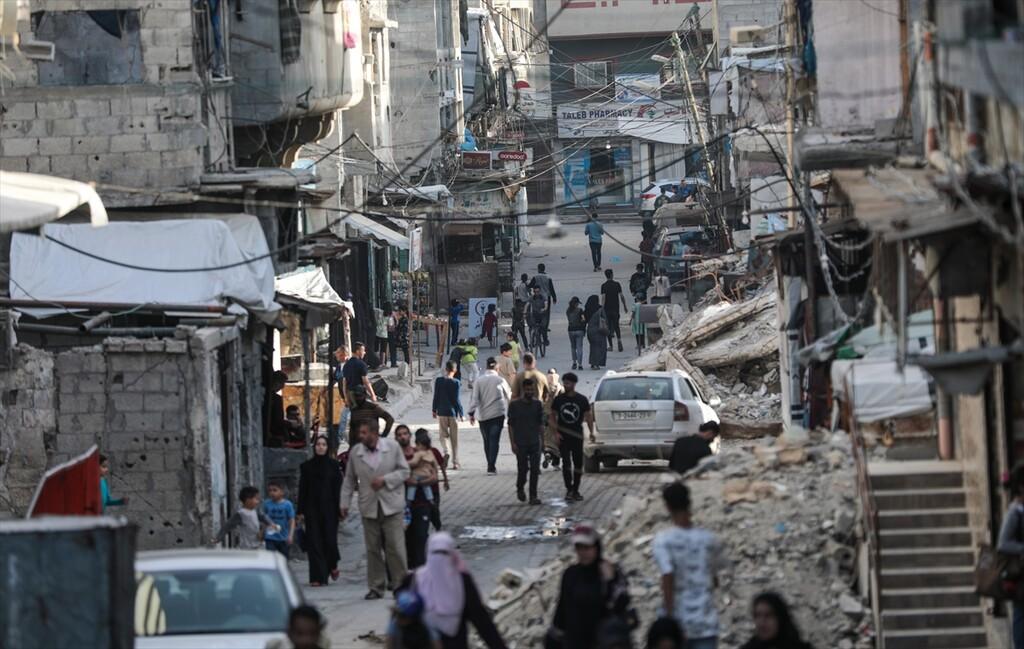
Daily life under siege in the Gaza Strip, 15 May 2026 - (Anadolu Agency)
Gaza Peace Council High Representative Nickolay Mladenov, in a press conference held on 13 May, stated that he had met with Israeli Prime Minister Benjamin Netanyahu as part of ongoing talks regarding Gaza and emphasized that consultations continue with all parties.
Mladenov emphasized that approximately two million people in Gaza are struggling to survive under harsh conditions and noted that his efforts are focused on providing Palestinians with a future in the region.
Mladenov stated that despite the ceasefire, violations continue daily in Gaza and that civilians are still losing their lives. He said, “We do not feel that the war in Gaza has ended completely, and we are working to reduce violations.” Mladenov noted that the 20-point plan proposed by U.S. President Donald Trump envisages allocating $17 billion over ten years for Gaza’s reconstruction. He added that the current political leadership in Gaza must step down. Mladenov stated that they do not seek the complete elimination of Hamas as a political movement and affirmed that Hamas could participate in elections. Mladenov indicated that the National Committee established to manage Gaza’s transition is ready and affirmed that the principle of “one authority, one law, one weapon” in Palestine is endorsed by all countries.
In a written statement from Gaza’s Ministry of Health on 14 May, it was recorded that over the past 48 hours, two dead and 24 injured were brought to hospitals in Gaza. Since the ceasefire came into effect on 10 October 2025, Israeli attacks have killed 857 people, injured 2,486, and recovered 771 bodies from under rubble. It was reported that since October 2023, Israeli attacks on the Gaza Strip have resulted in a total of 72,744 deaths and 172,588 injuries.
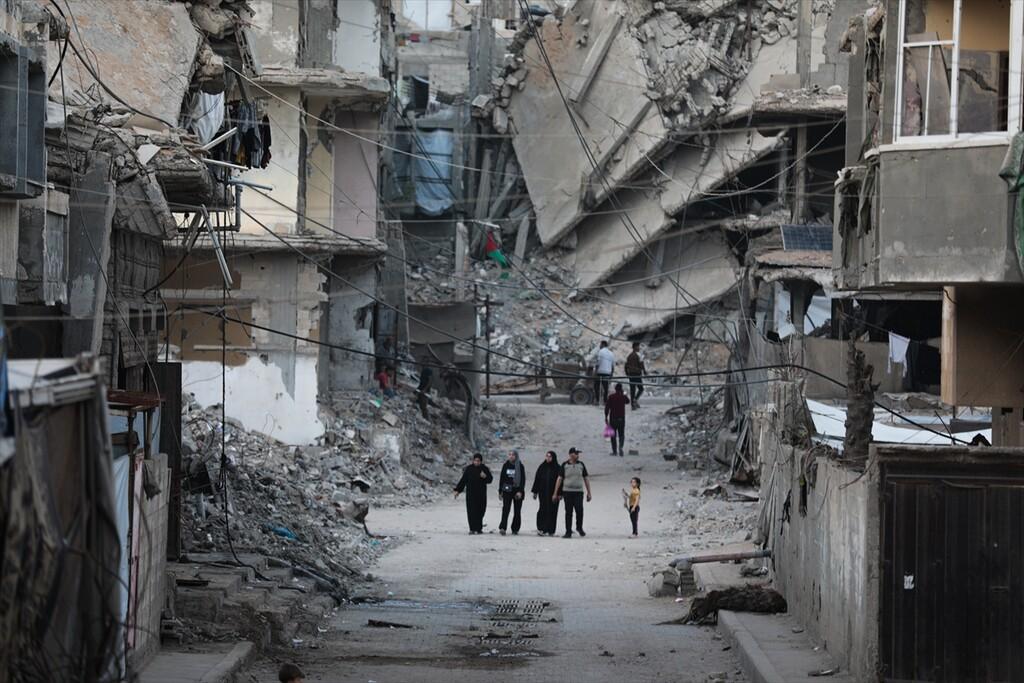
Daily life under siege in the Gaza Strip, 15 May 2026 - (Anadolu Agency)
On the same day, Israeli forces targeted civilians gathered in the northern town of Jabaliya with UAVs, killing Razi Fevzi Halave (25). A sniper from the Israeli military killed a Palestinian named Hasan Abid near a clinic affiliated with UNRWA in Jabaliya Refugee Camp. Israeli soldiers then targeted civil defense teams attempting to retrieve Abid’s body with UAVs; civil defense later succeeded in reaching Abid’s body and transported it to Shifa Hospital.
An Israeli UAV attack on a group of civilians on En-Nuzhe Street in Jabaliya killed Tamir el-Mutavvak and his cousin Muhammad el-Mutavvak; their bodies were taken to Shifa Hospital. Tamir el-Mutavvak’s father, Iyad el-Mutavvak, had been killed on 9 May when an Israeli UAV targeted a motorcycle west of Jabaliya Refugee Camp.
On 15 May, Israeli military airstrikes on a house and a vehicle in northern Gaza Strip, despite the ceasefire, killed eight Palestinians. According to health sources, three people died when a civilian vehicle was targeted and five died when a residential building was bombed. The Israeli military targeted an apartment building in the Rimal neighborhood in western Gaza City; the strike caused a fire and rendered the building unusable. The number of injured taken to hospitals in Gaza City exceeded 45, with some of the injured reported to be in critical condition. Bodies were transported to Shifa Hospital and the Es-Saraya field hospital operated by the Palestinian Red Crescent.
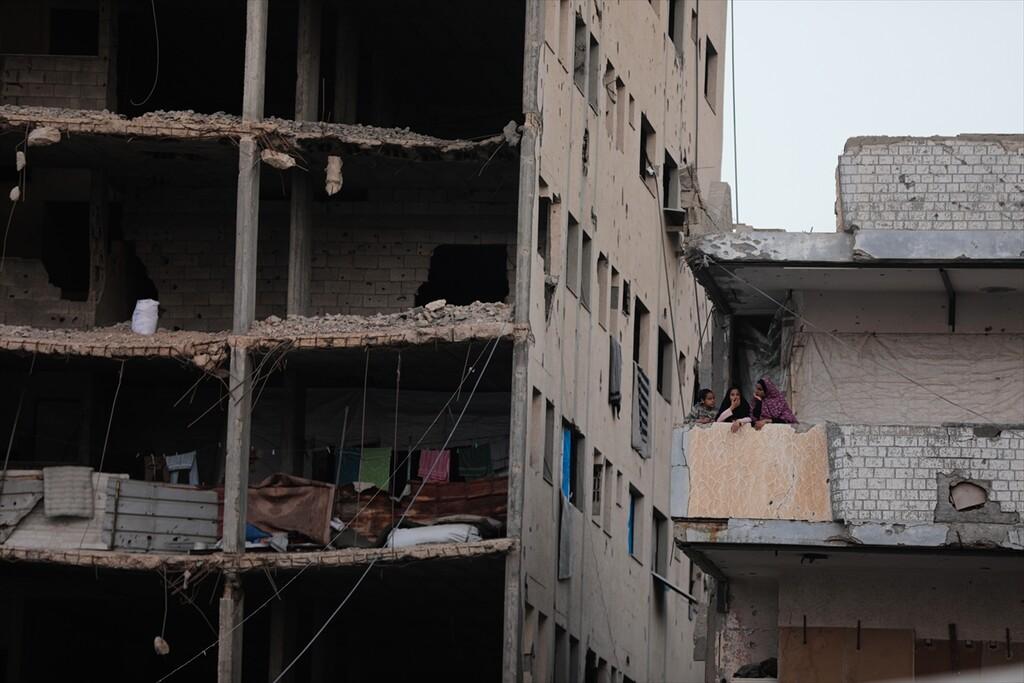
Daily life under siege in the Gaza Strip, 15 May 2026 - (Anadolu Agency)
Additionally, a house in Gaza City, partially destroyed in earlier Israeli attacks, completely collapsed; one Palestinian was killed under the rubble and several others were injured.
On the same day, Israeli Defense Minister Yisrael Katz claimed that the Israeli military targeted Izzeddin el-Haddad, a senior figure from Hamas’s armed wing, the Izzeddin al-Qassam Brigades, in an airstrike on Gaza City. Katz stated that he issued the order jointly with Prime Minister Benjamin Netanyahu and had previously issued assassination threats against senior Hamas figures, including Khalil al-Hayya and Izzeddin el-Haddad.
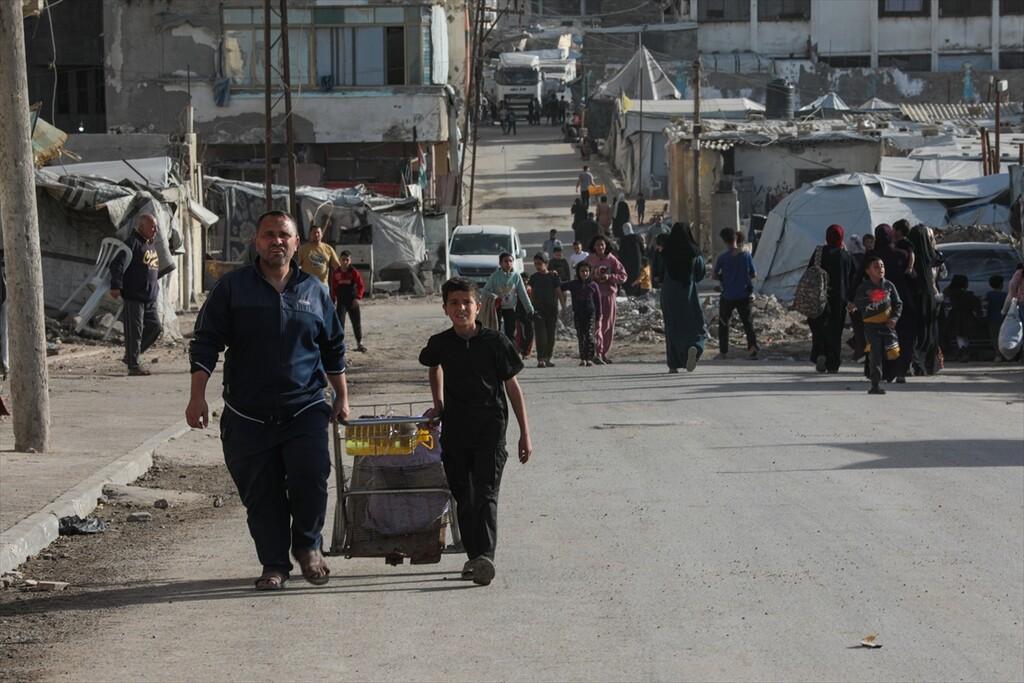
Daily life under siege in the Gaza Strip, 15 May 2026 - (Anadolu Agency)
A group of 86 Palestinians, mostly patients, injured individuals, and their companions who had traveled to Egypt for medical treatment, returned to the Gaza Strip after a prolonged separation and reunited with their families. The patients and companions, mostly women, children, and elderly, arrived by bus at the Nasir Hospital in the southern Gaza Strip town of Han Yunus.
In a statement from Gaza’s Ministry of Health on 16 May, it was recorded that over the past 48 hours, 13 dead and 57 injured were brought to hospitals in Gaza. Since the ceasefire came into effect on 10 October 2025, Israeli attacks have killed 870 people, injured 2,543, and recovered 771 bodies from under rubble. It was reported that since October 2023, Israeli attacks on the Gaza Strip have resulted in a total of 72,757 deaths and 172,645 injuries. With one death resulting from a building collapse, the number of people killed in building collapses rose to 30.
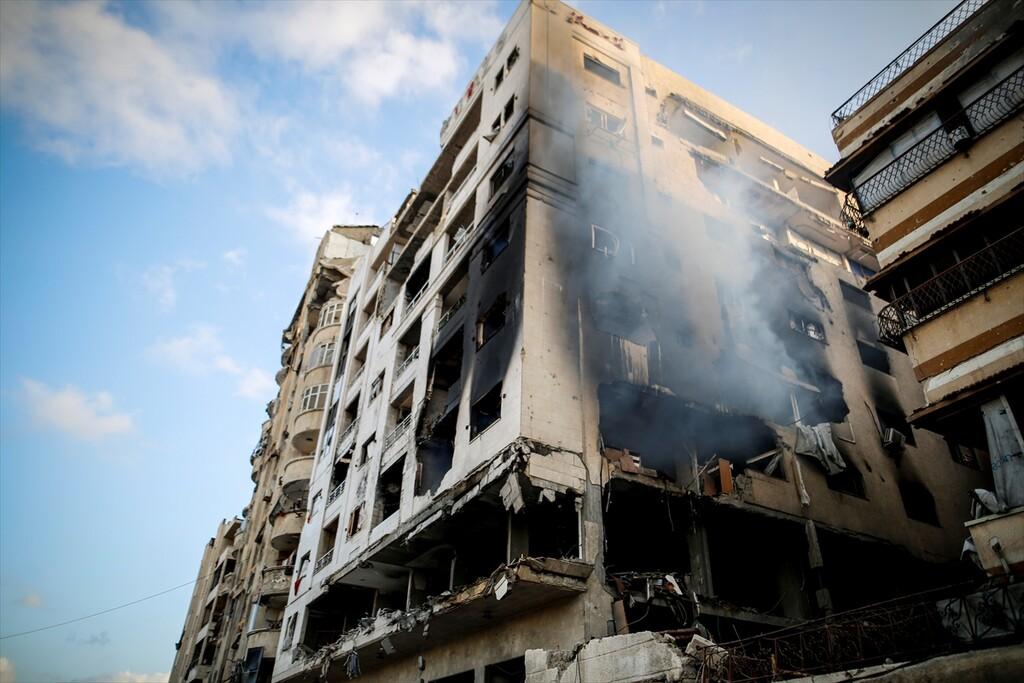
A building targeted by Israeli attacks despite the ceasefire, 16 May 2026 - (Anadolu Agency)
In a UAV attack on a civilian vehicle near the El-Vahde Apartment on Shifa Street in western Gaza City, two Palestinians were killed and three others were injured. Additionally, the bodies of eight Palestinians killed in Israeli attacks were honored in a ceremony held at Shifa Hospital in western Gaza City.
Hamas officially announced that Izzeddin el-Haddad (Abu Suhayb), commander of the Izzeddin al-Qassam Brigades, was killed in an Israeli attack. Hamas’s official spokesperson, Hazem Kassam, in a video statement, offered condolences for Haddad and stated that Haddad “will remain a mountain among the mountains of Palestine.” Kassam emphasized, “Haddad’s martyrdom is a great loss, but this path continues,” and stressed that the struggle will continue until Al-Aqsa Mosque is liberated.
According to local sources, Haddad was killed in an Israeli airstrike on a building in Gaza City along with his wife and daughter. A funeral was held for Haddad in Gaza City. In a written statement from Hamas, the assassination was condemned as a breach of responsibility by guarantor and mediator countries.
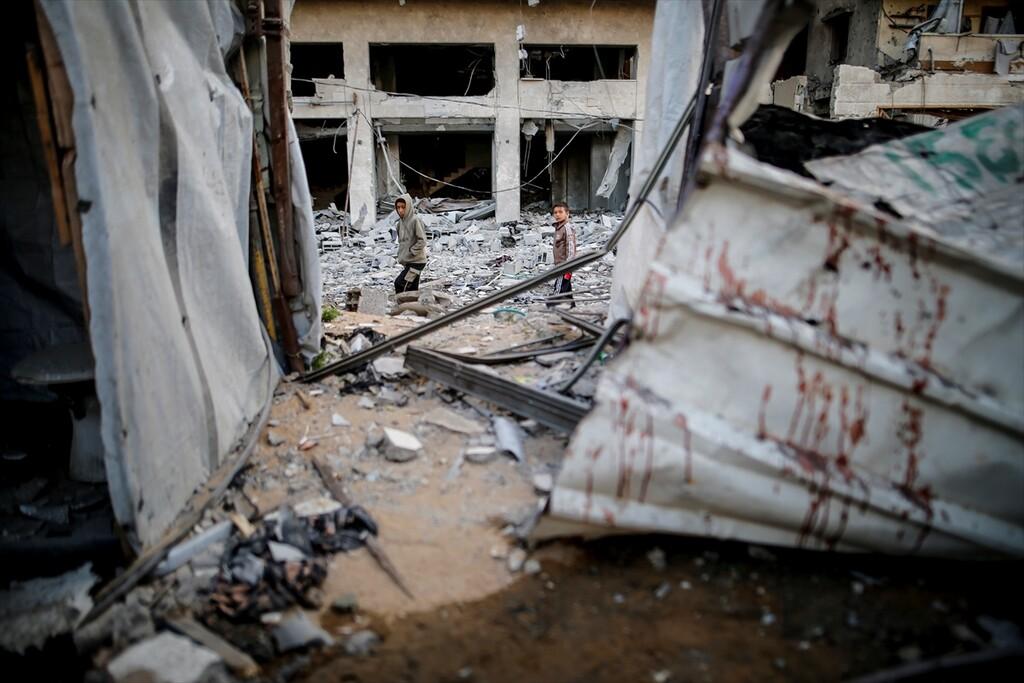
Daily life in the Gaza Strip, 16 May 2026 - (Anadolu Agency)
Izzeddin el-Haddad, known as Abu Suhayb, was born in the Gaza Strip in 1970 and was married with eight children. He joined Hamas in 1987 at the age of 17 and held various positions, from squad and battalion commander to commander of the Gaza Brigade. After Muhammad Sinwar, Haddad assumed command of the Qassam Brigades and lost his son in the Israeli attack on Gaza City on 18 January 2025. The Israeli military announced in November 2023 that it would offer a reward of $750,000 to anyone providing information on Haddad’s whereabouts.
On 17 May, it was reported that the Israeli military killed six Palestinians in various areas despite the ceasefire. Two missiles launched by an Israeli UAV struck a humanitarian food distribution point established in the courtyard of a house near Aksa Martyrs’ Hospital in northern Deir al-Balah, killing three people and injuring many others. Two people were killed in attacks in the center of Han Yunus; at least nine people were injured in an attack on a tent used as a café in the Tel al-Heva neighborhood in southwestern Gaza City; and one Palestinian was killed in an attack on the Zaytun neighborhood. One person was killed in an Israeli UAV attack targeting civilians on El-Bereke Street in southern Deir al-Balah.
In a written statement from Hamas, the attack on the food distribution point in Deir al-Balah was labeled a “war crime,” and the international community’s silence was said to have emboldened Israel. Additionally, a Palestinian named Jihad Selman, who had been injured in a previous Israeli bombing in Beit Lahiya, died.
On 17 May, eyewitnesses reported that Israeli military forces entered the town of Beni Suheyla east of Han Yunus, accompanied by gunfire and artillery bombardment. Witnesses stated that Israeli machinery had pushed concrete markers designating the “yellow line” dozens of meters westward, indicating an expansion of areas under Israeli control. Israeli Prime Minister Benjamin Netanyahu, in a statement on 15 May, claimed that Israel had increased the area it occupied in the Gaza Strip to 60 percent despite the ceasefire.
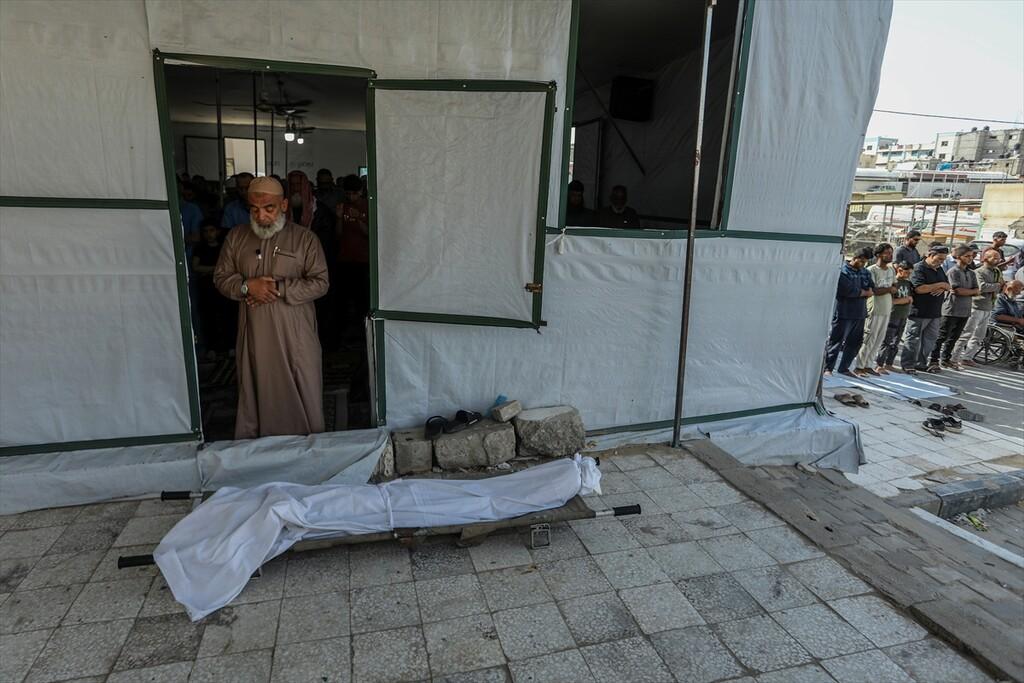
Daily life in the Gaza Strip, 19 May 2026 - (Anadolu Agency)
On the same day, Gaza’s Ministry of Health reported that in the past 24 hours, six dead and 19 injured were brought to hospitals, four of the dead having been recovered from under rubble. Since the ceasefire, 871 people have been killed, 2,562 injured, and 776 bodies recovered from under rubble. It was reported that since October 2023, Israeli attacks on the Gaza Strip have resulted in a total of 72,763 deaths and 172,664 injuries.
On 18 May, it was reported that one person was killed in an Israeli attack on the southern Gaza Strip town of Han Yunus. According to the Palestinian news agency WAFA, an Israeli UAV targeted civilians at the Beni Suheyla Junction east of Han Yunus, killing a young Palestinian. Since the ceasefire, Israeli attacks have killed 878 people and injured 2,602.
In a statement from the Palestinian Ministry of Health, it was confirmed that Mahmud Ziyad el-Amle (32), shot by Israeli soldiers in the village of Beit Ula in the West Bank, had died. It was reported that Amle sustained severe head injuries from gunfire by Israeli soldiers stationed near the Separation Wall, built on Palestinian land west of Beit Ula.
On 19 May, Israeli naval forces opened fire on Palestinian fishing boats off the coast of Han Yunus in southern Gaza Strip, injuring two fishermen. According to officials at Nasir Hospital, the two injured fishermen were taken to the hospital after Israeli warships fired on Palestinian fishing vessels off the coast of Han Yunus. Israeli warplanes were reported to have targeted an area near the Karara el-Mevasi region in the northwestern part of Han Yunus during nighttime hours, near camps housing displaced Palestinians.
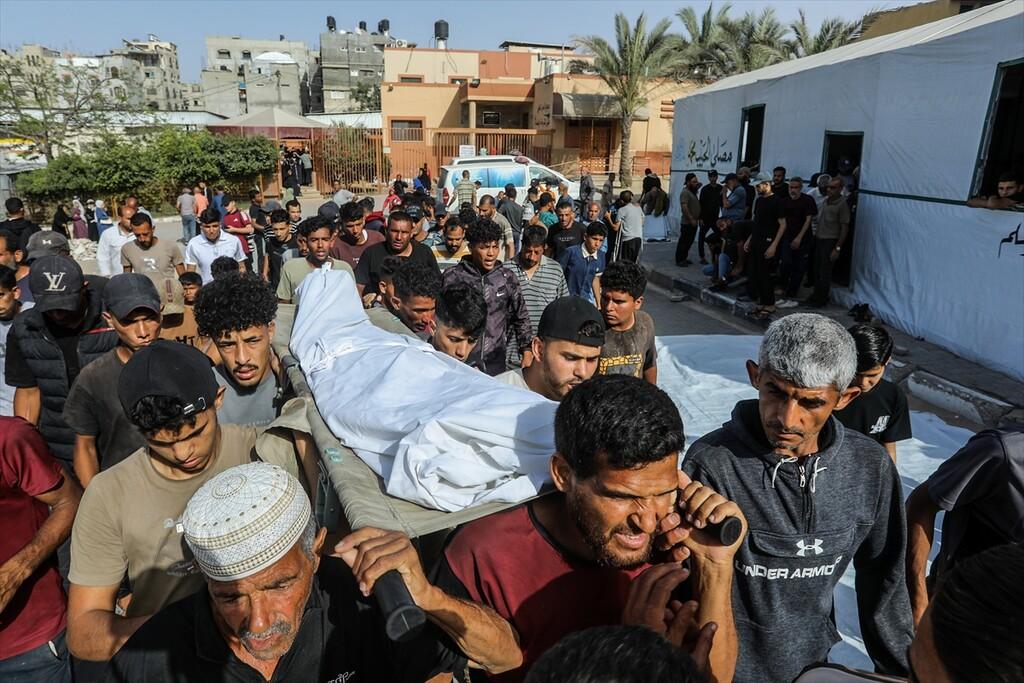
Daily life in the Gaza Strip, 16 May 2026 - (Anadolu Agency)
Mahmud Basal, spokesperson for the Gaza Civil Defense Directorate, noted that approximately 8,500 Palestinian bodies remain buried under rubble and that bulldozers, excavators, and trucks are urgently needed to reach them, as it is impossible to retrieve the dead without such equipment. Basal stated that approximately 90 percent of civil defense vehicles have been destroyed in Israeli attacks and said, “Israel is preventing heavy equipment from entering Gaza.”
The Palestinian government warned that approximately 1.6 million people, representing about 77 percent of the Gaza Strip’s population, face famine. The statement noted that the World Central Kitchen (WCK) had reduced its daily food distribution in Gaza from one million meals to “hundreds of thousands” due to financial pressures. The statement also criticized Israel for failing to fulfill its obligations under the ceasefire agreement and condemned the conversion of the UNRWA headquarters in the Sheikh Jarrah neighborhood of East Jerusalem into a military facility.
In Israeli attacks on northern and southern regions of the Gaza Strip, one Palestinian was killed and at least eight others were injured. Israeli forces used UAVs to target a civilian vehicle in the Rimal neighborhood in central Gaza City, killing Bedr Halil Ehl and injuring four others. In the Zaytun neighborhood in southern Gaza City, an Israeli UAV attack on a gathering of civilians injured four Palestinians. Additionally, 14-year-old Muhammad Salah Rakab, who had been injured in a previous Israeli bombing of Han Yunus, died.
According to data from Gaza’s Ministry of Health, in the past 24 hours, three dead and three injured were brought to hospitals; since October 2023, Israeli attacks on the Gaza Strip have resulted in a total of 72,772 deaths and 172,707 injuries.
On 20 May, Israeli military airstrikes and artillery attacks on two homes and civilians in the Gaza Strip, despite the ceasefire, injured seven Palestinians, including children. According to health sources, the Israeli military conducted an airstrike on the home of the Palestinian “Zakkut” family in the En-Nasr neighborhood of Gaza City, injuring five people, including children. Israeli artillery targeted areas east of Gaza City and northeast of Jabaliya. In a UAV attack targeting a group of civilians on 5th Street in the Mevasi region of Han Yunus, two people were injured. Israeli warplanes bombed the home of the Palestinian “Abu Shamaleh” family in the El-Bureyc Refugee Camp in central Gaza Strip after issuing evacuation warnings.
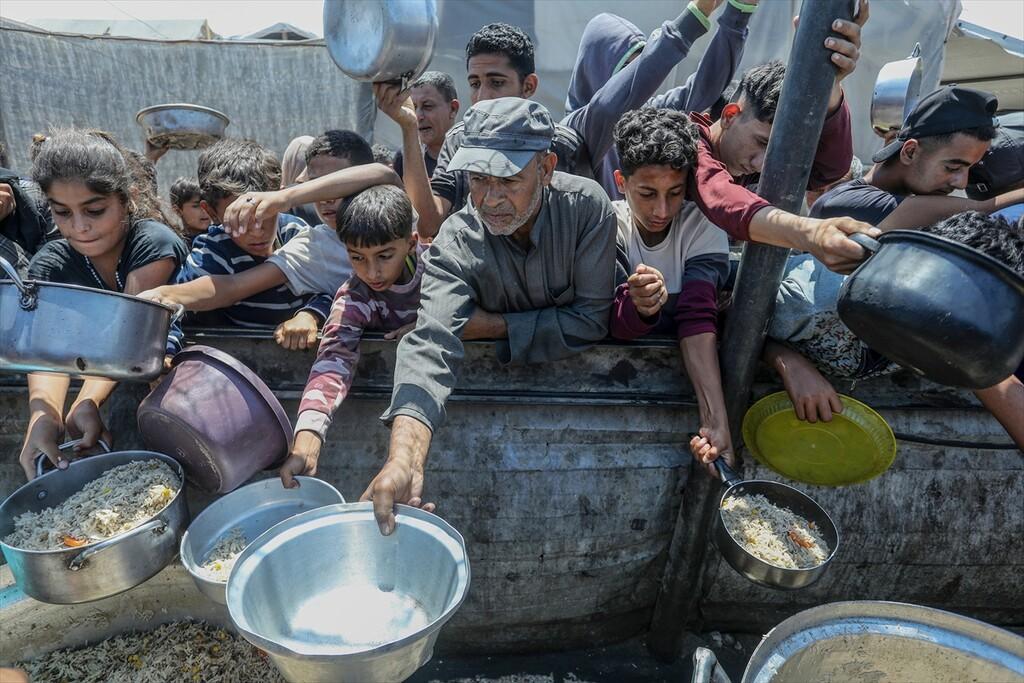
Hot meals are being distributed to displaced Palestinians in Gaza, 22 May 2026 - (Anadolu Agency)
One Palestinian fisherman was killed after Israeli naval vessels opened fire on fishing boats off the coast of the Gaza Strip; his body was taken to Shifa Hospital in Gaza City.
On the same day, Gaza’s Ministry of Health reported that in the past 24 hours, one dead and 16 injured were brought to hospitals. Since the ceasefire came into effect on 10 October 2025, Israeli attacks have killed 881 people, injured 2,621, and recovered 776 bodies from under rubble. It was reported that since October 2023, Israeli attacks on the Gaza Strip have resulted in a total of 72,773 deaths and 172,723 injuries.
In a statement from the International Committee of the Red Cross (ICRC), it was reported that seven Palestinians released by Israel were transferred to the Gaza Strip via the Kerem Abu Salim Border Crossing. One of the released Palestinians, Subhi Serhan, told the Anadolu Agency, “We were tortured, but praise be to God, we have returned.” He added, “I was subjected to tortures in prison that I had never seen in my life.”
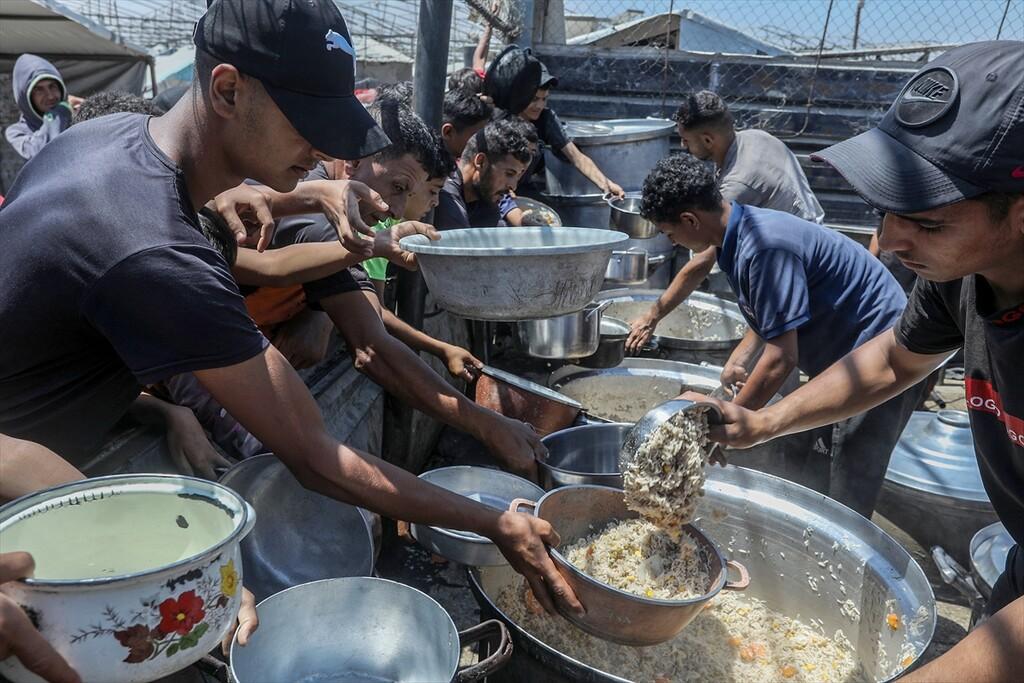
Hot meals are being distributed to displaced Palestinians in Gaza, 22 May 2026 - (Anadolu Agency)
On 21 May 2026, Israeli military attacks, despite the ceasefire, injured many Palestinians in the Gaza Strip, including women and children. According to hospital sources, Israeli warplanes bombed a house in the Megazi Refugee Camp in central Gaza Strip. The attack completely destroyed the house, and the resulting fire spread to nearby homes, causing widespread damage in the area.
Many Palestinians, including women and children, were injured in the attack. One of the injured taken to the Aksa Martyrs’ Hospital in Deir al-Balah was reported to be in critical condition.
On the same day, according to eyewitnesses, Israeli forces opened fire on the “Block 1” area of the Bureyc Refugee Camp in central Gaza Strip, injuring one Palestinian severely.
On 21 May, according to hospital sources, Israeli forces used a UAV to bomb an area in the Mejru Beyt Lahiya region where civilians had gathered. In the attack, 13-year-old Joud Duweik was killed and two others were injured.
According to the Palestinian news agency WAFA, on the same day, one Palestinian was killed in the town of Karara east of Han Yunus in southern Gaza when Israeli soldiers opened fire. In the northern Gaza Strip town of Beit Lahiya, a drone belonging to the Israeli military targeted a group of Palestinians, killing one person and injuring many others.
Two Palestinians were killed when Israeli forces opened fire in the Refah town in southern Gaza, specifically in the Mevasi region. According to Palestinian media reports, the victims were humanitarian aid truck drivers. Additionally, one person was injured in the Halave Refugee Camp north of Jabaliya due to a bomb dropped by an Israeli armed drone.
According to a report from the official Palestinian agency WAFA, on the same day, the Israeli military targeted a tent housing displaced Palestinians in the Mevasi region of Han Yunus in southern Gaza Strip. According to initial assessments, one person was killed and many others were injured. A fire broke out in a tent in the Nusayrat Refugee Camp in central Gaza Strip due to Israeli attacks, resulting in the death of Palestinian infant Rahil Abu Camus and injuring three others.
Another Israeli UAV attack, despite the ceasefire, killed a Palestinian woman. The body of 23-year-old Fatma al-Zahra, killed in an Israeli attack in the central Gaza Strip town of Deir al-Balah, was taken to a hospital.
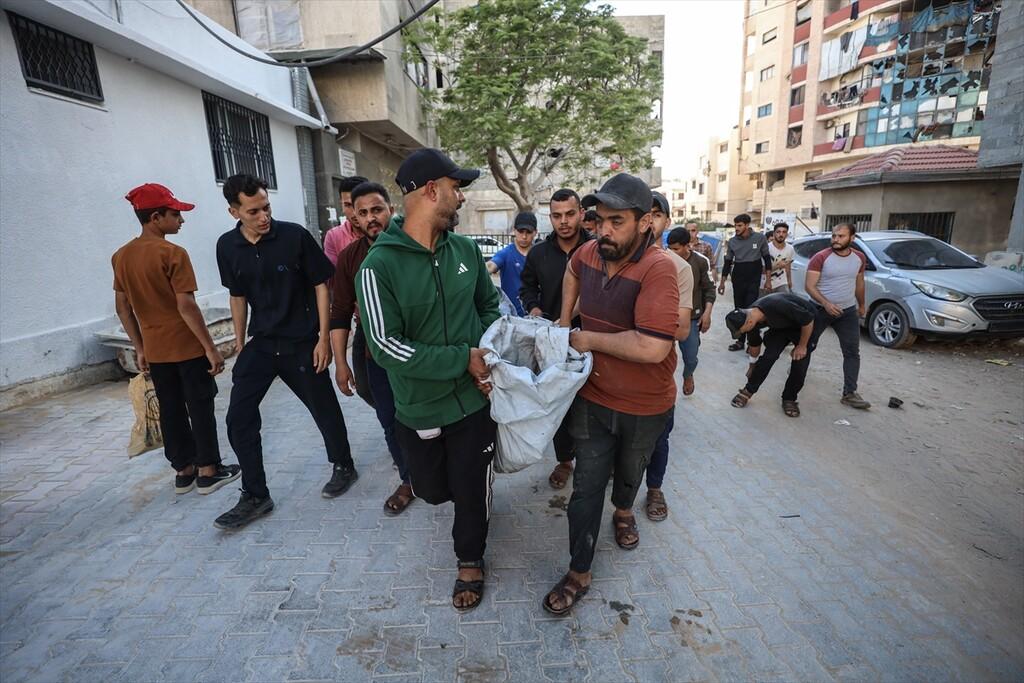
Funeral of Palestinians killed in Israeli attacks in Gaza, 22 May 2026 - (Anadolu Agency)
In a written statement from Gaza’s Ministry of Health, it was recorded that in the past 24 hours, two dead and 27 injured were brought to hospitals. Since the ceasefire came into effect on 10 October 2025, Israeli attacks have killed 883 people, injured 2,648, and recovered 776 bodies from under rubble. It was reported that since October 2023, Israeli attacks on the Gaza Strip have resulted in a total of 72,775 deaths and 172,750 injuries.
On 22 May 2026, according to hospital sources and eyewitnesses, Israeli forces targeted a shepherd with a UAV in the Shakus region of the southern Gaza Strip town of Refah. The shepherd, Rafet Adil Berike (42), was killed in the bombing. The Israeli military also heavily shelled eastern areas of Han Yunus. On the same day, a Palestinian, Luey Basal (27), was killed in an attack on eastern Gaza City.
On 22 May, a report issued by the Government Media Office in Gaza provided information on truck and pedestrian entries into the Gaza Strip between 15 and 21 May. According to the ceasefire agreement, 600 trucks per day and 4,400 per week are supposed to enter the Gaza Strip, but only 1,287 trucks managed to enter in the past week. Israel has permitted only 30 percent of the required trucks. The report stated that 693 trucks carried humanitarian aid, 559 carried commercial goods, and 35 carried fuel, and noted that Israel’s restrictions on truck entries have deepened the crisis in the Gaza Strip.
The same report recalled that the ceasefire agreement stipulates an average of 1,400 two-way passenger crossings daily through the Refah Border Crossing, but only 403 pedestrians crossed in the past week, 249 departing and 154 arriving. It was reported that only 28 percent of permitted crossings were allowed.
Reinhilde Van de Weerdt, representative of the World Health Organization (WHO) in the occupied Palestinian territories, made assessments regarding the situation in Gaza during the weekly press briefing of the United Nations Office in Geneva. Weerdt said, “The situation in Gaza, the West Bank, and East Jerusalem remains dire. I was in Gaza at the beginning of this month for my second visit and was as shocked and saddened as I was during my first. Despite the ceasefire of October 2025, violence has not ceased. Since the ceasefire began, at least 880 people have been killed and more than 2,600 injured.”
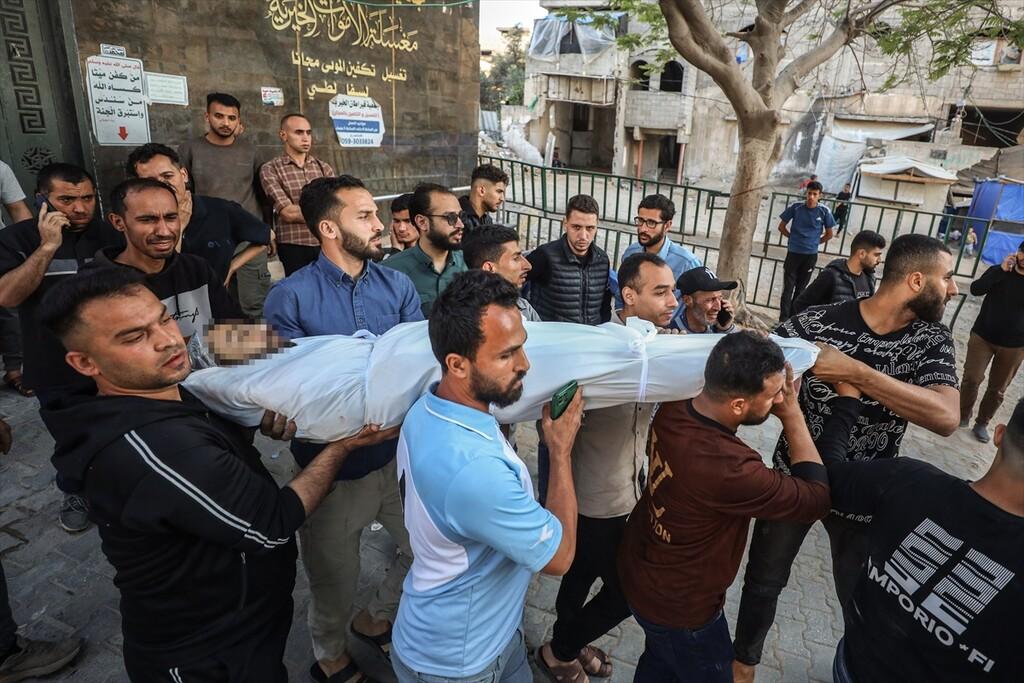
Funeral of Palestinians killed in Israeli attacks in Gaza, 22 May 2026 - (Anadolu Agency)
Weerdt reported that WHO has documented 22 attacks on health services in Gaza this year and emphasized that only 53 percent of hospitals in Gaza are partially operational. Weerdt stated that restrictions on the entry of essential medical supplies have hindered the functioning of health facilities and said, “Bureaucratic procedures and access restrictions on globally recognized essential medicines and supplies must be lifted.” Weerdt also noted that WHO has supported the evacuation of approximately 12,000 patients from the Ministry of Health and that more than 30 countries have been able to accept these patients.
On 22 May, the Israeli military, in violation of the ceasefire, entered two areas west of the “Yellow Line” in central Gaza Strip and demolished several homes. According to eyewitnesses, Israeli military forces, using tanks, bulldozers, and excavators, advanced 100 meters into the Selka Valley east of Deir al-Balah and demolished three homes belonging to the Said family. Israeli military vehicles also advanced dozens of meters westward along the Netzarim Corridor in central Gaza Strip.
On 23 May 2026, according to health sources, an Israeli UAV targeted an area in the northern Gaza Strip town of Jabaliya where displaced civilians were located. Two young Palestinians were injured in the attack. Eyewitnesses reported that the UAV targeted a gathering area near the Halava Refugee Camp east of Jabaliya, where displaced persons were housed, and that the attack caused widespread panic in the area.
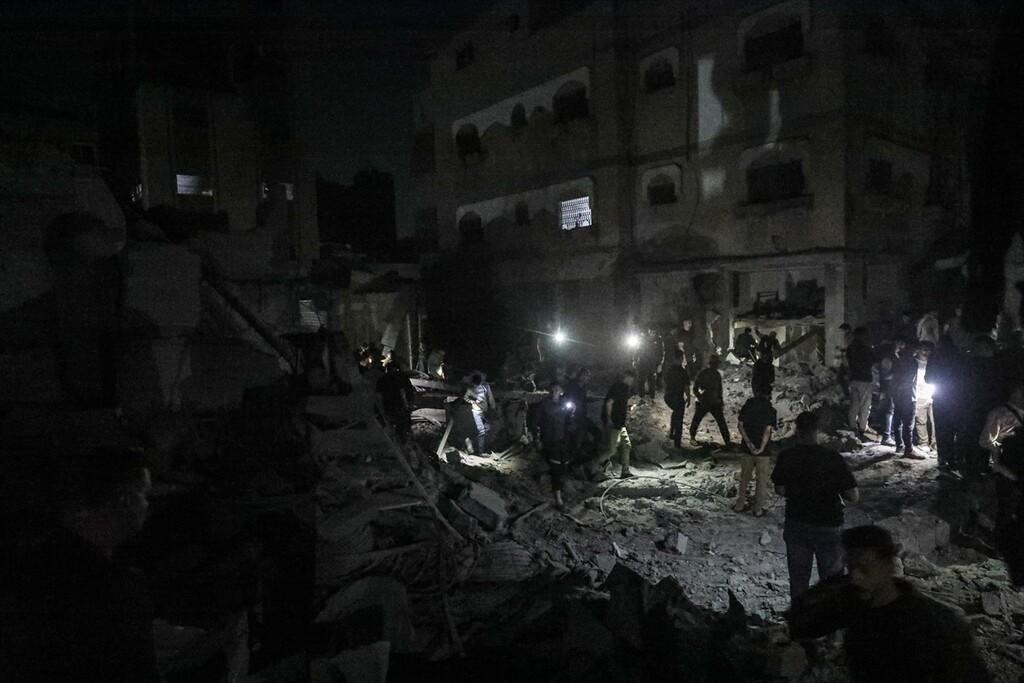
The Israeli military continues its attacks on Gaza despite the ceasefire, 23 May 2026 - (Anadolu Agency)
On the same day, the Israeli military used explosives to level civilian structures in the Shucaiyah neighborhood in eastern Gaza City. Loud explosion sounds were heard during the demolition. The Israeli military continued to target the northern Gaza Strip town of Beit Lahiya and the southern town of Han Yunus with artillery fire and intense gunfire from military vehicles.
On 23 May, five Palestinians were killed and many others injured in an Israeli military attack on the northern Gaza Strip. According to hospital sources, an Israeli UAV fired two missiles at a police station near the “17 Junction” in western Gaza City.
Hamas stated that the Israeli attack targeting a Palestinian police station in northern Gaza City was “part of a systematic plan aimed at creating chaos and constitutes a war crime.” In a written statement, Hamas emphasized that attacks on police, whose duty is to ensure public safety, are “systematic” and constitute “a continuation of genocide and attempts to collapse Gaza’s social structure.”
On the same day, according to local sources, the Israeli military bombed a house belonging to the Abu Sayf family on 20th Street in the Nusayrat Refugee Camp in central Gaza Strip. Sources indicated that the attack occurred after evacuation warnings were issued to all residents of the block. The Israeli military also targeted another building in the Bureyc Refugee Camp in central Gaza Strip, where shops were located.
The evacuation warnings in both areas caused dozens of families to flee in panic, generating fear and panic, especially among women and children. It was reported that both buildings targeted in the airstrikes were completely destroyed and that significant damage occurred to surrounding structures. Hospital sources recorded that two Palestinians were injured in the attack on the Bureyc Refugee Camp.
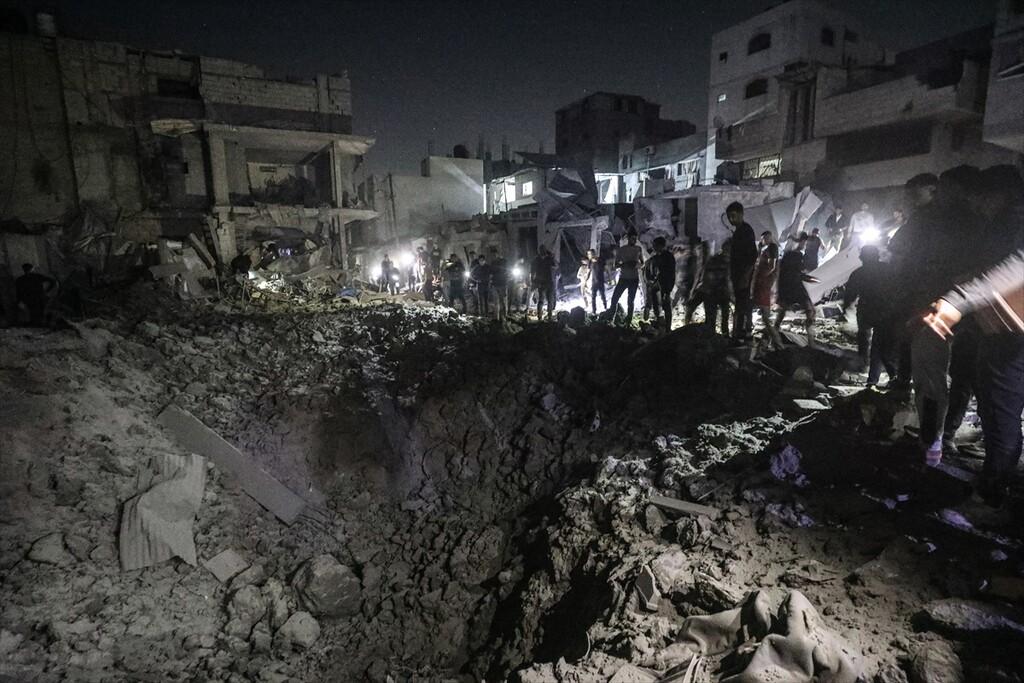
The Israeli military continues its attacks on Gaza despite the ceasefire, 23 May 2026 - (Anadolu Agency)
In a statement from Gaza’s Ministry of Health, it was recorded that in the past 48 hours, eight dead and 29 injured were brought to hospitals. Since the ceasefire came into effect on 10 October 2025, Israeli attacks have killed 890 people, injured 2,677, and recovered 777 bodies from under rubble. It was reported that since October 2023, Israeli attacks on the Gaza Strip have resulted in a total of 72,783 deaths and 172,779 injuries.
On 24 May 2026, the Israeli military targeted and leveled a building in western central Gaza Strip after forcing Palestinian residents to flee under threat of attack. According to eyewitnesses, Israeli forces contacted a resident living west of Deir al-Balah and demanded that they leave their home under threat of attack. After the Israeli threat, numerous families were forced to abandon their homes near the hospital.
Israeli warplanes bombed the targeted house and destroyed it completely. Significant damage also occurred to surrounding buildings.
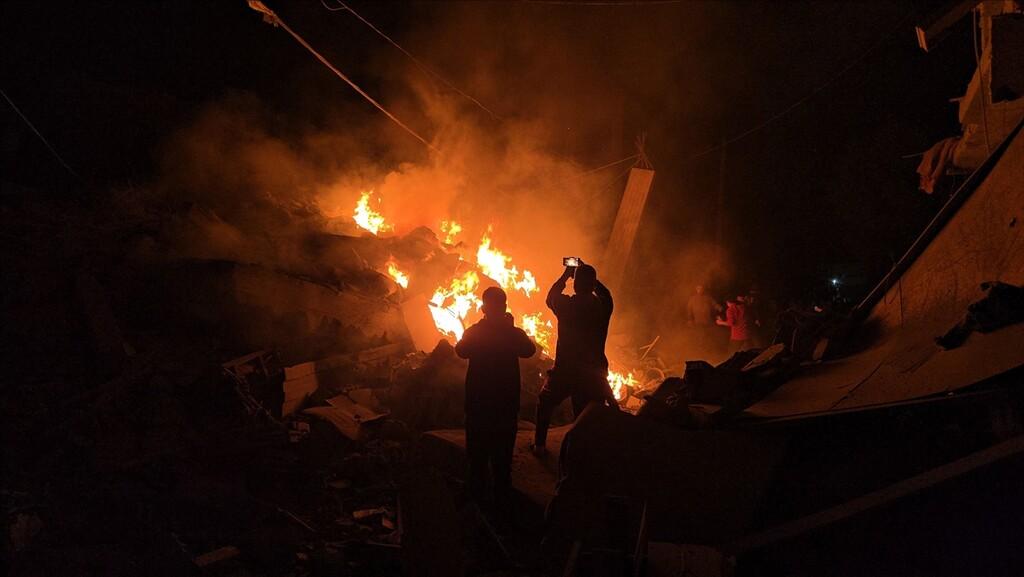
The Israeli military continues its attacks on Gaza despite the ceasefire, 24 May 2026 - (Anadolu Agency)
On 25 May, a demonstration in the Gaza Strip protested the violations against Palestinian detainees in Israeli prisons and called on the international community to act. Relatives of Palestinian detainees, along with civil society organizations, held a protest in front of the International Committee of the Red Cross in Gaza City. Protesters, holding photographs of detainees, condemned Israel’s mistreatment of Palestinian detainees.
Hamas spokesperson Hazem Kassam, who participated in the protest, stated that the issue of Palestinian detainees must always remain at the top of national and international agendas. Kassam said, “Torture, murder, attacks, and starvation of prisoners in Israeli prisons are serious violations.” Verde Ridwan, a female representative from Palestinian national and Islamic groups participating in the protest, said, “Today we have come here in support of Palestinian female prisoners and all flotillas and caravans attempting to break the siege and reach Gaza.”
According to reports from the Palestinian Society of Detainees, since October 2023, 89 detainees whose identities have been confirmed have died in Israeli prisons. Diseases such as scabies have been identified as leading causes of death in prisons.
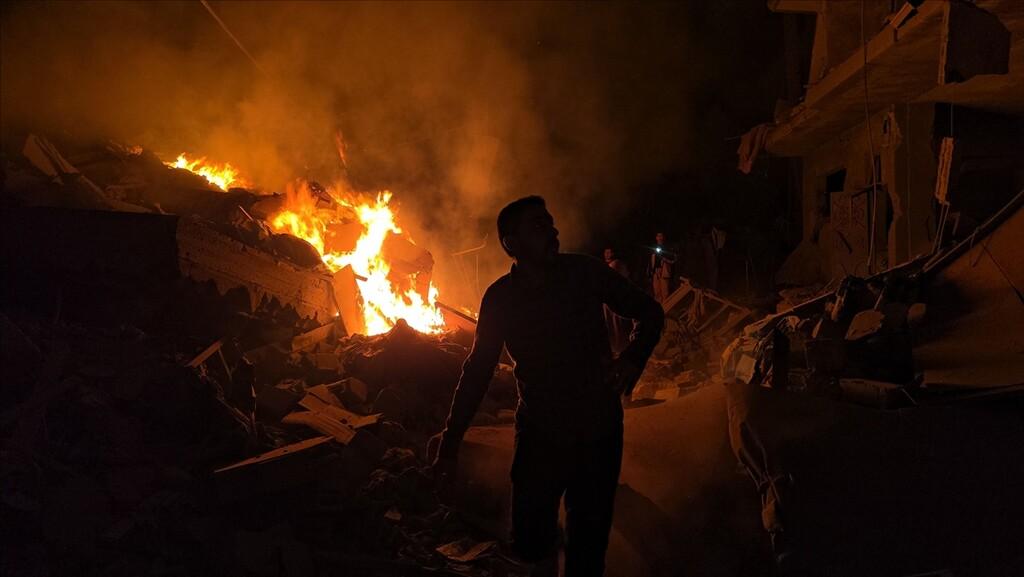
The Israeli military continues its attacks on Gaza despite the ceasefire, 22 May 2026 - (Anadolu Agency)
On 26 May, the Israeli military conducted an airstrike on an apartment building in the Rimal neighborhood in western Gaza City. According to hospital sources, three Palestinians, including one woman, were killed and at least 20 others were injured. Footage on social media showed significant damage to the targeted building and surrounding areas.
In a joint statement, Israeli Prime Minister Benjamin Netanyahu and Defense Minister Yisrael Katz claimed that the Israeli military targeted Muhammad Avde, a commander from Hamas’s armed wing, the Izzeddin al-Qassam Brigades, in the attack on Gaza Strip. The joint statement indicated that the attack was carried out under the orders of Netanyahu and Katz and claimed that Avde was the new leader of the Qassam Brigades. According to a report by the Israeli newspaper Yedioth Ahronot, citing an Israeli security official, it was estimated that Avde was killed in the attack.
On the same day, on the eve of Eid al-Adha, the Israeli military bombed an area in the Megazi Refugee Camp in central Gaza Strip where civilians had gathered. According to initial assessments, five people were killed and many others were injured. The bodies of the deceased Palestinians and the injured were taken to Aksa Martyrs’ Hospital in Deir al-Balah.
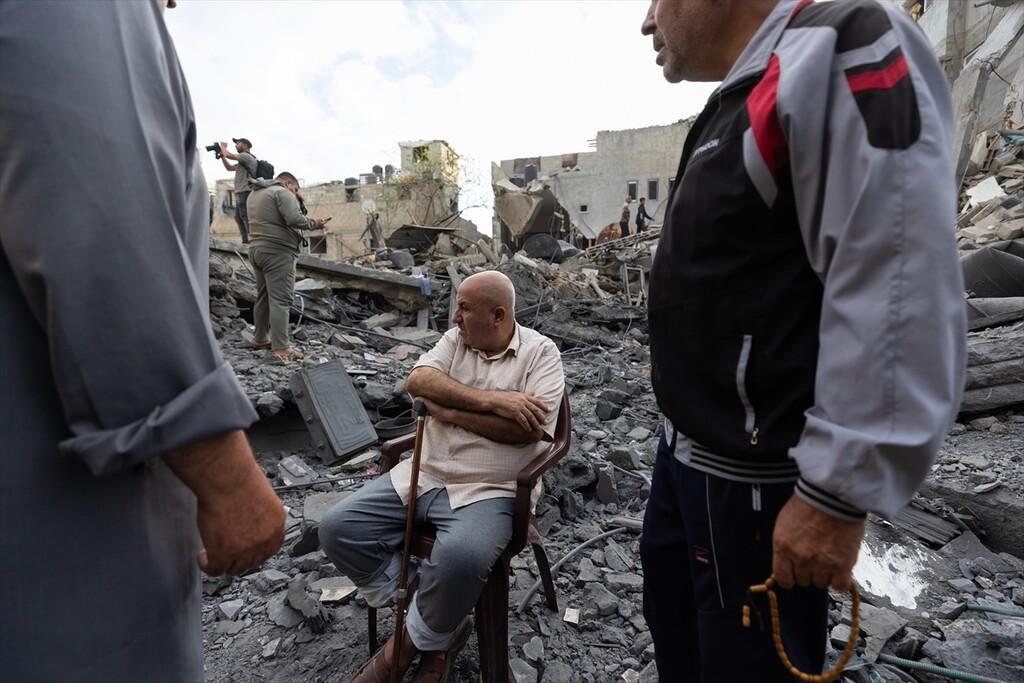
Daily life in the Gaza Strip, 26 May 2026 - (Anadolu Agency)
An Israeli UAV targeted a vehicle west of Han Yunus, killing two Palestinians. According to the official Palestinian news agency WAFA, in an attack by the Israeli military on tents housing displaced Palestinians in the Mevasi region of Han Yunus, 15-year-old Fatima Muhammad Abdulhadi Hatib, who was severely injured, died one day before Eid al-Adha. Six-year-old girl and a woman were killed, and 20 others, mostly children and women, were injured in gunfire from Israeli “Apache” helicopters targeting tents in the Mevasi region.
In a statement from Gaza’s Ministry of Health, it was recorded that in the past 24 hours, the bodies of six people killed in Israeli attacks and 34 injured were brought to hospitals.
Since the ceasefire came into effect on 10 October 2025, Israeli attacks have killed 906 people, injured 2,747, and recovered 781 bodies from under rubble. It was reported that since October 2023, Israeli attacks on the Gaza Strip have resulted in a total of 72,803 deaths and 172,855 injuries.
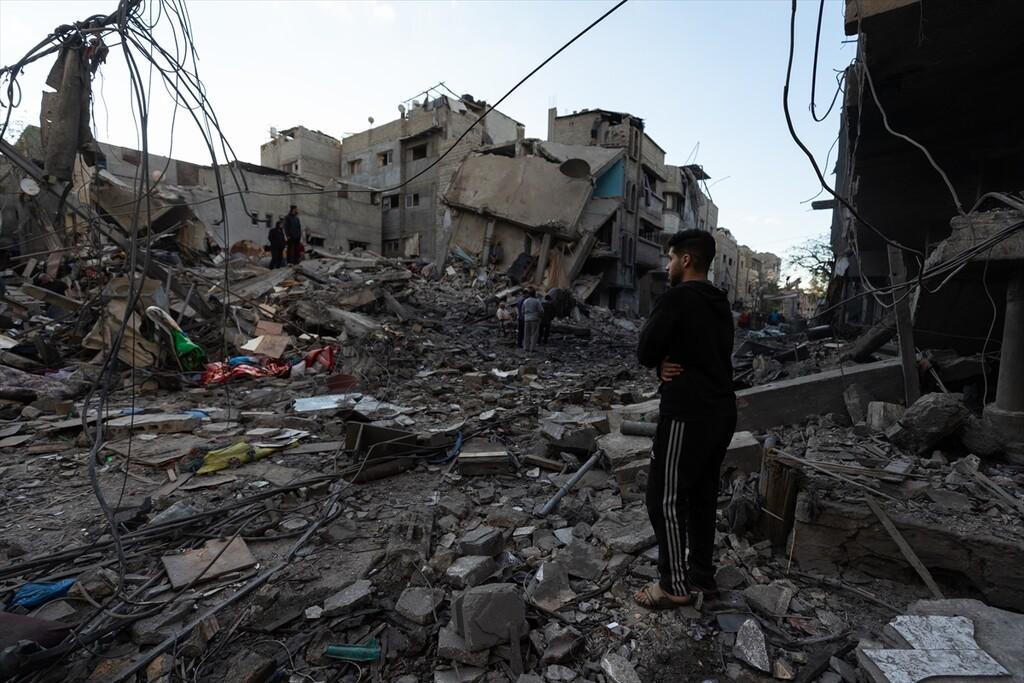
Daily life in the Gaza Strip, 26 May 2026 - (Anadolu Agency)
On 27 May 2026, Hamas announced that Muhammad Avde, a commander from the Izzeddin al-Qassam Brigades, and his family were killed in an Israeli attack on the Gaza Strip. In a written statement from Hamas, it was stated that Avde was killed along with his wife and two children in an Israeli bombardment targeting a residence in Gaza City the previous evening. The statement described the attack as “a desperate attempt to break our people’s resistance and determination.”
The statement referred to Avde as “the great leader of Qassam” and noted that he belonged to the “first generation of founders of jihad and military activities” and played a significant role in all military operations, including Aksa Flood. Avde, born on 20 July 1975 in the Jabaliya Refugee Camp in northern Gaza Strip, joined Hamas’s military wing in 1987.
It was reported that six Palestinians were killed and at least 20 others injured in an Israeli airstrike on an apartment building in the Rimal neighborhood in western Gaza City.
On 27 May, thousands of Palestinians in the Gaza Strip performed Eid prayers among the rubble of destroyed mosques, on streets, and in tent camps. In the southern Gaza Strip town of Han Yunus, Palestinians performed Eid prayers on the rubble of the Huda Mosque, which was destroyed in Israeli bombardment. In the Nusayrat Refugee Camp in central Gaza Strip, thousands gathered on streets and rubble areas for Eid prayers after mosques became unusable. Thousands of Palestinians gathered in the Saraya Square in central Gaza City. According to a statement from the Jerusalem Islamic Waqf, approximately 140,000 people performed Eid prayers at the Al-Aqsa Mosque in the Old City of occupied East Jerusalem. In the occupied West Bank town of Hebron, where the Ibrahimi Mosque is located, only a small number of Palestinians were able to perform Eid prayers due to Israeli restrictions. Hebron Governor Khalid Dudin said, “Due to Israeli practices, participation in Eid prayers at the Ibrahimi Mosque has fallen below 30 percent of normal levels.”
In a written statement from the government’s Media Office in Gaza, it was reported that the number of violations by the Israeli military since the ceasefire came into effect until the first day of Eid al-Adha reached 3,005. It was emphasized that 910 Palestinians have been killed and 2,747 injured in Israeli attacks since the ceasefire, and that the Israeli military has detained 82 residents of Gaza during this period. During this time, only 49,973 aid trucks reached the Gaza Strip instead of the promised 135,600, and only 5,636 patients were allowed to leave Gaza for medical treatment instead of the planned 17,000.
On the same day, the International Committee of the Red Cross (ICRC) announced that Israel had released 15 Palestinian detainees, including one woman, who had been held in the Gaza Strip. The ICRC noted that more than 2,500 Palestinians have been released through this method since 2023.
On 28 May, three Palestinians were killed and many others injured in Israeli attacks on various areas of the Gaza Strip on the second day of Eid al-Adha. Two Palestinians were killed and many others injured when an Israeli UAV targeted a police station near the slaughterhouse in southern Han Yunus. Three Palestinians were injured in an attack on a food storage facility and vacant land in the Mevasi region west of Han Yunus.
In Gaza City, an Israeli UAV targeted an area where civilians had gathered behind the Imam Shafi’i Mosque in the Zaytun neighborhood, killing one Palestinian. On Wednesday evening, the first day of Eid al-Adha, a house near the El-Isra Tower on Omar al-Mukhtar Street in central Gaza City was targeted, killing 10 Palestinians, including two children and two women, and injuring 18 others.
On the same day, Israeli warplanes conducted an airstrike on a residential area in the Shati Refugee Camp in western Gaza City. Five people were injured in an Israeli airstrike on the area around Yarmouk Street in central Gaza City.
On 28 May, Netanyahu announced that he had ordered the Israeli military to increase the area it occupies in Gaza to 70 percent. It was also reported that Israeli authorities approved a plan to expand a Jewish settlement near the eastern West Bank town of Jericho during the same period. The plan envisages constructing 517 new homes on approximately 1,692 dunums of Palestinian land. According to council data, as of 30 March, the number of settlements and illegal outposts in the West Bank exceeded 542, and the number of Israelis living in the region surpassed 780,000.
On the same day, according to local sources, the Israeli military conducted an airstrike on a building in Gaza City. In a statement from the Palestinian Red Crescent, it was reported that eight Palestinians, including two girls and two women, were killed and 18 others injured in the attack.
In a statement from Hamas, it was stated that Israeli attacks on the Gaza Strip and ceasefire violations have placed the Gaza ceasefire agreement at risk of collapse, and that the killing of more than 20 Palestinians in attacks on populated areas in the past 48 hours demonstrates Israel’s intention to return to a “genocide” process.
In a statement from Gaza’s Ministry of Health, it was recorded that in the past 24 hours, the bodies of 16 people killed in Israeli attacks and 39 injured were brought to hospitals.
Since the ceasefire came into effect on 10 October 2025, Israeli attacks have killed 922 people, injured 2,786, and recovered 781 bodies from under rubble. It was reported that since October 2023, Israeli attacks on the Gaza Strip have resulted in a total of 72,819 deaths and 172,894 injuries.
On 29 May 2026, many Palestinians were injured in an Israeli airstrike on a house in the Bureyc Refugee Camp in central Gaza Strip. According to reports in Palestinian media, Israeli warplanes targeted a residence in the Bureyc Refugee Camp.
On the second day of Eid al-Adha, Israeli attacks on various areas of the Gaza Strip killed three Palestinians and injured many others. According to the government’s Media Office in Gaza, since the ceasefire came into effect, approximately 910 Palestinians have been killed and 2,747 injured in Israeli attacks.
The Israeli military, in violation of the ceasefire, targeted a gathering of civilians in the Tuffah neighborhood in eastern Gaza City on the third day of Eid al-Adha, killing Palestinian Ahmed Hils.
In a written statement from the Palestinian Ministry of Foreign Affairs, it was stated that Israeli attacks in the Gaza Strip constitute a clear violation of international law, international humanitarian law, and agreements on the ceasefire. The statement noted that since the ceasefire declaration, more than 1,000 Palestinians, mostly children and women, have been killed and thousands injured. The statement condemned Israeli Prime Minister Benjamin Netanyahu’s statements regarding expanding attacks in the Gaza Strip and establishing Israeli control over approximately 70 percent of the region.
European Union Commissioner for Equality, Preparedness, and Crisis Management Hadja Lahbib, in response to a report on Netanyahu’s directive to expand Israeli-occupied areas in the Gaza Strip to 70 percent, said, “The humanitarian aid space in Gaza is shrinking.” Lahbib added, “Families are becoming trapped between borders that are moving without warning.”
UN Spokesperson Dujarric, during his daily press briefing, assessed the latest situation in Gaza. Dujarric said, “One hundred percent of Gaza belongs to the Palestinian people; that is what we want to see. We call on Israel to withdraw its occupation forces from the so-called yellow line.” He added, “Our position on this matter will remain unchanged.” Hamas spokesperson Hazem Kassam criticized the silence of Gaza Peace Council High Representative Nickolay Mladenov regarding Israel’s plan to control 70 percent of the Gaza Strip.
In a statement from the United Nations Relief and Works Agency for Palestine Refugees in the Near East (UNRWA), it was noted that rodent and parasite infestations in Gaza have increased, negatively affecting the health of residents, especially children. UNICEF representative Oweis, participating virtually in the UN Geneva Office’s weekly press briefing, said, “The inability to meet children’s basic needs in Gaza traps them in an endless cycle of suffering.” Oweis added, “Families in Gaza do not have sufficient clean water. Families are forced to choose between using their limited water for drinking, bathing, or cooking.”
In a statement from the Israeli military, it was claimed that during an attack in northern Gaza Strip, Imad Islam, a commander from the Qassam Brigades, was killed. The statement alleged that Islam had managed the Aksa Flood Operation on 7 October 2023. No statement has been issued by the Qassam Brigades regarding this claim.
On 30 May 2026, seven Palestinians were killed in Israeli attacks on the Gaza Strip despite the ceasefire in the past 48 hours. In a written statement from Gaza’s Ministry of Health, it was recorded that in the past 24 hours, the bodies of seven people killed in Israeli attacks and 25 injured were brought to hospitals. Since the ceasefire came into effect on 10 October 2025, Israeli attacks have killed 929 people, injured 2,811, and recovered 781 bodies from under rubble. It was reported that since October 2023, Israeli attacks on the Gaza Strip have resulted in a total of 72,938 deaths and 172,919 injuries. Additionally, 112 more bodies with confirmed identities since the beginning of May have been added to the total death toll.
On the same day, hospital sources reported that Israeli forces launched two rockets at civilians gathered around the Firas Market in central Gaza City. One of the injured taken to the El-Ehli Baptist Hospital was reported to be in critical condition.
According to data released on 31 May 2026, Israeli military attacks on the Gaza Strip during Eid al-Adha killed 33 Palestinians and injured at least 130 others.
In a written statement from Gaza’s Ministry of Health, it was recorded that in the past 24 hours, one dead and eight injured were brought to hospitals. Since the ceasefire came into effect on 10 October 2025, Israeli attacks have killed 930 people, injured 2,819, and recovered 781 bodies from under rubble. It was reported that since October 2023, Israeli attacks on the Gaza Strip have resulted in a total of 72,939 deaths and 172,927 injuries.
On the same day, an Israeli UAV attack on the Gaza Port killed one person and injured 18 others. According to eyewitnesses, Israeli UAVs targeted a group of civilian Palestinians gathered at the fishing port on the coast of Gaza City. One person was killed in the attack, and 18 others, including children in critical condition, sustained injuries to various parts of their bodies.
In an Israeli military attack targeting a house in the Bureyc Refugee Camp in central Gaza Strip, one person was killed and four others, including one child, were injured. According to local sources, Israeli military reconnaissance aircraft targeted the house of the Abu Zahir family in “Block 9” of the camp. The child’s health condition was reported to be critical.
Since the ceasefire came into effect on 10 October 2025, Israeli attacks in Gaza have killed 247 children and 191 women.
On 1 June 2026, Israeli military attacks continued despite the ceasefire in the Gaza Strip. According to the Palestinian news agency WAFA, the Israeli military targeted a cyclist moving in the El-Bureyc Refugee Camp in central Gaza Strip. The cyclist’s identity was not disclosed, and it was reported that injuries occurred in the attack carried out by an Israeli warplane.
On the same day, according to local sources, Israeli warplanes conducted intensive flights along the Gaza Strip and simultaneously shelled civilian areas from military vehicles stationed in eastern Gaza City.
In a written statement from Gaza’s Ministry of Health, it was recorded that in the past 24 hours, two dead and 40 injured were brought to hospitals. The statement noted that since the ceasefire came into effect on 10 October 2025, Israeli attacks have killed 932 people, injured 2,859, and recovered 781 bodies from under rubble.
It was reported that since October 2023, Israeli attacks on the Gaza Strip have resulted in a total of 72,941 deaths and 172,967 injuries. It was noted that thousands of bodies remain buried under rubble in the Gaza Strip.
On 1 June, according to a report by WAFA citing local sources, Israeli soldiers set fire to dozens of homes and properties east of the Jabaliya Refugee Camp in northern Gaza Strip. The Israeli military attacked homes belonging to Palestinians near the “Yellow Line” in the camp, and thick smoke rose from the area after the attack. Flames from the fire were visible from areas in northeastern Gaza Strip. It was reported that Israeli “Apache” helicopters continued intensive flights over western areas of Gaza City.
UN Spokesperson Stephane Dujarric, during his daily press briefing in New York, stated that the roof of a UN school building in the Nusayrat region of Gaza, used to provide shelter for displaced families, was hit by an airstrike and damaged, but no injuries were reported.
Dujarric reported that a Palestinian attempting to cross the Israeli security barrier into East Jerusalem for work was killed by gunfire. He shared that since October 2023 until 11 May 2026, 17 Palestinians have been killed and 290 injured while attempting to cross the Israeli security barrier. Dujarric noted that the Zikim Crossing would remain closed, leaving only the Kerem Abu Salim (Shalom) Border Crossing as the sole entry point for cargo.
In a statement from the government’s Media Office in Gaza, it was reported that since the ceasefire came into effect on 10 October 2025 until 31 May, Israel violated the ceasefire 3,076 times, resulting in the killing of 932 people, injuring 2,859, and detaining 82 individuals.
According to the statement, of the 139,200 aid trucks required to enter the Gaza Strip under the ceasefire agreement—600 per day and 4,400 per week—only 50,636 were permitted to enter, representing just 36 percent of the committed amount. During the same period, only 5,836 of the 17,800 people scheduled for evacuation from Gaza were allowed to leave, representing 32 percent of those designated for medical evacuation.
On 2 June 2026, the Israeli military conducted attacks on homes belonging to Palestinians near the “Yellow Line” in the eastern areas of the Jabaliya Refugee Camp in northern Gaza Strip, and thick smoke rose from the area after the attack.
According to hospital sources, on the same day, the Israeli military attacked the Hamed area in northern Han Yunus, killing Ali Yasir el-Udeyni (28), who sustained a head injury from Israeli gunfire. In a UAV attack targeting the Abu Salah area in the village of Zevayide in central Gaza Strip, one person was killed and five others injured. The body of the deceased, Hamis Mahmud el-Cuweyfil (47), and the injured were taken to Aksa Martyrs’ Hospital in Deir al-Balah.
According to health sources at Aksa Martyrs’ Hospital, Ahmed Halid Abu Magasib (32), who was in a vehicle targeted by the Israeli military near the el-Mezraa School east of Deir al-Balah, was killed, and many others were injured in the vehicle, which caught fire and became unusable. According to WAFA, an Israeli UAV targeted a tent housing displaced Palestinians in the Mevasi region northwest of Han Yunus, killing one person.
In a statement from Gaza’s Ministry of Health, it was recorded that in the past 24 hours, one dead and nine injured were brought to hospitals. Since the ceasefire came into effect on 10 October 2025, Israeli attacks have killed 933 people, injured 2,868, and recovered 781 bodies from under rubble. It was reported that since October 2023, Israeli attacks on the Gaza Strip have resulted in a total of 72,942 deaths and 172,967 injuries.
In a statement from Gaza’s Ministry of Health, it was noted that the highest number of casualties since the beginning of 2026 occurred in May. The statement recorded that during Israeli attacks in May, despite the ceasefire and Eid al-Adha, 119 Palestinians were killed, including 19 children and 10 women.
On the same day, according to WAFA, the Israeli military targeted a tent housing displaced persons in the Shati Refugee Camp, injuring 10 Palestinians, one critically. Israeli artillery units bombed northern areas of the Bureyc Refugee Camp in central Gaza Strip and carried out widespread destruction in eastern Han Yunus.
On 3 June 2026, according to information obtained by an AA correspondent from hospital sources, the Israeli military targeted a house in the Megazi Refugee Camp in central Gaza Strip with an airstrike. In the attack, two Palestinian civilians were killed and four others critically injured. According to WAFA, Israeli forces bombed the Mughraka area in central Gaza with a missile strike, and the body of the deceased Palestinian was taken to Aksa Martyrs’ Hospital.
On the same day, it was reported that the Israeli military continued large-scale destruction operations in southern and northern areas of the Gaza Strip, using explosives to demolish homes in Han Yunus and targeting the city with intense artillery fire. The Israeli military also conducted a raid on the northern West Bank town of Jaba in occupied East Jerusalem, where soldiers with bulldozers demolished a two-story house and business owned by Palestinian Ziyad Sultan, citing “unauthorized construction.”
In a statement from Gaza’s Ministry of Health, it was recorded that in the past 24 hours, three dead and 35 injured were brought to hospitals. Since the ceasefire came into effect on 10 October 2025, Israeli attacks have killed 936 people, injured 2,903, and recovered 781 bodies from under rubble. It was reported that since October 2023, Israeli attacks on the Gaza Strip have resulted in a total of 72,945 deaths and 173,011 injuries.
On the same day, U.S. Secretary of State Marco Rubio stated that Israel’s plan to occupy 70 percent of Gaza is not part of President Donald Trump’s 20-point peace plan. In response to a question from Democratic Representative Rosa DeLauro during a House subcommittee meeting regarding Israeli Prime Minister Benjamin Netanyahu’s directive to “take control” of 70 percent of Gaza’s territory, Rubio replied, “We have a plan. This plan does not envisage such a thing.” He added, “He (Netanyahu) made this statement, but it is not part of the plan.”
In response to criticism that the Trump administration has failed to advance its peace plan for Gaza, Rubio stated that the issue has not been forgotten but that Hamas’s refusal to disarm is the reason, saying, “No one will invest money in Gaza until Hamas disarms, because everyone knows another war will break out.” It was reported that Netanyahu, in his statement on Thursday, indicated that Israeli forces currently control approximately 60 percent of the area and plan to increase it to 70 percent.
On 4 June 2026, during nighttime Israeli airstrikes on various areas of Gaza City despite the ceasefire, at least nine Palestinians, including a mother, father, and three children from the same family, were killed and 20 others injured. According to local sources, Israeli warplanes and helicopters simultaneously targeted homes in various locations in western and northern Gaza City.
The attacks targeted the home of the Muhenna family in the Shati Refugee Camp, an apartment unit in the Sheikh Rizwan neighborhood, a residence in the Tel al-Heva neighborhood, and the Lebid Apartment in the Muhaberat region in northwestern Gaza City. Sources indicated that the heaviest casualties occurred in the attack on the fourth floor of the Lebid Apartment in the Muhaberat region.
In the attack, Hasan Rebah Lebid, his wife Menar, eldest son Muhammad, daughter Rehef, and youngest son Temim were killed. The only survivor from the family was 9-year-old Hala Hasan Rebah Lebid, who sustained minor injuries; additional injured individuals were extracted from the rubble, one of whom was in critical condition. In the Israeli attack targeting an apartment unit in the Tel al-Heva neighborhood, two Palestinians were killed; in the attacks on the Muhenna family home in the Shati Refugee Camp and the apartment near the Sheikh Rizwan Intersection, at least two Palestinians were killed.
The injured and deceased were taken to Shifa Hospital in Gaza City. The Israeli military also conducted airstrikes on the Mevasi region, injuring many people.
In a statement from Gaza’s Ministry of Health on 4 June, it was recorded that in the past 24 hours, the bodies of 11 people killed in Israeli attacks and 32 injured were brought to hospitals. Since the ceasefire came into effect on 10 October 2025, Israeli attacks have killed 947 people, injured 2,935, and recovered 781 bodies from under rubble. It was reported that since October 2023, Israeli attacks on the Gaza Strip have resulted in a total of 72,956 deaths and 173,043 injuries.
On 5 June 2026, a written statement from Hamas stated that the Hamas delegation led by Khalil al-Hayya had arrived in Egypt. The statement noted that the delegation would meet with Egyptian officials and other mediators in Cairo the following day for a new round of negotiations lasting several days to discuss implementation of the first phase of the ceasefire agreement.
The Hamas delegation would also address the cessation of Israeli violations of the ceasefire during its talks in Cairo and seek to establish mechanisms to advance to the second phase of the agreement. The delegation would also meet with other Palestinian groups, and the discussions among the groups were emphasized as being focused on “national unity.” The statement noted that the delegation led by Hayya included Hamas’s West Bank Representative Zahir Jaber, as well as Hamas Political Bureau members Hussam Bedran and Gazi Hamed.
On the same day, according to local sources, the Israeli military conducted an airstrike on tents housing displaced Palestinians in the El-Mevasi region west of Han Yunus. According to a statement from Nasir Hospital in Han Yunus, one woman was killed and 16 others, including children, were injured. According to WAFA, Israeli forces opened fire on civilians from a UAV in Gaza City, injuring a child in the Tuffah neighborhood.
Hamas spokesperson Hazem Kassam, in a written statement, said, “The guilty Zionist occupiers continue their massacres against civilians in the Gaza Strip, while guarantor countries, mediators, and the so-called Peace Council fail to stop or even condemn these massacres.” Kassam called on mediators, guarantor countries, and the Gaza Peace Council to “apply pressure on the occupying forces, who reject the agreement and disregard all efforts to halt violations.”
Kassam also stated, “This ongoing massacre against the Palestinian people imposes a historic and moral responsibility on all parties, beginning with the Arab League and the Organization of Islamic Cooperation, to take urgent action.” It was reported that since the ceasefire came into effect on 10 October 2025, Israeli attacks have killed 947 people, injured 2,935, and recovered 781 bodies from under rubble, with total deaths reaching 72,956 and injuries reaching 173,043.
On 6 June 2026, Hamas spokesperson Hazem Kassam stated in a statement that the movement had met with Palestinian groups and mediators in Cairo. Kassam said the talks aimed to ensure the effective implementation of the ceasefire agreement, complete the provisions of the first phase, halt Israeli attacks, open border crossings, and ensure humanitarian aid enters Gaza.
Kassam said discussions on the second phase would address various options for Gaza’s future governance, including international force deployment, the establishment of a national committee to govern Gaza, and issues related to Palestinian groups’ weapons. The last negotiation on implementing the ceasefire agreement between Hamas and Egyptian officials and mediators was recalled as having taken place on 21 April.
On the same day, according to eyewitnesses, the Israeli military used a UAV to attack tents housing displaced Palestinians in the Jawazat Refugee Camp in Gaza City. In the attack, eight Palestinians were killed and 10 others, including children, were injured.
Hamas spokesperson Hazem Kassam condemned the Israeli attack on tents housing displaced persons in the Rimal neighborhood in western Gaza City. Kassam stated that the attack targeted civilians, including children and women, and said, “The tent massacre in Gaza City is a criminal escalation aimed at sabotaging the ceasefire process in the Gaza Strip.” Kassam highlighted that the attack occurred while negotiations on implementing the ceasefire agreement were underway in Cairo.
In a statement from Gaza’s Ministry of Health on 6 June, it was recorded that in the past 48 hours, five dead and 49 injured were brought to hospitals. Since the ceasefire came into effect on 10 October 2025, Israeli attacks have killed 951 people, injured 2,984, and recovered 782 bodies from under rubble. It was reported that since October 2023, Israeli attacks on the Gaza Strip have resulted in a total of 72,961 deaths and 173,092 injuries.
On 7 June 2026, according to an unnamed source cited by the Egyptian television channel El-Ihbariye, consultations between Palestinian groups and mediators continued in the Egyptian capital, Cairo. The report stated that meetings began to discuss ways to implement the second phase of the Sharm El-Sheikh agreement, with mediators from Egypt, Qatar, and Turkey participating.
The report emphasized that Egypt, Qatar, and Turkey have made “intensive efforts” to overcome the impasse in implementing the Sharm El-Sheikh agreement’s provisions. It was noted that the Israeli military continues to occupy more than 60 percent of the Gaza Strip; the parties made progress on some issues regarding Gaza’s reconstruction and future governance, but disagreements persisted on disarmament, Israeli withdrawal from Gaza, and details of the reconstruction process.
On the same day, according to a statement from the Palestinian Red Crescent, Israeli forces bombed the Nas area in Han Yunus. The General Directorate of Security in the Gaza Strip reported that the bombardment targeted a police station in the Mevasi region of Han Yunus. Five Palestinians were killed and at least 17 others injured in the attack.
According to local sources, an Israeli UAV targeted a vehicle near the Palestinian Intersection in the Rimal neighborhood, killing four people and injuring seven according to initial assessments. Five people were injured in an Israeli attack on the northern Gaza Strip town of Beit Lahiya. Additionally, Israeli naval forces opened fire on fishing boats off the coast of Deir al-Balah, killing 15-year-old Muhammad Musa Abu Jiyab. Sources reported that Israeli naval forces detained four Palestinian fishermen off the coast of Gaza City and Deir al-Balah.
In a statement from Gaza’s Ministry of Health on 7 June, it was recorded that in the past 24 hours, 10 dead and 36 injured were brought to hospitals. Since the ceasefire came into effect on 10 October 2025, Israeli attacks have killed 961 people, injured 3,020, and recovered 782 bodies from under rubble. It was reported that since October 2023, Israeli attacks on the Gaza Strip have resulted in a total of 72,971 deaths and 173,128 injuries.
On the same day, before a cabinet meeting, Netanyahu claimed that the area occupied by Israel under the ceasefire agreement, initially at 53 percent and later quietly expanded to 60 percent, would soon reach 70 percent, and indicated that attacks on the region would continue. Netanyahu claimed that Israel had killed 350 Hezbollah members in Lebanon in the past week and stated that it had conducted intense attacks on Lebanon.
On 8 June 2026, the Director of the National Intelligence Organization (MİT), Ibrahim Kalın, met with Palestinian groups and representatives of guarantor countries in Cairo as part of efforts to implement the second phase of the Gaza ceasefire agreement. According to the Egyptian Ministry of Foreign Affairs, the parties in Cairo worked on a “roadmap” to advance the ceasefire process and resolve on-the-ground obstacles. The parties’ assessments were generally described as taking place in a “constructive atmosphere.”
According to security sources, Kalın also met with Egyptian Intelligence Minister Hasan Reşad and Qatari Prime Minister and Foreign Minister Muhammad bin Abdurrahman Al Sani on the sidelines of the Cairo meeting. Discussions covered the U.S./Israel–Iran conflict, Somalia, Sudan, and Libya.
On the same day, according to local sources, Israeli helicopters targeted an apartment unit in the Tel al-Heva neighborhood in southwestern Gaza City, injuring eight Palestinians, mostly women and children. The injured were taken to the Al-Quds Hospital, affiliated with the Palestinian Red Crescent. According to WAFA, Israeli forces targeted Palestinians in the Jabaliya Refugee Camp, killing three Palestinians, including an eight-year-old child, and injuring at least 10 others. Three Palestinians were injured in an Israeli airstrike on a vehicle in Han Yunus.
In a statement from Gaza’s Ministry of Health on 8 June, it was recorded that in the past 24 hours, nine dead and 43 injured were brought to hospitals, with seven of the deceased killed in new attacks and one dying from wounds sustained earlier. Since the ceasefire came into effect on 10 October 2025, Israeli attacks have killed 970 people, injured 3,063, and recovered 782 bodies from under rubble. It was reported that since October 2023, Israeli attacks on the Gaza Strip have resulted in a total of 72,980 deaths and 173,171 injuries.
UN Secretary-General Antonio Guterres spoke at a memorial ceremony for UN staff who died in 2025. Guterres noted that 136 UN personnel died last year, 97 of whom were civilian men and women and 39 were uniformed peacekeepers. The Secretary-General highlighted that 80 of those who died served with the United Nations Relief and Works Agency for Palestine Refugees in the Near East (UNRWA) in Gaza and said, “These tragedies deeply affect us all and should shake the conscience of the entire world.”
On 9 June 2026, according to a statement from Gaza’s Ministry of Health, the Israeli military detained seven ambulance crews from the Palestinian Red Crescent who were carrying out humanitarian duties on Salahaddin Street in Gaza. After interrogating five of the health workers, the Israeli military released them but continued to detain two. The Ministry demanded the immediate release of the two detained ambulance drivers and reminded that targeting medical personnel constitutes a violation of international humanitarian law.
Zakaria Bekir, President of the “Fishermen’s Committees Union,” stated that Israeli warships launched heavy gunfire and artillery shells at fishing boats operating off the coasts of Sheikh Aclin and Deir al-Balah in the morning, and that Israeli naval forces detained nine fishermen and took them to an unknown location. Additionally, 52-year-old Mazin el-Bubli was injured in an Israeli attack and taken to Aksa Martyrs’ Hospital in Deir al-Balah, and a Palestinian child was injured in the Tuffah neighborhood.
In a statement from Gaza’s Ministry of Health, it was recorded that in the past 24 hours, eight dead and 34 injured were brought to hospitals. Since the ceasefire came into effect on 10 October 2025, Israeli attacks have killed 978 people, injured 3,097, and recovered 782 bodies from under rubble. It was reported that since October 2023, Israeli attacks on the Gaza Strip have resulted in a total of 72,988 deaths and 173,205 injuries.
Hamas spokesperson Hazem Kassam, in an interview with the Anadolu Agency, stated that during the talks in Cairo, acceptable approaches were reached on contentious issues of the ceasefire agreement. Kassam said that Hamas and other Palestinian groups have approached the proposals and compromise formulas presented by mediators from Egypt, Qatar, and Turkey with flexibility and positivity.
Kassam stated that “the ball is now in Israel’s and the Gaza Peace Council’s court” and emphasized the need for U.S. President Donald Trump’s peace plan to be fully and concretely implemented. He accused Israel of “attempting to destroy the ceasefire agreement through ongoing violations, daily massacres, bombings, and the continuous westward expansion of the Yellow Line, as well as restricting aid access to the Gaza Strip.”
The United Nations stated that it had reopened the Kerem Abu Salim Border Crossing, the only entry point into Gaza, which Israel had closed the previous day citing tensions with Iran. UN Spokesperson Farhan Haq emphasized that this crossing is currently the only authorized entry point for cargo into Gaza. Haq underscored that humanitarian organizations provided 1.5 million meals per day in March, but by the end of May, this had dropped to 678,000 meals.
On the same day, Australia, Austria, Belgium, Denmark, Estonia, France, Finland, Iceland, Ireland, Italy, Japan, Luxembourg, the Netherlands, the United Kingdom, Norway, Poland, Portugal, Slovakia, Spain, Sweden, Switzerland, and the European Union Commission issued a joint statement expressing concern over the humanitarian situation in Gaza.
The statement expressed concern over the “catastrophic” humanitarian situation in Gaza, noting that “humanitarian aid reaching Gaza is grossly insufficient in both quantity and quality, and nearly the entire population is dependent on these vital services.”
The statement called on Israel to fulfill its obligations under international law and emphasized that access to humanitarian aid in Gaza is not subject to negotiation. The statement noted that Israel has revoked the licenses of numerous humanitarian organizations under its new international civil society organization law.
On 10 June 2026, Israeli military fire in the central Gaza Strip areas of Nusayrat and Megazi refugee camps injured two Palestinians, one of whom was a child. According to a statement from the Palestinian Red Crescent, one person was injured when Israeli soldiers opened fire west of the Nusayrat Refugee Camp and was transferred to Aksa Martyrs’ Hospital in Deir al-Balah. Local health sources recorded that a girl was injured when Israeli soldiers stationed east of the Megazi Refugee Camp opened fire.
It was reported that Israeli artillery units targeted areas east of Deir al-Balah and Han Yunus, and that attacks were launched from sea and land against the coastal and northeastern areas of Gaza City. According to WAFA, a Palestinian named Abdullah Abu Mustafa, who was injured in an Israeli attack targeting a vehicle in Deir al-Balah the previous day, died this morning.
In a statement from Gaza’s Ministry of Health, it was recorded that in the past 24 hours, three dead and five injured were brought to hospitals. Since the ceasefire came into effect on 10 October 2025, Israeli attacks have killed 981 people, injured 3,104, and recovered 783 bodies from under rubble. It was reported that since October 2023, Israeli attacks on the Gaza Strip have resulted in a total of 72,991 deaths and 173,212 injuries.
According to Haaretz, the Israeli military is preparing for large-scale attacks in Gaza under the pretext that Hamas has regained strength. Israeli Chief of Staff Eyal Zamir approved attack plans submitted by the Southern Command for the resumption of ground operations in Gaza. According to Israeli military sources, Southern Commander Yaniv Asor argued that no international organization can disarm Hamas, necessitating a major Israeli military offensive in Gaza.
Political sources noted that although Israeli Prime Minister Benjamin Netanyahu has made statements about expanding occupation beyond 70 percent in Gaza, the Israeli military has not yet approved its attack plans. The report recalled that despite the October 2025 agreement under U.S. President Donald Trump’s peace plan, Israel has still not permitted the entry of a committee of Palestinian technocrats to govern Gaza.
In a statement from Gaza’s Ministry of Health, it was reported that 24 patients and 45 companions departed through the Refah Border Crossing to continue their treatment abroad. The Ministry reiterated its call to accelerate procedures for the evacuation of numerous patients and injured seeking medical treatment abroad.
It was recalled that the Israeli military announced on 10 October 2025, despite the ceasefire, that all border crossings in the region, including the Refah Border Crossing, would remain closed until a second announcement. The Refah Border Crossing was reopened on 19 March solely for pedestrian crossings. It was noted that Israeli authorities frequently impose restrictions at the Refah Border Crossing, Gaza’s only gateway to the world, for various reasons.
Anadolu Ajansı. "BM, İsrail’in Dün Kapattığı Kerem Ebu Salim Sınır Kapısının Yeniden Açıldığını Bildirdi." Accessed June 11, 2026. https://www.aa.com.tr/tr/dunya/bm-israilin-dun-kapattigi-kerem-ebu-salim-sinir-kapisinin-yeniden-acildigini-bildirdi/3961847
Anadolu Ajansı. "Filistinli Gruplar, Gazze Ateşkesinin İkinci Aşamasını Görüşmek Üzere Kahire’de Temaslarını Sürdürüyor." Accessed June 11, 2026. https://www.aa.com.tr/tr/dunya/filistinli-gruplar-gazze-ateskesinin-ikinci-asamasini-gorusmek-uzere-kahirede-temaslarini-surduruyor/3959354
Anadolu Ajansı. "Gazze Ateşkesinin İkinci Aşaması İçin Kahire’de Görüşmeler Sürüyor." Accessed June 11, 2026. https://www.aa.com.tr/tr/dunya/gazze-ateskesinin-ikinci-asamasi-icin-kahire-de-gorusmeler-suruyor/3960351
Anadolu Ajansı. "Gazze Barış Kurulu Temsilcisi Mladenov: Gazze’deki Savaşın Tamamen Bittiğini Hissetmiyoruz." Accessed June 11, 2026. https://www.aa.com.tr/tr/dunya/gazze-baris-kurulu-temsilcisi-mladenov-gazzedeki-savasin-tamamen-bittigini-hissetmiyoruz/3936469
Anadolu Ajansı. "Gazze’de Filistinliler Bayram Namazını Yıkılan Camilerin Enkazında ve Çadır Kamplarında Kıldı." Accessed June 11, 2026. https://www.aa.com.tr/tr/dunya/gazzede-filistinliler-bayram-namazini-yikilan-camilerin-enkazinda-ve-cadir-kamplarinda-kildi/3949477
Anadolu Ajansı. "Gazze’de İsrail Hapishanelerindeki Filistinli Tutuklulara Yönelik Kötü Muamele Protesto Edildi." Accessed June 11, 2026. https://www.aa.com.tr/tr/dunya/gazzede-israil-hapishanelerindeki-filistinli-tutuklulara-yonelik-kotu-muamele-protesto-edildi/3948179
Anadolu Ajansı. "Gazze’deki Filistinliler Kurban Bayramı’na Acı ve Gözyaşıyla Girdi." Accessed June 11, 2026. https://www.aa.com.tr/tr/dunya/gazzedeki-filistinliler-kurban-bayramina-aci-ve-gozyasiyla-girdi/3949674
Anadolu Ajansı. "Gazze’ye Geri Dönen 86 Filistinli Yakınları Tarafından Sevinç Gözyaşlarıyla Karşılandı." Accessed June 11, 2026. https://www.aa.com.tr/tr/dunya/gazze-ye-geri-donen-86-filistinli-yakinlari-tarafindan-sevinc-gozyaslariyla-karsilandi/3938801
Anadolu Ajansı. "Hamas Heyeti Gazze’deki Ateşkes Müzakereleri İçin Kahire’de." Accessed June 11, 2026. https://www.aa.com.tr/tr/dunya/hamas-heyeti-gazzedeki-ateskes-muzakereleri-icin-kahirede/3957950
Anadolu Ajansı. "Hamas, Gazze Ateşkesinin İkinci Aşamasını Görüşmek Üzere Kahire’de Temaslara Başladı." Accessed June 11, 2026. https://www.aa.com.tr/tr/dunya/hamas-gazze-ateskesinin-ikinci-asamasini-gorusmek-uzere-kahirede-temaslara-basladi/3958682
Anadolu Ajansı. "Hamas, Kassam Komutanı Haddad’ın İsrail Saldırısında Hayatını Kaybettiğini Resmen Duyurdu." Accessed June 11, 2026. https://www.aa.com.tr/tr/dunya/hamas-kassam-komutani-haddadin-israil-saldirisinda-hayatini-kaybettigini-resmen-duyurdu-/3939426
Anadolu Ajansı. "Hamas, Kassam Tugayları Liderlerinden Muhammed Avde’nin Gazze’deki İsrail Saldırısında Öldüğünü Duyurdu." Accessed June 11, 2026. https://www.aa.com.tr/tr/dunya/hamas-kassam-tugaylari-liderlerinden-muhammed-avdenin-gazzedeki-israil-saldirisinda-oldugunu-duyurdu/3949878
Anadolu Ajansı. "MİT Başkanı Kalın, Kahire’de Gazze Ateşkesinin İkinci Aşamasına İlişkin Görüşmelere Katıldı." Accessed June 11, 2026. https://www.aa.com.tr/tr/gundem/mit-baskani-kalin-kahire-de-gazze-ateskesinin-ikinci-asamasina-iliskin-gorusmelere-katildi/3960539
Anadolu Ajansı. "Rubio, Gazze’nin Yüzde 70’inin İşgal Edilme Planının ABD’ye Ait Olmadığını Belirtti." Accessed June 11, 2026. https://www.aa.com.tr/tr/dunya/rubio-gazzenin-yuzde-70inin-isgal-edilme-planinin-abdye-ait-olmadigini-belirtti/3954726
Anadolu Ajansı. "Çok Sayıda Ülke Gazze’deki İnsani Duruma İlişkin Ortak Açıklama Yaptı." Accessed June 11, 2026. https://www.aa.com.tr/tr/dunya/cok-sayida-ulke-gazzedeki-insani-duruma-iliskin-ortak-aciklama-yapti/3961199
Anadolu Ajansı. "İsrail Askerleri Gazze’deki Cibaliya Mülteci Kampında Onlarca Evi Ateşe Verdi." Accessed June 11, 2026. https://www.aa.com.tr/tr/dunya/israil-askerleri-gazzedeki-cibaliya-multeci-kampinda-onlarca-evi-atese-verdi/3953506
Anadolu Ajansı. "İsrail Donanması, Gazze Açıklarında Filistinlilere Ait Balıkçı Teknelerine Ateş Açtı." Accessed June 11, 2026. https://www.aa.com.tr/tr/dunya/israil-donanmasi-gazze-aciklarinda-filistinlilere-ait-balikci-teknelerine-ates-acti/3941774
Anadolu Ajansı. "İsrail Helikopterlerinin Gazze’de Bir Konuta Düzenlediği Saldırıda Çoğu Kadın ve Çocuk 8 Kişi Yaralandı." Accessed June 11, 2026. https://www.aa.com.tr/tr/dunya/israil-helikopterlerinin-gazzede-bir-konuta-duzenledigi-saldirida-cogu-kadin-ve-cocuk-8-kisi-yaralandi/3960089
Anadolu Ajansı. "İsrail Ordusu Gazze Şeridi’ne Hava Saldırısı Düzenledi." Accessed June 11, 2026. https://www.aa.com.tr/tr/dunya/israil-ordusu-gazze-seridine-hava-saldirisi-duzenledi/3948596
Anadolu Ajansı. "İsrail Ordusu Gazze’nin Orta Kesiminde Bir Binayı Bombaladı." Accessed June 11, 2026. https://www.aa.com.tr/tr/dunya/israil-ordusu-gazzenin-orta-kesiminde-bir-binayi-bombaladi/3947040
Anadolu Ajansı. "İsrail Ordusu, Gazze Şeridi’nin Merkezindeki 2 Binayı Hava Saldırısıyla Yıktı." Accessed June 11, 2026. https://www.aa.com.tr/tr/dunya/israil-ordusu-gazze-seridinin-merkezindeki-2-binayi-hava-saldirisiyla-yikti/3946330
Anadolu Ajansı. "İsrail Ordusu, Gazze’de Sivillerin Toplandığı Alanı Hedef Aldığı Saldırıda 1 Çocuğu Öldürdü." Accessed June 11, 2026. https://www.aa.com.tr/tr/dunya/israil-ordusu-gazze-de-sivillerin-toplandigi-alani-hedef-aldigi-saldirida-1-cocugu-oldurdu/3944240
Anadolu Ajansı. "İsrail Ordusu, Lübnan’da İşgal Altında Tuttuğu Sarı Hat’ın Ötesinde Kara Saldırılarına Başladı." Accessed June 11, 2026. https://www.aa.com.tr/tr/dunya/israil-ordusu-lubnanda-isgal-altinda-tuttugu-sari-hattin-otesinde-kara-saldirilarina-basladi/3948499
Anadolu Ajansı. "İsrail Ordusunun Gazze’de Bir Evi Hedef Aldığı Saldırıda Çok Sayıda Kişi Yaralandı." Accessed June 11, 2026. https://www.aa.com.tr/tr/dunya/israil-ordusunun-gazzede-bir-evi-hedef-aldigi-saldirida-cok-sayida-kisi-yaralandi/3944037
Anadolu Ajansı. "İsrail Ordusunun Gazze’de Polis Noktasını Hedef Aldığı Saldırıda 5 Kişi Öldü, 17 Kişi Yaralandı." Accessed June 11, 2026. https://www.aa.com.tr/tr/dunya/israil-ordusunun-gazzede-polis-noktasini-hedef-aldigi-saldirida-5-kisi-oldu-17-kisi-yaralandi/3958889
Anadolu Ajansı. "İsrail Ordusunun Gazze’de Yerinden Edilmişlerin Çadırlarını Vurması Sonucu 1 Kadın Hayatını Kaybetti." Accessed June 11, 2026. https://www.aa.com.tr/tr/dunya/israil-ordusunun-gazze-de-yerinden-edilmislerin-cadirlarini-vurmasi-sonucu-1-kadin-hayatini-kaybetti/3957117
Anadolu Ajansı. "İsrail Ordusunun Gazze’ye Saldırısında Bir Kişi Hayatını Kaybetti." Accessed June 11, 2026. https://www.aa.com.tr/tr/dunya/israil-ordusunun-gazzeye-saldirisinda-bir-kisi-hayatini-kaybetti/3952966
Anadolu Ajansı. "İsrail Savunma Bakanı, Gazze’de Kassam Tugaylarının Üst Düzey İsimlerinden Birini Hedef Aldıklarını Öne Sürdü." Accessed June 11, 2026. https://www.aa.com.tr/tr/dunya/israil-savunma-bakani-gazzede-kassam-tugaylarinin-ust-duzey-isimlerinden-birini-hedef-aldiklarini-one-surdu/3938993
Anadolu Ajansı. "İsrail, Gazze’de Ateşkesin Yürürlüğe Girdiği Günden Beri 910 Filistinliyi Öldürdü." Accessed June 11, 2026. https://www.aa.com.tr/tr/dunya/israil-gazzede-ateskesin-yururluge-girdigi-gunden-beri-910-filistinliyi-oldurdu/3949419
Anadolu Ajansı. "İsrail, Gazze’de Filistinlilerin Çadırlarını Vurdu; Bir Çocuk ve Bir Kadın Hayatını Kaybetti." Accessed June 11, 2026. https://www.aa.com.tr/tr/dunya/israil-gazzede-filistinlilerin-cadirlarini-vurdu-bir-cocuk-ve-bir-kadin-hayatini-kaybetti/3947878
Anadolu Ajansı. "İsrail, Kurban Bayramı’nın İkinci Gününde Gazze’de 3 Filistinliyi Öldürdü." Accessed June 11, 2026. https://www.aa.com.tr/tr/dunya/israil-kurban-bayraminin-ikinci-gununde-gazzede-3-filistinliyi-oldurdu/3950827
Anadolu Ajansı. "İsrailli Askerin Paylaştığı Görüntüler, Gazze’de Ateşkese Rağmen Ev Yıkımlarının Sürdüğünü Gösteriyor." Accessed June 11, 2026. https://www.aa.com.tr/tr/dunya/israilli-askerin-paylastigi-goruntuler-gazze-de-ateskese-ragmen-ev-yikimlarinin-surdugunu-gosteriyor/3939952
Anadolu Ajansı. "İsrail’den Gazze’de Sivillerin Toplandığı Alana İHA Saldırısı." Accessed June 11, 2026. https://www.aa.com.tr/tr/dunya/israilden-gazzede-sivillerin-toplandigi-alana-iha-saldirisi/3946511
Anadolu Ajansı. "İsrail’in Ateşkese Rağmen Gazze’de Düzenlediği Saldırılarda 5’i Aynı Aileden 9 Filistinli Hayatını Kaybetti." Accessed June 11, 2026. https://www.aa.com.tr/tr/dunya/israilin-ateskese-ragmen-gazzede-duzenledigi-saldirilarda-5i-ayni-aileden-9-filistinli-hayatini-kaybetti/3955936
Anadolu Ajansı. "İsrail’in Ateşkese Rağmen Gazze’de Düzenlediği Saldırılarında 3 Filistinli Yaşamını Yitirdi." Accessed June 11, 2026. https://www.aa.com.tr/tr/dunya/israilin-ateskese-ragmen-gazzede-duzenledigi-saldirilarinda-3-filistinli-yasamini-yitirdi/3955047
Anadolu Ajansı. "İsrail’in Ateşkese Rağmen Gazze’deki Saldırısında 1 Kişi Hayatını Kaybetti." Accessed June 11, 2026. https://www.aa.com.tr/tr/dunya/israilin-ateskese-ragmen-gazzedeki-saldirisinda-1-kisi-hayatini-kaybetti/3941225
Anadolu Ajansı. "İsrail’in Ateşkese Rağmen Gazze’ye Düzenlediği Saldırılarda 2 Kişi Öldü, 3 Kişi Yaralandı." Accessed June 11, 2026. https://www.aa.com.tr/tr/dunya/israilin-ateskese-ragmen-gazzeye-duzenledigi-saldirilarda-2-kisi-oldu-3-kisi-yaralandi/3963719
Anadolu Ajansı. "İsrail’in Ateşkese Rağmen Gazze’ye Düzenlediği Saldırılarda Son 24 Saatte 8 Kişi Hayatını Kaybetti." Accessed June 11, 2026. https://www.aa.com.tr/tr/dunya/israilin-ateskese-ragmen-gazzeye-duzenledigi-saldirilarda-son-24-saatte-8-kisi-hayatini-kaybetti/3961030
Anadolu Ajansı. "İsrail’in Ateşkese Rağmen Gazze’ye Düzenlediği Saldırılarda Ölen Filistinli Sayısı 8’e Yükseldi." Accessed June 11, 2026. https://www.aa.com.tr/tr/dunya/israilin-ateskese-ragmen-gazzeye-duzenledigi-saldirilarda-olen-filistinli-sayisi-8e-yukseldi/3939024
Anadolu Ajansı. "İsrail’in Ateşkese Rağmen Gazze’ye Saldırılarında Can Kaybı 72 Bin 757’ye Yükseldi." Accessed June 11, 2026. https://www.aa.com.tr/tr/dunya/israilin-ateskese-ragmen-gazzeye-saldirilarinda-can-kaybi-72-bin-757ye-yukseldi/3939275
Anadolu Ajansı. "İsrail’in Ateşkese Rağmen Lübnan’da 2 Mart’tan Bu Yana Düzenlediği Saldırılarda Ölenlerin Sayısı 3 Bin 355’e Yükseldi." Accessed June 11, 2026. https://www.aa.com.tr/tr/dunya/israilin-ateskese-ragmen-lubnanda-2-marttan-bu-yana-duzenledigi-saldirilarda-olenlerin-sayisi-3-bin-355e-yukseldi/3950944
Anadolu Ajansı. "İsrail’in Gazze Şeridi’ne Saldırılarında Can Kaybı 72 Bin 961’e Yükseldi." Accessed June 11, 2026. https://www.aa.com.tr/tr/dunya/-israilin-gazze-seridine-saldirilarinda-can-kaybi-72-bin-961e-yukseldi/3958335
Anadolu Ajansı. "İsrail’in Gazze’de Ateşkesi İhlal Ederek Düzenlediği Saldırıda 1’i Çocuk 2 Filistinli Yaralandı." Accessed June 11, 2026. https://www.aa.com.tr/tr/dunya/israil-in-gazzede-ateskesi-ihlal-ederek-duzenledigi-saldirida-1i-cocuk-2-filistinli-yaralandi/3962296
Anadolu Ajansı. "İsrail’in Gazze’de Sürdürdüğü Saldırılarda 2 Filistinli Hayatını Kaybetti." Accessed June 11, 2026. https://www.aa.com.tr/tr/dunya/israilin-gazzede-surdurdugu-saldirilarda-2-filistinli-hayatini-kaybetti/3945539
Anadolu Ajansı. "İsrail’in Gazze’de İki Evi ve Sivilleri Hedef Aldığı Saldırılarda 7 Kişi Yaralandı." Accessed June 11, 2026. https://www.aa.com.tr/tr/dunya/israilin-gazzede-iki-evi-ve-sivilleri-hedef-aldigi-saldirilarda-7-kisi-yaralandi/3942740
Anadolu Ajansı. "İsrail’in Gazze’deki El-Bureyc Mülteci Kampı’na Düzenlediği Saldırıda Çok Sayıda Filistinli Yaralandı." Accessed June 11, 2026. https://www.aa.com.tr/tr/dunya/israil-in-gazzedeki-el-bureyc-multeci-kampi-na-duzenledigi-saldirida-cok-sayida-filistinli-yaralandi/3951106
Anadolu Ajansı. "İsrail’in Gazze’ye Düzenlediği Saldırıda 7 Filistinli Hayatını Kaybetti, 18 Kişi Yaralandı." Accessed June 11, 2026. https://www.aa.com.tr/tr/dunya/israilin-gazzeye-duzenledigi-saldirida-7-filistinli-hayatini-kaybetti-18-kisi-yaralandi-/3950025
Anadolu Ajansı. "İsrail’in Gazze’ye Düzenlediği Saldırılarda Son 24 Saatte 11 Filistinli Hayatını Kaybetti." Accessed June 11, 2026. https://www.aa.com.tr/tr/dunya/israilin-gazzeye-duzenledigi-saldirilarda-son-24-saatte-11-filistinli-hayatini-kaybetti/3956287
Anadolu Ajansı. "İsrail’in Gazze’ye Düzenlediği Saldırılarda Son 48 Saatte 16 Filistinli Hayatını Kaybetti." Accessed June 11, 2026. https://www.aa.com.tr/tr/dunya/israilin-gazzeye-duzenledigi-saldirilarda-son-48-saatte-16-filistinli-hayatini-kaybetti/3950063
Anadolu Ajansı. "İsrail’in Gazze’ye Düzenlediği Saldırılarda Son 48 Saatte 7 Filistinli Hayatını Kaybetti." Accessed June 11, 2026. https://www.aa.com.tr/tr/dunya/israilin-gazzeye-duzenledigi-saldirilarda-son-48-saatte-7-filistinli-hayatini-kaybetti/3951718
Anadolu Ajansı. "İsrail’in Gazze’ye Saldırıları ve Mühimmat Patlaması Sonucu 16 Filistinli Yaralandı." Accessed June 11, 2026. https://www.aa.com.tr/tr/dunya/israilin-gazzeye-saldirilari-ve-muhimmat-patlamasi-sonucu-16-filistinli-yaralandi/3936557
Anadolu Ajansı. "İsrail’in Gazze’ye Saldırılarında Can Kaybı 72 Bin 744’e Yükseldi." Accessed June 11, 2026. https://www.aa.com.tr/tr/dunya/israilin-gazzeye-saldirilarinda-can-kaybi-72-bin-744e-yukseldi/3937269
Anadolu Ajansı. "İsrail’in Gazze’ye Saldırılarında Can Kaybı 72 Bin 783’e Yükseldi." Accessed June 11, 2026. https://www.aa.com.tr/tr/dunya/israilin-gazzeye-saldirilarinda-can-kaybi-72-bin-783e-yukseldi/3946518
Anadolu Ajansı. "İsrail’in Gazze’ye Saldırılarında Can Kaybı 72 Bin 942’ye Yükseldi." Accessed June 11, 2026. https://www.aa.com.tr/tr/dunya/israilin-gazzeye-saldirilarinda-can-kaybi-72-bin-942ye-yukseldi/3953717
Anadolu Ajansı. "İsrail’in Gazze’ye Saldırısında 1’i Bebek 4 Kişi Hayatını Kaybetti." Accessed June 11, 2026. https://www.aa.com.tr/tr/dunya/israilin-gazzeye-saldirisinda-1i-bebek-4-kisi-hayatini-kaybetti/3947136
Anadolu Ajansı. "İsrail’in Han Yunus’a Düzenlediği Hava Saldırısında 1 Filistinli Hayatını Kaybetti." Accessed June 11, 2026. https://www.aa.com.tr/tr/dunya/israil-in-han-yunus-a-duzenledigi-hava-saldirisinda-1-filistinli-hayatini-kaybetti/3958151
Anadolu Ajansı. "İsrail’in Kurban Bayramı’nda Gazze’ye Düzenlediği Saldırılarda 33 Filistinli Yaşamını Yitirdi." Accessed June 11, 2026. https://www.aa.com.tr/tr/dunya/israilin-kurban-bayraminda-gazzeye-duzenledigi-saldirilarda-33-filistinli-yasamini-yitirdi/3952248
The Israeli military bombed a tent in the Mevasi area west of Han Yunus, where displaced Palestinians were sheltering. In the attack, a mother and her young daughter lost their lives.
Another tent housing displaced civilians along the coast of Han Yunus was targeted by an unmanned aerial vehicle. According to initial assessments, one person was killed in the attack; the death toll later rose to two, and 27 Palestinians were injured. The wounded were transported to Kuwait Hospital in Han Yunus and Mevasi Desert Hospital for treatment.
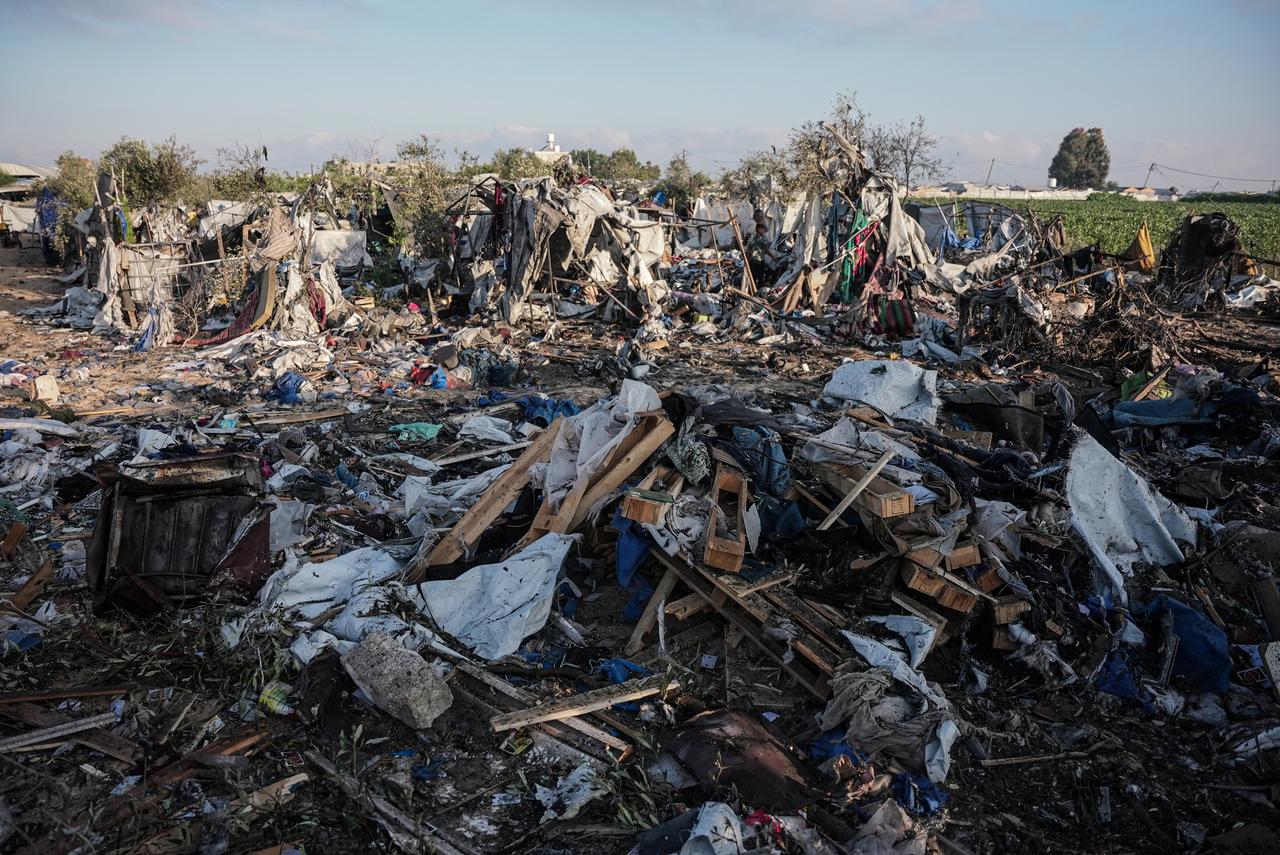
Attacks in Han Yunus (29 June 2026) Anadolu Ajansı
Israeli forces opened fire on civilians at the Beni Suheyla intersection east of Han Yunus, resulting in the death of one Palestinian and an injury to a child.
The Israeli military detonated explosives to destroy buildings and facilities in the northeast of Han Yunus. Intense explosions in the area were audible from nearby residential zones.
An unmanned aerial vehicle operated by the Israeli military targeted the Baraka neighborhood of Deyr el-Belah in the central part of the Gaza Strip. Three Palestinians were killed, including one child.
The Selatın area of Beit Lahiya in northern Gaza was targeted by Israeli military artillery fire. Two Palestinians were injured in the attack, one of them a woman.
As a result of attacks in Han Yunus, Deyr el-Belah and Beit Lahiya, the number of Palestinians killed across the Gaza Strip since early morning has risen to eight. Dozens of others were reported injured in the attacks.
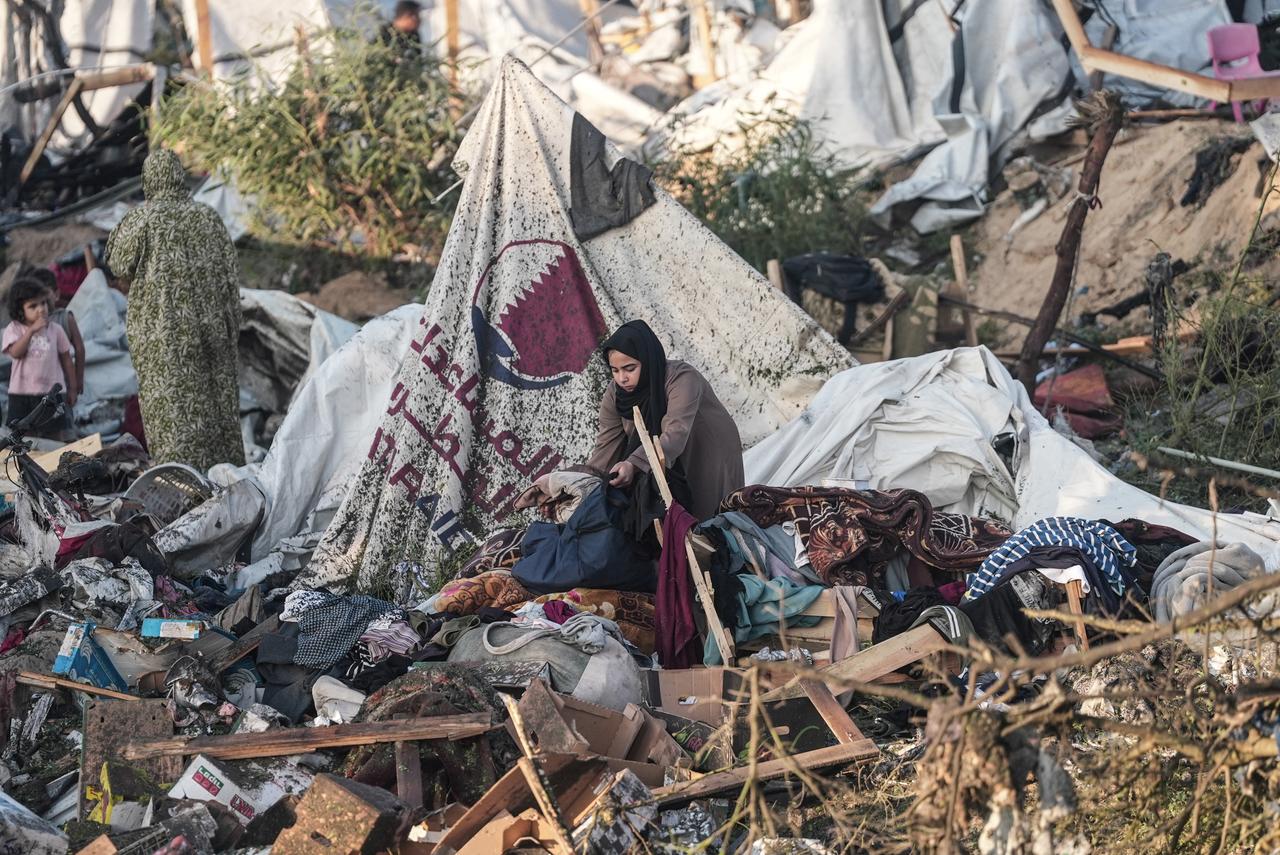
Attacks in Han Yunus (29 June 2026) Anadolu Ajansı
According to data released by the Government Media Office in Gaza, the Israeli military has violated the ceasefire, in effect since 10 October 2025, a total of 3,465 times over a 260-day period. The statement indicated that these violations resulted in 1,045 people killed, 3,380 injured, and 113 detained. It was noted that the Israeli military has carried out attacks on various areas of the Gaza Strip almost daily throughout the ceasefire period.
Al Jazeera. "Israeli attack in Gaza kills three, including a child." Accessed June 30, 2026. https://www.aljazeera.com/news/2026/6/29/israeli-attack-in-gaza-kills-three-including-a-child?utm_source=chatgpt.com
11 June information released on this date indicates that Palestinians living in the Gaza Strip, largely destroyed by Israeli attacks, are facing severe living conditions due to rising temperatures, insect infestations and water shortages accompanying the summer season. As a result of Israeli attacks, approximately 2 million of the 2.3 million population have been displaced, and over 90 percent of the region’s infrastructure has been destroyed. In Gaza, where hospitals, medical facilities, water treatment plants, wells, sewage and water networks have also been damaged, access to clean water for Palestinians living in tents has become severely restricted.
Dr. Rami Velid Abdullah eş-Şeyyah, Head of the Emergency Department at El-Avde Hospital in the Nusayrat Refugee Camp, stated: “The people of Gaza, especially the displaced and those living in tents, are currently suffering from harsh health conditions. Unfortunately, the environment is polluted, water and food are unsanitary, and infrastructure has been destroyed. This situation has led to a significant increase in rodents and insects, especially with the onset of summer.”
On the same day, it was reported that Israeli forces, despite the ceasefire, launched attacks in the Gaza Strip resulting in the deaths of two Palestinians, one of them a woman, and injuries to three others. According to hospital sources, one Palestinian was killed in an Israeli bombardment targeting an apartment building opposite the El-Mısri Refugee Camp in the Gaza Strip. Israeli soldiers opened fire in the El-Atatra area west of Beit Lahiya in northern Gaza, and a woman seriously wounded in the attack was transported to Shifa Hospital in Gaza City.
An Israeli unmanned aerial vehicle exploded near civilians on Kaşku Street in the Zeytun neighborhood of southeastern Gaza City, injuring two Palestinians who were treated at El-Ehli Baptist Hospital in Gaza. According to local sources, Israeli artillery bombarded the eastern areas of Khan Yunis in southern Gaza, while the Israeli navy targeted the western coastal areas of the city with artillery fire.
In central Gaza, Israeli military vehicles opened machine gun fire on areas east of the Megazi Refugee Camp, with no injuries reported from this attack. According to the official Palestinian agency WAFA, the Israeli army conducted an air strike on the home of the “Feravine” family near the El-Mağribi Intersection in Gaza City; initial assessments indicated one person was killed and others were injured.
It was reported that as of 11 June, the total number of deaths resulting from Israeli attacks on the Gaza Strip since October 2023 had risen to 72,991, with the number of injured reaching 173,219.
On 12 June, it was reported that Israeli forces bombed a school housing displaced Palestinians in the Gaza Strip, despite the ceasefire, injuring five Palestinians. According to information from the Ministry of Health under the Gaza Interior Ministry, Israeli artillery units targeted the Abu Hussein School in the Jabaliya Refugee Camp.
According to eyewitnesses, an Israeli unmanned aerial vehicle targeted the Senafor Intersection in the Tuffah neighborhood of Gaza City. In the central part of Gaza, in the Megazi Refugee Camp, Israeli forces ordered local residents to evacuate their homes before bombing and destroying two houses belonging to the “El-Ayidi” and “El-Humeysi” families. The attack caused serious damage to surrounding buildings, and local residents were forcibly displaced again.
On the same day, Israeli warplanes targeted land near a house in Deir al-Balah, causing significant material damage. In the eastern areas of Khan Yunis in southern Gaza, Israeli forces continued demolishing homes and buildings, with loud explosion sounds heard in the region.
On the same day, Hamas spokesperson Hazim Qasim stated that the Israeli army’s continued westward shift of the “Yellow Line” within the Gaza Strip aims to undermine the negotiation process and sabotage efforts to make the ceasefire permanent. Qasim emphasized that the simultaneous bombardments and forced displacements carried out by the Israeli army constitute a clear violation of the ceasefire agreement.
On 13 June, it was reported that Israeli forces, despite the ceasefire, launched attacks on the central and southern parts of the Gaza Strip, killing three Palestinians and injuring two others. According to health sources in Gaza, an Israeli unmanned aerial vehicle targeted a civilian location in the El-Emel neighborhood of Khan Yunis, killing two Palestinians and injuring a child.
Meanwhile, the Israeli army targeted a waste storage area near the Bureyc Refugee Camp in central Gaza, killing one Palestinian and injuring another. Local sources identified the deceased as a sanitation worker employed by the Bureyc Municipality who was killed while on duty.
On 13 June, a written statement from Gaza’s Ministry of Health indicated that in the past 48 hours, two dead and 11 injured were brought to hospitals in Gaza. Since the ceasefire came into effect on 10 October 2025, 983 people have been killed and 3,122 injured in Israeli attacks, with 783 bodies recovered from under the rubble.
The statement also noted that since October 2023, the total number of deaths from Israeli attacks on the Gaza Strip has reached 72,993, and the number of injured has risen to 173,230.
On the same day, Hamas issued a statement stating that new regulations imposed by the administration of Ofer Prison in Israel, restricting detainees’ access to their lawyers, constitute “serious and degrading violations.” The statement emphasized that these practices represent the continuation of a “brutal and inhumane policy” against Palestinian detainees, violating international law, humanitarian values and moral principles.
Hamas called on the international community, the United Nations in particular, to take action to isolate Israel, halt its practices and pressure it to end these violations.
On 14 June, it was reported that Israeli forces, despite the ceasefire, launched attacks on the Gaza Strip, killing six Palestinians. According to the official Palestinian agency WAFA, Israeli soldiers opened fire on Palestinians in southern Gaza, killing 30-year-old Zaki Muhammad al-Karra in an attack near the Beni Suheyla Intersection.
According to local sources, Muhammad Remzi Abu Hasira, injured the previous day in an Israeli unmanned aerial vehicle attack near the Saraya Intersection in central Gaza City, and Khalil Jamal al-Misri, injured in gunfire from Israeli soldiers on Sevre Street, both died in the hospitals to which they were transported.
A funeral ceremony was held for 13-year-old Amir Imad al-Bashiti, killed in an Israeli attack on Khan Yunis, at Nasser Hospital. Additionally, an Israeli unmanned aerial vehicle attack targeting the entrance of a market in the Jabaliya Refugee Camp killed four people, and another attack on Khan Yunis that same morning killed two more people.
On 14 June, the Gaza Ministry of Health reported that in the past 24 hours, three dead and 16 injured were brought to hospitals. Since the ceasefire began on 10 October 2025, 986 people have been killed and 3,138 injured in Israeli attacks, with 783 bodies recovered from under the rubble.
The statement also noted that since October 2023, the total number of deaths from Israeli attacks on the Gaza Strip has reached 72,996, and the number of injured has risen to 173,246.
On the same day, Hamas announced that Palestinian groups, during talks in Cairo facilitated by Egypt, Qatar and Türkiye, reached a consensus on a common national stance, which was communicated to the mediators. The statement emphasized that the groups focused particularly on implementing the second phase of the plan and stressed that all provisions of the first phase must be fully implemented.
The Palestinian groups called for the implementation of the humanitarian protocol, the complete cessation of Israeli attacks in Gaza, the full withdrawal of Israel from Gaza, the establishment of a temporary administrative committee and the initiation of a reconstruction process.
On the same day, the Palestinian Ministry of Health in Gaza, in a statement marking World Blood Donor Day, reported that due to Israeli attacks and the blockade, 87 percent of medical supplies and laboratory testing products used in laboratories have been exhausted. Deputy Director General of the Palestinian Ministry of Health Maher Shamiye emphasized that blood banks are the “lifeline” of the health system during wartime and stressed the urgent need for support for laboratory supplies and medical needs.
The statement noted that Gaza’s health system is facing a severe crisis due not only to hospital destruction but also to shortages of medicine, fuel and medical supplies. It also noted that the Rafah Crossing, partially reopened on 2 February 2026 under the first phase of the ceasefire, was closed again at the end of February, operated with limited activity in March and April, and since 21 May 2026 has been restricted to pedestrian crossings only.
On 15 June, it was reported that Israeli forces, despite the ceasefire, launched attacks across various areas of the Gaza Strip, killing two people, one a three-year-old child and the other a woman, and injuring three others. According to local sources, Israeli forces targeted an area inhabited by Palestinians in the town of Ez-Zevayide in central Gaza using an unmanned aerial vehicle. According to WAFA, Nadiya Kamal Ayash was killed and two Palestinians were injured, one seriously.
Israeli soldiers also opened fire on the Vadi es-Salka area of Deir al-Balah, killing three-year-old Rayan Beha Abu al-Acin and injuring his father. Additionally, four-year-old Gina Bulbul was seriously injured after being shot in the head during an attack on the Meşahire area of the Tuffah neighborhood.
According to hospital sources, Israeli forces bombed an apartment in the Sheikh Rizwan neighborhood of northern Gaza City using an unmanned aerial vehicle, killing Shifa Hospital health worker Muhammad Hebil and his son Musa.
According to local sources, Israeli forces targeted the area around the Al-Razi School in the Nusayrat Refugee Camp with an unmanned aerial vehicle; in the attack, a tent was hit, killing one person and injuring several others. In the northern Gaza city of Beit Lahiya, intense gunfire was reported from Israeli military vehicles near the Abbas Kilani Intersection and Shayma Street.
According to a report published by the Gaza government’s Media Office, between 10 October 2025 and 31 May 2026, over 247 days, Israel violated the ceasefire 3,269 times, resulting in 992 deaths, 3,138 injuries and 95 detentions.
The statement noted that of the 147,000 aid trucks required to enter Gaza under the ceasefire, only 52,740 were permitted entry, representing just 36 percent of the committed amount. Additionally, of the 19,600 people planned for medical evacuation, only 6,845 were allowed to leave, a rate of just 35 percent.
On 15 June, the Gaza Ministry of Health reported that in the past 24 hours, seven dead and six injured were brought to hospitals. Since the ceasefire began on 10 October 2025, 992 people have been killed and 3,144 injured in Israeli attacks, with 784 bodies recovered from under the rubble.
According to the statement, since October 2023, the total number of deaths from Israeli attacks on the Gaza Strip has reached 73,003, and the number of injured has risen to 173,252.
On 17 June, it was reported that the number of people killed by Israeli attacks on the Gaza Strip since the ceasefire began on 10 October 2025 had exceeded one thousand. According to the Gaza Ministry of Health, in the past 24 hours, two dead and five injured were brought to hospitals, and six others injured in previous attacks also died.
Latest figures indicate that since the ceasefire began on 10 October 2025, 1,005 people have been killed, 3,157 injured and 784 bodies recovered from under the rubble. Additionally, since October 2023, the total death toll has reached 73,016 and the number of injured has risen to 173,265.
International Committee of the Red Cross (ICRC) announced that three Palestinians detained in Gaza had been released. The detainees were transferred via the Kerem Abu Salim Crossing to the Al-Aqsa Martyrs Hospital.
The ICRC noted that since 2023, it has assisted in the transfer of more than 2,500 Palestinian detainees, but since October 2023, it has been unable to access Palestinian detainees held in Israeli detention centers and prisons. According to Palestinian and international human rights organizations, more than 9,600 Palestinians, including 350 children and 84 women, remain detained in Israeli prisons.
Health sources reported that an Israeli unmanned aerial vehicle targeted civilians on the shoreline in the Mevasi area of Khan Yunis, killing two people and injuring six. Eyewitnesses reported that the area, due to the hot weather, had become crowded with civilians and displaced Palestinians, and that the beach had become one of the few places where the people of Gaza could breathe freely.
Hamas spokesperson Hazim Qasim announced that Hamas negotiations with mediator countries and the Gaza Peace Council had reached broad agreements. Qasim noted that discussions covered the Gaza Administration National Committee, the deployment of international forces in the Gaza Strip and the handling of weapons by Palestinian groups.
Qasim further stated that significant progress had been made toward completing the first phase of the ceasefire and moving to the second phase, emphasizing that Hamas’s priority is ending attacks in Gaza, delivering humanitarian aid and initiating the reconstruction process.
Israel’s Channel 13 television reported that U.S. President Donald Trump had halted Israel’s planned new attack on the Gaza Strip. The report claimed that the attack plan, after evaluation by high-level Israeli political and security circles, was presented to the United States, and U.S. officials opposed it and demanded it not be implemented.
On the same day, the United Nations (UN) announced that serious violations against children increased by 34 percent in 2025, with 9,465 serious violations identified against Israeli forces in occupied Palestinian territories. The “Children and Armed Conflict (CAAC)” report issued by UN Secretary-General Antonio Guterres confirmed that in 2025, 38,558 serious violations were verified and 24,174 children were directly affected by these violations.
The report stated that children have been subjected to numerous serious violations, including killing, maiming, recruitment by armed groups, abduction, sexual violence, attacks on schools and hospitals, and obstruction of humanitarian aid. The highest number of serious violations occurred in occupied Palestinian territories and Israel (12,445), followed by the Democratic Republic of the Congo, Nigeria, Myanmar and Somalia. The report highlighted a 34 percent increase in killings of children and a 10 percent increase in maiming.
Of the 12,445 verified serious violations, 12,436 occurred in occupied Palestinian territories and 9 in Israel. Of these, 5,452 occurred in the West Bank and 6,984 in the Gaza Strip. The UN also noted that verification processes are ongoing regarding information that 4,588 children were killed in Gaza and 346 children were maimed in Israel.
The report attributed 9,465 serious violations to Israeli armed and security forces and 326 serious violations to Israeli civilians attempting to seize Palestinian land. It also stated that 981 Palestinian children were detained, of whom 180 were held without charge or trial, 66 reported physical abuse and mistreatment while detained, one child died in detention and three children were used as human shields.
UN Secretary-General Antonio Guterres expressed being “shocked” by the serious violations in the Gaza Strip and “deeply concerned” about the rising violence in the West Bank, including East Jerusalem. A senior UN official stated that for the first time in 30 years, government forces have been listed as the primary perpetrators of serious violations against children, with the Israeli army and security forces at the top of the list. The official described 2025 as “one of the darkest years” since reporting on child protection began.
On 18 June, Hamas spokesperson Hazim Qasim assessed statements made by U.S. President Donald Trump at the G7 Summit. Qasim welcomed Trump’s assertion that “Hamas is adhering to the ceasefire”, stating that this reflects Hamas’s seriousness in implementing the ceasefire. Qasim also called on the United States to pressure Israel to halt its ceasefire violations.
On 17 June at the G7 Summit, Trump stated that he hoped an agreement with Iran would be the beginning of broader peace in the Middle East, and that in Gaza, “Hamas is extremely quiet” and efforts are underway to disarm the organization.
On the same day, UN Deputy Secretary-General and Emergency Relief Coordinator Tom Fletcher told the UN Security Council that the ceasefire, which came into effect in October 2025, reduced civilian casualties and removed some barriers to humanitarian access, but that the 2803 resolution of the UN Security Council outlined far more comprehensive goals than the current ceasefire.
Fletcher emphasized that the humanitarian situation in Gaza is “unsustainable”, with Palestinians deprived of basic life necessities. He added that Gaza remains “the most dangerous place in the world for humanitarian workers”, with nearly 600 humanitarian workers killed in approximately three years, accounting for more than half of all humanitarian worker deaths worldwide. Fletcher noted that humanitarian aid is still delivered through one or two operational border crossings.
Fletcher also noted that forced displacements, home demolitions, land seizures and movement restrictions in the West Bank, including East Jerusalem have accelerated, appearing to aim at changing the demographic structure of occupied Palestinian territories, in violation of international law.
Hamas spokesperson Hazim Qasim assessed the report issued by the United Nations Independent International Commission of Inquiry on the Occupied Palestinian Territories. Qasim stated that the report is important for documenting Israeli crimes in Palestine and asserted that the evidence confirms Israeli forces have used civilians as human shields during military operations in Gaza.
Qasim further argued that Israel intentionally targets civilians, conducting attacks on residential areas, shelters, hospitals and schools, and that these actions demonstrate the commission of the crime of genocide against the Palestinian people.
The commission’s report concluded that Israeli authorities and security forces have intentionally targeted Palestinian children in the Gaza Strip, committing genocide, crimes against humanity and war crimes; in the West Bank, they have committed war crimes.
On the same day, it was reported that an Israeli attack targeting a vehicle in the Gaza Strip, despite the ceasefire, killed three Palestinians. According to hospital sources, Israeli forces targeted the Abu Hudayra Intersection in central Gaza City with an unmanned aerial vehicle, and a missile struck a vehicle passing through the intersection, killing three people and injuring many others. The injured were taken to the Saraya Sahra Hospital, operated by the Palestinian Red Crescent. Eyewitnesses stated that the targeted area is one of the busiest and most densely populated points in Gaza City.
According to the Gaza Ministry of Health, in the past 48 hours, two dead and eight injured were brought to hospitals. Since the ceasefire began on 10 October 2025, 1,007 people have been killed and 3,165 injured in Israeli attacks, with 784 bodies recovered from under the rubble.
The statement also noted that since October 2023, the total number of deaths from Israeli attacks on the Gaza Strip has reached 73,018, and the number of injured has risen to 173,273.
Gaza Strip Municipalities Union warned that due to Israel’s blocking of industrial oils and fuel from entering the region, water and waste management services have reached a standstill. The statement noted that electric generators, water wells, sewage facilities and municipal vehicles and equipment depend on industrial oils, and that the ongoing crisis constitutes an urgent humanitarian and environmental threat.
The union stated that municipalities produce more than 140,000 cubic meters of water daily, discharge approximately 60,000 cubic meters of wastewater into the sea, and collect more than 3,000 cubic meters of waste daily, holding Israel directly responsible for any potential collapse of municipal services. The statement called for immediate permission for the entry of industrial oils, diesel, spare parts, vehicle tires, pumps and other maintenance materials into the region.
Gaza Administration National Committee (NCAG) announced that a delegation led by President Ali Shaas held coordination meetings with representatives of the European Union, the United Nations and the World Bank. The meetings addressed damage and needs assessments in the Gaza Strip, early recovery processes, reconstruction priorities and international support mechanisms.
Ali Shaas stated that the committee has prepared plans for rubble removal and reconstruction and that sectoral intervention plans are complete and ready for implementation when conditions permit. Priority areas include health, shelter, infrastructure, economy, agriculture, communications and social protection.
On 19 June, it was reported that Israeli forces, despite the ceasefire, launched attacks targeting civilians in southern Gaza, killing one person and injuring many others, four of them children. According to the official Palestinian news agency WAFA, Israeli forces targeted tents housing displaced Palestinians in the El-Mevasi area west of Khan Yunis. The injured were taken to Nasser Hospital, and one of them later died in the hospital.
According to eyewitnesses and health sources, Israeli forces also targeted the Beni Suheyla area east of Khan Yunis. Fire opened on the area, located outside the Israeli-controlled “Yellow Line,” injured one Palestinian, and the Israeli navy bombarded the western areas of Khan Yunis from the sea.
According to the latest official figures as of 19 June, since the ceasefire began, Israeli attacks have killed 1,007 people, injured 3,165 and recovered 784 bodies from under the rubble. Additionally, since October 2023, 73,018 people have been killed and 173,273 injured in the Gaza Strip.
United Nations Children’s Fund (UNICEF) spokesperson James Elder described the ceasefire period in Gaza for Palestinian children as a “cruel and deadly illusion” in a statement at the UN office in Geneva.
Elder stated that since the ceasefire was declared on October 2025, 265 Palestinian children have been killed, with an average of one child dying every day over the past eight months. Elder said children are being killed in their homes, at school, while playing football and while fishing, and that while the world speaks of a ceasefire, families in Gaza continue burying their children.
Elder also noted that this week a two-year-old baby was shot and killed by Israeli forces; during the ceasefire period, 400 children have been injured and hundreds require urgent medical evacuation.
On 20 June, it was reported that Israeli forces, despite the ceasefire, launched attacks in the Gaza Strip, killing ten Palestinians, four from the same family and one an Al Jazeera photojournalist.
Israeli forces bombed the home of the Safadi family in Gaza City, killing four people from the same family, two of them children, and injuring many others. Near the Es-Saftavi Intersection in northern Gaza City, an attack on pedestrians killed one person and injured another. In an unmanned aerial vehicle attack in the Sheikh Rizwan neighborhood, five people were injured.
Israeli forces also opened fire on a Palestinian woman in Beit Lahiya, killing Tagrid Zamlat. In an attack by Israeli naval forces targeting tents of displaced people in the El-Imadi area west of Gaza City, Kemal Ahmed al-Sayyid (62) was killed.
In an unmanned aerial vehicle attack on a house in the El-Bureyc Refugee Camp in central Gaza, two people were killed, including Al Jazeera Mobasher photojournalist Ahmed Vishah, and one person was injured. With Vishah’s death, the number of Al Jazeera staff killed in Israeli attacks in Gaza has risen to twelve.
In another Israeli drone attack in Khan Yunis, one person was killed and seven injured; in an attack near the Abu Hamid Intersection in eastern Gaza City, two women were injured. According to the latest official figures, since the ceasefire began, Israeli attacks have killed 1,012 people and injured 3,208.
On the same day, the Gaza Government Media Office announced that since the ceasefire began on 10 October 2025, over 251 days, Israel has violated the ceasefire 3,338 times. According to the statement, these violations resulted in 1,012 Palestinians killed, 3,208 injured and 100 Palestinians detained.
The statement also noted that of the 150,600 aid trucks required to enter Gaza under the ceasefire, only 54,203 were permitted entry, representing just 36 percent of the committed amount.
It was stated that of the 20,600 people planned for evacuation from Gaza, only 7,417 were granted passage. The statement called on mediator countries, Arab and Muslim nations and the international community to pressure Israel to comply with the ceasefire.
Information released on 21 June indicated that power outages at the Nasser Hospital in Khan Yunis in southern Gaza are threatening the lives of critically ill patients. Due to the ongoing blockade and restrictions on the entry of spare parts, generator maintenance has been impossible, resulting in operations sometimes being unable to be performed.
It was reported that one of the hospital’s four generators is broken, another is used only in emergencies, and the remaining two operate on rotation, providing only 70 percent of the hospital’s electricity needs.
The mother of 10-month-old Eymen, a patient at the hospital, described the immense difficulties they face due to power outages and lack of medical supplies, while hospital doctors stated that equipment used to monitor critically ill patients cannot operate during power outages. Director of Technical Services Hamed al-Najjar stated that if the necessary maintenance materials are secured, the hospital’s electricity needs could be met at 90 percent capacity.
On the same day, it was reported that Israeli forces, despite the ceasefire, launched attacks on the Gaza Strip, killing nine Palestinians and injuring 41 in the past 24 hours. In an attack targeting a house in the Bureyc Refugee Camp, three people were killed, including Al Jazeera Mubasher cameraman Ahmed Vishah.
According to local sources, Israeli warplanes targeted the area around the Shati Refugee Camp and the Nasira neighborhood, and an attack on a tent housing displaced people in the garden of the Ibn Sina School killed one person and injured many others. Another aerial attack in the same area also resulted in injuries.
According to WAFA, Israeli forces targeted Palestinians near a wedding hall west of Khan Yunis with an unmanned aerial vehicle, killing a young man and a girl and injuring many others.
According to the latest official figures as of 21 June, since the ceasefire began on 10 October 2025, Israeli attacks have killed 1,021 people, injured 3,249 and recovered 784 bodies from under the rubble. Additionally, since October 2023, the total death toll in the Gaza Strip has reached 73,032 and the number of injured has risen to 173,357.
On the same day, due to Israel’s limited permission, 97 Palestinians crossed into Egypt through the Rafah Crossing for medical treatment. Of those crossing, 35 were patients and 62 were companions.
The statement noted that Palestinian Red Crescent teams coordinated the evacuation process from the Tehil Medical Hospital in Khan Yunis, providing humanitarian and logistical support to patients and companions.
On 22 June, it was reported that an Israeli attack targeting a vehicle in the Gaza Strip, despite the ceasefire, killed 18-year-old Ragad Hussein Ashour, who was on his way to university exams. Israeli forces launched an unmanned aerial vehicle attack on a crowded area in the Rimal neighborhood of Gaza City due to university exams, killing one person and injuring three others when a vehicle on Ahmed Abdulaziz Street was targeted.
It was reported that Ragad Hussein Ashour, who died, had gone to a café in the area to take his high school graduation exam due to internet outages. The deceased and injured were transferred to the Saraya Sahra Hospital, operated by the Red Crescent, and it was stated that Ashour was his family’s only child and that his father had been killed in a previous Israeli attack.
According to WAFA, Israeli forces also targeted a civilian vehicle from the air in the Mevasi area of Khan Yunis, killing health worker Meysera Hawaja and injuring many others.
Palestinian Ministry of Education announced on 9 June that since October 2023, 20,814 students and 1,054 education personnel have been killed in attacks in the Gaza Strip and occupied West Bank.
The statement noted that in Gaza, more than 179 public schools, over 105 UNRWA schools and over 63 university buildings have been destroyed. Additionally, in the attacks, 20,480 students have been killed, including 1,379 university students, and 31,436 students have been injured, including 3,017 university students.
United Nations (UN) announced that Israel continues its aerial, land and sea attacks on the Gaza Strip despite the ceasefire that came into effect in October 2025.
UN Secretary-General Spokesperson Stephane Dujarric said UN Office for the Coordination of Humanitarian Affairs (OCHA) staff reported that civilians in Gaza continue to be subjected to aerial attacks, naval fire, artillery bombardments and armed attacks in populated areas. Dujarric expressed concern over reports of attacks continuing in the area west of the “Yellow Line” and civilians being killed at crossing points.
Dujarric also noted that the Kerem Abu Salim Crossing remains the only entry point for humanitarian aid into Gaza and called for additional crossings to be opened and restrictions on aid materials to be lifted. Dujarric emphasized that violence in the occupied West Bank remains alarmingly high and stressed that perpetrators of deadly attacks must be held accountable.
According to the Gaza Ministry of Health on 22 June, in the past 24 hours, three dead and 11 injured were brought to hospitals. Since the ceasefire began on 10 October 2025, 1,024 people have been killed and 3,260 injured in Israeli attacks, with 784 bodies recovered from under the rubble.
The statement also noted that since October 2023, the total number of deaths from Israeli attacks on the Gaza Strip has reached 73,035, and the number of injured has risen to 173,368.
On 23 June, it was reported that the number of people killed by Israeli attacks on the Gaza Strip since October 2023 has risen to 73,039. According to the Gaza Ministry of Health, in the past 24 hours, four dead and 20 injured were brought to hospitals, one of the dead recovered from the rubble, one previously injured and two newly injured.
Since the ceasefire began on 10 October 2025, 1,027 people have been killed, 3,280 injured and 785 bodies recovered from under the rubble.
Nasser Hospital sources reported that an Israeli unmanned aerial vehicle targeted a tent housing displaced Palestinians at the Bir Iyad location in the Mevasi area of Khan Yunis, killing 48-year-old Ismail Mahmoud al-Misri and injuring one person.
Hospital sources also reported that Israeli forces targeted a motorcycle with an unmanned aerial vehicle west of Khan Yunis, killing one Palestinian and injuring many others.
The Palestinian government, following its weekly meeting in Ramallah, stated that the health system in Gaza is on the verge of collapse and that the humanitarian crisis is deepening.
The statement noted that more than 20,000 injured people in Gaza require medical treatment and called on the international community to pressure Israel, permit the evacuation of the injured and ensure their access to necessary healthcare services.
In the occupied West Bank, 31 attacks on Palestinian villages were recorded in the past week, 26 Palestinian structures were demolished and 46 demolition orders were issued. The statement also described the killing of a young man and a child in Beit Ummar and the detention of their bodies as a “double crime”, and held Israeli authorities responsible for setting fire to two mosques in the villages of Celciliya and Mezraat en-Nubani.
United Nations (UN) announced that approximately 1.7 million people have been displaced in Gaza due to Israeli attacks and are living in extremely poor conditions.
UN Secretary-General Spokesperson Stephane Dujarric, citing data from the UN Office for the Coordination of Humanitarian Affairs (OCHA), stated that civilians in Gaza continue to be affected by artillery fire, aerial attacks and bombings. Dujarric recalled that a 17-year-old girl student, one of UNICEF’s youth champions, was killed while on her way to take high school exams.
Dujarric noted that a study covering the 1,600 areas inhabited by the 1.7 million displaced people, who constitute approximately 80 percent of Gaza’s population, confirmed that people face limited access to basic humanitarian supplies, inadequate healthcare services, water shortages and security issues.
The statement noted that at least 59,000 shelters house more than eight people each, approximately 39,000 people sleep in the open air, 600,000 people lack access to sufficient drinking water, half of the areas lack drainage systems, and nearly half face fire risks. Additionally, 80 percent of the areas have rodent infestations, more than half have open sewers and accumulated waste, and explosive hazards have been detected in 250 facilities housing approximately 250,000 people.
On 24 June, a report published in Israel indicated that the wars Israel has waged since 7 October 2023 on the Gaza Strip, Lebanon, Syria and Iran have cost the country’s economy approximately 700 billion shekels (20.5 billion U.S. dollars).
Times of Israel’s Zman Yisrael, based on data from the Bank of Israel, reported that the direct cost of the conflict to the Israeli government has exceeded 405 billion shekels. This amount includes 243 billion shekels in defense spending, 33 billion shekels in compensation, 57 billion shekels in civilian expenditures and 19 billion shekels in interest payments on public debt.
The report also noted that U.S. military assistance to Israel is valued at approximately 26 billion U.S. dollars; production losses between October 2023 and the end of 2025 reached 177 billion shekels, and with developments in 2026, this figure could exceed 200 billion shekels.
On the same day, it was reported that Israeli attacks targeting tents of displaced Palestinians in the Mevasi area of Khan Yunis killed two people, one of them a child.
According to local sources, Adem Abu Hadayid, injured in an Israeli unmanned aerial vehicle attack on the tents, later died. Nasser Hospital sources reported that in another attack in the same area, child Ahmed Muhsin al-Raqab was killed and two others were injured.
Eyewitnesses stated that the tents were targeted by at least one missile, and in another attack targeting tents of displaced civilians in the Sheikh Aclin neighborhood west of Gaza City, debris was created and surrounding tents were damaged.
According to the Gaza Ministry of Health on 24 June, in the past 24 hours, two dead and 14 injured were brought to hospitals. Since the ceasefire began on 10 October 2025, 1,029 people have been killed, 3,294 injured and 785 bodies recovered from under the rubble.
Additionally, since October 2023, the total number of deaths from Israeli attacks on the Gaza Strip has reached 73,041, and the number of injured has risen to 173,402.
According to the Israeli newspaper Yedioth Ahronoth, Israeli Prime Minister Benjamin Netanyahu admitted at the “Muni Expo 2026” event in Tel Aviv that operations targeting Rafah have expanded Israel’s control area in Gaza.
Netanyahu stated that Israel’s control area in Gaza has increased from 53 percent at the start of the ceasefire, to 60 percent in May 2026, and as of 24 June, to 70 percent. The report noted that this means approximately 255 square kilometers of Gaza’s 365-square-kilometer territory is under Israeli control, forcing approximately 2.13 million Palestinians to live in an area of just 110 square kilometers.
On 25 June, United Nations Children’s Fund (UNICEF) spokesperson James Elder announced that since October 2025, more than 260 children have been killed in Gaza during the so-called ceasefire.
Elder stated that children in Gaza face malnutrition, lack of clean water and limited access to healthcare, with most children fed only two types of food, primarily bread. He emphasized that water infrastructure has been largely destroyed and the water crisis continues despite the ceasefire.
Elder used the phrase “On average, one child dies every day” to describe the ceasefire as a “cruel and deadly illusion” for children. Elder noted that children in Gaza do not live in safe environments, with only about half able to attend school and no child receiving adequate and balanced nutrition.
Elder also noted that nine out of ten homes and nine out of ten hospitals and schools in Gaza have been damaged or destroyed. He stated that UNICEF faces an approximately 80 percent funding gap, and that malnutrition among pregnant women and children over five has reached emergency levels.
On the same day, Israeli soldiers opened fire in the northern Gaza town of Beit Lahiya, violating the ceasefire and killing one Palestinian. The body of the deceased was taken to Shifa Hospital.
In an Israeli unmanned aerial vehicle attack targeting a civilian location in the Nasr neighborhood of Gaza City, two Palestinians were injured, one of whom was in serious condition.
According to the Gaza Ministry of Health on 25 June, in the past 24 hours, two dead and 15 injured were brought to hospitals. Since the ceasefire began on 10 October 2025, 1,031 people have been killed, 3,309 injured and 785 bodies recovered from under the rubble. Additionally, since October 2023, the total number of deaths from Israeli attacks on the Gaza Strip has reached 73,043 and the number of injured has risen to 173,417.
International Committee of the Red Cross (ICRC) announced that 13 Palestinian detainees held by Israel in the Gaza Strip have been released. The detainees were transferred via the Kerem Abu Salim Crossing by Palestinian Red Crescent teams to the Al-Aqsa Martyrs Hospital.
The statement recalled that since 2023, the ICRC has supported the transfer of more than 2,500 Palestinian detainees and noted that it continues to engage with Israeli authorities to gain access to detained Palestinians and enable families to obtain information about their relatives.
On 26 June, it was reported that Israeli forces, despite the ceasefire, launched attacks in the Gaza Strip, bringing the number of those killed that day to five. According to WAFA, Israeli forces targeted a vehicle carrying civilians in the central Gaza Strip with an unmanned aerial vehicle, killing three Palestinians and injuring others. The injured were taken to the Al-Aqsa Martyrs Hospital.
The Gaza Interior Ministry stated that the targeted vehicle was a police vehicle and that the three killed in the attack in the Bureyc Refugee Camp were police officers. According to Gaza Ministry of Health data, since the ceasefire began on 10 October 2025, Israeli attacks have killed 1,031 people and injured 3,309.
According to local sources, Velid Mecdi Heniyeh, seriously injured in an attack the previous day in the Nasr neighborhood of Gaza City, died. Additionally, one person was injured in Israeli gunfire near the Austria Cemeteries west of Khan Yunis, while Israeli forces launched artillery attacks on eastern Khan Yunis and naval vessels opened heavy machine gun fire on fishing boats along the western coast.
Local sources also reported that Israeli forces killed 35-year-old Uday Hamdi Younis in an unmanned aerial vehicle attack in Beit Lahiya, stating that Younis was killed while collecting firewood near the area where Israeli forces were stationed.
Hamas spokesperson Hazim Qasim announced that Hamas is maintaining contact with Palestinian groups and mediators in Türkiye, Egypt and Qatar and is preparing to visit Cairo to evaluate new proposals.
Qasim stated that Hamas hopes the efforts of mediators and Gaza Peace Council High Representative Nikolay Mladenov will compel Israel to fulfill its obligations under the ceasefire agreement. In the second phase of the ceasefire, the entry of the Gaza Administration National Committee (NCAG) into the region, the deployment of international forces in Gaza and the handling of weapons by Palestinian groups are foreseen.
Qasim also accused Israel of restricting humanitarian aid, continuing attacks and expanding the “Yellow Line” to cause further displacements and destruction in new areas. He stressed that mediator countries must exert greater pressure on Israel to enable the entry of the NCAG into Gaza and initiate the reconstruction process.
United Nations Food and Agriculture Organization (FAO) and UN Satellite Centre (UNOSAT) jointly reported that more than 81 percent of Gaza Strip greenhouses remain damaged and non-operational.
According to the report, 1,094 hectares of the 1,325-hectare greenhouse area in Gaza have been damaged, and approximately 87 percent of cultivated land has become unusable. Significant losses have also occurred in agricultural infrastructure, irrigation systems, storage facilities and farm assets.
FAO reported limited recovery in livestock, with sheep numbers increasing by 33 percent and goat numbers by 8 percent. FAO Deputy Director-General Beth Bechdol stated that some farmers are attempting to resume production but that this is insufficient against widespread destruction, calling for immediate permission for the entry of seeds, fertilizer, equipment and other agricultural inputs into Gaza.
On 27 June, it was reported that Israeli forces expanded their control area in the eastern part of the El-Megazi Refugee Camp in central Gaza and the eastern part of Deir al-Balah. According to local sources, two tanks and one military bulldozer advanced approximately 200 meters westward, opening heavy fire and moving yellow concrete blocks westward to expand the “Yellow Line” boundary as defined in the ceasefire agreement.
It was recalled that Israeli Prime Minister Benjamin Netanyahu stated that approximately 70 percent of the Gaza Strip is under Israeli military control. According to this, the controlled area has increased from 53 percent at the start of the ceasefire, to 60 percent in May 2026, and then to 70 percent. This has forced approximately 2.13 million Palestinians to live in an area of just 110 square kilometers.
According to the Gaza Ministry of Health, since October 2023, the number of people killed by Israeli attacks on the Gaza Strip has risen to 73,051.
In the past 24 hours, eight bodies, one recovered from the rubble and one from previous injuries, along with 20 injured, were brought to hospitals. Since the ceasefire began on 10 October 2025, 1,038 people have been killed, 3,329 injured and 786 bodies recovered from under the rubble.
Nasser Hospital sources reported that 10-year-old Velid Yusuf Abu Cezer, injured in an attack several days earlier in the El-Mevasi area west of Khan Yunis, died.
Israeli forces were also reported to have targeted a tent housing displaced Palestinians on Cela Street in Gaza City, violating the ceasefire.
According to hospital sources, Israeli forces targeted two tents housing displaced people on Reshid Street in the El-Mevasi area west of Khan Yunis with an unmanned aerial vehicle, killing two Palestinians, one of them a woman, and injuring six. Many surrounding tents were also reported damaged in the attack.
Information released on 28 June indicated that efforts to reach approximately 8,500 bodies buried under rubble from Israeli attacks since October 2023 could take years due to lack of equipment.
Search efforts at the home of the Gabun family in the Sabra neighborhood of Gaza City have become symbolic of the situation in the region. Civil Defense teams are reported to be attempting to reach the bodies of eight people under the rubble using the only operational heavy machine in Gaza.
Gaza Civil Defense Spokesperson Mahmud Basal stated that approximately 8,500 corpses and human remains remain buried under rubble across Gaza and that operations are severely hindered due to Israel’s refusal to allow heavy machinery into the region. Basal stated that with the necessary equipment, bodies could be recovered in approximately three months, but with current capabilities, operations could last for years.
On the same day, it was reported that Israeli forces, despite the ceasefire, launched attacks on the Gaza Strip from early morning, killing four Palestinians, one of them a girl, and injuring many others.
According to hospital sources, an Israeli unmanned aerial vehicle targeted civilians in the Selatin area of Beit Lahiya, killing two Palestinians and seriously injuring one. In the Amudi area of the same town, a 33-year-old woman was injured by Israeli gunfire.
In an attack by Israeli forces near the Beni Suheyla Intersection in eastern Khan Yunis, 13-year-old Ilin Islam Ferra was killed. In an attack bombing an area where civilians had gathered in the Mevasi area west of Khan Yunis, one person was killed and three injured.
The Gaza Ministry of Health announced that due to Israel’s refusal to grant security approvals, the evacuation of patients for medical treatment abroad has been largely blocked. In recent weeks, only five of approximately 70 patients requiring urgent treatment were granted travel permits.
The ministry also reported that more than 17,000 patients are awaiting evacuation from Gaza for medical treatment and that delays are increasing patient deaths.
Director of the Kidney Disease and Transplant Department at Shifa Hospital, Gazi al-Yazici stated that the department is facing a severe crisis due to a shortage of sodium bicarbonate used in dialysis. Yazici noted that 25 dialysis machines have been taken out of service, only 26 machines are partially operational, leading to reduced dialysis durations and weekly session numbers, negatively affecting the health of approximately 240 chronic kidney patients.
On the same day, the family of Palestinian Mecdi Abu Arra, through the Israeli human rights organization HaMoked, announced that they had been informed of their son’s death. The family stated they had received no information about their son’s fate for approximately one and a half years, while Palestinian media reported that Mecdi Abu Arra was killed in an Israeli unmanned aerial vehicle attack on 3 December 2024.
On 28 June, the Gaza Ministry of Health reported that in the past 24 hours, three dead and 43 injured were brought to hospitals. Since the ceasefire began on 10 October 2025, 1,041 people have been killed, 3,372 injured and 786 bodies recovered from under the rubble.
Additionally, since October 2023, the total number of deaths from Israeli attacks on the Gaza Strip has reached 73,054, and the number of injured has risen to 173,480.
On 29 June, it was reported that Israeli forces, despite the ceasefire, launched attacks on the Gaza Strip from early morning, bringing the number of those killed to eight.
According to hospital sources and eyewitnesses, Israeli forces targeted tents housing displaced Palestinians in the Mevasi area west of Khan Yunis, killing a mother and her young daughter. In another unmanned aerial vehicle attack on a tent on the shoreline in the same area, one person was killed and 27 injured.
Israeli forces opened fire on civilians near the Beni Suheyla Intersection, killing one Palestinian and injuring a girl. Additionally, in an unmanned aerial vehicle attack on the El-Baraka area of Deir al-Balah, three people were killed, one of them a child.
The Selatin area of northern Gaza’s Beit Lahiya was targeted with artillery fire, injuring two people, one of them a woman. According to the Gaza Government Media Office, since the ceasefire began on 10 October 2025, over 260 days, Israel has violated the ceasefire 3,465 times, killing 1,045 people, injuring 3,380 and detaining 113.
According to the Gaza Ministry of Health, in the past 24 hours, four bodies and eight injured were brought to hospitals.
Since the ceasefire began on 10 October 2025, 1,045 people have been killed, 3,380 injured and 786 bodies recovered from under the rubble.
Additionally, since October 2023, the total number of deaths from Israeli attacks on the Gaza Strip has reached 73,058, and the number of injured has risen to 173,488.
According to health sources, an Israeli armed unmanned aerial vehicle attack on the El-Baraka area of Deir al-Balah killed <strong class
Anadolu Ajansı. "Ateşkese Rağmen İsrail'in Gazze'ye Saldırılarında 6 Filistinli Hayatını Kaybetti." Accessed August 1, 2026.https://www.aa.com.tr/tr/dunya/ateskese-ragmen-israilin-gazzeye-saldirilarinda-6-filistinli-hayatini-kaybetti/3966401
Anadolu Ajansı. "BM: Filistin'de İsrail Güçlerinin Çocuklara Yönelik 9 Bin 465 Ağır İhlalde Bulunduğu Tespit Edildi." Accessed August 1, 2026.https://www.aa.com.tr/tr/dunya/bm-filistinde-israil-guclerinin-cocuklara-yonelik-9-bin-465-agir-ihlalde-bulundugu-tespit-edildi/3970254
Anadolu Ajansı. "BM: Gazze'de Yerinden Edilen 1,7 Milyon Kişi Son Derece Kötü Koşullarda Yaşıyor." Accessed August 1, 2026.https://www.aa.com.tr/tr/dunya/bm-gazzede-yerinden-edilen-1-7-milyon-kisi-son-derece-kotu-kosullarda-yasiyor/3975942
Anadolu Ajansı. "BM: Gazze'deki Filistinliler Temel İhtiyaçlardan Mahrum Kalmaya Devam Ediyor." Accessed August 1, 2026.https://www.aa.com.tr/tr/dunya/bm-gazzedeki-filistinliler-temel-ihtiyaclardan-mahrum-kalmaya-devam-ediyor/3971437
Anadolu Ajansı. "Filistin Hükümeti: Gazze'de 20 Binden Fazla Yaralı Tedavi Bekliyor." Accessed August 1, 2026.https://www.aa.com.tr/tr/dunya/filistin-hukumeti-gazzede-20-binden-fazla-yarali-tedavi-bekliyor/3976007
Anadolu Ajansı. "Gazze Şeridi'ndeki Nasır Hastanesinde Yaşanan Elektrik Kesintileri Hastaların Yaşamını Tehdit Ediyor." Accessed August 1, 2026.https://www.aa.com.tr/tr/dunya/gazze-seridindeki-nasir-hastanesinde-yasanan-elektrik-kesintileri-hastalarin-yasamini-tehdit-ediyor/3973504
Anadolu Ajansı. "Hamas: İsrail Ateşkese Rağmen Gazze'de Öldürmeye, Aç Bırakmaya ve Tedaviyi Engellemeye Devam Ediyor." Accessed August 1, 2026.https://www.aa.com.tr/tr/dunya/hamas-israil-ateskese-ragmen-gazzede-oldurmeye-ac-birakmaya-ve-tedaviyi-engellemeye-devam-ediyor/3984416
Anadolu Ajansı. “ABD'nin İsrail'e Gazze'nin Yeniden İmarı İçin Gerekli Koşulları İçeren Bir Belge Sunduğu İddia Edildi.” Accessed August 1, 2026.https://www.aa.com.tr/tr/dunya/abdnin-israile-gazzenin-yeniden-imari-icin-gerekli-kosullari-iceren-bir-belge-sundugu-iddia-edildi/3981784
Anadolu Ajansı. “Ateşkesi İhlal Eden İsrail Askerlerinin Gazze'deki Saldırısında 1 Filistinli Daha Hayatını Kaybetti.” Accessed August 1, 2026.https://www.aa.com.tr/tr/dunya/ateskesi-ihlal-eden-israil-askerlerinin-gazzedeki-saldirisinda-1-filistinli-daha-hayatini-kaybetti/3977436
Anadolu Ajansı. “Gazze'de Enkaz Altındaki 8 Bin 500 Kayıp Cenazeyi Bulmak İçin Tek İş Makinasıyla Verilen Umutsuz Mücadele.” Accessed August 1, 2026.https://www.aa.com.tr/tr/dunya/gazzede-enkaz-altindaki-8-bin-500-kayip-cenazeyi-bulmak-icin-tek-is-makinasiyla-verilen-umutsuz-mucadele/3980439
Anadolu Ajansı. “Gazze'de İsrail'in Yerinden Ettiği Filistinliler Haşereler, Sıcak Hava ve Su Kıtlığıyla Mücadele Ediyor.” Accessed August 1, 2026.https://www.aa.com.tr/tr/dunya/gazzede-israilin-yerinden-ettigi-filistinliler-hasereler-sicak-hava-ve-su-kitligiyla-mucadele-ediyor/3963764
Anadolu Ajansı. “Hamas, Trump'ın Gazze'de Ateşkes Taahhüdüne İlişkin Açıklamalarını Olumlu Olarak Değerlendirdi.” Accessed August 1, 2026.https://www.aa.com.tr/tr/dunya/hamas-trumpin-gazzede-ateskes-taahhudune-iliskin-aciklamalarini-olumlu-olarak-degerlendirdi/3971431
Anadolu Ajansı. “UNICEF, Gazze'de Yaşanan Sözde Ateşkes Sürecinde 260'tan Fazla Çocuğun Öldürüldüğünü Bildirdi.” Accessed August 1, 2026.https://www.aa.com.tr/tr/dunya/unicef-gazzede-yasanan-sozde-ateskes-surecinde-260tan-fazla-cocugun-olduruldugunu-bildirdi/3977470
Anadolu Ajansı. “İsrail Basını: 7 Ekim'den Bu Yana Savaşların İsrail'e Maliyeti 205 Milyar Dolara Ulaştı.” Accessed August 1, 2026.https://www.aa.com.tr/tr/dunya/israil-basini-7-ekimden-bu-yana-savaslarin-israil-e-maliyeti-205-milyar-dolara-ulasti/3977133
Anadolu Ajansı. “İsrail Basını: ABD, İsrail'in Gazze'ye Saldırısını Durdurdu.” Accessed August 1, 2026.https://www.aa.com.tr/tr/dunya/israil-basini-abd-israilin-gazzeye-saldirisini-durdurdu/3969188
Anadolu Ajansı. “İsrail Basını: Barış Konseyi Yakında Gazze'de İnsani Barınma Merkezlerini Yönetmeye Başlayacak.” Accessed August 1, 2026.https://www.aa.com.tr/tr/dunya/israil-basini-baris-konseyi-yakinda-gazzede-insani-barinma-merkezlerini-yonetmeye-baslayacak/3982770
Anadolu Ajansı. “İsrail Gazze Şeridi'nde Ateşkesi İhlal Ederek 3 Filistinliyi Öldürdü.” Accessed August 1, 2026.https://www.aa.com.tr/tr/dunya/israil-gazze-seridinde-ateskesi-ihlal-ederek-3-filistinliyi-oldurdu/3983276
Anadolu Ajansı. “İsrail Ordusu Gazze Şeridi'nde Sivil Aracı Vurdu, 3 Kişi Yaşamını Yitirdi.” Accessed August 1, 2026.https://www.aa.com.tr/tr/dunya/israil-ordusu-gazze-seridinde-sivil-araci-vurdu-3-kisi-yasamini-yitirdi/3970464
Anadolu Ajansı. “İsrail Ordusu Gazze Şeridi'nin Orta Kesiminde Kontrolünü Genişletti.” Accessed August 1, 2026.https://www.aa.com.tr/tr/dunya/israil-ordusu-gazze-seridinin-orta-kesiminde-kontrolunu-genisletti/3979593
Anadolu Ajansı. “İsrail Ordusunun Gazze'ye Düzenlediği Saldırılarda Hayatını Kaybedenlerin Sayısı 8'e Yükseldi.” Accessed August 1, 2026.https://www.aa.com.tr/tr/dunya/israil-ordusunun-gazzeye-duzenledigi-saldirilarda-hayatini-kaybedenlerin-sayisi-8e-yukseldi/3981740
Anadolu Ajansı. “İsrail'in Ateşkese Rağmen Gazze'de Sürdürdüğü Saldırılarda 3 Filistinli Hayatını Kaybetti.” Accessed August 1, 2026.https://www.aa.com.tr/tr/dunya/israilin-ateskese-ragmen-gazzede-surdurdugu-saldirilarda-3-filistinli-hayatini-kaybetti/3965814
Anadolu Ajansı. “İsrail'in Ateşkese Rağmen Gazze'de Sürdürdüğü Saldırılarda 5 Filistinli Yaralandı.” Accessed August 1, 2026.https://www.aa.com.tr/tr/dunya/israilin-ateskese-ragmen-gazzede-surdurdugu-saldirilarda-5-filistinli-yaralandi/3964899
Anadolu Ajansı. “İsrail'in Ateşkese Rağmen Gazze'de Sürdürdüğü Saldırılarda Bir Filistinli Hayatını Kaybetti.” Accessed August 1, 2026.https://www.aa.com.tr/tr/dunya/israilin-ateskese-ragmen-gazzede-surdurdugu-saldirilarda-bir-filistinli-hayatini-kaybetti/3971656
Anadolu Ajansı. “İsrail'in Ateşkese Rağmen Gazze'de Sürdürdüğü Son Saldırılarda Hayatını Kaybedenlerin Sayısı 5'e Çıktı.” Accessed August 1, 2026.https://www.aa.com.tr/tr/dunya/israilin-ateskese-ragmen-gazzede-surdurdugu-son-saldirilarda-hayatini-kaybedenlerin-sayisi-5e-cikti/3978644
Anadolu Ajansı. “İsrail'in Ateşkese Rağmen Gazze'ye Düzenlediği Saldırılarda 10 Filistinli Hayatını Kaybetti.” Accessed August 1, 2026.https://www.aa.com.tr/tr/dunya/israilin-ateskese-ragmen-gazzeye-duzenledigi-saldirilarda-10-filistinli-hayatini-kaybetti/3972720
Anadolu Ajansı. “İsrail'in Ateşkese Rağmen Gazze'ye Düzenlediği Saldırılarda 2 Kişi Öldü, 3 Kişi Yaralandı.” Accessed August 1, 2026.https://www.aa.com.tr/tr/dunya/israilin-ateskese-ragmen-gazzeye-duzenledigi-saldirilarda-2-kisi-oldu-3-kisi-yaralandi/3963719
Anadolu Ajansı. “İsrail'in Ateşkesten Bu Yana Gazze Şeridi'ne Düzenlediği Saldırılarda Hayatını Kaybedenlerin Sayısı Bini Aştı.” Accessed August 1, 2026.https://www.aa.com.tr/tr/dunya/israilin-ateskesten-bu-yana-gazze-seridine-duzenledigi-saldirilarda-hayatini-kaybedenlerin-sayisi-bini-asti/3969870
Anadolu Ajansı. “İsrail'in Gazze Şeridi'ndeki Saldırılarında Can Kaybı 73 Bin 39'a Yükseldi.” Accessed August 1, 2026.https://www.aa.com.tr/tr/dunya/israilin-gazze-seridi-ndeki-saldirilarinda-can-kaybi-73-bin-39a-yukseldi/3975332
Anadolu Ajansı. “İsrail'in Gazze Şeridi'ndeki Saldırılarında Can Kaybı 73 Bin 58'e Yükseldi.” Accessed August 1, 2026.https://www.aa.com.tr/tr/dunya/israilin-gazze-seridi-ndeki-saldirilarinda-can-kaybi-73-bin-58e-yukseldi/3980931
Anadolu Ajansı. “İsrail'in Gazze Şeridi'ne Düzenlediği Saldırılarda Can Kaybı 73 Bin 66'ya Çıktı.” Accessed August 1, 2026.https://www.aa.com.tr/tr/dunya/israilin-gazze-seridine-duzenledigi-saldirilarda-can-kaybi-73-bin-66ya-cikti/3981953
Anadolu Ajansı. “İsrail'in Gazze Şeridi'ne Düzenlediği Saldırılarda Can Kaybı 73 Bin 76'ya Çıktı.” Accessed August 1, 2026.https://www.aa.com.tr/tr/dunya/israilin-gazze-seridine-duzenledigi-saldirilarda-can-kaybi-73-bin-76ya-cikti/3984436
Anadolu Ajansı. “İsrail'in Gazze'de Yerinden Edilenlerin Çadırlarını Hedef Alması Sonucu Biri Çocuk 2 Filistinli Hayatını Kaybetti.” Accessed August 1, 2026.https://www.aa.com.tr/tr/dunya/israilin-gazzede-yerinden-edilenlerin-cadirlarini-hedef-almasi-sonucu-biri-cocuk-2-filistinli-hayatini-kaybetti/3976292
Anadolu Ajansı. “İsrail'in Gazze'ye Düzenlediği Saldırıda Üniversite Sınavına Giren 18 Yaşındaki Kız Hayatını Kaybetti.” Accessed August 1, 2026.https://www.aa.com.tr/tr/dunya/israilin-gazzeye-duzenledigi-saldirida-universite-sinavina-giren-18-yasindaki-kiz-hayatini-kaybetti/3974352
Anadolu Ajansı. “İsrail'in Gazze'ye Düzenlediği Saldırılarda Biri Çocuk 2 Filistinli Hayatını Kaybetti.” Accessed August 1, 2026.https://www.aa.com.tr/tr/dunya/israilin-gazzeye-duzenledigi-saldirilarda-biri-cocuk-2-filistinli-hayatini-kaybetti/3967033
Anadolu Ajansı. “İsrail'in Gazze'ye Saldırılarında Son 24 Saatte 9 Kişi Hayatını Kaybetti.” Accessed August 1, 2026.https://www.aa.com.tr/tr/dunya/israilin-gazzeye-saldirilarinda-son-24-saatte-9-kisi-hayatini-kaybetti/3973475
Anadolu Ajansı. “İsrail'in Gazze'ye Saldırısında Biri Kız Çocuğu 4 Filistinli Hayatını Kaybetti.” Accessed August 1, 2026.https://www.aa.com.tr/tr/dunya/israilin-gazzeye-saldirisinda-biri-kiz-cocugu-4-filistinli-hayatini-kaybetti/3980237
Anadolu Ajansı. “İsrail, Gazze Şeridi’nde Ekim 2025’te Varılan Ateşkesi 3 Bin 269 Kez İhlal Etti.” *Anadolu Ajansı İnfografik*. Accessed August 1, 2026.https://www.aa.com.tr/tr/info/infografik/52413
According to data from the Government Media Office in Gaza on 3 July, over the past 1000 days since October 2023, approximately 2.4 million Palestinians have been forcibly displaced, with more than 21,500 children and more than 12,500 women among the 73,066 Palestinians killed. In Gaza Strip, at least 90 percent of buildings have been destroyed. During this period, the International Criminal Court (ICC) issued arrest warrants for Benjamin Netanyahu and former Defense Minister Yoav Gallant on charges of crimes against humanity and war crimes, while the International Court of Justice (ICJ) initiated a genocide case against Israel following a complaint by South Africa.
Gaza City Mayor Yahya al-Sarraj stated that due to Israel’s 1000-day campaign of attacks on the Gaza Strip, approximately 90 percent of the city’s infrastructure has been destroyed and only 30 percent of the population’s water needs can be met. Sarraj noted that due to Israel’s closure of border crossings and its blockade of equipment, construction materials and spare parts, essential municipal services in Gaza City, home to about 1 million people, have severely deteriorated, with damage to municipal buildings, vehicles, networks and infrastructure reaching 80 to 90 percent.
Sarraj said Israel’s control over approximately 70 percent of the Gaza Strip has prevented municipal teams from accessing numerous critical facilities and hampered maintenance and repair efforts. Sarraj noted that in many areas, daily water supply per person has dropped to 10 to 20 liters, well below the United Nations standard of at least 50 liters per person per day.
Sarraj also stated that the destruction of the Bureij Wastewater Treatment Plant has led to massive discharges of untreated sewage into the sea, turning the Sheikh Radwan Lagoon into a sewage reservoir, increasing the risk of outbreaks of diarrhea, hepatitis and skin diseases.
Sarraj indicated that more than 85 percent of the municipality’s heavy, medium and light machinery is no longer operational, and due to inability to access main waste disposal sites, garbage has accumulated in neighborhoods and around shelters, increasing insect and rodent populations. Sarraj warned that if Israel continues to deny entry of motor oil, vehicle tires, batteries and spare parts into Gaza, municipal services could cease entirely, and called on the international community to open the border crossings.
According to data from the Government Media Office in Gaza, since Israel’s attacks began on 8 October 2023, 21,500 children have been killed. Of these, 1,022 were infants under one year old and 520 were born after the attacks began. In the attacks, 10,500 children have been injured and over a thousand have suffered limb loss. According to end-of-2025 figures, children constitute 30 percent of the 73,000 killed and 26 percent of the 170,000 injured. Additionally, it has been reported that approximately 4,000 children are at risk of death due to the collapse of the health system.
UNICEF Spokesperson James Elder stated in a 25 June announcement that during the so-called ceasefire process since October 2025, more than 260 children have been killed and 400 children injured. The statement also noted that 157 children have died due to malnutrition. According to a report by the Palestinian Central Bureau of Statistics, based on OCHA data, in February 2026, more than 3,700 children aged 6 to 59 months were enrolled in malnutrition treatment programs, with over 600 diagnosed with severe acute malnutrition.
It has been reported that on 10 November 2023, the Israeli military besieged the Nasser Children’s Hospital in western Gaza City, forced medical staff to evacuate, and denied evacuation of infants in intensive care and incubators. After the Israeli military withdrew, it was confirmed that five premature babies died in the neonatal unit.
According to UNICEF data, over 58,000 children in Gaza have lost one or both parents. According to the latest official figures, since October 2023, Israel’s attacks on the Gaza Strip have resulted in a total death toll of 73,074 and 173,537 injured.
Shifa Hospital Director Dr. Muhammad Abu Silmiyya stated that due to the collapse of Gaza’s health system, the number of deaths caused by lack of medical care now exceeds those directly killed by Israeli airstrikes. Abu Silmiyya said the health system is enduring an unprecedented humanitarian catastrophe, and even during a nine-month-long ceasefire, hospitals were not allowed to rebuild. He emphasized that due to the collapse of the health system, approximately 1,500 patients awaiting treatment abroad have died, and cancer and dialysis patients continue to die daily due to lack of access to care, concluding that “The main cause of death in Gaza is no longer bombardment, but the collapsed health system.”
Abu Silmiyya noted that since the war began, more than 1,700 health workers have been killed, over 330 have been arrested, and 88 remain detained in Israeli prisons. He reported that there are over 173,000 injured in Gaza, approximately 6,000 have lost limbs, and over 2,000 are paralyzed. He added that more than half of essential medicines and over 70 percent of medical consumables have been depleted.
Abu Silmiyya stated that approximately half of Gaza’s dialysis patients have died, and those still receiving treatment are at risk of death due to sodium bicarbonate shortages. He noted that there are approximately 14,000 cancer patients in Gaza, of whom 4,000 require chemotherapy, radiotherapy or biological therapy, but none of these treatments are available in the region.
Abu Silmiyya said there are over 22,000 patients who require treatment outside Gaza. Even during limited openings of the Rafah Crossing, only about 30 patients have been allowed to leave. He noted that Gaza has no magnetic resonance imaging (MRI) machine at all, and Israel has denied entry of mammography, computed tomography (CT) and other essential imaging equipment. Abu Silmiyya called on the international community to open border crossings, allow entry of medicines and medical equipment, and permit evacuation of patients from Gaza.
Families of Israelis captured by Hamas in October 2023 held demonstrations at Tel Aviv’s Art Museum Square demanding the return of the captives. Mass protests that began on 11 November 2023 continued until the body of the last Israeli captive was handed over on 27 January 2026. However, it has been noted that those participating in the protests remained largely silent about the attacks in Gaza, one and a half hours from Tel Aviv, where over 73,000 people have been killed, and their demands were limited to securing a deal for the release of captives.
Israeli activist Ofer Neiman described Israel’s 1000-day campaign of attacks on the Gaza Strip as “an open genocide carried out with the complicity of the West”. Neiman said there is broad consensus among human rights organizations, Holocaust experts and historians on this issue, and argued that Israeli society is aware of what is happening but refuses to confront it. Neiman said such a confrontation would necessitate a broader discussion extending back to the 1948 Nakba and the origins of Zionism.
Israeli history teacher Meir Baruchin stated that most Jews in Israel are unaware of what is happening in Gaza, do not wish to know, or do not care, and argued that a significant portion of Israeli society fails to see Palestinians as human beings, which facilitates the justification of these actions.
Zazim Director Raluca Ganea noted that speaking about Gaza within Israeli society is extremely difficult, attributing this not only to negative attitudes toward Palestinians but also to fear and demonizing narratives. Ganea also argued that one of the primary goals of the Benjamin Netanyahu government is to prevent the establishment of a Palestinian state.
In its statement marking the 1000th day of the genocide, the Government Media Office in Gaza, citing data from the Palestinian Journalists Syndicate, reported that since October 2023, 262 journalists have been killed in Israeli attacks, including 27 women, and three journalists who have been uncontactable for months are presumed dead, bringing the total number of deceased journalists to 265. The statement noted that approximately 500 media personnel have been injured and that approximately 900 of the 1,200 registered journalists in the Gaza Strip have lost their homes or been forcibly displaced.
Palestinian Journalists Syndicate President Tahsin al-Estal said most journalists in Gaza are working under extremely difficult conditions in tents, on sidewalks or in shelters, and that 60 to 75 percent of journalists have lost their homes or been forcibly displaced. Al-Estal also stated that more than 80 percent of press offices and media institutions in Gaza have been completely or partially destroyed.
On 25 August 2025, during an Israeli attack on the Nasser Hospital in Khan Yunis, five journalists were killed: Reuters photojournalist Husam al-Masri, Al Jazeera cameraman Muhammad Salameh, Meryem Abu Dekka, NBC News journalist Muaz Abu Taha and Ahmed Abu Aziz. On 10 August 2025, six journalists, including Al Jazeera reporters Enes al-Sharif and Muhammad Qureika, were killed when a tent housing journalists near the Shifa Hospital was targeted.
During an attack on the El-Ahli Baptist Hospital in June 2025, Filistin al-Yawm reporter Suleiman Haccac, cameraman Islam Bedah and Shems News reporter Samir al-Rufai were killed. Anadolu Agency’s freelance cameraman in Gaza, Said Abu Nebhan, was killed by sniper fire on January 2025 while on duty in the Nuseirat Refugee Camp. Al Jazeera reporter Wael al-Dahdouh’s son and fellow journalist Hamza al-Dahdouh was killed in January 2024 in a bombardment targeting a vehicle used by journalists in Khan Yunis.
Assessments have emerged that Israel is taking steps of an ethnic cleansing nature in the occupied West Bank, concurrent with its attacks in Gaza. Doctors for Human Rights Project Coordinator Oneg Ben Dror argued that Israeli prisons have become part of an ethnic cleansing mechanism, stating, “These are camps where Palestinians are left starving, attacked, and denied medical care.” Ben Dror also assessed that “The Israeli regime is a genocidal regime. This is part of the genocide,” and noted a significant increase in arrests in the West Bank.
From Peace Now experts, Hagit Ofran stated that since October 2023, Israel has expanded settlement activity in the West Bank, approving 103 new illegal settlements and turning a blind eye to the establishment of over 200 illegal settler outposts. Ofran argued that Israel’s insistence on the E1 Project aims to block Palestinians’ ability to develop an independent state and economy.
After losing his parents in October 2023, Israeli anti-occupation activist Maoz Inon argued that Israel had long pursued a policy of “managing the conflict”, but now this has been replaced by a policy aimed at expelling Palestinians first from Gaza and then from the West Bank. Inon stated, “This has become the official policy of the Israeli government.”
Meanwhile, it has been reported that Palestinian Christians have suffered 83 incidents of harassment and attacks by Israeli settlers seizing Palestinian land over the past three months. A report by the Religious Freedom Data Center (RFDC), active in Israel, noted that attacks against Christians have increased since April 2026 in Jerusalem and the West Bank, as well as in Haifa and Jenin, and that children have been encouraged to engage in verbal abuse and harassment.
It has been reported that Israel’s use of artificial intelligence in its military operations in Gaza has turned into “a digital massacre”. At the U.S.-backed Civil-Military Coordination Center near the Gaza border, real-time data from satellite imagery, biometric data, drone signals and telecommunications logs are processed by AI systems and directly transmitted to military units. Palantir, a U.S.-based company, uses its “Maven” platform to automate targeting processes, while CIA-backed Dataminr provides real-time risk analysis using social media data.
Israel is said to use AI-based targeting systems named “Lavender” and “Where’s Daddy” in its Gaza attacks. The “Where’s Daddy?” system tracks individuals to their homes and workplaces and alerts Israeli forces when they enter their homes, leading to bombings regardless of who is inside. The “Lavender” system makes predictions about possible links between Palestinians and Hamas or other groups. The partnership between Palantir and Tel Aviv was solidified during a visit by Palantir co-founders Alex Karp and Peter Thiel to Israel in January 2024, when Palantir signed a strategic partnership agreement with Israeli President Isaac Herzog and Defense Ministry officials, acknowledging it provides targeting-focused support to the Israeli military.
Under the $1.2 billion “Nimbus Project” signed by Google and Amazon with the Tel Aviv government in April 2021, Israel was granted capabilities for facial recognition, image classification, object tracking, and sentiment analysis of audio and images. The system’s “AutoML” tool can analyze Palestinian detainee records, attack plans and reconnaissance reports to generate targeting coordinates. Since October 2023, Israel’s attacks have directly affected over 2.4 million people in the Gaza Strip, occupied over 80 percent of Palestinian land, and caused destruction across 90 percent of the region using over 223,000 tons of explosives.
The Israeli military has acknowledged the authenticity of a photograph showing a Palestinian prisoner held in the Gaza Strip being tortured by Israeli soldiers, which sparked widespread outrage on social media. According to Israeli Army Radio, an unnamed military spokesperson confirmed, “The military confirms that images circulating on Palestinian social media accounts over the past 24 hours, showing a person from Gaza with bound hands and blindfolded, tied to a bed with a metal bar attached to his back, are real and occurred in the Gaza Strip.”
The spokesperson said a military investigation has been launched into the circumstances of the incident and that appropriate measures will be taken against those responsible based on the findings. Israeli Army Radio did not disclose details on when or where in Gaza the incident occurred. According to Palestinian prisoner institutions, approximately 9,500 Palestinians are currently held in Israeli prisons. International human rights organizations and Palestinian officials emphasize that Israel systematically applies torture, deliberate starvation, medical neglect and human rights violations against prisoners.
On 7 October 2023, following Hamas’s launch of an attack named “Al-Aqsa Flood” in response to Israeli practices in the occupied West Bank and at Al-Aqsa Mosque, Israel began aerial and artillery attacks on the Gaza Strip the same day and announced the start of the “Iron Swords” operation on 8 October. On 13 October, Israel ordered approximately 1.2 million Palestinians in northern Gaza to evacuate their homes, and on 27 October launched ground assaults into northern Gaza. In November, the Netzarim Corridor was established, and on 24 November a four-day temporary ceasefire, brokered by Qatar, Egypt and the U.S., came into effect. On 29 December, South Africa filed a genocide case against Israel at the International Court of Justice (ICJ).
In 2024, on 2 January, Israel killed Hamas Political Bureau Deputy Chairman Salih al-Aruri in Beirut. On 6 May, Israel launched attacks on Rafah and seized control of the Rafah Crossing the next day. On 31 May, then-U.S. President Joe Biden announced a three-phase ceasefire proposal, which Hamas accepted but could not be implemented due to Netanyahu’s imposition of new conditions. On 8 June, Israeli attacks on the Nuseirat Refugee Camp killed 274 Palestinians. On 31 July, Hamas Political Bureau Chairman Ismail Haniyeh was assassinated in Tehran. On 6 October, the Israeli military launched a ground assault on the Jabalia Refugee Camp, and on 17 October announced the killing of Hamas leader Yahya Sinwar. On 21 November, the International Criminal Court (ICC) issued arrest warrants for Prime Minister Benjamin Netanyahu and former Defense Minister Yoav Gallant.
In 2025, on 19 January, a ceasefire and prisoner exchange agreement was implemented between Hamas and Israel, but Israel broke the agreement on 18 March and resumed attacks. On 12 May, U.S.-Israeli dual citizen soldier Edan Alexander was released. On 16 May, the Israeli military launched the “Gideon’s War Chariots” attack plan. On 8 August, the Israeli Security Cabinet approved a plan to occupy Gaza City. On 22 August, the IPC reported that famine in Gaza had reached its most severe level (Phase 5). On 9 September, the Israeli military attacked the building in Doha where the Hamas negotiation team was located. On 29 September, U.S. President Donald Trump announced a 20-point Gaza plan. On 10 October, a ceasefire came into effect in Gaza, and on 13 October, during the prisoner exchange, Hamas delivered 20 living Israeli captives and the bodies of four others, while Israel released 1,968 Palestinians.
In 2026, on 14 January, the second phase of Trump’s plan was launched, and on 16 January, the establishment of the Peace Council was announced. On 26 January, the Israeli military announced it had located the body of the last Israeli captive. On 2 February, the Rafah Crossing was partially reopened. On 28 February, Israel closed all border crossings citing Iranian missile attacks. On 15 May, Prime Minister Benjamin Netanyahu stated that Israel had expanded its control to 60 percent of the occupied area, and on the same day killed Izzeddin al-Haddad, a commander of Hamas’s military wing. On 6 June, a new round of negotiations began in Cairo, and on 24 June, Netanyahu admitted that 70 percent of the Gaza Strip is under Israeli military control.
Anadolu Ajansı. "İsrail'in Gazze'de Yapay Zekayı Kullanarak Sürdürdüğü Saldırılar Dijital Bir Kıyıma Dönüştü." Accessed August 1, 2026.https://www.aa.com.tr/tr/dunya/israilin-gazzede-yapay-zekayi-kullanarak-surdurdugu-saldirilar-dijital-bir-kiyima-donustu/3985032
Anadolu Ajansı. “Gazze'de 1000 Gündür Devam Eden Soykırımın Faili İsrail, Batı Şeria'da da Etnik Temizlik Adımlarını Sıklaştırdı.” Accessed August 1, 2026.https://www.aa.com.tr/tr/dunya/gazzede-1000-gundur-devam-eden-soykirimin-faili-israil-bati-seriada-da-etnik-temizlik-adimlarini-siklastirdi/3985123
Anadolu Ajansı. “Gazze'de 1000. Güne Girecek Soykırımda İsrail Tüm Bölgeyi Ateş Çemberine Çevirdi.” Accessed August 1, 2026.https://www.aa.com.tr/tr/dunya/gazze-de-1000-gune-girecek-soykirimda-israil-tum-bolgeyi-ates-cemberine-cevirdi/3984172
Anadolu Ajansı. “Gazze'de İsrail'in 1000. Gününe Girecek Soykırımında Öldürülen Çocuk Sayısı 21 Bin 500'ü Aştı.” Accessed August 1, 2026.https://www.aa.com.tr/tr/dunya/gazzede-israilin-1000-gunune-girecek-soykiriminda-oldurulen-cocuk-sayisi-21-bin-500u-asti/3984329
Anadolu Ajansı. “İsrail Ordusundan Gazze'de Filistinli Esire İşkence Yapıldığı İtirafı.” Accessed August 1, 2026.https://www.aa.com.tr/tr/dunya/israil-ordusundan-gazzede-filistinli-esire-iskence-yapildigi-itirafi/3984831
Anadolu Ajansı. “İsrail Ordusunun Gazze Şeridi'ne Başlattığı Soykırımın Üzerinden 1000 Gün Geçti.” Accessed August 1, 2026.https://www.aa.com.tr/tr/dunya/israil-ordusunun-gazze-seridine-baslattigi-soykirimin-uzerinden-1000-gun-gecti/3985249
Anadolu Ajansı. “İsrail Toplumu, Yanı Başında 1000 Gündür Süren Gazze Soykırımına Büyük Ölçüde Sessiz.” Accessed August 1, 2026.https://www.aa.com.tr/tr/dunya/israil-toplumu-yani-basinda-1000-gundur-suren-gazze-soykirimina-buyuk-olcude-sessiz/3985222
Anadolu Ajansı. “İsrail'in 1000 Gündür Sürdürdüğü Soykırım Gazze'de Belediye Hizmetlerini Çöküşün Eşiğine Getirdi.” Accessed August 1, 2026.https://www.aa.com.tr/tr/dunya/israilin-1000-gundur-surdurdugu-soykirim-gazze-de-belediye-hizmetlerini-cokusun-esigine-getirdi/3985552
Anadolu Ajansı. “İsrail'in Gazze'de 1000 Gündür Süren Saldırılarında 265 Gazeteci Soykırımı Belgelemenin Bedelini Canlarıyla Ödedi.” Accessed August 1, 2026.https://www.aa.com.tr/tr/dunya/israilin-gazzede-1000-gundur-suren-saldirilarinda-265-gazeteci-soykirimi-belgelemenin-bedelini-canlariyla-odedi/3985216
Anadolu Ajansı. “İsrail'in Gazze'de 1000. Güne Girecek Soykırımındaki Yıkımın Bilançosu En Az 80 Milyar Dolara Ulaştı.” Accessed August 1, 2026.https://www.aa.com.tr/tr/dunya/israil-in-gazze-de-1000-gune-girecek-soykirimindaki-yikimin-bilancosu-en-az-80-milyar-dolara-ulasti/3984272
Anadolu Ajansı. “İsrail'in Gazze'deki Soykırımının 1000. Gününde Hastalar Tedaviye Ulaşamadığı İçin Hayatını Kaybediyor.” Accessed August 1, 2026.https://www.aa.com.tr/tr/dunya/israilin-gazzedeki-soykiriminin-1000-gununde-hastalar-tedaviye-ulasamadigi-icin-hayatini-kaybediyor/3985238
Anadolu Ajansı. “İsrail'in Gazze'deki Soykırımının En Ağır Bedelini Ödeyen Çocuklar 1000 Gündür Hayatta Kalma Savaşı Veriyor.” Accessed August 1, 2026.https://www.aa.com.tr/tr/dunya/israilin-gazzedeki-soykiriminin-en-agir-bedelini-odeyen-cocuklar-1000-gundur-hayatta-kalma-savasi-veriyor/3985264
On 4 July, it was reported that the number of people killed in Israeli military attacks on the Gaza Strip since October 2023 had risen to 73,090. According to a statement from Gaza’s Ministry of Health, over the past 48 hours, the bodies of 16 people killed in Israeli attacks and 16 injured were transported to hospitals in Gaza. Of these, 7 Palestinians died in new attacks, while 9 individuals were rescued from under the rubble. Since the ceasefire came into effect on 10 October 2025, Israeli attacks have resulted in 1,066 deaths, 3,445 injuries, and the recovery of 797 bodies from under the rubble. It was stated that since October 2023 until 4 July 2026, the total number of deaths from Israeli attacks on the Gaza Strip reached 73,090, and the number of injured rose to 173,553.
According to health sources, on 4 July, an Israeli unmanned aerial vehicle targeted a young cyclist near the Askule intersection in the Zeytun neighborhood of southern Gaza City, killing Muhammad Naseeb Ashour. In an UAV strike near the Abu Sherh intersection, west of the Jabaliya Refugee Camp in northern Gaza, five Palestinians were injured, three of them seriously. In the southern city of Han Yunus, an elderly Palestinian woman was injured by Israeli gunfire. The injured were taken to Shifa and El-Ehli Baptist Hospitals.
Health sources reported that Israeli forces killed two Palestinians near the area where Israeli units were stationed in Beit Lahiya, and their bodies were retrieved by medical teams. Local sources identified the deceased as Bilal Hussein Abu Rebii and Hamza Imad Hamdune, noting that no contact had been made with them for several days before their bodies were recovered that day. The Israeli military targeted the Selatin area west of Beit Lahiya with artillery fire and intense gunfire. According to eyewitnesses, Israeli forces continued to demolish buildings and facilities belonging to Palestinians in areas under their control in Refah and Han Yunus using explosives, with no casualties reported from the explosions.
On 5 July, it was reported that an Israeli unmanned aerial vehicle targeted a civilian gathering area near the Samir Intersection in central Gaza City, killing two Palestinians and injuring many others. According to Palestinian local health sources, Israel’s latest attack once again violated the ceasefire, demonstrating that the Israeli military continues its assaults on the Gaza Strip through aerial strikes, artillery fire, and demolition operations despite the ceasefire.
According to Israeli state television KAN, the "Regavim" screening center near the Refah Border Crossing, where Palestinians returning from Egypt undergo security checks, will be relocated to the Kerem Abu Salim Border Crossing. The decision, according to the report, followed the detection of attempts to smuggle goods through checkpoints. Israeli authorities stated that only Palestinians listed on approved lists are permitted to return to Gaza, and all luggage is subject to detailed searches. According to semi-official figures, approximately 80,000 Palestinians have registered to return to Gaza.
Hamas spokesperson Hazem Qassem stated in a written statement that Israel’s increasing claims that Hamas has strengthened its military capabilities in terms of personnel and armaments constitute open propaganda against Hamas. Qassem noted that these allegations aim to "justify Israel’s ongoing attacks, massacres, and violations of the ceasefire agreement in the Gaza Strip."
Israeli media reports published on 3 July cited Israeli military assessments claiming that Hamas possesses approximately 27,000 armed personnel, thousands of rockets, explosive devices, and unmanned aerial vehicles, and has reactivated its tunnel systems.
On 6 July, it was reported that Israeli military attacks in the Gaza Strip, despite the ceasefire, resulted in 5 deaths and 25 injuries. According to hospital sources and eyewitnesses, a tent housing forcibly displaced Palestinians in the Mevasi area, near the southern Gaza City of Han Yunus, was bombed, killing two Palestinians. In Gaza City, Israeli forces targeted a fishing boat in the Shati North area with an unmanned aerial vehicle, injuring three fishermen from the Abu Rayyale family.
In the early morning hours, the Israeli military launched a missile strike on a house in the Tel Heva neighborhood of southern Gaza City, killing a married couple and injuring six people. The Israeli military also targeted a vehicle in the Mevasi area west of Han Yunus, killing one Palestinian and injuring 16 people. Eyewitnesses reported that Israeli soldiers also targeted another vehicle near the Meftarik Matahin area north of Han Yunus.
In a statement from Gaza’s Ministry of Health on 6 July, it was reported that the bodies of 5 people killed in Israeli attacks over the past 24 hours and 7 injured were delivered to hospitals in Gaza. Since the ceasefire came into effect, 1,072 Palestinians have been killed and 3,463 injured in Israeli attacks. It was recorded that since October 2023, the total number of deaths from Israeli attacks on the Gaza Strip reached 73,098, and the number of injured rose to 173,571. According to a statement from Gaza’s Civil Defense Directorate, search and rescue teams recovered the bodies of 8 people from the rubble of the Safedi family’s home in the Sabra neighborhood of Gaza City.
The Chairman of the Gaza Administration National Committee (NCAG), Ali Shaas, stated that the committee is prepared to assume responsibility for governing the Gaza Strip if the necessary conditions and resources are provided. Shaas said, "Our committee is fully ready to carry out its duties once the necessary conditions and resources are secured." He emphasized that for the committee’s work to succeed, there must be "a single authority, a single legal framework, and a single armed force under that authority."
In a written statement from the Government Media Office, it was announced that administrative and legal preparations for transferring governance of the Gaza Strip to the National Gaza Administration Committee have been completed. The statement noted that Muhammad Abdulhalik al-Farra, Chairman of the Government Emergency Committee and Acting Head of Government Monitoring, had resigned and that the Emergency Committee had been dissolved. It was stated that all preparations for the administrative transition had been completed, and the arrangements had been formally presented to a national body representing Palestinian factions, tribal and clan leaderships, civil society organizations, and a United Nations observer. It was also stated that technical and professional personnel within the government would continue their duties to ensure no disruption in public services.
In a written statement, Hamas spokesperson Hazem Qassem confirmed that the Government Working Committee in the Gaza Strip had resigned, describing this step as taken "to eliminate all pretexts for the national interest and the occupying Israeli forces." Qassem responded to Israeli state television KAN's characterization of the resignation as a "practically ineffective deceptive act" by stating, "We confirm that this step is serious and will be implemented on the ground. This is also a serious step forward toward implementing the ceasefire agreement in Gaza." He added, "We are now fully opening the doors for the National Committee to enter Gaza." and called on mediator countries, guarantor states, the Gaza Peace Council, and the U.S. administration to pressure Israel. Qassem accused Israel of violating the ceasefire agreement, stating that since its implementation, more than 5,000 violations and attacks have been carried out, resulting in the deaths of more than 1,500 Palestinians.
In a separate written statement by Hamas, it was emphasized that full commitment has been shown to implementing the ceasefire agreement in its entirety, and efforts will continue in this direction until administrative control is fully transferred to the Gaza Administration National Committee. Hamas stated that Israel is "trying to block the implementation of the agreement and impose an administrative vacuum in the Gaza Strip" and called on mediators and guarantor states to "act urgently" to pressure Israel to allow the Committee to enter the region and begin its duties.
On 7 July, it was reported that Israeli military attacks in the Gaza Strip, despite the ceasefire, resulted in seven deaths, one of them a child. According to hospital sources and eyewitnesses, the Israeli military targeted a vehicle near the Barcelona Park area in southern Gaza City with an unmanned aerial vehicle. An Israeli UAV violated the ceasefire and attacked the Mevasi area of the Gaza Strip, killing two Palestinians and injuring at least 10 people; the injured were taken to the Aksa Martyrs Hospital. In the same attack, another person was killed, raising the death toll to three, one of them a child, and injuring three people.
In the Muaviye area, northwest of the southern Gaza Strip city of Refah, five Palestinians were injured by Israeli gunfire. Israeli soldiers, during the day, opened fire in the Mevasi area west of Han Yunus, killing Palestinian Ala Sabri Berike and injuring nine people. After the attack, Israeli forces did not allow medical teams to reach Berike; when International Committee of the Red Cross teams arrived, all efforts to save him failed and he died.
In another attack targeting the Mevasi area, where forcibly displaced Palestinians are sheltered, one Palestinian was killed and five people were injured, four of them children. In a UAV attack on a civilian gathering area in Han Yunus, one Palestinian was killed and three injured. In an Israeli UAV attack on a tent housing displaced persons near the Gaza Port, one Palestinian was killed.
According to the Ministry of Health’s data for 7 July, since the ceasefire came into effect, Israeli attacks have killed 1,072 Palestinians, injured 3,463 people, and recovered 799 bodies from under the rubble. It was reported that since October 2023, the total number of Palestinians killed in Israeli attacks on the Gaza Strip reached 73,098, and the number of injured rose to 173,571.
On 8 July, according to information from the Shifa Hospital in Gaza City, a civilian vehicle in the Sabra neighborhood of southern Gaza was bombed by the Israeli military the previous evening. The child Fadi al-Dayri, aged 8, who was injured in the attack, later died from his wounds. According to a statement from the Civil Defense Directorate, a Palestinian woman was injured by gunfire from Israeli warboats in Gaza’s port area, and the Israeli military fired numerous artillery shells into the eastern and southern areas of the Bureyc Refugee Camp.
In a statement from Gaza’s Ministry of Health, it was reported that over the past 24 hours, the bodies of 8 people killed in Israeli attacks and 17 injured were delivered to hospitals. Since the ceasefire came into effect, 1,084 Palestinians have been killed and 3,491 injured in Israeli attacks. It was recorded that since October 2023, the total number of Palestinians killed in Israeli attacks on the Gaza Strip reached 73,110, and the number of injured rose to 173,599.
According to the Palestinian official news agency WAFA, an Israeli UAV targeted a tent housing forcibly displaced civilians in the Han Yunus city, killing four people, including a 10-year-old child, and injuring ten. The deceased were identified as Bessam Hussein Qasem al-Qadi (47), his son Hussein (19), Rashid Nayif Rashid al-Qadi (38), and Amir Imad Muharib Shaban (10).
Israeli warplanes bombed the area around the Hasan Selame School in Gaza City, killing one Palestinian. It was reported that Abdurrahman Refik Badwan, aged 6, injured by Israeli gunfire in the Zeytun neighborhood of Gaza City, died at the Shifa Hospital where he was taken.
In an Israeli UAV attack targeting a point where civilians were gathered in the Sheikh Rizwan neighborhood of northern Gaza City on el-Uyun Street, two people were killed. In another UAV attack targeting a civilian vehicle near universities in western Gaza City, one Palestinian was killed and two injured.
It was reported that an Israeli warship’s gunfire wounded a Palestinian woman in the port area of western Gaza City. It was also reported that Ahmed Nasir Selim, a 26-year-old truck driver working as a driver for humanitarian aid trucks waiting to be loaded at the Kerem Abu Salim Border Crossing in Refah, was killed by Israeli gunfire. It was recorded that Israeli soldiers’ gunfire in the el-Mevasi area of Han Yunus near the Ita Station and Regional Park injured seven Palestinians.
United Nations Independent International Commission of Inquiry on the Occupied Palestinian Territory expressed deep concern over the severe mistreatment of Palestinian doctor Safiyya following her arrest by Israel in December 2024, stating, "Israel must immediately release Safiyya and all Palestinian health workers arbitrarily detained and comply with international law." The statement called for the immediate, unconditional, and safe release of all health workers and demanded that Israeli authorities provide Safiyya with immediate independent medical care.
In a separate written statement by UN rapporteurs, the immediate release of Palestinian doctor Safiyya and all other arbitrarily detained health and care workers was demanded. The statement stated, "Safiyya’s arbitrary detention without charge or trial reflects Israel’s systematic targeting of Palestinian health workers and the deliberate destruction of Gaza’s healthcare system to create conditions leading to the mental and physical collapse of Palestinians."
According to health sources in Gaza, on 8 July, the number of people killed in Israeli attacks on the Gaza Strip over the course of the day rose to 10.
On 9 July, it was reported that Israeli military attacks on the Gaza Strip over the past 24 hours killed eight Palestinians and injured 17 people. In a statement from Gaza’s Ministry of Health, since the ceasefire came into effect on 10 October 2025, Israeli attacks have killed 1,092 Palestinians, injured 3,507 people, and recovered 799 bodies from under the rubble. It was recorded that since October 2023, the total number of Palestinians killed in Israeli attacks on the Gaza Strip reached 73,118, and the number of injured rose to 173,615.
According to local sources, the Israeli military launched an air strike on a building housing civilians in the Batin al-Semin area, attached to the southern Gaza city of Han Yunus. Initial assessments indicated that two people were killed and many others injured. It was also reported that Israeli soldiers opened fire on civilian settlements in the southern Gaza Strip city of Refah.
According to Palestinian local media reports, an Israeli UAV targeted a civilian vehicle near the Abbas Intersection in western Gaza City, killing at least one Palestinian and injuring many others.
In an Israeli UAV attack targeting a point where civilians were gathered in the central section of the Gaza Strip, one Palestinian was killed and many others injured. With these attacks, the number of people killed in Israeli attacks on the Gaza Strip that day rose to four.
The Israeli military and internal intelligence agency Shin Bet (Shabak) claimed that in an air strike in southern Gaza, Hamas military official Wahid Abu Salim was killed. The statement alleged that Abu Salim participated in the abduction and detention of Israeli civilians during the 7 October 2023 attacks. No statement has been issued by any Palestinian group in Gaza regarding this claim.
Seher Ganim, Director of the Laboratories and Blood Banks Unit at Gaza’s Ministry of Health, stated in a written statement that shortages in laboratory supplies have severely disrupted laboratory and diagnostic services provided to patients and the injured. Ganim noted that shortages in laboratory supplies had risen to 87%, and shortages in essential consumables used in laboratories had reached 74%. Ganim recorded that blood gas tests have completely stopped, and complete blood count (CBC) tests are at risk of becoming unavailable within a few days.
Hamas announced on 9 July that it had arrived in Cairo to finalize negotiations aimed at securing a lasting ceasefire in the Gaza Strip and moving to the second phase of the agreement. Tahir al-Nunu, Press Advisor to the Head of Hamas’ Political Bureau, stated that the delegation led by Khalil al-Hayya was in Cairo to meet with mediators, and the purpose of the visit was to "finalize negotiations to make the ceasefire permanent and reach agreement on transitioning to the second phase of the agreement."
Nunu stated, "Hamas emphasizes the need to increase humanitarian aid to the Gaza Strip, complete the implementation of the first phase of the agreement, and accelerate the process of the National Gaza Administration Committee assuming its duties."
Nunu noted that this step followed the resignation of the current administration committee in Gaza two days earlier, stating that all national and governmental preparations in the Gaza Strip have been completed and that they are ready to facilitate the handover process.
On 10 July, UN Secretary-General Spokesperson Stephane Dujarric reported that Israel continues to restrict humanitarian aid operations in Gaza, thereby sustaining the spread of infectious diseases. Speaking at his daily press briefing, Dujarric stated that staff from the UN Office for the Coordination of Humanitarian Affairs (OCHA) confirmed that Israel continues to restrict humanitarian aid operations in Gaza, adding, "We and our partners continue to support people facing prolonged displacement affecting nearly all 2.1 million residents of Gaza."
Dujarric noted that civilians in Gaza are affected by Israeli aerial attacks, military operations, new displacements, and movement restrictions around the so-called "Yellow Line". He stated that infectious diseases remain widespread in Gaza, with acute respiratory and skin diseases continuing to be the most commonly reported illnesses. Dujarric said, "Especially in the area around Han Yunus, waterborne diseases continue to increase, with over 18,000 new cases of chickenpox, external parasite infestations, and bacterial skin infections such as impetigo recorded last week." He also noted that since the beginning of the month, 24 buildings have been demolished in the occupied West Bank, and only one-quarter of the $4.1 billion required for humanitarian operations in the occupied Palestinian territories has been secured this year.
It was reported that 65-year-old Palestinian Muhammad Wahidi, known for his humanitarian aid work in the Gaza Strip and for leading mass viewing events for World Cup matches, was killed on 7 July during an Israeli military attack on a civilian vehicle in Gaza City during the Egypt-Argentina match. It was noted that Wahidi worked to set up large screens in shelters across Gaza, enabling displaced Palestinians to watch World Cup matches together despite power outages and severe destruction.
Palestinian Yusuf Faris, in a social media post, stated that Israeli UAVs targeted Wahidi twice, saying, "Wahidi survived the first UAV attack, but the second strike hit his vehicle and killed him." Wahidi’s cousin Nizar Wahidi stated that his cousin worked in humanitarian activities under the Egyptian Aid Committee in Gaza and was targeted while preparing viewing areas for the Egypt-Argentina World Cup match. The Egyptian Aid Committee in Gaza, in its condolence message, described Wahidi as "one of the social reformers."
According to official data released on 10 July, since the ceasefire came into effect in Gaza, Israeli attacks have killed 1,092 people, injured 3,507 people, and recovered 799 bodies from under the rubble. It was reported that since October 2023, the total number of deaths from Israeli attacks on the Gaza Strip reached 73,118, and the number of injured rose to 173,615.
According to hospital sources in the region, the Israeli military targeted the Kemal Advan Hospital in the northern Gaza Strip town of Beit Lahiya with a "quadcopter"-type unmanned aerial vehicle, injuring three hospital staff members, two of them seriously. The Israeli military also opened fire on civilians in the eastern part of the Bureyc Refugee Camp in the central Gaza Strip, injuring four Palestinians, two of them children. It was reported that Israeli unmanned aerial vehicles and military vehicles launched intense fire on civilian homes in the Tuffah neighborhood of eastern Gaza City.
In a written statement from Gaza’s Ministry of Health, it was stated, "The occupying Israeli forces launched a bomb at the Kemal Advan Hospital via a UAV." The statement emphasized that the hospital, located in a green zone, was still targeted by Israeli attacks. The statement called on international organizations and human rights bodies, led by the United Nations, to protect healthcare institutions and personnel in Gaza.
According to the Palestinian official news agency WAFA, radical settler groups under Israeli military protection attacked Palestinians in the West Bank cities of Hebron and Nablus. Settlers under Israeli military protection attempted to steal sheep in the Mesafir Yatta area south of Hebron, attacked Palestinians resisting them, and injured eight people. Israeli forces also arrested 15-year-old Muhammad Ismail Awad in the same area. In an attack on the village of Beit Furik east of Nablus, two Palestinians were injured.
According to a written statement from the Palestinian Prisoners Media Office, Israeli soldiers conducted raids on Palestinian homes in various West Bank cities in the early morning hours, arresting eight people, including former Palestinian detainees. It was reported that Israeli soldiers arrested Sami al-Zeyr, the Mayor of the Cenate village in Beitullahim city, during a raid on his home.
According to Palestinian official data, since Israel launched its attacks on the Gaza Strip on 8 October 2023, 1,175 Palestinians have been killed and 12,919 injured in the West Bank. Approximately 24,000 Palestinians have been arrested in Israeli operations, and 33,000 have been displaced.
According to local sources, a wall near the Hamis Abu Hasira restaurant in the port area of western Gaza City collapsed for unknown reasons, injuring 10 people in various ways. After the incident, civil defense and medical teams were dispatched to the area, provided first aid to the injured, and transported them to hospitals.
According to a report by the Saudi-based Al Arabiya television station, citing a security source in Gaza, the Israeli military targeted the vehicle of Hamas spokesperson Hazem Qassem with an aerial attack in the Gaza Strip. It was reported that Qassem was not in the vehicle during the attack, but his bodyguard was killed.
On 11 July, it was reported that the number of people killed in Israeli military attacks on the Gaza Strip since October 2023 had risen to 73,221. According to a statement from Gaza’s Ministry of Health, over the past 48 hours, the bodies of seven people killed in Israeli attacks and 28 injured were delivered to hospitals in Gaza. Of those delivered to hospitals, six Palestinians died in new attacks, and one person was rescued from under the rubble. The Ministry of Health stated that, based on verified data from the Forensic Medicine Institution, which reviewed missing persons reports and tips since the beginning of June, an additional 96 people were added to the total death toll. Since the ceasefire came into effect in Gaza, Israeli attacks have killed 1,092 people, injured 3,535 people, and recovered 800 bodies from under the rubble.
Local health sources speaking to the Associated Press stated that the Israeli military targeted a civilian vehicle in the Resid Street area west of the Nusayrat Refugee Camp, killing one Palestinian and injuring two others. Health sources at the Han Yunus Hospital reported that an Israeli UAV targeted Amr Abu Shabab, aged 22, in the Satr al-Gharbi area of northern Gaza City. Abu Shabab was hit by at least one missile while walking in the area and died; his body could not be retrieved from the area until evening.
Israel released 12 Palestinian prisoners held in the Gaza Strip through the Kerem Abu Salim Border Crossing. The released Palestinians were transported to the Gaza Strip under the coordination of the International Committee of the Red Cross (ICRC) and the Palestinian Red Crescent and taken to the Aksa Martyrs Hospital in the city of Deir al-Balah for medical checks.
Among the released Palestinians, Abu Raid al-Tumi described conditions in Israeli prisons as "We saw death there." He said they survived on meals consisting of only a piece of bread and some cheese every two or three days. According to data from Palestinian and international human rights organizations, over 9,600 Palestinians, including 350 children and 84 women, are currently held in Israeli prisons.
On 12 July, it was reported that Israeli attacks across various areas of the Gaza Strip killed eight Palestinians, including one girl. According to health sources and eyewitnesses, two people previously injured in earlier attacks died while receiving treatment in hospitals. In an Israeli bombardment targeting a building in the Sabra neighborhood of southern Gaza City, four Palestinians were killed and many others injured. Eyewitnesses reported that an Israeli UAV launched at least three missiles at a building in the Sabra neighborhood and that Israel conducted another aerial attack on the site where the dead and injured were located.
In another attack targeting tents housing displaced Palestinians in the Mevasi area of Han Yunus, one more person was killed. In the Ayn Calut towers area of the Nusayrat Refugee Camp, a nine-year-old girl, Tala Juma Abu Matar, who was seriously injured in an Israeli attack, also died.
In Gaza City, Israeli gunfire killed the young Palestinian Bilal Abu Musa. The injured Muhammad Majid Abu Sunayda, wounded in an Israeli attack on the Satr al-Gharbi area of Han Yunus the previous day, and Mahmud Muhammad Tawfiq Muslih, seriously injured in Israeli gunfire in the eastern part of the Bureyc Refugee Camp the day before, also died in hospitals where they were receiving treatment. It was reported that Israeli forces indiscriminately opened fire in the al-Iklimi area southwest of Han Yunus, hitting tents housing forcibly displaced Palestinians and causing widespread panic. In a statement from the Palestinian Red Crescent, it was reported that in another attack by an Israeli UAV targeting the Sabra neighborhood of Gaza City, initial assessments indicated that two people were killed. According to Gaza’s Ministry of Health, since the ceasefire, 1,098 people have been killed, 3,535 injured, and 800 bodies recovered from under the rubble. Since October 2023, Israeli attacks on the Gaza Strip have resulted in a total of 73,221 deaths and 173,643 injuries.
According to a written statement from the Ministry of Health, due to the ongoing blockade, targeting of medical teams, accumulation of technical failures, and denial of access to tires, batteries, spare parts, and oil, 70% of vehicles under the Ministry’s control have been taken out of service. Of the 82 ambulances under the Ministry’s control, 39 are completely out of service, and 17 urgently require maintenance. Technical teams perform approximately 5,000 patient and medical personnel transfers weekly and 20,000 monthly, and 140 truckloads of medicines and medical supplies are delivered to health facilities weekly.
It was reported that 100 of the Ministry’s service vehicles are out of service, with 80 awaiting emergency repairs, and that 250 liters of engine oil are needed monthly for vehicles in usable condition. The Ministry emphasized that the blocking of tire and spare part imports into Gaza amounts to a deliberate decision to shut down the emergency health system and called on the international community, the United Nations, and humanitarian organizations to immediately act to supply spare parts, engine oil, and tires to Gaza. It was stated that 60 new diesel-powered ambulances must be urgently acquired to sustain ambulance and emergency health services.
On 13 July, it was reported that Israeli military attacks in the Gaza Strip, despite the ceasefire, resulted in two deaths and 13 injuries since early morning. In an Israeli UAV attack targeting a motorcycle in the Tel al-Heva neighborhood of Gaza City, citizen Usama Naim Shamlah was killed and nine people injured. In an Israeli aerial attack targeting a location where security personnel were stationed in northern Gaza City, four police officers were injured, one of whom, Sair Ramzi Feyyad, died. In an aerial attack on a house in the Megazi Refugee Camp in the central Gaza Strip, a young Palestinian was injured.
According to the Palestinian official news agency WAFA, the Israeli military targeted tents housing displaced civilians in the Han Yunus city with an air strike, and some of the injured were taken to the Nasir Hospital. The report also stated that Israeli forces targeted a group of civilians gathered in northern Gaza City with an aerial attack, resulting in numerous injuries, one of them serious.
According to health and local sources, an Israeli UAV targeted a house in the Beraket al-Levz area of the Megazi Refugee Camp in the central Gaza Strip, killing one Palestinian. In the Tuffah neighborhood of eastern Gaza City, Israeli forces opened fire on homes, injuring three Palestinians, including a child. In another Israeli UAV attack targeting a motorcycle in the Tel al-Heva neighborhood of Gaza City, one additional Palestinian was killed.
In a statement from Gaza’s Ministry of Health on 13 July, it was reported that over the past 24 hours, the bodies of eight people and 32 injured were delivered to hospitals. Since the ceasefire came into effect, Israeli attacks have killed 1,108 people and injured 3,578 people. It was reported that since October 2023, the total number of deaths from Israeli attacks on the Gaza Strip reached 73,231, and the number of injured rose to 173,686.
In a written statement from the Gaza Government Media Office, it was stated that the incident at the World Food Programme (WFP) food distribution center in the Ebu Rashid area of the Jabaliya Refugee Camp was not a raid, attack, or obstruction of humanitarian work, but rather a "law enforcement operation." The statement indicated that Palestinian forces entered the area after detecting "smuggled goods" in aid packages. It was also recalled that the UN Assistant Special Coordinator for the Middle East Peace Process, Ramiz Alakbarov, had condemned officials for claims that humanitarian activities in Gaza were being obstructed.
Palestinian Prime Minister Mustafa, in a joint press statement following the Second Palestinian Donor Group Meeting in Brussels with EU Commissioner for the Mediterranean, Dubravka Suica, emphasized that despite difficult conditions, the Palestinian administration continues its institutional reform program and called for increased international support to rebuild Gaza.
Mustafa welcomed the EU Commission’s announced €883.6 million "Gaza Team Initiative", stating, "But to be frank, no significant progress can be made as long as Israel does not withdraw from Palestinian territories. If this does not happen, the problem will persist." He added, "The situation in Gaza is absolutely unacceptable... The primary responsibility lies with the occupying authorities who prevent essential supplies from entering Gaza and force people to live in tents, in the rain, and under scorching heat."
Suica stated, "Gaza’s early recovery process cannot wait for all political issues to be resolved. The people of Gaza need support now... The core issue is access to Gaza."
On 14 July, it was reported that the number of people killed in Israeli military attacks on the Gaza Strip, despite the ceasefire, rose to 13. According to health sources, the Israeli military bombed a tent housing displaced civilians near the Sheikh Aqleen Mosque in Gaza City, killing two Palestinians: Ali Shamleh and Nasir al-Lawh. In an Israeli aerial attack targeting a police station in the western part of the Jabaliya Refugee Camp, the death toll rose to seven, including Muhammad Mervan Salim, Director of the Jabaliya Police Center.
An Israeli UAV targeted tents housing displaced persons in southern Gaza, killing one Palestinian and injuring three civilians. In Gaza City, Israeli gunfire killed the young Palestinian Bilal Abu Musa. In an attack on the Mevasi area of Han Yunus, 9-year-old Mutez Abu Shaar and 36-year-old Husam al-Shafi were killed.
In a statement from Gaza’s Ministry of Health, it was reported that over the past 24 hours, two new bodies and 21 injured were delivered to hospitals. The statement noted that since the ceasefire came into effect, the number of deaths reached 1,110, the number of injuries reached 3,599, and since the Israeli attacks began on 7 October 2023, the total death toll reached 73,233 and the number of injured rose to 173,707.
The Gaza Strip Government Media Office published a report on the nine months since the ceasefire came into effect on 10 October 2025. According to the report, at least 1,110 people have been killed in attacks despite the ceasefire, approximately 3,600 people have been injured, and 142 Palestinians have been detained in the Gaza Strip over the nine months. It was stated that Israeli forces have carried out more than 3,689 violations of the ceasefire agreement since its implementation.
The report noted that while 165,000 aid trucks were supposed to enter the Gaza Strip through border crossings since the ceasefire, only 58,664 trucks have entered, representing only 35% of the committed amount. Severe restrictions have also been imposed on movements through the Refah Border Crossing; of the 24,000 people who needed to leave the area, only 8,878 were permitted to travel, representing approximately 36%.
The Iranian Ministry of Foreign Affairs issued a statement condemning Israel’s attacks on Palestine and the Palestinian people, as well as restrictions on humanitarian aid entering Gaza. The statement noted that Israel has violated the Gaza ceasefire 3,600 times and killed 1,100 Palestinians, including women and children, and accused the United States of complicity in crimes against humanity in Palestine due to its support for Israel.
Additionally, it was reported that Israeli forces have demolished homes and agricultural facilities in various areas of the occupied West Bank, including the destruction of homes and agricultural facilities used by 22 families in the Ummatin village east of Kalkilya. It was reported that Israeli settlers who occupy Palestinian land attacked the Zahra area on the outskirts of the Beita village south of Nablus, cutting electrical cables, injuring two young Palestinians, and attacking an ambulance sent to assist them. According to Palestinian official data, since October 2023, 1,179 Palestinians have been killed and approximately 13,000 injured in the West Bank, and nearly 24,000 have been arrested.
In a report prepared by Gaza’s Ministry of Health, attention was drawn to the devastating impact of Israeli attacks on Gaza and the blockade on humanitarian aid on infant mortality, miscarriages, and maternal health. The report noted that before Israel launched its attacks in October 2023, there were 140 miscarriages per 1,000 births in the Gaza Strip, but this rate has now risen to 460 miscarriages per 1,000 births, and the rate of anemia among pregnant women has doubled.
There has also been a significant decline in the number of births in the Gaza Strip; while 6,076 births occurred in November of last year, this number dropped by 67% to 2,004 by April 2026.
Pediatrician Ahmed Abdulhalik al-Feran noted an unprecedented increase in miscarriage rates among Palestinian expectant mothers, saying, "Expectant mothers are struggling with anemia and malnutrition. They are migrating from one place to another without a sense of security or peace."
Feran stated, "The inability to conduct prenatal care, the lack of necessary nutritional supplements and vitamins for women, the absence of a safe environment, and the lack of safe transportation to reach hospitals for monitoring or delivery have all been effective factors." He noted that miscarriage rates during pregnancy have increased by 13% over the past year and added, "When we look at anemia rates among pregnant women in their first trimester, we see these rates reaching 57%, sometimes 60% or even 70%."
On 15 July, it was reported that the Israeli military continued its violations of the ceasefire by targeting numerous locations in the central Gaza Strip with intensive aerial attacks. According to local sources, Israeli warplanes repeatedly bombed homes in Deir al-Balah, Megazi Refugee Camp, and Nusayrat Refugee Camp after issuing evacuation warnings. The Israeli military first issued an evacuation warning for the home of the Berake family on Buruk Street in southern Deir al-Balah, and shortly afterward, the house was completely destroyed in an attack by warplanes. The home of the Nebrisi family near the Kasr al-Sultan Hall in the Megazi Refugee Camp and the home of the Matar family in the Hasayine area west of the Nusayrat Refugee Camp were also targeted after evacuation warnings.
The Israeli military issued a fourth evacuation warning for residents of the 6th Block in the Bureyc Refugee Camp within less than two hours. It was reported that Israeli tanks advanced in the eastern part of the Zeytun neighborhood of Gaza City, which was heavily targeted with artillery fire, and that Israeli forces destroyed numerous buildings with explosives in the eastern part of Han Yunus. According to hospital sources in Gaza, Israeli military attacks on various areas of the Gaza Strip since early morning have killed three Palestinians and injured 15 people.
In an Israeli aerial attack on a house in the Gaza Strip, a mother, father, and their 6-year-old daughter were killed. According to the Palestinian official news agency WAFA, an Israeli helicopter targeted a house in the city of Deir al-Balah, killing 33-year-old father Omar Abu Qasem, mother Asma Abu Qasem, and the couple’s 6-year-old daughter Habiba; the couple’s 4-year-old son Sami survived the attack injured.
An Israeli UAV targeted a group of Palestinians near the Shahid Khalil al-Vezir Mosque in the Sheikh Aclin neighborhood of western Gaza City, killing one Palestinian and injuring many others. It was reported that Israeli forces carried out extensive demolition operations in the Kizan Nejjar area of Han Yunus and conducted an aerial attack near the Beni Suheyla intersection in eastern Gaza City.
In a statement from Gaza’s Ministry of Health on 15 July, it was reported that over the past 24 hours, the bodies of 13 people and 18 injured were delivered to hospitals. Since the ceasefire came into effect, the number of deaths reached 1,123 and the number of injuries reached 3,616. The statement noted that since October 2023, the total number of deaths from Israeli attacks on the Gaza Strip reached 73,246, and the number of injured rose to 173,727.
On 16 July, it was reported that the number of people killed in Israeli military attacks on the Gaza Strip since October 2023 had risen to 73,250. According to a statement from Gaza’s Ministry of Health, over the past 24 hours, the bodies of four people killed in Israeli attacks and 28 injured were delivered to hospitals in Gaza.
Since the ceasefire came into effect on 10 October 2025, Israeli attacks have killed 1,127 people, injured 3,643 people, and recovered 800 bodies from under the rubble. It was recorded that since October 2023, the total number of deaths from Israeli attacks on the Gaza Strip reached 73,250, and the number of injured rose to 173,751.
According to the Palestinian official news agency WAFA, in a bombardment by Israeli artillery units targeting the area around the Devle Intersection in the eastern part of the Zeytun neighborhood of Gaza City, one person was killed and three injured. In an Israeli aerial attack targeting the area around the Sanafur Intersection in the northeastern part of the Tuffah neighborhood of Gaza City, two Palestinians were killed and many others injured. According to a statement from the Palestinian Red Crescent, one Palestinian was killed in an Israeli aerial attack targeting the port area of western Gaza City.
On 17 July, it was reported that Israeli military attacks targeting Palestinians gathered for a funeral in the central Gaza Strip area of the Nusayrat Refugee Camp killed eight people and injured 20 people. According to local sources, the Israeli military targeted civilians gathered to bid farewell to the body of a Palestinian killed in a previous attack in front of the Avde Hospital, killing eight Palestinians and injuring 20 people.
According to health sources, an Israeli UAV targeted an apartment in a building on Yarmouk Street in central Gaza City, killing the Palestinian Muhammad Taysir Ubeid and injuring six civilians, including women and children. In the al-Kenis area southwest of Han Yunus, the Palestinian woman Emani Ibrahim Abu Jazer (49) was killed by Israeli gunfire. In an attack on a shelter housing displaced civilians in the Sevarha area west of the Nusayrat Refugee Camp, one person was killed and three injured.
One of the four people injured in an attack targeting a gathering of civilians near the Gurab Intersection in the al-Cedid Refugee Camp, 37-year-old Sulayman Ibrahim Feracallah, died in the hospital. An Israeli UAV attack targeting the area near the Abu Temmam School in the town of Beit Lahiya killed the Palestinian woman Enam Abdullah al-Attar (52).
In a written statement from the Gaza Government Media Office, it was stated that the Israeli military intensified its attacks over the past 72 hours targeting markets, funeral processions, civilian gathering areas, and homes, resulting in the deaths of more than 25 Palestinians. The statement noted that since the ceasefire came into effect on 10 October 2025, more than 3,750 violations by Israel have been documented.
The statement stated that Israel’s attacks targeting civilians constitute "a systematic policy of terror" and held Israel and its supporting countries responsible for these attacks. It also called on the ceasefire mediators and guarantor states to pressure Israel to stop its attacks.
On 18 July, it was reported that the number of people killed in Israeli military attacks on the Gaza Strip, despite the ceasefire, rose to nine. According to the Palestinian official news agency WAFA, the Israeli military targeted a house in the al-Nasr neighborhood of northern Gaza City with an air strike, killing and injuring numerous civilians, including a girl. According to hospital sources in the area, at least five civilians, including a girl, were killed in the Israeli attack on the al-Nasr neighborhood, and many others were injured.
According to hospital sources, an Israeli "Quadcopter"-type UAV targeted Palestinians gathered near the Devle Intersection in the Zeytun neighborhood of Gaza City, killing three Palestinians and injuring many others. The Israeli military launched a UAV attack on the Zehra School camp housing displaced Palestinians in the Shucaiyeh neighborhood of eastern Gaza City, injuring one Palestinian. It was reported that Israeli forces targeted the ez-Zeytun neighborhood of Gaza City with artillery fire, killing one woman and injuring several others.
According to the Palestinian official news agency WAFA, a statement from health sources in Gaza reported that over the past 24 hours, the bodies of 19 people killed in Israeli attacks were delivered to hospitals in Gaza. Of these, 16 were killed in new attacks, one died from injuries sustained earlier, and two were bodies recovered from under the rubble. In the attacks, 60 people were injured, and it was recorded that the total death toll from Israeli attacks on the Gaza Strip since October 2023 had risen to 73,269.
In a written statement from Hamas, it condemned Israel’s intensified attacks targeting civilians in the Gaza Strip despite the ceasefire, stating, "This reflects Israel’s government’s insistence on continuing its genocide in Gaza despite the ceasefire agreement being in effect." Hamas called on the U.S. administration and the guarantor countries of the ceasefire to intervene to stop Israeli attacks.
On 19 July, it was reported that in an Israeli attack on Gaza City despite the ceasefire, at least three Palestinians, including one woman, were killed and many others injured. According to health sources, Israeli artillery units targeted Keshku Street in the Zeytun neighborhood of eastern Gaza City; after the attack, the bodies of three Palestinians recovered from the rubble were taken to the Shifa Hospital. In the el-Mevasi area west of Han Yunus, a five-year-old girl was injured by Israeli gunfire. In another attack targeting tents housing displaced Palestinians in the el-Mevasi area west of Han Yunus, one Palestinian was killed and ten injured, who were taken to the Nasir Hospital.
In the Israeli attacks over the past four days, Sami Abu Qasem (3) and Eyhem Nisman (13) survived injured. On 15 July, the Israeli military targeted an apartment in Deir al-Balah in the early morning hours; in the attack, the Abu Qasem family’s father Omar (33), mother Esma (32), and 6-year-old Habiba were killed, and a fire broke out in the apartment. According to local sources, 3-year-old Sami crawled on his stomach to escape the flames and reached the apartment door, surviving but suffering burns on his feet and left hand. Eyhem Nisman left his home in the Nasr neighborhood of western Gaza City on 18 July to collect some necessities; shortly afterward, the Israeli military bombed his home. When he returned, he learned that he was the only survivor from his five-member family.
According to a statement from the Gaza Government Media Office, since Israel launched its attacks on the Gaza Strip on October 2023, 2,700 families consisting of 8,574 people have been completely wiped out from population records, and 6,020 families have been left with only one survivor.
Director of the Palestinian Medical Relief Society, Bessam Zekkut, stated that due to Israel’s ongoing attacks, targeting of healthcare infrastructure, and blockade preventing the entry of medicines and medical supplies, the healthcare sector has reached a "disaster phase". Zekkut noted that due to the blockade on the import of medicines, medical equipment, and materials needed to operate dialysis machines, approximately 70% of the Gaza population’s healthcare needs are unmet. He noted that approximately 5,000 chickenpox cases are seen weekly in Gaza and that tuberculosis cases are beginning to emerge.
Director of Media Affairs at Gaza’s Ministry of Agriculture, Luey Receb, stated that more than 30,000 dunums of agricultural land remain within the area designated by Israel as the "Yellow Line", leaving thousands of farmers unable to access their land. He noted that currently cultivated agricultural land represents only 5% of Gaza’s total agricultural area. Receb stated that before the attacks, Gaza was self-sufficient in many vegetables and exported approximately 300 tons of vegetables daily, but today the population is dependent on expensive imported vegetables.
On 20 July, it was reported that Israeli attacks on the Gaza Strip during the day killed at least seven Palestinians, including women and children, and injured many others. According to local sources, the Israeli military continued targeting centers housing civilians and healthcare facilities across the northern, central, and southern areas of the Gaza Strip throughout the day. In an aerial attack on the first floor of the Yemen al-Said Hospital in the Jabaliya Refugee Camp, two Palestinians were killed, one of them a woman, and many civilians, mostly children, were injured. In another UAV attack on a shelter in the northern region, one Palestinian and his daughter were killed. According to hospital sources, the Israeli military bombed a civilian vehicle in Gaza City, injuring nine Palestinians, two of whom were in critical condition.
According to the Palestinian news agency WAFA, citing health sources, Israeli warplanes targeted a vehicle near the British Hospital in the Mevasi area south of Han Yunus, killing three Palestinians and injuring many others. In Gaza City, Mahmud Salih, who was injured in a previous Israeli attack on a vehicle at the Gafri Intersection, also died. In a statement from Gaza’s Ministry of Health, it was reported that over the past 24 hours, the bodies of three people killed in Israeli attacks and 22 injured were delivered to hospitals. Since the ceasefire came into effect, Israeli attacks have killed 1,158 people, injured 3,756 people, and recovered 802 bodies from under the rubble. It was recorded that since October 2023, the total number of deaths from Israeli attacks on the Gaza Strip reached 73,283, and the number of injured rose to 173,864.
General Director of the Ministry of Health, Munir al-Bursh, stated, "The serious shortage of medicines and medical equipment is causing Palestinians to die; regular deaths are recorded due to the limited supply of these materials." Bursh noted that materials used for kidney dialysis and cancer medications are almost completely depleted, and there is also a serious shortage of medicines and equipment used in radiological imaging and magnetic resonance procedures. He stated that Israel has permitted only 25 out of 20,000 patients with medical referral documents who require treatment outside the Gaza Strip to leave.
Head of the Pediatrics Department at the Nasir Medical Complex, Dr. Ahmed al-Ferra, stated that approximately 10,000 cases of chickenpox have been diagnosed among children in Gaza, one of the highest numbers seen in the region so far. He noted that a 2-year-old child died from complications caused by the disease. Ferra reported that the rate of anemia among pregnant women has reached 50 to 55% and miscarriage rates have reached approximately 47%, highlighting the scale of the humanitarian and health crisis in Gaza.
It was reported that Khalil al-Hayya has been elected as the Head of Hamas’ Political Bureau. In a written statement from Hamas, it was stated that Hayya was elected as the movement’s Political Bureau Head to replace Yahya Sinwar, who was killed in combat during Israeli attacks on Gaza. It was recalled that Sinwar was elected to this position on 6 August 2024 following the assassination of former Hamas Political Bureau Head Ismail Haniyeh in Tehran, Iran, and that Sinwar was killed by the Israeli military on 17 October 2024 during its attacks on Gaza.
Deputy President of the Palestinian State, Hussein al-Shaykh, and the Director General of Egyptian General Intelligence, Major General Hasan Reshad, called Hayya to congratulate him on his election. In the conversations, Hayya emphasized his determination to serve the Palestinian people and their just cause and to uphold national principles, stating, "Hamas will continue working in cooperation with its brothers in Egypt, Qatar, and Turkey to achieve success in ending the suffering of our people in the Gaza Strip, forcing Israeli occupation forces to withdraw from the region, and rebuilding Gaza."
It was reported that Khalil al-Hayya was born in Gaza in 1960. Hayya completed his undergraduate education in Gaza and earned a doctorate in 1997 in the field of "Sunnah of the Prophet and Hadith Sciences." Hayya joined Hamas during the First Intifada, served as a part-time teacher in Gaza during this period, and is known for his closeness to former Hamas leader Yahya Sinwar. He was elected as a member of the Palestinian Legislative Council representing Gaza in 2006. It was noted that Hayya was appointed to the position of "Office of Relations with the Arab and Islamic World" in Hamas’ most recent elections in 2021, served as Sinwar’s assistant, and assumed responsibility for Gaza’s affairs within the movement in October 2024 following Sinwar’s death. It was stated that Hayya has survived numerous Israeli assassination attempts, but in different Israeli attacks targeting him and his family over the years, he has lost four sons and five grandchildren, among many other close relatives.
On 21 July, it was reported that the number of Palestinians killed in Israeli attacks on the Gaza Strip since early morning rose to 12, six of whom were from the same family. According to a statement from Gaza’s Civil Defense Directorate, the Israeli military bombed the home of the al-Masri family on al-Selasin Street in southern Gaza City, killing the entire family consisting of a mother, father, and four children; the bodies of the deceased were recovered from the rubble of the building. It was reported that an Israeli aerial attack targeting a civilian vehicle in the northeastern part of the Nusayrat Refugee Camp in the central Gaza Strip killed two Palestinians. An Israeli UAV targeted an apartment in a building opposite the Public Services Hospital in the central Gaza City, killing three Palestinians and injuring many others. A Palestinian woman injured in an Israeli aerial attack on a house in Gaza City also died.
In a statement from Gaza’s Ministry of Health on 21 July, it was reported that over the past 24 hours, the bodies of 10 people killed in Israeli attacks and 42 injured were delivered to hospitals in Gaza. Since the ceasefire came into effect, Israeli attacks have killed 1,168 people and injured 3,798 people, and 802 bodies have been recovered from under the rubble. It was recorded that since October 2023, the total number of deaths from Israeli attacks on the Gaza Strip reached 73,293, and the number of injured rose to 173,906.
UN High Commissioner for Human Rights Spokesperson Thameen Al-Kheetan, in a statement to journalists in Geneva, said, "Nine months have passed since the ceasefire was declared, and there is still no safe place for Palestinians in Gaza." Al-Kheetan noted that since October 2025, 1,100 Palestinians have been killed in Israeli attacks in Gaza, and since mid-April, 685 Palestinians have been killed, adding, "The killing of civilians in these attacks increases concerns that war crimes and other possible atrocities have been committed in Gaza." Al-Kheetan called on third countries to act to ensure full respect for the ceasefire, an end to violations, accountability, and justice.
Independent U.S. Senator Bernie Sanders, in a speech at an event in Minnesota, emphasized that Israel has "no right to commit genocide in Gaza" and called for an end to U.S. support for Israel. Sanders stated, "But Netanyahu has no right to wage a total war against the Palestinian people. He has no right to kill 73,000 Palestinians, mostly women, children, and the elderly, or to injure 173,000." He added, "Israel has no right to commit genocide against the people of Gaza. Netanyahu’s extremist government should not receive even a single cent from U.S. taxpayers."
On 22 July, it was reported that the Israeli military constructed a land barrier extending hundreds of meters beyond two points outside the "Yellow Line" in the Gaza Strip. According to a report by the newspaper Haaretz based on satellite imagery, the land barrier, which the Israeli military has been constructing for months, consists largely of earth embankments and trenches, and the expansion of the occupation has increased the area under Israeli control to approximately 65% of the Gaza Strip. Planet Labs photographs taken in July 2026 showed that the barrier extends hundreds of meters beyond the "Yellow Line" in two locations in southern Gaza. It was reported that in the Han Yunus region, a section of the barrier extends approximately 400 meters beyond the "Yellow Line" along Salahaddin Street, and in the Refah region, the barrier extends approximately 1,300 meters beyond the "Yellow Line" at one point.
It was reported that Israeli military attacks on the Gaza Strip, despite the ceasefire, killed 15 Palestinians. According to a statement from Gaza’s Ministry of Health, over the past 24 hours, the bodies of 12 people killed in Israeli attacks were delivered to hospitals in Gaza, and since the ceasefire came into effect, Israeli attacks have killed 1,180 people and injured 3,810 people. It was reported that since October 2023, the total number of deaths from Israeli attacks on the Gaza Strip reached 73,305, and the number of injured rose to 173,918.
Gaza’s Civil Defense Unit described the attack in which an entire six-member family was burned to death in Gaza City the previous day as a "horrific and painful crime against humanity." The statement noted that the house, targeted by the Israeli military without any warning, was reduced to rubble, and the civilians’ distress calls went unanswered. It was pointed out that Gaza’s humanitarian response capacity has been reduced to 25% of its level, due to the shutdown of the civil defense center serving western Gaza about a month ago because of insufficient fuel and spare parts.
According to hospital and local sources, the Israeli military also targeted tents housing displaced Palestinians in Han Yunus with intense gunfire. The body of Mufid Abdulhamid Abu al-Anin (59), killed by Israeli gunfire, and the injured were taken to the Nasir Hospital. In a UAV attack on the Nusayrat Refugee Camp, one Palestinian was killed, and the Palestinian Abdullah Ahmed Hassan (34), who was injured in previous Israeli attacks, also died.
Israel’s far-right Minister of National Infrastructure, Amichai Eliyahu, stated that the ultimate goal of the Tel Aviv government is to seize control of the Gaza Strip and establish settlements there. In a statement published by Israeli state television KAN, Eliyahu said, "Our ultimate goal is to regain control of Gaza and establish settlements there." Eliyahu acknowledged that Israeli Prime Minister Netanyahu has not yet brought this issue to the agenda but stated that the issue is on the table. It was recalled that on 20 July, far-right Israeli ministers and lawmakers marched to the Gaza border demanding the establishment of new illegal Jewish settlements in the Gaza Strip.
On 23 July, it was reported that the number of people killed in Israeli military attacks on the Gaza Strip since October 2023 increased by six over the past 24 hours to 73,311. According to a statement from Gaza’s Ministry of Health, three Palestinians were killed in Israeli attacks over the past 24 hours, two others died from injuries sustained in earlier attacks, and one body was recovered from under the rubble. Since the ceasefire came into effect, Israeli attacks have killed 1,185 people and injured 3,816 people, and 803 bodies have been recovered from under the rubble.
It was recalled that Israeli forces killed six Palestinians, three of them children in an attack on the home of the al-Masri family on al-Selasin Street in southern Gaza City. According to health sources, Israeli military vehicles opened fire on the Mevasi area in Han Yunus, where displaced Palestinians are sheltered, killing four Palestinians, one of them a 1-year-old infant and the other a child, and injuring four others. According to the Palestinian official news agency WAFA, Israeli forces targeted a group of Palestinians near the Yemen al-Said Hospital in the Jabaliya Refugee Camp, killing two people and injuring many others.
In a written statement from Gaza’s Ministry of Social Development, it was reported that Israeli attacks in Gaza have left behind 65,279 orphans and 28,224 widows. The statement noted that between the implementation of the ceasefire on 11 October 2025 and July, 2,393 children became orphans, 54,468 children lost one or both parents in the attacks, and 742 women became widows during the ceasefire period. The statement also noted that approximately 3,000 women in Gaza have experienced violence and 200 women have been abandoned, and divorce rates have significantly increased. It was stated that Israeli attacks have targeted more than 20 shelters and camps since the ceasefire was declared, resulting in 638 families losing their shelter completely, and that the Israeli military’s advance in the "Yellow Line" area has caused more than 800 families to be displaced again within Gaza.
In a report prepared by United Nations agencies, the Integrated Food Security Phase Classification (IPC), it was stated that despite recent improvements in the delivery of humanitarian aid, 1.4 million people in Gaza are projected to face high levels of acute food insecurity by December 2026. According to IPC phases, the number of people facing conditions worse than "crisis" (Phase 3) is expected to reach 67% of Gaza’s population, and 212,000 people are expected to remain in "emergency" (Phase 4). The report noted that 83% of families in Gaza have no source of income, and without humanitarian aid, approximately 1.9 million people, or 90% of Gaza’s population, will face high levels of acute food insecurity by December, and 74,200 children under five may require treatment for acute malnutrition by April 2027.
On 24 July, it was reported that Israeli military attacks on a house in the central Gaza Strip injured four Palestinians, two of them women. According to local sources, Israeli warplanes targeted a house in the Megazi Refugee Camp after issuing an evacuation warning; the house was completely destroyed and many surrounding homes sustained heavy damage. Health sources reported that in the attack on the home of the Ayash family, four Palestinians, two of them women, were injured. Sources at the Shifa Hospital in Gaza City reported that Muna Madi Sabit, aged 56, a Palestinian injured in an Israeli attack on a house in the Zeharne area of Cela Street the previous evening, died.
According to a written statement from the Palestinian Ministry of Health, Israeli forces and settlers who occupy Palestinian land opened fire on Palestinians near the Tel village attached to Nablus, killing four Palestinians and injuring four Palestinians, three of them seriously. The Israeli military claimed that a clash occurred between Palestinians and settlers from the illegal "Havat Gilad" settlement near Tel village, alleging that one Palestinian seized an Israeli security officer’s weapon and opened fire on Israelis, resulting in four Israelis being injured, one of them fatally. Tel village Mayor Walid Zeydan stated that tensions began when 20 Israeli settlers, under Israeli military protection, attacked the outskirts of the village, saying, "Israel’s narrative that Jewish settlers were attacked by village residents is false and unrealistic."
In a statement from the Palestinian administration, the decision taken by Israeli Prime Minister Netanyahu and Defense Minister Yisrael Katz to "recognize illegal Jewish settlements on Palestinian land and accelerate the process of establishing new ones" following the attack in Tel was condemned. It was reported that since the beginning of the year, 87 Palestinians have been killed, 21 of them by Israelis. In a separate statement from the Palestinian Ministry of Health, it was recorded that since the beginning of 2026, 86 Palestinians have been killed by gunfire, 21 of them by Israeli settlers. In the village of Ferata near Kalkilya, Israeli armed attackers injured seven Palestinians, and in the city of Hebron, Israeli soldiers injured two Palestinians, one of them seriously. The Israeli military announced a curfew in Tel village and surrounding Palestinian villages, closed roads with barriers, and reinforced the area with additional troops in preparation for widespread raids and attacks.
It was reported that Israeli military attacks on various areas of the Gaza Strip injured four Palestinians. Israeli warplanes destroyed the Nur Mosque in the El-Bureyc Refugee Camp in the central Gaza Strip and bombed two homes in Gaza City. According to sources at the El-Ehli Baptist Hospital, in an attack on a house in the Ez-Zeytun neighborhood of southern Gaza City, two people were injured, and in another attack on a house in the Yermuk neighborhood, two others were injured; a fire broke out in the second house as a result of the attack. Mahmoud Basal, Spokesperson for the Gaza Civil Defense Directorate, stated that due to Israeli attacks on homes and facilities, a large-scale displacement has occurred across various areas of Gaza. It was reported that since October 2023, the total number of deaths from Israeli attacks on the Gaza Strip reached 73,311, and the number of injured rose to 173,924.
On 25 July, it was reported that in Israeli military attacks on the Gaza Strip, five Palestinians, one of them a woman, were killed and at least 23 people were injured. In a written statement from Gaza’s Ministry of Interior, it was stated, "The Director of Northern Gaza Security, Abdunnasir Muhammad al-Mekadime (54), was martyred in an attack by Israeli warplanes targeting the Sheikh Rizwan neighborhood in northwestern Gaza City." According to eyewitnesses, an Israeli UAV targeted a bicycle near the Gazali Intersection in the Sheikh Rizwan neighborhood, killing Mekadime and injuring many others.
Health sources reported that an Israeli UAV targeting a house in the Burak neighborhood of Han Yunus killed two Palestinians and injured four people. It was reported that an Israeli aerial attack targeting a point where civilians were gathered near the 5th Street in the Mevasi area of Han Yunus killed 18-year-old Palestinian Khalid Berim and injured five people. In an Israeli aerial attack targeting civilians gathered in front of the Aksa Martyrs Hospital in the city of Deir al-Balah, 11 Palestinians were injured, and 22-year-old Wesam Hattab, who was injured in the same attack, died. In a statement from Gaza’s Ministry of Health, it was reported that over the past 48 hours, six people were killed, and since the ceasefire came into effect on 10 October 2025, Israeli attacks have killed 1,191 Palestinians and injured 3,853 people.
Gaza’s Ministry of Interior stated that Israel is targeting the fundamental elements of the police force in Gaza "to create a state of chaos". The statement noted that since the ceasefire came into effect on October 2025, 53 members of the police force have been killed in direct attacks targeting police stations, patrols, police vehicles, and security personnel. The ministry called on the international community and mediator countries to pressure Israel to stop its attacks targeting the police force.
It was reported that violence by Israeli settlers, supported by the Israeli military, has escalated in the occupied West Bank. Israeli settlers conducted raids, opened fire, beat people, and burned homes, properties, and agricultural land in 16 areas, with the majority of attacks concentrated in the northern West Bank, particularly in the areas around the city of Nablus and the villages of Tel, Sirra, Urif, Beit Furik, Salim, and Iraq Burin. On Friday morning in the Nablus governorate, Israeli settlers under Israeli military protection attacked the village of Tel, killing four Palestinians and injuring four Palestinians; during the clash as villagers resisted, two Israelis were also killed. It was reported that during the Israeli military’s raid on the village of Tel, at least 40 Palestinians were arrested.
Israeli soldiers raided the Nablus Specialized Hospital, where injured Palestinians were taken, entered the emergency department, attacked medical staff, arrested two brothers injured in the Tel village incident, and seized security camera footage. In armed attacks in Kalkilya, seven Palestinians, three of them seriously injured, were wounded; in attacks on the village of Farata in Kalkilya, eight Palestinians, six of them hit by live ammunition, were injured. The Israeli military arrested seven Palestinians in raids on the village of Beit Furik near Nablus and two Palestinians in the village of Salim. UN Special Rapporteur on Palestine, Francesca Albanese, stated, "Armed Israelis are increasing deadly attacks against innocent Palestinians in the West Bank. Their leaders openly speak of 'Gaza-izing' the West Bank."
On 26 July, it was reported that Israel’s security cabinet approved the entry of the International Stability Force, part of the administrative structure under U.S. President Donald Trump’s Gaza Plan. According to the newspaper Israel Hayom, the security cabinet granted approval, but far-right National Security Minister Itamar Ben-Gvir voted "no." According to the newspaper Yedioth Ahronoth, Ben-Gvir stated, "Hamas has not fulfilled its obligation to disarm Gaza. Therefore, we are not obligated to do so either. The solution in Gaza is to encourage migration." In response, Foreign Minister Gideon Saar told Ben-Gvir, "This is an international plan. Perhaps we will not succeed, but at least we must not sabotage it." Israeli state television stated that this approval gives the green light for the International Stability Force to establish its headquarters near the city of Refah in southern Gaza.
It was reported that Israeli military attacks targeting a civilian vehicle in the city of Deir al-Balah, despite the ceasefire, killed two people. According to local sources, Israeli warplanes launched three missiles at a civilian vehicle in the al-Bereke area south of Deir al-Balah, killing Colonel Vail al-Ledawi, Director of the Central Region of Gaza’s Internal Security Organization, and a brigadier general accompanying him; several others were injured.
According to a statement from Gaza’s Ministry of Health on 26 July, nine Palestinians were killed and 36 people were injured in Israeli attacks on the Gaza Strip over the past 24 hours. Since the ceasefire came into effect on October 2025, Israeli attacks have killed 1,200 people and injured 3,888 people, and 803 bodies have been recovered from under the rubble. It was reported that since October 2023, the total number of deaths from Israeli attacks on the Gaza Strip reached 73,326, and the number of injured rose to 173,997.
On 27 July, it was reported that the bodies of 99 people from the al-Sharia and al-Hasayine families were recovered from the rubble of a building in the Sabra neighborhood of southern Gaza Strip. According to the Palestinian news agency WAFA, search and rescue teams worked to clear the rubble of a building targeted by Israeli warplanes between October 2023 and 7 June 2025, which killed dozens of people. It was stated that approximately 50 to 68 million tons of rubble have accumulated in Gaza due to Israeli attacks, and approximately 8,500 bodies remain buried under the debris awaiting recovery.
It was reported that Israel released 60 Palestinian prisoners held in the Gaza Strip. According to health sources in Gaza, the released Palestinians were brought to the city of Han Yunus through the International Committee of the Red Cross (ICRC) and taken to the Nasir Hospital for medical checks. It was observed that the released Palestinian prisoners struggled to walk, one used crutches, and another was carried by a friend. According to Palestinian and international human rights organizations, over 9,600 Palestinians, including 350 children and 84 women, are currently held in Israeli prisons.
In Gaza, where Israeli attacks and the blockade continue despite the ceasefire, Palestinians are spending hours in queues at food kitchens to obtain a single meal. Nesrin Abu Matar, a cancer patient who moved from the Tel es-Sultan neighborhood of Refah to Mevasi, said she walks to the food kitchen every day to bring a meal to her five children, saying, "There is no fuel. We have to sit for hours under the fire, and I am sick, so this is forbidden for me. My health is continuously deteriorating." She added, "I wait in line from 10 a.m. until 3 p.m. Sometimes I return with food, sometimes I return empty-handed."
Palestinian Shadi Sulayman, who moved from Refah to Mevasi, pointed out that due to restrictions, the World Central Kitchen has reduced its daily food distribution, saying, "Food kitchens have become the only place for my family to eat and survive." Food kitchen owner Saad Abdin said, "The reason people come here is that they cannot find fuel to cook and the prices of wood and other fuel are very high." He warned that if aid decreases and the blockade continues, food distribution from food kitchens may also be at risk.
On 28 July, it was reported that Israeli warplanes bombed and completely destroyed the al-Muttakin Mosque in central Gaza City. The bombing of the mosque, located near the Young Men’s Christian Association (YMCA) in Gaza City, targeted tents housing displaced civilians and damaged surrounding homes, leaving hundreds of Palestinians homeless once again. In a statement issued by Gaza’s Waqf and Religious Affairs Ministry on 2 July, it was reported that since the war began, 1,050 of the 1,275 mosques in Gaza have been completely destroyed and 191 have been partially damaged.
It was reported that the number of people killed in Israeli military attacks on the Gaza Strip, despite the ceasefire, increased by four over the past 24 hours to 73,333. According to a statement from Gaza’s Ministry of Health, over the past 24 hours, four Palestinians were killed in Israeli attacks, one of whom died from injuries sustained earlier, and 14 Palestinians were injured. Since the ceasefire came into effect, Israeli attacks have killed 1,207 people and injured 3,914 people.
Hamas announced that its negotiation delegation would travel to Cairo on the same day to continue negotiations regarding the implementation of the second phase of the Gaza Strip ceasefire agreement. In a written statement from Hamas, it was stated, "The Hamas negotiation delegation will travel today to Cairo to continue negotiations regarding the implementation of the second phase of the ceasefire agreement in Gaza." It was stated that the delegation plans to meet with Egyptian officials as well as mediators from Qatar and Turkey and Palestinian groups. The negotiations aim to make the ceasefire permanent, guarantee all obligations agreed upon in Sharm el-Sheikh, address the humanitarian situation in the Gaza Strip, and transition to the second phase of Trump’s plan. It was reported that Israeli military attacks on areas including the Nusayrat Refugee Camp, Deir al-Balah, and the western part of Han Yunus injured 17 Palestinians.
On 29 July, it was reported that the number of people killed in Israeli military attacks on the Gaza Strip since October 2023 had risen to 73,335. According to a statement from Gaza’s Ministry of Health, over the past 24 hours, the bodies of two people killed in Israeli attacks and 29 injured were delivered to hospitals. Since the ceasefire came into effect, Israeli attacks have killed 1,209 people and injured 3,943 people, and 803 bodies have been recovered from under the rubble. It was stated that since October 2023, the total number of deaths from Israeli attacks on the Gaza Strip reached 73,335, and the number of injured rose to 174,052.
According to the report titled "Massacres Against Palestinian Families" published by Gaza’s Ministry of Health, since the Israeli attacks began in October 2023, 2,276 Palestinian families have been completely erased from population records, and 60,737 children have been left orphaned or parentless. According to the report, during this period, 8,858 people from the 2,276 families were killed, completely erasing these families from population records. Of the 2,348 families targeted by Israeli attacks (8,340 people), only one person survived, and in 4,903 families, more than one person survived. The report noted that a total of 60,737 children in the Gaza Strip have been orphaned or parentless, with 52,005 losing their fathers, 5,929 losing their mothers, and 2,713 losing both parents in Israeli attacks. In the Gaza governorate, where the most parental losses occurred, 19,700 children lost their fathers, 2,803 lost their mothers, and 1,075 lost both parents.
The Israeli military admitted to destroying a mosque in the northern Gaza Strip, claiming it was being used as a weapons depot. In a statement from the Israeli military, it was stated that attacks were carried out against weapons depots belonging to Hamas in the central and northern Gaza Strip, and one of these weapons depots was located in a mosque in the northern Gaza Strip.
On 30 July, it was reported that Israeli military attacks in the occupied Gaza Strip since early morning killed six Palestinians, two of them children, and injured 37 people, mostly children. According to hospital sources and eyewitnesses, the Israeli military targeted a cyclist near the Yermuk Stadium in the central Gaza City with an unmanned aerial vehicle, killing two Palestinians and injuring 10 people. The Israeli military also targeted a civilian gathering area on Cela Street in central Gaza City with a UAV, injuring four Palestinians. In an Israeli UAV attack targeting civilians in the Jabaliya region of northern Gaza, one young Palestinian was killed and one person seriously injured.
Gaza's Nasr neighborhood, in the Selahaddin School area near the Bessam Apartment, a residence was targeted by an aerial attack; the resulting fire was controlled by nearby residents, and the attack injured 13 Palestinians, mostly children. The Israeli military launched artillery attacks on areas south of Han Yunus and intensified fire on the Mevasi area in the northwest of Refah. In the early morning, Israeli forces targeted a tent in the Faculty Area of Mevasi; a missile fired from a helicopter struck the tent while Palestinians were sleeping, killing two people, one a 5-year-old girl and the other a 20-year-old youth, and injuring five people, including children. In an attack on the Bureyc Refugee Camp, one child was killed and four Palestinians injured. It was reported that since the ceasefire, Israeli attacks have killed 1,209 people and injured 3,943 people.
Anadolu Ajansı. "Ateşkese Rağmen İsrail Ablukasının Devam Ettiği Gazze'de Filistinlilerin Açlıkla İmtihanı Sürüyor." Accessed August 1, 2026.https://www.aa.com.tr/tr/dunya/ateskese-ragmen-israil-ablukasinin-devam-ettigi-gazzede-filistinlilerin-aclikla-imtihani-suruyor/4010384
Anadolu Ajansı. "BM: İsrail, Gazze'de İnsani Yardımları Kısıtlamaya Devam Ediyor." Accessed August 1, 2026.https://www.aa.com.tr/tr/dunya/bm-israil-gazzede-insani-yardimlari-kisitlamaya-devam-ediyor/3994585
Anadolu Ajansı. “BM İnsan Hakları Yüksek Komiserliğinden İsrail'in Gazze'deki Saldırıları İçin Savaş Suçları Uyarısı.” Accessed August 1, 2026.https://www.aa.com.tr/tr/dunya/bm-insan-haklari-yuksek-komiserliginden-israilin-gazzedeki-saldirilari-icin-savas-suclari-uyarisi/4004868
Anadolu Ajansı. “Gazze Yönetimi Ulusal Komitesi Başkanı: Komite Göreve Başlamaya Hazır.” Accessed August 1, 2026.https://www.aa.com.tr/tr/dunya/gazze-yonetimi-ulusal-komitesi-baskani-komite-goreve-baslamaya-hazir/3987221
Anadolu Ajansı. “Gazze'de Daha Önce Hedef Alınan Binanın Enkazından İki Aileye Ait 99 Cenaze Çıkarıldı.” Accessed August 1, 2026.https://www.aa.com.tr/tr/dunya/gazzede-daha-once-hedef-alinan-binanin-enkazindan-iki-aileye-ait-99-cenaze-cikarildi/4010847
Anadolu Ajansı. “Gazze'de Dünya Kupası Maçlarını İzleterek Halkı Eğlendiren 65 Yaşındaki Filistinli İsrail Saldırısında Öldürüldü.” Accessed August 1, 2026.https://www.aa.com.tr/tr/dunya/gazzede-dunya-kupasi-maclarini-izleterek-halki-eglendiren-65-yasindaki-filistinli-israil-saldirisinda-olduruldu/3994565
Anadolu Ajansı. “Hamas Heyeti Ateşkes Müzakereleri İçin Kahire'ye Ulaştı.” Accessed August 1, 2026.https://www.aa.com.tr/tr/dunya/hamas-heyeti-ateskes-muzakereleri-icin-kahire-ye-ulasti/3992483
Anadolu Ajansı. “Hamas Sözcüsü Kasım'ın İsrail'in Aracına Düzenlediği Saldırıdan Kurtulduğu Belirtildi.” Accessed August 1, 2026.https://www.aa.com.tr/tr/dunya/hamas-sozcusu-kasimin-israilin-aracina-duzenledigi-saldiridan-kurtuldugu-belirtildi/3993863
Anadolu Ajansı. “Hamas'ın Siyasi Büro Başkanlığına Halil el-Hayye Seçildi.” Accessed August 1, 2026.https://www.aa.com.tr/tr/dunya/hamasin-siyasi-buro-baskanligina-halil-el-hayye-secildi/4003666
Anadolu Ajansı. “Hamas: İsrail, Gazze'ye Saldırılarını Meşrulaştırmak İçin Aleyhimizde Propaganda Yürütüyor.” Accessed August 1, 2026.https://www.aa.com.tr/tr/dunya/hamas-israil-gazzeye-saldirilarini-mesrulastirmak-icin-aleyhimizde-propaganda-yurutuyor/3986680
Anadolu Ajansı. “İsrail Basını: İsrail Ordusu Sarı Hat'ı Aşarak İşgali Genişletti.” Accessed August 1, 2026.https://www.aa.com.tr/tr/dunya/israil-basini-israil-ordusu-sari-hati-asarak-isgali-genisletti/4005900
Anadolu Ajansı. “İsrail Gazze'de Bir Evi Vurdu, Anne, Baba ve 6 Yaşındaki Kızları Hayatını Kaybetti.” Accessed August 1, 2026.https://www.aa.com.tr/tr/dunya/israil-gazzede-bir-evi-vurdu-anne-baba-ve-6-yasindaki-kizlari-hayatini-kaybetti/3998613
Anadolu Ajansı. “İsrail Güvenlik Kabinesi Uluslararası İstikrar Gücünün Gazze'ye Girişine Onay Verdi.” Accessed August 1, 2026.https://www.aa.com.tr/tr/dunya/israil-guvenlik-kabinesi-uluslararasi-istikrar-gucunun-gazzeye-girisine-onay-verdi/4009911
Anadolu Ajansı. “İsrail Güçleri ve Filistin Topraklarını Gasbeden İsraillilerin Açtığı Ateşte 4 Filistinli Hayatını Kaybetti.” Accessed August 1, 2026.https://www.aa.com.tr/tr/dunya/israil-gucleri-ve-filistin-topraklarini-gasbeden-israillilerin-actigi-ateste-4-filistinli-hayatini-kaybetti/4007756
Anadolu Ajansı. “İsrail Ordusu Gazze Şeridi'nde Bir Camiyi Hedef Alarak Yıktığını Kabul Etti.” Accessed August 1, 2026.https://www.aa.com.tr/tr/dunya/israil-ordusu-gazze-seridinde-bir-camiyi-hedef-alarak-yiktigini-kabul-etti/4012458
Anadolu Ajansı. “İsrail Ordusu Gazze'de Bir Camiyi Daha Hava Saldırısıyla Yerle Bir Etti.” Accessed August 1, 2026.https://www.aa.com.tr/tr/dunya/israil-ordusu-gazzede-bir-camiyi-daha-hava-saldirisiyla-yerle-bir-etti/4011945
Anadolu Ajansı. “İsrail Ordusunun Gazze'de Bir Aracı Hedef Aldığı Saldırıda 2 Kişi Yaşamını Yitirdi.” Accessed August 1, 2026.https://www.aa.com.tr/tr/dunya/israil-ordusunun-gazzede-bir-araci-hedef-aldigi-saldirida-2-kisi-yasamini-yitirdi/4009607
Anadolu Ajansı. “İsrail Ordusunun Gazze'de Düzenlediği Son Saldırılarla Biri Kız Çocuğu 8 Filistinli Hayatını Kaybetti.” Accessed August 1, 2026.https://www.aa.com.tr/tr/dunya/israil-ordusunun-gazzede-duzenledigi-son-saldirilarla-biri-kiz-cocugu-8-filistinli-hayatini-kaybetti/3995587
Anadolu Ajansı. “İsrail Ordusunun Gazze'ye Düzenlediği Saldırılarda 5 Filistinli Yaşamını Yitirdi.” Accessed August 1, 2026.https://www.aa.com.tr/tr/dunya/israil-ordusunun-gazzeye-duzenledigi-saldirilarda-5-filistinli-yasamini-yitirdi/3986971
Anadolu Ajansı. “İsrail'in Ateşkese Rağmen Gazze'deki Saldırılarında 15 Kişi Hayatını Kaybetti.” Accessed August 1, 2026.https://www.aa.com.tr/tr/dunya/israilin-ateskese-ragmen-gazzedeki-saldirilarinda-15-kisi-hayatini-kaybetti/4005605
Anadolu Ajansı. “İsrail'in Ateşkese Rağmen Gazze'ye Düzenlediği Saldırıda 2 Filistinli Hayatını Kaybetti.” Accessed August 1, 2026.https://www.aa.com.tr/tr/dunya/israil-in-ateskese-ragmen-gazze-ye-duzenledigi-saldirida-2-filistinli-hayatini-kaybetti/3986664
Anadolu Ajansı. “İsrail'in Ateşkese Rağmen Gazze'ye Düzenlediği Saldırıda 3 Filistinli Hayatını Kaybetti.” Accessed August 1, 2026.https://www.aa.com.tr/tr/dunya/israilin-ateskese-ragmen-gazzeye-duzenledigi-saldirida-3-filistinli-hayatini-kaybetti/4002638
Anadolu Ajansı. “İsrail'in Ateşkese Rağmen Gazze'ye Düzenlediği Saldırılarda Son 24 Saatte 4 Filistinli Hayatını Kaybetti.” Accessed August 1, 2026.https://www.aa.com.tr/tr/dunya/israilin-ateskese-ragmen-gazzeye-duzenledigi-saldirilarda-son-24-saatte-4-filistinli-hayatini-kaybetti/4011200
Anadolu Ajansı. “İsrail'in Ateşkese Rağmen Gazze'ye Saldırılarında 8 Yaşında Bir Çocuk Hayatını Kaybetti.” Accessed August 1, 2026.https://www.aa.com.tr/tr/dunya/israilin-ateskese-ragmen-gazzeye-saldirilarinda-8-yasinda-bir-cocuk-hayatini-kaybetti-/3990762
Anadolu Ajansı. “İsrail'in Gazze Şeridi'ndeki Saldırılarında Can Kaybı 73 Bin 221'e Yükseldi.” Accessed August 1, 2026.https://www.aa.com.tr/tr/dunya/israilin-gazze-seridi-ndeki-saldirilarinda-can-kaybi-73-bin-221e-yukseldi/3994848
Anadolu Ajansı. “İsrail'in Gazze Şeridi'ndeki Saldırılarında Can Kaybı 73 Bin 90'a Çıktı.” Accessed August 1, 2026.https://www.aa.com.tr/tr/dunya/israilin-gazze-seridi-ndeki-saldirilarinda-can-kaybi-73-bin-90a-cikti/3985945
Anadolu Ajansı. “İsrail'in Gazze'de Bir Eve Düzenlediği Saldırıda 2'si Kadın 4 Filistinli Yaralandı.” Accessed August 1, 2026.https://www.aa.com.tr/tr/dunya/israilin-gazzede-bir-eve-duzenledigi-saldirida-2si-kadin-4-filistinli-yaralandi/4007953
Anadolu Ajansı. “İsrail'in Gazze'de Bir Eve Düzenlediği İHA Saldırısında 1 Filistinli Hayatını Kaybetti.” Accessed August 1, 2026.https://www.aa.com.tr/tr/dunya/israilin-gazzede-bir-eve-duzenledigi-iha-saldirisinda-1-filistinli-hayatini-kaybetti/3996155
Anadolu Ajansı. “İsrail'in Gazze'de Bugün Düzenlediği Saldırılarda Hayatını Kaybedenlerin Sayısı 9'a Çıktı.” Accessed August 1, 2026.https://www.aa.com.tr/tr/dunya/israilin-gazzede-bugun-duzenledigi-saldirilarda-hayatini-kaybedenlerin-sayisi-9a-cikti/4001988
Anadolu Ajansı. “İsrail'in Gazze'de Cenaze İçin Toplanan Filistinlilere Saldırısında 8 Kişi Hayatını Kaybetti, 20 Kişi Yaralandı.” Accessed August 1, 2026.https://www.aa.com.tr/tr/dunya/israilin-gazzede-cenaze-icin-toplanan-filistinlilere-saldirisinda-8-kisi-hayatini-kaybetti-20-kisi-yaralandi/4001147
Anadolu Ajansı. “İsrail'in Gazze'de Düzenlediği Son Saldırılarda 5 Filistinli Hayatını Kaybetti, En Az 23 Kişi Yaralandı.” Accessed August 1, 2026.https://www.aa.com.tr/tr/dunya/israilin-gazzede-duzenledigi-son-saldirilarda-5-filistinli-hayatini-kaybetti-en-az-23-kisi-yaralandi/4008967
Anadolu Ajansı. “İsrail'in Gazze'de Gerçekleştirdiği Soykırım, Bebek Ölümleri ve Düşük Oranlarında Görülmemiş Artışa Sebep Oldu.” Accessed August 1, 2026.https://www.aa.com.tr/tr/dunya/israilin-gazzede-gerceklestirdigi-soykirim-bebek-olumleri-ve-dusuk-oranlarinda-gorulmemis-artisa-sebep-oldu/3997930
Anadolu Ajansı. “İsrail'in Gazze'de Gün Boyunca Sürdürdüğü Saldırılarda 2 Kişi Hayatını Kaybetti, 13 Kişi Yaralandı.” Accessed August 1, 2026.https://www.aa.com.tr/tr/dunya/israilin-gazzede-gun-boyunca-surdurdugu-saldirilarda-2-kisi-hayatini-kaybetti-13-kisi-yaralandi/3996823
Anadolu Ajansı. “İsrail'in Gazze'ye Düzenlediği Saldırılarda Can Kaybı 73 Bin 250'ye Yükseldi.” Accessed August 1, 2026.https://www.aa.com.tr/tr/dunya/israilin-gazzeye-duzenledigi-saldirilarda-can-kaybi-73-bin-250ye-yukseldi/3999880
Anadolu Ajansı. “İsrail'in Gazze'ye Gün İçinde Düzenlediği Saldırılarda Hayatını Kaybedenlerin Sayısı 7'ye Yükseldi.” Accessed August 1, 2026.https://www.aa.com.tr/tr/dunya/israilin-gazzeye-gun-icinde-duzenledigi-saldirilarda-hayatini-kaybedenlerin-sayisi-7ye-yukseldi-/3988713
Anadolu Ajansı. “İsrail'in Gazze'ye Sabahtan Bu Yana Düzenlediği Saldırılarda Can Kaybı 12'ye Çıktı.” Accessed August 1, 2026.https://www.aa.com.tr/tr/dunya/israilin-gazzeye-sabahtan-bu-yana-duzenledigi-saldirilarda-can-kaybi-12ye-cikti/4004254
Anadolu Ajansı. “İsrail'in Gazze'ye Saldırılarında 3'ü Sağlık Görevlisi 7 Filistinli Yaralandı.” Accessed August 1, 2026.https://www.aa.com.tr/tr/dunya/israilin-gazzeye-saldirilarinda-3u-saglik-gorevlisi-7-filistinli-yaralandi/3993907
Anadolu Ajansı. “İsrail'in Gazze'ye Saldırılarında Aralarında Kadın ve Çocukların da Bulunduğu 7 Filistinli Hayatını Kaybetti.” Accessed August 1, 2026.https://www.aa.com.tr/tr/dunya/israilin-gazzeye-saldirilarinda-aralarinda-kadin-ve-cocuklarin-da-bulundugu-7-filistinli-hayatini-kaybetti/4003483
Anadolu Ajansı. “İsrail'in Gazze'ye Saldırılarında Can Kaybı Son 24 Saatte 6 Artarak 73 Bin 311'e Çıktı.” Accessed August 1, 2026.https://www.aa.com.tr/tr/dunya/israilin-gazzeye-saldirilarinda-can-kaybi-son-24-saatte-6-artarak-73-bin-311e-cikti/4006610
Anadolu Ajansı. “İsrail'in Gazze'ye Yönelik Saldırılarında 4 Filistinli Yaralandı.” Accessed August 1, 2026.https://www.aa.com.tr/tr/dunya/israilin-gazzeye-yonelik-saldirilarinda-4-filistinli-yaralandi/4007601
Anadolu Ajansı. “İsrail'in Gazze'ye Yönelik Saldırılarında Hayatını Kaybedenlerin Sayısı 13'e Çıktı.” Accessed August 1, 2026.https://www.aa.com.tr/tr/dunya/israilin-gazzeye-yonelik-saldirilarinda-hayatini-kaybedenlerin-sayisi-13e-cikti/3997402
Anadolu Ajansı. “İsrail'in Son 24 Saatte Gazze Şeridi'ne Saldırılarında 8 Filistinli Yaşamını Yitirdi.” Accessed August 1, 2026.https://www.aa.com.tr/tr/dunya/israilin-son-24-saatte-gazze-seridine-saldirilarinda-8-filistinli-yasamini-yitirdi/3992925
Anadolu Ajansı. “İsrail, Ateşkese Rağmen Gazze'nin Orta Kesimini Yoğun Hava Saldırılarıyla Hedef Aldı.” Accessed August 1, 2026.https://www.aa.com.tr/tr/dunya/israil-ateskese-ragmen-gazzenin-orta-kesimini-yogun-hava-saldirilariyla-hedef-aldi/3999556
Anadolu Ajansı. “İsrail, Ateşkesin Üzerinden Geçen 9 Ayda Gazze'de 3 Bin 600'den Fazla İhlal Gerçekleştirdi.” Accessed August 1, 2026.https://www.aa.com.tr/tr/dunya/israil-ateskesin-uzerinden-gecen-9-ayda-gazzede-3-bin-600den-fazla-ihlal-gerceklestirdi/3997921
Anadolu Ajansı. “İsrailli Aşırı Sağcı Bakan: Hükümetin Nihai Hedefi Gazze'yi Ele Geçirmek ve Orada Yerleşimler Kurmak.” Accessed August 1, 2026.https://www.aa.com.tr/tr/dunya/israilli-asiri-sagci-bakan-hukumetin-nihai-hedefi-gazzeyi-ele-gecirmek-ve-orada-yerlesimler-kurmak/4005602
Anadolu Ajansı. “İşgal Altındaki Batı Şeria'da İsrail Ordusu ve Filistin Topraklarını Gasbeden İsraillilerin Şiddeti Tırmanıyor.” Accessed August 1, 2026.https://www.aa.com.tr/tr/dunya/isgal-altindaki-bati-seriada-israil-ordusu-ve-filistin-topraklarini-gasbeden-israillilerin-siddeti-tirmaniyor/4009093
On 31 July, it was reported that the Gaza Peace Council shared on the corporate social media account of the US-based company X a 15-point roadmap prepared by US President Donald Trump to advance his Peace Plan. According to the roadmap, the first phase requires Israel to end its attacks on Gaza and ensure humanitarian access to the region, while Hamas and other Palestinian groups must cease all military activities. It was stated that oversight of the process would be conducted by the International Verification Commission (IVC), that full civil and security authority in the Gaza Strip would be transferred to the Gaza Administration National Committee (NCAG), that no weapons collected would be handed over to Israel or any other party, and that heavy weapons, military production facilities, ammunition depots, and tunnels would be progressively destroyed. It was noted that the withdrawal of Israeli forces would not be tied to a predetermined date but would be dependent on progress made and verified by the IVC, and that the International Stability Force (ISF) deployed in the region would establish a demarcation line between Israeli forces and NCAG-controlled areas.
US President Donald Trump, in a post on his social media account, announced that the Peace Council had reached a "historic" agreement requiring Hamas and all other armed groups in Gaza to fully disarm, declared that Israeli forces would withdraw as disarmament progressed, and thanked Türkiye, Qatar, and Egypt for their mediation roles.
Hamas Political Bureau member Ghazi Hamad stated that they had accepted a comprehensive package agreement including Israel’s withdrawal from Gaza, reconstruction, deployment of an international force, and transfer of responsibilities to the National Committee, adding, "If Israel does not fulfill its obligations under the Gaza agreement, we will not fulfill ours." The Palestinian Islamic Jihad Movement clarified that reports of an agreement between Palestinian groups and Israel were false and that they had withdrawn from the process. Gaza Peace Council High Representative Nickolay Mladenov announced that an agreement had been reached on disabling weapons and civil transition, while Israel’s far-right National Security Minister Itamar Ben-Gvir rejected the draft as "unacceptable," arguing that assassinations in Gaza must continue and that displacement must be encouraged.
The Palestinian Centre for Human Rights (PCHR) announced that the Israeli military had systematically intensified its attacks against Palestinian civilians across the Gaza Strip. According to PCHR, on 30 July, a tent camp housing displaced persons in the Mevasi area of Khan Yunis was targeted, resulting in the deaths of 8-year-old Ratil Mahmud Musa Abdullah and his uncle Abdullah Nasır Abdulfettah el-Belavi, with three children seriously injured.
In an attack on a gathering point for civilians in the Rimal neighborhood of Gaza City, 28-year-old Ahmed Muin Muhammed el-Ankar was killed and many others were injured. After evacuation warnings were issued for certain neighborhoods in Deir al-Balah and Gaza City, some homes and a mosque were targeted, with numerous residences and civilian infrastructure damaged.
According to a report by Haaretz, a reserve soldier in the Israeli military committed suicide near Birüssebi in southern Israel, bringing the total number of Israeli soldiers who have taken their own lives since the start of the year to 17. According to a previous report published by the newspaper, 22 soldiers died by suicide while on duty in 2025, the highest annual suicide rate recorded in the Israeli military in the past 15 years. Israeli media has emphasized that the rise in suicides within the military is linked to psychological trauma caused by the attacks on the Gaza Strip since 8 October 2023.
According to data released by the Gaza Ministry of Health Information Center, a total of 152 Palestinians were killed in Israeli attacks on various cities in the Gaza Strip during July, marking the highest monthly death toll since the start of the year, including 21 children, 14 women, and a four-year-old.
According to local health sources, the Israeli military targeted an area in Gaza City where civilians had gathered on Telatini Street, resulting in the death of one Palestinian injured in the attack. An Israeli unmanned aerial vehicle struck a home in the Hayy er-Reis neighborhood in southern Gaza City, killing two Palestinians. In an attack targeting a group of Palestinians in the Gazali area of northern Gaza City, one person was killed and another seriously injured.
An Israeli drone attack on the eastern entrance to Deir al-Balah killed one Palestinian, while another drone strike targeting a group of Palestinians near Ahmed Pharmacy in the Sheikh Rizwan neighborhood of Gaza City resulted in two deaths. The number of Palestinians killed in Israeli attacks since early morning in the Gaza Strip rose to 8. The Gaza Ministry of Health reported that in the past 48 hours, 8 bodies and 76 injured persons were brought to hospitals, and since the ceasefire took effect, 1,222 people have been killed and 4,053 injured in Israeli attacks. It was noted that since October 2023, Israel’s total death toll has reached 73,349 and the number of injured has risen to 174,162.
Israeli warplanes bombed the central area of the Gaza Strip early in the morning in Deir al-Balah, targeting a drug warehouse located in a tent camp where displaced persons had taken shelter near Al-Aqsa Martyrs Hospital. The warehouse was completely destroyed, along with dozens of tents that were burned or damaged. The Gaza Ministry of Health stated that due to the high-explosive missiles used in the attack, two of the four drug warehouses in the area were destroyed, significant damage was inflicted on the remaining two, and the attack also caused major damage to the adjacent polyclinic building.
Gaza Strip’s Director General of the Palestinian Ministry of Health Munir el-Burş said, "The attacks are no longer limited to patients, medical staff, or hospitals; today they have extended to drug warehouses." He added, "The targeting of the drug warehouse occurred at a time when 51 percent of essential medicines and 59 percent of medical supplies were unavailable, and 22.5 percent of laboratory equipment could not be used due to lack of spare parts." The President of the Palestinian National Council Ruhi Futuh assessed that "the destruction by occupation forces of the drug and medical supplies warehouse at Al-Aqsa Martyrs Hospital... is a new war crime added to the record of organized crimes."
According to a report by Haaretz citing two informed sources, Israel found three provisions of the 15-point roadmap announced on 31 July unacceptable and conveyed its objections to Tony Blair, former British Prime Minister and member of the Gaza Executive Committee of the Peace Council. The Tel Aviv government reportedly objected to the complete cessation of Israeli military operations, demanded the freedom to conduct attacks on areas designated for the International Stability Force, insisted on the destruction rather than storage of Hamas weapons, and opposed the inclusion of Qatar and Türkiye in the International Verification Commission (IVC).
Despite Hamas’s acceptance of implementing the second phase of the ceasefire agreement reached with the United States, Israeli military attacks on the Gaza Strip since Friday, 31 July, have killed at least 28 Palestinians. On Friday, at least two Palestinians were killed in Deir al-Balah, Khan Yunis, and central Gaza City. On Saturday, eight Palestinians were killed in pinpoint drone strikes targeting areas in southern Gaza City and Deir al-Balah. On Sunday, a drone strike on an apartment unit in western Gaza City killed the entire Abu Tayf family: 33-year-old Abdullah Abu et-Tayf, his 26-year-old pregnant wife Abir Ana, and their 5-year-old child Azzam, who were killed in an attack on the Susi apartment building near the port area of central Gaza. Their entire family was erased from official records. By the end of the day, the number of those killed in bombardments targeting civilian vehicles, shelters, and homes rose to 18, including two children and one unborn baby.
A civilian vehicle was targeted by a drone at the intersection of Al-Aqsa Martyrs Hospital and Salahaddin Street in Deir al-Balah, killing two Palestinian brothers. A home in the El-Mushayla area southwest of Deir al-Balah was targeted by a helicopter, killing a Palestinian couple aged 69 and 59. In an attack targeting a house in the Karara area north of Khan Yunis, three members of the same family — a mother, father, and daughter — were killed. Since the ceasefire took effect in Gaza, Israeli attacks have killed 1,230 people and injured 4,076, raising Israel’s total death toll since October 2023 to 73,356 and the number of injured to 174,185. Hamas stated that Israel’s escalation aims to undermine the agreement reached with the US administration, calling these attacks "a deliberately intensified process by the war criminal Netanyahu government."
According to Haaretz, Israel’s far-right Finance Minister Bezalel Smotrich and Settlements Minister Orit Strock sent a letter to Prime Minister Benjamin Netanyahu demanding the immediate halt of the International Stability Force’s entry into the Gaza Strip.
The letter called for the immediate reconvening of the Security Cabinet and the suspension of the Peace Council’s roadmap until it is aligned with Israel’s "military objectives." It was reported that Gaza Peace Council High Representative Nickolay Mladenov and Senior Advisor Aryeh Lightstone, during their meeting with Netanyahu, urged him to halt attacks on Gaza, with Mladenov telling Netanyahu, "Stop the attacks in Gaza as you pledged in the agreement," to which an unnamed Israeli official responded that Israel would not retreat from its current position.
According to a report by Yedioth Ahronot citing Israeli military data, since the start of attacks on the Gaza Strip in October 2023, expenditures on reserve soldiers have reached $32.7 billion (100 billion Israeli shekels), with the total military spending of the Tel Aviv administration rising to $91.6 billion. The Israeli Knesset Committee on Foreign Affairs and Defense approved, at the government’s request, extending the service period of 240,000 reserve soldiers until 30 September.
The Gaza Ministry of Health reported that despite the new ceasefire agreement, Israeli attacks in the past 24 hours killed 19 Palestinians and injured 35, bringing the total number of Palestinians killed in Israeli attacks since the ceasefire took effect to 1,250 and the injured to 4,110. Israel’s total death toll since October 2023 has reached 73,375 and the number of injured to 174,220. An Israeli air strike on a vehicle on Rashid Street in western Gaza City killed two Palestinians and injured many others; this attack occurred immediately after Mladenov and Lightstone demanded that Israel halt its attacks.
Palestinian media reported that student Eşrem, while sitting in class holding a pen, was shot by Israeli soldiers, with the bullet striking his hand and lodging in his wrist. The Palestinian Ministry of Education emphasized that targeting students during class constitutes "a multifaceted crime, a clear violation of the right to life and education." Palestinian Presidential Spokesperson Nebil Ebu Rudeyne recalled that Israel killed 19 Palestinians in Gaza the previous day, stating that the agreement on implementing the second phase of the ceasefire had become a "paper agreement on paper, death on the ground". UN Deputy Spokesperson Farhan Haq confirmed that over 150 Palestinians were killed in July, the highest monthly death toll reported since the beginning of the year.
UN Deputy Spokesperson Farhan Haq reported that Israeli forces had destroyed "the last remaining school in the region", along with homes, in northern Gaza the previous day. Haq noted that OCHA office staff in Gaza City reported a sixth-grade student injured by a bullet while in a tent classroom and taken to hospital. He recalled that last week Israeli forces destroyed tents of approximately 12 families sheltering near the "Sarai Line" and replaced them with new concrete blocks. In the West Bank, Israeli authorities demolished parts of a school in the Masafer Yatta area south of Hebron, with over 80 Palestinian schools facing demolition or demolition orders across the West Bank.
The remains of 112 Palestinians killed in an Israeli attack in November 2023 that claimed over 300 lives were laid to rest in a large-scale funeral ceremony in the region. The attack occurred on 24 November 2023, one day before the ceasefire began, targeting the Sabra neighborhood in southern Gaza City, where homes belonging to the Hasayine and Abu Shari’a families were located. Gaza’s Civil Defense Directorate reported that after approximately two weeks of arduous search efforts lasting 136 hours, teams recovered the bodies and remains of 112 Palestinians, including 40 children, 38 women, and seven disabled persons. Team leader Muhammad Abu Dan reported that the bodies of 157 people still missing under the rubble had not been recovered.
Teysir Hasayine, a relative of those killed in the attack, said, "Most of the victims were children, women, elderly, and disabled, killed while sitting in their homes, which were turned into mass graves." Mahir Mezher, a member of the Popular Front for the Liberation of Palestine, said, "The large turnout at the funeral illustrates the scale of the tragedy left behind by Israel’s attacks in the Gaza Strip."
The Gaza Ministry of Health reported that in the past 48 hours, two bodies and 19 injured persons were brought to hospitals, bringing the total number of Palestinians killed in Israeli attacks since the ceasefire took effect to 1,252 and the injured to 4,120. Israel’s total death toll since October 2023 has reached 73,377 and the number of injured to 174,230.
According to Israeli media, the security cabinet meeting to review the roadmap for implementing the second phase of the ceasefire was canceled due to internal divisions within the government; Settlements Minister Orit Strock said, "We demand radical changes. All information known to the Prime Minister, including agreements reached with the US, has been thrown in the trash."
Following a ministerial meeting on Jerusalem hosted by Jordan, 14 countries (Jordan, Algeria, Iraq, Qatar, Saudi Arabia, Tunisia, Somalia, Palestine, Egypt, Morocco, Indonesia, Malaysia, Türkiye, Pakistan) and the Arab League Secretariat issued a joint statement condemning Israel’s policies aimed at altering Jerusalem’s Arab-Muslim and Christian identity, legal status, and demographic composition. The statement reiterated that East Jerusalem is part of occupied Palestinian territory and that Israel has no sovereignty over it, and condemned Israeli violations targeting Al-Aqsa Mosque/Haram al-Sharif.
The Gaza Ministry of Health reported that in the past 24 hours, four dead and one injured person were brought to hospitals, bringing the total number of Palestinians killed in Israeli attacks since the ceasefire took effect to 1,254 and the injured to 4,121. Israel’s total death toll since October 2023 has reached 73,381 and the number of injured to 174,231. UN Deputy Spokesperson Farhan Haq reported that Israeli military operations near the "Sarai Line" in Gaza have disrupted civilian life, damaged shelters, and caused new displacements.
The Gaza Strip Government Media Office published a report on the 300 days since the ceasefire came into effect on 10 October 2025. According to the report, at least 1,254 people have been killed in attacks despite the ceasefire, approximately 4,121 have been injured, 159 Palestinians have been detained in the Gaza Strip, and the Israeli military has committed over 4,091 violations since the ceasefire. While 180,000 humanitarian aid trucks were expected to enter through border crossings since the ceasefire, only 63,094 trucks have been allowed entry, and of the 27,400 people eligible to exit through the Rafah Border Crossing, only 10,073 (approximately 39 percent) were permitted to leave.
The Foreign Ministers of Türkiye, Egypt, Indonesia, Jordan, Pakistan, Qatar, Saudi Arabia, and the United Arab Emirates issued a joint statement strongly condemning Israel’s attacks on healthcare facilities and medical infrastructure in the Gaza Strip and violations of international humanitarian law. The ministers stated that the continuation of these violations has undermined international and regional efforts aimed at implementing the second phase of the ceasefire plan.
The Gaza Ministry of Health reported that in the past 24 hours, one body and five injured persons were brought to hospitals, bringing the total number of Palestinians killed in Israeli attacks since the ceasefire took effect to 1,255 and the injured to 4,125, with 806 bodies recovered from the rubble. Israel’s total death toll since October 2023 has reached 73,382 and the number of injured to 174,236. The Gaza Civil Defense Directorate reported that investigations into the rubble of eight completely destroyed buildings revealed the presence of 170 bodies beneath the debris.
The United Nations Children’s Fund (UNICEF) reported that since the ceasefire announced in October 2025, at least 300 children have been killed in Israeli attacks in Gaza, equivalent to an average of one child killed per day over the past 300 days. UNICEF Regional Director for the Middle East and North Africa Edouard Beigbeder said, "A ceasefire that results in the average death of one child per day fails to meet its responsibility toward children."
According to Israeli television channel 14, the Israeli Security Cabinet, meeting in the evening, formally notified the US administration that it found the Peace Council’s 15-point roadmap unacceptable in its current form and rejected the plan. A senior Israeli political official speaking to Channel 14 said, "We informed Washington that we will not withdraw from the current Sarai Line and will continue eliminating all threats to our citizens." It was stated that the only point approved by the Security Cabinet was the immunity granted to a limited number of Moroccan and Ugandan soldiers within the International Stability Force. It was reported that ministers from Prime Minister Netanyahu’s Likud, Religious Zionism, and Jewish Power parties opposed the plan.
Israeli state television KAN reported that the US has been pressuring Israel to initiate a two-week ceasefire in the Gaza Strip and implement a plan to disarm Hamas, while some ministers in the government have opposed this step. According to sources, Israel’s Secretary General Yossi Fuchs informed cabinet members that the agreement, which envisages the deployment of a multinational force in Gaza, had not yet been signed by Israel.
The Gaza Strip Civil Defense General Directorate reported that after four days of search operations in the rubble of the "Kerem" building on Industrial Street in western Gaza City, the bodies of 19 Palestinians were recovered. Civil Defense Spokesperson Mahmud Basal said the operations were part of the second phase of the project to recover bodies from the rubble, launched on 19 July, which will last 800 hours and includes searching for missing persons in 147 destroyed homes in northern and central Gaza where an estimated 1,072 bodies remain buried. The first phase of the project, launched in November 2025 over 500 hours of work, recovered the bodies of 333 of the 559 missing persons from 54 buildings, while the bodies of approximately 226 remained unrecovered. The Gaza government’s Media Office stated that since the start of Israeli attacks in October 2025, the number of missing Palestinians is approximately 9,500.
According to health sources, one Palestinian was killed by Israeli gunfire in Deir al-Balah, and Israeli tanks stationed near the Shakuş area southwest of Khan Yunis launched heavy bombardments, injuring seven Palestinians, two of whom were children, who were transferred to Nasser Hospital.
The Gaza Ministry of Health reported that in the past 48 hours, two bodies and six injured persons were brought to hospitals, bringing the total number of Palestinians killed in Israeli attacks since the ceasefire took effect to 1,257 and the injured to 4,131. Israel’s total death toll since October 2023 has reached 73,384 and the number of injured to 174,242. Israeli television channel 12 reported that security officials were considering the option of a partial Israeli withdrawal from certain areas in the Gaza Strip and the replacement of Israeli forces with a multinational force.
The Gaza Ministry of Health reported that in the past 24 hours, two bodies and eight injured persons were brought to hospitals, bringing the total number of Palestinians killed in Israeli attacks since the ceasefire took effect to 1,258 and the injured to 4,139. Israel’s total death toll since October 2023 has reached 73,386 and the number of injured to 174,250.
The Commission for Prisoners and Former Detainees Affairs, affiliated with the Palestine Liberation Organization (PLO), reported that Israeli authorities informed them of the death of Palestinian prisoner Ihab Muhammed Abdulkadir Diyab, detained in Gaza in December 2023. Israel claimed Diyab suffered from certain illnesses, but his family denied this. Since October 2023, the number of Palestinians who have died in Israeli prisons, 53 of whom were from the Gaza Strip, has risen to 91, and since 1967, the total number of Palestinian prisoners who have died in Israeli prisons is 328.
Israeli Prime Minister Benjamin Netanyahu, in his opening remarks at the weekly cabinet meeting, announced that Israel had not accepted the 15-point new roadmap announced by the Peace Council for implementing the second phase of the ceasefire in Gaza, stating that Israeli forces would not withdraw from occupied areas in Gaza until Hamas is fully disarmed. Netanyahu said, "When we speak of disarmament, we mean heavy and light weapons — in short, all weapons. We are not talking about a fake or imaginary disarmament, but a real disarmament."
Hamas stated that despite Israel’s rejection, it remains "committed" to the second-phase plan for the Gaza ceasefire and called on mediator and guarantor countries to prevent delays in implementing the plan or its sabotage by Israel.
According to a report by Israeli television channel 12 citing an Israeli source, Netanyahu held a phone call last week with Jared Kushner, advisor and son-in-law of US President Trump, during which he expressed disbelief that Hamas would lay down its arms but stated he was "willing to give the plan a chance", and reportedly committed to reducing attacks on Gaza and preventing Israeli forces from advancing west of the "Sarai Line." Gaza Peace Council High Representative Mladenov explained that the plan rests on three key elements: "the complete disarmament of Gaza, the transfer of administrative responsibility for Gaza to a national committee through the Peace Council, and the entry of an international security force to oversee implementation of the agreement."
According to health sources, the 13-year-old Palestinian girl Saba Haşhaş, who was injured in the head by Israeli gunfire in the Mevasi area of Khan Yunis two days earlier, died in the hospital where she was being treated. The Israeli military has conducted artillery shelling and armed attacks on various areas of the Gaza Strip, with heavy artillery fire concentrated around Tine Street south of Khan Yunis and intense gunfire from Israeli tanks in the Kizan Resvan area of southern Gaza City. The Gaza Ministry of Health reported that in the past 24 hours, six people were injured, bringing the total number of Palestinians killed in Israeli attacks since the ceasefire took effect to 1,258 and the injured to 4,145, with 807 bodies recovered from the rubble. Israel’s total death toll since October 2023 has reached 73,386 and the number of injured to 174,256.
According to a report by Haaretz citing security sources, Israel is holding approximately 1,700 Palestinian bodies, the majority of which belong to Gazans who participated in the attacks of 7 October 2023 or subsequent clashes, while some belong to Palestinians who did not participate in the fighting.
In a statement from the Gaza Strip government’s media office, Netanyahu’s clear rejection of the 15-point plan and his opposition to the Israeli military’s withdrawal from the Gaza Strip were described as "an open and clear blow" to the negotiation process, deliberately obstructing the ceasefire and worsening the humanitarian situation. The statement called on mediators, guarantor countries, the international community, and the United Nations to immediately pressure the Israeli government, demand the immediate withdrawal of Israeli forces from the Gaza Strip, open border crossings, and lift the blockade.
On 11 August, World Health Organization (WHO) Spokesperson Tarik Jasarevic stated that since October 2023, 12,913 patients, including 6,186 children, have been medically evacuated from Gaza, along with 16,000 accompanying persons. Jasarevic noted that medical evacuations occur three to four times per week, adding, "Last week, from 2 to 8 August, 101 patients and 164 companions were evacuated. Thousands of patients are still waiting for medical evacuation." The Gaza Ministry of Health reported that since the ceasefire took effect, Israeli attacks have killed 1,259 people and injured 4,146, raising Israel’s total death toll since October 2023 to 73,387 and the number of injured to 174,257.
Gaza Civil Defense Spokesperson Mahmud Basal said that a multi-story home belonging to the Garbiyye family in the Ketibe area of western Gaza City was targeted in the first days of Israel’s attacks on Gaza, resulting in many deaths, and that 13 bodies of children, women, and elderly persons remain buried under the rubble. Basal said, "If we continue like this, resolving the issue of bodies under the rubble could take years. But with the necessary equipment, vehicles, and resources, we could complete this file in a few months." He added that teams are working "with bare hands" and lack personal protective equipment.
According to Israeli state television KAN, US Central Command (CENTCOM) Commander Brad Cooper reportedly conveyed to International Stability Force representatives that the Washington administration remains "committed to the 15-point ceasefire agreement". It was stated that Cooper visited the Civil-Military Coordination Center established by Israel in Kiryat Gat to monitor the ceasefire and told representatives in the headquarters, "The US is committed to the 15-point ceasefire agreement and will work to implement it in accordance with the understandings." It was reported that Morocco has offered a small contingent, but the legal framework of the International Stability Force has not yet been finalized and the timing of its deployment remains uncertain.
The Gaza Ministry of Health reported that in the past 24 hours, the body of one person killed in earlier attacks was recovered from the rubble, and two people were injured in recent attacks, bringing the total number of Palestinians killed in Israeli attacks since the ceasefire took effect to 1,259 and the injured to 4,148. Israel’s total death toll since October 2023 has reached 73,388 and the number of injured to 174,259.
According to information from Shifa Hospital in northern Gaza, two people were injured, one seriously, in an Israeli drone strike targeting a vehicle near the intersection west of Beit Lahiya. From Nasser Hospital in the south, it was reported that an Israeli drone strike targeting a group of civilians in central Khan Yunis injured an elderly person and a child. In the eastern part of the Bureyc Refugee Camp in central Gaza, Israeli soldiers stationed there opened fire on Palestinians on Salahaddin Street, injuring two people.
The Gaza Strip Ministry of Interior and National Security reported that Gaza Security Director Colonel Jamal Mahmud Abu Kamil (43) was killed in an Israeli air strike targeting his vehicle in southwestern Gaza City. The statement said Abu Kamil was killed when his vehicle was targeted by Israeli warplanes on Rashid Street in Gaza City, describing the attack as an "open violation of international law" and a dangerous escalation aimed at creating chaos by targeting key figures in Gaza’s civilian police force. According to Shifa Hospital, Abu Kamil’s body and two injured persons were brought to the hospital following the attack.
According to a report by the Palestinian official agency WAFA, the Israeli military targeted the El-Emel neighborhood of Khan Yunis with an air strike, hitting a motorcycle and killing a civilian. A health source at Nasser Hospital reported that an Israeli drone targeting an electric bicycle in the El-Emel neighborhood of western Gaza City killed Huzeyfe Kavar and brought an injured elderly person to the hospital. The Gaza Ministry of Health reported that in the past 24 hours, one body and seven injured persons were brought to hospitals, bringing the total number of Palestinians killed in Israeli attacks since the ceasefire took effect to 1,260 and the injured to 4,154. Israel’s total death toll since October 2023 has reached 73,389 and the number of injured to 174,266.
In a written statement from the Palestinian Ministry of Foreign Affairs, the Israeli authorities’ "inhuman practices" toward Palestinians returning to Gaza were condemned as a clear violation of Palestinian rights and dignity. According to the UN Office for the Coordination of Humanitarian Affairs in occupied Palestinian territory, reports have increased that Palestinians returning to Gaza have faced physical violence, threats, degrading treatment, and arbitrary searches at the Kerem Abu Salim Border Crossing, previously at the Rafah Crossing. In July alone, on a single day, 54 of the 92 Palestinians returning to Gaza had part or all of their personal belongings confiscated, including medicines and medical assistive devices. The ministry called on the US administration, mediator and guarantor countries, and the international community to take "effective measures" to compel Israel to comply with the ceasefire agreement.
Gaza Civil Defense Spokesperson Mahmud Basal said search operations in the rubble of the home of the El-Batnici family near the Ashkula area in eastern Gaza City had been completed and the bodies and remains of 12 Palestinians were recovered, and that operations in the rubble of the Garbiyye family home in the Ketibe area had also been completed, with the bodies and remains of 9 Palestinians recovered. Basal said teams then moved to the area of the Maghribi family home in the Zaytun neighborhood, where they received reports of 40 bodies and remains still buried under the rubble. Basal reiterated that civil defense teams are facing serious challenges due to lack of heavy machinery, vehicles, logistical capacity, and fuel.
According to hospital sources, the Israeli military targeted a motorcycle in the eastern part of Deir al-Balah with a drone, injuring three Palestinians, one seriously. Since the ceasefire took effect in Gaza, Israeli attacks have killed 1,262 people and injured 4,168, raising Israel’s total death toll since October 2023 to 73,391 and the number of injured to 174,280. A house in the Zaytun Market area of Khan Yunis and two homes in the Jawret al-Lut neighborhood were targeted, and one Palestinian was killed in an attack on the Nuseyrat Refugee Camp.
The Palestinian Medical Relief Society warned that due to Israeli restrictions on the entry of supplies, shortages of motor oil and spare parts for generators and vehicles threaten to halt operations at health facilities in the Gaza Strip. The Gaza Ministry of Health reported that 22 oxygen-generating stations for medical use have been taken out of service, and the remaining 12 may soon become non-operational. The statement said, "The shortage of motor oil and spare parts required for electric generators poses a threat of their shutdown."
It was reported that a high-level delegation led by Hamas Political Bureau Chairman Khalil al-Hayya traveled to Cairo to discuss developments regarding the Palestinian issue, particularly to make the Gaza ceasefire agreement permanent. The visit was noted as al-Hayya’s first visit to Egypt since assuming leadership of Hamas, and the delegation was expected to meet with the head of Egypt’s General Intelligence Service, Lieutenant General Hasan Reshad. The delegation included Hamas Shura Council Chairman Muhammad Darwish, head of foreign affairs Khalid Meshal, West Bank representative Zaher Jabarin, and head of Arab and Islamic Relations Office Basim Naim.
Israeli military radio reported that US President Trump’s advisor and son-in-law Jared Kushner and Gaza Peace Council High Representative Nikolay Mladenov also arrived in Cairo to meet with Egyptian President Abdulfettah al-Sisi and Egyptian intelligence officials. Hamas stated that Israel has violated the Sharm el-Sheikh Agreement and rejected the agreed-upon roadmap.
It was reported that 13 Palestinians were injured in attacks carried out by the Israeli military and Israeli settlers occupying Palestinian land in the Hebron area of the occupied West Bank. According to the Palestinian Red Crescent, in the Er-Ras area of Hebron’s El-Caberi neighborhood, medical assistance was provided to 10 injured and eight beaten individuals following attacks by fanatical Israelis and the military. In the Beyt Aynun area east of Hebron, Jewish settlers attacked properties belonging to the "Zellum" family, resulting in more than 20 Palestinians being beaten.
It was reported that the Israeli military began transporting prefabricated homes to the Kedim settlement east of Jenin on 19 August as part of a plan to reestablish Israeli settlements. Israel’s far-right Finance Minister Bezalel Smotrich announced on 12 August that demolition of 26 buildings belonging to Palestinians in Jenin had begun to pave the way for the reestablishment of the Kedim and Ganim settlements, evacuated in 2005.
According to local sources, the Israeli military launched an attack on a tent camp housing displaced persons near Al-Aqsa University in western Khan Yunis, injuring many Palestinians. An Israeli drone targeted the home of the Rafet Abu Hubeyze family in the Nuseyrat Refugee Camp, injuring many. Another drone strike targeting tents where displaced Palestinians in Khan Yunis had taken shelter killed one Palestinian and injured at least seven.
Israeli National Security Minister Itamar Ben-Gvir, in an interview with released Israeli prisoner Rom Braslavski, argued that the Israeli military should carry out 30 to 40 attacks on Gaza every night, saying, "It is not only those who endanger you. There are people there who should not be alive. They must not live." He called for Gaza to be fully seized by Israel as soon as possible. The Foreign Ministers of Türkiye, Egypt, Indonesia, Jordan, Pakistan, Qatar, Saudi Arabia, and the United Arab Emirates issued a joint statement condemning Israel’s rejection of Trump’s Gaza Plan, stating, "This rejection confirms that Israel is now responsible for blocking efforts to achieve peace in Gaza and the rest of the occupied Palestinian territories."
The Gaza Ministry of Health reported that in the past 48 hours, five dead and 18 injured persons were brought to hospitals in Gaza, bringing the total number of Palestinians killed in Israeli attacks since the ceasefire took effect to 1,265 and the injured to 4,198, with 813 bodies recovered from the rubble. Israel’s total death toll since October 2023 has reached 73,399 and the number of injured to 174,310.
It was reported that the meeting between US President Donald Trump’s son-in-law and chief advisor Jared Kushner and Israeli Prime Minister Benjamin Netanyahu, aimed at addressing the transition to the second phase of the Gaza agreement, began in West Jerusalem. It was noted that Gaza Peace Council High Representative Nikolay Mladenov and Peace Council member and former British Prime Minister Tony Blair accompanied Kushner, and that Kushner, Mladenov, and Blair had met the previous day in Cairo with Egyptian President al-Sisi and the Hamas delegation. The Israeli Prime Minister’s Office stated that during the four-hour meeting, two working groups were established: one focused on Gaza’s disarmament and the other on hygiene, clean water, and other public health issues for the people of Gaza. According to The Jerusalem Post, it was agreed that Hamas weapons would be handed over to the International Stability Force under the leadership of US commander Jasper Jeffers, but Israel insisted that "reconstruction efforts will not begin until Hamas is disarmed", Netanyahu refused to halt attacks, and no decision was reached on Israeli withdrawal from Gaza.
Israel’s far-right Finance Minister Bezalel Smotrich, in a speech at a Yeshiva in Sderot, argued that the only way to defeat Hamas is the full occupation of the Gaza Strip, calling for "full occupation of Gaza, establishment of a military administration and illegal Jewish settlements there, and encouragement of Palestinian emigration". Speaking to Fox News, Trump said he was communicating with Hamas through different channels and claimed Hamas had said it would "lay down its arms", asserting that Israel must "stop attacking Gaza". The Gaza Government Media Office reported that the total number of displaced families in the Gaza Strip is 509,393, with over 2.15 million Palestinians living in dire humanitarian conditions, of whom 1,027,396 are in shelters and 1,122,566 are in tents.
UN High Commissioner for Human Rights Spokesperson Thameen Al-Kheetan, in response to Israel’s rejection of Trump’s Gaza Plan, affirmed that the UN’s position has not changed, stating, "We demand an immediate end to hostilities, full accountability for all human rights violations and abuses including international crimes, the end of the Israeli occupation, and the realization of the Palestinian people’s right to self-determination."
In a statement from the Gaza Strip government’s Media Office, attention was drawn to the "unprecedented humanitarian catastrophe" in Gaza due to the continuation of Israel’s blockade and the closure of border crossings, and a call was made for the Gaza Administration National Committee to assume its duties and responsibilities. The statement emphasized that all necessary administrative, legal, and logistical arrangements for the transfer of authority in Gaza have been completed. Hamas stated that the Israeli military’s attack on a café in the port area of western Gaza City signifies "the continuation of aggression and deliberate escalation" and that Netanyahu is deliberately sabotaging Gaza negotiations and the ceasefire agreement.
Despite US President Trump’s request the previous day for Israel to halt attacks on the Gaza Strip, an Israeli drone strike on a café in the port area of Gaza City killed five Palestinians, including one child, and injured more than 12 others.
The United States announced sanctions against the President of the International Criminal Court (ICC), Japanese judge Tomoko Akane, and senior ICC official Abdoulaye Seye. The US State Department stated that the Trump administration has labeled the ICC as "a corrupted and lethally politicized international court that abuses its authority and exceeds its mandate", adding, "These individuals have directly participated in efforts to investigate, arrest, detain, or prosecute officials in countries that have not consented to the ICC’s jurisdiction." It was recalled that on 21 November 2024, the ICC issued arrest warrants for Israeli Prime Minister Netanyahu and former Defense Minister Yoav Gallant over war crimes and crimes against humanity committed in Gaza.
The Palestinian Ministry of Health in Gaza reported that following an Israeli attack targeting Palestinians on the Gaza coast, the bodies of six people and 14 injured persons were brought to Shifa Hospital, with the attack described as a "massacre." Israeli Defense Minister Yisrael Katz asserted that Israel’s policy in Gaza is to "eliminate threats" and "take revenge on everyone involved in the 7 October attacks", threatening to continue attacks on the Gaza Strip.
The United Nations Office for the Coordination of Humanitarian Affairs (UNOCHA), on the occasion of World Humanitarian Day on 19 August, released a report stating that in 2025, "Gaza remained the deadliest environment for humanitarian workers for the third consecutive year, with 186 humanitarian workers killed", followed by Sudan with 71. UN Deputy Secretary-General and Emergency Relief Coordinator Tom Fletcher stated, "More than 1,000 humanitarian workers have been killed in just three years, and this is absolutely unacceptable."
Médecins Sans Frontières (MSF) Gaza Emergency Operations Unit Head Ozan Ağbaş said that in Gaza, where Israeli attacks continue, a Palestinian is killed or injured almost every 80 minutes since 10 October 2025, adding, "This is not perceived as a ceasefire anywhere else in the world; it is perceived as active conflict." He pointed out that the monthly death toll rose from 119 in May to 121 in June and 152 in July, noted that the Israeli government maintains a list of dual-use medical products whose import is banned, and stated that MSF and approximately 37 international organizations had their registrations canceled because they rejected Israel’s "registration requirement".
The International Criminal Court labeled the US sanctions as an "open attack on judicial independence", noting that with these sanctions, nine of the ICC’s 18 judges, both deputy prosecutors, the former chief prosecutor, and one staff member have been sanctioned by the US. The foreign ministries of the Netherlands, the United Kingdom, and France stated they do not endorse the US sanctions and support the ICC’s independence.
Despite US President Trump’s call for Israel to halt attacks on the Gaza Strip, medical sources reported that the Israeli military’s air strike on a police station in Gaza City raised the number of those killed to 9, with 15 injured.
The Gaza Ministry of Interior stated that Israel’s attack on the police headquarters was part of an effort to "render the police force dysfunctional and create chaos in the Gaza Strip", condemning the attack as a "brutal massacre." Hamas stated that nine Palestinians were killed in the attack, most of whom were police officers and personnel, and that the attack constitutes a "new war crime", noting that the Netanyahu government continues to evade its obligations.
The latest statement from the Gaza Ministry of Health reported that since the ceasefire took effect in Gaza, Israeli attacks have killed 1,273 people and injured 4,223, with 813 bodies recovered from the rubble. Israel’s total death toll since October 2023 has reached 73,407 and the number of injured to 174,335. It was reported that the number of those killed in the attack on the café in Gaza City the previous day, including one injured person who later died in the hospital, rose to seven, including one child.
The bodies and remains of 50 Palestinians killed in Israeli attacks on the Gaza Strip and recovered from the rubble of homes over the past two weeks were buried. The funeral procession, which began in front of Shifa Hospital in Gaza City, was attended by thousands of Palestinians as well as political figures and tribal representatives. The bodies were buried in the Baptist Cemetery in the Zaytun neighborhood of southern Gaza City. The deceased were identified as members of the Suvayfiri, Batnici, Kerm, Aff, Haraz, and Rukayk families, killed when Israel bombed their homes in Gaza City in December 2023.
The Gaza Ministry of Health reported that despite the ceasefire agreement, Israeli attacks in the past 24 hours killed 10 Palestinians and injured 25, bringing the total number of Palestinians killed in Israeli attacks since the ceasefire took effect to 1,283 and the injured to 4,248, with 813 bodies recovered from the rubble. Israel’s total death toll since October 2023 has reached 73,417 and the number of injured to 174,360.
According to Shifa Hospital sources, 13-year-old Ahmed Remzi Akl, injured when Israeli forces opened fire on a school housing displaced Palestinians in Beit Lahiya, could not be saved despite all efforts. The Israeli military also launched artillery attacks on the northern and western areas of Beit Lahiya, and gunfire targeting tents where Palestinians live in the Batn es-Semin area of central Khan Yunis injured two people, one of whom was a woman.
On 21 August, it was reported that an Israeli soldier killed one Palestinian in Khan Yunis in southern Gaza despite the ceasefire. According to Nasser Hospital sources, Ibrahim Muhammed Kevari (29), was killed by Israeli gunfire in the Kizan en-Neccar area. In a written statement from the Israeli military, it was claimed that a person approaching Israeli soldiers after crossing the "Sarai Line" in southern Gaza was identified and that soldiers opened fire on this individual, who was alleged to be a threat. Since the ceasefire began on 10 October, Israeli attacks have killed 1,283 people and injured 4,248, raising Israel’s total death toll since October 2023 to 73,417 and the number of injured to 174,360.
According to eyewitness accounts, an Israeli drone targeted the courtyard of a home in the El-Bassa area of Deir al-Balah. Health sources reported that one Palestinian was killed in the attack and many others were injured. The Gaza Ministry of Health reported that in the past 48 hours, two dead and four injured persons were brought to hospitals, bringing the total number of Palestinians killed in Israeli attacks since the ceasefire took effect to 1,285 and the injured to 4,252. Israel’s total death toll since October 2023 has reached 73,419 and the number of injured to 174,364.
Israeli warplanes targeted a building in the Zaviya town in central Gaza Strip, killing 4-year-old Abdusselam Hasan Taha and injuring one person. An Israeli drone targeted civilians in Khan Yunis, injuring four people, one seriously, in an attack on the El-Mahatta neighborhood. Another Israeli drone targeted a tent in the El-Luham camp for displaced persons in Khan Yunis, injuring seven people according to initial assessments.
The Gaza Ministry of Health reported that in the past 48 hours, one dead and five injured persons were brought to hospitals, bringing the total number of Palestinians killed in Israeli attacks since the ceasefire took effect to 1,286 and the injured to 4,257. Israel’s total death toll since October 2023 has reached 73,420 and the number of injured to 174,369.
Alongside Israeli National Security Minister Ben-Gvir, Israel’s Sephardic Chief Rabbi David Yosef, in a speech at the Gush Katif Museum in West Jerusalem, said, "Gaza is ours and we will return to it," and prayed, "The Holy One, destroy all of Gaza, so we may return," adding, "They call themselves the Palestinian people, but they are not a people. They have never been a people and have no rights."
Israeli newspaper Maariv published a report on the situation of the Israeli military as it approaches the third anniversary of the attacks on the Gaza Strip. According to the report, since October 2023, 1,138 Israeli soldiers have been killed and 11,730 have suffered "physical and psychological injuries" in the attacks. The Israeli military has used as much ammunition in the past three years as it did in 30 years, and its air forces have carried out air operations equivalent to what would normally take nine years in just three years.
The report noted that the Israeli military maintains an average of 53,000 reserve soldiers on duty daily, that the monthly cost of reserve military service last year was approximately 2.1 billion shekels (about $702 million), that five battalions of the Israeli military are stationed around the "Sarai Line," which covers approximately 60 percent of the Gaza Strip, and that the US has provided Israel with approximately $33 billion in aid over the past 10 years.
In a statement from the Israeli Prime Minister’s Office, Prime Minister Benjamin Netanyahu and Defense Minister Yisrael Katz held a situation assessment meeting with Chief of Staff Eyal Zamir and senior Israeli military commanders, during which kites launched from the Gaza Strip and landing in Israeli settlements were discussed. It was reported that the Israeli military threatened to launch intensive attacks on areas from which kites are launched and forcibly displace the population if the kites are not stopped. Hamas spokesperson Hazem Kassam stated that Israel’s threats regarding kites are a fabricated excuse to continue attacks against the Palestinian population, including children, and called on the US, mediator and guarantor states, and the UN Security Council to pressure Israel.
The Israeli military targeted a home in the Bureyc Refugee Camp, killing one child and injuring the mother and sister. Israeli soldiers opened fire on Palestinians in Khan Yunis, killing one girl and injuring two others. The Gaza Ministry of Health reported that in the past 24 hours, two dead and 32 injured persons were brought to hospitals, bringing the total number of Palestinians killed in Israeli attacks since the ceasefire took effect to 1,288 and the injured to 4,290. Israel’s total death toll since October 2023 has reached 73,422 and the number of injured to 174,401.
The Gaza government’s media office published a report on violations of the ceasefire since it came into effect on 10 October 2025. According to the report, Israel has violated the ceasefire agreement 4,379 times in the past 315 days, resulting in 1,286 Palestinians killed and 4,257 injured, with 180 detained. Of the 189,000 humanitarian aid trucks expected to enter Gaza since the ceasefire, only 66,607 have been allowed entry (35 percent), and of the 29,800 people eligible to exit through the Rafah Crossing, only 11,759 (39 percent) have been permitted to leave.
UN Office for the Coordination of Humanitarian Affairs (UNOCHA) Spokesperson Jens Laerke stated that there is no full ceasefire in Gaza, saying, "Frankly, this is not the kind of ceasefire we normally understand... We have called it a lighter ceasefire." Laerke added, "Humanitarian intervention is still far from where it should be," noting that the only crossing point through which aid can be delivered is Kerem Shalom, and that approximately 95 percent of people living in Gaza are now squeezed into coastal areas.
Israeli warplanes bombed a newly constructed water treatment facility in the Sheikh Rizwan neighborhood in northwestern Gaza City, destroying the facility and causing major damage to nearby tents where displaced Palestinians are sheltered. It was reported that at the same time, the Israeli military pressured civilians in the Shati Refugee Camp near the French clinic and Shati Primary School to evacuate. The Gaza government’s Media Office reported that since October 2023, Israel has killed more than 21,500 children in Gaza and bombed 1,244 of the 1,275 mosques found there.
UN Secretary-General Spokesperson Stephane Dujarric, in a daily press briefing, stated that despite humanitarian aid and food distribution in Gaza, significant hunger remains, with 12.2 percent of children under five suffering from chronic malnutrition and only 22.4 percent of children aged six to 23 months reaching an acceptable level of nutrition. Dujarric, responding to a question about concerns over kites, said, "What we need to see is a reduction in the Israeli military presence in Gaza. We want Palestinians to have more space to live."
Israeli forces placed explosives and detonated numerous buildings in the Abu al-Acin area in southeastern Deir al-Balah. The Palestinian injured in an Israeli attack on Khan Yunis the previous day, Rizk Abu Shahme, died. In the Mevasi area of Khan Yunis, 23-year-old Amir Ahmed Ibrahim al-Qadsh was killed in an Israeli air strike targeting civilians, with four others injured. The Israeli military bombed a home near the Kemal Advan Hospital in Beit Lahiya, killing four Palestinians. The Gaza Ministry of Health reported that despite the ceasefire agreement, six people were killed and 36 injured in the past 24 hours, bringing the total number of Palestinians killed in Israeli attacks since the ceasefire took effect to 1,296 and the injured to 4,296. Israel’s total death toll since October 2023 has reached 73,431 and the number of injured to 174,437.
According to reports in the Israeli press, Israeli settlers occupying Palestinian land gathered near the Kerem Abu Salim Border Crossing to protest the International Stability Force (ISF) expected to enter Gaza under Trump’s plan, blocking the passage of humanitarian aid trucks during the demonstration.
The Gaza Ministry of Health reported that in the past 24 hours, seven dead and 10 injured persons were brought to hospitals, bringing the total number of Palestinians killed in Israeli attacks since the ceasefire took effect to 1,303 and the injured to 4,336, with 814 bodies recovered from the rubble. Israel’s total death toll since October 2023 has reached 73,438 and the number of injured to 174,447.
UN Deputy Special Coordinator for the Middle East Peace Process Ramiz Alakbarov, speaking at a UN Security Council meeting in New York, stated that the situation in Gaza after more than 10 months of ceasefire is "unacceptable", saying, "It has been over 10 months since the ceasefire, and this situation is unacceptable." Alakbarov noted that access to approximately two-thirds of the region remains blocked, that only 40 percent of the funding required for Gaza this year has been secured, and that Israel recently launched a tender process for over 1,200 housing units in the E1 area of East Jerusalem, warning that if implemented, this plan would "effectively sever the north and south of the West Bank".
An Israeli air strike targeting a zone in Khan Yunis where displaced Palestinians live in tents killed one Palestinian. An Israeli drone targeted a motorcycle near the Industrial Junction in southern Gaza City with a missile, killing one Palestinian. An Israeli drone strike on a home in the Shati Refugee Camp in Gaza City killed a young man who had been seriously injured in the attack.
Brigadier General Muhammad Abu Dan, responsible for recovering bodies from rubble in Gaza, said that in the rubble of 20 homes destroyed by Israel, 407 Palestinians were missing, and that 233 of their bodies have been recovered, including 73 children and 106 women. He said teams were able to reach these bodies after 381 hours of work under extremely limited resources.
UN Secretary-General Spokesperson Stephane Dujarric stated that approximately one-fifth of families in Gaza can eat only one meal per day, that 50 percent of these families reported having gone without food at least once last month, and that according to the World Food Programme, three-quarters of households in Gaza are experiencing cash shortages and difficulty accessing basic food items due to high prices.
An Israeli drone targeted a gathering point in the El-Karara town in northern Khan Yunis, killing three Palestinians from the same family (Abidin family). An Israeli military attack on a bicycle in the Es-Sabra neighborhood of southwestern Gaza City killed one Palestinian. An Israeli drone strike on a tent housing displaced persons in the El-Mushahire neighborhood of Gaza City killed one person. According to the Gaza Ministry of Health, since the ceasefire took effect, Israeli attacks have killed 1,303 people and injured 4,336, with Israel’s total death toll since October 2023 reaching 73,438 and the number of injured to 174,447.
World Health Organization (WHO) Director-General Tedros Adhanom Ghebreyesus reported that last week, 106 patients, including 19 children, and 132 companions were medically evacuated from the Gaza Strip through the Rafah and Kerem Shalom border crossings. Since October 2023, a total of 13,237 patients, including 6,276 children, and 16,406 companions have been evacuated.
Gaza Peace Council High Representative Nikolay Mladenov, in an interview with Al Jazeera based in Qatar, warned that if the roadmap is not followed, the ceasefire in Gaza could collapse, with devastating consequences for both sides. Mladenov stated, "There is currently no better alternative to the existing plan", noted that the mechanism and locations for deploying the international force in Gaza have been determined, confirmed that Morocco has officially agreed to join the force, but stated that Israel has vetoed Türkiye’s participation, reported securing a $7 billion financial commitment for Gaza’s reconstruction, and emphasized the important role played by Qatar, Egypt, and Türkiye in advancing the agreement with Hamas.
UN Secretary-General Spokesperson Stephane Dujarric shared reports compiled by the UN Children’s Fund (UNICEF), stating that four children, including one killed last week from injuries sustained, were killed in recent Israeli attacks, and reported that a UN convoy returning to Gaza with fuel passed approximately 30 meters away from an explosive device detonation while crossing the "Sarai Line" in Gaza.
The Gaza Ministry of Health reported that in the past 48 hours, 10 bodies — nine killed in new attacks and one recovered from rubble after dying in earlier attacks — and 18 injured persons were brought to hospitals, bringing the total number of Palestinians killed in Israeli attacks since the ceasefire took effect to 1,313 and the injured to 4,361. Israel’s total death toll since October 2023 has reached 73,449 and the number of injured to 174,472.
According to Al-Aqsa Martyrs Hospital officials, Muhammad Fayik al-Attar was killed while working on agricultural land in eastern Deir al-Balah after being targeted by an Israeli "quadcopter"-type drone. The Israeli military directly targeted the drug warehouse inside Al-Aqsa Martyrs Hospital in Deir al-Balah with a drone, injuring three Palestinians during the attack. Local sources reported that Israeli military vehicles advanced tens of meters into the occupied zones east of the El-Masdar village, Deir al-Balah, and the El-Meghazi refugee camp.
According to health sources, an Israeli drone strike in Khan Yunis killed one Palestinian and injured four. Jerusalem Hospital sources recorded that an Israeli drone targeting an electric bicycle belonging to a courier company in the Tel el-Heva neighborhood of southwestern Gaza City killed two Palestinians and injured two others.
The Palestinian Center for the Disappeared and the Forcibly Displaced, in a statement on International Day of the Disappeared, stated that approximately 2,500 to 3,000 people may have been forcibly disappeared during Israeli attacks on the Gaza Strip, based on an analytical study using a sample of 317 cases. Of the 317 cases analyzed, 302 were men, with the highest number recorded in Gaza City (89), and it was estimated that between 4,000 and 5,000 missing persons remain buried under the rubble of buildings destroyed by Israeli attacks. The Palestinian Ministry of Justice, in a statement issued in April 2026, reported that since October 2023, more than 11,200 Palestinians have been recorded as missing or forcibly disappeared.
The Gaza Ministry of Health reported that in the past 24 hours, eight dead and 14 injured persons were brought to hospitals, bringing the total number of Palestinians killed in Israeli attacks since the ceasefire took effect to 1,318 and the injured to 4,375. Israel’s total death toll since October 2023 has reached 73,454 and the number of injured to 174,486.
An elderly woman was injured when Israeli forces opened fire on Palestinians in the southwestern area of Khan Yunis. The 21-year-old Muhammad Nasreddin, seriously injured in a bomb attack targeting civilians in the Emel neighborhood of western Khan Yunis last week, died. The Israeli military bombed an area in western Deir al-Balah where civilians had gathered, killing two people, one of whom was a three-year-old child, and injuring two Palestinians.
The Israeli military launched an air strike on a vehicle in the Tel el-Heva neighborhood of southern Gaza City, killing three Palestinians. A drone strike targeting the entrance of an apartment building near the municipal park in central Gaza City killed two people. Israeli assault boats opened fire on fishing boats operating off the coast of the Gaza Strip, injuring five fishermen. The Gaza Ministry of Health reported that despite the ceasefire, two people were killed and 10 injured in the past 24 hours, bringing the total number of Palestinians killed in Israeli attacks since the ceasefire took effect to 1,320 and the injured to 4,385. Israel’s total death toll since October 2023 has reached 73,456 and the number of injured to 174,496.
In a written statement from Hamas, it was reported that since early morning, Israeli forces have intensified their attacks on Gaza, killing at least five people, stating, "The systematic fascist actions of the war criminal Netanyahu government are no longer isolated violations. They constitute a continuing war and an escape from the ceasefire agreement."
UN Secretary-General Spokesperson Stephane Dujarric said, "We are deeply concerned about the impact of Israel’s air and other military attacks in Gaza over the weekend on civilians." He noted that the UN and humanitarian partners are working on needs related to flood risks in hundreds of settlements due to the approaching rainy season, but that Israel’s restrictions and insufficient humanitarian aid are making this more difficult.
General Secretary of the Palestinian Sports Media Union Mustafa Siyam reported that the number of Palestinian athletes killed in Israeli attacks in the Gaza Strip has risen to 1,014. Siyam reported that the latest victim was Cibaliya Services Club player Abdulfettah Abu al-Ayish, killed on 29 August when an Israeli drone targeted an electric motorcycle belonging to a special food distribution company in the Tel el-Heva neighborhood of southwestern Gaza City. Abu al-Ayish was preparing with his team to participate in the "1000 Martyrs Cup" tournament planned by the Palestinian Football Federation to begin on 4 September.
According to the Palestinian Sports Media Union, Israel has destroyed more than 50 of the 56 sports clubs in the Gaza Strip and approximately 20 artificial turf fields built by the Palestinian Football Federation with FIFA support. It was noted that the first steps toward restarting sports activities in Gaza were taken in early March with the organization of the first official football tournament on only three fields that survived the destruction.
Al Jazeera. “Board of Peace envoy Mladenov warns Gaza ceasefire risks ‘collapse’.” Accessed September 4, 2026.https://www.aljazeera.com/news/2026/8/28/board-of-peace-envoy-mladenov-warns-gaza-ceasefire-risks-collapse
Al Jazeera. “Israel defies Trump’s peace plan as it escalates deadly attacks on Gaza.” Accessed September 4, 2026.https://www.aljazeera.com/news/2026/8/3/israel-defies-trumps-peace-plan-as-it-escalates-deadly-attacks-on-gaza
Al Jazeera. “Why Kushner met Hamas leaders, and what it means for Trump’s Gaza roadmap.” Accessed September 4, 2026.https://www.aljazeera.com/news/2026/8/17/why-kushner-met-hamas-leaders-and-what-it-means-for-trumps-gaza-roadmap
Anadolu Ajansı. "ABD, Uluslararası Ceza Mahkemesi Başkanı Akane’yi ve Bir Yetkiliyi Yaptırım Listesine Aldı." Accessed September 4, 2026.https://www.aa.com.tr/tr/dunya/abd-uluslararasi-ceza-mahkemesi-baskani-akaneyi-ve-bir-yetkiliyi-yaptirim-listesine-aldi/4030975
Anadolu Ajansı. "Ateşkese Rağmen İsrail Saldırılarının Sürdüğü Gazze'de Son 24 Saatte 8 Kişi Hayatını Kaybetti." Accessed September 4, 2026.https://www.aa.com.tr/tr/dunya/ateskese-ragmen-israil-saldirilarinin-surdugu-gazzede-son-24-saatte-8-kisi-hayatini-kaybetti/4044986
Anadolu Ajansı. "BM'ye Göre Tam Anlamıyla Bir Ateşkesin Olmadığı Gazze'de İnsani Müdahale Olması Gerekenden Çok Uzakta." Accessed September 4, 2026.https://www.aa.com.tr/tr/dunya/bmye-gore-tam-anlamiyla-bir-ateskesin-olmadigi-gazzede-insani-mudahale-olmasi-gerekenden-cok-uzakta/4035525
Anadolu Ajansı. "BM: Gazze'de Ateşkesin Üzerinden 1 Yıl Geçmesine Rağmen Güvenli Hiçbir Yer Yok." Accessed September 4, 2026.https://www.aa.com.tr/tr/dunya/bm-gazzede-ateskesin-uzerinden-1-yil-gecmesine-ragmen-guvenli-hicbir-yer-yok/4046800
Anadolu Ajansı. "BM: Gazze'deki Kronik Yetersiz Beslenme Sorunu Devam Ediyor." Accessed September 4, 2026.https://www.aa.com.tr/tr/dunya/bm-gazzedeki-kronik-yetersiz-beslenme-sorunu-devam-ediyor/4036209
Anadolu Ajansı. "BM: Gazze’nin 2025’te de En Fazla İnsani Yardım Çalışanının Öldürüldüğü Bölge Olduğunu Bildirdi." Accessed September 4, 2026.https://www.aa.com.tr/tr/dunya/bm-gazzenin-2025te-de-en-fazla-insani-yardim-calisaninin-olduruldugu-bolge-oldugunu-bildirdi/4031168
Anadolu Ajansı. "BM: İsrail, Gazze’nin Kuzeyinde Evlerin Yanı Sıra Bölgede Ayakta Kalan Son Okulu da Yıktı." Accessed September 4, 2026.https://www.aa.com.tr/tr/dunya/bm-israil-gazzenin-kuzeyinde-evlerin-yani-sira-bolgede-ayakta-kalan-son-okulu-da-yikti/4018482
Anadolu Ajansı. "BM’den İsrail’in Filistin Topraklarındaki İşgalinin Sona Ermesi Çağrısı." Accessed September 4, 2026.https://www.aa.com.tr/tr/dunya/bmden-israilin-filistin-topraklarindaki-isgalinin-sona-ermesi-cagrisi/4030369
Anadolu Ajansı. "Filistin İnsan Hakları Merkezi: İsrail Gazze’de Sivillere Yönelik Saldırılarını Sistematik Şekilde Yoğunlaştırıyor." Accessed September 4, 2026.https://www.aa.com.tr/tr/dunya/filistin-insan-haklari-merkezi-israil-gazze-de-sivillere-yonelik-saldirilarini-sistematik-sekilde-yogunlastiriyor-/4015028
Anadolu Ajansı. "Filistinli Kaynaklara Göre Gazze’de Ateşkesin İkinci Aşaması İsrail’in Çekilmesi ve Silahsızlanmaya Odaklanacak." Accessed September 4, 2026.https://www.aa.com.tr/tr/dunya/filistinli-kaynaklara-gore-gazzede-ateskesin-ikinci-asamasi-israilin-cekilmesi-ve-silahsizlanmaya-odaklanacak/4014944
Anadolu Ajansı. "Gazze Barış Kurulu, Gazze’de Ateşkesin İkinci Aşamasına Geçişe İlişkin Yol Haritasının Detaylarını Paylaştı." Accessed September 4, 2026.https://www.aa.com.tr/tr/dunya/gazze-baris-kurulu-gazzede-ateskesin-ikinci-asamasina-gecise-iliskin-yol-haritasinin-detaylarini-paylasti-/4015316
Anadolu Ajansı. "Gazze Hükümeti: Netanyahu’nun Açıklamaları Müzakere Sürecine Açık Bir Darbedir." Accessed September 4, 2026.https://www.aa.com.tr/tr/dunya/gazze-hukumeti-netanyahunun-aciklamalari-muzakere-surecine-acik-bir-darbedir/4023095
Anadolu Ajansı. "Netanyahu, Barış Kurulunun Açıkladığı Gazze’deki Ateşkesin İkinci Aşaması Planını Reddettiklerini Açıkladı." Accessed September 4, 2026.https://www.aa.com.tr/tr/dunya/netanyahu-baris-kurulunun-acikladigi-gazze-deki-ateskesin-ikinci-asamasi-planini-reddettiklerini-acikladi/4022438
Anadolu Ajansı. "Trump, Hamas’ın Silah Bırakması Konusunda Barış Kurulunun Anlaşmaya Vardığını Açıkladı." Accessed September 4, 2026.https://www.aa.com.tr/tr/dunya/trump-hamasin-silah-birakmasi-konusunda-baris-kurulunun-anlasmaya-vardigini-acikladi/4014448
Anadolu Ajansı. "Trump’ın Danışmanı Kushner ile Netanyahu’nun Gazze’de Yeni Aşamayı Ele Alacakları Görüşme Başladı." Accessed September 4, 2026.https://www.aa.com.tr/tr/dunya/trumpin-danismani-kushner-ile-netanyahunun-gazzede-yeni-asamayi-ele-alacaklari-gorusme-basladi/4029172
Anadolu Ajansı. "İsrail'in Gazze'ye Son 24 Saatte Düzenlediği Saldırılarda 8 Kişi Hayatını Kaybetti." Accessed September 4, 2026.https://www.aa.com.tr/tr/dunya/israilin-gazzeye-son-24-saatte-duzenledigi-saldirilarda-8-kisi-hayatini-kaybetti/4041412
Anadolu Ajansı. “Gazze Barış Kurulu Yüksek Temsilcisi, Yol Haritasına Uyulmazsa Gazze'deki Ateşkesin Sonlanabileceğini Söyledi.” Accessed September 4, 2026.https://www.aa.com.tr/tr/dunya/gazze-baris-kurulu-yuksek-temsilcisi-yol-haritasina-uyulmazsa-gazzedeki-ateskesin-sonlanabilecegini-soyledi/4040546
Anadolu Ajansı. “Gazze'deki İçişleri Bakanlığı: İsrail Güçlerinin Saldırısında Siviller Öldü, Bir Güvenlik Subayı Kaçırıldı.” Accessed September 4, 2026.https://www.aa.com.tr/tr/dunya/gazzedeki-icisleri-bakanligi-israil-guclerinin-saldirisinda-siviller-oldu-bir-guvenlik-subayi-kacirildi/4044470
Anadolu Ajansı. “Gazze’de 3 Yıl Sonra Acı Vedalaşma: Enkazdan Çıkarılan 112 Filistinli Son Yolculuğuna Uğurlandı.” Accessed September 4, 2026.https://www.aa.com.tr/tr/dunya/gazzede-3-yil-sonra-aci-vedalasma-enkazdan-cikarilan-112-filistinli-son-yolculuguna-ugurlandi/4017891
Anadolu Ajansı. “Gazze’de İsrail Askerlerinin Başından Vurduğu 13 Yaşındaki Kız Çocuğu Hayatını Kaybetti.” Accessed September 4, 2026.https://www.aa.com.tr/tr/dunya/gazzede-israil-askerlerinin-basindan-vurdugu-13-yasindaki-kiz-cocugu-hayatini-kaybetti/4022913
Anadolu Ajansı. “Gazze’de İsrail Saldırıları Sonucu Yaralanan Bir Çocuk Yaşamını Yitirdi.” Accessed September 4, 2026.https://www.aa.com.tr/tr/dunya/gazzede-israil-saldirilari-sonucu-yaralanan-bir-cocuk-yasamini-yitirdi/4033320
Anadolu Ajansı. “Gazze’de İsrail Saldırısında Yıkılan Binanın Enkazından 19 Filistinlinin Naaşı Çıkarıldı.” Accessed September 4, 2026.https://www.aa.com.tr/tr/dunya/gazze-de-israil-saldirisinda-yikilan-binanin-enkazindan-19-filistinlinin-naasi-cikarildi/4021616
Anadolu Ajansı. “Gazze’de İsrail’in Yıktığı Evlerin Enkazından 21 Filistinlinin Naaş ve Kalıntıları Çıkarıldı.” Accessed September 4, 2026.https://www.aa.com.tr/tr/dunya/gazzede-israilin-yiktigi-evlerin-enkazindan-21-filistinlinin-naas-ve-kalintilari-cikarildi/4028128
Anadolu Ajansı. “Gazze’deki Filistin Hükümetinden Gazze Yönetimi Ulusal Komitesine Sorumluluklarını Üstlenme Çağrısı.” Accessed September 4, 2026.https://www.aa.com.tr/tr/dunya/gazzedeki-filistin-hukumetinden-gazze-yonetimi-ulusal-komitesine-sorumluluklarini-ustlenme-cagrisi/4030826
Anadolu Ajansı. “Gazze’deki Sağlık Bakanlığı: İsrail Ordusunun Ateşkese Rağmen Gazze’deki Saldırılarında Temmuzda 152 Kişi Öldü.” Accessed September 4, 2026.https://www.aa.com.tr/tr/dunya/gazzedeki-saglik-bakanligi-israil-ordusunun-ateskese-ragmen-gazzedeki-saldirilarinda-temmuzda-152-kisi-oldu/4015911
Anadolu Ajansı. “Haaretz: Israel Objects to Three Points in the Peace Council’s Roadmap for Ceasefire in Gaza.” Accessed September 4, 2026.https://www.aa.com.tr/tr/dunya/haaretz-israil-baris-kurulunun-gazzede-ateskese-iliskin-acikladigi-yol-haritasinda-3-maddeye-itiraz-etti/4016361
Anadolu Ajansı. “Hamas Heyeti, Gazze’deki Ateşkes Anlaşmasının Kalıcı Hale Getirilmesi İçin Kahire’ye Gidiyor.” Accessed September 4, 2026.https://www.aa.com.tr/tr/dunya/hamas-heyeti-gazzedeki-ateskes-anlasmasinin-kalici-hale-getirilmesi-icin-kahireye-gidiyor/4028531
Anadolu Ajansı. “Hamas: Gazze’de Kapsamlı Ateşkes Anlaşmasını Kabul Ettik.” Accessed September 4, 2026.https://www.aa.com.tr/tr/dunya/hamas-gazzede-kapsamli-ateskes-anlasmasini-kabul-ettik/4015004
Anadolu Ajansı. “Hamas: İsrail, Şarm El Şeyh Anlaşması’na ve Trump’ın Gazze Planına Uymuyor.” Accessed September 4, 2026.https://www.aa.com.tr/tr/dunya/hamas-israil-sarm-el-seyh-anlasmasina-ve-trumpin-gazze-planina-uymuyor/4028700
Anadolu Ajansı. “Kushner-Netanyahu Görüşmesinde Gazze Konusunda 2 Çalışma Grubu Kurulması Kararı.” Accessed September 4, 2026.https://www.aa.com.tr/tr/dunya/kushner-netanyahu-gorusmesinde-gazze-konusunda-2-calisma-grubu-kurulmasi-karari/4029741
Anadolu Ajansı. “Netanyahu Yönetiminden Uçurtma Nedeniyle Gazze'ye Sürgün ve Saldırı Tehdidi.” Accessed September 4, 2026.https://www.aa.com.tr/tr/dunya/netanyahu-yonetiminden-ucurtma-nedeniyle-gazzeye-surgun-ve-saldiri-tehdidi/4035322
Anadolu Ajansı. “Türkiye ve 7 Ülke, İsrail’in Gazze Planına Uymayı Reddetmesini Kınadı.” Accessed September 4, 2026.https://www.aa.com.tr/tr/dunya/turkiye-ve-7-ulke-israilin-gazze-planina-uymayi-reddetmesini-kinadi/4028912
Anadolu Ajansı. “UCM, ABD’nin Yaptırım Kararını Yargı Bağımsızlığına Açık Saldırı Olarak Niteledi.” Accessed September 4, 2026.https://www.aa.com.tr/tr/dunya/ucm-abdnin-yaptirim-kararini-yargi-bagimsizligina-acik-saldiri-olarak-niteledi/4031442
Anadolu Ajansı. “Ürdün’deki Kudüs Konulu Bakanlar Toplantısının Ardından Ortak Açıklama Yapıldı.” Accessed September 4, 2026.https://www.aa.com.tr/tr/dunya/urdundeki-kudus-konulu-bakanlar-toplantisinin-ardindan-ortak-aciklama-yapildi/4019124
Anadolu Ajansı. “İsrail Basını: CENTCOM Komutanı Cooper, Gazze’de Ateşkes İçin 15 Maddelik Plana Bağlı Olduklarını Belirtti.” Accessed September 4, 2026.https://www.aa.com.tr/tr/dunya/israil-basini-centcom-komutani-cooper-gazzede-ateskes-icin-15-maddelik-plana-bagli-olduklarini-belirtti/4024674
Anadolu Ajansı. “İsrail Basını: Netanyahu, Gazze’ye İlişkin 15 Maddelik Plana Şans Vermeye Hazır.” Accessed September 4, 2026.https://www.aa.com.tr/tr/dunya/israil-basini-netanyahu-gazzeye-iliskin-15-maddelik-plana-sans-vermeye-hazir/4022697
Anadolu Ajansı. “İsrail Ordusu Ateşkese Rağmen Gazze'nin Güneyinde 1 Filistinliyi Öldürdü.” Accessed September 4, 2026.https://www.aa.com.tr/tr/dunya/israil-ordusu-ateskese-ragmen-gazzenin-guneyinde-1-filistinliyi-oldurdu/4034227
Anadolu Ajansı. “İsrail Ordusu Gazze'de Su Arıtma Tesisine Saldırarak Çok Sayıda Filistinliyi Tahliyeye Zorladı.” Accessed September 4, 2026.https://www.aa.com.tr/tr/dunya/israil-ordusu-gazzede-su-aritma-tesisine-saldirarak-cok-sayida-filistinliyi-tahliyeye-zorladi/4036145
Anadolu Ajansı. “İsrail Ordusu Gazze'nin Deyr El-Belah Kentinde Geniş Çaplı Yıkımlar Gerçekleştiriyor.” Accessed September 4, 2026.https://www.aa.com.tr/tr/dunya/israil-ordusu-gazzenin-deyr-el-belah-kentinde-genis-capli-yikimlar-gerceklestiriyor/4036606
Anadolu Ajansı. “İsrail Ordusu ve Filistin Topraklarını Gasbeden İsraillilerin Batı Şeria’daki Saldırılarında 13 Kişi Yaralandı.” Accessed September 4, 2026.https://www.aa.com.tr/tr/dunya/israil-ordusu-ve-filistin-topraklarini-gasbeden-israillilerin-bati-seriadaki-saldirilarinda-13-kisi-yaralandi/4028661
Anadolu Ajansı. “İsrail Ordusunda Bir Asker Daha İntihar Etti.” Accessed September 4, 2026.https://www.aa.com.tr/tr/dunya/israil-ordusunda-bir-asker-daha-intihar-etti/4015973
Anadolu Ajansı. “İsrail Ordusunun Gazze Kentinin Doğusundaki Saldırılarında Yaralananlar Oldu.” Accessed September 4, 2026.https://www.aa.com.tr/tr/dunya/israil-ordusunun-gazze-kentinin-dogusundaki-saldirilarinda-yaralananlar-oldu/4029051
Anadolu Ajansı. “İsrail Ordusunun Gazze'de Ateşkese Rağmen Açtığı Ateşte Biri Çocuk 2 Filistinli Hayatını Kaybetti.” Accessed September 4, 2026.https://www.aa.com.tr/tr/dunya/israil-ordusunun-gazzede-ateskese-ragmen-actigi-ateste-biri-cocuk-2-filistinli-hayatini-kaybetti/4046122
Anadolu Ajansı. “İsrail Ordusunun Gazze'ye Saldırılarında Ekim 2023'ten Bu Yana 1138 Askeri Öldü.” Accessed September 4, 2026.https://www.aa.com.tr/tr/dunya/israil-ordusunun-gazzeye-saldirilarinda-ekim-2023ten-bu-yana-1138-askeri-oldu/4035174
Anadolu Ajansı. “İsrail Savaş Uçakları Gazze’de Hastane Yakınındaki İlaç Deposunu Bombaladı.” Accessed September 4, 2026.https://www.aa.com.tr/tr/dunya/israil-savas-ucaklari-gazzede-hastane-yakinindaki-ilac-deposunu-bombaladi/4015475
Anadolu Ajansı. “İsrail Savunma Bakanı Katz, Filistinlilerin Gazze'den Sürgün Edilmesi Planının Gündemde Olduğunu Belirtti.” Accessed September 4, 2026.https://www.aa.com.tr/tr/dunya/israil-savunma-bakani-katz-filistinlilerin-gazzeden-surgun-edilmesi-planinin-gundemde-oldugunu-belirtti/4045700
Anadolu Ajansı. “İsrail'in 8 Ekim 2023'ten Bu Yana Gazze'ye Saldırılarında 1014 Filistinli Sporcu Hayatını Kaybetti.” Accessed September 4, 2026.https://www.aa.com.tr/tr/dunya/israil-in-8-ekim-2023ten-bu-yana-gazze-ye-saldirilarinda-1014-filistinli-sporcu-hayatini-kaybetti/4042888
Anadolu Ajansı. “İsrail'in Ateşkese Rağmen Gazze'de Çadırları Hedef Aldığı Saldırıda 1 Kişi Hayatını Kaybetti.” Accessed September 4, 2026.https://www.aa.com.tr/tr/dunya/israil-in-ateskese-ragmen-gazzede-cadirlari-hedef-aldigi-saldirida-1-kisi-hayatini-kaybetti/4038963
Anadolu Ajansı. “İsrail'in Ateşkese Rağmen Gazze'ye Düzenlediği Saldırılarda Son 24 Saatte 7 Filistinli Hayatını Kaybetti.” Accessed September 4, 2026.https://www.aa.com.tr/tr/dunya/israilin-ateskese-ragmen-gazzeye-duzenledigi-saldirilarda-son-24-saatte-7-filistinli-hayatini-kaybetti/4037706
Anadolu Ajansı. “İsrail'in Ateşkese Rağmen Gazze'ye Düzenlediği İHA Saldırısında 1 Filistinli Hayatını Kaybetti.” Accessed September 4, 2026.https://www.aa.com.tr/tr/dunya/israilin-ateskese-ragmen-gazzeye-duzenledigi-iha-saldirisinda-1-filistinli-hayatini-kaybetti/4034473
Anadolu Ajansı. “İsrail'in Gazze Kentinde Bir Araca Düzenlediği Saldırıda 3 Filistinli Hayatını Kaybetti.” Accessed September 4, 2026.https://www.aa.com.tr/tr/dunya/israilin-gazze-kentinde-bir-araca-duzenledigi-saldirida-3-filistinli-hayatini-kaybetti/4042244
Anadolu Ajansı. “İsrail'in Gazze Şeridi'ne Düzenlediği Saldırılarda 4 Filistinli Hayatını Kaybetti, 10 Kişi Yaralandı.” Accessed September 4, 2026.https://www.aa.com.tr/tr/dunya/israilin-gazze-seridine-duzenledigi-saldirilarda-4-filistinli-hayatini-kaybetti-10-kisi-yaralandi/4041119
Anadolu Ajansı. “İsrail'in Gazze Şeridi'ne Saldırılarında Can Kaybı 73 Bin 449'a Yükseldi.” Accessed September 4, 2026.https://www.aa.com.tr/tr/dunya/israilin-gazze-seridine-saldirilarinda-can-kaybi-73-bin-449a-yukseldi/4040869
Anadolu Ajansı. “İsrail'in Gazze Şeridi'ne Yönelik Hava Saldırısında 3'ü Aynı Aileden 5 Kişi Yaşamını Yitirdi.” Accessed September 4, 2026.https://www.aa.com.tr/tr/dunya/israil-in-gazze-seridi-ne-yonelik-hava-saldirisinda-3u-ayni-aileden-5-kisi-yasamini-yitirdi/4039966
Anadolu Ajansı. “İsrail'in Gazze'ye Düzenlediği Saldırıda 4 Yaşındaki Çocuk Hayatını Kaybetti.” Accessed September 4, 2026.https://www.aa.com.tr/tr/dunya/israilin-gazzeye-duzenledigi-saldirida-4-yasindaki-cocuk-hayatini-kaybetti/4034971
Anadolu Ajansı. “İsrail'in Gazze'ye Gün İçerisinde Düzenlediği Saldırılarda Hayatını Kaybedenlerin Sayısı 4'e Yükseldi.” Accessed September 4, 2026.https://www.aa.com.tr/tr/dunya/israilin-gazzeye-gun-icerisinde-duzenledigi-saldirilarda-hayatini-kaybedenlerin-sayisi-4e-yukseldi/4046712
Anadolu Ajansı. “İsrail'in Gazze'ye Saldırılarında Biri Çocuk 3 Filistinli Hayatını Kaybetti.” Accessed September 4, 2026.https://www.aa.com.tr/tr/dunya/israil-in-gazze-ye-saldirilarinda-biri-cocuk-3-filistinli-hayatini-kaybetti/4035462
Anadolu Ajansı. “İsrail'in Gazze'ye Saldırılarında Yaklaşık 2 Bin 500 ila 3 Bin Kişinin Zorla Kaybedilmiş Olabileceği Açıklandı.” Accessed September 4, 2026.https://www.aa.com.tr/tr/dunya/israilin-gazzeye-saldirilarinda-yaklasik-2-bin-500-ila-3-bin-kisinin-zorla-kaybedilmis-olabilecegi-aciklandi/4040923
Anadolu Ajansı. “İsrail, Ateşkese Rağmen Gazze’de Yerinden Edilenlerin Kaldığı Çadırlara Saldırdı.” Accessed September 4, 2026.https://www.aa.com.tr/tr/dunya/israil-ateskese-ragmen-gazzede-yerinden-edilenlerin-kaldigi-cadirlara-saldirdi/4028773
Anadolu Ajansı. “İsrail, Üzerinden Yaklaşık 300 Gün Geçen Gazze’deki Ateşkesi 4 Binden Fazla Kez İhlal Etti.” Accessed September 4, 2026.https://www.aa.com.tr/tr/dunya/israil-uzerinden-yaklasik-300-gun-gecen-gazzedeki-ateskesi-4-binden-fazla-kez-ihlal-etti/4020250
Anadolu Ajansı. “İsrailli Aşırı Sağcı Bakanlar, Netanyahu’dan Uluslararası İstikrar Gücünün Gazze’ye Girişini Önlemesini İstedi.” Accessed September 4, 2026.https://www.aa.com.tr/tr/dunya/israilli-asiri-sagci-bakanlar-netanyahudan-uluslararasi-istikrar-gucunun-gazzeye-girisini-onlemesini-istedi/4017297
Anadolu Ajansı. “İsrail’den Gazze’deki Ateşkes Mutabakatına Saldırılarla Yanıt: 3 Günde 28 Ölü.” Accessed September 4, 2026.https://www.aa.com.tr/tr/dunya/israilden-gazzedeki-ateskes-mutabakatina-saldirilarla-yanit-3-gunde-28-olu/4016064
Anadolu Ajansı. “İsrail’in Ateşkese Rağmen Gazze Şeridi’ne Saldırıları Devam Ediyor.” Accessed September 4, 2026.https://www.aa.com.tr/tr/dunya/israilin-ateskese-ragmen-gazze-seridine-saldirilari-devam-ediyor/4024082
Anadolu Ajansı. “İsrail’in Ateşkese Rağmen Gazze Şeridi’ne Saldırıları Devam Ediyor.” Accessed September 4, 2026.https://www.aa.com.tr/tr/dunya/israilin-ateskese-ragmen-gazze-seridine-saldirilari-devam-ediyor/4025166
Anadolu Ajansı. “İsrail’in Ateşkese Rağmen Gazze Şeridi’ne Son 24 Saatte Düzenlediği Saldırılarda 19 Filistinli Hayatını Kaybetti.” Accessed September 4, 2026.https://www.aa.com.tr/tr/dunya/israilin-ateskese-ragmen-gazze-seridine-son-24-saatte-duzenledigi-saldirilarda-19-filistinli-hayatini-kaybetti/4016917
Anadolu Ajansı. “İsrail’in Ateşkese Rağmen Saldırdığı Gazze’de Her 80 Dakikada Bir Filistinli Ölüyor veya Yaralanıyor.” Accessed September 4, 2026.https://www.aa.com.tr/tr/dunya/israilin-ateskese-ragmen-saldirdigi-gazzede-her-80-dakikada-bir-filistinli-oluyor-veya-yaralaniyor/4031336
Anadolu Ajansı. “İsrail’in Gazze Kentindeki Bir Kafeye Saldırısında 6 Filistinli Hayatını Kaybetti, 14’ten Fazla Kişi Yaralandı.” Accessed September 4, 2026.https://www.aa.com.tr/tr/dunya/israilin-gazze-kentindeki-bir-kafeye-saldirisinda-6-filistinli-hayatini-kaybetti-14ten-fazla-kisi-yaralandi/4031105
Anadolu Ajansı. “İsrail’in Gazze Şeridi’ndeki Saldırılarında Can Kaybı 73 Bin 382’ye Yükseldi.” Accessed September 4, 2026.https://www.aa.com.tr/tr/dunya/israilin-gazze-seridi-ndeki-saldirilarinda-can-kaybi-73-bin-382ye-yukseldi/4019962
Anadolu Ajansı. “İsrail’in Gazze Şeridi’ne Saldırılarında Can Kaybı 73 Bin 377’ye Yükseldi.” Accessed September 4, 2026.https://www.aa.com.tr/tr/dunya/israilin-gazze-seridi-ne-saldirilarinda-can-kaybi-73-bin-377ye-yukseldi/4017879
Anadolu Ajansı. “İsrail’in Gazze’de Ateşkesin İkinci Aşamasının Uygulanmasına İlişkin Yeni Yol Haritasını Reddettiği Bildirildi.” Accessed September 4, 2026.https://www.aa.com.tr/tr/dunya/israilin-gazzede-ateskesin-ikinci-asamasinin-uygulanmasina-iliskin-yeni-yol-haritasini-reddettigi-bildirildi/4020636
Anadolu Ajansı. “İsrail’in Gazze’de Bir Kafeye Saldırısında 5 Filistinli Hayatını Kaybetti, 12’den Fazla Kişi Yaralandı.” Accessed September 4, 2026.https://www.aa.com.tr/tr/dunya/israilin-gazzede-bir-kafeye-saldirisinda-5-filistinli-hayatini-kaybetti-12den-fazla-kisi-yaralandi/4030872
Anadolu Ajansı. “İsrail’in Gazze’de Polis Noktasına Düzenlediği Saldırıda 9 Kişi Hayatını Kaybetti.” Accessed September 4, 2026.https://www.aa.com.tr/tr/dunya/israilin-gazzede-polis-noktasina-duzenledigi-saldirida-9-kisi-hayatini-kaybetti/4031468
Anadolu Ajansı. “İsrail’in Gazze’ye Düzenlediği Hava Saldırısında Gazze Emniyet Müdürü Ebu Kemil Yaşamını Yitirdi.” Accessed September 4, 2026.https://www.aa.com.tr/tr/dunya/israilin-gazzeye-duzenledigi-hava-saldirisinda-gazze-emniyet-muduru-ebu-kemil-yasamini-yitirdi/4026080
Anadolu Ajansı. “İsrail’in Gazze’ye Saldırılar Başlatmasından Bu Yana Yedek Askerlere Harcadığı Meblağ 32,7 Milyar Dolara Ulaştı.” Accessed September 4, 2026.https://www.aa.com.tr/tr/dunya/israilin-gazzeye-saldirilar-baslatmasindan-bu-yana-yedek-askerlere-harcadigi-meblag-32-7-milyar-dolara-ulasti/4017256
Anadolu Ajansı. “İsrail’in Gazze’ye Saldırılarında Can Kaybı 73 Bin 381’e Çıktı.” Accessed September 4, 2026.https://www.aa.com.tr/tr/dunya/israilin-gazzeye-saldirilarinda-can-kaybi-73-bin-381e-cikti/4018798
Anadolu Ajansı. “İsrail’in Gazze’ye Saldırılarında Can Kaybı 73 Bin 386’ya Yükseldi.” Accessed September 4, 2026.https://www.aa.com.tr/tr/dunya/israilin-gazzeye-saldirilarinda-can-kaybi-73-bin-386ya-yukseldi/4022347
Anadolu Ajansı. “İsrail’in Gazze’ye Saldırılarında Can Kaybı 73 Bin 399’a Yükseldi.” Accessed September 4, 2026.https://www.aa.com.tr/tr/dunya/israilin-gazzeye-saldirilarinda-can-kaybi-73-bin-399a-yukseldi/4029438
Anadolu Ajansı. “İsrail’in Gazze’ye Saldırılarında Hayatını Kaybeden ve Enkazdan Çıkarılan 50 Filistinlinin Naaşı Toprağa Verildi.” Accessed September 4, 2026.https://www.aa.com.tr/tr/dunya/israilin-gazzeye-saldirilarinda-hayatini-kaybeden-ve-enkazdan-cikarilan-50-filistinlinin-naasi-topraga-verildi/4032446
BBC News. "What's in the Gaza peace deal roadmap?" Accessed September 4, 2026.https://www.bbc.com/news/articles/c20e94k2ex5o
BBC News. “At least 13 killed in Israeli strikes on Gaza after Hamas agree disarmament deal.” Accessed September 4, 2026.
BBC News. “Board of Peace's Gaza envoy criticises Israeli strikes and Hamas actions.” Accessed September 4, 2026.https://www.bbc.com/news/articles/cew92l07kwzo
BBC News. “Hamas says it has agreed to disarm after Trump announces Board of Peace plan.” Accessed September 4, 2026.https://www.bbc.com/news/articles/cj03m512r4go
BBC News. “Israel rejects Trump's 15-point plan for Gaza, Netanyahu says.” BBC News. Accessed September 4, 2026.https://www.bbc.com/news/articles/c5yw4lpe0yeo
BBC News. “Israeli attacks kill five in Gaza, including two children, medics say.” Accessed September 4, 2026.https://www.bbc.com/news/articles/ce8x1rdgp3lo
BBC News. “Mass funeral in Gaza for 112 Palestinians killed in 2023 Israeli strike.” Accessed September 4, 2026.
BBC News. “More than 900 killed in Gaza this year despite ceasefire, Hamas-run health ministry says.” Accessed September 4, 2026.https://www.bbc.com/news/articles/c7708dy33pdo

The Israeli attacks that began on 7 October 2023 have continued for nearly two years. From 7 October 2023 to 31 December 2025, more than 72,000 Palestinians lost their lives, with 98 percent of these casualties occurring in the Gaza Strip. As a result of the attacks, much of Gaza’s infrastructure has been destroyed, approximately two million people have been displaced, and more than 1.5 million are living in tents. As 2026 begins, the ceasefire process is ongoing and the humanitarian crisis in Gaza continues.
No Discussion Added Yet
Start discussion for "Israel's Attacks on Gaza and Developments Regarding Gaza (2026)" article
January 1, 2026
Historical Background
January 1, 2026
Military Operations and Course of Attacks in Gaza in 2025
January 1, 2026
Overall Situation in Gaza as of End of 2025
January 1, 2026
Developments in Gaza Between 1–10 January 2026
January 14, 2026
Developments in Gaza Between 11–14 January 2026
February 3, 2026
Developments in Gaza Between 15–20 January 2026
February 3, 2026
Developments in Gaza Between 21–31 January 2026
February 3, 2026
Historical Background
February 3, 2026
Military Operations and Course of Attacks in Gaza in 2025
February 3, 2026
Overall Situation in Gaza as of End of 2025
February 3, 2026
Developments in Gaza Between 1–10 January 2026
February 16, 2026
Developments in Gaza Between 11 and 16 February 2026
February 16, 2026
Gaza Municipality’s Solid Waste Crisis and Intervention Efforts
February 16, 2026
Generator Failure at Al-Aqsa Martyrs Hospital
February 16, 2026
Tent Fire in Gaza
February 19, 2026
Ceasefire Violations and Airstrikes Against Gaza During Ramadan
February 19, 2026
Developments on 20 February 2026
February 19, 2026
Developments on 21 February 2026
February 19, 2026
Developments on 22 February 2026
February 19, 2026
Developments on 23 February 2026
February 19, 2026
Developments on 25 February 2026
February 19, 2026
Developments on 26 February 2026
February 19, 2026
Developments on 27 February 2026
February 19, 2026
Developments on 28 February 2026
February 19, 2026
Developments on 1 March 2026
February 19, 2026
Developments on 2 March 2026
February 19, 2026
Developments on 3 March 2026
February 19, 2026
Developments on 4 March 2026
February 19, 2026
Developments on 5 March 2026
February 19, 2026
Developments on 6 March 2026
February 19, 2026
Developments on 7 March 2026
February 19, 2026
Developments on 8 March 2026
February 19, 2026
Developments on 9 March 2026
February 19, 2026
Developments on 10 March 2026
February 19, 2026
Developments on 11 March 2026
February 19, 2026
Developments on 12 March 2026
February 19, 2026
Developments on 15 March 2026
February 19, 2026
Developments on 16 March 2026
February 19, 2026
Developments on 18 March 2026
February 19, 2026
Developments on 19 March 2026
February 19, 2026
Developments on 20 March 2026
February 19, 2026
Developments on 22 March 2026
February 19, 2026
Developments on 23 March 2026
February 19, 2026
Developments on 24 March 2026
February 19, 2026
Developments on 25 March 2026
February 19, 2026
Developments on 27 March 2026
February 19, 2026
Developments on 28 March 2026
June 12, 2026
Developments on 13 May 2026
June 12, 2026
Developments on 14 May 2026
June 12, 2026
Developments on 15 May 2026
June 12, 2026
Developments on 16 May 2026
June 12, 2026
Developments on 17 May 2026
June 12, 2026
Developments on 18 May 2026
June 12, 2026
Developments on 19 May 2026
June 12, 2026
Developments on 20 May 2026
June 12, 2026
Developments on 21 May 2026
June 12, 2026
Developments on 22 May 2026
June 12, 2026
Developments on 23 May 2026
June 12, 2026
Developments on 24 May 2026
June 12, 2026
Developments on 25 May 2026
June 12, 2026
Developments on 26 May 2026
June 12, 2026
Developments on 27 May 2026
June 12, 2026
Developments on 28 May 2026
June 12, 2026
Developments on 29 May 2026
June 12, 2026
Developments on 30 May 2026
June 12, 2026
Developments on 31 May 2026
June 12, 2026
Developments on 1 June 2026
June 12, 2026
Developments on 2 June 2026
June 12, 2026
Developments on 3 June 2026
June 12, 2026
Developments on 4 June 2026
June 12, 2026
Developments on 5 June 2026
June 12, 2026
Developments on 6 June 2026
June 12, 2026
Developments on 7 June 2026
June 12, 2026
Developments on 8 June 2026
June 12, 2026
Developments on 9 June 2026
June 12, 2026
Developments on 10 June 2026
August 1, 2026
Israeli Attacks and Ceasefire Process in the Gaza Strip (11 June–2 July 2026)
August 1, 2026
Developments on 11 June 2026
August 1, 2026
Developments on 12 June 2026
August 1, 2026
Developments on 13 June 2026
August 1, 2026
Developments on 14 June 2026
August 1, 2026
Developments on 15 June 2026
August 1, 2026
Developments on 17 June 2026
August 1, 2026
Developments on 18 June 2026
August 1, 2026
Developments on 19 June 2026
August 1, 2026
Developments on 20 June 2026
August 1, 2026
Developments on 21 June 2026
August 1, 2026
Developments on 22 June 2026
August 1, 2026
Developments on 23 June 2026
August 1, 2026
Developments on 24 June 2026
August 1, 2026
Developments on 25 June 2026
August 1, 2026
Developments on 26 June 2026
August 1, 2026
Developments on 27 June 2026
August 1, 2026
Developments on 28 June 2026
August 1, 2026
Developments on 29 June 2026
August 1, 2026
The 1000th Day of the Genocide (3 July 2026)
August 1, 2026
Chronology of 1000 Days
August 1, 2026
1000-Day Accountability (7 October 2023 – 2 July 2026)
August 1, 2026
Developments on 4 July 2026
August 1, 2026
Developments on 5 July 2026
August 1, 2026
Developments on 6 July 2026
August 1, 2026
Developments on 7 July 2026
August 1, 2026
Developments on 8 July 2026
August 1, 2026
Developments on 9 July 2026
August 1, 2026
Developments on 10 July 2026
August 1, 2026
Developments on 11 July 2026
August 1, 2026
Developments on 12 July 2026
August 1, 2026
Developments on 13 July 2026
August 1, 2026
Developments on 14 July 2026
August 1, 2026
9-Month Report on Ceasefire Violations
August 1, 2026
Developments on 15 July 2026
August 1, 2026
Developments on 16 July 2026
August 1, 2026
Developments on 17 July 2026
August 1, 2026
Developments on 18 July 2026
August 1, 2026
Developments on 19 July 2026
August 1, 2026
Developments on 20 July 2026
August 1, 2026
Developments on 21 July 2026
August 1, 2026
Developments on 22 July 2026
August 1, 2026
Developments on 23 July 2026
August 1, 2026
Developments on 24 July 2026
August 1, 2026
Developments on 25 July 2026
August 1, 2026
Developments on 26 July 2026
August 1, 2026
Developments on 27 July 2026
August 1, 2026
Developments on 28 July 2026
August 1, 2026
Developments on 29 July 2026
August 1, 2026
Developments on 30 July 2026
September 4, 2026
Developments on 31 July 2026
September 4, 2026
Developments on 1 August 2026
September 4, 2026
Developments on 2 August 2026
September 4, 2026
Developments on 3 August 2026
September 4, 2026
Developments on 4 August 2026
September 4, 2026
Developments on 5 August 2026
September 4, 2026
Developments on 6 August 2026
September 4, 2026
Developments on 7 August 2026
September 4, 2026
Developments on 8 August 2026
September 4, 2026
Developments on 9 August 2026
September 4, 2026
Developments on 10 August 2026
September 4, 2026
Developments on 11 August 2026
September 4, 2026
Developments on 12 August 2026
September 4, 2026
Developments on 13–14 August 2026
September 4, 2026
Developments on 15 August 2026
September 4, 2026
Developments on 16 August 2026
September 4, 2026
Developments on 17 August 2026
September 4, 2026
Developments on 18 August 2026
September 4, 2026
Developments on 19 August 2026
September 4, 2026
Developments on 20 August 2026
September 4, 2026
Developments on 21 August 2026
September 4, 2026
Developments on 22 August 2026
September 4, 2026
Developments on 23 August 2026
September 4, 2026
Developments on 24 August 2026
September 4, 2026
Developments on 25 August 2026
September 4, 2026
Developments on 26 August 2026
September 4, 2026
Developments on 27 August 2026
September 4, 2026
Developments on 28 August 2026
September 4, 2026
Developments on 29 August 2026
September 4, 2026
Developments on 30 August 2026
September 4, 2026
Developments on 31 August 2026