This article was automatically translated from the original Turkish version.
+1 More
Location | Coastal areas of Demre district Antalya Province | ||||||||
|---|---|---|---|---|---|---|---|---|---|
Area(s) | Approximately 7 km² | ||||||||
Perimeter Length | 19 km | ||||||||
Protection Status | Kaş–Kekova Special Environmental Protection Area (extended in 1990 and 2006) | ||||||||
Area Size | 258.3 km² (92 km² of which is marine area) | ||||||||
Key Features | Sunken City, Tersane Bay, Kaleköy (Simena), archaeological remains | ||||||||
Biodiversity | Mediterranean monk seal, sea turtles, Pinna nobilis, over 1,000 species | ||||||||
Archaeological Periods | Hellenistic, Roman, Byzantine | ||||||||
Important Findings | Corinthian capitals, churches, cisterns, amphorae, lamps | ||||||||
Tourism Activities | Boat tours, blue tour, diving tourism | ||||||||
Kekova is a region defined by an island and its surrounding settlements, located along the coast of the Demre district in Antalya Province. The island covers an area of approximately 7 km², has a coastline of 19 km in length, and its highest point reaches 188 meters. Part of the island’s coastline remains submerged, giving rise to an area known as the “Sunken City.” This morphology has resulted in ancient ruins being situated at the intersection of land and sea.
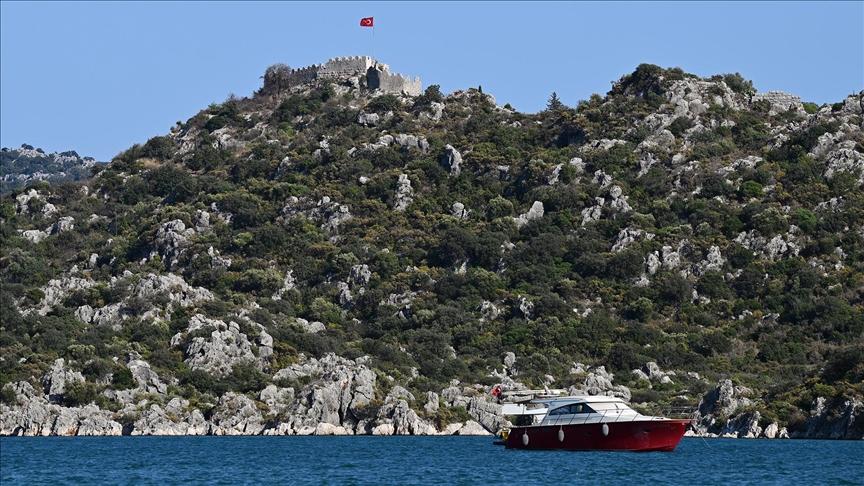
The Kekova coastline features a rugged, indented structure with small islets, coves, and peninsulas. The terrestrial area is covered by Mediterranean maquis vegetation and has limited freshwater sources, which define its natural character. The region is not confined to the island alone; ancient settlements such as Simena (Kaleköy), Teimiussa, and Üçağız are also considered part of the Kekova whole.
The geomorphological structure of the coastline and the underwater topography are significant both for biological diversity and archaeological value. In particular, the submerged ruins along the northern coast are among the most recognizable features of the island’s landscape.
In 1990, Kekova and its surroundings were designated as a Special Environmental Protection Area. In 2006, the protected area was expanded to include Uluburun and İnceburun toward Kaş, bringing the total size to 258.3 km². Approximately 92 km² of this area consists of marine ecosystems.

Areas closed to fishing (Mediterranean Conservation Society)
The protection process is not limited to terrestrial archaeological and natural values. Restrictions have been imposed on fishing, diving, and anchoring within the marine area to maintain a balance between conservation and use. Fishing prohibition zones introduced in 2012 were updated in 2020, with specific restrictions applied to sub-regions such as Hidayet, Beşadalar, Sıcak Denizi, and Üçağız Harbour.
In addition to national institutions, civil society organizations have played a role in area management. WWF-Türkiye’s biodiversity initiatives and the Mediterranean Conservation Society’s marine protection systems have contributed to the implementation of conservation measures.
The Kekova marine ecosystem hosts a rich assemblage of over 1,000 species. Species such as the Mediterranean monk seal, sea turtles, and Pinna nobilis are among the key elements requiring protection. These species find habitat in the rocky coastlines and caves of the region.
Following the implementation of fishing prohibition zones, signs of recovery have been observed in certain predatory fish populations. However, fluctuations in the numbers of juvenile and adult individuals necessitate long-term and consistent monitoring of conservation measures.
The region also provides an opportunity to observe the impacts of climate change. Increases in Lessepsian species, shifts in sea temperatures, and habitat transformations are monitored as part of regional programs.

A view from Kekova -(Flickr)
Three main coastal settlements have been identified on Kekova Island: Tersane Cove, Northern Settlement, and Lighthouse Settlement. Numerous architectural remains from the Hellenistic, Roman, and Byzantine periods have been documented at these sites. Tersane Cove is the most well-known area of the island. Along its shoreline and surrounding areas, terraced residential foundations, workshops, water channels, storage areas, and especially Byzantine-era church remains are present. This area demonstrates the integration of production and settlement with the marine environment.
The Northern Settlement is built on terraces along the island’s steep slopes. Here, cisterns, wall constructions, staircases, and church remains are visible. The presence of numerous religious structures indicates a dense religious life among the island’s population. Additionally, due to rising sea levels along the northern coast, parts of the ruins have become submerged, creating today’s sunken appearance. This situation reveals the impact of both natural processes and earthquakes on the settlement’s layout.
The Lighthouse Settlement is located at the eastern tip of the island. Here, residential remains, cisterns, and Byzantine churches have also been identified. The Lighthouse Settlement represents another focal point of religious and civic life on the island. The remains in this area demonstrate that Kekova was not merely a harbor but a complete settlement surrounded by religious structures.
Archaeological research has dated the Corinthian capitals used in the island’s churches to the second half of the 5th century and the first half of the 6th century through stylistic analysis. These capitals illustrate the fusion of local stonework traditions with the architectural style of the Byzantine period. In particular, the capitals documented at the Tersane Cove B Church and the Northern Settlement E Church confirm that the island’s religious buildings were not isolated from broader Byzantine architectural trends.
The presence of numerous church and chapel remains along the coastline highlights the central role of religious life on the island. These structures likely served both the local population and seafarers and merchants visiting the region. At the same time, workshops, storage areas, and cisterns found along the coast provide evidence that the island’s economy was deeply integrated with production and trade.
Underwater archaeological investigations have revealed amphora piles aligned parallel to the coast, wall remains, and harbor arrangements. These findings indicate that Kekova was part of a maritime trade network connected to the ports of Myra and Andriake. Especially during the Byzantine period, intensified maritime traffic transformed Kekova into a significant center both religiously and commercially.

A remnant found in Kekova (Flickr)
During surface and underwater surveys at Kekova, numerous lamps have been discovered. These lamps were small artifacts used primarily in religious spaces and domestic settings. The forms and decorative features of the lamps provide insights into daily life in the late antique period.
Lamp finds offer clues not only about liturgical equipment but also about the settlement’s trade connections. The typological diversity in the region indicates both local production and external influences.
These discoveries demonstrate that archaeological research has been systematically conducted since the 2010s and that site protection has facilitated the documentation of small artifacts.
The Kekova coastline is one of Turkey’s leading centers for diving tourism. The coastal morphology, submerged city ruins, and biological diversity make it an attractive destination for divers. The region forms part of a corridor with Kaş and Demre, where diving sites are concentrated.
Specific restrictions are applied to ensure the sustainability of diving tourism. Diving in areas containing the submerged city is controlled, and certain zones are entirely prohibited. These measures are essential for preserving archaeological and biological values.
Studies on tourism indicate high visitor satisfaction and recognition of well-developed infrastructure. However, for sustainability, monitoring, education, and restriction mechanisms remain continuously on the agenda.
Kekova tour video -(Go Türkiye)
Kekova is one of the main routes for blue cruises. Visitors explore stops such as Kaleköy, Tersane Cove, Hamidiye Cove, and the Sunken City via boat tours. The sarcophagus in Kaleköy is one of the region’s most iconic symbols.
For visitors, the region is not merely defined by its archaeological remains. The clear sea, coves, and coastal landscape are integral parts of the experience. Therefore, Kekova stands out as a site where nature and cultural tourism converge.
Akdeniz Koruma Derneği. "Kaş-Kekova Deniz Koruma Alanı Yönetim Planı PDF." Accessed September 28, 2025. https://akdenizkoruma.org.tr/storage/UWUChKvyd8HO79yCUfbGUDVyzYVE9wQJ6Q3OZ2uX.pdf
Akdeniz Koruma Derneği. "Kaş-Kekova." Accessed September 28, 2025. https://akdenizkoruma.org.tr/tr/calismalarimiz/deniz-koruma-alanlari/b/kas-kekova
Anadolu Ajansı. "Kekova’da Mavi Tura Çıkan Turistler Batık Şehir ile Doğa Harikası Koyları Görüyor." Accessed September 28, 2025. https://www.aa.com.tr/tr/yasam/kekovada-mavi-tura-cikan-turistler-batik-sehir-ile-doga-harikasi-koylari-goruyor/3693783
Arkhaia Anatolika. "Kekova Adası Erken Bizans Dönemi Korinth Başlıkları." *Arkhaia Anatolika 1* (2018): 52-60. Accessed September 28, 2025. http://www.arkhaiaanatolika.org/Yukleme/Sayfalar/pdfcoR5M715112018182057.pdf
Aslan, Erdoğan, Yusuf Kılıç, Uğurcan Orhan, and Yasin Göçer. “Kekova Adası Arkeolojik Yüzey/Sualtı Araştırması-2016.” *Kekova Adası Arkeolojik Yüzey/Sualtı Araştırması*, 2016. Accessed September 28, 2025. https://www.researchgate.net/publication/325114497_Kekova_Adasi_Arkeolojik_YuzeySualti_Arastirmasi-2016
Culture Portal. "Kekova." Ministry of Culture and Tourism of the Republic of Türkiye. Accessed September 28, 2025. https://www.kulturportali.gov.tr/turkiye/antalya/gezilecekyer/kekova
Demre District Governorship. "Kekova Batık Şehir." Accessed September 28, 2025. http://www.demre.gov.tr/kekova-batiksehir
Doğa Derneği. *Kekova Önemli Doğa Alanları Kitabı*. PDF. Accessed September 28, 2025. https://dogadernegi.org/wp-content/uploads/2018/11/akd011-kekova-onemli-doga-alanlari-kitabi.pdf
Erdoğan, Ufuk. “Kekova Adası’nda Bulunan Kandiller.” *Cedrus* 7, June (June 2019): 441–48. Accessed September 28, 2025. https://dergipark.org.tr/tr/download/article-file/837727
Go Türkiye. "Kekova – Only In Türkiye | Go Türkiye." YouTube. Accessed September 28, 2025. https://www.youtube.com/watch?v=OfbS8FcH9kA
Kaş Gezi Rehberi. "Kekova Adası." Accessed September 28, 2025. https://www.kasgezirehberi.com/nm-Kekova_Adas%C4%B1-cp-40
Le Peru, Romuald. “Kekova.” Flickr. Accessed September 28, 2025. https://www.flickr.com/photos/lithium/8586003556/
Ministry of Environment, Urbanization and Climate Change of the Republic of Türkiye. "Kekova." PDF. Accessed September 28, 2025. https://webdosya.csb.gov.tr/db/tabiat/icerikler/kekova-20211124130122.pdf
Price, Andrew. “Kekova.” Flickr. Accessed September 28, 2025. https://www.flickr.com/photos/27457334@N02/44297445712
T.C. Ministry of Environment, Urbanization and Climate Change. "Kaş-Kekova." *General Directorate of Nature Conservation and National Parks*. Accessed September 28, 2025. https://tvk.csb.gov.tr/kas-kekova-i-396
WWF Türkiye. "Kekova Özel Çevre Koruma Bölgesi." PDF. Accessed September 28, 2025. https://wwftr.awsassets.panda.org/downloads/kakekovaweb.pdf
Yaşar, Okan. Konurhan Zekeriya. “Kaş ve Demre İlçesi Kıyılarında Su Altı Dalış Turizmine Yönelik Bir Değerlendirme.” *International Journal of Social and Humanities Sciences Research (JSHSR)* 6, no. 44 (2025): 3454-3473. Accessed September 28, 2025. https://www.jshsr.org/index.php/pub/article/download/1858/1768
Özer, Aslı. “Kekova Antik Kenti.” Türkiye Turizm Ansiklopedisi. Accessed September 28, 2025. https://turkiyeturizmansiklopedisi.com/kekova-antik-kenti

Location | Coastal areas of Demre district Antalya Province | ||||||||
|---|---|---|---|---|---|---|---|---|---|
Area(s) | Approximately 7 km² | ||||||||
Perimeter Length | 19 km | ||||||||
Protection Status | Kaş–Kekova Special Environmental Protection Area (extended in 1990 and 2006) | ||||||||
Area Size | 258.3 km² (92 km² of which is marine area) | ||||||||
Key Features | Sunken City, Tersane Bay, Kaleköy (Simena), archaeological remains | ||||||||
Biodiversity | Mediterranean monk seal, sea turtles, Pinna nobilis, over 1,000 species | ||||||||
Archaeological Periods | Hellenistic, Roman, Byzantine | ||||||||
Important Findings | Corinthian capitals, churches, cisterns, amphorae, lamps | ||||||||
Tourism Activities | Boat tours, blue tour, diving tourism | ||||||||
Protection Status
Biodiversity
Archaeological Settlements and Remains
Small Finds
Underwater Tourism
Visit Experience