


This article was automatically translated from the original Turkish version.
+2 More
Prepared using visual artificial intelligence.
Sustainable City
Sustainability Criteria | Circular Economy Principles Economic Sustainability Criteria Social Sustainability Criteria Environmental Sustainability Criteria | ||||||||
|---|---|---|---|---|---|---|---|---|---|
Sustainable Cities in Türkiye | Muğla Malatya Gaziantep Istanbul Konya Ankara | ||||||||
Sustainable cities are urban centers built on the principles of environmental, social, and economic sustainability, aiming to combat climate change, use resources efficiently, and create inclusive, safe, resilient, and equitable communities. Today, approximately half of the world’s population—3.5 billion people—lives in cities, and this share is expected to reach 60 percent by 2030 and 75 percent by 2050. This rapid urbanization leads cities to account for 60 to 80 percent of global energy consumption and 75 percent of carbon emissions, while simultaneously deepening challenges such as poverty, inequality, and environmental degradation. Within the United Nations Sustainable Development Goals (SDGs) framework, SDG 11 (“Sustainable Cities and Communities”) and SDG 13 (“Climate Action”) stand out as key targets addressing these challenges. Sustainable cities seek to generate positive local and global impacts by transitioning to renewable energy, developing green infrastructure, integrating transportation systems, and enhancing disaster resilience.

Smart City (Image generated using artificial intelligence.)
Sustainable cities are defined by the following key characteristics:
The COVID-19 pandemic exposed inequalities in access to urban services—for example, 1.2 billion people in the Global South live in informal settlements without access to basic services—and highlighted the vulnerability of two billion workers dependent on the informal economy. This situation underscored the critical importance of social justice and resilience in sustainable urban planning.

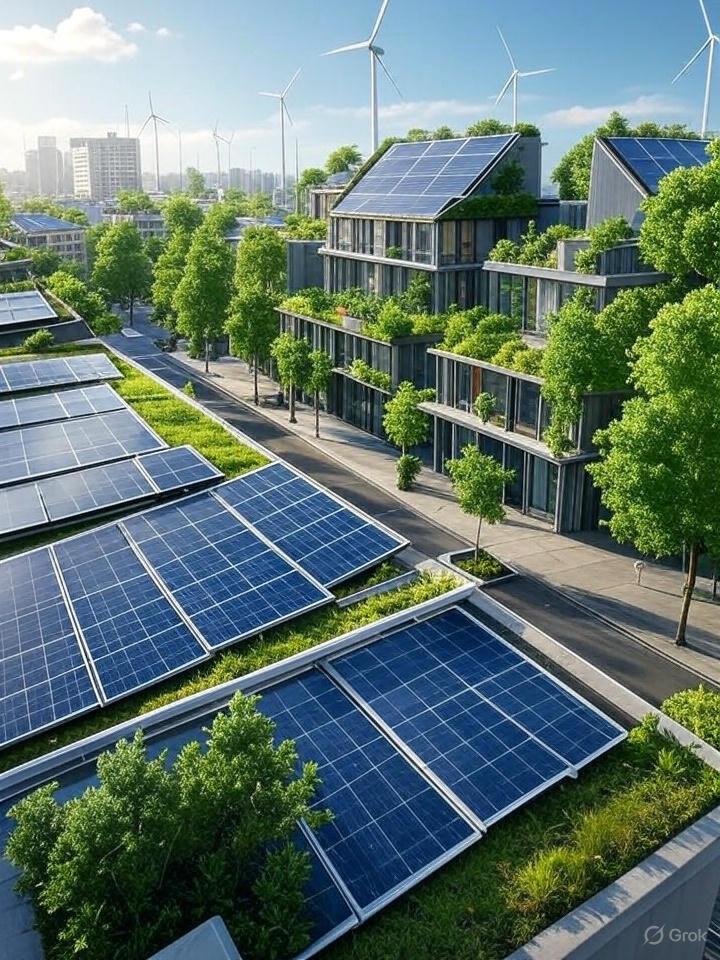
Solar Panels (Image generated using artificial intelligence.)
The following ten cities serve as global models for sustainability, with detailed explanations of their achievements:
Copenhagen is a global leader aiming to become carbon neutral by 2025. Fifty-two percent of its population commutes by bicycle, supported by a network of over 400 kilometers of bike lanes. The “Street Lab” initiative exemplifies innovation through smart parking systems, waste sorting, and air quality sensors. The city has improved energy efficiency using wind power (accounting for 50 percent of energy production) and district heating systems, reducing per capita carbon emissions to 2.2 tCO2 in 2019. Citizen participation and public-private partnerships—such as those with the energy company Ørsted—have been instrumental in this success.
Stockholm phased out fossil fuels by 1990 and was named European Green Capital in 2010. Seventy-five percent of its energy comes from renewable sources (hydropower, biofuel). Eighty percent of heating demand is met through energy recovery from waste heat, with a goal to eliminate fossil fuel use entirely by 2030. Ecological neighborhood projects like Hammarby Sjöstad, green roofs, and integrated public transit are hallmarks of the city. Forty percent of its green areas are under protection.
Amsterdam reduced its carbon emissions by 25 percent between 1990 and 2020. Thirty percent of its electricity is generated from renewable sources, including one of the world’s largest offshore wind farms. Thirty-eight percent of the city is covered by bicycle lanes, with a plan to make all vehicles electric by 2025. Waste management has increased recycling rates to 50 percent, while green roofs and vertical gardens contribute to an environmentally friendly urban fabric.
Zurich has reduced per capita carbon emissions to 1.5 tCO2 through renewable energy (80 percent hydropower) and incentives for electric vehicles. Its public transportation system (trains, trams, buses) operates entirely on electricity, with a target of carbon neutrality by 2030. Green building standards such as the Minergie certification, aligned with the “2000-Watt Society” vision, optimize energy consumption. Water conservation projects, including lake and river rehabilitation, further support sustainability.
Fifty percent of Oslo is covered by forested areas, and a carbon tax of approximately 50 euros per ton of CO2 has reduced emissions by 30 percent. The city promotes electric buses and over 100,000 electric vehicles toward a zero-emission transport goal by 2030. With renewable energy accounting for 98 percent of its supply (all hydropower) and green roof initiatives, Oslo offers a lifestyle in harmony with nature.
Vancouver aims to become carbon neutral by 2050. Ten percent of its population commutes by bicycle, and green spaces such as Stanley Park make up 11 percent of the city’s area. The city is recognized for energy efficiency programs—including LEED-certified buildings—and a recycling rate of 60 percent. Investments in climate-resilient infrastructure, particularly to address sea-level rise, position it as a leader in climate adaptation.
Berlin’s 2015 Smart City Project targets an 85 percent reduction in carbon emissions by 2050. Renewable energy (40 percent from wind and solar) and smart grid systems (for electricity, gas, and heating) have improved energy efficiency. Green spaces cover 20 percent of the city, and bicycle lanes have expanded to 620 kilometers. Recycling rates in waste management have reached 67 percent.
Singapore plans to reduce carbon emissions by 36 percent by 2030. Sustainable development within limited space is achieved through smart mobility (MRT metro system) and vertical garden projects like Gardens by the Bay. Waste incineration plants generate energy, and recycling has reached 61 percent. Despite its dense population, per capita green space has increased from 0.8 m² to 1.2 m².
San Francisco launched its zero-waste goal in 2020 with a ban on plastic bags. The city aims to cut carbon emissions by 80 percent by 2050 and is known for its renewable energy (50 percent from solar and wind) and electric buses. Green roof initiatives and public transit—with 33 percent of trips made by bicycle—create an environmentally friendly urban environment.
Despite a population of 38 million, Tokyo stands out for its zero-waste culture. Public transit—90 percent of which relies on subways and trains—and 200 kilometers of bicycle lanes keep private vehicle use below 30 percent. The 2050 Zero Emission Strategy aims to raise renewable energy to 40 percent and increase waste recycling to 80 percent. Green spaces cover 15 percent of the city.

Smart Irrigation System (Image generated using artificial intelligence.)
In Türkiye, metropolitan municipalities have developed projects aligned with SDG 11 and SDG 13 to combat climate change and promote sustainable urbanization:
Erciyes University is taking the following steps toward sustainability at the campus level:
In the Global South, the gap in access to urban services—water, sanitation, electricity—affects 33 percent of the urban population (66 percent in low-income countries). Informal employment (50–90 percent, as in Kenya and India), unplanned urbanization, and climate risks—such as sea-level rise and storms—hinder sustainability.
Proposed solutions:
Türkiye’s 2019 greenhouse gas emissions totaled 506.1 million tons, a 130.5 percent increase since 1990. Seventy-two percent stem from energy use, and 13.4 percent from agriculture. Under the Kyoto Protocol (2009) and the Paris Agreement (2021), Türkiye aims to reduce emissions by 21 percent by 2030. The Ministry of Environment, Urbanization and Climate Change leads a 2050 Strategy focused on agriculture and renewable energy. However, local authorities face limited capacity, and both vertical (central-local) and horizontal (inter-municipal) cooperation must be enhanced.
Sustainable cities are indispensable in combating climate change and improving social well-being. Global leaders such as Copenhagen and Stockholm, alongside local initiatives in Türkiye—including Ankara and Istanbul—offer hope. Yet, these goals can only be achieved by addressing inequalities, scaling innovative technologies, and strengthening global cooperation. As of 19 June 2025, sustainable urbanization remains an urgent priority for the planet’s future.
Gündoğdu, Hakan Gökhan, and Ahmet Aytekin. "İklim Değişikliği, Sürdürülebilir Şehirler Ve Topluluklar Bağlamında Çok Kriterli Bir Değerlendirme." *İnsan ve İnsan* 9, no. 33 (July 2022): 33–52. https://doi.org/10.29224/insanveinsan.1104121. Accessed June 19, 2025.
“Daha Eşit Bir Şehre Doğru.” wrisehirler.org. Accessed June 19, 2025.
“Sustainable Cities and Communities – SDG 11.” United Nations Türkiye. Accessed June 19, 2025.
“Sustainable Cities and Communities.” kureselamaclar.org. Accessed June 19, 2025.
“Sustainable Cities for Societies Report.” Erciyes Üniversitesi. Accessed June 19, 2025.
“Sürdürülebilir Kalkınma Amaçları Çerçevesinde Mevcut Durumun Değerlendirilmesi Raporu.” ilbank.gov.tr. Accessed June 19, 2025.
“Sürdürülebilir Yerleşim Alanlarının Kentsel Planlama Açısından Değerlendirilmesi.” DergiPark. Accessed June 19, 2025.
“Sürdürülebilir Şehir ve Yaşam Alanları.” *Global Compact Türkiye*. Accessed June 19, 2025.
“Sürdürülebilir Şehirler ve Topluluklar.” marmara.gov.tr. Accessed June 19, 2025.
“Sürdürülebilirlik Konusunda Dünyanın En Önde Gelen Şehirleri.” Eureko Sigorta Blogu. Accessed June 19, 2025.
“Sürdürülebilirlik ve Akıllı Şehir Projeleri.” GTE. https://gte.com.tr/category/projeler/surdurulebilir-akilli-sehirler-projeleri/. Accessed June 19, 2025.

Prepared using visual artificial intelligence.
Sustainable City
Sustainability Criteria | Circular Economy Principles Economic Sustainability Criteria Social Sustainability Criteria Environmental Sustainability Criteria | ||||||||
|---|---|---|---|---|---|---|---|---|---|
Sustainable Cities in Türkiye | Muğla Malatya Gaziantep Istanbul Konya Ankara | ||||||||
Characteristics and Principles of Sustainable Cities
Leading Sustainable Cities in the World
Copenhagen, Denmark
Stockholm, Sweden
Amsterdam, Netherlands
Zurich, Switzerland
Oslo, Norway
Vancouver, Canada
Berlin, Germany
Singapore
San Francisco, USA
Tokyo, Japan
Sustainable City Initiatives in Türkiye
Sustainability Initiatives at Erciyes University Campus
Challenges and Proposed Solutions for Sustainability
Türkiye’s Climate and Sustainability Status