

This article was automatically translated from the original Turkish version.
Ukraine–United States Mineral Resources Agreement (2025)
Signature Date | 30 April 2025 | ||||||||
|---|---|---|---|---|---|---|---|---|---|
Parties | Ukraine, United States of America | ||||||||
Scope(s) | natural gas petroleum 55 minerals | ||||||||
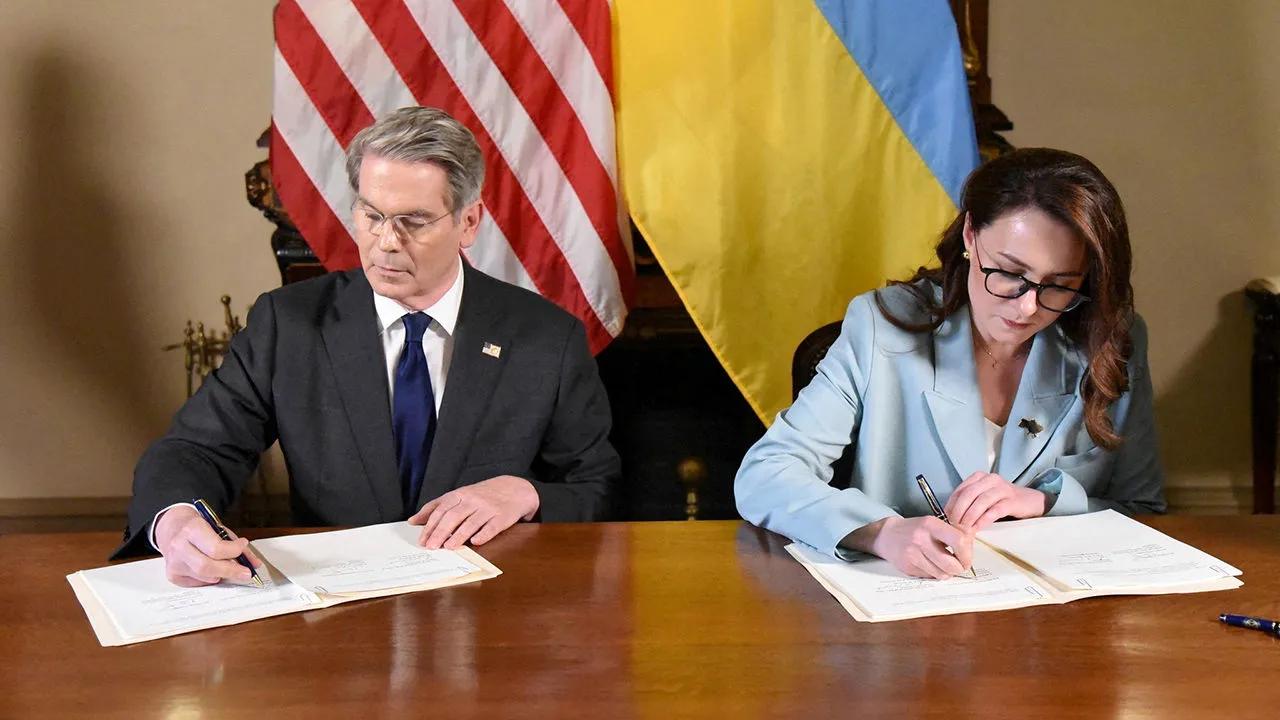
Ukraine–United States Minerals Resources Agreement (2025) is an international agreement signed in Washington on 30 April 2025 between Ukraine and the United States of America (USA), containing comprehensive provisions on the joint exploitation of natural resources, post-war reconstruction financing, and economic cooperation. The agreement provides for the establishment of an investment fund financed by revenues from new mining projects, to be used exclusively for Ukraine’s post-war reconstruction.

The foundation of the agreement is the establishment of the “USA–Ukraine Reconstruction Investment Fund,” a joint entity created by both countries. This fund aims to pool new revenues generated from Ukraine’s natural resources and direct or indirect contributions from the United States—including military assistance—and allocate them exclusively to projects implemented on Ukrainian territory.
Management of the fund is based on the principle of equal partnership. The United States has designated the U.S. International Development Finance Corporation (DFC) as the managing authority for fund operations. Ukraine, for its part, will implement local management through its Ministry of Economy and relevant mining licensing authorities. Both parties have committed that no external profits will be extracted from the fund over a ten-year period and that all revenues generated will be reinvested in projects within Ukraine.
Under the agreement, Ukraine has agreed to channel 50 percent of state revenues from newly opened mining, oil, and natural gas projects into the fund. Existing operations, such as state-controlled energy companies Naftogaz and Ukrnafta, are excluded from the fund system. The United States’ contribution consists of two components: direct financial transfers and the monetary value of future military support, including equipment, ammunition, training, and air defense systems.

Ukraine President Volodymyr Zelensky and U.S. President Donald Trump, April 26, 2025 (AA)
All forms of U.S. military assistance will be counted as capital contributions to the fund. Furthermore, the profit-sharing arrangement will be reviewed and renegotiated by both parties only at the end of the first ten years.
The agreement grants the United States a “priority access right” to new mining projects in Ukraine. This right will be exercised within the framework of market-based commercial “offtake” contracts. The United States or its designated investor companies will have the first right to offer for resources extracted from new Ukrainian mining sites.
This arrangement applies exclusively to new projects and does not involve any transfer of ownership. According to the agreement, ownership of subsurface resources remains with the Ukrainian state, and decisions regarding which minerals are extracted, how, and where are made solely by Ukrainian authorities.
The agreement does not limit itself to rare earth elements but encompasses a wide range of mineral and energy resources. These include economically and strategically significant materials such as lithium, titanium, uranium, graphite, copper, gold, oil, and natural gas. The agreement lists a total of 55 minerals and provides for the possibility of expanding the scope in the future.
Ukraine possesses 22 of the 34 minerals deemed critical by the European Union. These resources are of major importance for the production of electronic devices, electric vehicle technology, renewable energy systems, and the defense industry. The agreement aims to encourage investments necessary for the extraction and processing of these resources in accordance with international standards.
The agreement text explicitly states that the provisions governing cooperation between the parties shall take precedence over Ukrainian domestic law. Under the agreement, all transactions, earnings, payments, and transfers conducted under the fund will be exempt from any taxes, fees, or state deductions in Ukraine.
Decisions regarding fund management and resource allocation will be carried out in accordance with the bilateral agreement’s rules; neither party may enact domestic legislation that contradicts the agreement’s provisions.
The parties have recognized the supremacy of the international agreement text in the event of any conflict between its provisions and Ukrainian laws. Additionally, should Ukraine assume additional obligations in the future due to its European Union accession process, a “good faith negotiation” mechanism will be activated to align the agreement’s terms with these new requirements.
During negotiations, Ukraine requested security guarantees, but these demands were not explicitly reflected in the agreement text. The agreement contains only a diplomatic formulation affirming the United States’ long-term strategic support for Ukraine’s security, sovereignty, and reconstruction. It does not include any direct defense commitment or guarantee of military intervention.
On the day the agreement was signed, the U.S. administration approved the sale of $50 million in new weapons and defense systems to Ukraine. Additionally, military assistance elements such as air defense systems, radar, ammunition, and training support have been incorporated into the investment fund framework. All future U.S. military aid and equipment deliveries will be recorded as capital contributions to the fund.
For the agreement to enter into force, it must be approved by the Ukrainian Parliament (Verkhovna Rada). Ukrainian Minister of Economy Yuliya Svyrydenko stated that the text to be submitted to parliament includes documents previously mutually agreed upon by both sides in technical negotiations. The process is expected to be completed within several weeks.
Some members of parliament have indicated that insufficient information has been provided regarding the draft agreement and have demanded full disclosure of the technical documents. Ukrainian Prime Minister Denys Shmyhal has been holding closed-door meetings with various political groups to secure support. The agreement is subject to Ukraine’s constitutional procedures for ratifying international treaties.
The feasibility of implementing the agreement depends on the up-to-date geological mapping of Ukraine’s subsurface resources. The country’s current mineral inventory is based on outdated technical data from the Soviet era, which is considered inadequate for economic and technical evaluations by international investors.
Modern geophysical and geochemical surveys are required to determine the depth, ore quality, reserve type, and processability of resources such as rare earth elements, lithium, and titanium. The U.S. Geological Survey (USGS) will provide advisory and technical support during this process. Moreover, since mining is an energy-intensive activity, Ukraine’s energy infrastructure—damaged by the war—must be rebuilt. One-third of the country’s electricity generation capacity was lost between 2022 and 2023.
The agreement is part of a broader U.S. initiative to position Ukraine as a strategic partner in the global competition for strategic minerals. The U.S. administration has also initiated a similar mineral cooperation process with the Democratic Republic of the Congo (DRC). In talks with the DRC, which possesses rare minerals, security assistance has been offered in exchange for mineral access. With support from the U.S. Department of State, a “principles declaration” was signed between the DRC and Rwanda in Washington on 24 April 2025.
The agreement contains special provisions designed to provide an alternative to China’s dominance in global rare earth element production, avoid conflict with the European Union, and not impede Ukraine’s accession process. The agreement text includes an explicit clause enabling the renegotiation of terms should Ukraine become a member of the European Union.
Al Jazeera. “Ukraine Says It Is Set to Sign Minerals Deal with US.” Accessed May 2, 2025. https://www.aljazeera.com/news/2025/4/30/ukraine-says-it-is-set-to-sign-minerals-deal-with-us
Anadolu Ajansı. “Ukrainian Premier Says Minerals Deal with US to Be Signed ‘Hopefully within Next 24 Hours.’” Accessed May 2, 2025. https://www.aa.com.tr/en/americas/ukrainian-premier-says-minerals-deal-with-us-to-be-signed-hopefully-within-next-24-hours-/3553456
Associated Press. “US, Ukraine Agree on Rare Earth Minerals Deal.” AP News. Accessed May 2, 2025. https://apnews.com/article/ukraine-us-rare-earth-minerals-deal-8566241ea0e121a30437d845357055d8
BBC News. “Ukraine Mineral Deal: What We Know So Far.” BBC News. Accessed May 2, 2025. https://www.bbc.com/news/articles/c5yg456mzn8o
BBC News. “Ukraine-US Deal Sparks Debate over Strategic Autonomy.” BBC News. Accessed May 2, 2025. https://www.bbc.com/news/articles/c5ypw7pn9q3o
CNN. "What We Know about Trump’s Ukraine Mineral Deal." CNN International. Accessed May 2, 2025. https://edition.cnn.com/2025/05/01/world/what-we-know-about-trumps-ukraine-mineral-deal-intl
CNN. “Ukraine, US Mineral Deal Could Shift Regional Dynamics.” CNN International. Accessed May 2, 2025. https://edition.cnn.com/2025/04/30/europe/ukraine-us-mineral-deal-intl
Center for Strategic and International Studies (CSIS). “What to Know about the Signed US-Ukraine Minerals Deal.” CSIS. Accessed May 2, 2025. https://www.csis.org/analysis/what-know-about-signed-us-ukraine-minerals-deal
Reuters. "US Says Minerals Deal Will Strengthen Trump Talks with Russia." Accessed May 2, 2025. https://www.reuters.com/world/europe/us-says-minerals-deal-will-strengthen-trump-talks-with-russia-2025-05-01/

Ukraine–United States Mineral Resources Agreement (2025)
Signature Date | 30 April 2025 | ||||||||
|---|---|---|---|---|---|---|---|---|---|
Parties | Ukraine, United States of America | ||||||||
Scope(s) | natural gas petroleum 55 minerals | ||||||||
No Discussion Added Yet
Start discussion for "Ukraine–United States Mineral Resources Agreement" article
Key Elements of the Agreement
Fund Contributions and Economic Sharing
Access to Resources Provisions
Natural Resources Covered
Legal Status and Tax Regulations
Security Provisions and Military Support Mechanism
Ukrainian Parliamentary Approval Process
Geological Mapping and Energy Infrastructure Challenges
International and Geopolitical Context