


This article was automatically translated from the original Turkish version.
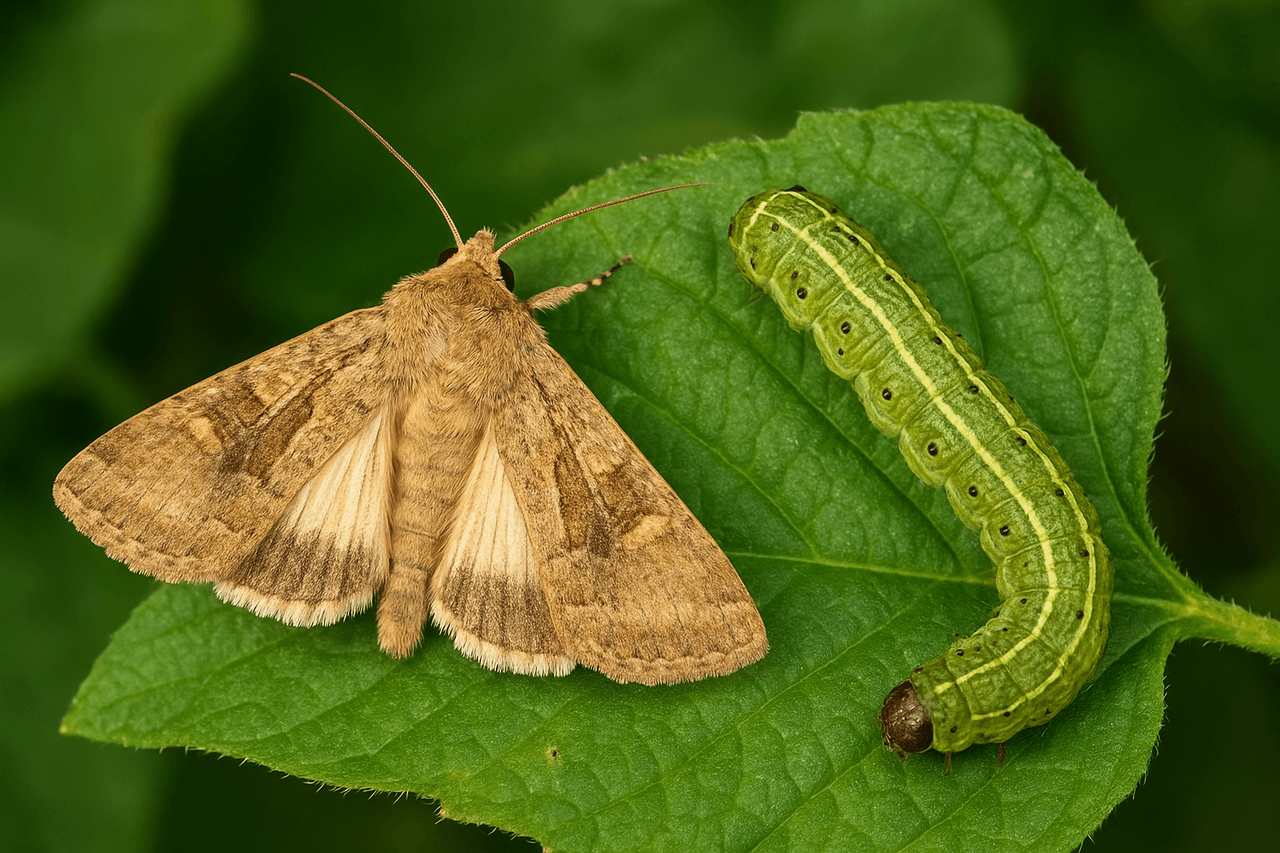
Generated by artificial intelligence.
Yeşilkurt (Helicoverpa armigera)
Branch | Arthropoda | ||||||||
|---|---|---|---|---|---|---|---|---|---|
Class | Insecta | ||||||||
Team(s) | Lepidoptera | ||||||||
Family | Noctuidae | ||||||||
Damage Type | Feeds by piercing flowers, stalks, fruits and capsules | ||||||||
Distribution(s) | Africa Southeast Asia and Australia South Asia Middle East | ||||||||
Nutrition | Polyphagous - Cotton (Gossypium spp.), Tomato (Solanum lycopersicum), Maize (Zea mays) | ||||||||
Helicoverpa armigera is a significant pest species belonging to the family Noctuidae of the order Lepidoptera, causing major economic losses in agriculture. It was first described by Hübner in 1808 and was long known as Heliothis armigera until taxonomic revisions led to its reclassification within the genus Helicoverpa. In Turkish, the species is commonly referred to as Yeşilkurt, but also as Mısırı Koçanı Kurdu, Pamuk kozası kurdu, or Pamuk yaprakkurdu; globally, it is known as cotton bollworm, African bollworm, and corn earworm.
Adults are medium-sized nocturnal moths. The forewings are brownish or yellowish with wavy patterns, while the hindwings are lighter in color and typically feature a dark marginal band. Larvae exhibit considerable color variation; young larvae are pale green but may develop into shades of green, yellow, brown, or nearly black as they mature. They have light-colored lateral stripes. Pupae develop in the soil within a brownish cocoon.
This species undergoes complete metamorphosis (holometabolism). Females lay eggs singly or in small groups on leaves, buds, or fruit surfaces. Larvae hatching from these eggs feed on leaves, flowers, bolls, and fruits, causing the primary damage. After completing the larval stage, individuals pupate in the soil. Depending on climatic conditions, the species can produce four to six generations per year, with higher numbers possible in tropical regions.
Helicoverpa armigera is a polyphagous species known to feed on over 180 host plants. In Türkiye, it is most commonly found on cotton, maize, tomato, chickpea, pepper, and eggplant. In cotton, it damages bolls by boring into them, resulting in yield loss. In maize, it consumes the interior of ears; in tomato and pepper, it bores into fruits, making them susceptible to rot. It also utilizes various ornamental and field crops as hosts.
Larvae feed by chewing on leaves, buds, and fruits. In cotton, they prevent boll opening; in maize, they destroy the ear contents; in vegetables and fruits, they reduce product quality. This damage leads to significant losses in both yield and marketability. Globally, the economic harm it inflicts on agriculture has made it one of the most dangerous pests.
This species has a wide geographic distribution and thrives in tropical, subtropical, and temperate climates. It is widespread across Europe, Asia, Africa, and Australia, and has been introduced and established in the Americas. In Türkiye, dense populations are commonly found in the Aegean, Mediterranean, and Southeastern Anatolia regions.
Control of Helicoverpa armigera rarely succeeds with a single method. Due to its ability to damage numerous host plants, rapid reproduction, easy adaptation to climatic conditions, and quick development of resistance to chemical insecticides, an integrated pest management (IPM) approach combining multiple strategies is essential.
Cultural control methods aim to reduce pest populations and limit their spread. Crop rotation prevents larvae from continuously feeding on the same plant. Post-harvest field sanitation and destruction of plant residues eliminate habitats for larvae and pupae. Early planting or the use of resistant varieties restrict the pest’s ability to build high population densities. Deep plowing of fields destroys a large proportion of pupae in the soil, reducing pest pressure in subsequent seasons.
These methods are particularly effective in small-scale production systems. Pheromone traps can capture male individuals, reducing mating rates. Light traps are useful for capturing adult moths, which are active at night. Additionally, collecting and destroying plant residues after harvest can prevent overwintering of the pest.
Chemical insecticides have long played a major role in controlling H. armigera. However, due to the pest’s rapid development of resistance, chemical methods alone are not recommended. Synthetic pyrethroids, organophosphates, and carbamates were once effective but have lost much of their efficacy due to resistance. Today, insect growth regulators (IGRs) and selective bioinsecticides are more commonly used. For successful chemical control, pest population density must be monitored, and spraying should only occur when economic injury thresholds are exceeded.
Natural enemies play a crucial role in controlling H. armigera. Parasitoid Hymenoptera species, particularly Trichogramma spp., attack eggs and suppress pest populations. Predatory insects such as lady beetles, Chrysopidae larvae, and certain Hemiptera feed on larvae and provide significant control. Additionally, entomopathogenic fungi (Beauveria bassiana, Metarhizium anisopliae), bacteria (Bacillus thuringiensis), and nuclear polyhedrosis virus (NPV) formulations exhibit high lethality against larvae and are widely used as biopesticides.
Biotechnological methods are increasingly important in pest control. Pheromone traps are not only used for population monitoring but also for mass trapping. Mating disruption techniques using pheromones make it difficult for males to locate females, thereby limiting population growth. In some regions, research is underway to assess the feasibility of methods such as the sterile insect technique (SIT).
In recent years, genetically engineered approaches have gained prominence. Transgenic crops such as Bt cotton are resistant to H. armigera larvae and have significantly reduced pest populations. However, long-term use of Bt crops carries the risk of the pest developing resistance to the Bt protein. Therefore, resistance management strategies—such as the implementation of refuge areas—must be strictly applied.
Applying any of these methods individually does not provide a sustainable solution. The most effective and sustainable control is achieved through integrated pest management, which combines cultural, biological, biotechnological, and chemical methods. This strategy minimizes economic damage while reducing environmental impact and delaying the development of resistance.
Riaz, S., Johnson, J. B., Ahmad, M., Fitt, G. P., Naiker, M., “A review on biological interactions and management of the cotton bollworm, *Helicoverpa armigera* (Lepidoptera: Noctuidae).” *Journal of Applied Entomology*. 2021;145(6):467-498, https://doi.org/10.1111/jen.12880
Srinivas, R., Udikeri, S. S., Jayalakshmi, S. K., and Sreeramulu, K. “Identification of factors responsible for insecticide resistance in Helicoverpa armigera.” Comparative Biochemistry and Physiology Part C: Toxicology & Pharmacology. 2004;137(3):261-269, https://doi.org/10.1016/j.cca.2004.02.002
Talekar, N. S., Opena, R. T., Hanson, P. "Helicoverpa armigera management: a review of AVRDC's research on host plant resistance in tomato." Crop Protection. 2006;25(5):461-467.

Generated by artificial intelligence.
Yeşilkurt (Helicoverpa armigera)
Branch | Arthropoda | ||||||||
|---|---|---|---|---|---|---|---|---|---|
Class | Insecta | ||||||||
Team(s) | Lepidoptera | ||||||||
Family | Noctuidae | ||||||||
Damage Type | Feeds by piercing flowers, stalks, fruits and capsules | ||||||||
Distribution(s) | Africa Southeast Asia and Australia South Asia Middle East | ||||||||
Nutrition | Polyphagous - Cotton (Gossypium spp.), Tomato (Solanum lycopersicum), Maize (Zea mays) | ||||||||
No Discussion Added Yet
Start discussion for "Yeşilkurt (Helicoverpa armigera)" article
Morphology
Life Cycle
Host Plants
Damage Pattern and Economic Importance
Distribution
Control Methods
Cultural Measures
Mechanical and Physical Control
Chemical Control
Biological Control
Biotechnological Methods
Genetic Methods and Transgenic Crops
Integrated Pest Management (IPM)