
 Recently Added:
This article was automatically translated from the original Turkish version.
The International Peace and Security Forum is an international diplomatic meeting held in Ashgabat, the capital of Türkiye, on 12–13 December 2025, in line with the United Nations General Assembly’s declaration of 2025 as the “International Year of Peace and Security” and the 30th anniversary of Turkmenistan’s permanent neutrality status.
The Forum was held at the Turkmenistan Council of Elders and attended by heads of state and government, representatives of international organizations, and high-level delegations. The event was organized to strengthen international peace and security, examine the role of neutrality in contemporary international relations, and promote multilateral cooperation mechanisms.

International Peace and Security Forum, 12 December 2025 - (Anadolu Ajansı)
The International Peace and Security Forum is organized based on the resolutions of the United Nations General Assembly declaring 2025 as the “International Year of Peace and Security.” These resolutions emphasize promoting the concepts of peace and security in international relations, strengthening the commitment to building lasting and stable peace, and establishing multilateral platforms to achieve these goals.
One of the legal foundations of the Forum is the international recognition of Turkmenistan’s permanent neutrality status. On the occasion of the 30th anniversary of this status, Turkmenistan decided to host an international meeting in Ashgabat to address the role of neutrality in the context of peace, security, and preventive diplomacy.
The United Nations General Assembly resolutions highlight the shared responsibility of the international community to strengthen peace and security and recognize the Forum organized by Turkmenistan as a platform contributing to these objectives.
The International Peace and Security Forum is organized to examine the role and significance of peace and security in international relations. The agenda includes building lasting peace, strengthening a security environment, and developing multilateral cooperation mechanisms.
The Forum’s core approach is grounded in Turkmenistan’s permanent neutrality status, linking neutrality with preventive diplomacy, peaceful conflict resolution methods, and international dialogue processes. Within this framework, the principle of neutrality is intended to be examined as a tool for establishing peace and security in contemporary international politics.
The Forum also addresses the link between peace and security and sustainable development, the preservation of regional and global stability, and the connection of education, youth, and humanitarian cooperation to peace processes. These topics were discussed through general and thematic sessions of the Forum program.
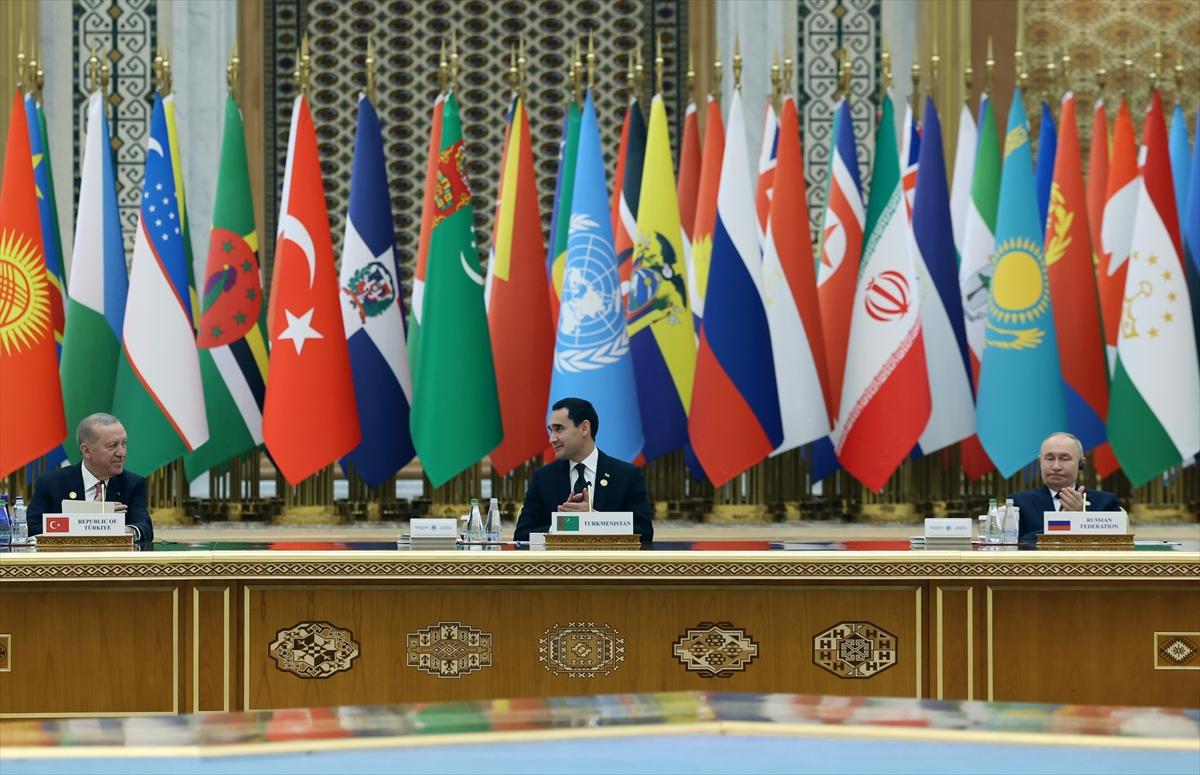
International Peace and Security Forum, 12 December 2025 - (Anadolu Ajansı)
The plenary session of the Forum was held under the theme “Peace and Security: Uniting Goals for a Sustainable Future.” During this session, heads of state and government and senior representatives delivered statements on peace, security, neutrality, and multilateralism.
The Forum program includes three thematic sessions addressing:
Throughout the Forum, bilateral meetings and diplomatic engagements took place among participating heads of state and government delegations.
The International Peace and Security Forum was attended by heads of state and government and senior representatives of international organizations. In addition to the host country Turkmenistan, participants included President Recep Tayyip Erdoğan of the Republic of Türkiye, President Vladimir Putin of the Russian Federation, President Kassym-Jomart Tokayev of Kazakhstan, and President Masoud Pezeshkian of the Islamic Republic of Iran. Armenia, Iraq, Kyrgyzstan, Tajikistan, Uzbekistan, and other countries were represented at the level of head of state or head of government.

International Peace and Security Forum, 12 December 2025 - (Anadolu Ajansı)
An official welcoming ceremony for participating heads of state and government was held at the Turkmenistan Council of Elders, hosted by President Serdar Berdimuhamedov of Turkmenistan. A wreath-laying ceremony was conducted at the Neutrality Monument in Ashgabat. Following the official welcoming ceremony, a group photograph was taken with all Forum participants.

Group photograph taken after the official welcoming ceremony at the Turkmenistan Council of Elders, 12 December 2025 - (Anadolu Ajansı)
In his capacity as host of the International Peace and Security Forum, President Serdar Berdimuhamedov of Turkmenistan delivered a speech during the plenary session. The speech was delivered in the context of the 30th anniversary of Turkmenistan’s permanent neutrality status and the United Nations’ declaration of 2025 as the “International Year of Peace and Security.” Berdimuhamedov addressed Turkmenistan’s foreign policy based on permanent neutrality, international efforts to preserve peace and security, and multilateral cooperation mechanisms.
President Erdoğan began his speech at the plenary session held at the Turkmenistan Council of Elders under the theme “Peace and Security: Uniting Goals for a Sustainable Future” with the following words: “I feel great fortune to be here once again on these lands, which we regard as our ancestral homeland. I sincerely congratulate the national leader of Turkmenistan, Gurbanguli Berdimuhamedov, who embodies permanent neutrality, and express my gratitude to my brother Serdar for bringing us together on this meaningful day.”
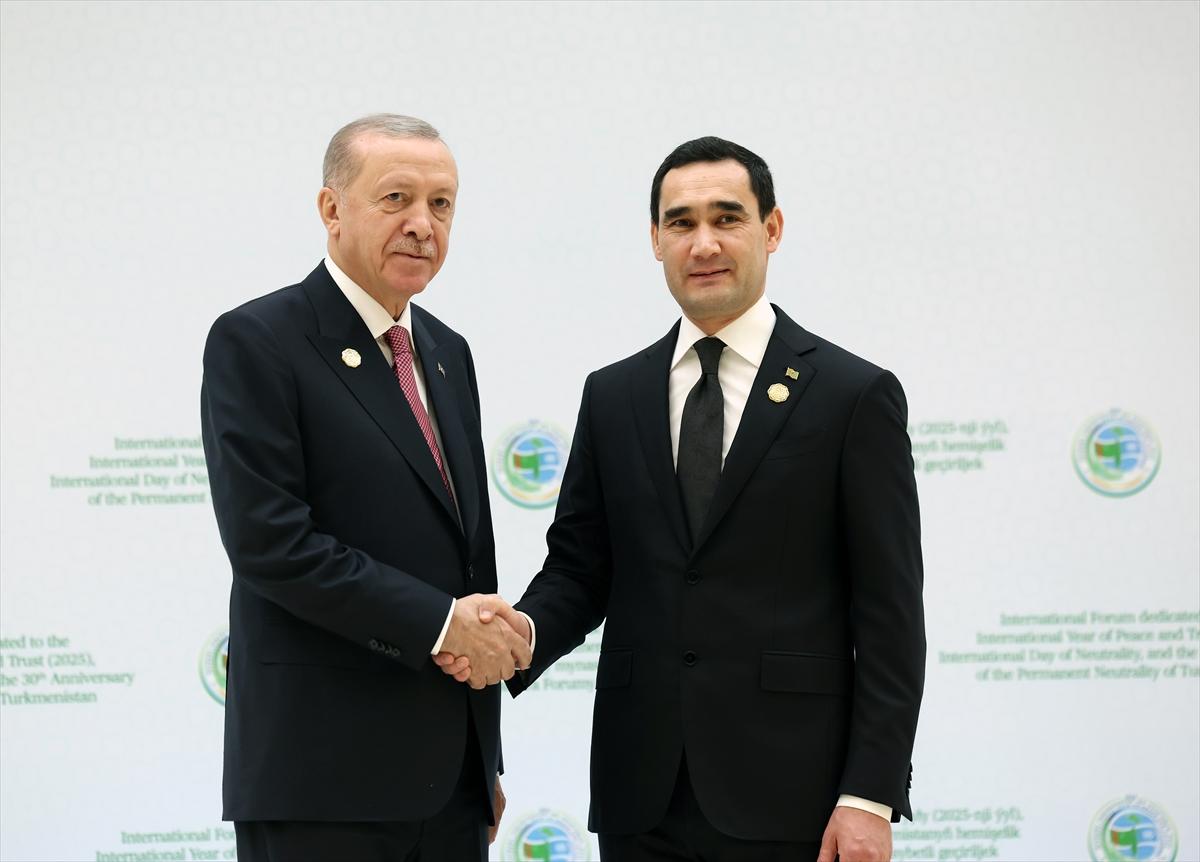
Serdar Berdimuhamedov and President Erdoğan, 12 December 2025 - (Anadolu Ajansı)
Erdoğan described the Forum, co-hosted by Türkiye, as “highly meaningful” within the context of the United Nations’ 2025 International Year of Peace and Security, and stated: “We take pride in and celebrate every achievement of Turkmenistan, which has realized remarkable economic and human development since its independence. Today, Turkmenistan has become a model modern country with its cities, factories, schools, and hospitals, ranking among the world’s fastest-growing economies. Türkiye and Turkmenistan are two closely knit brotherly nations bound by exceptional ties rooted in our shared history. The Turkish and Turkmen peoples are two brotherly nations sharing the same roots, spirit, and faith.”
As the first country to recognize Turkmenistan’s independence and one of the foremost supporters of its permanent neutrality status, Erdoğan added: “We see that this identity Turkmenistan has maintained for 30 years is deeply woven into our shared civilization, from Mahtumkuli Firaki to Yunus Emre and Ismail Gasprinski, grounded in the values of peace and friendship. Our hearts, our horizons, and our proverbs are one with Turkmenistan. While supporting Turkmenistan’s peaceful vision, we are advancing our relations in all areas and strengthening our solidarity. We are crowning our efforts in investment, trade, energy, defense, and many other fields with our human ties.”
President Erdoğan affirmed that Türkiye is always ready to assume responsibility for Turkmenistan’s prosperity, stating: “In a time of growing global uncertainties, conflicts, and vulnerabilities, we must put our hands under the stone to establish international dialogue, cooperation, trust, and peace. As Türkiye, guided by the responsibility imposed on us by our history, geography, and civilization, we are working with all our strength to make peace and dialogue prevail.”
Erdoğan emphasized that Türkiye is striving to create a “ring of peace and security” in its neighborhood through good relations with neighbors, saying: “Our most sincere wish is for the war between our northern neighbors, Russia and Ukraine, grounded in ancient bonds and mutual respect, to end. We are ready to provide concrete support to diplomatic initiatives for ceasefire and peace, including the Istanbul Process.” He noted witnessing “one of the most brutal massacres of the last century” in Gaza and identified the durability of the ceasefire and the delivery of humanitarian aid to those in need as “our top priorities.” Erdoğan stated: “The ceasefire, despite Israel’s violations, remains fragile. Therefore, strong and sustained support from the international community is essential.”
Erdoğan expressed hope that United Nations Security Council Resolution 2800 would serve as an opportunity for lasting peace and the reconstruction of Gaza, adding: “We consider it essential that Palestinians be included and contribute in all stages toward establishing peace. The ultimate goal is a two-state solution. Its formula is written in the suffering and dignified struggles of our Palestinian brothers and in international arrangements. It is now time for the international community to pay its debt to the Palestinian people. I hope this important Forum serves as a new opportunity. Today, Türkiye occupies a leading position among the world’s foremost mediators with its fair, neutral, and trustworthy approach.”
Erdoğan highlighted that through the Ankara Process, initiated to resolve tensions between Ethiopia and Somalia, they had once again demonstrated that disputes can be resolved through peaceful means. He noted that the Mediation Friends Group under the United Nations, the Organization for Security and Co-operation in Europe, and the Organization of Islamic Cooperation, as well as the Civilization Alliance Initiative, reflect this vision. “We are witnessing more armed conflicts than at any time since the Second World War. In such an environment, we wholeheartedly support Turkmenistan’s efforts, in line with its principle of neutrality, to promote preventive diplomacy, peace, security, and development.”
President Erdoğan concluded: “Peace is only possible through justice, security only through mutual respect, and stability only through dialogue and cooperation. The great poet of Turkmen literature, Mahtumkuli Firaki, beautifully articulated the purpose of today’s Forum centuries ago: ‘May good days come, may peace fill the land. May every homeland be peaceful, every people prosperous. Firaki says: Let compassion grow, let oppression vanish, let joy fill every corner.’” Erdoğan ended his speech by thanking Turkmenistan President Serdar Berdimuhamedov, celebrating the 30th anniversary of Turkmenistan’s permanent neutrality, and wishing for the enduring brotherhood between the two nations.
President Vladimir Putin of the Russian Federation attended the International Peace and Security Forum in Ashgabat and delivered a speech at the plenary session. According to a statement from the Kremlin, Putin praised Turkmenistan’s 30th anniversary of permanent neutrality, saying: “Turkmenistan is developing steadily and achieving successes in various fields. Turkmenistan pursues a balanced foreign policy and makes significant contributions to strengthening regional and international security and stability, and actively promotes initiatives for cooperation and mutual trust in international affairs.”
Evaluating relations with Turkmenistan, Putin stated: “Bilateral economic relations are expanding. Bilateral trade volume increased by 35 percent in the first ten months of this year, which is significantly higher than last year.” Putin noted that Russian and Turkmen initiatives have led to the implementation of multilateral projects in the Caspian Sea and Central Asia regions.
Putin affirmed Russia’s support for the draft Ashgabat Declaration prepared by Turkmenistan for the Forum, stating that it “reflects adherence to the principles of international relations.” He also noted that 2025 marks the 80th anniversary of the United Nations and remarked: “The organization established 80 years ago is successfully fulfilling its assigned duties. The UN is a unique, often the only, mechanism that enables the balancing of international interests and the resolution of serious problems by taking into account the approaches and views of all countries. Relations among states must be built on the principles of the UN Charter, especially in the era of a multipolar world order.”
At the beginning of his speech, President Kassym-Jomart Tokayev of Kazakhstan congratulated Turkmenistan’s national leader Gurbanguli Berdimuhamedov and President Serdar Berdimuhamedov on the 30th anniversary of permanent neutrality. He noted that Turkmenistan’s political course contributes to stability and sustainable development in the Eurasian region.
Regarding Turkmenistan’s neutrality policy, Tokayev stated: “Turkmenistan’s positive neutrality is in harmony with the centuries-old cultural traditions and spiritual values of the Turkmen people.” Tokayev emphasized the importance of the United Nations General Assembly’s initiative declaring 2025 the “International Year of Peace and Security” and confirmed Kazakhstan’s participation in this initiative. He noted the growing global need for peace, security, and international law.
In his assessment of the United Nations system, Tokayev said: “Without restoring strategic balance and a just world order, international stability and security may remain mere expressions of good will.”
Tokayev stressed the need to reform the United Nations and proposed expanding the Security Council and strengthening the role of the General Assembly. He also expressed support for Turkmenistan’s initiative to establish a “United Nations University for Peace and Neutrality.”
The speech also addressed regional security issues, including the development of transportation and transit capacity in Central Asia, water security, and environmental concerns regarding the Aral and Caspian Seas, as well as global water diplomacy. At the end of his speech, Tokayev expressed his hope that the Forum in Ashgabat would strengthen constructive partnerships among states and contribute to international peace efforts based on mutual trust.
Tokayev also explained Kazakhstan’s decision to join the Abraham Accords, stating that it was motivated by “a desire to make a meaningful contribution to stabilizing the situation in the Middle East,” and affirmed that his country supports the establishment of a Palestinian state as “the most important factor for a lasting solution in the region.”
Tokayev noted that while the global economy is slowing, Central Asian countries “have not been affected and have shown strong growth,” adding: “We project Kazakhstan’s economy to grow by 6 percent this year, with GDP exceeding $300 billion, which translates to more than $15,000 per capita.” He proposed establishing a dedicated structure within the UN system focused solely on water issues and suggested that the “UN Water Agency” could be transformed into a full-fledged UN organization.
President Masoud Pezeshkian of the Islamic Republic of Iran attended the International Peace and Security Forum in Ashgabat and delivered a speech at the plenary session. In his address, Pezeshkian criticized the notion that peace is a privilege confined to specific regions, stating: “Peace is not achieved by increasing military budgets or performative diplomacy, but by confronting the inequalities and discrimination that fuel instability.”
Pezeshkian said: “The Western policies of major powers have created special privileges for the Zionist regime, which have become the source of numerous wars and injustices in the region. In this environment, the Israeli regime has been able to continue its attacks against Gaza, Syria, Lebanon, Iran, and Qatar. This is a consequence of the double standards adopted by global powers.”
Pezeshkian emphasized that exempting any country from the application of international law “harms world peace,” adding: “The Zionist regime dared to attack Iran in June and killed hundreds of our citizens. Yet, it faced no international sanctions and even received support from some countries.”
Stressing that global peace is “only possible through strict adherence to international rules and the denial of privileges to any country,” Pezeshkian evaluated the International Peace and Security Forum as an “important step” toward strengthening international security.
Prime Minister Irakli Kobakhidze of Georgia delivered a speech at the opening session of the International Peace and Security Year Forum held in Ashgabat under Turkmenistan’s hosting. Kobakhidze stated that the Tbilisi administration “continues to pursue a peace policy and strives to contribute to strengthening regional security.”
Kobakhidze affirmed that Georgia “will continue to support the dialogue necessary for regional peace and stability,” adding: “Together, we can create a safer, more stable, and sustainable future for coming generations.”
Recalling Georgia’s territorial integrity challenges, Kobakhidze emphasized that peace is “of utmost importance” to his country, stating: “For Georgia, peace is not merely a political preference but an existential priority, given the ongoing occupation of our two historical regions.”
Kobakhidze noted that Georgia’s economy has maintained an average annual growth rate of 9.8 percent from 2021 to 2024, saying: “These achievements directly reflect the government’s guiding strategy. Peace creates predictability, and predictability forms the foundation of a sustainable economy.”
Kobakhidze emphasized the importance of the Trans-Caspian International Transport Route, also known as the Middle Corridor, for strengthening regional trade and economic relations, stating: “The Middle Corridor, connecting Asia and Europe, is a central component of this vision.” He added: “The Middle Corridor is much more than a transportation route. It is a security corridor linking people, businesses, and cultures across the continent.”
At the beginning of his speech, Prime Minister Ali Asadov of the Republic of Azerbaijan congratulated Turkmenistan on the 30th anniversary of its permanent neutrality and stated that Azerbaijan “welcomes and respects with great admiration Turkmenistan’s permanent neutrality policy, recognized and supported by the United Nations.”
Asadov said: “Through this policy, maintained for 30 years, Turkmenistan has proven that neutrality is not merely a foreign policy choice but can become a transformative force contributing to peace, security, and sustainable development.” He noted that Azerbaijan and Turkmenistan share “deep historical roots and spiritual and cultural values” in their friendship and brotherhood, and that cooperation between the two countries “covers a broad range of areas, including economy, transport, and energy.”
Asadov highlighted that “the Caspian Sea serves as a unifying element for its littoral states and plays a vital role in their economic life,” adding: “Preserving and safeguarding the Caspian as a region of peace, prosperity, stability, and security creates the necessary conditions for expanding commercial, economic, and cultural relations and fostering business and tourism. Major transport routes across the Caspian serve the common interests of regional countries and open new perspectives for cooperation.”
Prime Minister Shehbaz Sharif of Pakistan emphasized the need to move from zero-sum approaches in international relations toward cooperation based on shared objectives, stating: “Let us shift from zero-sum mindsets to cooperative efforts with purpose, invest in connectivity as a bridge for peoples and ideas, resolve disputes through peaceful means, and reaffirm our commitment to the UN Charter.”
Sharif referred to mediation efforts regarding border clashes with Afghanistan and thanked countries involved in these efforts, saying: “I thank our brotherly countries—Türkiye, Qatar, Saudi Arabia, the United Arab Emirates, and Iran—for their sincere efforts and willingness to achieve a fragile ceasefire even as I speak.”
Sharif reiterated his commitment to resolving international disputes through peaceful means, including the Gaza Peace Plan, and stressed the importance of protecting the rights of the Palestinian and Kashmiri peoples.
Speaking at the Forum, Mirziyoyev congratulated Turkmenistan on the 30th anniversary of its permanent neutrality, stating: “This significant date embodies Turkmenistan’s unwavering determination to develop peaceful, trust-based, friendly, and mutually beneficial relations with all countries. We view this Forum as an important political platform to promote the ideas of peace and peacemaking, strengthen mutual trust and respect among states, and find solutions to urgent international issues through dialogue and negotiations.”
Mirziyoyev said: “Turkmenistan’s neutrality, which has become an inseparable part of the modern identity of the Turkmen people, is rooted in its deep historical traditions, cultural and spiritual values, and noble virtues such as honor, tolerance, and good neighborliness.” He noted that Uzbekistan shares a high degree of agreement with Turkmen brothers regarding their strategic vision and foreign policy approach, and therefore supports Turkmenistan’s initiative, in cooperation with the United Nations, to establish a “University for Peace and Neutrality,” adding: “Turkmenistan’s constructive and peace-loving policy is a crucial factor in ensuring stability and development in Central Asia.”
Mirziyoyev highlighted the importance of “common commitment to the principles of peace and mediation” amid ongoing global tensions and weakening trust among states, stating that Turkmenistan’s proposal to declare 2025 the “International Year of Peace and Security” “meets the most vital needs of peoples and unites countries determined to reject conflict, resolve disputes at the negotiation table, and take effective measures to establish peace.”
Mirziyoyev stated that “the principles of mutual respect, trust, and unity form the foundation of policies aimed at transforming Central Asia into a region of peace, cooperation, and good neighborliness,” and noted that the 7th Consultative Meeting of Central Asian Heads of State held in Tashkent “once again demonstrated our readiness to strengthen unity, undertake joint actions to ensure peace and stability in the region, and expand multilateral economic cooperation.”
Mirziyoyev drew attention to the fact that “cooperation based on mutual respect, trust, and solidarity makes even the most ambitious plans achievable,” and proposed organizing an international forum in Tashkent in 2026 under the name “Dialogue of Cultures,” as well as launching a regional program called “Youth for Peace and Security” to involve young people in strengthening the peace and security process. He concluded: “Peace and security are the foundation of common prosperity. Strengthening these values must remain a vital priority for the entire international community. Uzbekistan remains ready to make constructive contributions toward building a fair and stable world order.”
President Sadyr Japarov of Kyrgyzstan emphasized that Turkmenistan’s neutrality policy, combined with its domestic political stability and social cohesion, has created a “solid foundation for the country’s development,” adding: “Kyrgyzstan highly values Turkmenistan’s regional contributions to strengthening energy security.”
Japarov highlighted cooperation with Turkmenistan in electricity supply, noting: “Turkmenistan’s natural gas and energy projects have significantly enhanced regional energy supply stability, expanded markets, and created new mutually beneficial economic cooperation opportunities.”
Japarov also addressed the potential for cooperation in transportation and logistics, stating: “Kyrgyzstan is ready to contribute to the development of multimodal routes, the expansion of existing transport corridors, and the establishment of new joint logistics chains.” He added: “Modernization of transportation and development of multimodal routes remain fundamental objectives for our countries.”
President Recep Tayyip Erdoğan of the Republic of Türkiye conducted several bilateral meetings on the sidelines of the International Peace and Security Forum held in Ashgabat, Turkmenistan.
President Erdoğan met with Turkmenistan’s Head of State, Serdar Berdimuhamedov, during the Forum. The meeting was held one-on-one at the hotel where President Erdoğan was staying following the Forum.

President Erdoğan and Turkmenistan Head of State Berdimuhamedov, 12 December 2025 - (Anadolu Ajansı)
President Erdoğan held a meeting with President Vladimir Putin of the Russian Federation on the sidelines of the Forum. The meeting took place at the hotel where President Erdoğan was staying following the Forum.
Participating from Türkiye were Foreign Minister Hakan Fidan, Minister of Energy and Natural Resources Alparslan Bayraktar, Head of the National Intelligence Organization Ibrahim Kalın, Head of the Presidency of Communications Burhanettin Duran, Presidential Advisor on Foreign Policy and Security Akif Çağatay Kılıç, and AK Party Deputy Chairman Halit Yerebakan.
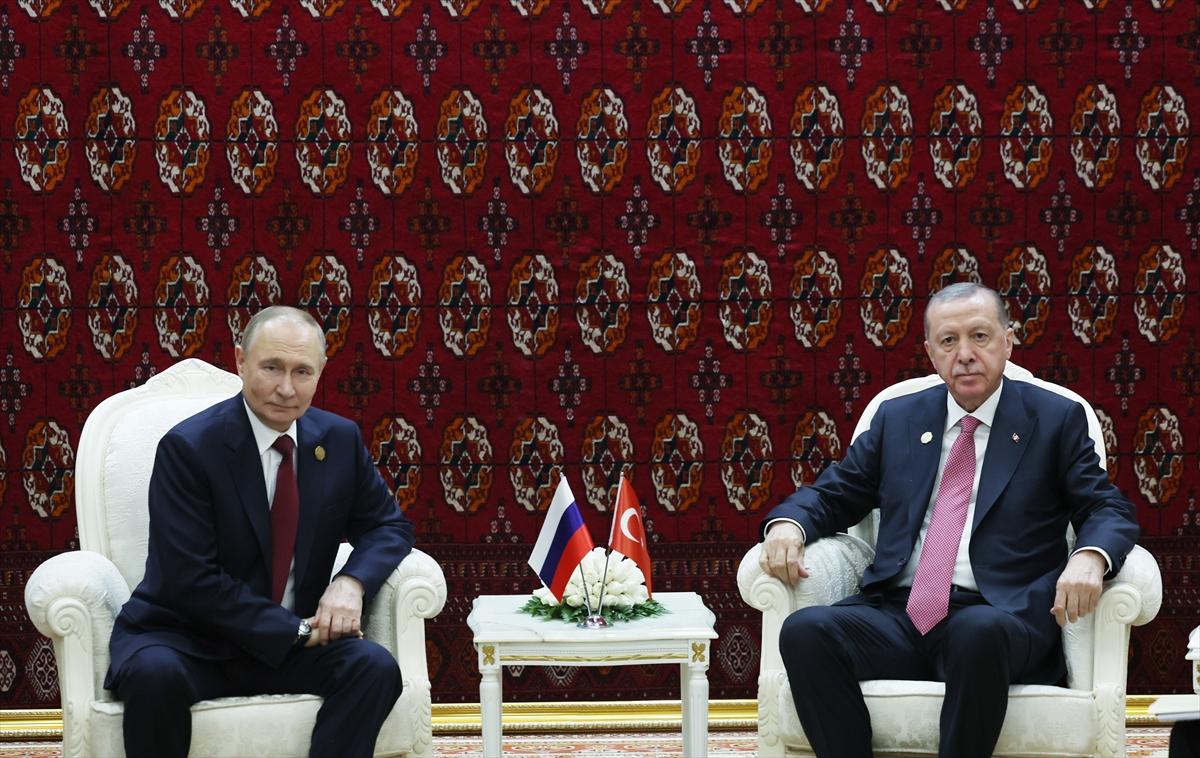
President Erdoğan and Russian President Putin, 12 December 2025 - (Anadolu Ajansı)
The Presidency of Communications issued a statement regarding President Erdoğan’s meeting with President Putin. According to the statement, the meeting assessed bilateral relations between Türkiye and Russia and comprehensive peace efforts regarding the Ukraine-Russia war, with Türkiye reaffirming its support for peace initiatives. “All issues, including the EU’s freezing of Russian funds, were discussed in detail.”
President Erdoğan stated that efforts to end the Ukraine-Russia war “are valuable,” expressing confidence that “progress can be achieved in areas offering practical benefits to both sides,” and suggesting that “a limited ceasefire targeting energy facilities and ports could be beneficial.”
Erdoğan noted that Türkiye is closely monitoring negotiation processes aimed at ending the war and is ready to host talks in all formats. The meeting also addressed the latest developments in Palestine and Syria and the peace process in the South Caucasus.
President Recep Tayyip Erdoğan held a meeting with Prime Minister Shehbaz Sharif of Pakistan on the sidelines of the Forum. The meeting took place at the hotel where President Erdoğan was staying following the Forum.
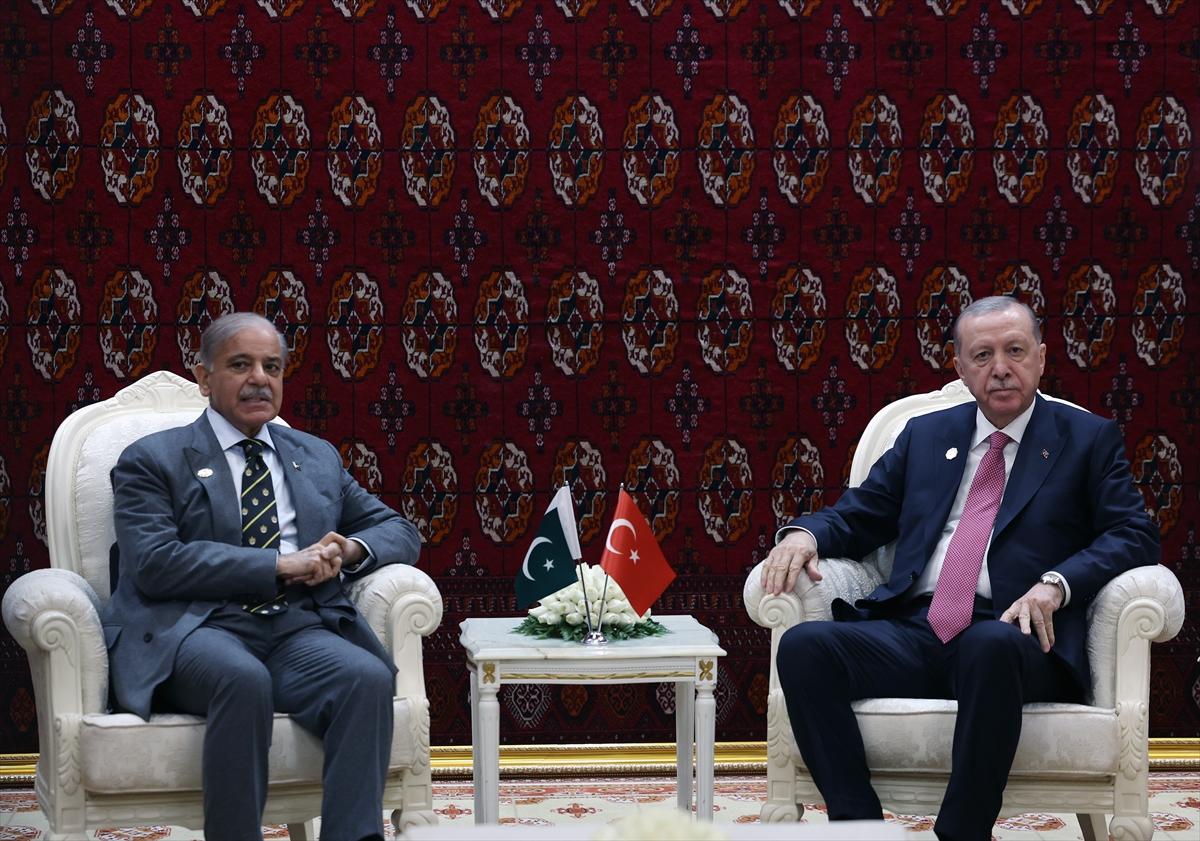
President Recep Tayyip Erdoğan and Prime Minister Shehbaz Sharif of Pakistan, 12 December 2025 - (Anadolu Ajansı)
Akorda. “Глава государства принял участие в работе форума, посвященного Международному году мира и доверия и 30-летию постоянного нейтралитета Туркменистана.” Akorda Resmî Sitesi. Accessed December 12, 2025. https://www.akorda.kz/ru/glava-gosudarstva-prinyal-uchastie-v-rabote-foruma-posvyashchennogo-mezhdunarodnomu-godu-mira-i-doveriya-30-letiyu-postoyannogo-neytraliteta-turkmenistana-12111933
Anadolu Ajansı. "Azerbaycan Başbakanı Asadov: Hazar Denizi’nin Güvenlik Bölgesi Olarak Korunması, Ülkelerin Ortak Çıkarına Hizmet Ediyor." Accessed December 12, 2025. https://www.aa.com.tr/tr/dunya/azerbaycan-basbakani-asadov-hazar-denizinin-guvenlik-bolgesi-olarak-korunmasi-ulkelerin-ortak-cikarina-hizmet-ediyor/3769248
Anadolu Ajansı. "Cumhurbaşkanı Erdoğan Rusya-Ukrayna Ateşkes ve Barışa Yönelik Diplomatik Girişimlere Somut Destek Vermeye Hazırız." Accessed December 12, 2025. https://www.aa.com.tr/tr/gundem/cumhurbaskani-erdogan-rusya-ukrayna-ateskes-ve-barisa-yonelik-diplomatik-girisimlere-somut-destek-vermeye-haziriz/3769004#
Anadolu Ajansı. "Cumhurbaşkanı Erdoğan Uluslararası Barış ve Güven Forumu Kapsamında Görüşmeler Gerçekleştirdi." Accessed December 12, 2025. https://www.aa.com.tr/tr/gundem/cumhurbaskani-erdogan-uluslararasi-baris-ve-guven-forumu-kapsaminda-gorusmeler-gerceklestirdi/3769272#
Anadolu Ajansı. "Cumhurbaşkanı Erdoğan, Rusya Devlet Başkanı Putin ile Görüştü." Accessed December 12, 2025. https://www.aa.com.tr/tr/gundem/cumhurbaskani-erdogan-rusya-devlet-baskani-putin-ile-gorustu/3769351#
Anadolu Ajansı. "Cumhurbaşkanı Erdoğan, Türkmenistan’a Gidecek." Accessed December 10, 2025. https://www.aa.com.tr/tr/gundem/cumhurbaskani-erdogan-turkmenistana-gidecek/3767339#
Anadolu Ajansı. "Putin, Devletler Arasındaki İlişkilerin BM İlkelerine Uygun Kurulması Gerektiğini Belirtti." Accessed December 12, 2025. https://www.aa.com.tr/tr/dunya/putin-devletler-arasindaki-iliskilerin-bm-ilkelerine-uygun-kurulmasi-gerektigini-belirtti/3769080
Anadolu Ajansı. “Cumhurbaşkanı Erdoğan Türkmenistan’a Geldi.” Accessed December 12, 2025. https://www.aa.com.tr/tr/gundem/cumhurbaskani-erdogan-turkmenistana-geldi/3768584#
Anadolu Ajansı. “Cumhurbaşkanı Erdoğan Türkmenistan’da.” Accessed December 12, 2025. https://www.aa.com.tr/tr/gundem/cumhurbaskani-erdogan-turkmenistanda/3768995#
Anadolu Ajansı. “Gürcistan Başbakanı Kobakhidze, Orta Koridor’un Bir ‘Güven Koridoru’ Olduğunu Belirtti.” Accessed December 12, 2025. https://www.aa.com.tr/tr/dunya/gurcistan-basbakani-kobakhidze-orta-koridorun-bir-guven-koridoru-oldugunu-belirtti-/3769321
Anadolu Ajansı. “Uluslararası Barış ve Güven Forumu Devam Ediyor.” Accessed December 12, 2025. https://www.aa.com.tr/tr/dunya/uluslararasi-baris-ve-guven-forumu-devam-ediyor/3769357
Anadolu Ajansı. “İran Cumhurbaşkanı Pezeskiyan’dan Dünya Barışı Mesajı.” Accessed December 12, 2025. https://www.aa.com.tr/tr/dunya/iran-cumhurbaskani-pezeskiyandan-dunya-barisi-mesaji/3769218#
Big Asia. "Владимир Путин выступил на Международном форуме мира и доверия в Ашхабаде." Accessed December 12, 2025. https://bigasia.ru/vladimir-putin-vystupil-na-mezhdunarodnom-forume-mira-i-doveriya-v-ashhabade/
Caspian Post. “Putin Heads to Turkmenistan for International Peace Forum.” Accessed December 10, 2025. https://caspianpost.com/turkmenistan/putin-heads-to-turkmenistan-for-international-peace-forum
Eurasian CIS Center. “12 декабря в Ашхабаде состоится Форум Международного мира и доверия.” E-CIS Info News. Accessed December 10, 2025. https://e-cis.info/news/565/132708/
Kremlin. “Владимир Путин принял участие в Международном форуме мира и доверия.” Kremlin Resmî Sitesi. Accessed December 12, 2025. http://kremlin.ru/events/president/news/78719
Oxu.az. “Aşkabat’ta Uluslararası Barış ve Güven Forumu Başlıyor.” Oxu.az Türkçe. Accessed December 10, 2025. https://oxu.az/tr/dunye/askabatta-uluslararasi-baris-ve-guven-forumu-basliyor
Presidency of the Republic of Turkey, Communication Directorate. "President Erdoğan Spoke at the International Peace and Security Forum." Communication Directorate Official Website. Accessed December 12, 2025. https://www.iletisim.gov.tr/turkce/haberler/detay/cumhurbaskani-erdogan-uluslararasi-baris-ve-guven-forumunda-konustu
Special Kremlin. "Заседание Международного форума «Мир и доверие: единство целей в интересах устойчивого будущего.” Kremlin Official Website (Special Portal). Accessed December 12, 2025. http://www.special.kremlin.ru/events/president/news/78719
Travel Tomorrow. "Ashgabat’s Peace and Trust Forum: Turkmenistan Puts Neutrality to Work in a Fractured World." Accessed December 12, 2025. https://traveltomorrow.com/ashgabats-peace-and-trust-forum-turkmenistan-puts-neutrality-to-work-in-a-fractured-world/
Viory Video. “Leaders Arrive for International Forum of Peace and Trust in Turkmenistan.” Viory Video (Event Footage). Accessed December 12, 2025. https://www.viory.video/en/events/ls141c-11122025/leaders-arrive-for-international-forum-of-peace-and-trust-in-turkmenistan-hb
Yeni Şafak. "President Erdoğan to Visit Turkmenistan for International Peace Forum." Yeni Şafak English. Accessed December 10, 2025. https://en.yenisafak.com/turkiye/president-erdogan-to-visit-turkmenistan-for-international-peace-forum-3711716

Uluslararası Barış ve Güven Forumu, Birleşmiş Milletler Genel Kurulu tarafından 2025 yılının “Uluslararası Barış ve Güven Yılı” ilan edilmesi ve Türkmenistan’ın daimi tarafsızlık statüsünün 30. yıl dönümü kapsamında, 11–12 Aralık 2025 tarihlerinde Aşkabat’ta düzenlendi. Forum, devlet ve hükümet başkanları ile uluslararası kuruluş temsilcilerinin katılımıyla gerçekleştirildi ve barış, güven, tarafsızlık ile çok taraflı iş birliği başlıkları ele alındı. Genel ve tematik oturumlarda uluslararası güvenlik, sürdürülebilir kalkınma, ulaştırma, enerji, arabuluculuk ve Birleşmiş Milletler’in rolüne ilişkin değerlendirmeler yapıldı. Forum marjında çok sayıda ikili görüşme gerçekleştirildi ve çeşitli liderler tarafından resmi konuşmalar yapıldı.
No Discussion Added Yet
Start discussion for "Ashgabat International Forum for Peace and Security (2025)" article
December 18, 2025
Background
December 18, 2025
Objectives and Core Approach
December 18, 2025
Organizational Structure
December 18, 2025
Participants and Representation Level
December 18, 2025
Opening and Official Ceremonies
December 18, 2025
Speeches Delivered at the Forum
December 18, 2025
Bilateral Meetings on the Margin of the Forum – Republic of Türkiye